

Quick Answer
- A restaurant app costs $15,000–$250,000+ to build in 2026. A single-restaurant ordering app typically runs $15,000–$40,000, a multi-outlet app with loyalty and POS integration $40,000–$120,000, and a multi-vendor delivery platform $120,000–$250,000+. Budget 15–20% of build cost per year for maintenance. These are planning ranges, not quotes.
The restaurant industry has swiftly made its move towards online orders, as a necessary step towards maximizing reach and expanding business. Statistics indicate that every 3 in 4 people use online media to decide on which restaurant they want to visit next. Moreover, the growing online space and fierce competition on food delivery apps make an independent app for any restaurant a must-have today.
However, the restaurant app development cost depends on what the business wants to achieve through the app. The needs of a simple single restaurant ordering app are vastly different from a multi-vendor food delivery platform that has a customer app, a restaurant app, a delivery partner app, and an admin portal.
The price of a simple MVP can range between $5,000 and $15,000, and if the custom app has more features, the price can shoot up to $250,000 or more. Investment will probably be greater with enterprise platforms.
This guide discusses the restaurant app costs for 2026, the factors influencing their development cost, features to consider, and how to deliver a budget-friendly and scalable restaurant app. If you want a team to scope it, see our restaurant app development services.
Why Should Restaurant Owners Invest in Apps?
Restaurant apps are about more than just a digital menu. If targeted to real restaurant needs, they can assist restaurants in constructing immediate customer relationships, streamlining ordering processes, and promoting repeat business.
Simplify Online Food Ordering Dedicated to Your Restaurant
Customers are able to view the restaurant’s menu, place an order on a favourite item, customise it to their liking, and pay without ever speaking to the restaurant or being influenced by different restaurant offers within a third-party application. You’ll also have a lower number of steps, which means you’ll have fewer orders to abandon and fewer mistakes in taking orders.
Establish Direct Customer Relationships
A branded app is a channel through which the restaurant directly reaches diners without the help of platforms like Swiggy or Zomato. Restaurant order status, specials, new menus, and promotional information can be communicated, with permission and privacy controls in place.
Repeat Orders are made possible through Loyalty
Digital Loyalty points, reward tiers, Referrals, Birthday offers, and personalized restaurant discounts are all included in restaurant loyalty. These attributes provide diners a reason to revisit as well as businesses more room to nurture a more enduring relationship.
Improve Operational Efficiency
Efforts to manually record orders can be reduced with an application that seamlessly integrates the order management system, kitchen workflow, and Petpooja, the POS system. Staff are more consistent in processing orders, and owners get real-time data on orders and sales.
Provide Easy Payment & Order Tracking
Customers may want to enable any payment means available via the system, such as UPI, cards, wallet,t and so on. Delivery tracking and timely notifications can help improve transparency if the app is connected with delivery and/or location services.
Estimated Cost Breakdown of Restaurant App Development
The restaurant app development cost depends on the app’s complexity, features, design requirements, technology stack, and third-party integrations. Understanding the cost breakdown helps restaurant owners allocate their budgets effectively and avoid unexpected expenses during development.
Here is an estimated breakdown of the major expenses involved in building a restaurant app in 2026.
Development component
Estimated cost (USD, global benchmark)
UI/UX design
$500–$3,000
Frontend development
$2,000–$10,000
Backend development
$2,000–$12,000
Admin dashboard
$1,000–$5,000
Payment gateway integration
$500–$2,000
POS and third-party integrations
$1,000–$5,000
Testing and quality assurance
$500–$3,000
Deployment and launch
$300–$1,500
Total (all components)
$7,800–$41,500
UI/UX Design
Design elements include wireframes, screen layouts, navigation, prototypes, and visual elements. A one-restaurant app might require fewer screens; a food delivery aggregator that has a different interface for the customer, restaurant, and delivery partner would require more.
Frontend and Backend Development
The work done to create the screens with which customers and restaurant staff will interact is called frontend development. Backend development includes user administration, menus, orders, database, payments, and business logic. All of these combine to constitute the biggest proportion of the budget.
Admin Dashboard and Integrations
The restaurant owner can play all the features like control the menu, prices and order, promotions from the admin panel. Payment Gateway and integration with POs, mapping, and delivery might require further development and testing.
Testing and Deployment
Quality Check aids in discovering any bugs, payment problems, user-experience issues, or device compatibility problems even before the launch. Deployment is the process of preparing the application for deployment and preparing the production environment.
Added together, these components total roughly $7,800–$41,500. A lean MVP can come in near $5,000, while advanced apps can exceed $45,000. To calculate the actual cost to build a restaurant app, request an itemized quotation that clearly separates initial development, recurring maintenance, hosting, and third-party service fees.
What Are the Key Factors Influencing Restaurant App Development Cost?
The restaurant app development cost varies depending on the features and requirements, the platform used, the integration, and the expertise of the development team. These are all factors that restaurant owners should consider when they are planning their restaurant projects and working out a budget.
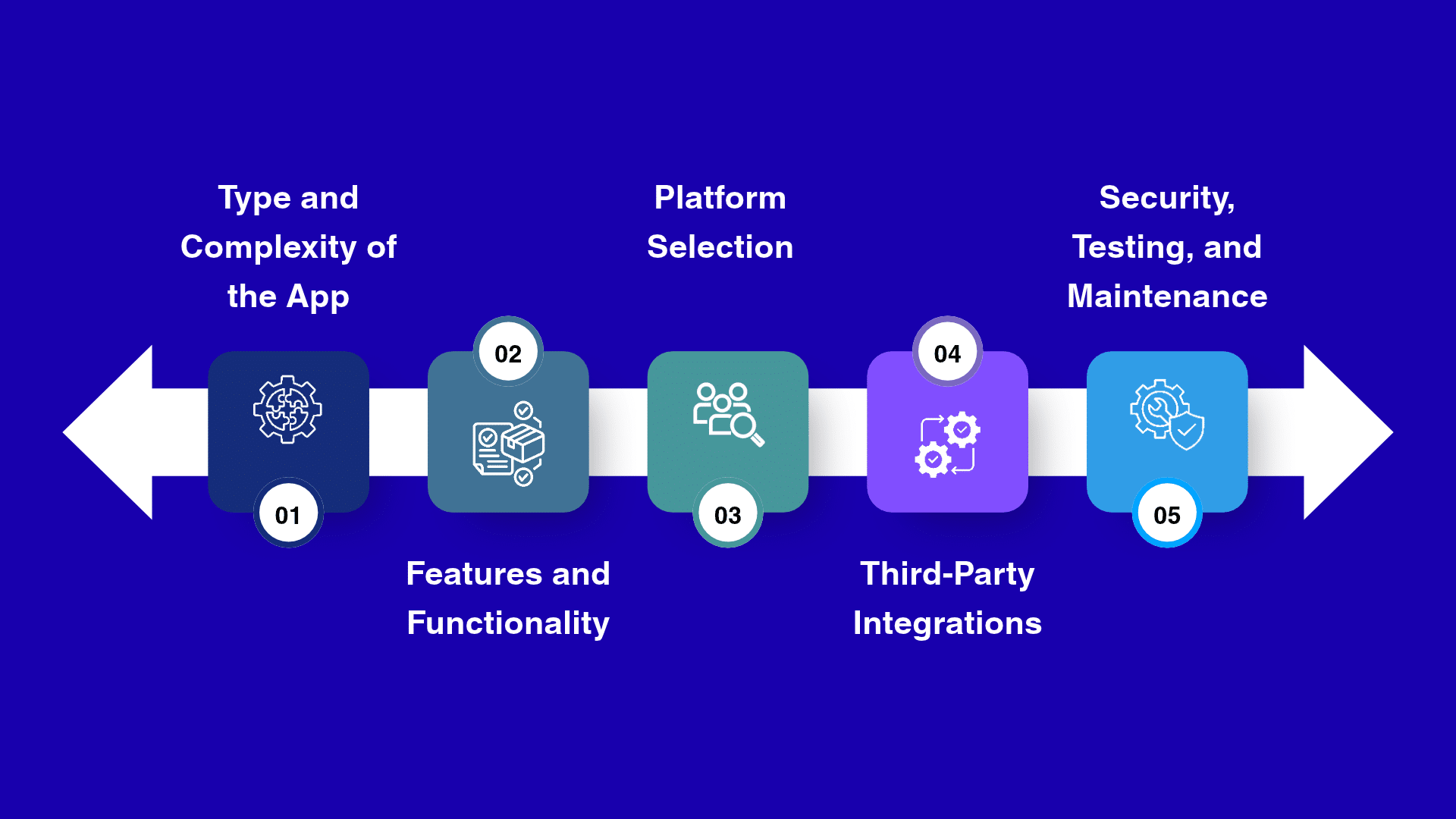
1. Type and Complexity of the App
The budget will vary depending on the type of restaurant application. The simplest restaurant app could have a digital menu, online ordering, and payment options. The multi-restaurant delivery app, on the other hand, requires several interfaces for the customers, restaurant owners, delivery companies, and admins.
2. Features and Functionality
More features and greater complexity increase the cost to develop a restaurant app. The basic features, like menu navigation, customer registration, shopping cart, and ordering,g are usually more affordable than other advanced features.
3. Platform Selection
The cost of building on two platforms (Android and iOS) is greater than building on one. Developing a cross-platform framework such as Flutter or React Native may have code reusability benefits, while the development of standalone native apps can be a time-consuming procedure. This will depend upon the performers, the requirements of the performance, and the attributes of the platform being used.
4. Third-Party Integrations
Generally, restaurant apps can be connected with a payment gateway like Razorpay and PayU, Point of Sale (POS), mapping services like Google Maps, and delivery services like BigBasket and notification services like Firebase Cloud Messaging. For each integration, the API configuration, custom development and testing can be required.
5. Security, Testing, and Maintenance
Secure authentication, data protection, payment security, and comprehensive testing are essential for a reliable application. The restaurant must ensure that it has the budget once the app goes live for bug fixes, OS updates, hosting, and improving features. Restaurants that have been collecting customer data must get their data strategy ready for the DPDP Act, 2023. The main responsibilities (consent notices, security measures, breach reporting) come into effect around May 2027.
The restaurant application development cost depends on how these factors combine. Clear requirements, prioritized features, and an itemized quotation keep the project within budget. Budget 15–20% of build cost per year; our app maintenance guide shows what that covers.
Hidden Cost Factors Affecting Restaurant App Development Cost
The first quote you get for developing a restaurant app isn’t always the final one. Once development has commenced or the app has been released, there may be a variety of recurring and extra expenses that impact your budget.
These costs can be planned ahead to be a part of the total cost of ownership and not solely the build cost.
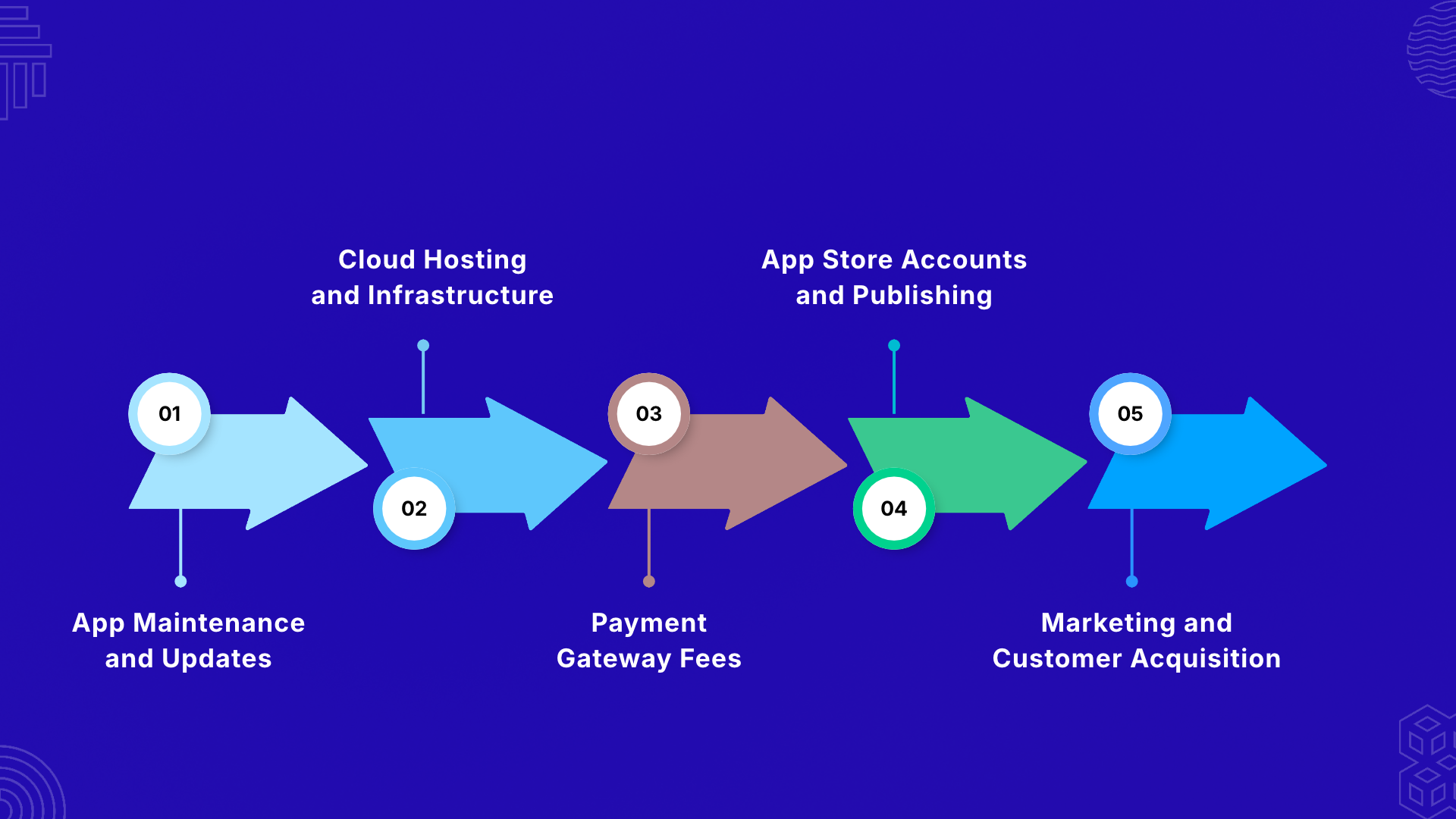
1. App Maintenance and Updates
A restaurant app needs regular upkeep: compatibility updates for new phone operating systems, security patches,s and new features. A good rule of thumb is to budget 15–25% of the original development cost each year for maintenance. The exact figure depends on your support agreement and how complex the app is. For an app that cost $6,300 to build, that works out to about $950– $1,600 a year.
2. Cloud Hosting and Infrastructure
The infrastructure you’ll need is data storage, order processing, and customer account management and administration. Hosting costs depend upon the amount of traffic, DB usage, storage, backup, and performance of the particular website. If it’s a single-outlet app, the resources on AWS/Google Cloud can be modest,t and if it is a big delivery platform, then resource scaling is essential.
3. Payment Gateway Fees
Transaction fees, setup fees, or other charges may apply, depending on the provider and payment method. For example, Stripe’s standard US plan charges 2.9% + 30% for each successful online card payment. If a restaurant processes $10,000 a month across 400 orders, that comes to $290 in percentage fees plus $120 in fixed fees, or $410 in total. ACH bank transfers cost much less, at 0.8% per payment with a $5 cap, but restaurant customers rarely pay this way.
Actual fees vary by provider, transaction mix, and the commercial agreement you negotiate.
4. App Store Accounts and Publishing
Apple charges $99/year for the Apple Developer Program; Google Play charges a one-time $25. Food orders are products, and thus restaurants don’t pay the typical in-app purchase fee of 15 to 30 percent.
5. Marketing and Customer Acquisition
There is no guarantee of downloads when an app is launched. Some examples of things that could be covered in launch costs are loyalty programmes, customer induction programmes, advertising, app store optimisation,n and promotion. The expenses here are on top of the development cost of the software, and can have an impact on whether the investment pays off.
How to Build a Restaurant App: Step-by-Step Process
A structured development process helps control scope, reduce rework, and ensure the final application meets your business objectives.
Step 1: Define Business Goals and Requirements
Before starting to write the application, the problem to be solved needs to be defined. Some of the shared objectives encompass streamlined and enhanced direct sales, comfortable table booking, handling various outlets, and introducing a food delivery marketplace.
When planning for development, record who you are developing for, the key process steps, budget/bid, and measurable aspects of the business.
Step 2: Research Your Market and Competitors
Do research on other restaurant apps & food aggregators like Swiggy, Zomato, and understand the requirements of diners. Planning a multi-restaurant marketplace instead? See our full food delivery app cost breakdown.
Grasp the process of ordering, menu presentation, modes of payment, loyalty system, and customer reviews. This research breaks down the distinction between features that diners use and features with no value that increase cost.
Step 3: Finalize the MVP and Technology Stack
Draw up a list of features, separating them into must-have features, nice-to-have features, and improvements that could be added in the future. Choose the tech stack based on performance needs, coverage, integration, long-term maintenance, and scalability of the team.
Consider a cross-platform framework such as Flutter or React Native if you need to develop both Android and iOS versions, as this can reduce cross-platform work duplication.
Step 4: Design the User Interface and Experience
Map primary customer journeys such as browsing menus, customizing menu items, checkout, reservations, and order tracking. Prototype and wireframe with Figma prior to development. The usability problems identified here are very cheap to resolve compared with after coding.
Step 5: Develop the Frontend and Backend
The front end provides the user-friendly interface, and the back end manages the business logic, databases, authentication, order processing, and communication among the application components.
In addition to these, build out the restaurant/partner and delivery dashboards and the admin interface.
Step 6: Integrate Payments and Restaurant Systems
Integrate the application with payment providers, POS software, delivery systems, notifications, and other necessary systems. Test edge cases such as failed payments, duplicate orders, unavailable menu items, delayed updates, and interrupted integrations to assess performance of the application. POS sync is one of the larger variables; here’s how cloud and legacy POS compare for restaurants.
Step 7: Test and Secure the Application
Perform functional, usability, performance, security, and device compatibility testing. Ensure critical workflows from start to finish, including placing orders and order confirmation, processing in the kitchen, cancellation, and refund.
Step 8: Launch and Monitor Performance
Get your app ready for Google Play and the Apple App Store, provide the stores with information, and configure production monitoring in Firebase Crashlytics. After the product is launched, track crash reporting, conversion rates of orders, repeat sales, customer feedback, and operational efficiency.
Step 9: Improve Based on Real Usage
Review data and customer feedback to determine what areas to focus on next for improvement and/or new implementation. Prevents restaurant owners from spending the entire budget before actual usage information shows which features are valued by diners.
How to Reduce Restaurant App Development Cost
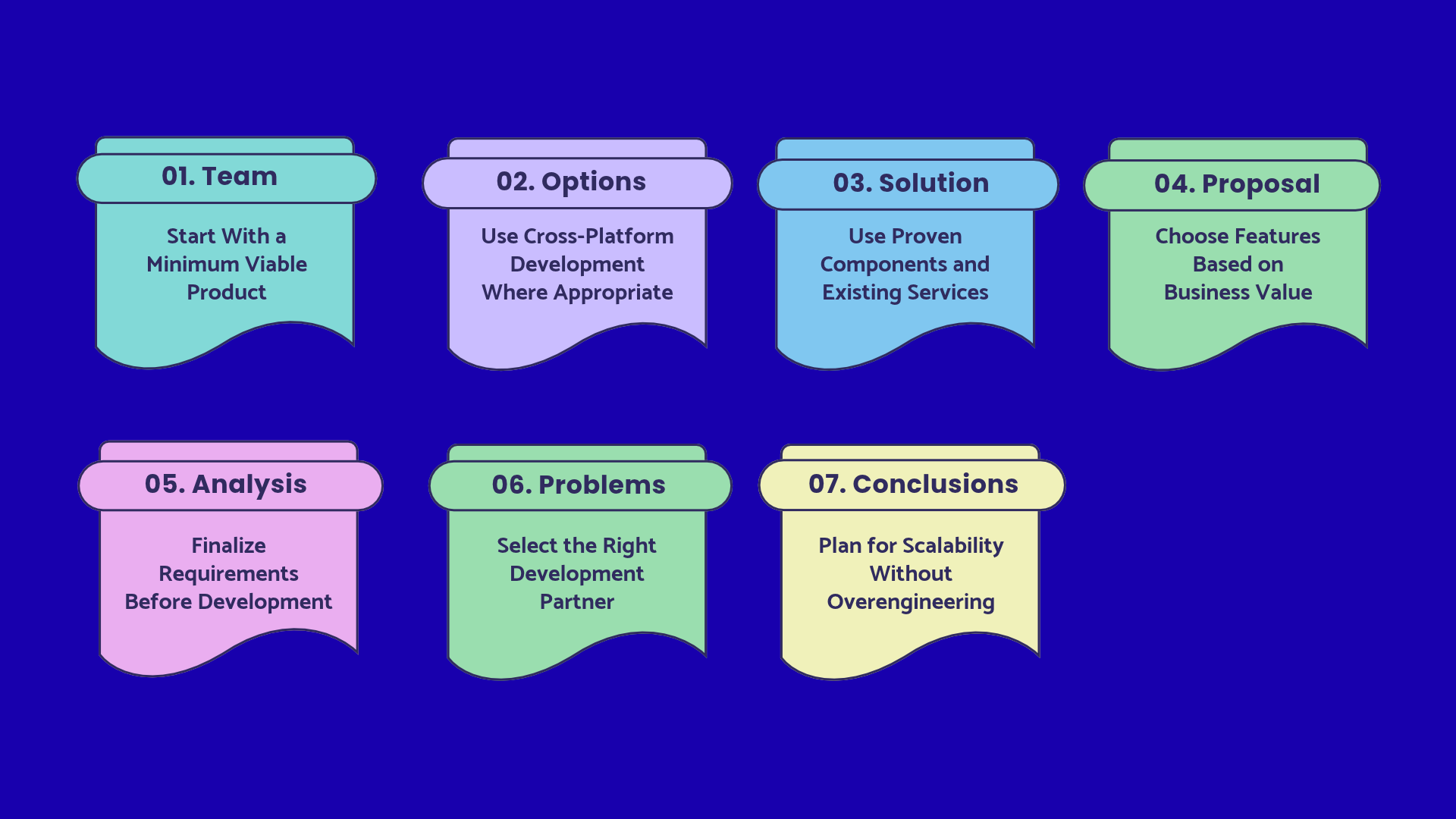
Reducing restaurant app development cost does not mean compromising on security, usability, or reliability. It involves making well-informed decisions on scope, technology, and development priorities.
1. Start With a Minimum Viable Product
Construct only features if they are necessary for testing the validity of the business concept and the main customer journey. The digital menu, checkout, payment processing, order management, and a basic admin panel are some of the features that a focused ordering app might require. High-tech Artificial Intelligence (“AI”) suggestions and predictive analytics can wait until order data indicates they should be used.
2. Use Cross-Platform Development Where Appropriate
Flutter and React Native allow running the same codebase on both Android and iOS platforms, thus eliminating duplicate work. Actual savings will vary based on the features of the app, device-specific requirements, and integrations.
3. Use Proven Components and Existing Services
Rather than creating individual pieces and parts, consider third-party payment gateways, notification services, authentication systems, and POS integration. There are ready-made services available that will save engineering hours, but the licensing cost, subscriptions, and vendor lock-in should be evaluated.
4. Choose Features Based on Business Value
Keep an eye on features that will directly impact the revenue, satisfaction, and/or efficiency of the business. For a takeout place, one-tap reordering and quick checkout provide a greater amount of value than a costly AR menu.
5. Finalize Requirements Before Development
When agreed requirements are frequently amended, the cost and delivery dates may be impacted. Simply write out the project scope, including features, acceptance criteria, integrations, deliverables, and exclusions.
6. Select the Right Development Partner
When looking at development companies, consider development experience, technical skills, communication, project management and support, as well as price. A lower quote at the outset of a project might not have the important features or have support upon the project’s completion; that means an elevated all-round cost.
7. Plan for Scalability Without Overengineering
Optimize for growth, without enterprise-level infrastructure until there is a call for it.
A well-thought-out architecture can allow for further improvements on the system but also not make the initial push too large. Building a cost-effective restaurant app with GMTA Software can be achieved in a number of ways.
How GMTA Software Can Help You Build a Cost-Effective Restaurant App
GMTA Software helps restaurant owners build cost-effective restaurant apps that match the restaurant’s business model and budget. Each project starts with a review of the customer base and operational requirements, then identifying the features critical for launch. We start with a project discovery session, so your quote itemises build, maintenance, hosting, and third-party fees
GMTA Software recommends launching with an MVP that covers the core functions: digital menu, online ordering, secure payment integration, order management, and an admin dashboard. As the business grows, loyalty programs, POS integration, delivery tracking,g and multi-outlet management can be added based on customer demand.
Costs stay under control through the right technology choices, proven third-party services, and a fixed scope during development. Clear estimates, milestone-based planning, and thorough testing support budget management, while planned maintenance and scalability keep the app secure, reliable, and responsive to changing customer needs.
Planning a restaurant app? Contact GMTA Software to discuss app requirements, launch timeline, and budget. A detailed discovery session is the most accurate starting point for estimating the actual cost.
Final Takeaway: Your Restaurant Needs A Dedicated App
Restaurant app development cost in 2026 varies based on the restaurant app’s purpose. A tightly scoped MVP keeps launch costs low, while a more sophisticated restaurant management or delivery system demands a higher budget for development, integration, infrastructure, and support.
The most cost-effective approach is to define clear business goals, prioritize high-value features, and choose a development partner that is transparent about upfront and ongoing costs.
Restaurants can develop a valuable digital ordering experience without paying for unnecessary complexity by working through it in phases and having a well-planned scope.
Frequently Asked Questions
How much does it cost to build a restaurant app in 2026?
Most restaurant apps cost $15,000 to $250,000+ in 2026. A single-restaurant ordering app typically runs $15,000–$40,000, a multi-outlet app with loyalty and POS integration $40,000–$120,000, and a multi-vendor delivery platform $120,000–$250,000+. These are planning ranges, not quotes; scope, integrations, and platforms move the final number.
How much does a simple restaurant ordering app cost?
A simple ordering app for one restaurant typically costs $15,000–$40,000 and takes about 3–5 months. That usually covers menu browsing, cart, online payments, order tracking, push notifications and a basic admin panel. Loyalty, POS sync, and delivery tracking move it into the next tier. These are planning ranges, not quotes.
How much does a cloud kitchen app cost?
A cloud kitchen app typically costs $40,000–$140,000, depending on how many brands it runs and whether it needs kitchen display, inventory, and delivery-partner integrations. A single-brand ordering app sits at the low end; multi-brand operations with order routing sit at the high end. Confirm scope before budgeting.
How much does it cost to maintain a restaurant app?
Budget about 15–20% of the original build cost per year for fixes, OS updates, security patches, and minor improvements. Add hosting, third-party fees, Apple’s $99 annual developer fee, and Google Play’s one-time $25 fee. A $60,000 app would typically need roughly $9,000–$12,000 per year for maintenance alone.
Is a custom restaurant app cheaper than a white-label app?
No. White-label apps usually cost less upfront and launch faster, but you pay recurring platform fees and get limited customization. A custom app costs more to build, but you own the code and can shape workflows, loyalty rules, and integrations. White-label fits one outlet with standard needs; custom fits growth.
How long does it take to build a restaurant app?
An ordering MVP usually takes 3–5 months, a growth app with loyalty and POS integration 5–9 months, and a full delivery platform 9–12+ months. Timeline depends on scope, number of apps (customer, restaurant, driver, admin), third-party integrations, and how quickly feedback and approvals arrive during development.
Do Apple and Google take 15–30% of restaurant app orders?
No. Apple and Google’s in-app purchase commission applies to digital goods and services, not to physical goods or services such as food orders. You still pay Apple $99 per year, and Google Play a one-time $25 fee, plus payment-processor fees, such as Stripe’s 2.9% + 30¢ per online card transaction.
How do I reduce restaurant app development cost?
Start with an MVP containing only ordering, payments, and notifications. Build cross-platform instead of two native apps, use proven third-party services for payments, maps, and notifications, and freeze scope before development starts. Changing requirements mid-build is one of the most common causes of budget overruns.

Rishi Ram is CTO at GMTA Software, with 6+ years of experience in software architecture and technical leadership. He’s led GMTA’s work across fintech—including eWallet apps, mobile banking platforms, and Sharia-compliant fintech builds—as well as on-demand and taxi app development and AI-integrated products like fraud detection agents and workflow automation tools.