


Key Takeaways
- AI dating app development can cost $15K–$150K+. Your investment depends on whether you integrate existing AI APIs or build custom matchmaking, recommendation, and fraud-detection systems
- Prioritize AI features based on business objectives. Address a specific bottleneck, such as low match-to-conversation conversion, before expanding into multiple AI capabilities
- Measure connection quality, not just engagement. Track reciprocal likes, conversation initiation, sustained interactions, and unmatches to determine whether AI recommendations produce meaningful outcomes
- Monetize AI without restricting match quality. Offer paid compatibility insights, advanced discovery, and profile coaching while keeping core matchmaking valuable for free users
- Budget for ongoing AI operations. Include API consumption, infrastructure, monitoring, model evaluation, and updates in your financial projections rather than treating implementation as a one-time expense.
The decision to bring AI’s capabilities into your dating app is indeed a next step forward in making your product competitive in the $10 billion online dating market. However, adding this technical ability isn’t as simple as integrating a recommendation API or launching a smart bot. That’s because your app’s underlying matching algorithm needs to account for both reciprocal attraction and relationship intentions, not just predict who someone will swipe right on. On the other hand, a smart fraud detection system must flag fake profiles and romance scams without mistakenly blocking genuine users. This means that to build each capability, you will need a defined problem, dataset, and cost structure, all different.
So, the challenge lies in determining which AI use case truly deserves the investment in 2026. Until and unless you have enough evidence in hand, justifying the fund spend will be difficult. Besides, you won’t have enough clarity on whether you can repurpose an existing LLM or should invest in a custom model for your dating app. After all, a compatibility engine, an AI profile assistant, or a fraud detection system will have different success criteria, and you need to validate each against the dating-facing problem you have discovered.
That’s why we have illustrated the leading use cases of AI in dating apps with real-world examples to help you understand how to position this technology smartly within your product. Whether it’s the process of evaluating each app or choosing an appropriate implementation strategy, this guide will give you a detailed overview of intelligent dating capabilities you can invest in.
What is AI in dating apps, and how is AI transforming dating apps?
With AI features in dating apps, you can substantially create a difference in how your product decides who gets recommended, what makes two people compatible, and how users move from discovering a profile to starting a conversation. The real opportunity, however, isn’t just to add an AI chatbot to the existing swipe interface. Rather, it’s to improve the overall matchmaking experience itself, especially when your current algorithm generates ample activity but struggles to turn it into meaningful connections.
Take your product’s recommendation engine, for example. When it relies heavily on likes and swipes, it can easily learn to show users more of what they already engage with. However, it won’t be able to determine whether those matches can actually lead to a meaningful click or not. But if we talk about neural models, you can effortlessly incorporate advanced capabilities to improve profile ranking, like:
- Reciprocal interest
- Relationship intentions
- Interaction outcomes
LLMs also play a crucial role here. The right model can help you extract preferences from profile descriptions that usually remain overlooked in conventional filters. The moment you combine these two, you get the opportunity to validate a more commercially meaningful question: do better compatibility signals lead to more conversations and stronger subscriber retention or not?
Generative AI opens up another part of the dating journey. The long series of confusing filters a traditional app has forces users to work manually. But you can use this technology to let them describe what they are looking for in natural language. Once you do so, there will be two different approaches you can invest in further.
- You refine the preferences through follow-up questions without requiring any manual intervention using conversational AI.
- You can also opt to ground recommendations in actual profile information using RAG pipelines, rather than inventing compatibility claims.
Agentic AI takes this further by coordinating multiple steps in a single, cohesive workflow, like:
- Interpreting a request
- Retrieving eligible profiles
- Applying permitted filters
- Presenting recommendations
However, it’s worth considering only when your product genuinely needs a multi-step workflow. In case you plan to invest in an AI agentic bot just because you have the funds and easy access to the technologies, justifying it later will be too difficult.
The key here is to identify where the current experience encounters friction and select the AI approach that addresses the specific breakdown point. Our AI development services team often starts by deciding which of these approaches fits the product.
What are the top use cases of AI in dating apps?
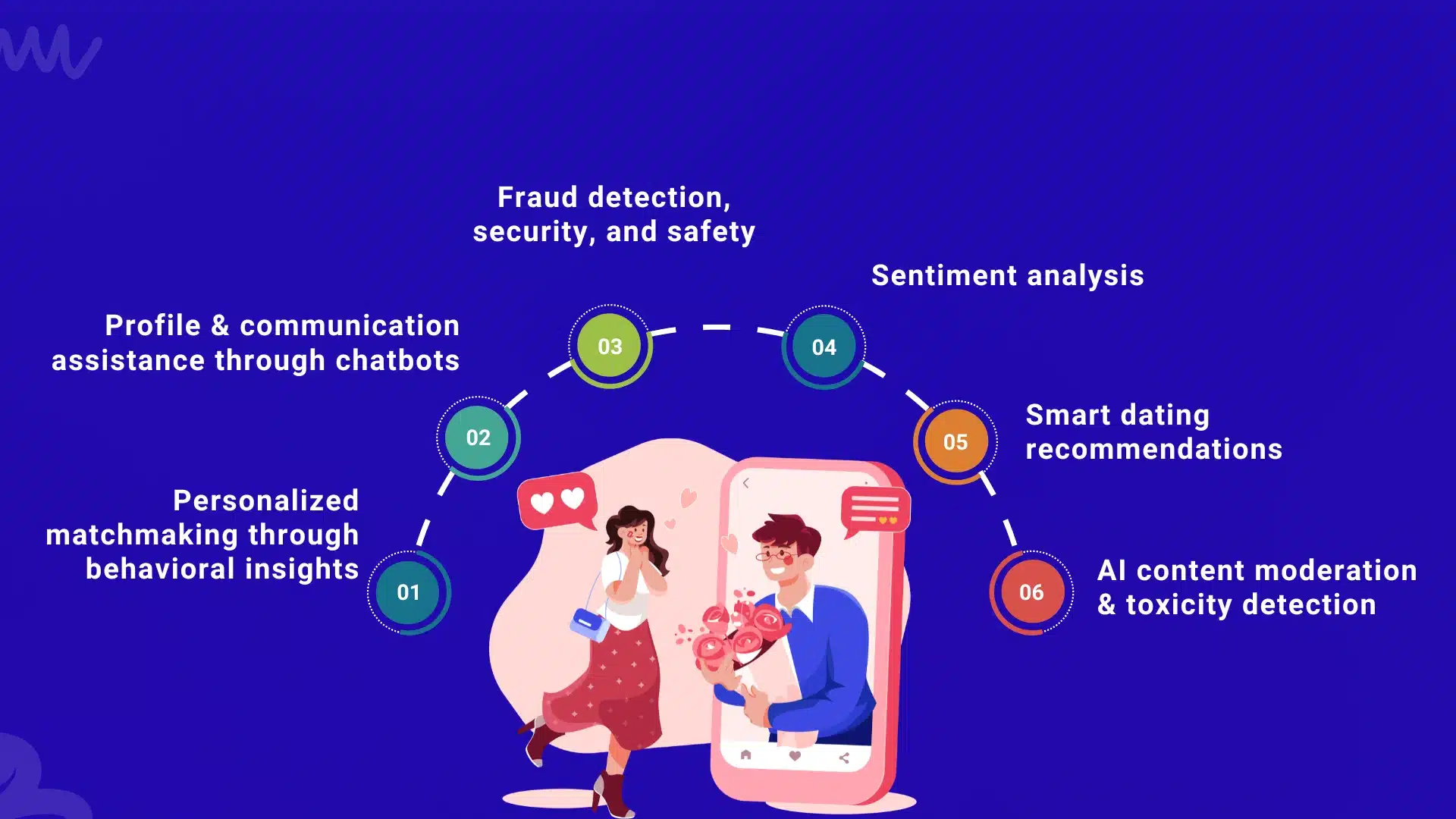
Personalized matchmaking through behavioral insights
Even when your dating app generates plenty of matches, it won’t create enough business opportunity if users rarely progress to meaningful conversations. In such cases, the primary issue often lies hidden in how your algorithm defines and treats compatibility. AI lets you refine this decision using profile attributes, interaction results, and relationship goals together as a combined entity. You no longer have to depend solely on static filters or swipe activity alone for matchmaking features.
Some of the best ways in which you can use behavioral insights to generate personalized matchmaking with utmost accuracy include:
- Use the two-tower recommendation model to decide which profiles qualify for recommendation before applying more computationally expensive ranking models
- A learning-to-rank model will allow you to determine which qualified profiles should appear first so that you can balance predicted mutual interest against excessive exposure to already-popular users
- Distinguish passive swiping from stronger signals, like repeatedly engaging with profiles that share specific relationship goals using behavior feature engineering
- Compare ranking versions with offline model evaluation and A/B testing and decide whether to roll out a model, adjust its ranking weights, or revert to the existing algorithm
The key here is to ensure that these models can support separate decisions, and not optimize one broad engagement score. If you focus only on likes, you risk increasing match volume without improving conversations. So, evaluate downstream engagement and exposure distribution accurately before making the new algorithm your default.
Profile & communication assistance through chatbots
Even though monthly reports or a simple analysis wouldn’t show it, your users might be struggling to present themselves well or initiate conversations with matched profiles. In such cases, you can use Generative AI to reduce the friction without turning your product into a platform full of artificial, interchangeable profiles and messages. The product decision is where you need AI to intervene. It can help users express their own personalities, suggest conversation starters, or guide them through a conversation.
So, let’s explore how GenAI can help you transform the communication dynamics of your dating app.
- An LLM-powered profile assistant can transform a user’s answers into a clearer bio while preserving their stated interests, personality, and relationship goals simultaneously
- Use a profile-grounded conversation generator to suggest opening messages based on details the recipient has chosen to display and determine whether personalized icebreakers belong in the free experience or a premium tier
- Decide which onboarding steps can be simplified without losing information your matching algorithm needs by investing in a conversational onboarding assistant
- Flag invented biographic details or inappropriate suggestions before they can reach users and force them to doubt your product’s credibility using LLM output validation and factuality checks
Track profile completion, first-message reply rates, user edits to generated content, and paid conversion. Only by doing so can you distinguish assistance from automation. If AI writes entire profiles or sends messages without meaningful user input, you will risk reducing trust and making interactions feel inauthentic. T
Fraud detection, security, and safety
When it comes to online dating apps, fraudulent accounts do more than create a poor user experience. Whether it’s impersonation, romance scams, or coordinated spam, these activities can undermine trust in the entire platform. Using just a basic keyword filter won’t help you catch every malicious scheme, especially as fraudsters are skilled in gradually building rapport before requesting money or moving conversations somewhere else.
Using AI in dating apps, you can, however, implement controls that can identify suspicious behaviors early and distinguish isolated anomalies from coordinated abuse. Here’s how!
- A graph-based fraud detection model can connect accounts through shared device signals, phone numbers, and payment identifiers so that you can decide when multiple accounts warrant a coordinated investigation
- Flag unusually rapid messaging, repetitive outreach, frequent account creation, or sudden changes in activity through a behavioral anomaly detection model
- An NLP-based scam classifier will unravel patterns associated with investment pitches, financial requests, coercion, or attempts to move users off-the-platform, ensuring you can escalate a conversation for review at the right time
- Image similarity detection will help you identify profile photos reused across accounts or associated with previously confirmed abuse
For this, you will have to put appropriate measurement protocols in place, especially for metrics like repeat-offender rates, false positives, and the time between detection and intervention. Only then can you decide when to tighten automated restrictions and route more cases to human agents. After all, the smartest approach is to set intervention thresholds grounded in risk and the quality of evidence you have in hand. See how AI agents in fraud detection handle coordinated abuse.
Sentiment analysis
Your dating app’s ratings and churn figures will reveal if users are dissatisfied. However, they will hardly tell you the exact changes or modifications your platform needs to generate both revenue and customer value. That’s why investing in AI-powered sentiment analysis is the most practical solution. It will help you identify recurring frustrations across support tickets, app reviews, survey responses, and other feedback metrics you are authorized to analyze. The primary business value lies in connecting these patterns to product decisions. Only then can you decide whether to revise onboarding, investigate match relevance, change notification frequency, or address a recurring trust issue.
Below are some of the ways in which sentiment analysis can help you improve your product’s detection of human emotions with the highest accuracy.
- Identify the areas that need immediate attention with the help of an aspect-driven analysis model, as it will help your team group complaints about match quality, profile credibility, or pricing
- Even when users use completely different descriptions, an embedding-based clustering model can accurately read between the lines of the underlying intent and categorize similar complaints
- A feedback-to-churn prediction model will give you a competitive advantage by letting your teams group complaint themes with both subscription history and cancellation events, making it easier to flag a declining retention rate
- You can also use the trend and cohort analytical algorithm to compare how users responded in real time before and after a feature release for your platform
Despite the advantages this AI-driven use case brings for your dating app, there’s a catch! You will have to keep the analysis hyper-focused on feedback users knowingly provide. Also, avoid treating private conversations as sentiment data without a clear, transparent basis for processing them.
Smart dating recommendations
If your dating app is already designed to recommend compatible profiles, the next opportunity is to decide which profiles users see, in what order, and how often. A strong compatibility score doesn’t automatically signal a good discovery experience. Users can continue seeing the same popular profiles repeatedly, run out of relevant options, or receive recommendations when potential matches are inactive.
Here, you can use AI to manage these trade-offs by combining compatibility predictions with profile availability, freshness, user activity, and exposure distribution. Here are some of the ways in which you can design a smart dating recommendation engine for your product.
- Use a candidate retrieval model to decide how to maintain recommendation relevance without making profile discovery computationally expensive as your user base grows
- A contextual ranking model will prove to be extremely helpful by allowing you to track recent activities, previous impressions, and changing engagement signals when ordering eligible profiles
- Reduce repetitive recommendations and limit excessive exposure to a small group of highly popular users through a diversity-aware reranking algorithm
- A multi-armed bandit or controlled exploration strategy allows you to validate less-exposed candidates while learning which recommendations work for different user cohorts
To get the most out of the smart recommendation engine, evaluate every decision. For this, use reciprocal likes, conversation starts, suggestion fatigue, and the distribution of profile exposure. The goal here is to improve discovery across the marketplace while preserving individual relevance.
AI content moderation & toxicity detection
Once your dating app starts growing, moderation becomes an operational challenge. Your human reviewers often get burdened with manually distinguishing awkward interactions from threats, harassment, hate speech, sexual coercion, and other types of policy violations without slowing legitimate conversation. Keyword filters alone struggle a lot with sarcasm, coded language, and messages that ultimately turn abusive over a course of time.
AI moderation will help you address these underlying challenges while ensuring you can specify the extent of automation you need at each risk level. Here’s how!
- A transformer-based text classifier generates confidence scores, which can be further used to decide which content can be allowed, flagged for review, or temporarily restricted under your business policies
- Use a context-aware LLM to assess reported messages alongside relevant conversation context, especially where your privacy policy and processing rules permit
- Invest in a risk-based moderation queue that can help you prioritize cases based on metrics like classifier confidence, violation severity, report history, and repeat-offender signals
- Human-in-the-loop review and appeal analysis will help you decide if thresholds need further adjustment or the policy labels need revisions
Remember that a well-designed system should reduce exposure to harmful content while letting you preserve due process and making enforcement more consistent. So, the key here is to track time to intervention, confirmed violation rates, false positives, appeal reversals, and moderator workload.
How is AI beneficial for Dating Apps in 2026?
Smarter matches through AI profile matching
Most AI-powered matchmaking apps improve the connection quality the platform produces without depending on a larger user base to drive growth. For your US dating app, the challenge lies in how conventional filters behave. These often narrow down the profiles by age, distance, and stated preferences but fail to reliably pinpoint which eligible users are likely to be interested in one another. This gap leaves you with ample volume of profiles and matches but too few conversations to retain users.
To address these issues, you can integrate complementary AI capabilities within your dating app platform, like:
- Embedding-based retrieval pipeline to identify promising candidates from a large pool of diverse profiles
- Compatibility prediction models to estimate mutual interest using interaction history and relationship goals
- Ranking models to determine which eligible profiles users will see on their screen
Once you factor in feedback from conversations, reciprocal likes, and unmatches, you can easily improve subsequent recommendations. However, these capabilities can generate proper business value only if your existing matching platform has enough interaction data to reveal patterns that fixed rules miss.
Personalization at scale
With an AI-based personalization engine, you can deliver different dating experiences to different users without building and maintaining separate product flows for every audience segment. In other words, you can cater to people having varied relationship intentions, levels of dating experience, and expectations from paid versus free features. Hence, you won’t have to worry about leaving users overwhelmed with irrelevant profiles. Also, you can avoid the hassles associated with manual segmentation, especially as it often becomes harder to maintain as these preferences and behaviors change.
For example, you can validate whether guided onboarding can improve activation among new users using an LLM-based assistant. Similarly, you can also invest in a user-state prediction model to distinguish new users with little interaction history from established users whose activity reveals clearer preferences. However, make sure to measure each outcome separately so you know which personalization investments deserve further development.
Improved safety toward smart features
Whether you want to protect your dating app’s reputation, reduce fraud-related losses, or preserve the trust required to attract and retain users, AI-powered safety features will bring numerous benefits to the table. It’s no longer hidden that romance scams and impersonation pose a huge risk. That’s because most scammers use fraudulent accounts that appear legitimate, build relationships over time, and only reveal their intention after users have invested emotionally.
With AI, however, you can address this underlying security risk and make your app appear more credible to users. Here’s how!
- A graph-based fraud detection model can help you identify groups of accounts linked by suspicious activity
- NLP classifiers can flag messages containing patterns that resemble financial solicitation or coercion
- Image similarity detection pinpoints profile photos being reused across multiple accounts on your platform
So, with early detection, you can easily reduce repeat offerings, lower investigation expenses, and protect the credibility of your platform with both users and advertisers.
Better engagement through smarter recommendations
AI-powered recommendations will give you an opportunity to make the most out of profiles and discovery features already available on your platform. The challenge that your business can often encounter isn’t simply finding people who check the compatibility profile perfectly. Rather, it’s deciding which profiles to show, how frequently to display them, and how to prevent discovery from becoming repetitive. If the same group of popular users continues to dominate recommendations, other users will automatically struggle to gain visibility.
That’s why you can use a diversity-aware reranking model that can balance compatibility with exposure distribution. With this, you can reduce unnecessary repetition without overriding users’ stated preferences. Similarly, exploration algorithms can help validate less-exposed candidates when your system has insufficient evidence about their potential relevance.
With these models, you can create a healthier discovery marketplace. Here, more users will have a realistic opportunity to receive interest and a reason in hand to return to your dating app. By doing so, you can also support subscription renewals and sustain advertising inventory.
Lower costs through automation
AI automation can reduce the cost of operating your dating app as your user base and moderation workload grow. You won’t have to then invest in support and operations headcount to increase at the same pace. Most dating platforms handle a mix of routine requests, subscription disputes, fake-profile reports, and sensitive safety complaints. Treating every case as a manual task makes operations expensive. But automating every decision risks mishandling account restrictions or billing issues.
For example, an LLM-powered support assistant can resolve routine questions about subscriptions, account settings, and profile visibility using approved product documentation. Meanwhile, an AI-assisted moderation triage can classify incoming reports by issue type and severity. The important distinction is that AI prepares responses and prioritizes cases. So, make sure your existing account, billing, and enforcement systems retain control over consequential actions.
This can improve your operating margin by reducing repetitive handling costs and freeing specialists to investigate fraud, resolve complex disputes, and improve the product. Also, prioritize high-volume, low-risk workflows first. Automating rare but sensitive cases may cost more to supervise than it saves.
Faster growth with flexible integrations
Flexible AI integrations can help you test new monetization features faster without committing your engineering team to building and maintaining every model internally. For a US dating app, this is especially valuable when you are uncertain whether a capability, such as AI-generated conversation starters, enhanced profile assistance, or smarter ad selection, will increase paid conversion or advertising yield enough to justify its ongoing cost.
You can compare adoption, incremental revenue, inference cost, latency, and support burden before deciding whether to expand, switch providers, or build in-house. For features that process sensitive dating information, assess data retention, model-training terms, and contractual privacy protections before sending user data to an external provider. Scale only when the measured commercial return justifies the additional cost and operational complexity. Building a proprietary model before validating demand can tie up capital in a feature users may not adopt. Many apps start with a ChatGPT integration before investing in custom models.
How are real-world apps using dating apps?
Tinder
Tinder provides the perfect example of real-world AI integration in dating apps, using this smart technology to improve profile discovery and conversation safety. Its Chemistry feature combines answers to onboarding questions with optional Camera Roll Scan insights to create personalized recommendations for users. Learning Mode adapts these recommendations using users’ activities and feedback responses, helping the underlying system identify relevant profiles faster.
In addition, Tinder also upgraded its “Are You Sure?” and “Does This Bother You?” safety features using LLMs. These models are trained to interpret conversational context, flag potentially harmful messages, and prompt users to reconsider sending them. The company has even reported an early retention signal. Internal testing involving 14 million users globally found that the Learning Mode was associated with a higher likelihood of new female users returning within their first week of use.
For your dating app, Tinder demonstrates two distinct AI-based investments:
- Personalization to reduce irrelevant browsing
- Contextual moderation to intervene before harmful conversations escalate
If early churn is your primary concern, test adaptive recommendations against your existing ranking system and measure first-week retention signals. If safety incidents drive cancellations, evaluate contextual message screening separately. You do not need Tinder’s entire AI pack. Prioritize the capability tied to your largest measurable source of user loss. If you are planning something similar, read how to build an app like Tinder.
Bumble
Bumble applies AI to profile creation, matching, and safety. Its AI-suggested Profile Guidance gives users personalized feedback on their bios and prompts, while AI Photo Feedback suggests ways to improve their profile pictures. Its matching algorithms also consider profile information, app activity, photo verification, and location. For safety, Private Detector identifies potentially explicit images and blurs them before users view them. In addition, the Review Before You Send feature flags potentially harmful messages, while Deception Detector uses AI to identify suspected scams with human moderation support.
Bumble has published measurable indicators for these investments. It reported that about 60% of its members with strong bios experienced higher engagement in mutual conversations, while women using two or three prompts received 1/3rd more responses than those using none. In its Deception Detector testing, Bumble also reported automatically blocking 95% of accounts identified as spam or scams.
For your app, Bumble illustrates two primary opportunities, namely:
- Improving profile-to-conversation conversion with guided profile creation
- Reducing fraud exposure with automated screening
Measure response rates and completed conversations for profile guidance. Track confirmed scam prevalence, moderation workload, and false positives for safety tools before expanding your AI investments for your dating app.
What challenges will dating apps face while implementing AI?
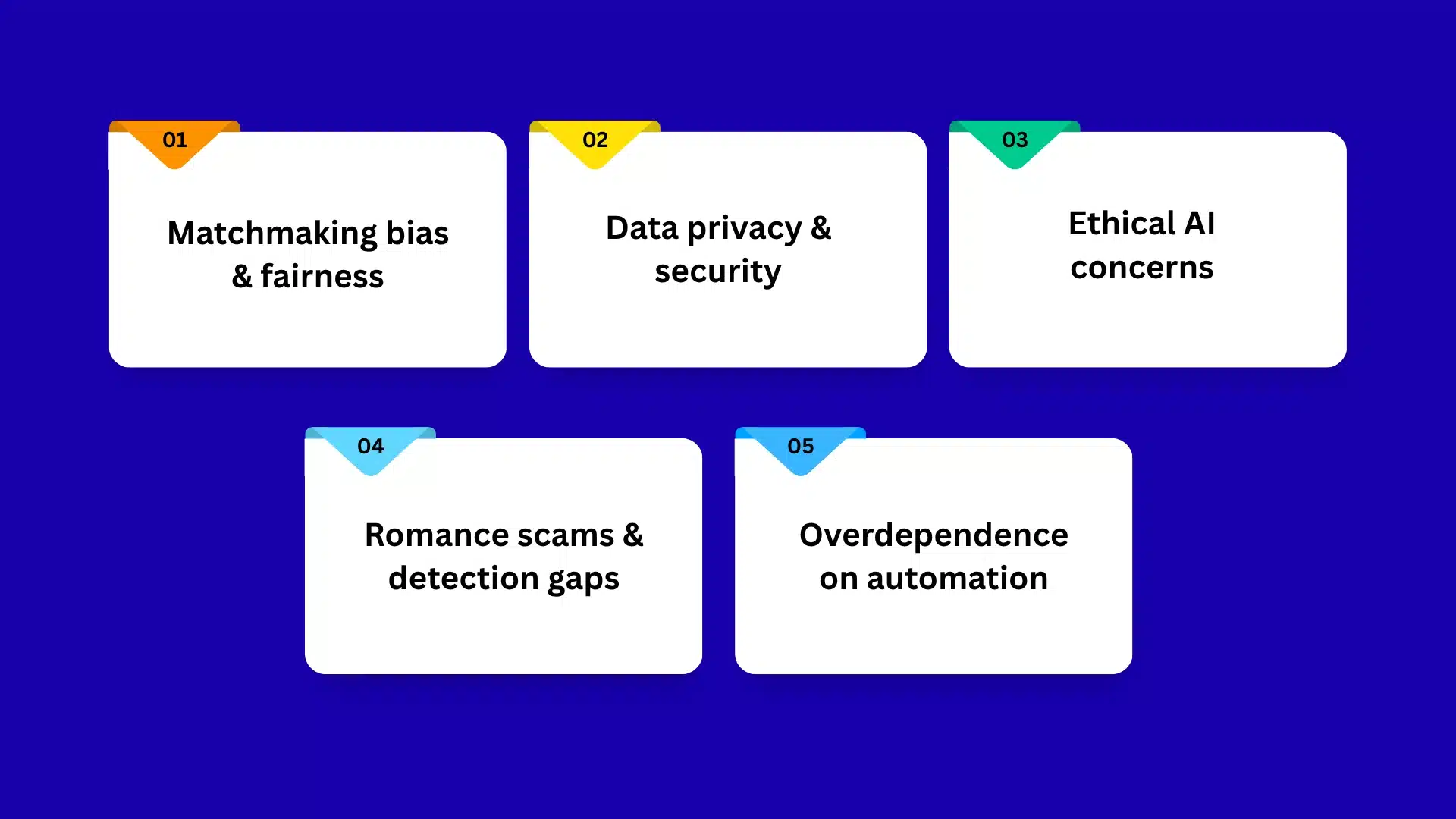
Matchmaking bias & fairness
AI matchmaking models learn from likes, matches, and messaging behavior, but historical engagement doesn’t necessarily reflect compatibility. If a model repeatedly promotes already popular profiles, it concentrates visibility among a highly specific group while making others harder to get discovered. This feedback loop often turns self-reinforcing because the underlying algorithm learns from interactions its own rankings helped generate.
For your business, this can bring uneven marketplace liquidity. Users struggling to receive relevant matches are likely to abandon your app, while reduced participation makes the pool less attractive to those who remain. For niche dating apps, losing members within a particular location, age group, or relationship-intent segment can sharply reduce the number of viable matches across your platform.
To address this, audit profile exposure, reciprocal likes, and conversation rates across relevant user groups. Test whether ranking changes reduce systematic disparities without compromising compatibility. Avoid optimizing solely for swipes or message volumes, as these metrics can reward popularity but not successful connections.
Data privacy & security
AI features may process intimate conversations, photographs, location histories, and relationship intentions to personalize recommendations or flag harmful behavior. Combining these data sources increases the consequences of unauthorized access, while external AI providers can introduce additional risks if they retain inputs or use them beyond the intended purpose. Users can also misunderstand how their information is being processed when they activate a specific AI feature within your app.
A privacy incident can expose users to stalking, blackmail, or unwanted disclosure. For your company, the consequences can include breach-response expenses, legal claims, regulatory scrutiny, and reduced user willingness to share the information that powers personalization. The exposure extends beyond the immediate incident. Collecting sensitive data without a clear product need increases your security obligations without necessarily improving matching quality.
The key here is to design each AI feature around data minimization. Before you share user content:
- Establish clear consent and deletion rules
- Encrypt sensitive information
- Restrict internal access
- Assess vendor retention and model-training practices
Review applicable US federal and state privacy requirements, especially the ones governing sensitive personal data. Where feasible, process information on-device or avoid sending identifying details to external models. These controls reduce unnecessary exposure while preserving the data needed to deliver the feature. For more on this, see data privacy in AI applications.
Ethical AI concerns
AI can generate profile descriptions, write opening messages, infer compatibility, and influence whom users see. That’s why convincing outputs can conceal uncertainty or misrepresent a person’s intentions. A generated message may sound more confident or attentive than its sender would naturally be. At the same time, a compatibility score can appear scientifically reliable despite being based on limited behavioral data.
Thus, AI creates a risk of weakened authenticity of the interactions your platform facilitates. If users discover that conversations are heavily automated or that paid compatibility assessments imply unsupported certainty, they will start questioning the credibility of both the service and its monetization model. Misleading product claims can also attract consumer-protection scrutiny.
What you need to do here is set explicit boundaries for AI-generated content and disclose its involvement when it materially affects an interaction. Let users review and edit generated messages, and avoid presenting compatibility predictions as guarantees of relationship success. Review whether paid AI features make claims that your evidence cannot support.
Romance scams & detection gaps
Fraudulent accounts can imitate genuine dating behavior, making it difficult to identify romance scams. Scammers often use stolen or AI-generated photos, maintain personalized conversations over weeks, and introduce financial requests only after establishing trust. Meanwhile, legitimate users can trigger superficial warning signs, such as frequent messaging or unusual location changes. Models trained on previously reported cases can, therefore, miss new scams that have not yet produced recognizable patterns.
The financial consequences extend beyond individual incidents. Users can suffer serious losses, while your company faces investigation costs, complaints, potential legal exposure, and damage to its safety reputation. False positives create a separate problem by restricting legitimate members and burdening support teams with appeals. A high number of flagged accounts does not necessarily mean your detection system is effective; it could indicate poor calibration.
The solution here is to build detection around multiple signals, including account behavior, image reuse, messaging patterns, and user reports. Use risk scores to trigger proportionate actions such as verification, warnings, or human investigation rather than relying on automatic bans for ambiguous cases. Track confirmed scam prevalence, false positives, and time to intervention. Make reporting accessible and provide clear warnings about financial requests, since even sophisticated detection will not catch every scam before a user is exposed.
Overdependence on automation
AI moderation and support systems classify language and behavior using learned patterns, which can fail when context matters. Sarcasm, cultural differences, consensual exchanges, coordinated false reports, and nuanced harassment cases can all produce misleading signals. The risk grows when automated outputs directly trigger permanent bans or close serious complaints without human review.
For your business, these errors can turn expected labor savings into additional operating costs. False suspensions generate appeals and may interrupt subscriptions; missed abuse can expose users to harm and create more serious escalation costs. If users cannot obtain a meaningful review, they may abandon the platform or publicly challenge its moderation practices. Automation can therefore shift workload from routine support to disputes instead of eliminating it.
So, use AI for repetitive tasks such as ticket categorization and initial moderation triage. However, retain human review for serious abuse allegations, contested permanent bans, and complex safety cases. Set confidence thresholds and maintain auditable records of consequential decisions. Compare the full cost per resolved case—including appeals, reversals, and escalation time—with the previous manual process.
How much does it cost to implement AI in dating apps?
Implementing AI in a dating app can cost $15K–$150K+, with a custom matchmaking engine or large-scale fraud detection system potentially exceeding this range. Your actual investment depends on whether you are adding intelligence to an existing app or building the data infrastructure and models needed to make AI decisions reliably.
For example, integrating an AI API to improve profile descriptions is a fundamentally different investment from training a recommendation model on user preferences, reciprocal likes, and conversation outcomes. The latter requires sufficient interaction data, experimentation, and continuous model evaluation.
Your budget must also account for inference costs as usage grows, privacy safeguards for sensitive dating data, and human review of flagged accounts. For a new app, start with one measurable problem—such as low match-to-conversation conversion—and validate its impact before committing to a proprietary AI system. General pricing is covered in AI app development cost.
| AI implementation | Estimated cost (USD) | Implementation timeline | Business value |
| AI profile generation and message suggestions | $5K–$20K | 2–4 weeks | Improves profile completion and reduces friction when starting conversations. |
| AI-powered matchmaking and recommendations | $20K–$60K | 6–10 weeks | Improves match relevance and supports retention and premium discovery features. |
| AI photo analysis and profile feedback | $15K–$45K | 4–8 weeks | Helps users improve profile quality and communicate their personality more effectively. |
| AI moderation and romance-scam detection | $25K–$80K | 8–14 weeks | Helps identify harmful content and suspicious accounts while reducing manual review workloads. |
| Custom AI matchmaking engine | $60K–$150K+ | 3–6+ months | Enables greater control over compatibility signals, ranking logic, and personalized recommendations. |
| Ongoing AI operations | $1K–$15K+ per month | Continuous | Covers API usage, infrastructure, monitoring, model updates, and moderation as the user base grows. |
Future trends of AI in dating apps
Future AI dating products are likely to move beyond profile discovery to manage more of the dating journey, from evaluating compatibility to coordinating real-world meetings. For you as a founder, these emerging capabilities offer potential differentiation and new revenue models. However, their success will depend on whether users trust AI with increasingly personal decisions. So, let’s explore the major trends that will shape the future of online dating apps embedded with AI capabilities.
- Autonomous matchmaking agents: Users can delegate candidate screening to AI agents that assess relationship goals, lifestyle preferences, and deal-breakers before suggesting introductions. This will support premium matchmaking subscriptions while keeping final decisions with users. Building one means AI agent development with clear limits on what the agent can do.
- Compatibility simulations: AI can be used to create hypothetical relationship scenarios based on voluntarily shared preferences, helping users explore differences before meeting. This offers a potential premium feature, provided simulations are presented as conversation aids rather than reliable predictions of relationship success.
- AI-coordinated dates: Future platforms can use AI workflows to coordinate availability, recommend activities, and arrange bookings after a match. This will help businesses extend monetization into date-planning services and venue partnerships beyond subscriptions.
- Cross-platform dating assistants: With explicit permission, AI agents can assist users in managing dating conversations and schedules across multiple services. This creates an opportunity to offer broader dating assistance, although privacy and platform-access restrictions remain significant barriers.
How GMTA will help Businesses building and implementing ai in dating apps?
Implementing AI in a dating app requires careful decisions about model selection, user data, recommendation logic, and the boundaries of automation. At GMTA Software, we bring AI engineering and application development together to address these requirements, with experience in RAG, agentic AI, and intelligent workflow development. We offer dating app development services with AI built in.
For a new dating platform, we therefore assess whether third-party APIs will be enough for profile assistance, conversation suggestions, or AI-powered support before committing to the cost of custom model development. If your product requires more control over matching logic, we can design recommendation pipelines around profile attributes, relationship preferences, reciprocal interest, and interaction signals. We also account for cold-start limitations, where a new platform has too little behavioral data to make reliable personalized recommendations.
Our work extends to the engineering behind these features. We can integrate AI services with user profiles, messaging, subscriptions, and moderation systems, while designing the data flows and access controls needed to protect sensitive information. For fraud detection and content moderation, we make sure to distinguish between automated flags and confirmed violations. See what we built in Match Magic, our dating app project.
If you are planning to build or expand an AI-powered dating app, we can work with you to assess your requirements, identify the right AI approach, and define a practical implementation roadmap. Connect with GMTA Software to discuss your product goals, technical constraints, and the AI capabilities that make sense for your next stage of development.
FAQs
How much user data does an AI dating app need before personalized matchmaking becomes effective?
An AI dating app does not need millions of users to begin personalized matchmaking. You can launch with profile attributes, stated relationship goals, preferences, and initial interaction signals. However, reliable behavioral personalization requires enough reciprocal likes, conversations, skips, and unmatches to identify meaningful patterns. So, start with rule-based filtering and existing recommendation models, then evaluate performance by user segment before investing in custom models.
How can AI dating apps generate revenue without compromising the quality of matches?
AI dating apps can monetize advanced discovery, personalized dating insights, and optional coaching without restricting access to compatible matches. For example, you can charge for expanded discovery filters, compatibility explanations, or AI-assisted profile feedback while keeping core matchmaking available to all users. Avoid ranking candidates primarily by payment status, as this can weaken perceived match quality and make premium subscriptions harder to justify over time.
Should an AI dating app let users customize how its matchmaking algorithm prioritizes potential partners?
Yes, user-controlled ranking preferences can make matchmaking more transparent and better aligned with individual relationship goals. You can let users adjust the relative importance of factors such as shared interests, distance, lifestyle, and long-term intentions while retaining eligibility rules for essential deal-breakers. Keep controls understandable and test whether adjustments improve reciprocal interest, rather than assuming that more customization automatically produces better matches.
Can AI help a dating app serve niche communities with smaller user pools?
Yes, AI can improve discovery within niche dating communities by ranking compatible profiles across shared interests, relationship intentions, and explicitly stated preferences. Semantic matching can identify meaningful similarities that rigid filters overlook, while carefully designed recommendations can expand discovery without ignoring users’ boundaries. However, AI cannot compensate for an insufficient local user pool. Your product may need broader geographic discovery, community partnerships, or virtual introductions to maintain viable matching opportunities.
Can AI-powered dating apps support voice-based and video-based matchmaking?
Yes, AI dating apps can analyze consented voice or video inputs to support accessibility, profile creation, and richer self-expression. Speech-to-text models can convert voice introductions into captions, while computer vision can support video quality checks and detect certain forms of manipulated media. These features require clear consent, secure processing, and safeguards against sensitive-trait inference. You should validate their impact on meaningful connections before making them central to paid subscriptions.

Rishi Ram is CTO at GMTA Software, with 6+ years of experience in software architecture and technical leadership. He’s led GMTA’s work across fintech—including eWallet apps, mobile banking platforms, and Sharia-compliant fintech builds—as well as on-demand and taxi app development and AI-integrated products like fraud detection agents and workflow automation tools.