



The short answer: A focused consumer MVP costs roughly AED 215K–330K (about $59K–90K). A premium subscription product runs about AED 365K–560K. An enterprise or health-connected platform lands around AED 940K–1.3M. If you launch on one platform in English only, you can start nearer AED 155K. Cloud, AI usage, and maintenance are on top of all of these.
Key Takeaways:
- Budget for the product you actually want to build. Cost to build a wearable fitness app: from AED 150K to AED 550K+. The biggest cost difference here comes from integrations, AI, data processing, and enterprise requirements.
- Choose wearable integrations based on your target customers. Supporting Apple Health and Google Health Connect will be enough for an MVP. Adding Garmin, Oura, Fitbit, and other ecosystems can significantly increase the costs.
- Arabic localization needs to go beyond basic translation. Arabic-English UX, RTL interfaces, voice interaction, and culturally relevant fitness logic can increase development costs, but they can create meaningful differentiation in the UAE market.
- Design for the UAE’s emerging health ecosystem. Abu Dhabi’s work with Oura and existing platforms like Sahatna show that wearable data is moving toward preventive and connected health, creating opportunities beyond D2C consumer fitness apps.
Entering an already crowded $90.8 million (2025) market based on a generic “fitness app” estimate will take you nowhere. The moment you plan to launch a wearable fitness app in the UAE, the real question is how deeply you want your product to integrate with the region’s booming digital health ecosystem. A wearable fitness app in the UAE costs roughly AED 150K with a focused MVP and can reach AED 550K+ for an enterprise-grade platform. The gap here is so significant because users expect more than just step tracking. They want their Apple Watch, Oura, Garmin, or Samsung device to translate continuous data into useful coaching, recovery insights, and personalized goals.
The business challenge is deciding where your product needs to sit on that spectrum. A basic fitness tracker can work with Apple Health and Google Health Connect. But a more mature and ambitious product has completely different requirements. Integrations with Fitbit, Garmin, or Oura, a bilingual Arabic-English UX, AI-powered coaching, personalized health insights, and user-specific dashboards will help you meet the benchmarks the market has set for all businesses.
Abu Dhabi’s 2026 partnership with ŌURA is exploring continuous wearable data for preventive health, including women’s health and cardiometabolic risk. On the other hand, the government’s Sahatna platform already supports wearable-connected wellness goals. So, if you position your product anywhere near this level, the architecture, data processing, and development budget will be substantially different from a generic calorie or steps tracker app.
That’s why we have prepared this guide to break down the wearable fitness app development cost in 2026 for the UAE region. Whether you want to know the differences in the numbers based on the product’s complexity, Arabic localization, or the backend infrastructure, you will come across everything likely to influence your budgeting here. If you’re comparing this against a global build, our wearable app development guide covers the same product in USD for a US audience.
Why should UAE businesses build wearable fitness apps in 2026?
The UAE offers a completely different opportunity from simply entering a global wearable fitness market because sports, preventive healthcare, and digital health are being developed as connected strategic sectors. The National Sports Strategy 2031 targets increasing participation from 43% to 71%, while raising the sector’s contribution to 0.5% of non-oil GDP. This proves that the UAE government is trying to build a larger sports ecosystem around infrastructure, participation, institutions, and technology. For your business, this means your wearable app can become the digital engagement layer for this ecosystem.
You don’t have to monetize only individual users. Instead, you can build products for gyms, sports clubs, employers, trainers, and wellness providers. Hence, the same underlying technology will support multiple revenue channels at once, provided you establish your product’s usability for different sectors smartly.
The UAE is also creating a pathway from fitness technology into preventive health. Abu Dhabi’s Department of Health and ŌURA launched a research program in 2026 to examine continuous wearable data for preventive health, with the initial work covering women’s health and cardiometabolic risk.
This significantly changes how you should think about the product roadmap. You could begin with fitness and wellness features, while architecting the platform to support more sophisticated health and wellness use cases later. In other words, you can give your product a potential expansion path into corporate wellness, preventive health programs, and healthcare partnerships.
Summing up, the real business advantages lie in the fact UAE’s sports strategy is expanding the addressable ecosystem, while Abu Dhabi’s preventive health initiatives are expanding the potential value of wearable data.
How much does a wearable fitness app cost in the UAE?
In 2026, the approximate cost to build a wearable fitness app for UAE consumers ranges between AED 150K and AED 550K+. The final numbers will depend on multifarious factors, including:
- The number of wearable ecosystems you plan to support
- The depth of data integration
- AI requirements
- Platform count
- Backend architecture and its robustness
- Security requirements and data governance
- Scalability
Consider building an MVP with activity tracking, user profiles, dashboards, notifications, and Apple Health/ Google Health Connect integration. Since it’s not that complex and won’t involve too much engineering depth, you can keep the capital investment around AED 150K-220K.
When you plan a wearable app with direct smartwatch integration, heart-rate and sleep analytics, GPS, subscriptions, and payment gateways, the numbers will quickly climb to the bracket of AED 220K-350K. Move to an enterprise platform with multi-device support, AI coaching, continuous biometric processing, Arabic-English UX, corporate wellness features, and advanced analytics. For this, you will need capital of AED 350K-550K+ due to the complex engineering effort involved. For cost context across other app types, get more insights from the mobile app development cost in Dubai guide.
What are the key factors affecting the cost of wearable apps in the UAE?
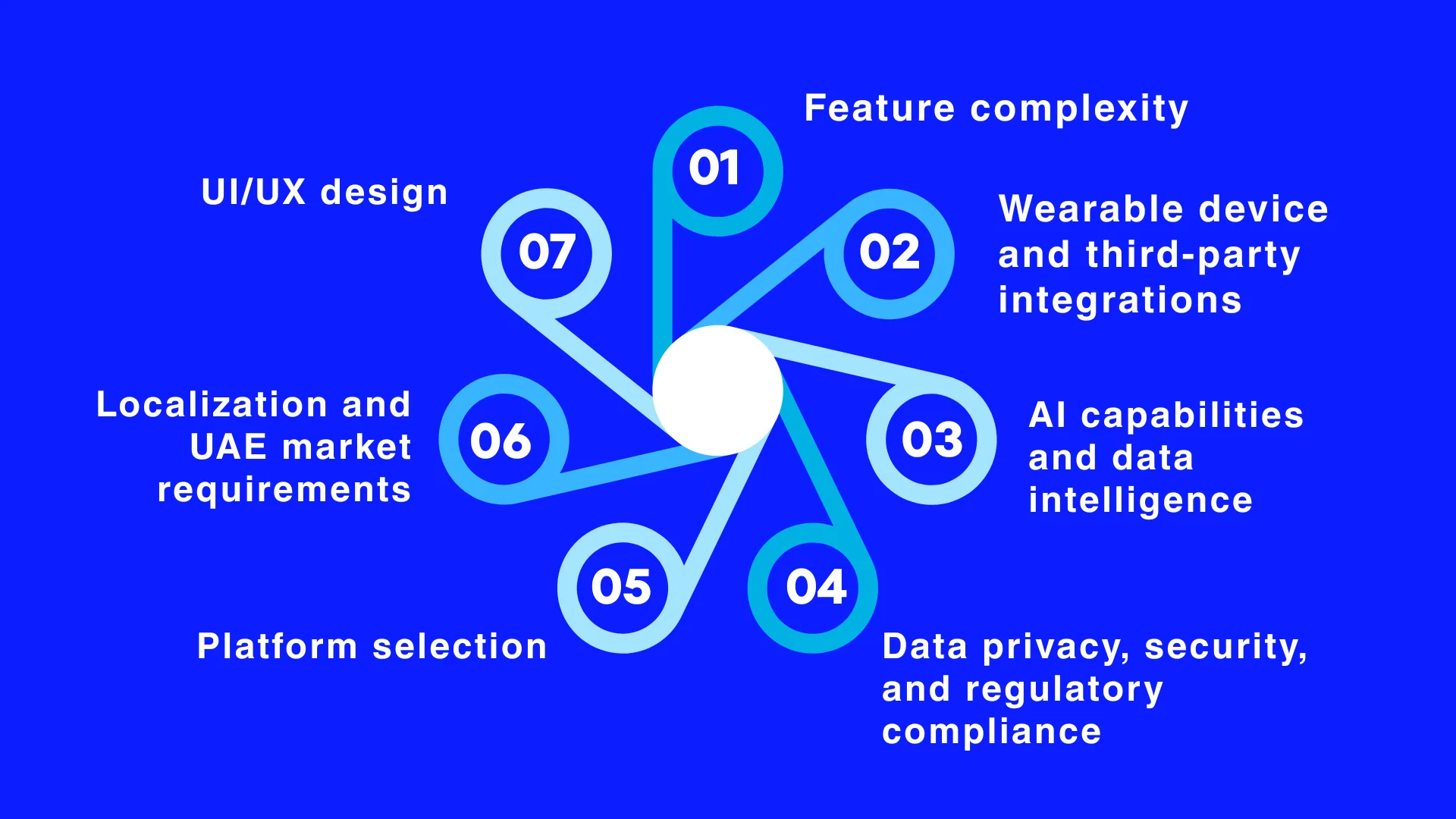
Feature complexity
Depending on how complex your feature scope is, building a wearable fitness app in the UAE will add AED 30K-180K+ to your budget. It’s factors like logic, data processing, integrations, and testing required behind the feature that drive the numbers. When we talk about basic features, like profiles, workout logs, and manually entered goals, the required backend processing power will be limited, and hence the investment.
Costs increase the moment your app’s features depend on continuous wearable data, personalized calculations, real-time triggers, or automated recommendations. You also need to pay more when one feature has to work differently for different users, devices, languages, or conditions. That’s because a UAE-based app needs to accommodate:
- Arabic and English content within the same interface
- Ramadan-specific fitness patterns
- UAE weather conditions and their impact on day-to-day activities and physical health
- Local wellness programs
- Health-oriented use cases
These requirements often need configurable rules rather than hard-coded content, which automatically increases backend and QA work. Consider a UAE fitness app having a Ramadan workout library. Building this feature alone will require an investment of AED 30K-60K.
The costs will increase if your app needs to adjust workout timing and intensity according to fasting cycles, local weather conditions, or users’ wearable data automatically. In that case, you will have to invest AED 70K-120K to get these capabilities developed. Now add recovery scoring, AI recommendations, or continuous health data analysis, and you will end up with a budget of AED 150K-180K+.
| Feature scope | Typical cost | Cost implication | When it makes business sense |
| Basic activity tracking | AED 30K–50K | Steps, calories, workouts, and goals | Best for validating demand before committing heavily |
| Personalized fitness plans | AED 50K–80K | User-specific plans and recommendations | Useful when personalization is central to retention |
| Real-time wearable insights | AED 70K–110K | Continuous activity, heart-rate and recovery data | Worthwhile for a premium wellness proposition |
| UAE-specific intelligence | AED 90K–140K | Weather, Ramadan and bilingual recommendation logic | Makes sense when UAE is your primary market |
| Advanced health intelligence | AED 150K–180K+ | Longitudinal analysis and predictive capabilities | Better for businesses targeting premium wellness or health partnerships |
Wearable device and third-party integrations
Depending on whether your wearable fitness app will remain a consumer-facing product or eventually connect with UAE’s wider digital health ecosystem, integrations will add AED 40K-200K+ to your budget. If your product uses Apple HealthKit and Google Health Connect to collect approved activity, heart rate readings, sleep, or workout information, you can keep the initial integration layer controlled. It will require about AED 40K to AED 70K only.
However, building direct connections to Garmin, Fitbit, Samsung, or Oura will require separate development. That’s because each manufacturer exposes different datasets, permissions, and APIs, which is why integration costs will increase to AED 80K-130K.
Also, in the UAE, government health systems are already using IoT devices to collect a vast range of health metrics from their users. On the other hand, Riayati is built around interoperability and data integrations. Thus, if your roadmap eventually includes healthcare or clinical partnerships, you will have to invest in an integration architecture supporting stronger interoperability and data controls from the beginning.
| Integration level | Typical cost | Cost implication | When it makes business sense |
| HealthKit / Health Connect | AED 20K–40K | Aggregated health and activity data | Best for an MVP or broad consumer launch |
| One direct wearable | AED 25K–40K | Device-specific API and data mapping | Makes sense when one device dominates your target segment |
| Deeper biometric integration | AED 40K–60K | Sleep, HRV, recovery and continuous data | Worth the investment for premium subscription features |
| 3–5 wearable ecosystems | AED 70K–100K | Multiple APIs and compatibility testing | Better when device diversity is limiting customer acquisition |
| Broad multi-device support | AED 150K–200K+ | Several direct integrations and maintenance | Justified when scale or enterprise contracts can support the investment |
AI capabilities and data intelligence
Building smart, intelligent capabilities within your fitness wearable app will add AED 50K-250K+ to your initial estimate. However, the exact numbers will depend on whether AI will simply generate fitness content or actually interpret longitudinal health data. A basic AI-driven coaching bot can use an existing model API to answer user questions and create tailored workout recommendations, allowing you to keep the costs within AED 50K-80K.
But if your system needs to combine multiple wearable signals and user history before deciding what recommendations to make, costs will automatically increase. That’s because you will have to invest in a structured data pipeline, personalization logic, model orchestration, monitoring, and governance safeguards. A platform analyzing continuous activity, sleep, recovery, and cardiovascular signals and producing personalized interventions will need an upfront capital of AED 150K-250K+.
Since MoHAP is actively developing a national policy for smart health services and AI, with emphasis on data quality, privacy, impact measurement, and proactive healthcare, you should budget for these smart capabilities early.
| AI capability | Typical cost | Cost implication | When it makes business sense |
| AI fitness assistant | AED 50K–80K | AI answers and basic recommendations | Good for improving engagement without heavy AI investment |
| AI workout generation | AED 60K–90K | Personalised workout plans | Useful when differentiation depends on personalisation |
| Recovery intelligence | AED 100K–150K | Sleep, activity and heart-rate analysis | Strong fit for premium wellness subscriptions |
| Continuous AI personalisation | AED 150K–200K | Ongoing wearable-data analysis | Justified when AI is a core product differentiator |
| Advanced health intelligence | AED 180K–250K+ | Longitudinal and predictive analytics | Consider when pursuing larger wellness or health-sector opportunities |
Data privacy, security, and regulatory compliance
Once your wearable fitness app moves into health-related information, biometric signals, location data, or preventive health insights, privacy and security specific to the UAE’s geography will add AED 40K-180K+. Apart from the specific requirements applicable to healthcare handling, you will have to consider the federal Personal Data Protection Law. That’s because the UAE Federal Law No. 2 of 2019 regulates ICT use in healthcare and requires controls around the confidentiality, integrity, and processing of health information.
For example, let’s assume you want to build a basic fitness app that stores step count and workout history. It will need AED 40K-70K upfront capital for consent management, encryption, secure authentication, access controls, and privacy-related development. If you collect continuous heart rate, sleep, reproductive health, or other sensitive information, the scope will automatically move to the expense bracket of AED 80K-120K. The investment will then cover stronger data governance, auditability features, and controls on who can access what information.
A product designed to work with UAE healthcare organizations will, however, need AED 150K-180K+, especially when it involves interoperability, health data handling, security assessments, and more stringent governance. If your roadmap includes clinical or hospital partnerships, our UAE remote patient monitoring cost guide covers similar compliance ground.
| Security scope | Typical cost | Cost implication | When it makes business sense |
| Basic application security | AED 40K–60K | Authentication, encryption and secure APIs | Minimum viable security for a consumer launch |
| Health-data controls | AED 60K–90K | Consent and granular access controls | Important when collecting sensitive biometric information |
| Advanced privacy architecture | AED 80K–120K | Governance and auditability | Useful when preparing for larger UAE partnerships |
| Enterprise security | AED 120K–150K | SSO, audit logs and advanced permissions | Needed when selling to larger organisations |
| Healthcare-oriented compliance | AED 150K–180K+ | Governance, interoperability and security | Consider when your revenue strategy includes healthcare organisations |
Get Compliance Right Before You Build, Not After
UAE data residency and consent requirements are far cheaper to design in from sprint one than to retrofit later. Let’s scope your architecture around them now.
Platform selection
Since the fitness wearable app is rarely just an iOS vs Android decision, platform-specific development will add AED 30K-150K+ to your budget. That’s because in the UAE, you will have to decide whether your target users will interact with your app through:
- iPhone and Apple Watch
- Android and Wear OS
- A combination of mobile platforms and third-party health ecosystems
So, when you choose just a mobile-only MVP, you can keep the budget within AED 30K-50K. The moment your product needs to support both iOS and Android versions, costs will move to the bracket of AED 60K-90K. Adding a dedicated smartwatch experience, rather than simply receiving fitness and health data through Health Connect or HealthKit APIs, will push the investment to AED 100K-150K+.
Also, native wearable development is way more expensive because watch interfaces have their own interaction patterns, background processing limitations, permissions, and testing requirements. So, your budget will have to cover these individual aspects depending on whether you want the app to communicate with Fitbit, Garmin, or any other specific watch brand.
| Platform strategy | Typical cost | Cost implication | When it makes business sense |
| iOS only | AED 30K–50K | One mobile platform | Suitable for a tightly defined Apple-focused audience |
| Android only | AED 30K–50K | One mobile platform | Suitable when Android adoption is central to your target segment |
| iOS + Android | AED 60K–90K | Two mobile platforms | Better for broad UAE consumer acquisition |
| Mobile + Apple Watch | AED 90K–120K | Dedicated Apple Watch experience | Makes sense for premium Apple-oriented users |
| Mobile + multiple smartwatch platforms | AED 100K–150K+ | Multiple wearable experiences | Justified when device coverage directly affects acquisition |
Localization and UAE market requirements
Launching a wearable fitness app in the UAE means it will have to operate across a market with English and Arabic users, different emirates, Ramadan-related behavioral changes, local payment expectations, and a highly digital consumer environment. That’s why localization alone can add AED 30K-110K+ to your development budget in 2026. Basic Arabic-English localization with static screens and standardized content can cost you AED 30K-45K.
But if you want to make Arabic language available for personalized workout plans, push notifications, AI-generated coaching, and dynamic health insights, costs will climb quickly to AED 50K-75K. You will also need RTL-aware components that can change direction without breaking charts, wearable metrics, or navigation. In case your fitness wearable app includes local subscription payments,
Ramadan-specific program logic, bilingual content management, and UAE-specific fitness recommendations, the development investments will enter the bracket of AED 80K-110K+. Payment integration should be considered during the requirements analysis and roadmap design phase only.
The UAE has a mature digital payment ecosystem, including cards, Apple Pay, Samsung Pay, and local government-linked platforms. So, if you are selling a recurring fitness subscription, you will have to invest in designing the payment systems around the way UAE consumers are familiar with from the very beginning.
| Localization scope | Typical cost | Cost implication | When it makes business sense |
| Basic Arabic translation | AED 30K–40K | Arabic interface and static content | Suitable for testing Arabic demand |
| Full Arabic RTL experience | AED 40K–60K | RTL layouts and navigation | Important when Arabic-speaking users are a core segment |
| Bilingual dynamic content | AED 50K–75K | Arabic/English personalised content | Useful when coaching and engagement are central |
| UAE-specific fitness logic | AED 70K–90K | Ramadan, weather and local behaviour logic | Valuable for a genuinely UAE-first product |
| Full UAE localisation | AED 80K–110K+ | Bilingual AI, local payments and market-specific functionality | Makes sense when UAE is the primary commercial market |
UI/UX design
Designing the user interface of your fitness wearable app for UAE consumers will cost you AED 35K-130K+, depending on how many experiences you want to design and how much health data the user has to understand. A straightforward consumer application with a mobile-first interface will need AED 35K-55K only. However, when we talk about a product with detailed wearable dashboards, personalized fitness journeys, and Arabic RTL layouts, your investment will move to AED 60K-85K.
For smartwatch interfaces, trainer or corporate dashboards, AI-generated recommendations, and complex health visualizations, more engineering effort will be involved in ensuring the UI/UX can deliver immersive experiences. That’s why your wearable fitness app will then cost AED 100K-130K+.
| Design scope | Typical cost | Cost implication | When it makes business sense |
| Basic fitness app UX | AED 35K–50K | Core fitness journeys | Suitable for testing product-market fit |
| Wearable data dashboards | AED 50K–70K | Health metrics and visualization | Worthwhile when data is a key part of your value proposition |
| Personalized user journeys | AED 60K–85K | Data-driven experiences | Useful for improving engagement and retention |
| Arabic RTL + smartwatch UX | AED 80K–100K | Additional layouts and interactions | Justified when Arabic and wearable usage are both priorities |
| Advanced multi-user UX | AED 100K–130K+ | Consumer, trainer and enterprise experiences | Valuable if your revenue model includes gyms or corporate wellness |
Get Your Exact Number, Not a Range
These are planning estimates. Tell us your target devices, platforms, and audience, and we’ll scope a line-item budget in AED and USD.
Key hidden cost challenges for your wearable fitness app budget
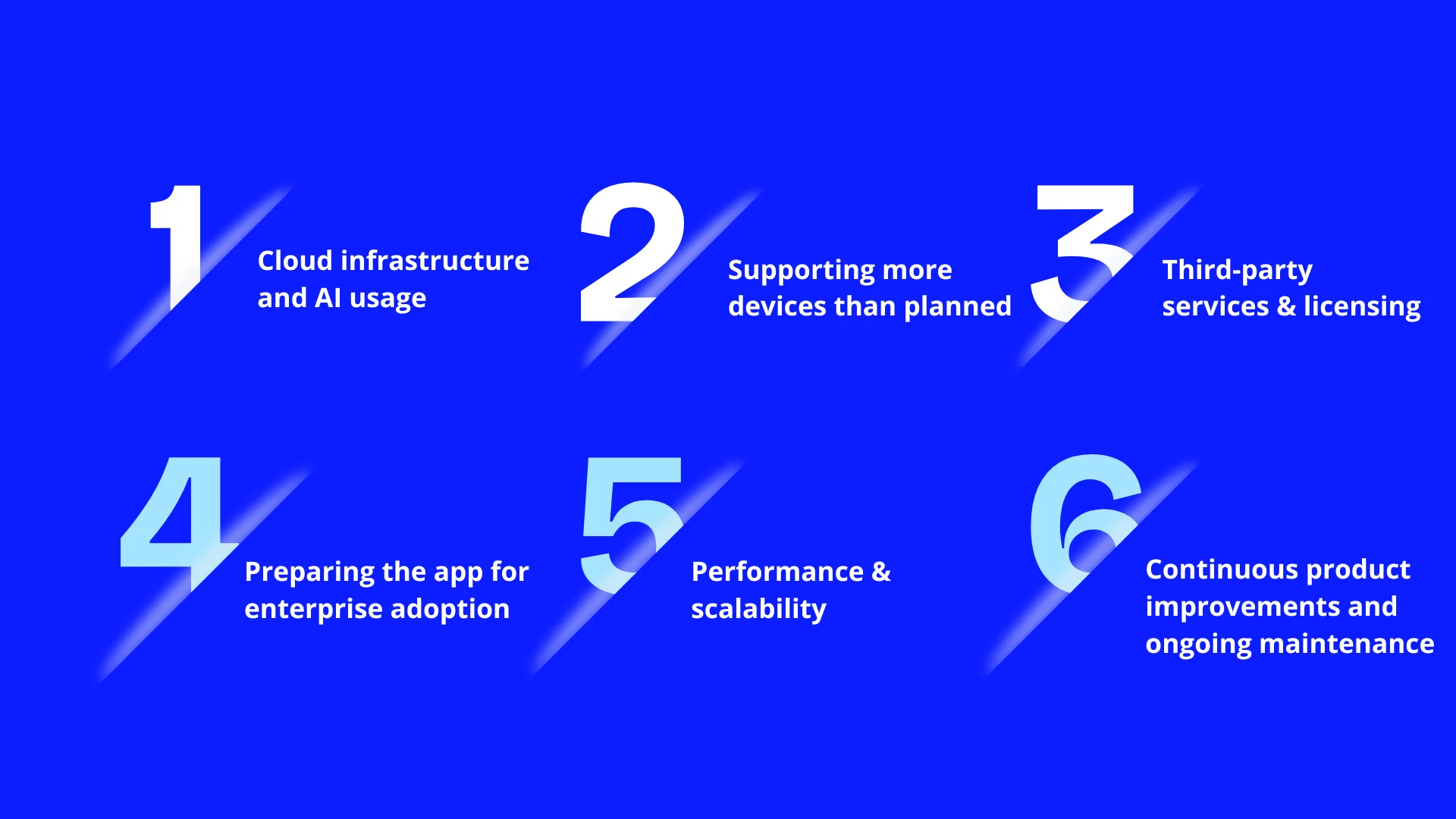
Cloud infrastructure and AI usage
Depending on the volume and type of wearable data your UAE-based fitness app processes, cloud infrastructure alone can incur AED 2K-30K+ every month. A basic MVP version storing daily steps, workouts, and user profiles will need modest compute and storage, thereby keeping the expenses around AED 2K-5K per month. The requirements will, however, change once you start collecting continuous heart rate, GPS, recovery, and other biometric signals. That’s because your app will then need higher-capacity databases, event processing, data pipelines, backups, monitoring, and scalable APIs. This will automatically move the infrastructure costs to AED 5K-15K per month.
AI creates a completely separate variable cost. An AI workout plan generator can add AED 2K-5K per month because it creates occasional model requests as per user demands. On the other hand, an AI recovery coach analyzing sleep, activity, and heart rate history may need AED 5K-12K monthly. Continuous personalized health intelligence, however, pushes the AI costs to the AED 15K-30K+ bracket. That’s because the system has to process wearable signals and generate individual recommendations repeatedly.
Supporting more devices than planned
Using Apple HealthKit or Google Health Connect as an aggregation layer will keep the initial integration cost for your fitness wearable app around AED 20K-40K. However, direct integrations with individual manufacturers will be more expensive because each comes with different APIs, authentication models, permissions, and data structures. Bringing in only steps and calories will be cheaper than importing sleep stages, heart-rate variability, readiness, recovery, or continuous heart rate monitoring features.
For a UAE-based product, this becomes a crucial consideration in budget estimation because Garmin, Oura, Apple Watch, Samsung, and Huawei can all appear within your potential customer base. Adding one deeper integration can cost another AED 25K-40K. Supporting three or four direct ecosystems will automatically push the expenses towards AED 70K-100K+.
Third-party services & licensing
If you are using third-party services for your wearable fitness app, make sure to budget AED 10K-100K+ per year. Even after the product is developed completely and launched for real-world users, you still need to pay separately for maps, weather data, cloud services, AI models, payment processing, messaging, analytics, and specialized health-data services. These do not remain fixed after launch. Rather, the bills will continue to increase as you start onboarding more users.
Let’s consider your fitness app recommends outdoor workout plans to the users. For this, maps and weather APIs will generate recurring expenses of AED 10K-20K annually, while heavy route tracking can push the costs to AED 30K-40K+. An AI coaching layer can add AED 10K-50K+ annually. The key here is to calculate the cost per active user and cost per transaction/API call before pricing the subscription.
Preparing the app for enterprise adoption
If you want to move your wearable fitness app from the individual consumer market to the enterprise level in the UAE, preparing for the adoption alone can incur AED 50K-200K+. That’s because selling to UAE organizations will require a completely different technical architecture from selling directly to consumers. A consumer app can isolate each person’s account and their own fitness data. Conversely, an enterprise platform needs more advanced elements, including:
- A multi-tenant architecture
- Organization-level administration
- Role-based permissions for access controls
- Employee onboarding portal
- Reporting and executive analytics dashboards
A basic enterprise layer with organization accounts, administrators, and employee management will add AED 50K-80K to your initial development budget. On the other hand, if you want to build a multi-tenant architecture, advanced permissions, and organization-level analytics, the budget will increase to AED 80K-120K. SSO, audit trails, HR systems integrations, and enterprise reporting further push the expenses to AED 120K-160K+.
Performance & scalability
As a fitness wearable app will generate a huge volume of data events even with a smaller user base, you should consider AED 30K-150K+ for performance and scalability. Unlike a conventional fitness app, your product will receive heart rate, movement, sleep, GPS, and workout data throughout the day. That’s why the backend needs to handle frequent requests without decelerating synchronization, dashboards, or personalized recommendations.
Supporting around 2k-5K users with periodic data synchronization will need AED 30K-50K in scalability engineering. At a 25K-50K user base, the costs will climb to AED 60K-100K because then you need to invest in queues, caching, database optimization, load balancing, and stronger monitoring. A platform designed for 100K+ users with continuous wearable processing will need a capital investment of AED 120K-150K+.
Continuous product improvements and ongoing maintenance
After the launch, you will have to invest AED 40K-180K+ per year for your product’s maintenance and continuous improvements. That’s because wearable APIs, OS updates, device firmware, cloud platforms, AI models, and payment services are likely to change after your application goes live. Accommodating these changes and testing your product for performance, scalability, and security will require significant capital investment.
For example, basic maintenance can cost AED 40K-60K annually, covering security patches, bug fixes, and iOS/Android compatibility testing. Supporting multiple wearable ecosystems can, however, push the numbers to AED 60K-90K as every integration will then need compatibility testing and occasional API changes. Adding AI improvements, new wearable metrics, and more sophisticated analytics can generate an annual expense of AED 100K-130K.
| Hidden cost challenge | Typical additional cost | Cost driver | Business risk if underestimated |
| Cloud infrastructure & AI usage | AED 2K–30K+ / month | Wearable data processing, storage, cloud scaling, and AI API usage | Higher monthly burn as users grow |
| Supporting more devices than planned | AED 20K–100K+ | New APIs, data mapping, testing, and device compatibility | Expensive integrations after launch |
| Third-party services & licensing | AED 10K–100K+ / year | AI, maps, weather, payments, messaging, and analytics | Lower margins as usage increases |
| Preparing the app for enterprise adoption | AED 50K–200K+ | Multi-tenancy, SSO, permissions, reporting, and enterprise integrations | Costly architecture changes later |
| Performance & scalability | AED 30K–150K+ | Database optimization, APIs, caching, queues, and monitoring | Performance issues during rapid growth |
| Continuous improvements & maintenance | AED 40K–180K+ / year | OS, wearable APIs, security, AI, and feature updates | Compatibility and security problems over time |
How to reduce the cost to build a wearable fitness app in UAE?
Build around your business model first.
Start with the UAE revenue model. A customer subscription app will need a completely different feature set from a corporate wellness platform. The same applies for a product targeting gyms, insurers, or healthcare organizations. If you are selling subscriptions, prioritize wearable syncing, personalized plans, and engagement features. Do not spend heavily on enterprise-level dashboards yet. Conversely, if corporate contracts are your priority, build multi-tenant accounts, permissions, and reporting early. This approach alone can help you save AED 50K-150K+ in unnecessary feature development. More importantly, your initial investment stays aligned with how you expect to generate revenue in the UAE.
Choose wearable integrations according to your audience
Do not support every wearable right upon launch. First identify the devices used by your target UAE customer segment. HealthKit and Health Connect can provide a smart starting point. Direct Garmin, Oura, Fitbit, Samsung, or Huawei integrations can follow when demand justifies them. This can save AED 30K-80K+ during the first release. It will also reduce testing and administrative burden. Track which devices the UAE audience usually connects to, and use that data to decide which wearable integration deserves the next investment.
Treat AI like a product feature
Do not simply add AI to your wearable fitness app just because your competitors have it. Rather, real value will come only when you give every AI feature a commercial purpose. An AI workout generator costs around AED 60K-90K to develop. Continuous recovery intelligence, on the other hand, needs AED 100K-150K+. Advanced AI that continuously analyzes sleep, heart rate, and physical activity can go beyond AED 150+. For a UAE launch, start with the AI feature that can help improve retention or subscription value. Expand only after you have evidence that users engage with it.
Make compliance a part of the first sprint
Do not leave privacy and security until the final development stage. Decide from the beginning what biometric data you will collect, where it will be stored, and who can access it. In case you want to deal with UAE healthcare organizations later, build consent management, encryption, access controls, and auditability into the architecture from the start. An early security and privacy foundation will need AED 40K-90K. Retrofitting these later will cost considerably more.
Build an architecture that can grow with your product
You do not need to pay for a 100K-user infrastructure on day one. You do need an architecture that can reach that scale without asking for a complete rebuild. Start with infrastructure suited to your initial UAE user base. Keep the database, APIs, and wearable data pipelines scalable. This approach will help you control the early cloud bill while protecting future growth.
Not Sure Which Wearables Are Worth the Investment?
We’ll map your target users’ actual devices against integration cost and complexity, so you’re not paying for support nobody uses.
What are the key features of a wearable fitness app with advanced features?
AI-powered health insights
An advanced wearable fitness app should turn wearable data into personalized actions, not just display steps and calories. AI can combine sleep, heart rate, activity, recovery, and workout history to identify patterns and recommend what users should do next.
These recommendations can account for Dubai and Abu Dhabi’s heat, humidity, and outdoor exercise conditions. Workout timing can shift away from extreme daytime temperatures. During Ramadan, training intensity, hydration reminders, and workout schedules can adapt to fasting and non-fasting hours. This makes intelligence more relevant than generic recommendations built around Western exercise patterns.
Real-time coaching
This feature uses live wearable data to guide users while they exercise. The app can monitor heart rate, pace, distance, and workout duration with the highest accuracy. It can then provide immediate instructions through a phone, smartwatch, or headphones. A runner completing an outdoor session in Dubai, for instance, will need different guidance as temperature and exertion rise. The app detects when heart rate moves beyond the target zone and recommends slowing down or taking a recovery interval. This will make your wearable app an active coaching tool rather than a device that simply records workouts.
Predictive health analytics
Predictive analytics looks at changes over time, rather than treating every workout session as an isolated event. The system can analyze heart rate, sleep quality, activity, recovery, and training load to identify meaningful changes in a user’s normal pattern. This will help you create a stronger proposition in a market increasingly investing in preventive wellness programs.
Connected health and device integrations
Your fitness app should bring data from the wearable devices customers already own into one profile. This can include Apple HealthKit, Google Health Connect, Garmin, Fitbit, or Oura. The most important capability here is not simply the number of integrations. Instead, it’s the ability to standardize the incoming data in a consistent format. One device can provide readiness scores while another might generate recovery or sleep metrics. Your app needs to interpret those inputs consistently before generating recommendations.
Arabic and English voice assistance
Voice assistance should support natural switching between Arabic and English, rather than offering a basic translated interface. Users can ask about their recovery, request a workout, or receive coaching without navigating through multiple screens. Arabic voice interaction also needs to work properly with the realities of the UAE’s multilingual environment.
Member challenges and reward programs
Challenges can give users a reason to keep connecting their wearables after the initial download. The platform can support step competitions, active-minute targets, workout streaks, and team challenges. Points can then be connected to rewards. This will help create opportunities beyond individual subscriptions. Gyms can use challenges to improve member engagement. Employers can run internal wellness campaigns. Brands can sponsor rewards. Fitness communities can create their own competitions. The same technology can therefore support several UAE revenue models without requiring separate products for each.
What is the process to build a wearable fitness app?
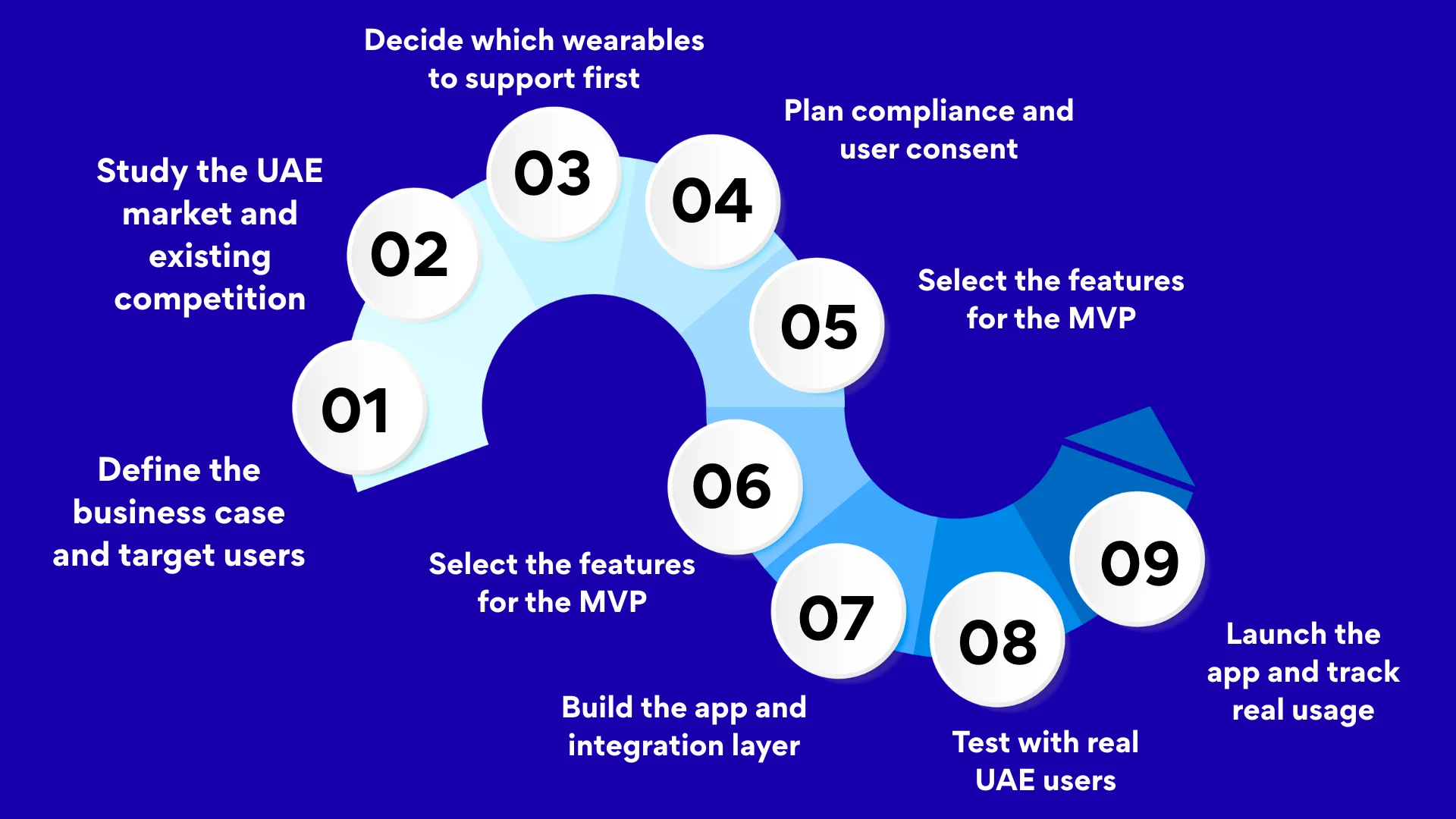
Step 1: Define the business case and target users
Start by deciding who will pay for the app and why. Your target could be consumers, gyms, employers, insurers, or wellness providers. Define the revenue model, target customer, core problem, and the expected commercial outcome before approving the product scope.
Step 2: Study the UAE market and existing competition
Assess competitors serving customers in Dubai, Abu Dhabi, and other major UAE markets. Compare their pricing tiers, wearable support, Arabic capabilities, AI features, and business models. Look for underserved segments rather than building another generic fitness tracker with the same feature set.
Step 3: Decide which wearables to support first
Choose integrations based on your target customers’ actual devices. You may start with Apple HealthKit and Google Health Connect, then add Oura, Garmin, Fitbit, and other platforms. Every integration adds development and maintenance costs. So, it’s best to prioritize those with real commercial value.
Step 4: Plan compliance and user consent
Decide what health and biometric information you will collect before development begins. Establish consent, storage, security, and data sharing rules from the start. This will become more important when you plan to work with UAE healthcare organizations, employers, and other regulated partners.
Step 5: Select the features for the MVP
Keep the first release focused on features that support your UAE revenue strategy. A consumer subscription may prioritize wearables syncing and personalized coaching. A corporate product will need employee challenges and administrative reporting. Avoid expensive AI or integrations that have no clear commercial value yet.
Step 6: Design the user and business dashboards
Design separate experiences for users, administrators, and professional partners where required. Users need simple fitness insights. Businesses may need participation and program-level reporting. Keep individual biometric information protected while giving authorized organization the information they actually need.
Step 7: Build the app and integration layer
Develop the mobile application alongside the wearable data and backend architecture. The integration layer should standardize information from different devices before it reaches your analytics or AI systems. This will prevent your product from becoming dependent on one manufacturer’s data format.
Step 8: Test with real UAE users
Test the product with people who match your intended customer segment. Check Arabic and English experiences, wearable synchronization, outdoor workouts, local connectivity, and real usage patterns. Test during different routines, including Ramadan if it is relevant to your target audience.
Step 9: Launch the app and track real usage
Launch with a controlled customer group rather than spending heavily on broad acquisition immediately. Track activation, wearable connections, feature usage, retention, subscription conversion, and customer acquisition cost. Use these numbers to decide which integrations and features deserve your next investment.
Common pitfalls in wearable fitness app development and their solutions
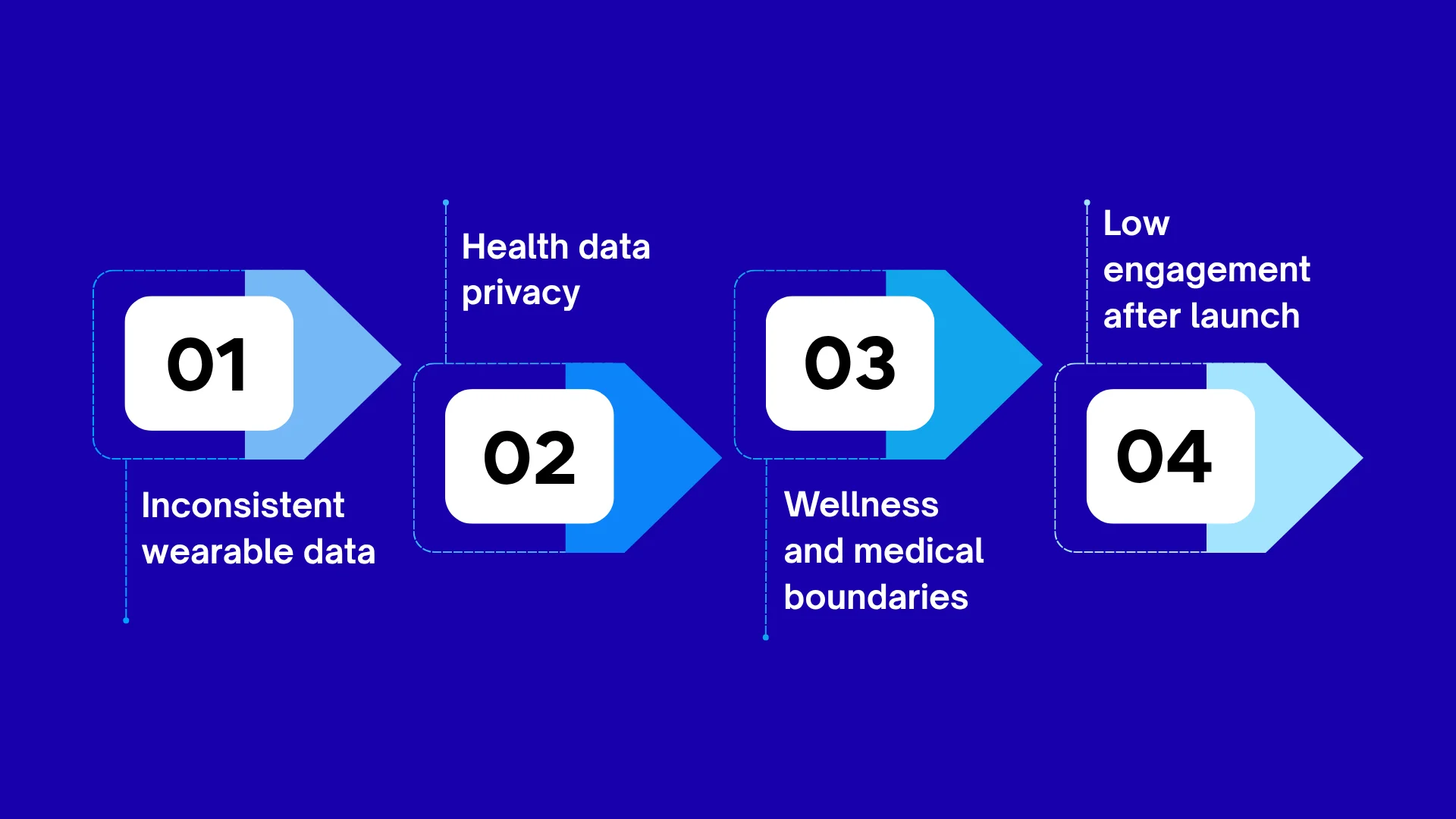
Inconsistent wearable data
Wearable manufacturers don’t measure or present health metrics in the same way. Apple Watch, Oura, Samsung, Garmin, or Huawei produce different readings for sleep, calories consumed or burnt, heart rate, and recovery. Combining these values without prior normalization will certainly produce misleading insights. What you need to do is build a standardized data layer that maps different device outputs into consistent metrics. Also, test integrations across device models and firmware versions before relying on the data for AI recommendations or risk scoring.
Health data privacy
A wearable fitness app can collect highly sensitive information, including heart rate, sleep patterns, location, activity history, and other biometric indicators. A privacy policy alone is not enough. Decide exactly what data you need to collect, why you need it, where it will be stored, and who can access it. Implement consent management, encryption, role-based permissions, and audit trails from the beginning.
Wellness and medical boundaries
The line between fitness guidance and medical advice can blur out when AI starts analyzing health metrics. Telling someone to improve their recovery is different from suggesting they have a medical condition. Define this boundary before developing advanced analytics. Your product claims, AI prompts, and recommendations should remain within the intended wellness scope.
Low engagement after launch
Many fitness apps see strong downloads but weak retention because users stop finding value after the initial novelty disappears. A wearable app needs to give users reasons to return regularly. Personalized goals, progress trends, challenges, coaching, and recovery insights can create recurring value. Measure activation, weekly retention, wearable connection rates, and feature usage after launch.
The future of wearable apps in UAE
AI that explains the reason behind a recommendation
The next generation of wearable fitness apps will explain why a recommendation was generated. Instead of simply telling the user to reduce workout intensity, the app could connect poor sleep, elevated resting heart rate, and recent training load to that decision. Users can also ask the intelligent bots follow-up questions like “why is my recovery low today?”, and receive an explanation based on their own historical data.
Heat and environment-aware coaching
Wearable apps are likely to combine real-time environmental conditions with biometric data to change workout recommendations automatically. In the UAE, this could mean checking temperature, humidity, and air quality before suggesting an outdoor run. During the workout, the app could monitor exertion and environmental stress together. It then might recommend slowing down, moving indoors, or changing the workout times when conditions become unreliable.
Predictive wellness programs
Future platforms will move from daily fitness recommendations to long-term wellness planning. By analyzing weeks or months of sleep, activity, recovery, and training data, it could identify declining recovery or reduced activity before the users notice the same. It will then become possible for the app to automatically adjust a training program, recovery schedule, or wellness goal.
Arabic-first voice coaching
Arabic voice interaction is likely to become a core interface rather than an optional language feature. Users could speak naturally with their fitness assistant, ask about their sleep or recovery, and receive personalized workout guidance in Arabic. The assistant could also switch between Arabic and English during the same interaction.
Digital fitness twins
Future apps could create a dynamic digital fitness twin that continuously represents a user’s current fitness and recovery state. It could combine wearable readings, workout history, sleep, and behavioral patterns. Users might then simulate different choices. For example, the system could estimate how adding another training session or taking an extra recovery day could affect their upcoming performance.
Smart gym and connected equipment integration
Wearable platforms are likely to become the digital layer connecting the entire gym experience. Future apps could automatically recognize connected treadmills, bikes, and strength equipment. Workout data could flow directly into the user’s profile. The app could then adjust resistance, training intensity, or exercise selection based on previous performance.
How does GMTA help UAE businesses scale with a wearable fitness app?
At GMTA Software Solutions, we approach a wearable fitness app as a scalable business platform, not simply a mobile application. The starting point is your commercial model, which could be consumer subscriptions, gym memberships, corporate wellness, or health and wellness partnerships. From there, we structure the product’s architecture around the users, integrations, and data flows you actually need.
We won’t be there just to build an MVP model for your UAE business only. Instead, we will help build the wearable integration layer, AI capabilities, cloud infrastructure, dashboards, and third-party integrations after the initial product launch. Whether you want to expand your UAE user base or move from individual subscriptions into gyms or employer contracts, our fitness app development team will ensure your product can accommodate the necessary changes as per your growth strategy.
FAQs
What UAE data privacy and healthcare compliance requirements affect wearable fitness app development?
UAE wearable fitness apps handling health or biometric data should account for the UAE Personal Data Protection Law, applicable health-data regulations, consent, secure processing, and access controls. Requirements can become stricter when integrating healthcare providers or processing clinical information. That’s why you should determine the regulatory scope, storage architecture, and data-sharing rules before development begins.
How can UAE businesses reduce wearable fitness app development costs without compromising quality?
Start with a focused MVP and support the wearable ecosystems your target customers actually use. Use HealthKit or Health Connect before building multiple direct integrations. Prioritize AI features with clear commercial value. Design scalable architecture from the beginning, but avoid paying for unnecessary capacity. Early compliance planning also reduces expensive retrofitting later.
What features should a wearable fitness app include in its MVP for the UAE market?
A UAE MVP should include wearable synchronization, activity tracking, personalized goals, workout tracking, basic health insights, Arabic and English language support, secure accounts, and consent management. If monetization depends on gyms or employers, you will have to add the necessary dashboards in the first development plan only. Advanced predictive analytics, extensive device integrations, and sophisticated AI features can be built in later sprints after the first launch.
How long does it take to develop and launch a wearable fitness app in the UAE?
A focused wearable fitness app MVP takes 4-6 months, while a premium, advanced platform needs 8-12+ months. Direct integrations with multiple wearables, AI, bilingual experiences, enterprise dashboards, and healthcare integrations can extend the timeline. Compliance planning and real-user testing must be included within the estimated development timeline, not after that.

Founder
Anjali Upadhyay is the Founder of GMTA Software Solutions, a mobile and web application development company she built from the ground up in 2019. Under her leadership, GMTA has delivered 200+ production applications across healthcare, fintech, and on-demand services for clients in the US, UK, Singapore, and UAE. She also leads GMTA’s AI practice, which has shipped production AI systems — including HIPAA-compliant healthcare workflows, LLM-integrated logistics platforms, and fintech automation tools — for US-based enterprise clients. Her writing covers AI product strategy, build-vs-buy decisions for AI systems, and the operational realities of moving AI from proof-of-concept to production at scale.