



Key Takeaways
- Budget $5,000–$50,000 for most business sites. Platforms, portals, and sites with AI features start at $50,000 and can pass $150,000.
- Page count matters least. Back-end logic, integrations, compliance, and AI features move the price most.
- Budget the three-year number. A website typically costs about 2 times its build price over three years once maintenance, hosting, and licenses are included.
- AI features are a separate line item. A chatbot, semantic search,h or recommendation engine adds roughly $3,000–$40,000+ to the build, plus usage costs every month.
- Compare quotes on assumptions, not totals. A cheaper quote has usually left out integrations, testing, handover, or maintenance.
- The fastest way to a reliable number is a short discovery phase. It turns “a website” into a written scope that every bidder can price the same way.
You have decided the business needs a new website, or a better one. Then the quotes arrive: $4,000 from one agency, $38,000 from another, and $120,000 from a third. All three claim to be building “a website.” Which number is right?
The honest answer is that all three can be. The cost to develop a website with a software agency runs from about $5,000 for a simple marketing site to $150,000 or more for a portal or platform. Most business websites land between $5,000 and $50,000. The spread exists because “a website” can mean a five-page brochure or a system where customers log in, pay, and manage their accounts.
Visitors judge both the same way. About 61% of web traffic worldwide now comes from mobile devices, according to StatCounter’s October 2026 figures, so people form an opinion in seconds, on a small screen, with no patience for slow or confusing pages. A site that cannot hold that attention costs you money, however little you paid for it.
This guide breaks the price down the way an agency actually builds it: by work involved, by site type, and by who does the work. It also covers what most cost guides skip: what the site costs to run over three years, how to test whether it will pay for itself, and how to compare quotes so you pick the right partner, not the cheapest one. Every figure here is a planning range, not a quote.
What Factors Impact the Cost to Develop a Website?
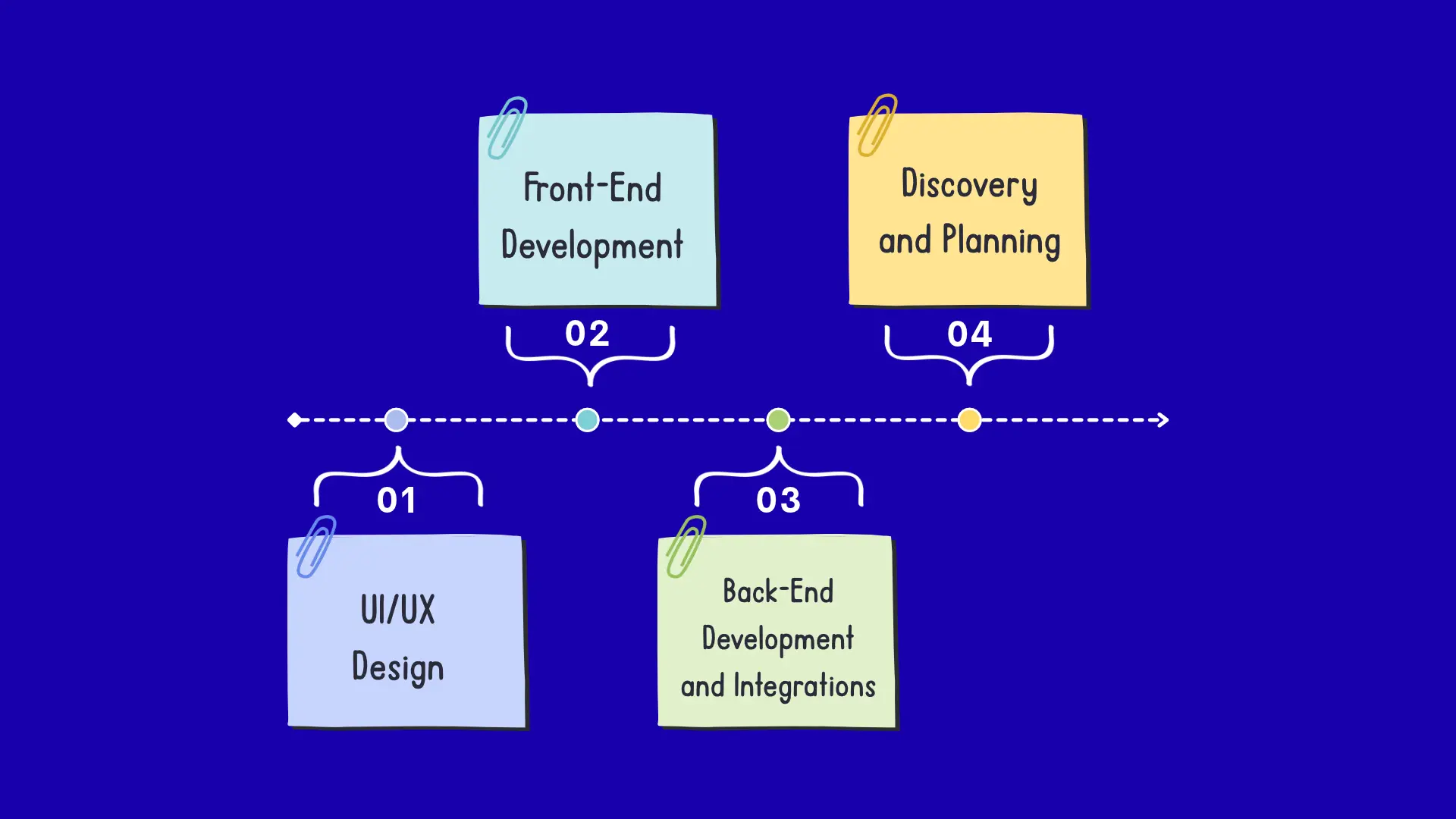
Agencies price a website by the hours each kind of work takes. Four areas account for most of the build: design, front-end, back-end, and the planning and testing around them. Understanding each one tells you where your own money will go.
The percentages below are shares of the total build budget. The dollar examples assume a $30,000 project, so you can scale them up or down.
UI/UX Design (10–15% of the build)
Design is not decoration. It decides whether a visitor finds what they came for, trusts you enough to continue, and fills in the form. Good design work includes mapping the paths users take through the site, sketching page layouts as wireframes, building the visual style, and testing a clickable prototype before any code is written.
On a $30,000 build, expect roughly 3,000–4,500 for design. What moves that number is not the page count but the number of unique templates. A site with 40 pages that reuse six layouts is cheap to design. A site with 12 pages that each need their own layout is not. How much user research you pay for and how many revision rounds the contract allows matter just as much.
Starting from a pre-built theme costs less than a fully custom design, but a theme limits what you can change later. If your brand is a selling point, such as a consultancy, a clinic, or a premium product, custom design usually earns its price. If the site is a simple information page, it often does not.
Front-End Development (20–25%)
The front end is everything a visitor sees and touches: layouts, menus, forms, filters, calculators, animations. Developers turn the approved design into pages that adapt to phones, tablets, and desktops, and they build in the speed, accessibility, and search-friendly markup that decide how the site performs.
On a $30,000 build, front-end work runs about 6,000–7,500. Interactivity is what pushes it up. A product filter, a price calculator,r or a live dashboard needs far more code than a page of text and images. Browser and device support also adds testing time, and so does connecting each page to the content management system so your team can edit it without a developer.
Speed is part of the job, not an extra. Google measures it through Core Web Vitals, and its “good” thresholds are a Largest Contentful Paint within 2.5 seconds, Interaction to Next Paint within 200 milliseconds, and Cumulative Layout Shift under 0.1. Write those targets into the contract.
Back-End Development and Integrations (25–35%)
The back end is everything your visitors never see: the database, the admin panel, user logins, business rules, and the connections to your CRM, payment gateway, or ERP. It is the largest share of the budget and the hardest to predict, which is why vague requirements become expensive here.
On a $30,000 build,d this is roughly 7,500–10,500. A brochure site needs almost none of it. A site with customer accounts, pricing rules,es or order history can spend a third of its budget here.
Integrations deserve special attention because they are the most common reason a final bill exceeds the first quote. As planning ranges for one integration with a third-party tool that already has a documented API:
- Email marketing or analytics tools: 500–2,000
- A CRM such as HubSpot or Salesforce: 2,000–8,000
- A payment gateway such as Stripe or PayPal: 1,500–5,000
- Booking or scheduling software: 2,000–6,000
- An ERP, inventory system, or custom API: 8,000–25,000 or more
List every system you need to connect before you ask for a quote. Our API integration services team scopes these as separate line items so nothing surprises you later.
Discovery, QA and Project Management
Three quieter phases make up the remainder, and they are where cheap quotes quietly cut corners. Discovery (5–10%) turns an idea into a written scope, a sitemap, and an estimate you can hold the vendor to. QA and testing (10–15%) cover functionality, browsers, performance, security, and accessibility. Project management (8–12%) keeps scope, schedule, and budget aligned through weekly demos and written change control.
On $30,000, that is roughly 1,500–3,000 for discovery, 3,000–4,500 for testing, and 2,400–3,600 for management. Skipping discovery is the most common cause of change requests later. Cutting testing usually returns as post-launch fixes that cost more and damage trust.
Additional Costs That Add to the Cost to Develop a Website
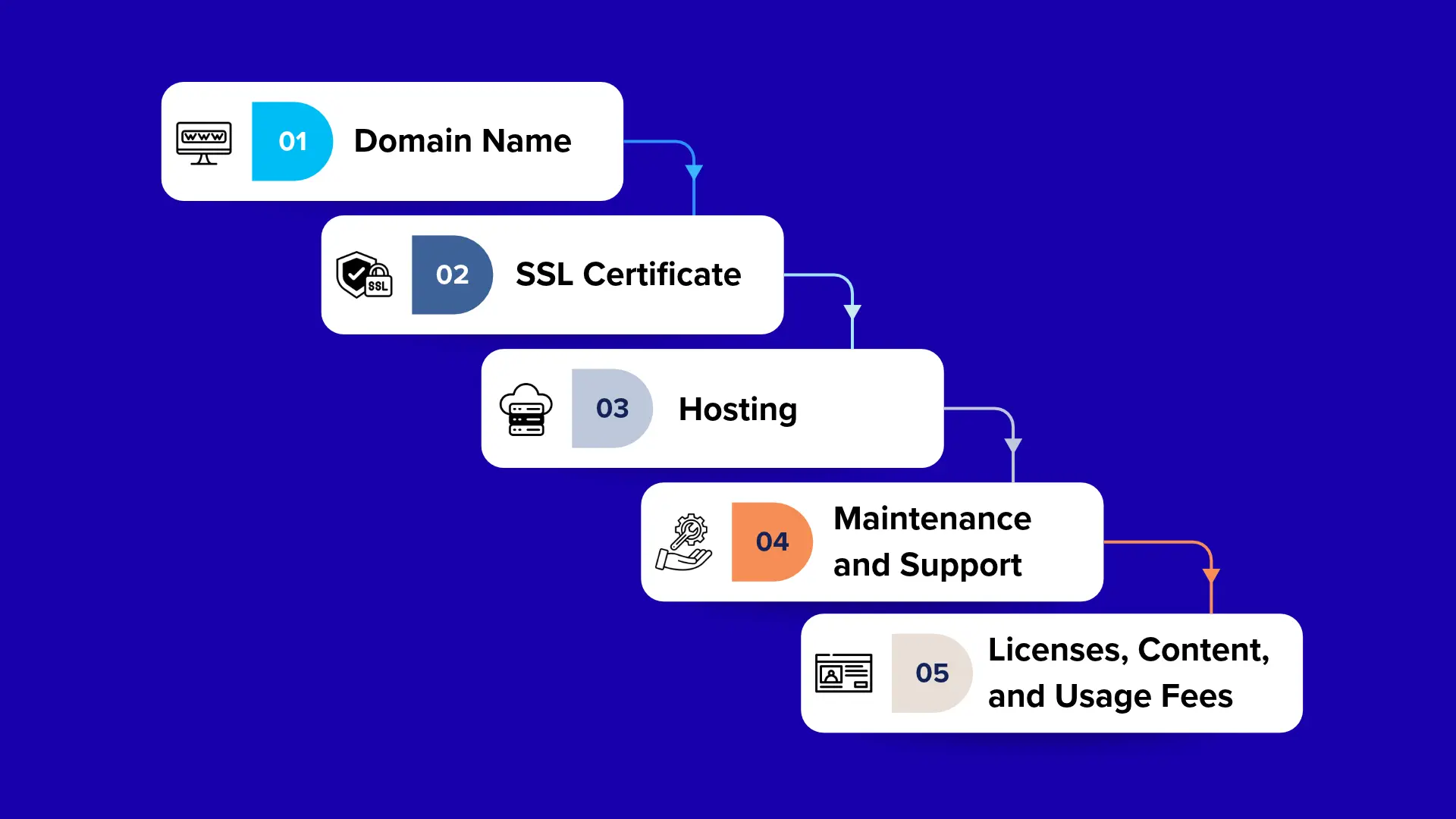
The build is a one-time price. Several costs keep arriving after launch, and a quote that leaves them out has not told you what you will really spend.
Domain Name
Your domain is your address on the web, and you rent it from a registrar each year. A standard domain costs about 10–50 a year. Premium names that someone already owns can cost far more, so check availability before you fall in love with a brand name. Register the domain in your company’s name and keep the login yourself. It should never sit in a vendor’s account.
SSL Certificate
An SSL certificate encrypts the connection between your visitor’s browser and your server, and it is what puts the padlock and “https” in the address bar. Without it, browsers warn visitors that the site is not secure, and most of them leave. Many hosts now include a certificate at no charge. If you need a business-validated or extended certificate, the cost runs up to a few hundred dollars a year.
Hosting
Hosting is the server that keeps your site online. A small managed site can run on about $20 a month. A site with heavy traffic, several environments,s and strict uptime needs can run to several hundred dollars a month on cloud infrastructure. The right choice depends on your traffic, how fast the site must respond under load, and how quickly you need to scale. Ask the agency which plan they assumed and what happens when traffic doubles.
Maintenance and Support
A site that is not maintained breaks. Plugins fall out of date, security patches go unapplied, and integrations stop working when a third party changes its API. Plan for 15–25% of the original build cost every year. That pays for updates, patches, backups, bug fixes, and monitoring. On an $18,000 site, that is 2,700–4,500 a year. At GMTA, every project includes 6 months of free post-launch maintenance and support. See our app maintenance guide for how to budget the first three years.
Licenses, Content and Usage Fees
Premium plugins, themes, fonts, and software tools carry recurring fees, so ask for a list of every paid component and who owns each account. Content writing, photography, and SEO are usually separate from a development quote. Per-use charges such as payment processing, SMS, or AI model usage are billed as you go, so estimate them at your expected volume.
Cost Comparison Based on the Complexity of the Website
Page count tells you very little about the price. What tells you more is what the site has to do. Four tiers cover most projects.
Starter Marketing Site (5,000–12,000)
A starter site has roughly 5 to 10 pages, a custom design, a content management system, contact forms,s and analytics. It exists to explain what you do and collect enquiries. Plan for 4 to 8 weeks, and about 750–3,000 a year to run. This tier suits a professional-services firm, a local business, or an early-stage company that needs credibility online without a complex system behind it.
Business Site With a Custom CMS (12,000–25,000)
This tier has 10 to 30 pages, several unique templates, a blog or resource hub,b and links to your CRM and marketing tools. Your marketing team publishes often and needs to do it without a developer. Plan for 8 to 14 weeks, and 1,800–6,250 a year to run. This is where many growing B2B companies land.
Advanced Site or eCommerce (15,000–50,000)
Here visitors do something more than read: browse a catalog, pay, book, or request a quote. The site connects to payments, shipping, inventory, or an ERP, and your team uses a custom admin panel. Plan for 3 to 5 months, and 2,250–12,500 a year to run. The spread inside this tier comes almost entirely from integrations and custom business rules.
Portal, Platform or SaaS Front End (50,000–150,000+)
At this level, the website is a working application. Users log in, see their own data, take actions, and move through workflows, with different roles seeing different things. Plan for 5 to 9 months or more, and 7,500–37,500 or more a year to run. We cover why this tier is so much more expensive in the next section.
| Tier | Build cost | Timeline | Typical yearly run cost |
| Starter marketing site | 5,000–12,000 | 4–8 weeks | 750–3,000 |
| Business site with custom CMS | 12,000–25,000 | 8–14 weeks | 1,800–6,250 |
| Advanced site or eCommerce | 15,000–50,000 | 3–5 months | 2,250–12,500 |
| Portal, platform or SaaS | 50,000–150,000+ | 5–9+ months | 7,500–37,500+ |
The tiers overlap on purpose. A simple online store can sit in the second tier, and a marketing site with many integrations can sit in the third. Yearly run cost is 15–25% of the build.
Average Cost to Develop a Website by Website Type
The tiers above describe complexity. These sections describe the most common business types and what usually decides their price.
Small Business Website
A small business site needs a clear message, a handful of pages (home, services, about, contact, often a blog), a mobile-friendly design, and a way to capture leads. Expect 5,000–12,000 for a custom-designed site of 5 to 10 pages, and about 5,000–8,000 for a custom 5-page site. Template-based builds cost less but limit design and integrations. Spend the money where customers decide: the page that explains your offer and the form that starts the conversation.
Corporate Website
A corporate site serves several audiences at once: customers, investors, candidates,s and the press. It usually needs more templates, a resource or news hub, multi-language support,rt and editor roles so different teams can publish without breaking each other’s work. Expect 12,000–25,000. The biggest swing factors are the number of unique templates and how many marketing tools it connects to.
eCommerce Website
An online store has more moving parts than any other common website. You need a catalog, search and filters, a cart, checkout, payments, tax and shipping rules, order emails, and an admin panel for your team. Custom builds run 15,000–50,000. Catalog size matters less than you would expect. What drives the price is payment logic, shipping and inventory connections, and how much control your team needs. Template-based stores on a platform such as Shopify cost less, with less control over how the store behaves. See our eCommerce development services for how we scope catalog, payments, and fulfillment together.
Web Portal and SaaS Website
A portal is a website that people use, not just read. Customers log in to view invoices, partners manage orders,s and patients check results. This needs authentication, roles, a database, business rules, and an audit trail, and those are the reasons it costs 50,000–150,000 or more. If your requirements include users can log in, different roles see different things, or it connects to our system, budget for a portal. Our SaaS development team can help you decide whether to build the product itself or start with a lean front end.
Marketplace Website
A marketplace connects buyers and sellers, and it carries the cost of both sides: seller onboarding, listings, search, reviews, payments split between parties, and dispute handling. It sits in the platform tier, and costs often exceed the $150,000 mark when you add payouts and moderation tools. Most marketplace founders do better to launch one side of the market first and add features as transactions begin.
Mobile-Friendly Website
Mobile is not a separate product. A modern website is built responsively from the start, so it adapts to phones, and that work is already inside the figures above. The cost question is different: do you need a mobile app as well? That is a separate project with its own budget, covered in our mobile app development services. Most businesses start with a fast, responsive site and add an app only when repeat use justifies it.
Feature to phase two. Governance matters as well: confirm what visitor data reaches the model provider, how responses are evaluated, and how you would switch providers.
For deeper costs, see AI chatbot development cost, building a RAG chatbot for business, and AI agent development cost. OurAI development service team can estimate AI features alongside the website build.
Cost Comparison Based on Who Builds Your Website
Who does the work changes the price as much as what you build. There are four realistic options.
Website Builder or Template
Builders such as Wix and Squarespace cost roughly $200–$3,000 and get a simple brochure site live fast. Template-based builds by a developer cost about $3,000–$12,000 and give you a more polished result. Both are limited: custom logic, internal-system integrations, user accounts,ts and strict security are hard or impossible. A useful rule: if the website is a brochure, use a builder or template. If it is a revenue channel, a product or a system your team depends on, build it properly.
Hire a Web Development Agency
An agency gives you a full team under one contract: strategy, design, development, testing, and project management. This is the route behind the tier prices in this guide. It costs more per hour than a freelancer, but it lowers delivery risk because no single person is a point of failure, and the agency stands behind the work after launch. For anything that carries revenue or sensitive data, an agency is usually the safer choice.
Build an In-House Team
An in-house team gives you full control and deep knowledge of your business. It also means salaries, benefits, hiring time, tools,s and management, and you carry that cost for months when there is less to build. It makes sense when the website is your core product and work is continuous. For a site you will rebuild every few years, it rarely does.
Hire a Freelancer
A freelancer suits a small, well-defined project, such as a landing page, a theme tweak, or a simple site. Rates vary widely,y and the cost is lowest here. The risks are the ones you would expect: one person covering design, code testing,g and support, limited availability,ity and a project that stalls if they become unavailable. Ask for references and a written scope, and make sure you own the code and hosting accounts from day one.
Website Development Cost by Agency Region
Developer rates depend heavily on location. These are typical hourly ranges for agencies.
| Region | Typical hourly rate |
| Offshore (for example India) | $25–$50 |
| Eastern Europe | $40–$90 |
| US and UK | $100–$200+ |
Website development cost in the USA is driven by those higher rates, which is why the same scope can cost far less from an offshore team. A lower rate does not guarantee a lower total, though. A senior team that scopes carefully and avoids rework can cost less than a cheaper team that rebuilds. Time zone overlap, communication quality, and contract terms count as much as the number on the rate card. See nearshore vs. offshore development, and if you need a dedicated resource instead of a project, you can hire web developers directly.
What a Website Really Costs Over Three Years
Finance teams should approve the lifetime number, not the launch number. A website’s three-year cost is typically about two times its build price, and more when AI usage, compliance work, or heavy integrations are involved.
Here is a worked example, using assumptions you can replace with your own. Take a business site built for $18,000. Maintenance at 15% is $2,700 a year. Hosting, monitoring, and licenses at $250 a month add $3,000 a year. That is $5,700 a year, or $17,100 over 36 months, about $475 a month. The three-year total is $35,100, which is about 1.95 times the build.
Now take an advanced site built for $60,000. Maintenance at 20% is $12,000 a year, and hosting, monitoring, and licenses at $800 a month add $9,600 a year. That is $21,600 a year, or $64,800 over three years. The three-year total is $124,800, about 2.1 times the build. Content, SEO, and marketing spend come on top in both cases.
When you collect quotes, ask each bidder to price maintenance, hosting,g and licenses explicitly. A low build price paired with a high support retainer can cost more than a higher build price with generous warranty terms.
Will the Website Pay for Itself?
Treat the website as a revenue asset with a payback period. The formula is simple:
Payback in months = Build cost ÷ (Monthly added gross profit − Monthly run cost)
Using the $18,000 site above, suppose the new site brings in 4 extra qualified leads a month, you close 15% of them, and each closed deal earns $8,000 in gross profit. That is 4 × 0.15 × $8,000 = $4,800 in added gross profit a month. Subtract the $475 run cost, and the net gain is $4,325 a month. Payback is $18,000 ÷ $4,325, about 4.2 months.
The result depends entirely on the lead assumption. With 2 added leads a month, payback stretches to about 9 months. With 1, it is about 25 months. If you cannot defend your lead number, the investment may be better as a smaller first phase. These inputs are illustrative, not client results.
To model your own case, gather five numbers before you request quotes: current monthly qualified leads and their source, close rate and average gross profit per deal, conversion rate on key pages, the cost of the current site, and the sales or support hours the new site could save. Bring them to a scoping session,n and we can model the case with you.
How to Choose the Right Team to Build Your Website
Most overruns come from the choice of partner and the scope that choice was based on, not from development itself. A few habits protect you.
Ask for evidence, not pitches. Request two projects similar to yours, with contactable references. Ask what the first estimate was, what the final cost was, and why they differed. A team that cannot answer has not tracked its own work.
Judge how they scope. A good agency asks about your goals, users, integrations, and compliance needs before it names a price. One that quotes after a ten-minute call is guessing. Bring these six things to every conversation: your goal (leads, sales, bookings, or self-service), a rough sitemap, the features you need, your integrations, any compliance requirements, and your budget and deadline.
Compare quotes on assumptions. Ask every vendor to price the same written scope and to list what is excluded. Compare maintenance, hosting, change-request rates and warranty terms alongside the build price. A cheaper quote has usually left something out.
Read the contract before you love the design. Make sure it gives you:
- full ownership of the source code, designs and documentation on payment;
- handover of the repository, hosting credentials and documentation, included in the price;
- written, testable acceptance criteria for each milestone;
- a change-control process and rate card, with your approval before extra work starts;
- a warranty period for defects, and response times once support begins;
- an NDA and a data processing agreement where personal data is involved;
- the right to exit with your code and data if delivery fails;
- payments tied to accepted milestones, not to dates.
Have your legal counsel review the final agreement. And be careful with compliance claims. Ask every vendor, including us, to separate certifications they hold from practices they follow. GMTA builds to GDPR, HIPAA, and PCI-DSS principles where required and does not claim formal certifications it does not hold.
Plan the first year. Agree the success measures before development starts: qualified leads, conversion rate on key pages, Core Web Vitals, and run cost against plan. Review the business case at months 6 and 12. If results trail, the fix is usually in content, conversion design, or tracking, not a rebuild.
Regulated work needs early attention. Healthcare and payments projects usually move up a tier because of security, auditability, and integration requirements. See healthcare software development, HIPAA-compliant app development, and fintech app development. Privacy rules differ by market: a site serving the UK or EU raises GDPR questions, and US healthcare data raises HIPAA questions. This guide is not legal advice, so involve your counsel for compliance decisions.
For more on choosing, read how to choose a software development company.
How Long Does It Take to Build a Website?
Time and cost move together, because most of the cost is team hours. A starter site takes 4 to 8 weeks, a business site 8 to 14 weeks, an advanced site or store 3 to 5 months, and a portal or platform 5 to 9 months or more.
Most delays come from the client side, not the code: late content, slow feedback, and changing requirements. Assign these roles before kickoff: an executive sponsor who owns the budget, one product owner who approves work within 48 hours, a content owner, and a technical contact for integrations. Weekly demos of working software and a one-page status (scope done, scope left, budget used, top risks, decisions needed) keep things moving. See agile app development.
7 Ways to Reduce the Cost to Develop a Website Without Cutting Quality
- Launch in phases. Ship the core site first and add advanced features once real users show you what they need. That is the logic behind MVP software development.
- Write your content before design starts. Late copy is one of the most common causes of delay and change requests.
- Reuse components. A design system and component library cut design and front-end time, and make later pages cheaper.
- Pick the simplest architecture that works. A well-structured monolith is cheaper to build and run than microservices for most early-stage products. See monolith vs microservices for startups.
- Limit integrations at launch. Connect only the tools you need on day one.
- Use AI where it saves real money. AI tools can speed up design and front-end work. Back-end engineering, integrations,ns and security still need experienced developers.
- Fix the scope for defined work. Use time-and-materials only for products whose requirements will change.
How GMTA Builds Websites
GMTA has delivered 200+ projects across 40+ industries for clients in 30+ countries. Every website project follows the same sequence. We start with a discovery call within 24 hours of your inquiry, then analyze your goals, users, features, and integrations. You receive a proposal with the scope, timeline, cost estimate, and the assumptions written down, so you can see what is included and what is not. Development runs in sprints, so you see working software early, and every project includes testing, launch, and 6 months of free maintenance and support.
We build with Python, PHP, Node.js, Laravel, Next.js, Vue, React and Django, so the stack follows your requirements, not a house preference. Our web development services cover the full range, and our portfolio includes platforms for healthcare (CodocCall), insurance claims (EasyClaims), and premium mobility (Li-nk).
Frequently Asked Questions
How much does it cost to develop a website in 2026?
A custom business website costs $5,000 to $50,000 in 2026. Simple marketing sites run $5,000–$12,000, custom CMS and eCommerce builds run $15,000–$50,000, and portals, platforms, and AI-enabled sites run $50,000–$150,000 or more. Page count affects the price least.
How much does a small business website cost?
Most small businesses spend $5,000–$12,000 for a custom-designed site of 5 to 10 pages. A custom 5-page site typically costs $5,000–$8,000. Template-based builds cost less but limit customization and integrations.
How much does website maintenance cost?
Plan for 15–25% of the build cost per year. That covers updates, security patches, backups, bug fixes, and monitoring. GMTA includes 6 months of free maintenance after launch.
How much does a website cost per month?
An agency-built site has a one-time build cost plus run costs of about 15–25% of the build cost per year. An $18,000 site costs about $475 a month to run in our example. Builders charge monthly plans instead.
Does the website cost include hosting and a domain?
Usually not. Hosting, domain, and licenses are recurring costs billed separately unless your agency bundles them. Confirm what is included in writing.
How much do AI features add to the cost of a website?
AI features typically add $3,000 to $40,000 or more, depending on the feature. A support chatbot sits at the low end and AI agent workflows at the high end. Expect monthly model usage costs on top.
How much does a web portal cost compared with a website?
Portals and web applications start around $50,000 and can pass $150,000, while most business websites cost $5,000–$50,000. The gap comes from logins, user roles, business logic, security,y and testing, not page count.
How long does it take to build a website?
Simple sites take 4 to 8 weeks, business sites 8 to 14 weeks, advanced builds 3 to 5 months,hs and platforms 5 to 9 months or more. Timelines depend on scope and how quickly you provide content and feedback.
Should I hire a freelancer or an agency?
Freelancers suit small, well-defined projects. Agencies suit projects that need design, development, testing, and project management together. Agencies cost more per hour but reduce delivery risk.
Is a website builder cheaper than custom development?
Yes, for simple sites. Builders cost about $200–$3,000 but limit custom functionality, integrations,s and scale. Custom development costs more upfront and suits growing or complex needs.
How much should a company budget for a website over three years?
Plan for about two times the build price. An $18,000 site costs about $35,100 over three years, and a $60,000 advanced build about $124,800, once maintenance, hosting, and licenses are included. Content, SEO,O and marketing come on top.
How do I compare website quotes fairly?
Ask every vendor to quote the same written scope and list assumptions and exclusions. Compare maintenance, hosting, change-request rates, and warranty terms next to the build price. A cheaper quote often leaves out items a better-scoped quote includes.
Should we pay for a discovery phase first?
For anything beyond a simple brochure site, yes. Discovery produces a sitemap, requirements,s and an estimate basis, which cuts overruns and makes later quotes comparable.
What happens if we end the relationship with the development partner?
Your contract should give you the source code, design documentation, and hosting accounts. With those, another team can take over without a rewrite. Confirm handover terms before you sign, not at exit.
Should the website build include SEO and AI search work?
Yes, the technical foundations. Core Web Vitals, crawlable rendering, structured data, redirects, and analytics are cheaper to build in than to retrofit. Ongoing content and link building are separate, continuing costs.

Rishi Ram is CTO at GMTA Software, with 6+ years of experience in software architecture and technical leadership. He’s led GMTA’s work across fintech—including eWallet apps, mobile banking platforms, and Sharia-compliant fintech builds—as well as on-demand and taxi app development and AI-integrated products like fraud detection agents and workflow automation tools.