



Key Takeaways
- LLM development in 2026 for a US startup can range from $50K to $5M+, depending on whether you are adding a focused AI capability, building a complex enterprise AI product, or developing a customized model and infrastructure.
- Using an existing model API is the most economical starting point for a startup. Building your own foundation model will require a fundamentally different investment in data, compute, training, evaluation, and specialized AI expertise.
- RAG is not the same as fine-tuning. RAG is more appropriate when your product needs reliable access to proprietary or frequently changing information. Fine-tuning makes sense when the model itself has to learn a specific behavior that prompting and retrieval cannot provide.
- Hidden costs arise outside the development quote. Commercial data licensing, AI liability and insurance, intellectual property clearance, and model deprecation can create additional investments that shouldn’t be overlooked during initial budgeting.
Getting the wrong cost for your LLM project in 2026 will turn into an expensive retrofit in 2028 or beyond. Underestimate it, and you may have to cut spending on sales or product development. Overestimate it, and you will put $500K into building an LLM that an API or an open-source model could have delivered for far less. The stakes are much higher now in 2026, as the custom LLM training model market is expected to reach $3.52 billion. With Google, Meta, and OpenAI cutting prices on their models, the economics of building and owning your own model won’t be the same as before.
The budget also changes based on the market you are entering. Building an AI product for a US healthcare customer will bring HIPAA obligations and BAA requirements. Selling to large enterprises can make SOC 2 evidence, auditability, security controls, and vendor reviews a part of the development process. NIST’s AI Risk Management Framework will also become a crucial reference point for managing risks.
This means that your budget should answer more than just stating the LLM development cost in numbers. You need to know the capital required before launch, the compliance and enterprise-readiness level to be followed, operating costs at scale, and if owning a proprietary model will be financially sensible as commercial model prices fall. That’s why this guide will break down those costs so that you can build an LLM around your US market, funding stage, customer requirements, and expected growth plans.
LLMs are also the reasoning layer behind AI agents. If you’re planning one, our AI agent development guide explains what building an agent involves beyond the model itself.
How Much Does LLM Development Actually Cost in 2026?
In 2026, custom LLM development costs sit within the bracket of $50K to $5M+. The primary reason why this cost spectrum is so broad is that when we talk about building an AI model, it will differ across different businesses. For example, you can choose to build the product on top of an existing model sourced from Meta or Claude.
Similarly, you could customize an open-source model for your business operations or train and operate a proprietary model. Each choice will have a direct influence on upfront capital, development time, and long-term operating costs. The level of accuracy you expect the LLM to deliver is also a factor not to be overlooked. A general AI chatbot will have completely different requirements from a model that will make decisions in strictly regulated industries like healthcare or finance.
Let’s say a US B2B SaaS company wants an AI sales assistant for analyzing CRM records, summarizing customer calls, and drafting follow-up emails. If it uses an existing model, it just has to invest $50K-$150K in buying the underlying architecture and implementing core business logic on top. But when a US insurance company plans to build a more specialized LLM for its underwriting assistant, the cost will reach $150K-$500K+. That’s because it needs a model that can work with policy documents, claims information, and internal underwriting rules. The engineering and testing efforts, along with the infrastructure, will be much more complex and expensive.
The moment you enter larger customization or proprietary-model territory, the numbers will quickly add up to $500K-$1.5M+. In addition, training the foundation model from scratch can even push the costs into the multi-million-dollar range. Thus, for your startup business, the real financial decision will be to know whether model ownership can give you enough differentiation, control, or long-term cost savings to justify the investment or not.
LLM Development Cost by Solution Type
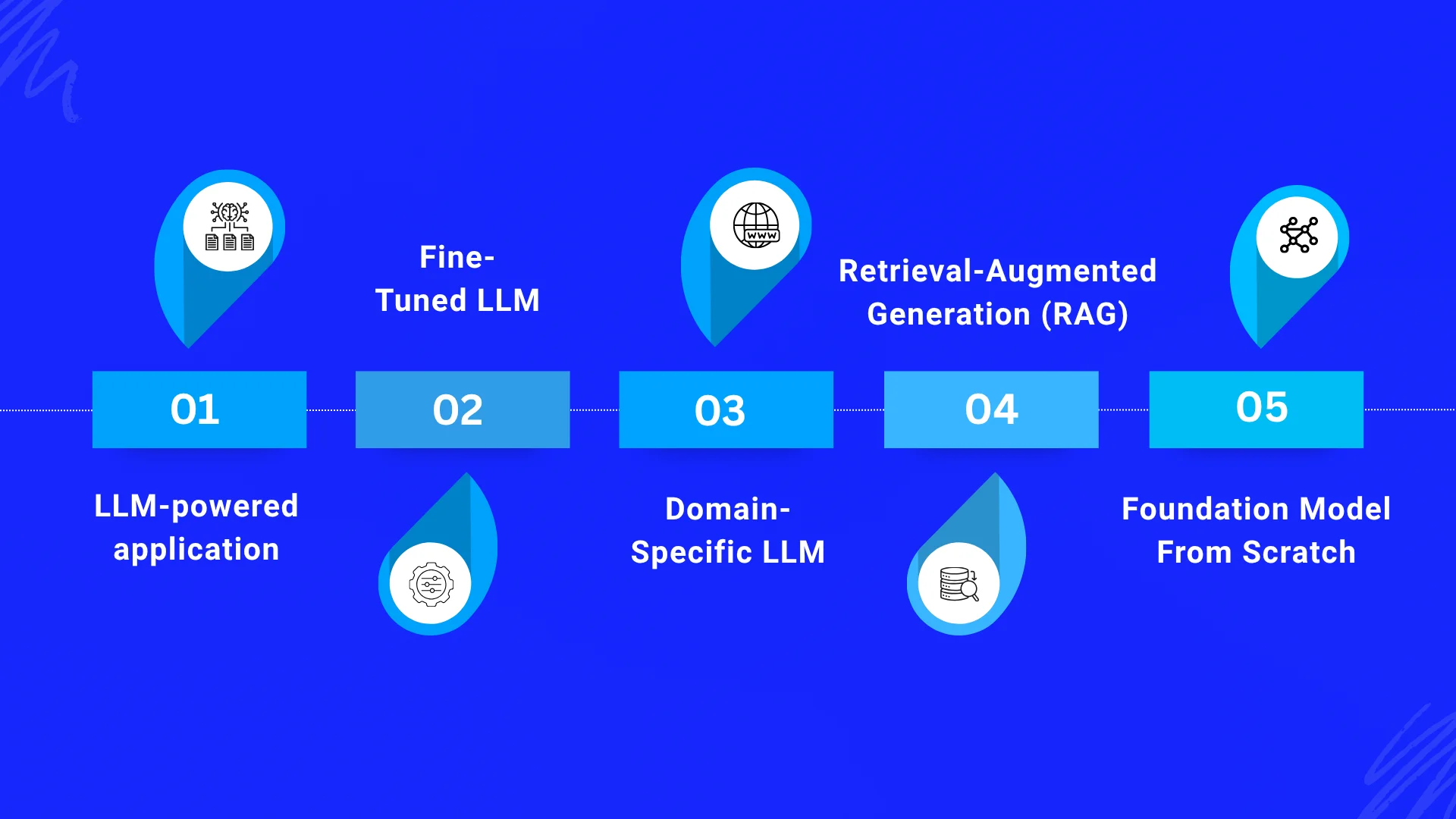
LLM-powered application
The cost to build an LLM for a startup roughly amounts to $50K-$150K because here, you will be buying the model capability rather than building it from scratch. Whether it’s OpenAI, Google, or Anthropic, you basically use an API from an LLM provider and build your core product around it. Hence, the budget you estimate goes towards:
- Building the application
- Designing and implementing the core business workflows
- Establishing the data connections
- Integrating and synchronizing user accounts
- Running different testing forms
- Investing in security and compliance guardrails specific to the application
- Organizing the production deployment
Let’s assume you want to build an AI sales assistant that can read CRM information, summarize calls, prepare account briefs, and draft follow-up emails. There is no need to train the foundation model. Rather, the commercial LLM you will buy is capable of handling the language generation and reasoning you need to power the assistant bot. Owing to this, the initial investment is relatively lower. This is the approach we typically recommend for most AI development and generative AI development projects at the MVP stage.
The economics change right after launch. API pricing is dependent on usage. So, the cost of serving customers will grow with the number and length of each request. That’s why operating a long-context application becomes more expensive as it sends large amounts of information to the model.
Fine-Tuned LLM
In this LLM development approach, you will take an existing model and teach it to perform a specific business task with the highest consistency possible. That’s why the cost increases to the bracket of $75K-$250K. The primary difference is the fact that you won’t be relying entirely on prompting. Instead, you will need a training dataset that can accurately represent the behavior you want from the model.
Suppose a US customer support company needs AI to follow company policies, use approved terminology, classify customer issues correctly, and produce responses in a standardized format. Given its vast repository of 200K historical conversations, the company will have to select, clean, structure, and turn them into useful training examples.
Now the real expense comes into the picture. They will have to compare the customized model with the original one. If the outcomes reveal that the improvement is great for billing questions but not for technical issues, another training cycle will follow. That’s why a $75K project can move to $250K or more within a couple of weeks.
Domain-Specific LLM
Whether it’s for healthcare, insurance, or fintech, building a proprietary LLM for a specific industry domain becomes expensive, costing between $150K-$750K+. That’s because it has to perform within a particular industry’s data and business processes. However, simply adding industry documents to a general-purpose model won’t make it a domain-specific LLM.
When you build an AI underwriting product, it needs to work with policy language, claim records, underwriting guidelines, and state-specific rules. The real value will come from helping an underwriter reach the decisive phase faster, not just simply answering any policy- or insurance-related question. This is what changes the entire field of development economics. You need representative insurance cases. SMEs will have to determine what constitutes an accurate and credible model output.
After all, the AI system must be capable of distinguishing a valid underwriting rule and an unsupported conclusion without needing manual intervention. We cover this in more depth in our guide to FinTech Development—including how underwriting-grade accuracy requirements change the build timeline. In addition, dealing with customer data means you will have to invest in appropriate access controls and privacy guardrails. Enterprise sales create another cost consideration.
A larger insurer can ask for SOC 2, audit logs, data retention policies, model governance, and vendor risk before signing a contract. Similarly, when you build the LLM for healthcare, HIPAA compliance has to be built into the model’s architecture from day one. All these will automatically increase the engineering complexity, thereby increasing the upfront capital.
Retrieval-Augmented Generation (RAG)
Depending on the amount and complexity of business data the LLM has to work with, the build costs of an RAG model range between $30K and $150K+. Here, you are not training it on your company’s core information repositories. Instead, the RAG will retrieve relevant information from your business documents or databases and feed the LLM with the same once a user asks something.
This is what makes the RAG approach more useful for a business dealing with a frequently changing information base. Let’s consider you run a fintech startup in the US with thousands of product documents, compliance policies, customer records, and internal procedures. If a certain policy changes next month, you just have to update the underlying knowledge source rather than retraining the LLM. See how we scope multi-tenant RAG architecture for regulated fintech products in our FinTech Development service.
However, the trade-off is building a multi-tenant access control system for your RAG-based LLM. Customer A should never retrieve information that belongs to Customer B. So, there should be stringent data privacy and compliance rules in place before you launch the LLM to production.
Foundation Model From Scratch
When you create the underlying model and assume responsibility for the entire training process, the costs will be the highest, falling within the bracket of $2M-$5M+. Here, you will be investing in:
- Large-scale training data
- Data processing
- GPU capacity
- Distributed training logic
- Machine-learning R&D
- Infrastructure
- Repeated training runs
The commercial risk is also high compared to the solutions we discussed above. You could end up spending millions in training a model only to find that a competitor’s newly released LLM performs better at a lower API cost. That’s why if you take up this approach, make sure to have a strong strategic moat from day one. You will need something that makes the model ownership valuable, like proprietary training data, a specialized capability that existing models cannot provide, exceptionally high inference volume, or a business where control over the model is a product in itself.
Recommended: Top machine learning frameworks
LLM Development Cost by Business Size
Pre-Seed and Early-Stage Startups: $50K–$100K
At this stage, the goal is validation, not model ownership. You will need enough AI capability to put a working product in front of your customers without spending a significant part of your budget on infrastructure. Let’s say you are building an AI research assistant. You could use an existing model with RAG over your business’s proprietary documents. The initial budget of $50K-$100K will be sufficient to cover:
- Product interface
- Model integration
- Document ingestion
- Retrieval of information
- User authentication
- Usage controls
Here, the important financial metric to consider is the cost per customer served, not the model’s size. If ten pilot customers use your product, spending $500K on a proprietary custom model will be difficult to justify. That’s because you will need evidence that customers are willing to pay before you take up that level of capital expense.
Seed-Stage Startups: $100K–$250K
At the seed stage, you already have a clearer product and customer feedback in hand. Hence, the question directly changes from whether you can build the LLM to whether you can make it reliable enough to sell the product after launch.
The LLM you build will need customer-specific knowledge, better retrieval logic, structured outputs, tool calling, CRM or ERP integrations, and a stronger evaluation framework. In addition, you will have to compare multiple models at once because the cheapest option is not always the one that guarantees accuracy and human review in its offerings.
For example, you can begin with an insurance LLM that summarizes policy details at first. However, after a few rounds of beta testing, your model may need to extract coverage terms, flag missing information, and generate an underwriter-ready summary. So, the investment will be justified when the AI product directly improves a measurable business metric, like claims processing time, customer retention, or cost per transaction.
Series A Startups: $250K–$750K+
The AI product is expected to operate at a meaningful customer volume, which further makes reliability and unit economics so crucial. Suppose your AI SaaS product has grown from 50 customers to 2K. The original API-based architecture will now generate a substantial monthly inference bill. Large document retrieval, longer prompts, repeated model calls, and expensive reasoning will automatically increase the cost of serving each account.
Now, this is where you may have to consider approaches like the following:
- Model routing
- Caching
- Open-weight models
- Selective fine-tuning
- Self-hosting infrastructure
In addition to this, you can also choose to invest in a stronger RAG architecture so that every request does not send an unnecessary volume of customer data to the LLM.
Series B+ and Well-Funded AI Startups: $750K–$2M+
At this stage, your startup can justify a deeper investment as AI becomes central to your brand’s competitive position across the US market. You can choose different approaches here for the LLM, like:
- Developing proprietary models
- Fine-tuning open-weight models extensively
- Building dedicated inference infrastructure
- Maintaining multiple models for different workloads
The objective here is to make performance better, reduce cost at scale, and gain more control over technology. For example, an AI document processing app can handle millions of documents, only for you to find that using a premium external model for every document is ruining your gross margins. If it’s only routine extraction, a smaller specialized LLM will be enough. A more capable commercial model makes sense when you have to handle complicated business use cases.
AI-Native Startups Building Their Own Model: $1M–$5M+
Being an AI-native startup in the US, you would need an upfront capital investment of $1M-$5M+ to develop a specialized foundation model. The major areas that will consume most of your budget include training, proprietary dataset preparation, GPU computation, ML research, and inference infrastructure. Here, you won’t be simply buying the AI capability from an external provider.
Instead, you will be starting from scratch, gathering and owning a dataset unique to your business and not accessible to anyone else. So, you will have to invest in a model optimized for a narrow but valuable workload responsible for generating revenue for your US startup.
Not sure which stage-appropriate budget fits your product?
We’ll scope your specific use case—model choice, data complexity, and compliance needs—and give you a real cost range in 48 hours, not a generic estimate.
Should You Build Custom or Just Use the OpenAI/Claude API?
If you are building the AI product for your startup, the OpenAI or Claude API will be more practical because you just need an upfront investment of $50K-$150K. But if your product’s value depends on owning the underlying LLM, spending $500K-$2M on a custom model will make sense. Hence, the decision should be based on what exactly you need the model to do, how much data it must handle, expected customer usage, and whether model ownership can improve your margins or create a disadvantage.
Let’s say your startup is building a B2B SaaS product and wants to add an AI assistant for customer support, document analysis, reporting, or workflow automation. For this, an API will be more than sufficient. You can use the model’s existing language and reasoning capabilities and spend the development budget on the parts unique to your business.
However, the calculation changes when you are building an AI-first product where model performance directly determines if customers will buy or not. Suppose your product automatically reviews insurance claims. If an off-the-shelf model misses too many important details, every error made will create manual work for your customers. Only when the testing outcomes reveal that the customized model can reduce these errors substantially can you justify the additional investment required.
The expected AI usage will also matter a lot. Let’s say your product has 100 customers. For this user volume, the API charges will remain manageable. The moment you expect millions of AI requests every month, model usage has to be considered. By doing so, you can easily compare the projected API expenditure against the cost of developing and operating a model you control.
| Decision factor | OpenAI / Claude API | Custom LLM |
| Development cost | ~$50K–$150K for a typical startup AI product using an existing model. | ~$500K–$2M+ for substantial proprietary model development; foundation models can cost considerably more. |
| Ongoing AI cost | Pay per usage. Your monthly cost rises with tokens, requests, context length, and model tier. | You absorb GPU/infrastructure, hosting, monitoring, maintenance, and ML engineering costs. |
| Time to revenue | Faster. Existing models let you launch and validate customer demand without model training. | Slower. Capital is committed before you can establish whether the custom model improves the business. |
| Model performance | Immediate access to highly capable general-purpose models and new model releases. | Performance depends on your training data, architecture, compute budget, and ability to improve the model. |
| Product differentiation | Differentiation comes mainly from your application, proprietary data, workflows, and integrations. | The model itself can become part of your proprietary technology and competitive moat. |
| Financial risk | Lower upfront risk but potentially higher variable COGS as AI usage scales. | Higher upfront risk but potentially better economics if you have very high, predictable usage. |
| Control & dependency | Provider controls pricing, model updates, availability, and model roadmap. | Greater control, but your company becomes responsible for model development and ongoing operations. |
| Best choice when | You need to validate the product, launch quickly, or AI is a feature within a larger SaaS product. | The model directly drives revenue, creates a defensible advantage, or existing models cannot meet a commercially important requirement. |
Adding LLM Features to an Existing Product vs. Building New
The cost to add AI to an existing app is roughly between $50K and $150K+, while building the LLM newly from scratch needs higher capital, approximating $100K-$500K+. The difference ultimately comes down to how much of the product you already have ready-made in hand and what parts you have to develop.
When we talk about an existing product, it already has users, authentication, databases, APIs, billing, business rules, and established workflows. So, you just need to add the LLM to its operating system. But an entirely new product means you will have to design all these first while ensuring the AI product can be useful for your early adopters.
Suppose your company already sells inventory management software to US manufacturers. You now want to add an AI purchasing assistant that can answer which SKUs are likely to fall below the threshold in the next 30 days or which suppliers the team should connect to replenish the stocks. Your existing database already contains key information pieces, like inventory levels, purchase orders, supplier records, lead times, and sales history. Thus, the development work will only involve:
- Connecting the LLM to those systems
- Translating the question into the right business queries
- Enforcing customer-level permissions
- Handling incomplete data
- Validating that the answer matches the underlying records
This keeps the implementation around $50K-$75K. If the feature needs several AI workflows, complex ERP integrations, audit logs, approval processes, and enterprise-grade RBAC, the cost can climb to $100K-$150K+.
Building a new LLM for an AI procurement platform is completely different. You would need the customer application, onboarding, account management, billing, supplier and ERP integrations, data ingestion, permissions, reporting, admin controls, and AI workflows. In addition, you will also have to determine which procurement problems customers will be ready to pay you to solve. That’s why a new LLM-powered product can start around $100K-$200K for an MVP and move towards $300K-$500K+ for a production-ready platform.
| Business consideration | Adding LLM features to an existing product | Building a new LLM-powered product |
| Typical investment | $50K–$150K+ | $100K–$500K+ |
| What you are actually building | A new AI capability inside an established product | The complete product, with AI as a core component |
| Existing assets | Reuses your customer accounts, database, authentication, APIs, billing, and business workflows | Most product infrastructure must be created from the ground up. |
| Where development effort goes | LLM integration, access to existing business data, workflow logic, permissions, response validation, and AI-specific UX | Product architecture, customer-facing application, data infrastructure, integrations, AI workflows, billing, security, and administration |
| Revenue validation | Existing customers provide a ready audience for testing and measuring upgrades, retention, or usage. | You must validate both the AI proposition and willingness to pay |
| Typical financial risk | Lower because the AI investment extends an existing revenue-generating product. | Higher because product-market fit and AI usefulness are both unproven. |
| When it makes sense | When AI can improve an existing workflow or create an additional revenue feature | When the AI capability represents a genuinely new product or business model |
| Example | Adding an AI purchasing assistant to existing inventory software using current inventory, supplier, and sales data | Building a new AI procurement platform that must create its own users, workflows, integrations, and data infrastructure |
What Actually Drives Your Cost Up (and Down)?
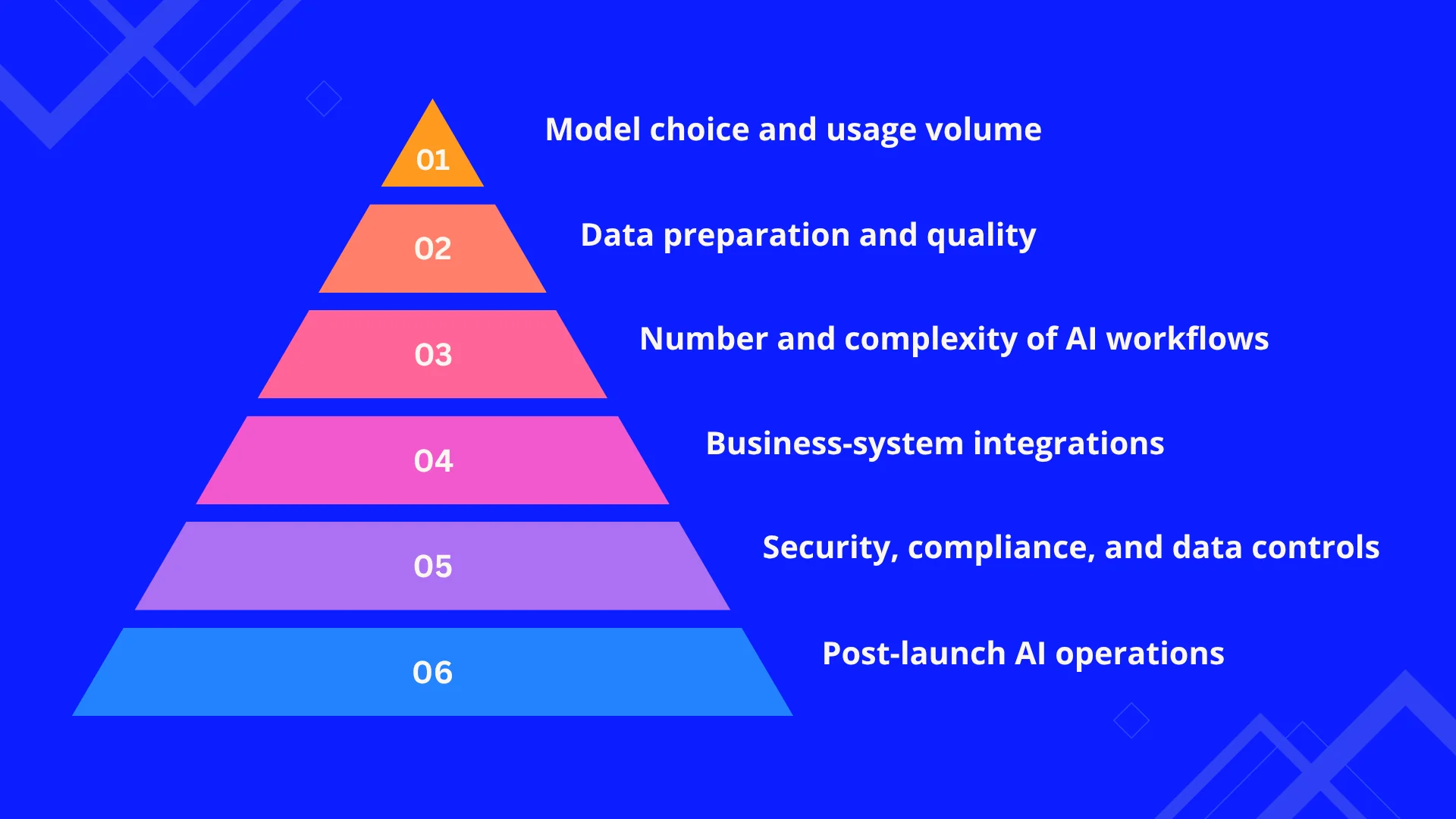
Model choice and usage volume
The model affects two separate budgets, namely the original development cost and the cost of goods sold after launch. Using OpenAI or Claude means you can avoid training a foundation model. But you still have to pay for inference based on factors like input tokens, output tokens, context size, model tier, and request volume.
Hence, for your business case, calculate the AI cost per customer per month, not just the API price. If each customer generates 10K AI requests monthly, a $0.01 difference in average cost per request becomes $100 per customer every month. At 5K customer volume, this will introduce an annualized cost difference of $5K.
Apart from this, long prompts and repeated retrieval will also matter. Sending an entire document or customer history with every request can inflate token consumption unnecessarily. Therefore, the LLM’s architecture will automatically affect the final bill.
Data preparation and quality
Data becomes expensive when the LLM depends on proprietary business information rather than knowledge the model already has. So, look at your actual data estate, like PDFs, emails, CRM records, database tables, spreadsheets, scanned documents, and historical records. Each source will have different extraction and normalization requirements. The main issue that you may encounter is data usability, not simply the volume.
Ten million clean database records will be easier to work with when compared to 50K poorly structured documents. That’s why the budget will increase when you need document OCR, metadata extraction, deduplication, data classification, freshness controls, tenant-level separation, or permission-aware retrieval. If your customers expect answers based on the latest information, you will need a mechanism to update it without having to rebuild the entire system.
Number and complexity of AI workflows
A single AI feature will remain relatively inexpensive. Costs rise when you build an LLM that is responsible for multiple business decisions or sequential operations. So, you should count workflows and not the screens. An application might have one AI interface but require separate workflows for document extraction, classification, summarization, recommendation, search, reporting, and automated actions.
Each workflow will need its own success criteria and failure handling mechanism. Complexity increases further when one LLM output becomes the input for another operation or when the model has access to business tools. From a budgeting perspective, stating that you want to build an AI assistant won’t be a proper scope definition. You should specify the number of AI tasks, what data each task would use, what systems it can access, and if its output is actionable or advisory.
Business-system integrations
Integrations account for a substantial portion of the LLM development cost in 2026. Connecting the model to one clean REST API is straightforward and inexpensive. But connecting it to Salesforce, SAP, Oracle, Microsoft Dynamics, proprietary datasets, or legacy enterprise software will require more work. The main business distinction comes in the form of read versus write access.
When the LLM has to read customer information, you need to invest in controlled retrieval logic. Allowing the model to update a CRM, issue a refund, create an order, or trigger a workflow will introduce authorization, approval, transaction validation, rollback, and audit requirements. Besides, your customers can also ask for SSO, SCIM, RBAC, audit logs, data residency, and security documentation before purchasing your product.
Security, compliance, and data controls
For your US startup, compliance will change the LLM’s architecture and, therefore, the development cost. If your product handles PHI, HIPAA requirements will become relevant. Payment environments can bring PCI DSS considerations. Enterprise customers usually ask about SOC 2, encryption, access controls, auditability, incident response, and vendor security practices.
Depending on your customers and data flows, state privacy laws like the California Consumer Privacy Act (CCPA/CPRA) may also end up affecting data handling logic. So, you must budget for this factor early rather than keeping it for future retrofits.
Post-launch AI operations
Your initial development quote is only part of the economics. After launch, you have recurring costs for model inference, monitoring, evaluation, infrastructure, security maintenance, data updates, and engineering support. You also need to account for model provider changes. If your app depends heavily on a particular model, a pricing change, deprecation, context-window change, or behavior change can affect your product economics.
The key here is to keep one-time development costs separate from recurring AI operating costs. Track the expense per customer, cost per successful task, gross margin after AI expenditure, and monthly AI spend. This will give you a much clearer picture of whether the product remains profitable as usage grows or not.
LLM Development Cost for Regulated Industries: Healthcare & Fintech
Healthcare
The LLM development cost for healthcare ranges between $100K and $300K+, compared to the $50K-$150K capital required for a general-purpose LLM application. If your product only generates summaries from information already available in a user manual, the scope will be contained, and so will be the expense. But once the LLM handles PHI, connects to EHRs, retrieves patient-specific records, or supports clinical decisions, the architecture becomes more demanding.
That’s why below we have explained how each of these factors can influence the initial development cost of a healthcare-specific LLM.
- PHI handling alone will add $15K-$40K+ to the project. It comes from implementing appropriate access controls, encryption, audit logging, retention rules, secure data flows, and vendor arrangements when ePHI will pass through the AI system. If an AI or cloud provider processes the PHI on your behalf, you would also need to consider BAA costs.
- EHR integration can add $20K-$60K+, depending on the systems involved. Connecting through FHIR or other healthcare APIs requires patient and provider identity mapping, permission controls, data synchronization, and handling of incomplete or inconsistent records.
- Clinical use of the LLM can push the project towards the $200K-$300K+ bracket because accuracy requirements become stricter. An AI supporting diagnostics or treatment-related workflows will need more testing, defined failure conditions, human oversight, and evidence that the system performs reliably. All these will automatically inflate the costs. This is exactly the scoping work we do upfront in every healthcare software development engagement—before any code is written.
Fintech
The LLM development cost for fintech startups in the US falls within $80K-$250K+, depending on how deeply AI is connected to financial data and regulated workflows. A fintech knowledge assistant and an AI system supporting transaction monitoring do not carry the same development budget. Rather, the expenses rise when the LLM needs to access customer financial information, connect to banking infrastructure, assist with KYC/AML processes, or influence actions involving money. Unlike healthcare, where PHI and clinical risk drive the costs, fintech costs are more influenced by transaction integrity, financial data controls, auditability, and the risks of an incorrect action.
Below, we have prepared a rough breakdown of how the costs vary in this regulated industry.
- Financial data access alone can put an LLM development project within the bracket of $80K-$120K. At this level, the model needs to analyze customer documents, explain account information, and even assist employees. Thus, the development effort focuses on restricting it to authorized financial data, separating customer accounts, and preventing sensitive information from appearing in the wrong context.
- KYC, AML, and transaction analysis features can push the costs toward $120K-$175K. Here, the AI model often needs to work with identity records, transaction histories, sanctions screening results, alerts, and investigation cases. Thus, it needs to keep the underlying records available to analysts so an AI-generated summary or risk explanation can be verified.
- Fraud, lending, and payment-related AI can reach $175K-$250K+. The costs inflate when the AI’s output influences a financial decision or triggers an operational action. Your application will then need clear authorization boundaries, human approvals, transaction validation, and an audit trail.
- Compliance can move the project towards $250K+. Depending on your product, you will have to build appropriate regulatory guardrails for BSA/AML, FinCEN obligations, GLBA safeguards, PCI DSS, SOC 2, and state privacy requirements.
Building AI for healthcare or fintech?
Compliance requirements (HIPAA, SOC 2, BSA/AML) change your architecture, not just your budget. Talk to a team that’s built PHI-compliant and financial-grade LLM products from day one.
Hidden Costs Nobody Quotes You Upfront
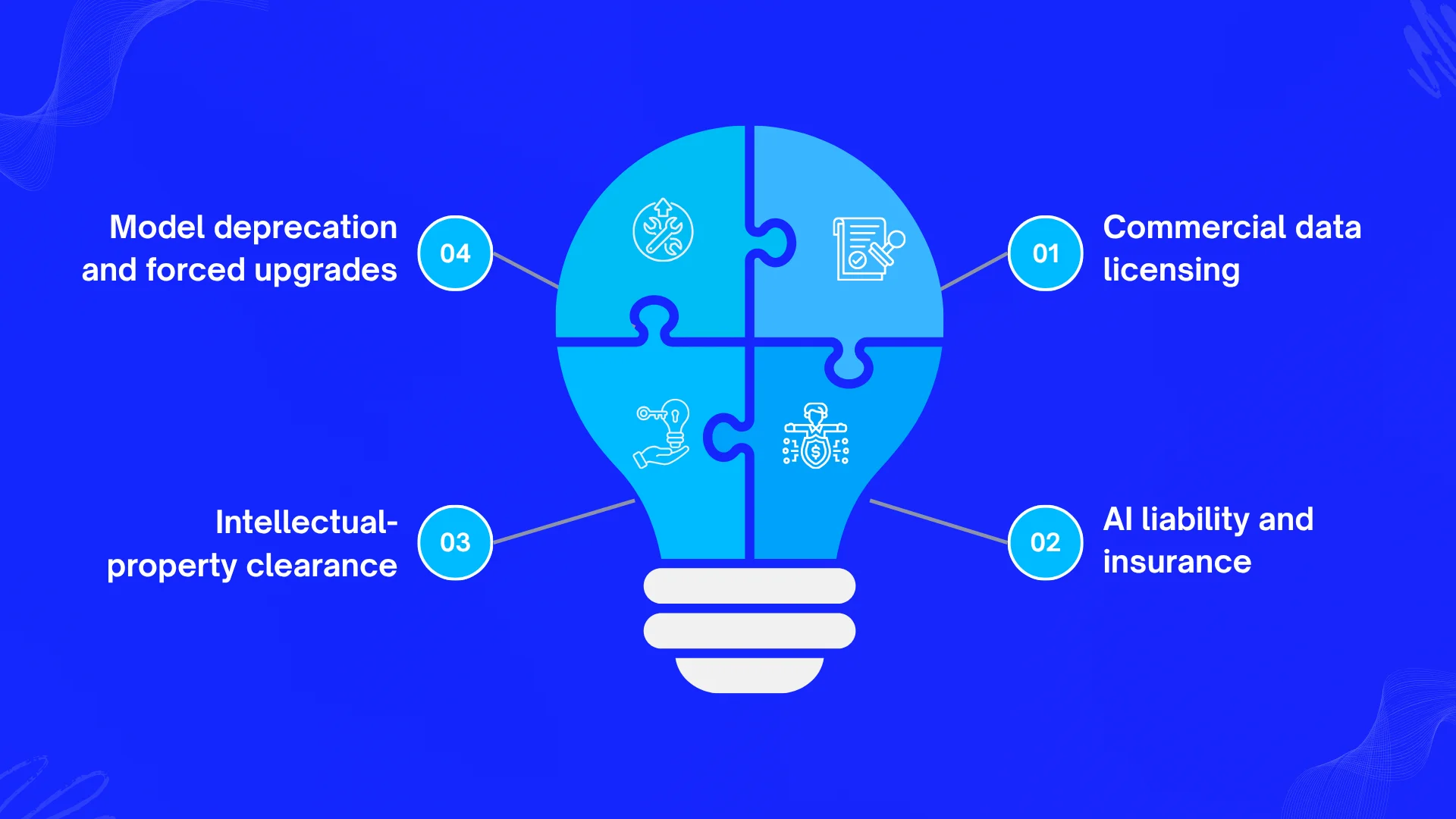
Commercial data licensing
This is the fee your startup pays for the legal right to utilize third-party data inside a commercial AI product. This is much different from buying or accessing the data itself. That’s because a publicly exposed dataset that can be accessed via different APIs might have security guardrails put in place for model training, fine-tuning, or commercial use.
So, if your LLM is supposed to consume such information, data licensing alone can add $5K-$50K+ to your project. In case it’s specialized financial, healthcare, legal, or proprietary datasets, the costs will be significantly higher. Thus, you should budget for this factor depending on what dataset your LLM has to access, the number of users, geographic coverage, and permitted AI use.
AI liability and insurance
If the LLM you have built produces an incorrect, harmful, or commercially consequential recommendation or output, your company will have to deal with AI liability. It becomes more important when your product shifts from being a low-risk content generator to a high-end model influencing operational, financial, healthcare, or legal decisions.
So, as part of the initial development cost estimate, you shouldn’t overlook the additional legal and insurance-related expenses you may have to pay later. A good margin is $5K-$25K+, covering multiple aspects, like reviewing liability provisions, increasing cyber or professional liability coverage, negotiating indemnification with customers, or redefining who bears the responsibility.
Intellectual-property clearance
IP clearance is the process of determining whether the data, content, models, and AI-generated outputs used by your product can create intellectual-property problems after a successful rollout. This matters for every US startup building an LLM because the model may have to answer multiple ownership questions, like the following:
- Where has the training data been sourced?
- Do you have permission to process customer content?
- What do your model provider’s terms permit?
- What rights can you give your customers over generated outputs?
It’s better to budget $5K-$25K+ for specialist IP review so that you won’t have to deal with any issues once you launch the LLM for public use.
Model deprecation and forced upgrades
Model deprecation is the cost created when your AI provider retires or materially changes the model your product depends on. A forced migration at that time will easily need an upfront capital of $10K-$40K+, depending on how deeply the LLM is embedded in the product. Once the migration is successful, you will have to retest important workflows, compare old and new outputs, update prompts, repeat customer-facing validation, and resolve behavioral changes.
Red Flags: How to Vet an LLM Development Vendor Before You Sign
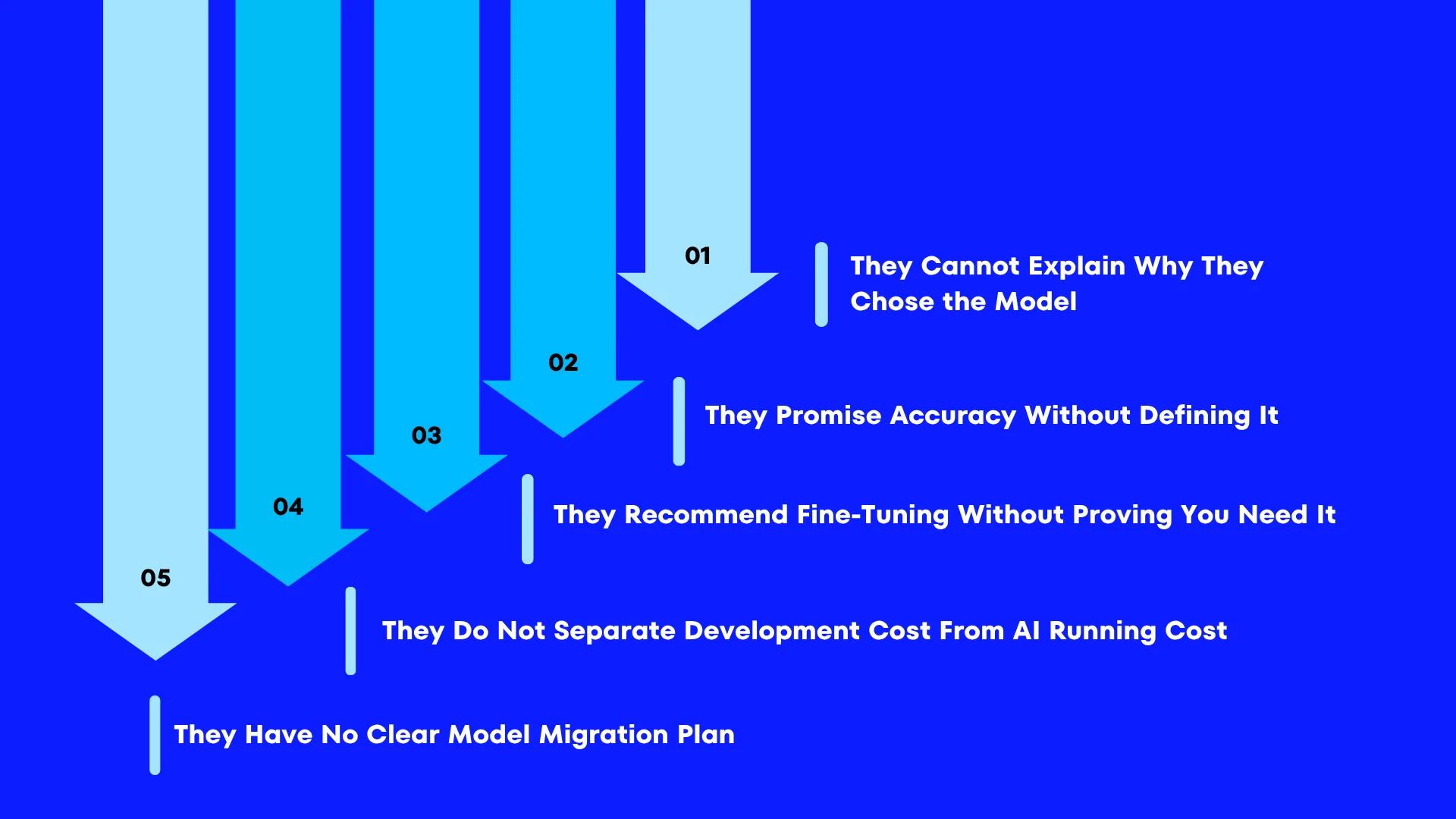
They Cannot Explain Why They Chose the Model
A good LLM vendor should be able to explain clearly why a specific model fits your business use case perfectly. The recommendation must cover accuracy expectations, response speed, data sensitivity, context requirements, and expected usage cost. If the team simply recommends the newest or most expensive model without comparing alternatives, you may end up accepting unnecessary AI costs from the very beginning.
They Promise Accuracy Without Defining It
Never accept an accuracy percentage without asking what exactly it measures. For example, if someone says they can build an LLM with 95% accuracy, it could refer to completely different things. So, what you should do is ask the vendor for the test dataset, evaluation method, and minimum acceptable performance. Make sure to establish these criteria before development, so you know what “working” means.
They Recommend Fine-Tuning Without Proving You Need It
Fine-tuning should only be recommended when it solves a clearly identified performance problem. A capable vendor should first determine whether prompting, RAG, structured outputs, or workflow design can help you achieve your business goals. Ask what improvements fine-tuning is expected to deliver and how you can measure those. If not, you may end up paying for unnecessary customization.
They do not separate development cost from AI running costs.
Your LLM development budget and your ongoing AI operating costs are two completely different numbers. So, you must ask the vendor what you should expect to spend at 1K, 10K, and 100K monthly AI interactions. This estimate will help you understand if the budget is enough to cover model usage, hosting, retrieval infrastructure, and other recurring costs.
They have no clear model migration plan.
Ask what happens if the LLM provider retires the model, changes its pricing plans, or introduces a replacement that performs differently. A vendor should explain whether your application can move to another model and who will be paying for migration and revalidation. Without having this clarity, your startup will become completely dependent on only one vendor.
Scope Your LLM Build — No Sales Pitch
No sales pitch — just a scoped cost range for your project based on what you’re actually trying to build.
How GMTA Helps You Build This Without Overpaying?
At GMTA Software, we always take a business-led approach to LLM development, and that’s what sets us apart. We make sure the architecture, model selection, and development scope remain tied directly to the product our clients plan to launch. Thus, they don’t have to pay for model capabilities, AI infrastructure, or engineering complexity that doesn’t contribute to the actual customer experience or business outcome.
Our approach begins by identifying the AI capability the product requires and then selecting the appropriate implementation strategy. For example, a knowledge-intensive product may need RAG and a well-designed retrieval layer. A product requiring consistent domain-specific outputs may justify fine-tuning. A workflow that needs the AI to interact with CRM, payment, ERP, or internal systems might need tool calling or agentic orchestration. We make these decisions based on the use case rather than treating every LLM project as an advanced AI build.
In addition, we also consider the long-term economics of the product and not just the initial development cost. Our AI experts evaluate model capability against expected usage, latency, context requirements, and inference economics. Besides, our development approach accounts for RAG quality, evaluation requirements, model changes, proprietary data handling, integrations, and production readiness before we finalize the architecture.
By doing so, we reduce expensive redevelopment and give our clients a clearer picture of both the initial investment and the operating cost of running the AI product. The result is an LLM application built around business value, measurable AI requirements, and sustainable unit economics.
FAQs
How much does it cost to add AI to my app?
Adding AI to an existing app will cost $50K to $500K+, depending on how deeply the technology is integrated within your product. A basic LLM feature using an API will be much less expensive compared to building RAG, complex workflows, enterprise integrations, or advanced automation. A large-scale AI product with extensive customization, multiple AI workflows, or substantial infrastructure can even reach the bracket of $1M-$5M+.
Is it cheaper to use the ChatGPT API or build my own AI?
Using the ChatGPT API is far cheaper than building your own foundation model, especially for a US startup. An API-based product falls within the cost range of $50K-$500K+. That’s because you will have the model ready with reasoning and language generation capabilities. But when you plan to build a proprietary foundation model, you will have to account for training data, GPU infrastructure, model training, evaluation, and specialized AI engineering. All these automatically inflate the costs to $1M-$5M+.
How much does fine-tuning an AI model cost?
Fine-tuning typically falls within $50K-$250K+ once you treat it as a part of the LLM development initiative. The actual model training expense may be much smaller, but preparing high-quality domain data, creating evaluation datasets, running multiple training experiments, validating performance, and integrating the resulting model into the app will increase the overall investment. That’s why you should choose fine-tuning only if prompting and RAG cannot deliver the required LLM behavior.
How much does AI maintenance cost per month?
LLM maintenance can range from $5K to $50K+ per month for a production-ready application. If you have a small-scale product, you just need to pay for model updates, monitoring, prompt adjustments, and infrastructure management. However, for enterprise AI systems, the investment required will be substantially higher because of continuous evaluation, security controls, RAG updates, model migration, performance monitoring, and integration maintenance.