



Key Takeaways
- Short answer: AI in logistics means using machine learning, optimisation, and language models to improve decisions such as which loads to accept, how to route vehicles, what stock to hold, and how to process freight documents. Most US carriers, brokers, and 3PLs start with one costly problem, pilot it against a baseline, then expand. Typical projects cost $30K to $300K.
- Prioritize AI use cases that address measurable cost drivers, such as empty miles, freight invoice errors, warehouse bottlenecks, and unplanned vehicle downtime, rather than investing in AI without a defined operational target
- Evaluate route optimization and load allocation against revenue per truck, cost per loaded mile, and tender acceptance, not just reduced travel time or mileage
- Connect AI to reliable TMS, WMS, telematics, and accounting data so recommendations reflect current carrier rates, shipment status, driver availability, and operating constraints
- Start with a focused pilot, establish baseline performance and track financial outcomes such as cost per load, processing expenses, and avoidable accessorial charges before expanding deployment.
In the $1.43 trillion logistics market, you are doing more than delivering orders across the US. Rather, you are balancing fuel expenses, driver availability, carrier rates, and shipment delivery commitments all together. At the same time, you also need to ensure that every load can generate a consistent profit margin. This is where AI in logistics unlocks the maximum value for every business, whether it’s a startup entering the market or an established enterprise operating across multiple states. The real opportunity lies in minimizing preventable costs and improving fleet utilization without expanding your workforce proportionately.
However, getting these values for your logistics business depends on how well AI fits your existing systems and workflows. Whether it’s the transportation management system, WMS, telematics platform, or the electronic logging devices, these platforms usually hold fragmented data. The moment you try to integrate an AI chatbot or an agentic system, you end up with erroneous predictions, failed integrations, and vanishing profit margins.
The key here is to start with one operational problem having a measurable revenue impact. Only then can you evaluate if AI in logistics and supply chain can deliver enough savings to justify the investment. So, to help you understand if this transformation is worthy for your business, we have illustrated its top use cases you must know before proceeding further.
What Is AI in Logistics? A Plain-English Definition
This smart technology paves the way for a logistics and supply chain business to make operational decisions based on what’s likely to happen next, and not solely stick to past performance or dispatcher experience. Suppose a freight lane where tender rejections continue to rise uncontrollably, and trucks return to the warehouse empty-handed almost every other day. AI doesn’t treat these as isolated events. Instead, it analyzes historical shipment patterns and shifting demand graphs to help you anticipate capacity gaps and adjust load planning before utilization declines even further.
This is what sets AI apart from conventional automation logic. Traditional systems are designed just to execute a set of predefined rules that you configure beforehand. But the smart bots, once deployed and connected with your business’s existing systems, can identify deep-buried patterns in operational data and use them further to generate recommendations or predictions.
However, there’s a catch! The value you expect will only match your goals if the outputs fit your dispatch, procurement, warehousing, and carrier management workflows. Otherwise, your entire investment will become a waste, and the technology decision can never help transform your day-to-day operations.
Where Do US Carriers, Brokers and 3PLs Use AI First?
You can witness its value in areas where decisions fueled by uncertainties have a direct, undeniable impact on operational expenses, service levels, and capacity utilization. Suppose your business deals with US trucking operations. When you have to decide which loads you should accept, your outlook should involve more than just comparing the freight rates. That’s because you need to account for:
- Deadhead miles
- Driver hours-of-service limits
- Equipment availability
- Delivery appointments
- Likelihood of securing a profitable backhaul
With AI, you get an upper hand in analyzing all these factors together and support better load and dispatch decisions. The same principle applies to the supply chain industry also. A freight broker, for example, can build predictive models to anticipate capacity constraints on specific lanes. At the same time, a warehouse operator can forecast inbound volumes, which will further help in accurate planning of labor and dock availability.
For a 3PL managing multiple clients, AI will bring the benefit of effortless identification of shipment exceptions requiring immediate intervention. Hence, staff won’t be forced to monitor every load manually and worry about missing key opportunities.
10 AI Use Cases in Logistics, With Cost and ROI Targets
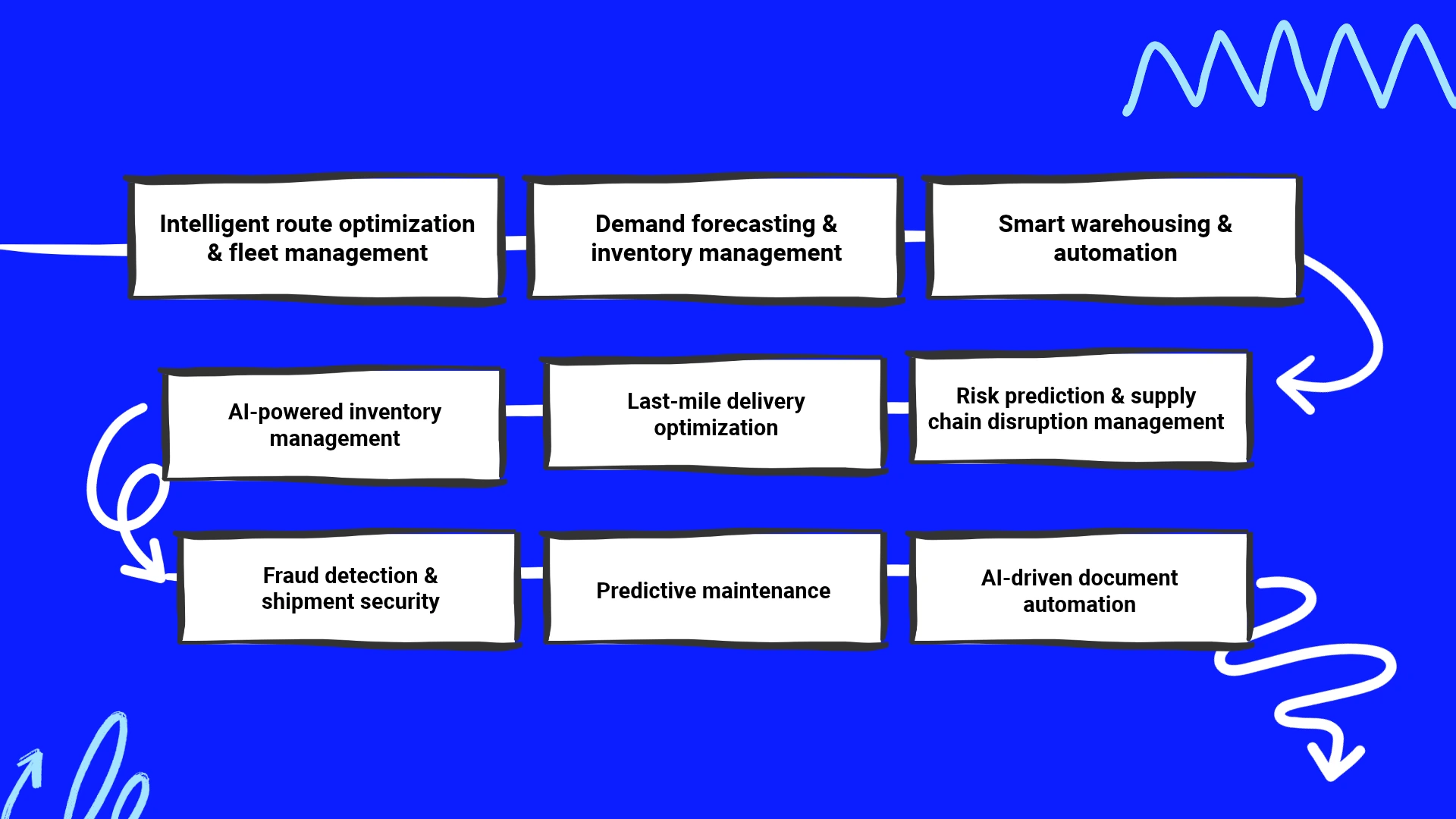
Intelligent route optimization & fleet management
AI bots will help you determine load assignment strategies, sequence pickups and deliveries, or position trucks to improve profitability like never before. Conventional route planners usually calculate only the path between two locations. But when you enable AI-based optimization, you can evaluate competing dispatch plans against key metrics like:
- Predicted traffic
- Freight rates
- Delivery appointments
- Driver hours-of-service limits
- Equipment availability
- Potential of securing a load
ML-based models usually help estimate both travel and service times accurately by analyzing patterns hidden in historical fleet data. Meanwhile, optimization-focused algorithms can consume these estimates to recommend assignments capable of generating higher margins across the fleet.
Let’s consider a scenario where your Texas-based carrier moves freight between Dallas, Houston, and San Antonio. A truck completing a delivery near Houston can return empty, accept a low-paying load, or wait till it gets a better backhaul. Now, an AI bot connected with your TMS can compare the available loads against pickup deadlines or additional mileage. Thus, you get recommendations offering the strongest expected contribution margin, and won’t have to worry about simply filling the truck or minimizing distance.
Now, here’s a catch, though! A system overlooking detention risk or suggesting a load that can compromise the next delivery will reduce profitability. So, the key here is to start with a defined fleet or a group of recurring lanes. Before you expand AI, always measure empty miles, cost per loaded mile, and revenue per truck.
Demand forecasting & inventory management
You can now use AI models to prepare an accurate estimate of future freight volumes your logistics business might experience, whether it’s due to a festive period or seasonal demand shift. The benefit lies in the fact that you can plan your actual capacity decisions and not rely on broad seasonal guesswork or last year’s shipment totals. Most AI demand forecasting tools use machine learning to identify hidden patterns in:
- Historical tenders
- Customer order forecasts
- Booking activities
- Lane-level demand
With more advanced implementations, you can also incorporate external signals into the analysis, like market conditions or weather predictions. Once you have the results, it will become much easier for you to determine:
- Where capacity is likely to tighten along the supply chain
- When to negotiate carrier commitments
- Which market segments will benefit most from repositioning equipment
The financial benefit stems from the ability to make better decisions before capacity turns expensive or becomes unavailable. The moment you underestimate demand, you end up covering loads at premium spot rates or rejecting customer tenders. Overcalculate it, and you will have to deal with unutilized carrier commitments and wasted positioning expenses. So, make sure to evaluate the AI model against your existing forecast process. Always measure whether it can reduce bottlenecks like:
- Load coverage costs
- Potential tender rejections
- Unnecessary capacity commitments
Smart warehousing & automation
When your operations are scattered across receiving, storage, picking, and dispatch, AI-powered tools will give you an upper hand in improving coordination amongst:
- Inventory
- Labor
- Equipment units
- Order priorities
With more advanced systems, the story is different. Then, you can combine data from your WMS with task completion times, equipment availability, and demand forecasts. Once this is done, your teams can then pinpoint exact areas where work needs to be prioritized at the earliest once conditions change. You won’t have to assign tasks based solely on fixed rules or supervisor judgment. Instead, the AI system itself can recommend which pallets you should be receiving first, which stocks need immediate replenishment, or which orders must be picked to protect outbound deadlines.
If you plan to deploy automated material-handling equipment or autonomous mobile robots, orchestration software can help coordinate task assignments. So, your investment decision completely depends on the bottleneck you are struggling with the most and which is impacting your revenue margin every month.
Suppose your primary concern at the moment is poor task sequencing. For this, robotics won’t solve anything by simply moving the goods faster around your warehouse. So, you will have to invest in planning software with an AI engine. Similarly, if repetitive picking travel or sustained high order volumes constrain your throughput, physical automation will be justifiable. That’s why before you commit to any transformation, establish your baseline for:
- Labor hours per order
- Dock-to-stock time
- Picking accuracy
- Orders shipped on time
AI-powered inventory management
Whether it’s determining the stock volume to hold or the perfect time for replenishment, this smart approach will ensure you don’t end up tying up excessive working capital or leaving customer orders unfulfilled. In most conventional inventory operations, the basic reorder rules are based on fixed stock thresholds. As a result, it becomes quite challenging to cater to dynamic demand shifts. But an AI tool estimates demand variability and supplier lead-time uncertainty at both the distribution-center and SKU level.
Thus, you get more transparency about where inventory is accumulating in one location while another facility is at a potential risk of stock-out. For US distributors and 3PLs managing inventory across multiple locations, this approach gives accurate information about replenishment quantities and stock transfers before shortages can trigger expedited shipping or emergency procurement.
However, remember that forecasts can become unreliable once you deal with unpredictable situations like:
- Slow-moving items
- Newly launched products
- Parts with irregular demand patterns
It is then that you need to identify the SKUs and locations where stockouts, excess holdings, or emergency transfers create the greatest financial debt. Only after you have the complete picture in hand should you plan an inventory-wide AI deployment. Also, to establish if this new tool is actually improving both availability and efficiency, make sure to define quantitative rules for:
- Inventory turnover
- Fill rate
- Stockout frequency
- Carrying expenses
Last-mile delivery optimization
You can easily decide the accurate logic necessary to group your deliveries for the next day, assign drivers according to the location proximities, sequence the number of stops along a specific route, and respond immediately once a delivery plan changes out of the blue. It’s way more complex than just finding the shortest route between the dispatch and delivery destinations. That’s because in AI-driven last-mile optimization, each stop brings its own:
- Service time
- Delivery window
- Package requirements
- Probability of successful completion
Whether you are a retailer or a regional delivery operator, you can easily use an AI tool to generate delivery plans rooted in actual operating conditions. Here, you will get the advantage of combining various data inputs and running a comprehensive evaluation, such as:
- Historical stop durations
- Traffic patterns
- Customer availability
- Vehicle capacity
- Live driver progress
The commercial value stems from minimizing the expenses involved in each successful delivery, and not simply increasing the number of stops assigned to every driver. Remember that once you overload a single route, you will have to deal with overtime, missed delivery windows, and repeat attempts. Also, inaccurate customer addresses or delivery instructions can lead to broken last-mile optimization plans. That’s why pilot your AI system in a delivery zone with sufficient stop volume. Only then compare the cost per successful delivery, first-attempt success rate, stops per driver hour, and overtime against your existing workflow.
Risk prediction & supply chain disruption management
With an AI-driven risk prediction model, you can effortlessly take corrective steps on time in case there’s a potential disruption threat in your shipments, supplier dependencies, or transport lanes. You won’t have to wait till a carrier reports the delay. Rather, predictive systems can automatically analyze shipment milestones alongside key metrics like:
- Weather forecasts
- Historical transit performance
- Port or terminal congestion
Changing network conditions
Once you have the resulting risk scores in hand, your ops teams can easily distinguish shipments requiring immediate intervention from routine movements progressing as expected. Whether you are moving freight through intermodal terminals or long-haul trucking networks, this approach can help improve exception management and minimize the unnecessary expenses involved with last-minute recovery.
But there’s an underlying catch! Suppose the warning arrived in your system only after the truck’s available capacity disappeared. Now, it will add little to almost no practical benefit. Meanwhile, false alarms will leave your team overwhelmed, especially when they are already buried under hundreds of exceptions. So, the key here is to start with one disruption category, which can be late inbound shipments or weather-driven delays. Only then will it become easier for you to accurately track variables like:
- Warning lead time
- Avoidable detention and demurrage costs
- Missed appointments
- Recovery spending
Fraud detection & shipment security
By identifying patterns differing from legitimate logistics workflows, an AI bot will help you detect suspicious freight transactions and shipment easily. In the US market, almost every logistics and supply chain business shares colossal data volumes. As a result, fraud often appears in the form of:
- Stolen carrier identities
- Fraudulent pickup instructions
- Double brokering
- Manipulated proof-of-delivery records
- Altered payment details
Although you have rule-based checks already implemented, these can only flag known warning signs. But ML models can compare multiple signals across transactions to flag unusual combinations or investigations. However, when you design an AI-based fraud detection system, you need to ensure it supports your existing verification controls, and not replace them altogether. That’s because fraudsters often adopt new approaches to remain undetected. Also, there’s a potential that legitimate carriers change their drivers or update contact details on short notice.
So, if the AI system treats every anomaly as fraud, you will have to deal with delayed deliveries and damaging carrier relationships. At the same time, depending entirely on automated risk scores and cutting off human oversight completely will allow sophisticated scams to go undetected. The best approach will be to prioritize checks around:
- Carrier onboarding
- Last-minute account changes
- Pickup authorization
- Payment amendments
Predictive maintenance
This approach uses vehicle diagnostics and operating data to prepare an accurate estimate of when a component is likely to fail. Thus, you get the chance to schedule repairs before a sudden breakdown can disrupt a load. Here, the practical advantage is replacing roadside repairs with planned maintenance that’s rooted in driver schedules, delivery commitments, and shop availability. Now, depending on the vehicle and telematics platform your business uses, AI models can analyze key details like:
- Engine fault codes
- Temperature readings
- Battery performance
- Mileage
- Maintenance history
However, you cannot consider a prediction to be same as that of a diagnosis. If the AI model doesn’t have strong calibration, you may end up with unnecessary inspection alerts. At the same time, incomplete diagnostic data can cause emerging faults to remain undetected. That’s why, before investing, make sure to check whether your telematics and maintenance systems expose sufficiently detailed, reliable data or not. Pilot the system on a subset of vehicles and compare roadside failures, unscheduled downtime, maintenance cost per mile, and unnecessary repair visits against a comparable group.
AI-driven document automation
This will help you process freight paperwork without requiring staff to manually read, retype, and reconcile every shipment record. In the US logistics market, a single load can generate a rate confirmation, bill of lading, proof of delivery, lumper receipt, freight invoice, and accessorial change. These repetitive tasks often create extra administrative costs and delay billing. AI here combines OCR, document classification, and LLMs to extract accurate information from various document sources your business handles every day. It then matches these extracted details against your TMS or accounting records to identify document fields, compare data, and flag discrepancies for further review.
The key decision, therefore, is to determine how much of the workflow you need to automate. Freight documents vary by format, scan quality, terminology, and carrier. Hence, even the slightest extraction error can lead to incorrect payments or inaccurate shipment records if every result gets accepted automatically. What you need to do is start with a high-volume, standardized document type and retain human approval for financial exceptions. Remember that the strongest business case stems from reducing manual effort and accelerating cash flow without introducing new reconciliation bottlenecks.
AI agents for exception handling and customer enquiries
An AI agent can handle defined, repeatable steps across your systems: spotting a rejected load tender, finding eligible alternative carriers, comparing rates and preparing a replacement tender for a dispatcher to approve. Customer-facing assistants can answer routine “where is my load?” enquiries. Oliver Wyman reports that logistics chatbots can handle up to 30% of enquiries end to end and cut agent handling time by about 50%.
Keep it bounded. Give the agent narrow, reversible actions (draft a message, prepare a tender), log every action, and require approval for rate changes, payments, and contract terms. Gartner’s February 2026 survey found 55% of supply chain leaders expect agentic AI to reduce entry-level hiring needs, so plan training for the people who will supervise it.
Measure: tender coverage time, share of exceptions resolved without escalation, and customer contacts per 1,000 loads.
How does AI connect to the software you already use?
AI integrates with existing logistics software through data connectors, APIs, or scheduled data transfers, all linking systems like transportation management systems, warehouse management systems, telematics platforms, electronic logging devices, and many more. An integration layer is tasked with data preparation for the AI model, which then returns predictions or recommendations to the operational software your team already uses.
Let’s assume you want to reduce empty miles for your delivery routes. So, your AI system will need more than the list of available loads. It must know:
- Where each truck is currently located
- When it will finish the current assigned delivery task
- How many driving hours are remaining for the day
- Which equipment it is carrying
- Whether another shipment fits its schedule
Now, your TMS will hold load details and delivery commitments, while telematics and ELDs provide information about the vehicles and the driver hours. Integration connects these records so that the AI model can evaluate backhaul opportunities against real operating constraints.
A properly structured AI integration architecture for a logistics business will have these 4 connected layers:
- Operational systems: Your TMS, WMS, telematics, ELD, and accounting platforms supply the shipment, vehicle, inventory, and cost datasets required for the selected use case
- Integration and data processing: APIs or middleware retrieve records, match shipment and vehicle identifiers, standardize timestamps, and flag missing or outdated information. A database then stores the combined data in case the targeted application requires historical analysis or frequent queries
- AI and decision engine: An ML model predicts outcomes like arrival delays or likely transit times. An optimization engine can then compare feasible load assignments using constraints like pickup windows, driver availability, empty miles, and expected contribution margin
- Operational interface: Recommendations return to a TMS dashboard or dispatch execution queue, where your team then reviews them and approves the appropriate action necessary
Here, the data flows matter a lot because AI predictions only create operational value when they reach the right decision-maker in time to change an outcome. If your system identifies a backhaul opportunity after the truck has already passed the pickup area, the recommendation will have little to almost no value. There, you need to invest in an integration architecture that refreshes location and load availability frequently enough for the decision being made, while detecting failed connections and stale records.
How Much Does AI in Logistics Cost in 2026?
The cost of AI in logistics typically ranges from $30K to $300K for mid-market carriers, brokers and 3PLs, depending on the workflow, the systems involved and the decisions AI supports. Large operators running network-wide programmes spend more: Oliver Wyman reports initial investment of about EUR 0.5 million to EUR 1 million per application among the operators it studied. A document processing application that extracts information from freight invoices will have a completely different cost profile from a dispatch optimization system evaluating live truck locations, driver availability, delivery appointments, and backhaul opportunities. That’s because the latter will need more frequent data updates, more complex decision logic, and additional operational safeguards. The budget will also depend on whether you can use existing AI services or will need custom models and app development.
Let’s assume a freight brokerage wants to automate invoice processing. For this, it might have to spend $60K-$90K for:
- Document extraction
- Rate confirmation matching
- TMS integration
- Exception-review dashboard
However, when a trucking company develops an AI-assisted dispatch optimization tool, it may have to invest $150K-$250K. That’s because the system should:
- Integrate TMS, telematics, and ELD data
- Evaluate competing loads against actual operational constraints
- Return recommendations as conditions change
The difference you see here stems from the number of integrations, data-refresh requirements, decision complexity, and consequences of an incorrect recommendation. To help you understand further, here’s a brief cost breakdown by the AI use cases in the logistics and supply chain industry we explained above.
| AI use case | Estimated implementation cost (USD) | Best for | Illustrative ROI |
| Intelligent route optimization and fleet management | $75K–$200K | Trucking companies seeking to reduce empty miles, fuel costs, and inefficient dispatching | 15–25% reduction in empty miles |
| Demand forecasting | $40K–$120K | Freight brokers and 3PLs planning lane capacity and seasonal carrier commitments | 10–20% reduction in avoidable capacity costs |
| Smart warehousing and automation | $100K–$300K | Warehouses with high order volumes, picking bottlenecks, or labor scheduling challenges | 10–25% reduction in warehouse operating costs |
| AI-powered inventory management | $50K–$150K | Retailers, distributors, and 3PLs managing inventory across multiple facilities | 10–20% reduction in excess inventory costs |
| Last-mile delivery optimization | $40K–$120K | Parcel carriers and delivery operators managing dense, time-sensitive routes | 10–20% reduction in delivery costs |
| Risk prediction and supply chain disruption management | $60K–$180K | Importers, freight forwarders, and shippers exposed to port congestion and shipment delays | 10–20% reduction in disruption-related costs |
| Fraud detection and shipment security | $50K–$150K | Freight brokerages and carriers exposed to cargo theft, identity fraud, and double brokering | 15–30% reduction in preventable fraud losses |
| Predictive maintenance | $60K–$180K | Fleet operators with significant repair bills, roadside breakdowns, or vehicle downtime | 10–20% reduction in maintenance costs |
| AI-driven document automation | $30K–$100K | Brokerages, carriers, and 3PLs processing high volumes of freight invoices, BOLs, PODs, and rate confirmations | 30–60% reduction in manual document-processing time |
What Drives the Cost: Integrations, Data and Decisions
- Development and functionality: Configuring an existing document AI service is less expensive than building a custom optimization engine with business-specific constraints, as the latter will need more engineering effort due to the involvement of custom dashboards, approval workflows, and automated decisions
- Software integrations: Each connection to your TMS, WMS, ELD, telematics, or accounting platform requires access, field mapping, and error handling. Poor APIs or inconsistent records will automatically
- Data preparation: Historical shipment records, carrier performance, invoice details, and timestamps often need cleaning before they can be used to support reliable predictions, which means you will have to invest in data cleansing, processing, and other necessary preparations
- Deployment and maintenance: Cloud computing, security controls, monitoring, model updates, employee training, and technical support will add more to your total initial cost
How to Calculate ROI on Logistics AI (With a Worked Example)
Evaluate AI against a measurable operating cost, not just model accuracy. Suppose implementation costs $100K and verified annual savings reach $150K through reduced document-processing labor, fewer billing errors, and faster invoice reconciliation. The estimated first-year net benefit is $50K, which is equivalent to a 50% first-year ROI before additional indirect costs are factored in.
So, calculate savings using your actual baseline, subtract recurring expenses, and account for implementation time. For seasonal operations, compare results across representative freight volumes before committing to a fleet-wide or company-wide rollout.
A 6-Step Rollout Plan for AI in Logistics
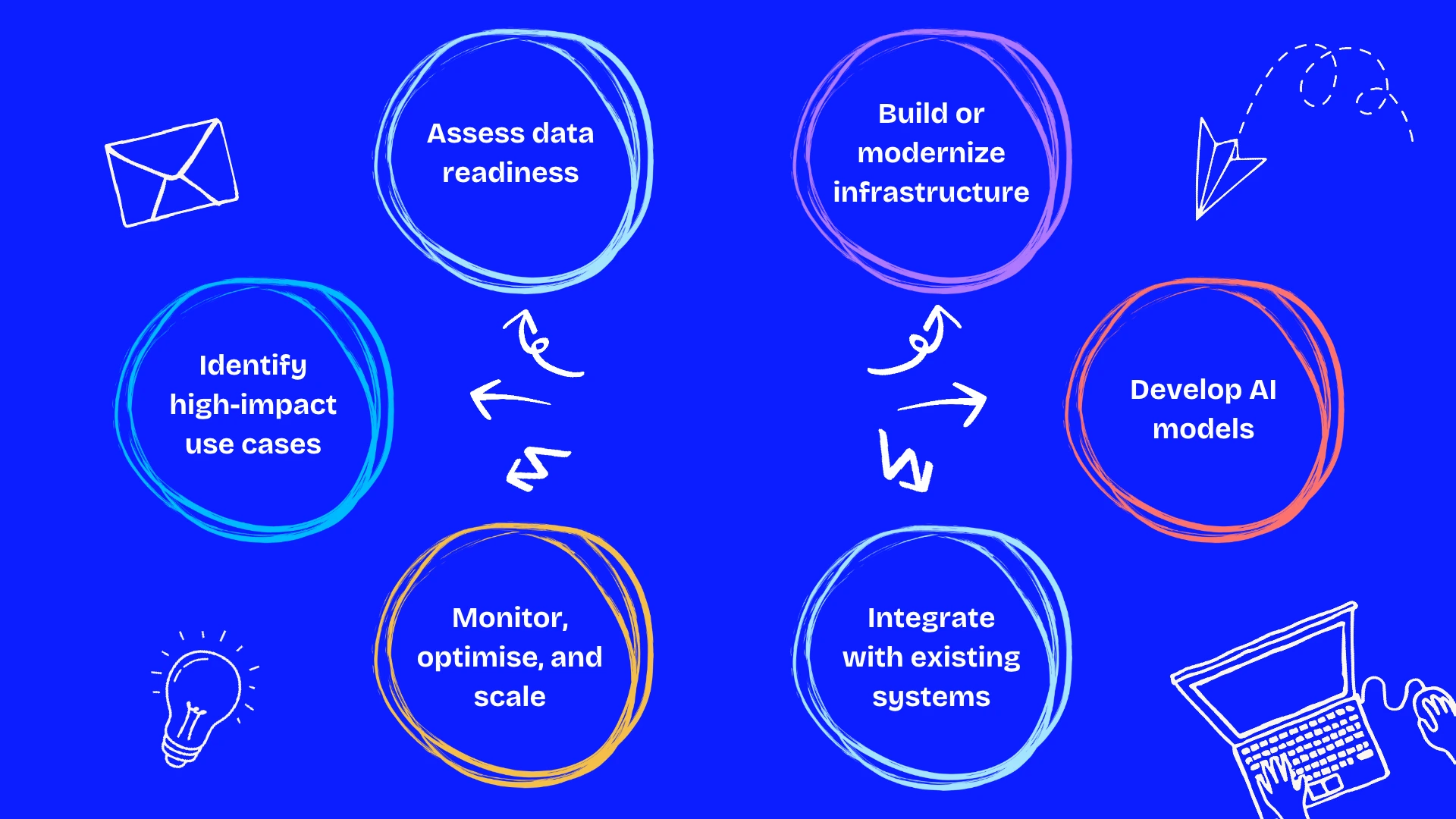
Step 1: Identify high-impact use cases
Start with the logistics process where inefficiencies are creating measurable expenses that you never budgeted for. For your trucking company, it would mean empty miles, recurring breakdowns, or missed delivery appointments. On the other hand, if you deal in freight brokerage, you would have to prioritize invoice discrepancies or poor carrier allocation. So, make sure to establish a baseline before choosing the technology. Record details that are directly connected to the problem, like:
- Current cost per mile
- Tender rejection rate
- Invoice processing time
Rank potential projects by financial impact, data availability, implementation effort, and operational risk. A narrowly defined use case with a clear success metric is much easier to validate than a company-wide AI initiative.
Step 2: Assess data readiness
AI requires relevant, sufficiently accurate historical and current logistics information. That’s why you should review records available in your TMS, WMS, telematics platforms, ELDs, and accounting software, depending on the use case you are targeting. For example, if you want to use AI to predict late deliveries, the model would need historical arrival times, appointment windows, shipment milestones, and reliable vehicle-location datasets.
So, make sure to check if the timestamps are consistent, shipment IDs match across systems, and missing records can be recovered. If the data is incomplete, begin by improving data capture and standardization logic. Building a predictive model before resolving these gaps means your team will have unreliable recommendations, regardless of how sophisticated the underlying algorithm is.
Step 3: Build or modernise infrastructure
Prepare the technical environment required to collect, process, secure, and serve operational data. This can involve:
- Cloud storage
- Databases
- API connections
- Access controls
- Data pipelines keeping current shipment information
You won’t have to necessarily replace your existing logistics software or start building a large-scale data platform. A focused pilot will require only a secure connection between your TMS and telematics provider. On the other hand, more extensive deployments will need real-time event processing, historical data storage, monitoring, and stronger disaster-recovery arrangements. So, choose an infrastructure depending on your expected data volume, update frequency, security requirements, and the risks of sudden system downtime.
Step 4: Develop AI models
Choose the AI approach according to the decision you need to improve or the logistics workflow you plan to automate. For instance, you can invest in ML models to estimate delivery delays, forecast freight demand, or identify vehicles that are at risk of sudden breakdowns. An optimization algorithm can then use these predictions alongside different constraints like driver hours, equipment availability, delivery windows, and load profitability to recommend the most feasible actions.
Document processing will combine OCR, LLMs, and validation rules to extract invoice details and compare them with rate confirmations. So, the key here is to test the solution against historical data, then evaluate it on new operational data that wasn’t used during development. Measure business outcomes and error rates, and not just accuracy alone.
Step 5: Integrate with existing systems
Connect the AI application to the software where relevant data originates and where employees make decisions. Consider a late-delivery prediction system, for example. It might have to retrieve load appointments from your TMS, obtain truck positions from telematics, estimate delay risk, and return flagged shipments to a dispatch exception queue. Dispatchers can then contact carriers or receiving facilities before an appointment gets missed.
Begin with recommendations that employees approve rather than allowing AI to change assignments automatically. Configure authentication, audit logs, error handling, and fallback procedures. This way, you can ensure that missed data or failed connections won’t disrupt dispatch operations.
Step 6: Monitor, optimise, and scale
Run the pilot you developed under normal operating conditions and compare results with the original baseline. A route optimization deployment should be evaluated using metrics like:
- Empty miles
- Cost per loaded mile
- On-time performance
- Revenue per truck
For document automation, however, you will have to consider a completely different set of evaluation metrics. In this case, you will have to factor in:
- Processing time
- Exception rates
- Duplicate payments
- Billing accuracy
In addition, you also need to account for seasonal freight patterns and changes in fuel prices, customer demand, or carrier availability. Once your AI system demonstrates sustained improvement, you can then plan to expand it to additional lanes, facilities, or workflows. Make sure to continue monitoring model performance and data quality as operating conditions change. Also, retain human oversight for high-impact exceptions.
Why Logistics AI Projects Stall, and How to Avoid It
Data fragmentation
AI can recommend an unprofitable load or miss a delivery risk when your TMS, ELD, telematics, and accounting systems describe the same shipment differently. For example, a truck might appear available because its delivery status has been updated in the TMS. However, its GPS feed can still show it at the previous stop. So, when records are conflicting, no AI model can optimize dispatch reliably.
How to address it:
- Create a shared load ID across dispatch, telematics, and billing records, alongside standardizing timestamps and location formats
- Reconcile GPS events against TMS pickups and delivery milestones before training or deploying a model
- Set data-freshness rules so as to withhold dispatch recommendations when vehicle locations or driver status records are outdated
Legacy system rigidity
Your older TMS might support EDI transactions for load tenders and shipment updates. However, it may lack APIs required for transferring real-time data the AI application needs. If you plan to replace the entire system from scratch, you may end up disrupting customer integrations and established dispatch workflows. The challenge here is accessing operational data without interfering with systems that already keep freight moving.
How to address it:
- Ask your TMS vendor whether shipment events can be exposed through APIs, database views, or scheduled exports
- Use middleware to translate existing EDI 204 tender, 214 status, and 210 freight-invoice transactions into consistent records for the AI model
- Keep AI separate from the core TMS initially, returning recommendations through a dashboard before enabling controlled write-back
The talent gap
A general-purpose AI team can build a technically accurate model that continues to generate impractical freight decisions. A load recommendation can look profitable. But it can ignore drivers’ hours-of-service limits, trailer requirements, detention exposure, or a customer’s appointment window.
How to address it:
- Involve dispatchers, load planners, safety managers, and billing staff when defining the model’s constraints
- Encode hard restrictions, including applicable driver-hours rules and equipment compatibility, separately from predictions about cost or arrival time
- Test recommendations against completed loads and have experienced operators review cases where predicted savings conflict with service commitments
Cybersecurity and compliance pressure
Connecting AI to carrier portals, load boards, dispatch software, and shipment records can create new routes for unauthorized access. In US freight, a compromised broker or carrier account can lead to fraudulent load bookings, altered pickup instructions, or cargo being redirected. What’s worse is that cyber-enabled cargo theft often involves compromised accounts and impersonated businesses.
How to address it:
- Implement multifactor authentication, least-privilege access, and separate credentials for AI services and operational systems
- Treat changes to carrier identity, pickup instructions, delivery addresses, and payment details as high-risk events requiring independent verification
- Maintain auditable records of AI recommendations and actions, and ensure integrations preserve applicable FMCSA, ELD, and hours-of-service requirements
AI in Logistics: Rules in the US, EU, Australia and UAE
United States
The US has no single, comprehensive federal AI law, which is why you must check the state rules relevant to your operations. For example, New York City’s Local Law 144 applies when a covered employer uses an automated employment decision tool to screen candidates or employees. For this, the requirements often include an independent bias audit, public audit information, and advance notices.
Meanwhile, Illinois employment-discrimination law addresses AI used in employment decisions. Separately, FMCSA rules restrict using ELD-connected technology to harass drivers or improperly pressure them around hours-of-service compliance. If your AI ranks drivers, monitors performance, or recommends disciplinary action, review those specific rules before deployment.
European Union
The EU AI Act does not automatically classify route optimization, warehouse forecasting, or predictive maintenance as high-risk AI. The classification depends on the system’s intended purpose and use. However, if your company uses AI for recruitment, worker selection, or certain employment-related decisions, high-risk requirements may apply, including risk management, documentation, record-keeping, and human oversight.
The GDPR also matters when AI processes identifiable driver or customer data. Article 22 is particularly relevant when a decision is based solely on automated processing and produces legal or similarly significant effects. Map each use case to the applicable obligations instead of treating every logistics AI tool identically.
Australia
Australia currently relies largely on existing laws rather than one comprehensive AI Act. The Privacy Act 1988 and Australian Privacy Principles can apply when AI processes personal information, such as driver GPS histories, employee performance records, or customer delivery details. You should identify the purpose of collection, restrict access, explain relevant data handling in privacy notices, and avoid retaining information unnecessarily.
From 10 December 2026, new privacy requirements concerning certain substantially automated decisions are scheduled to apply. If your system uses driver-monitoring data to make consequential decisions, review the new disclosure obligations and applicable workplace safety and surveillance rules before rollout.
The UAE
Federal Decree-Law No. 45 of 2021 on Personal Data Protection may apply when a logistics company processes personal data, subject to its scope and exemptions. If your AI platform sends driver records or identifiable location data to an overseas cloud provider, assess the applicable data-transfer requirements and vendor safeguards.
Companies operating in the Dubai International Financial Centre (DIFC) or Abu Dhabi Global Market (ADGM) must also check their separate data-protection regimes. DIFC rules are particularly relevant to high-risk processing involving extensive personal-data evaluation or automated profiling
What’s Next: Agentic AI, Digital Twins and Autonomous Fleets
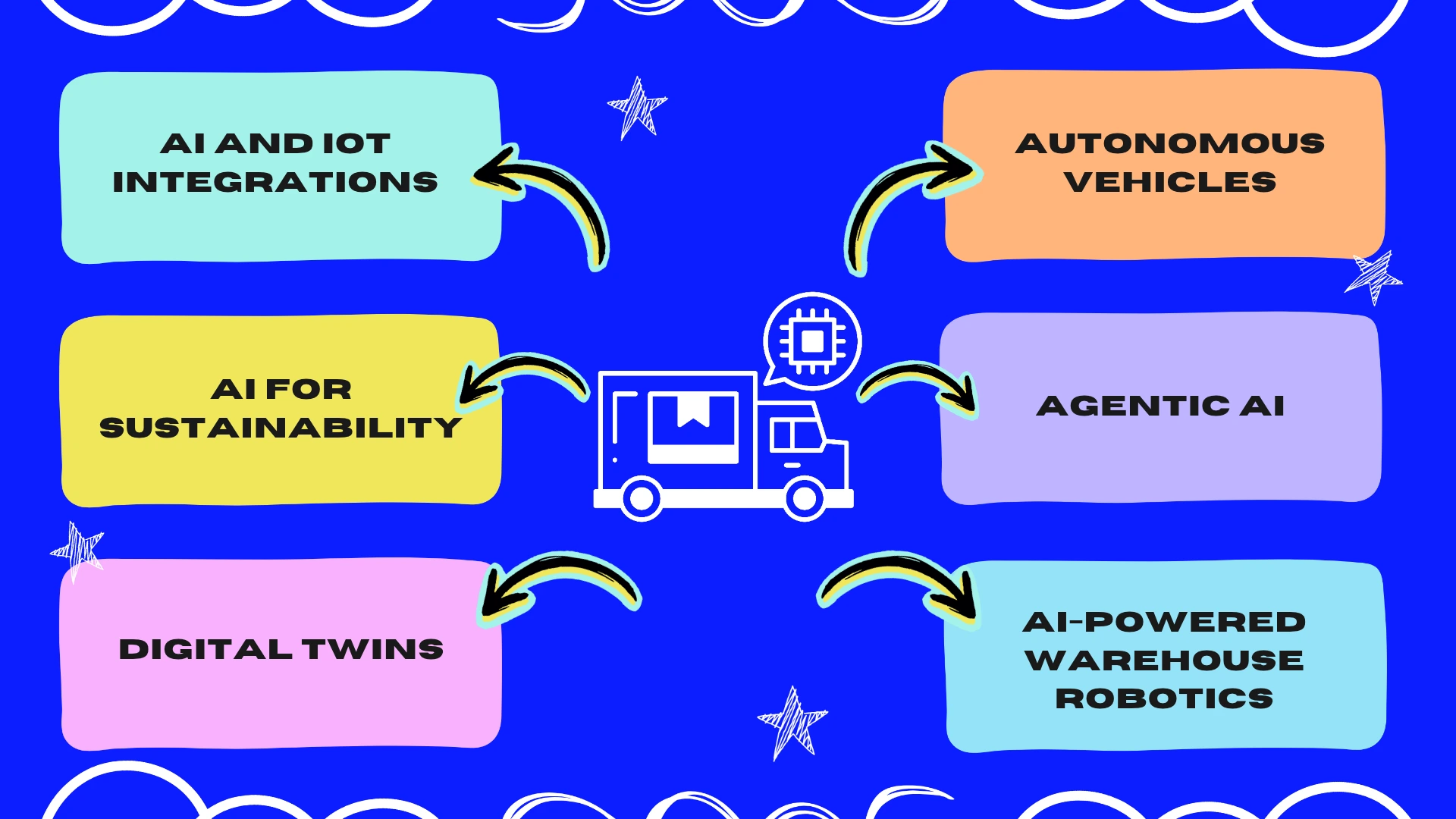
AI and IoT integrations
IoT sensors will provide real-time data on vehicle location, cargo temperature, fuel consumption, and equipment condition. AI will analyze this data to detect shipment delays, cold-chain temperature deviations, and potential vehicle failures before they disrupt deliveries.
Autonomous vehicles
Self-driving trucks, autonomous yard tractors, and delivery robots will automate specific transport tasks. Adoption will depend on safety standards, regulations, infrastructure, and operating costs. Controlled environments, such as warehouse yards, are likely to support adoption before autonomous vehicles become practical across more complex routes.
AI for sustainability
AI will help reduce fuel consumption and emissions by optimizing routes, consolidating loads, and reducing empty miles. Fleet operators can also use it to assess electric vehicle suitability based on route distances, payloads, charging availability, and energy costs.
Agentic AI
AI agents will increasingly handle routine, multi-step logistics tasks across connected systems. For example, an agent could identify a rejected load tender, find an eligible alternative carrier, compare rates, and prepare a replacement tender. Human approval can remain mandatory for exceptions, high-value decisions, and contractual changes.
Digital twins
Virtual models of fleets, warehouses, and supply chains will help businesses simulate operational changes before implementing them. Logistics managers can test peak-season demand, warehouse capacity, port delays, or fleet expansion scenarios to estimate their effects on costs, throughput, and delivery performance.
AI-powered warehouse robotics
AI will coordinate autonomous mobile robots, picking systems, and warehouse workflows according to order priorities and available capacity. This can improve picking productivity and order throughput, particularly in high-volume facilities with repetitive tasks.
How GMTA Builds Logistics AI That Fits Your Systems
At GMTA Software, we develop AI solutions that address the operational challenges logistics businesses face every day, from inefficient load allocation and delayed shipments to manual freight processing and fragmented fleet data. We combine AI engineering with custom software development to build solutions around your existing workflows, systems, and performance targets.
Our work in logistics AI covers predictive analytics, intelligent workflow automation, document processing, and operational decision support. We can develop machine learning models to forecast lane-level demand, identify patterns behind delivery delays, and support better capacity planning. For freight brokers, we can automate data extraction from bills of lading, proof of delivery, rate confirmations, and invoices, reducing manual entry while flagging discrepancies for verification. For fleet operators, AI-driven analysis of vehicle, route, and maintenance data can help improve utilization and identify potential issues before they disrupt operations.
We also work with agentic AI and RAG-based systems. In a logistics environment, an AI agent can coordinate defined tasks across connected systems, such as identifying a rejected tender, comparing eligible carrier options, and preparing an alternative for dispatcher approval. RAG can connect employees with information across carrier contracts, operating procedures, and shipment records without requiring them to search multiple repositories manually.
We don’t approach these projects as standalone AI experiments. We build the data pipelines, system integrations, application logic, and controls needed to make the solution usable in your operation. Our 14-week logistics prioritization agent project for WOW Logistics reflects our experience applying AI to logistics-specific decision-making.
With 7+ years of software development experience, 80+ customers, and 200+ projects, we bring both AI and engineering capabilities to the implementation. We can help you define a focused use case, develop and integrate the solution, and evaluate it against agreed operational measures such as cost per load, processing time, fleet utilization, or on-time delivery.
AI in Logistics FAQs
Can AI make reliable dispatch decisions when freight rates and carrier capacity change throughout the day?
Yes, AI can support reliable dispatch decisions by combining live carrier availability, updated freight quotes, driver hours, delivery windows, and historical performance. However, these recommendations will be accurate only when you feed consistent, reliable data to the models. Also, make sure your dispatch team retains approval authority for exceptions, while the system refreshes options when rates, capacity, or shipment priorities change.
How can AI help respond to sudden fuel price increases or freight market volatility?
AI can analyze fuel prices, spot market rates, lane demand, carrier quotes, and historical shipment costs to identify where margins are under pressure. It can help you compare alternative carriers, consolidate compatible loads, and reassess pricing on affected lanes. These suggestions can then support better revenue, even though actual savings will depend on capacity, contracts, and available alternatives.
Is it more cost-effective to build a custom logistics AI solution or subscribe to an existing platform?
An existing platform is more cost-effective when its AI features already match your workflows and integration needs. Custom development, on the other hand, makes more sense when you need proprietary pricing logic, specialized dispatch decisions, or workflows the platform cannot support. So, compare subscription fees, customization, integrations, data ownership, ongoing maintenance, and the cost of changing vendors.
Which logistics AI solutions can be deployed fastest without rebuilding existing systems?
Document processing, shipment-status classification, and internal knowledge assistants are often among the fastest options when your existing systems expose usable data or interfaces. These solutions can work alongside your TMS, WMS, or accounting software through APIs, file transfers, or other integrations. Deployment time, however, will depend on data quality, document variation, security requirements, and testing.

Founder
Anjali Upadhyay is the Founder of GMTA Software Solutions, a mobile and web application development company she built from the ground up in 2019. Under her leadership, GMTA has delivered 200+ production applications across healthcare, fintech, and on-demand services for clients in the US, UK, Singapore, and UAE. She also leads GMTA’s AI practice, which has shipped production AI systems — including HIPAA-compliant healthcare workflows, LLM-integrated logistics platforms, and fintech automation tools — for US-based enterprise clients. Her writing covers AI product strategy, build-vs-buy decisions for AI systems, and the operational realities of moving AI from proof-of-concept to production at scale.