

Key Takeaways:
- AI EdTech software development starts with an institutional integration plan, not a feature list. Whether you’re connecting to Canvas, Blackboard, Moodle, PowerSchool, or Ellucian changes your architecture, your timeline, and how enterprise buyers evaluate you.
- Do not measure AI ROI through user activity alone. For an AI tutoring product, track learning gains and cost per learner. For AI grading, measure grading hours saved and feedback turnaround. For early-alert systems, measure intervention rates, retention, and outcomes.
- FERPA and COPPA will directly influence your technical architecture and vendor selection. Before sending student prompts, essays, behavioral data, or academic records to an AI provider, determine what data is transferred, whether it is retained, whether it can be used for model training, who can access it, and how it can be deleted.
- Expect roughly 4-8 months for an AI tutoring MVP. Adding adaptive learning, district-specific curriculum, LMS/SIS integrations, educator dashboards, security testing, and pilot deployment can push the timeline beyond it.
As the global AI-based EdTech market is flourishing rapidly, with a projected CAGR of 25.9%, the most difficult decision isn’t finding ways to introduce intelligent learning. Instead, it’s figuring out which use cases are worth building, what business problems each one solves, and whether your investment can produce measurable returns. In the US EdTech market, you cannot simply add a chatbot or generative AI feature and hope that it will make your product competitive. You need to know where it can improve your economics, strengthen your product, or solve a problem your customers are already willing to pay to fix.
Understanding AI use cases helps you connect different problems to a specific solution. You can evaluate if an AI tutor can increase the number of learners supported per educator or whether adaptive learning can improve engagement. If you are stuck with high costs of producing new learning content, knowing the exact AI use case can help you decide if building automated assessment software can help you with this.
That’s why this guide examines the top 7 practical use cases of AI in education software development, going beyond what each feature does. For every example, we will discuss why it matters commercially, what it takes to build reliably, and where it can create meaningful value for your EdTech product.
What AI Actually Does in Education Software Today?
AI in education software primarily analyzes learner data, generates or adapts educational content, provides personalized support, automates repetitive academic and admin work, and helps educators make faster, better-informed decisions. Duolingo’s approach here is a useful model for any EdTech monetization strategy too — see these education app monetization models for how usage-based AI features like this tend to fit into pricing.
Khan Academy: AI is being used as a tutoring layer, not an answer machine
Instead of simply answering students’ questions about mathematics problems, Khanmigo guides them through the reasoning process, provides explanations, and helps them continue when stuck. Even teachers can use this AI tool to create lesson hooks, problem sets, and differentiated learning materials. What’s more, Khan Academy has already deployed its AI platform at district levels.
Newark Public Schools, serving around 43K students, piloted Khanmino in 2023. The implementation has since expanded to 29K students across 66 schools. This is not a tool that simply connects ChatGPT to a math app. Instead, Khanmino sits within an existing learning environment containing curriculum, exercises, student progress, and teacher workflows.
MagicSchool: AI is attacking the teacher workload problem
Rather than making students the primary user, MagicSchool focuses heavily on teachers and school staff through its AI EdTech solution. This smart bot helps teachers with tasks like lesson planning, assessment creation, writing feedback, text rewriting, and differentiation. In 2025, MagicSchool reported that generations on its platform increased to 87%, with tools like:
- Text rewriter
- Assessment generator
- Writing feedback
- Lesson planners
The commercial logic here is much clearer than simply stating “AI improves teaching”. Imagine a teacher previously spending an hour adapting a lesson for different reading levels. Now, the same work can be done through an AI tool much faster. All the teacher has to do is review and modify the initial version of the adapted lesson.
Duolingo: AI is being used to simulate expensive human interaction
Language learners need conversation practice. However, providing one-to-one interaction opportunity with a human instructor every time isn’t economically feasible and scalable. That’s why Duolingo introduced AI-powered Video Call and Roleplay features through its Max subscription. Learners can now engage in simulated conversations, practice real-life situations like ordering coffee, and receive feedback afterward.
Here, Duolingo has utilized AI in a completely different context. It has used this technology to create a scalable approximation of a human-intensive learning activity. This approach is particularly important if you are building an EdTech product with AI features embedded. Rather than asking where you can integrate Generative AI, just identify an expensive human interaction in your existing product and evaluate if AI can help lower the marginal cost of the same. Duolingo’s roleplay feature is also a useful cost benchmark if you’re scoping something similar — see what it costs to build an app like Duolingo.
Cold Spring School: AI is being inserted into an existing teaching workflow
The implementation at Cold Spring School in California demonstrates another major AI model in EdTech. The K-6 school uses a “Human -> AI -> Human” framework. Students first develop their own ideas, use AI for support, and then return to their own work for further refinements. Here, the technology doesn’t own the entire workflow. Rather, it creates an intermediary intelligence layer, leaving the final educational decision to the students.
Where AI Creates Real Value in Education Software?
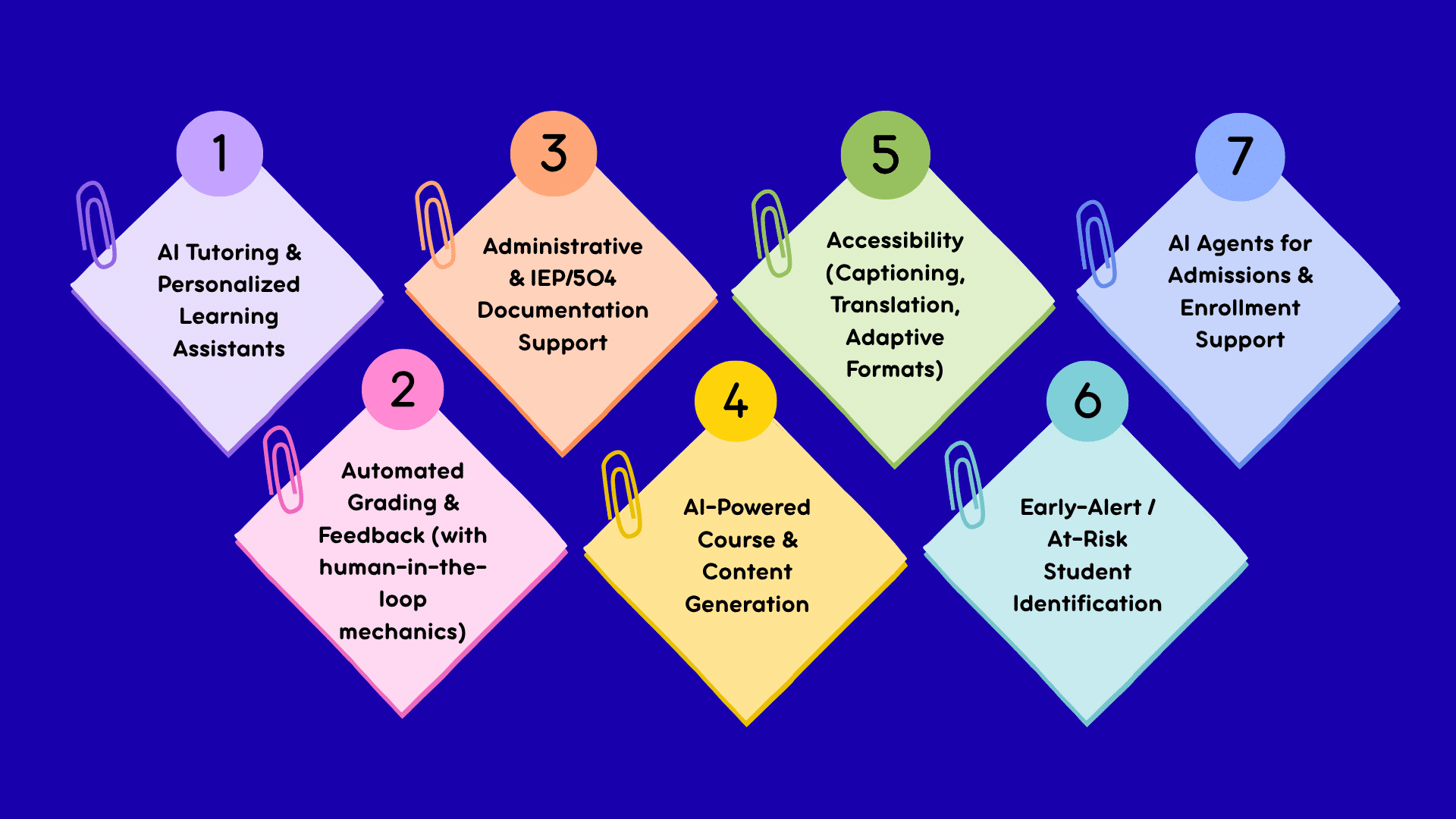
AI Tutoring & Personalized Learning Assistants
These intelligent bots make instruction responsive to individual learners rather than treating an entire class as if it has the same knowledge level. The software’s underlying LLM continuously interprets signals like:
- Quiz responses
- Mistakes
- Completion patterns
- Time spent on a concept
- Previous learning history
By doing so, it can easily determine whether a student is struggling and what type of learning assistance will be most appropriate. Generative AI adds another layer of intelligence to this process. Instead of simply directing a student to the next predetermined lesson, the system explains a concept in a different way, generates additional practice, asks follow-up questions, identifies misconceptions, and maintains a context-aware conversation. Carnegie Learning’s MATHia illustrates this business use case perfectly. Its adaptive mathematics platform analyzes student work as it happens and uses that information to adjust instruction and practice at the individual level.
Suppose teachers successfully pinpoint that multiple students are struggling with reading comprehension or solving an algebraic equation. However, they fail to provide each learner with an individualized explanation. Hiring enough tutors to close this gap is equally difficult, as instructional labor is expensive and difficult to scale. Thus, for your education software company, the opportunity is not simply to add an AI tutor. Rather, it is to increase the amount of personalized instructional support that one educator, tutor, or institution can deliver without increasing headcount at the same rate as enrolment.
The only trade-off you should focus on is control versus flexibility. A tightly grounded system reduces hallucinations and curriculum conflicts. But it may feel less conversational. At the same time, a more autonomous model creates richer interactions but increases the risks of incorrect explanations, inappropriate recommendations, and unpredictable behavior. For the education-specific version of this cost question, see the full breakdown of what it costs to build an education app or the broader education app development guide.
Automated Grading & Feedback (with human-in-the-loop mechanics)
You can design the education software in a way that it uses AI to evaluate student submissions against defined scoring metrics. Once done, it can then return structured feedback without requiring an instructor to manually review every response from scratch. It’s not just about assigning a score. Instead, the tool can perform way more crucial tasks intelligently, like:
- Identify recurring errors
- Compare responses against a rubric
- Flag gaps in reasoning
- Explain where an answer went wrong
- Generate feedback that points the students toward the relevant concept or next step
The University of Colorado’s AI-Augmented Personalized Feedback project is one of the best examples we can talk about here to illustrate this business use case. In its large enrolment aerospace engineering computing course, the system connects with Canvas and analyzes open-ended responses, lab reports, and code submissions. It then generates feedback that’s aligned with the course’s learning objectives. At the same time, teachers and instructors review and refine that feedback before students receive it. Here, the institution gains assessment capacity without having to remove academic judgment from the process.
There is, however, a fundamental trade-off between automation and assessment reliability. You can automate objective questions with relatively high confidence. But when it comes to essays, mathematical reasoning, programming assignments, and nuanced projects, you will need substantially more contextual judgment. The bottom line? Over-automating these evaluations can introduce inconsistent scoring, bias, or incorrect feedback.
Administrative & IEP/504 Documentation Support
Both IEPs and 504 plans are some of the strongest examples of AI use cases in education, helping with automated documentation for admin support across different levels. Before finalizing an individualized plan, professors and tutors often have to pull together various datasets, including:
- Attendance
- Assessment results
- Grades
- Intervention history
- Behavioral observations
- Service records
Usually, these sit isolated across multiple systems, like the SIS, assessment platform, student support tool, uploaded reports, and hard copies. The workload involved here is substantial. Special education managers end up spending 3-10 hours creating one individual IEP, with the initial IEPs consuming 6-10 hours.
AI here intervenes in the workflow before professional academic judgment becomes necessary. An educator won’t have to manually sift through heaps of documents and begin with a blank page. That’s because your AI bot can easily retrieve relevant student information, summarize patterns, identify missing records, organize evidence against predefined sections, and generate a review-ready draft. All the educator has to do is verify the evidence, change what’s inaccurate or incomplete, apply professional judgment, and approve the final document.
Take the example of Mesquite Independent School District in Texas. It ran a detailed survey only to find out that teachers had to spend 2-3 hours preparing an IEP. At the same time, evaluation reports took 4-6 hours for experienced diagnosticians and 12 hours for newer staff. It then introduced Panorama Solara, an AI-based education software that helped educators synthesize academic, attendance, behavioral, and other student data into drafts. This reduced the IEP drafting time to just 45 minutes, proving how AI can remove repetitive data logistics and give specialists more time for student-facing services and collaboration.
For your EdTech software business, however, this use case will demand a much stronger technical architecture compared to a generic document generator. You will have to design permission-controlled student data access protocols, source traceability, district-specific templates, audit logs, secure integrations, and clear human approval points. That’s because every additional automation layer will increase the consequences of an inaccurate or unsupported document.
In IEP/504 workflows, therefore, speed is only valuable when your system can display where its information was sourced from and keep the responsible educator in control of the final decision.
AI-Powered Course & Content Generation
This AI-powered feature will generate value for your EdTech platform only when you position it as a content production system, and not simply a writing tool. Education businesses, regardless of the size, constantly need to create and update lesson plans, quizzes, assignments, explanations, case studies, and remediation materials. The problem here is that every piece travels through several hands. An instructional designer structures it. A subject matter expert does the validation, while an editor refines the validated piece. Only after that, a teacher or academic team adapts it for actual classroom use. Multiply this process across hundreds of educational content pieces and the operating costs involved will become a serious concern.
Your AI system can significantly minimize this manual workload by taking in structured inputs and turning them into useful first drafts. For example, a course designer could provide a learning objective and source material to your tool. It can then use the underlying LLM to generate a lesson structure, explanation, practice question set, discussion prompt, or assessment item. The same content could then be adapted for different proficiency levels or converted into shorter revision material. Here, your product gives your customers a repeatable workflow for producing educational content faster and more consistently.
Take the example of the Learning Design Center tool that the University of San Diego launched. It uses ChatGPT and Microsoft Copilot to support course maps, learning-outcome alignment, assignments, discussion prompts, presentations, and branching scenarios. This way, the institute made sure that human instructional designers are in charge of just reviewing the resulting material for academic quality and relevance.
Although this business use case offers a strong profit model, there’s a marginal constraint you have to factor in. The more freedom you give to your model, the faster it can generate all the documents. However, the harder it will become for you to guarantee educational accuracy and consistency. That’s why you will have to treat grounding, validation, and human approval as the core product capabilities, not optional safeguards after the AI generator is built and launched.
Accessibility (Captioning, Translation, Adaptive Formats)
Your EdTech platform should serve students with different disabilities. It can be someone who is deaf, has visual or reading disabilities, speaks a completely different language, or simply wants information to be presented in a different format. Thus, for you, the business opportunity is to build accessibility directly into the content delivery layer so that one learning asset can automatically become multiple usable formats. At least then your customers won’t have to create and maintain each version manually.
With AI, you can easily make this process more scalable. Your platform can automatically:
- Transcribe a recorded lecture
- Generate synchronized captions
- Translate the transcript into another language
- Convert dense instructional text into simpler language
- Create audio versions
- Describe relevant visual content
- Restructure materials into formats compatible with assistive technologies
For your software business, this means accessibility will influence both product adoption and procurement. Your architecture, therefore, needs to go beyond an API that converts speech to text. You will need reliable speech recognition, translation models, text-to-speech, document and media processing, accessibility metadata, format conversion, and quality control mechanisms. In addition, you should also give administrators control over approved languages, terminology, accessibility settings, and generated content.
But there’s a catch. A captioning model can save enormous amounts of staff time. But a transcription error can change the meaning of a lecture. Machine translation can expand reach, yet educational terminology may be mistranslated. So, your product should allow automated generation while providing confidence indicators, editing tools, and human review for high-stakes content.
Early-Alert / At-Risk Student Identification
An early alert system uses predictive analytics and AI to identify students whose academic or engagement patterns indicate that they may need intervention. This gives educators and advisors an opportunity to act before the problem becomes more difficult to reverse. In practical terms, your EdTech software would continuously analyze signals like attendance, grades, assignment submissions, LMS activity, course performance, and advising history. Instead of waiting for an advisor to discover that a student has stopped submitting work or is falling behind, the system surfaces the concern and routes it to the person responsible for intervention.
This solves a significant problem for several US educational institutions. They have thousands of students and large volumes of data. But advisors cannot practically monitor all these manually. More importantly, a risk score alone cannot create value. Early-alert systems are a specific application of a broader pattern—see how predictive analytics software gets built for the underlying architecture. Your software, therefore, needs to connect prediction to action by:
- Explaining why the student was flagged
- Identifying the relevant change in their behavior
- Notifying the appropriate advisor
- Recommending or supporting an intervention
- Recording what happened afterward
Georgia State University demonstrates this AI-based education capability through its GPS Advising System. The university uses predictive analytics to monitor more than 40K students and hundreds of risk factors, generating alerts that prompt advisors to intervene. However, building such advanced capabilities will require more than adding an LLM to a student dashboard. You will need reliable SIS and LMS integrations, a predictive monitoring layer, configurable risk thresholds, explainable indicators, role-based access, audit trails, and continuous monitoring of model performance. The LLM can then sit on top of this infrastructure to summarize why a student was flagged or help an advisor prepare personalized outreach.
Recommended: How much does it cost to build an LLM for startups
AI Agents for Admissions & Enrollment Support
AI agents for admissions and enrolment act as a 24/7 digital admissions representative that can understand a prospective student’s question, retrieve information from institutional sources, determine what action is required next, and guide students through the next step. Unlike a conventional FAQ chatbot that can only return predefined answers, an agent can maintain context across a conversation and potentially handle tasks such as:
- Explaining application requirements
- Checking which documents are missing
- Answering financial-aid questions
- Directing students to the appropriate program
- Reminding applicants about deadlines
- Handling complex cases to an admissions counselor
A prospective student who cannot get an answer about a transcript, application requirement, tuition payment, or financial aid document can move to another institution. At the same time, having human counselors answer every routine question is expensive and difficult to scale during peak periods. Your AI agent can absorb the repetitive first layer of communication while allowing admission staff to spend their time on applicant who require judgment, persuasion, or case-specific assistance.
Take example of the “W the warrior” chatbot from Wayne State University. It was deployed to help prospective students navigate the application and enrolment process, including proactive reminders when required transcripts were missing. If you too want to build a similar AI agent for education, do not measure its performance simply by the number of questions it can answer. That’s because its value is tied to whether it can remove friction from the applicant journey and ultimately improves application completion, enrolment conversion, and access to timely support.
But there’s a trade-off you need to consider. Giving the agent access to more systems allows it to resolve more requests independently. However, it also increases the consequences of an incorrect answer or unauthorized action. For your EdTech product, therefore, the safest commercial model will be progressive autonomy. You will have to let the agent answer routine questions independently, require confirmation for consequential actions, and transfer complex or sensitive cases to the human staff. If you’re scoping the agent itself, what it costs to build an AI agent and GMTA’s AI agent development guide go deeper on architecture and pricing.
Which Use Case Should You Build First?
If you’re still narrowing this down, an MVP-focused build is usually the fastest way to test which use case actually moves the needle for your institution before committing to a full platform. This is usually the first real decision point in AI EdTech software development.
Where is your data already clean? AI tutoring and early-alert systems depend on continuous, structured learner signal — assessment results, LMS activity, submission history. If that data is scattered across systems that don’t talk to each other, these use cases will stall on data plumbing before you get near the AI itself. Content generation and accessibility tooling need far less continuous learner data, which makes them a faster, lower-risk first build if your data infrastructure isn’t there yet.
What’s your existing LMS/SIS relationship? If you’re already deeply integrated with one LMS/SIS combination, early-alert and grading tools that plug into that existing connection cost meaningfully less to ship than a new tutoring product that needs its own data pipeline from scratch. Building on an integration you already have is almost always cheaper than building the use case that’s theoretically most valuable.
What’s the actual bottleneck your buyer feels today? Institutions buying to solve a teacher-workload problem respond to content generation and grading tools first. Institutions buying to solve a retention problem respond to early-alert systems first. Match the use case to the budget line your buyer is already fighting for internally — not to whichever use case is most technically interesting to build.
A practical way to use this: score each candidate use case 1–3 on data readiness, integration cost, and buyer urgency. The use case with the highest combined score is usually the right first build, even if it isn’t the most ambitious one on your roadmap.
If you’re weighing a broader AI build against a narrower one, how to build generative AI apps covers the general build decision; this section applies specifically to education.
Not sure which use case fits your product?
Get a project-specific cost and timeline in one discovery call — not a generic range.
Build vs. Buy: How to Decide for Your EdTech Software
Build when the AI capability is directly responsible for your educational value proposition, and buy when the capability is an established infrastructure that your customers do not choose for you. For your AI-driven EdTech software in the US, this means building the proprietary layer that handles personalization, tutoring, assessment, learner-risk detection, curriculum grounding, and educator workflows, while buying foundational models, cloud infrastructure, authentication, communications, and other commodity services.
Suppose you are developing a platform that helps US school districts personalize mathematics instruction. The product uses student assessment results, assignment performance, learning history, and curriculum standards to determine what each student should practice next. If you train the foundational model by yourself, you may not get the value expected. An established model can already understand language, generate explanations, and respond conversationally.
So, your differentiation lies somewhere else. It stems from:
- Determining what the student has mastered
- Retrieving the appropriate district-approved content
- Deciding how much assistance to provide
- Generating an appropriate practice problem
- Giving the teacher visibility into the interaction
These components are worth building because they define the educational experience your customers are paying for. Buy when rebuilding the capability would consume engineering resources without materially improving the educational product. Cloud infrastructure is the most obvious example. There is little to almost no strategic value in developing your own data center infrastructure. That’s because established cloud providers can give you compute, storage, databases, monitoring, security tooling, and scaling capabilities.
| AI education software capability | When Buying Makes Sense | When Building Makes Sense |
| Foundation LLM | Use established models to avoid the enormous cost and complexity of training and maintaining a foundation model. | Build only when proprietary model performance, cost efficiency, or model control is itself a core competitive advantage. |
| AI tutoring & personalization | Buy when you need a ready-made tutoring capability and personalization is not your primary differentiator. | Build when your product depends on proprietary mastery models, adaptive learning paths, intervention logic, and curriculum-specific tutoring. |
| AI assessment & grading | Buy standardized evaluation tools when grading requirements are relatively simple and generic. | Build when you need subject-specific rubrics, confidence thresholds, evaluation rules, human review, and institution-specific grading workflows. |
| Curriculum RAG & knowledge layer | Buy vector databases and retrieval infrastructure rather than developing commodity components from scratch. | Build the grounding and retrieval logic that controls approved content, curriculum alignment, citations, and what the AI is permitted to use. |
| Early-alert & student-risk intelligence | Buy established predictive analytics when standard risk indicators and dashboards meet institutional needs. | Build when your differentiation depends on proprietary risk signals, configurable thresholds, intervention recommendations, and advisor workflows. |
| LMS/SIS integrations | Use existing APIs, connectors, and integration platforms to connect with established education systems. | Build your own integration and data-normalization layer when supporting multiple US LMS/SIS environments and complex student-data workflows. |
| Speech & accessibility capabilities | Buy mature speech-to-text, text-to-speech, translation, and related APIs to reduce development time. | Build specialized accessibility workflows when language support, adaptive formats, terminology, or accessibility controls are central to your product. |
| Teacher, administrator & analytics workflows | Buy generic workflow and BI tools when standard reporting and process management are sufficient. | Build when educator workflows, AI oversight, student-data controls, and education-specific KPIs directly determine product adoption and differentiation. |
RAG vs. Fine-Tuning: Which One Your Curriculum Layer Actually Needs
The Build vs. Buy table above recommends building your own “curriculum grounding and retrieval logic”—but that decision splits into two very different architectures, and picking the wrong one is one of the most expensive mistakes teams make early. Most teams don’t need to train or fine-tune a model from scratch to get this right—this is exactly the kind of decision where LLM development expertise helps you avoid over-building the wrong layer early.
Retrieval-Augmented Generation (RAG) keeps your curriculum content in a searchable knowledge base and retrieves the relevant pieces at query time, feeding them to the model as context before it answers. The model’s underlying behavior never changes—you’re controlling what it’s allowed to reference, not how it behaves. If you want the implementation-level version of this, building a RAG chatbot for a business use case walks through the retrieval architecture in more depth.
Fine-tuning adjusts the model’s own parameters using your curriculum and institutional data, so the model’s default behavior shifts to match your content and tone without needing that content fed in at query time.
For most EdTech products, RAG is the right starting point, for a few concrete reasons:
- Curriculum changes constantly. Updating a RAG knowledge base is a content update. Updating a fine-tuned model means retraining — slower, more expensive, and riskier to get wrong.
- Traceability matters in education. RAG lets you show exactly which curriculum passage an answer came from, which matters for FERPA-adjacent audit requirements and for teacher trust. A fine-tuned model can’t point to a source the way a retrieval system can.
- Cost profile is friendlier early on. RAG has lower upfront cost and scales with usage in a more predictable way. Fine-tuning has a larger upfront cost (data preparation and training runs) that only pays off at high query volume.
Fine-tuning becomes worth considering when you’re past roughly 100K queries/day on a single curriculum domain, when you need the model to reliably adopt a very specific tone or format that retrieval alone struggles to enforce consistently, or when per-query API cost at your actual volume starts to outweigh the cost of a training run. Below that volume, teams that fine-tune early are usually paying for flexibility they don’t need yet and giving up the traceability they do need.
Most production systems end up using both: RAG for the curriculum-grounding layer, with a lightly fine-tuned or well-prompted base model handling tone and format. Treat that as the default architecture unless you have a specific, measured reason to go further.
What Compliance Actually Requires For Your AI EdTech Software Development?
FERPA: Control Over Student Education Records
If your software education platform processes student records on behalf of a school or university, FERPA is the first framework your product’s compliance architecture needs to account for. This regulation governs access to and disclosure of PII from education records. When a school uses a third-party provider under the FERPA school-official exception, you will have to perform an institutional function, remain under the school’s direct control regarding the use and maintenance of records, and use the data only for authorized processes.
To implement this compliance standard, your product must have:
- RBACs to allow users to see only the student information necessary for their role
- Data segregation between districts, institutions, teachers, administrators, and students
- Audit logs showing who accessed, changed, exported, or deleted student information
- Purpose limitation to prevent anyone from repurposing student records silently for advertising or unrelated analytics
- Data retention and deletion controls that align with contractual and institutional requirements
- Vendor and subprocessor controls, especially when an external LLM, analytics platform, or cloud service processes student data
COPPA: Additional Requirements When Children Under 13 Use Your Product
If your software is directed to children under the age of 13, or you have the actual knowledge that you are collecting PII from this age group, COPPA will become a mandatory compliance standard. The FTC requires covered services to provide appropriate notice, obtain verifiable parental consent in applicable situations, provide parental rights over children’s information, and maintain reasonable security and retention practices.
For your AI product, this means you will have to decide before development whether children can directly interact with the model and what information the model actually needs. Avoid collecting unnecessary personal information simply because your AI system is capable of utilizing it.
AI Data Governance: Do Not Treat Student Data as Model Fuel
This is exactly where AI EdTech development differs from conventional education software. Your platform may continuously generate new data through prompts, conversations, essays, recommendations, assessment results, and behavioral signals. Thus, your architecture should be compliant so that it can establish a clear boundary between:
Student data -> AI processing -> generated output -> stored product data -> model training
Make sure the data architecture that you plan to build for your AI-backed EdTech software includes:
- Purpose-based access
- Retention policies
- Deletion mechanisms
- Consent/authorization workflows where required
- Explicit controls over downstream AI use
State-Level Student Privacy Laws
FERPA and COPPA are the federal floor — they are not the whole compliance picture, and treating them as sufficient is a common gap in EdTech architecture planning.
A number of US states have their own student-data privacy statutes layered on top of federal law. California’s Student Online Personal Information Protection Act (SOPIPA) is the most cited example, restricting what ed-tech vendors can do with student data — including targeted advertising and profile-building — beyond what FERPA and COPPA cover. Several other states have passed similar student-privacy statutes with their own specific requirements around data use, retention, and vendor obligations.
This matters architecturally, not just legally, for two reasons:
- State requirements can be stricter than federal ones, which means designing only to FERPA/COPPA minimums can leave you non-compliant the moment you sell into a state with additional requirements — and you may not find out until a district’s legal or procurement team flags it during a sales cycle.
- Requirements vary by state, so a single national data-handling policy may not be sufficient once you have customers in multiple states. This is worth a genuine legal review rather than an assumption, especially before a multi-state district or state-level contract.
If you’re selling nationally, build your data governance policy to the strictest applicable state requirement rather than to the federal floor, and confirm with counsel which state-specific obligations apply to your actual customer base before finalizing your architecture — retrofitting this after a state-level RFP flags a gap is far more expensive than designing for it upfront. If your product is already handling regulated data in another context, this compliance-by-design approach will feel familiar — it mirrors how GMTA structuxres HIPAA-aware healthcare software, where role-based access and audit trails are built in from day one rather than retrofitted. This is part of a broader shift in how AI products handle regulated data — see the future of data privacy in AI applications for the wider trend beyond education specifically.
The same compliance-by-design discipline applies across regulated industries — see enterprise AI governance and compliance or, for the healthcare parallel specifically, how to develop HIPAA-compliant software.
K-12 vs. Higher Ed vs. Corporate/EdTech: What Changes
Even though the AI architecture looks similar across different education markets, your product requirements are likely to change significantly based on the learner type, buyer, data environment, and definition of success. A K-12 platform has to account for minors, parents, teachers, districts, and classroom-based workflows. Contrary to this, higher education platforms serve adult learners but operate within complex institutional systems, like the SIS, LMS, advising, and financial-aid infrastructure. Talk about corporate learning, and the focus shifts immediately toward workforce skills, completion, productivity, and measurable business outcomes.
| Factor | K-12 | Higher Education | Corporate / Commercial EdTech |
| Primary buyer | School districts, states, schools | Universities, colleges, departments | Employers, training providers, individual consumers |
| End users | Students, teachers, administrators, parents | Students, faculty, advisors, administrators | Employees, managers, trainers, learners |
| AI priorities | Personalized learning, tutoring, assessment, teacher assistance, early alerts | Tutoring, advising, retention, assessment, content generation | Skills assessment, personalized training, AI coaching, knowledge assistance |
| Data sensitivity | Very high because products may process children’s data and education records | High because of student records, academic performance, and institutional data | Varies; employee and proprietary company data can be highly sensitive |
| Key compliance considerations | FERPA, COPPA where applicable, accessibility, state student-privacy requirements, district contracts | FERPA, accessibility, institutional privacy/security requirements, state requirements where applicable | Privacy laws, employment considerations, contractual requirements, industry-specific obligations |
| Integrations | SIS, LMS, assessment platforms, rostering, identity systems | SIS, LMS, CRM, advising, assessment, identity, financial-aid systems | HRIS, LMS/LXP, CRM, SSO, knowledge bases, productivity platforms |
| Human oversight | Usually high; teachers and administrators need control over AI-generated decisions and content | High for academic, advising, and high-impact decisions | Can be more automated for low-risk training and knowledge tasks |
| Success metrics | Learning gains, engagement, teacher capacity, intervention outcomes | Retention, completion, learning outcomes, student engagement, advisor efficiency | Skill acquisition, course completion, productivity, employee performance, training ROI |
Cost & Timeline by Use Case
As the underlying architecture varies by each use case, there’s no single cost range for AI EdTech software development. A basic AI content-generation feature can be delivered quickly with a much more controlled budget. But when it comes to an AI-powered LMS development initiative or AI tutoring, you will have to invest in learner-data pipelines, integrations, evaluation infrastructure, and more rigorous testing routines. These ranges are consistent with what GMTA sees on comparable AI builds — see how LLM development costs break down for startups for a closer look at where budget typically goes on the model layer specifically.
| AI EdTech use case | Estimated development cost | Typical MVP timeline | What drives the cost |
| AI Tutoring & Personalized Learning | $80K–$250K+ | 4–8 months | Learner profiles, mastery models, curriculum RAG, adaptive learning logic, AI evaluation, teacher dashboards |
| Automated Grading & Feedback | $50K–$150K+ | 3–6 months | Rubric engine, assignment processing, subject-specific evaluation, confidence scoring, educator review |
| IEP/504 Documentation Support | $60K–$180K+ | 4–7 months | SIS integrations, document extraction, structured drafting, permissions, audit trails, human approval |
| AI Course & Content Generation | $40K–$120K+ | 2–5 months | Content repository, prompt orchestration, curriculum grounding, templates, review workflows, LMS integration |
| Accessibility, Translation & Adaptive Formats | $35K–$100K+ | 2–4 months | Speech APIs, translation, captioning, document conversion, accessibility validation, quality controls |
| Early-Alert / At-Risk Student Identification | $90K–$250K+ | 5–9 months | SIS/LMS data pipelines, predictive models, risk scoring, explainability, advisor workflows, monitoring |
| AI Admissions & Enrollment Agent | $60K–$180K+ | 3–6 months | RAG, CRM/application integration, institutional knowledge, agent workflows, escalation and authentication |
For AI-specific MVP budgeting beyond EdTech, AI MVP development cost and what it costs to develop an AI app in the USA are useful cross-checks.
Budget Beyond the MVP: What AI Systems Cost After Launch
The cost table above covers initial build—but AI systems carry a real, recurring cost profile after launch that a standard software MVP doesn’t, and leaving it out of your budget planning is how “the AI feature” quietly becomes the most expensive line item in your product a year after shipping.
Four things to budget for beyond delivery:
Inference cost at scale. What costs a few hundred dollars a month during a pilot can scale non-linearly once real usage kicks in—API-based pricing means cost grows with query volume, and growth here is rarely linear with your user growth. Model your expected usage over the next 12–18 months before committing to a purely API-based architecture, not just your usage at launch.
Model drift and retraining. Model behavior degrades over time as the underlying data patterns it was tuned or grounded against shift—new curriculum, new student populations, changing usage patterns. Left unaddressed, this shows up as slowly declining answer quality that’s easy to miss until a teacher or student complains. Budget for periodic evaluation and retraining or re-grounding as a recurring line item, not a one-time task.
Compliance review cadence. Your FERPA/COPPA/state-law posture isn’t a one-time design decision—it needs periodic review as your data footprint grows, as you add new institutional customers in new states, and as vendor/subprocessor relationships change. Treat this as an annual (at minimum) checkpoint, not something you set once at launch and revisit only if something breaks.
Vendor and foundation-model changes. If you’re building on a third-party foundation model, pricing, capabilities, and even model availability can change on the vendor’s timeline, not yours. Budget some flexibility for adapting to model updates or, in some cases, migrating providers.
As a planning rule of thumb, budget roughly 15–25% of your initial build cost per year for post-launch maintenance and model upkeep, with compliance-heavy products (early-alert systems, IEP documentation tools) tracking toward the higher end of that range given the audit and review requirements involved. This isn’t a hard industry benchmark—it’s a reasonable planning assumption to stress-test against your own usage projections before you commit to an architecture. Ongoing model upkeep, compliance review, and infrastructure monitoring are exactly the kind of work covered under ongoing maintenance and support — worth scoping alongside your initial build rather than after launch.
Ready to scope your AI EdTech build?.
Talk to GMTA about your use case, data readiness, and compliance requirements before you commit to an architecture.
How does GMTA approach AI in education?
At GMTA Software Solutions, we approach AI in education as a product and learning problem first, and a technology problem second. Our objective is not to add an AI chatbot simply because your product can support one. We first identify where AI can improve learner engagement, personalization, assessment, content delivery, or operational efficiency. Only after this do we design the data, workflows, and integrations around that outcome.
Our existing EdTech work provides a practical foundation for this approach. With Volorex, we built an educational platform around structured courses, personalized learning paths, interactive content, enrolment, and learning-progress tracking. The project began with user research and analysis of learner behavior before architecture and interface decisions were made.
Our experience with Quizzire also demonstrates how we approach complex, real-time learning experiences. At GMTA, we developed its multilayer quiz platform with server-authoritative game logic, real-time synchronization, chat, analytics, and an admin layer. The platform achieved roughly 2x session duration compared with single-player trivia apps in the same category.
For AI-powered education products, we bring the same principle forward. We start with the learning outcome, build the right data and product architecture around it, and use AI where it creates measurable value rather than novelty.
FAQs
How can generative AI support personalized learning in education software?
Generative learning can personalize learning by adapting explanations, practice activities, feedback, and learning paths to each student’s demonstrated needs. An education platform can combine assessment results, learning history, mastery levels, and interaction patterns to determine what a student needs next. Retrieval-Augmented Generation (RAG) can then ground responses in approved curriculum content. The strongest implementations keep teachers involved, giving educators direct visibility into AI interactions and control over institutional decisions rather than allowing the model to operate without oversight.
Is AI safe for student data under FERPA and COPPA, and what safeguards are required?
AI can be used safely with student data, but compliance depends on how the product collects, processes, stores, and shares that information. FERPA requires appropriate controls over education records, while COPPA can apply when services collect PII from children under the age of 13 years. Your architecture should then include data minimization, encryption, role-based access, audit logs, retention and deletion controls, vendor governance, and restrictions on secondary usage. AI providers should also be evaluated for whether customer data can be retained or used for model training.
What student information should an AI education app collect, store, and process?
An AI education software should collect only the student information that’s necessary to deliver its defined educational functions. Depending on the use case, this may include learning progress, assessment results, course enrolment, submitted work, or interaction history. Avoid collecting sensitive information simply because the AI could use it. Separate personally identifiable information from analytical data where practical, define retention periods, restrict access by role, and document why each data category is collected. Data minimization will also help you reduce both privacy exposure and security risks.
Can AI replace teachers, or is it better used to augment classroom instruction?
AI is better positioned to augment teachers than replace them, especially for educational institutions requiring context, judgment, and an understanding of individual students. AI can handle repetitive work like generating practice materials, summarizing information, providing preliminary feedback, or identifying students who may need attention. Teachers remain responsible for interpreting those outputs, addressing complex learning needs, and making consequential decisions. For EdTech businesses, the stronger product strategy is therefore to increase teacher capacity rather than design AI around removing educators from the workflow.
How much does it cost to build an AI-powered education app in the US?
Building an AI-powered education app in the US costs between $40K and $250K+ for an MVP, depending heavily on the use case and required integrations. A basic AI content generator falls towards the lower end, while personalized tutoring, predictive analytics, or complex LMS/SIS integrations can push the costs substantially higher. Also, you should budget separately for AI inference, cloud infrastructure, security, compliance, third-party APIs, testing, and post-launch optimization.
How long does it take to build an AI tutoring platform for a school or EdTech company?
An AI tutoring platform takes 4-8 months to develop for an MVP-based approach, assuming the scope is clearly defined and the team uses an existing foundation model rather than training one from scratch. The timeline increases when the platform requires adaptive learning, curriculum RAG, LMS/SIS integrations, teacher dashboards, advanced analytics, or extensive evaluation. Discovery, data architecture, AI evaluation, security testing, and pilot deployment should be included in the timeline rather than treating development as the only project phase.

Rishi Ram is CTO at GMTA Software, with 6+ years of experience in software architecture and technical leadership. He’s led GMTA’s work across fintech—including eWallet apps, mobile banking platforms, and Sharia-compliant fintech builds—as well as on-demand and taxi app development and AI-integrated products like fraud detection agents and workflow automation tools.