


Enhancement of technology is a vital part of any development. Like if we take the example of drones. This device is very useful in every field, like delivering items to inspect and land and mine for workers. There is a huge involvement of AI in Drones to become smarter and more sensible. Now AI Drones are a reliable source to seek out any kind of traditional problem.
AI in Drones can make aerial systems more intelligent and responsive compared to earlier times. In this blog, we’ll delve into its growing role. What are the major benefits, practical applications, and industry challenges in the drone sector — and how AI can help overcome them through advanced drone development?
Understand the Significance of AI in Drone Technology

As per the report of market.us, the global AI drone will be projected up to $206.09 by 2033 with the CAGR of 32.4% as per this period. Drones are simple and sorted machines that would be enhanced by AI technologies. With the help of AI, now drones can execute various complex tasks. Here are some major components of AI technologies in drones.
1. Observation and Tactile Fusion
These elements can help drones to understand the environment by perception. Mostly drones use cameras and other sensors to collect information and data from unmanned aerial vehicles. However, a single sensory system is not enough to handle multiple things. That’s why AI technologies include sensor fusion. This function can help to combine multiple sensors for more accurate tasks.
2. Self-Navigating and Routing
This would be an important element in the development of an AI Drone. The autonomous navigation technology helps to clear out the maps by using algorithms that can determine the best route to reach its destination from ai driven drones. This element can also help to avoid various obstacles like power lines and buildings.
3. Decision-Taking and Management
AI in Drones can enhance the power of decision-making, which is based on gathered data. The drones can learn various activities like adjusting altitude, returning to base, and changing direction automatically without any command. It can be managed by control system for seamless operations. It is generally beneficial for detecting weather conditions for the further plan.
4. ML and Modeling Development
Machine learning is a vital part of artificial intelligence. Mostly drones are trained with huge datasets that can enhance the performance over time in ai powered drones. This element is very important for ai driven drones. That can learn to detect the different kinds of vehicles or any suspect activity that can also analyze previous footage.
5. Swarm Intelligence
In this element, several drones are used for multiple operations like delivering and monitoring the large site. The swarm intelligence can help you to integrate the AI technology for smooth communication and a collaborative approach to finish its tasks. This technology is inspired by insects like bees and ants that always work as a team.
6. Frontier Computing and Immediate Analysis
Drones need to gather the information quickly, especially in important and risky missions. Edge computing helps drones to enable the data in domestic regions rather than multiple servers in ai driven drones. This also ensures real-time processing, which is vital for the tasks. This can help to handle sudden barriers or trace any moving target.
Also Read: Top AI Business Ideas for For Your Startup
Unlock drone potential using AI—develop custom applications today.

Primary Drone Industry Challenges to Solve with AI
Currently the drone industry is rapidly growing, but it also faces several challenges. However, AI in drone technologies can help to find a solution to overcome all the challenges. Let’s check the current challenges in the drone industry and how AI can provide effective solutions for it.
1. Security and Deterring Collisions
In drone operations you need to maintain safety along with preventing collision. AI plays an important role in this case to leverage predictive algorithms to clearly understand the obstacles and create real-time strategies for ai powered drones. This can help drones to enhance safety and reduce the risks in operations.
2. Assessing and Interpreting Data
In the traditional method of data analysis, the drones have to carry large datasets during operations. But now AI technologies can optimize and extract the data for evaluation in ai driven drones.
AI can also utilize the advanced algorithms. AI technologies can handle a huge amount of data that can extract informational insights that can help the decision-making process.
3. Observance of Regulations
Maintaining the complex regulations that can handle privacy and safety. This thing creates a primary obstacle for ai driven drones. At this stage, the integration of AI that can emerge is a useful tool that is capable of simulating scenarios that can peerless the flight paths that can also fulfill all rules.
4. Autonomous Activities
Generally, drones are facing this problem of requiring the assistance of human support in complex tasks by ai powered drones. Although AI can help to expand the autonomy of drones that can understand and make independent decisions in emergencies.
AI can refine the algorithms as per real-world scenarios that enable drones to work effectively without any human support. It can also maximize the efficiency that can also reduce the operational expenses.
5. Security
One major concern with drones is their vulnerability to hacking, which can lead to the extraction of sensitive operational data. However, incorporating artificial intelligence into military drones can significantly enhance their security and decision-making capabilities
It can enhance the mechanisms of drones using ai that would not be interrupted by cyber invasions. It works like a security shield that can protect the valuable information of drone operations.
6. Battery Lifespan and Effectiveness
Sometimes drones experience restricted operational times due to the heavy battery constraints that make a certain flying area for drones. But now AI models are using generative techniques that can optimize the route and modify the settings for saving battery effectively in ai powered drones. It also enhances the range of timeframes that can maximize the output of drone operations as well.
Also Read : How to Build an AI App? Steps, Features, Costs, & Trends
Benefits of AI Technologies in Drones
Drones are simply flying machines for normal operational use. But if you integrate AI technologies with drones, then it can become faster, smarter, and more reliable for artificial intelligence drones. Here are some benefits of drones with integrated AI technology.

1. Decision-Making Process & Data Analysis
AI process drones have the main ability to process and analyze data in operation time. AI can gather information for drone usage and interpret it for making decisions effectively in ai powered drones. AI can help drones to make quick decisions on swift actions from the operations.
2. Planning Paths & Automated Guidance
Examining the best flying route in operations is very important for drones. This process can help to find optimized routes, such as potential obstacles, terrain, and weather. This can ensure safer, faster, and more energy-efficient flight operations.
3. Increased Independence
AI can enable drones to do any kind of task without requiring human assistance. Drones can plan their routes and also adjust according to the changes for completing the mission. Like if a drone delivers the supplies, it can self-navigate and avoid all sudden obstacles without any guidance.
4. Maintenance Forecasting
AI technologies can analyze the data that can be collected through a drone’s sensors when it is predicting the maintenance of the components, like the battery or motor, that might fail in ai powered drones. This can help to wait or break down the process; it can help you to pre-identify any error in the drone system. This can consume less time and enhance the lifespan of a drone.
5. Improved Situational Consciousness
AI can enhance the learning capability of drones that can understand the surroundings in an operation. Now drones can use advanced sensors and machines that can help to identify the objects and detect the obstacles to minimize risk in ai powered drones. This ability is mostly required on search-and-rescue missions.
6. Ideal Coordination of Swarm Intelligence
AI can also help to use multiple drones for a single operation that works as a coordinated unit. The term swarm intelligence is very effective for large-scale operations. For example, in any drone operation, a group of drones can cover a large area to share the information to build a comprehensive map of affected regions. This kind of collaboration can speed up the operation that can enhance output in your business.
Top Use Cases of Artificial Intelligence in Drones

Artificial intelligence in drones can do various kinds of tasks for several industries. Generally, drones in smart cities are innovative and always prioritized that will be equipped with AI for the development. Here are some uses of AI in drones.
1. Surveillance & Security
Ai-powered drones are very reliable in terms of security. AI support is already capable of object detection with facial recognition abilities. These drones can monitor large areas and also find unauthorized access and suspicious activities.
Generally the drones are deployed to supervise vast areas as ai military drones. This can also help to maintain crowd management and security by providing real-time video feeds to reduce potential threats by taking quick actions on them.
2. Search and Rescue Operations
AI can enhance the drone’s ability for lifesaving missions. AI technologies in drones can use thermal imaging for real-time processing to find missing persons in difficult environments like collapsed buildings or high mountains.
Furthermore, many governments worldwide are using artificial intelligence in drone technology to safeguard borders to reduce the level of risk in rescue operations.
3. Exploration in Mining
Drones are vital elements in the mining industry. AI-driven drones are specially crafted for mapping and surveying operations of drones and artificial intelligence.
They can also generate the 3D models of mining sites by gathering information for analyzing terrain. The drones can also examine the potential hazards and valuable resources from mining spots.
4. Delivery Services
There is the rise of e-commerce in smart city initiatives. AI-driven drones are refining the delivery services. These drones autonomously follow the routes through urban environments and can also avoid obstacles.
AI drones can automatically optimize the routes by path planning. In the US, most tech companies with AI developers are testing AI-featured drones to deliver packages and parcels. This same kind of process is also used in ai-powered taxi app development on the basis of testing the complete process of development. This can ensure timely and effective deliveries in every city.
5. Precision Agriculture
In the agricultural sector, ai and drones are the best source of farming practices. These drones can use machine learning and computer vision that can help to analyze the crop health and irrigation system and detect pests and diseases in crops. It can also help to forecast the weather updates, which makes the agriculture practices precise.
6. Infrastructure Inspection
AI in Drones are very reliable for transforming the infrastructure of any space. AI-driven drones can freely scan buildings, power lines, pipelines, and bridges. AI drones can also use sensors, fusion, and computer vision for detecting cracks, structural weakness, and corrosion with precision in ai powered drones.
Where AI in Real Estate is used for handling the urban infrastructure with optimized logistics and property examining systems. This process can help to reduce human inspection and minimize the risk in the infrastructure of any space as well.
Enhance drone operations—partner with us for AI app solutions.

Essential Components for AI Drone Development
The integration of AI in drones is based on various technologies like data processing techniques, advanced algorithms, and neural networks in the development stage. Here are some essential components for the inclusion of AI in drones.
1. Integration of Cloud Computing
Artificial intelligence in drone technology is revolutionizing the way unmanned aerial systems operate. With the help of AI, drones can now perform tasks such as real-time object detection, autonomous navigation, and predictive maintenance. By combining cloud computing with AI, modern drones can process large volumes of data efficiently, enabling smarter decision-making in critical missions.
2. Machine Learning (ML)
Machine learning is one of the crucial parts of AI technologies. It can train the large datasets so that it can recognize the patterns and exceptions in ai powered drones. Let’s take an example of agriculture. Here, AI can examine the crop stress, which is based on real-time imagery and historical data.
3. Predictive Analysis
It can help AI to analyze the real-time data along with historical timelines. It also offers predictive insights that can help to make the decision-making process in various sectors. AI-driven drones are faster, smarter, and more accurate in operations.
This can be used in several industries, like agriculture, mining, infrastructure, rescue operations, and delivery services.
4. Computer Vision
Computer vision is another important element in AI technologies. It can interpret AI with visual data from drone cameras to classify objects. So it can detect the faults and generate the actionable insights. This process is important for the inspection of infrastructure.
Complete Process of Implementation of AI in Drones

The incorporation of AI in drones involves various stages, and it also needs proper preparation with suitable equipment for placement. AI Development Companies needs to understand the technical matters of AI-driven drones in various operations. Here are some major steps to make a fusion of AI in drones by this complete process.
1. Examine the Objectives with Scope
You need to determine the objectives of using AI in drones for object detection that include several activities like route planning, autonomous flight, and real-time data processing. It can help you to come to desired outcomes with an AI strategy from the initial level.
2. Gather and Arrange Useful Information
Mostly AI-system is bounded by data, so the data that is also good in domain-specific areas will be gathered first. It can refer to various kinds of data like images, video feeds, and sensor logs of telemetry data. This process is best for testing the data in real situations.
3. Choose the Correct AI Models
You need to select the set of algorithms with AI tools. In aerial observations you need to examine various elements like 3D reconstruction, terrain mapping, and autoencoders. There are various AI models like SFM (structure-from-motion) & LSTMs (Long Short-Term Memory networks), which can also include predictive maintenance with sensor data.
4. Develop and Optimize the AI
Now you need to apply the collected data that can train your required models. Then do some adjustments to increase the level of reliability, speed, and accuracy. This kind of same structure is generally used to build an ai trading app like moomoo. In this strategy, real-time data models and optimized whole units are used for intelligent decision-making programs. Various data and its model would be tested for the guarantee of the best results in different situations of an operation.
5. Associate to Drone Technology
Now you need to add trained models for various elements in drones. Like processors, sensors, and cameras for Artificial Intelligence in drones. You would ensure that AI functions are properly aligned with flight control moments at the onboard system to make quick decisions.
6. Specify the Processing Infrastructure
Now you need to add a cloud platform to the AI system of the drones. It can help for on-board routing to work, but it also needs to maintain hardware boundaries for artificial intelligence in drones. The cloud-based platform offers the best features, which are essential for a strong network.
Ethical & Privacy Concerns of AI in Drones
AI in drones is very beneficial, but in some cases it can also become a major issue of ethical and privacy issues, which you need to look closely at, which is issued by Generative AI development services for various businesses. These concerns must be addressed:
1. Concerns for Security
In this case the generated and gathered data will be targeted by cyberattacks or crackers. They can misuse this data for their profit. It can include sensitive data that can be easily misused. There is the need to enhance the data security at an extreme level.
2. Authority & Solitude
AI technologies make drones smarter and self-supporting. So these devices can also lose human control. It can generate various issues just because of the gap in understanding of these autonomous drones. It can also lead to various ethical problems later.
3. Data Violations
Mostly drones have cameras and detectors for gathering information in various forms, like images and videos. Generally, creative AI has the ability to edit the information. But sometimes it can lead to a disaster by changing the private assets, which can be harmful for any operation.
4. Avoidable Obligation
In this case, if AI-powered drones can do damage, who is mainly responsible? It would be an unclear responsibility for anyone as artificial intelligence in drones. The defaulter can be anyone, like a drone maker, drone operator, or AI coder. It can generate legal and ethical concerns towards the gathered data.
Future Enhancement of AI-Powered Drones
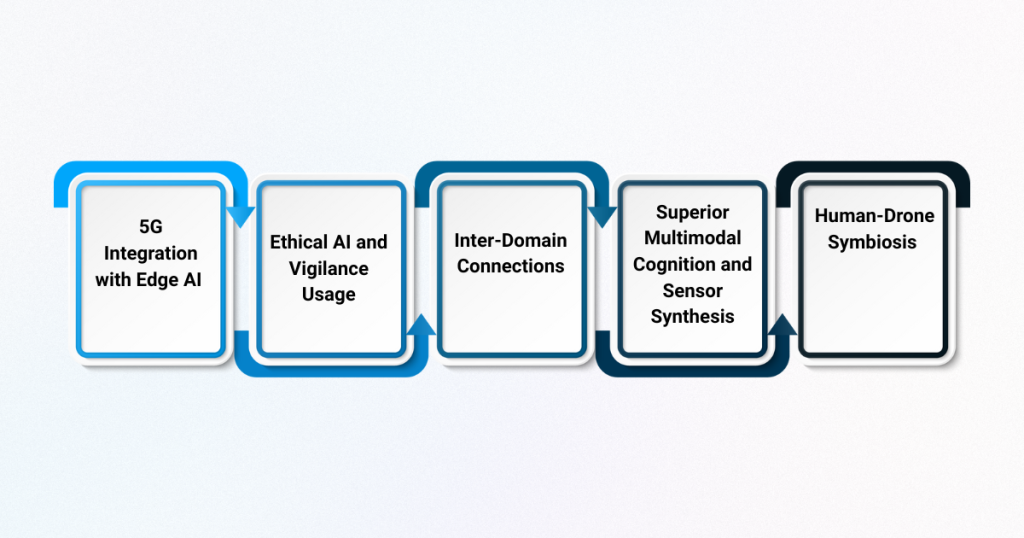
AI technology always evolves at a breathtaking pace. There are various applications for drones in several industries, and their domains would be expanded to build an ai app that can easily control their drone system. Here are some of the hopeful prospects of future AI-powered drones.
1. 5G Integration with Edge AI
This would be a beautiful combination of 5G connectivity with edge computing of AI in drones. It can allow for real-time processing and helps in the decision-making process for artificial intelligence in drone technology. It can also unlock the rapid responsiveness and autonomy levels that can increase the situational awareness.
2. Ethical AI and Vigilance Usage
This technology can ensure an AI framework in drone technologies. It can develop the accountability with transparency with the alignment of human value, which is very important. Similarly, the ethical approaches are also applied in various sectors for implementation, like ai in car wash app solutions. Where the guidelines are mainly included for deployment strategies.
This whole process can build and foster trust that can reduce risks and complete the process of AI for drone adoption.
3. Inter-Domain Connections
Apart from common usage, AI in drones is having new features like underwater operations, space exploration, and travel to other planets from artificial intelligence in drones.
It can be a flexible and smart decision-making machine that can expand human discoveries. This future technology brings revolution and enhances the field of computer science.
4. Superior Multimodal Cognition and Sensor Synthesis
AI-driven future drones will contain an advanced fusion of sensors that can combine data streams from various sensors like infrared, radar, cameras, and LiDAR. This would be a multimodal AI perception that can enable drones to operate and guide the dynamic setting for unexpected situations and increase awareness with a strengthened decision-making process.
5. Human-Drone Symbiosis
AI drones always integrate with human support. It can create a balance of human partnership with AI on the basis of gut feelings and mental skills. This process is generally necessary for computer ability, self-rule, and robot accuracy.
It can be a better way for understanding the situation to make quick decisions in operations. This approach can help humans and machines to work collaboratively in the time of operations.
How GMTA Software Can Help You to Initialize the AI-Driven Conversion in Drones
The combination of drone technologies with AI can revolutionize several industries. Now, mostly businesses and industries opt for drone technologies in their work processes of artificial intelligence in drones. And we also see the impact of ai on social media regarding drone technologies in the future. It would be a great advantage to have various opportunities and growth options in the businesses.
GMTA Software is also here to provide you proper assistance. We have a crew of experts that can guide you through the AI integration process in drones from the initial to the last level. Our commitment to innovation always ensures that your projects will become a revolution for your business with our cutting-edge solutions that can drive efficiency that can increase new opportunities for your business growth.
Make your drone smarter with AI—get your app now.

Conclusion
AI technologies are the revolution in the drone industry. There are new innovations and advanced intelligence that are used by AI technologies in several industries. Many elements are also handled by chatgpt integration services to make drone operations more effective and interactive.
AI drones are the perfect example of innovation by computer science. Through this blog, you also get an idea about AI in Drones. The major role of AI and primary challenges and essential elements of AI in Drones. Let’s build your first drone application with the power of AI with GMTA Software.
Frequently Asked Questions
What are the benefits of AI in drones?
Here are some benefits of AI in Drones
Predictive Maintenance
Expanded Applications
Enhanced Autonomy
Real-Time Data Analysis
Intelligent Navigation
How to integrate AI in drones?
You need to integrate the data with the fusion of several resources. So, it can develop a comprehensive understanding of its surroundings clearly. You need to also include GPS and GNSS for the positional data, route planning, and geolocation.
What is the AI drone concept?
Mostly AI-powered drones have advanced processors and algorithms. It can allow the analysis of the massive amount of data for operations. It can help with real-time data processing for various applications in many industries.
What are the uses of AI applications for the drone industry?
AI technologies can enhance the drone’s system effectively. It is also concerned with several factors like efficiency and dependability. It can also offer new opportunities for the drone industry through multiple applications regarding other sectors.
Which technology is necessary for AI drones?
AI drones need communication technologies like 5G Modems, radio transmitters, and satellite systems for data transfer and command reception as per the situation of the operations

Rishi Ram is CTO at GMTA Software, with 6+ years of experience in software architecture and technical leadership. He’s led GMTA’s work across fintech—including eWallet apps, mobile banking platforms, and Sharia-compliant fintech builds—as well as on-demand and taxi app development and AI-integrated products like fraud detection agents and workflow automation tools.