
Key Takeaways:
- The right development partner should have proven experience taking agents beyond prototypes into production environments with measurable operational requirements.
- Production readiness requires more than model integration. So, you will need evaluation, observability, guardrails, access controls, failure handling, and ongoing AgentOps.
- Enterprise integration capability is critical when an agent must interact with CRM, ERP, EHR, databases, payment platforms, APIs, or legacy applications.
- Before hiring an AI agent development company, compare its architecture expertise, production track record, integration capabilities, security practices, pricing, support model, and ability to scale the solution.
Whether you are in logistics, fintech, healthcare, or eCommerce, the AI agent buying decision has just gotten harder by several notches in 2026. Most businesses are under the pressure of turning AI spend into measurable operating gains. Yet deploying an agentic bot isn’t just about adding another AI tool to the list, but more about changing how work moves through the organization. According to Deloitte’s State of AI in the Enterprise 2026 report, 74% of companies plan to deploy agentic AI within two years, but only 21% report having a mature governance model for autonomous agents.
The top AI agent development companies in 2026 are GMTA Software, TechAhead, LeewayHertz, Markovate, Appinventiv, Kanerika, Intuz, Master of Code Global, eSparkBiz and Azumo. We ranked them on production experience, integration depth, security, scalability, and evaluation practices. Projects typically cost $50K to $1.5M+, depending on scope.
The commercial pressure is much clearer when you look at what happens after the rollout. KPMG’s Q2 2026 AI Pulse Survey of large US enterprises found that 53% of organizations are using AI agents, yet only 26% have full, real-time visibility into what their AI systems cost to run. Unfortunately, only 26% have real-time visibility into the operating costs. So, for your business budgeting six figures for an AI initiative, the true concern is assessing what might happen once the contract is signed. A development team can deliver the bot on schedule, and yet leave you with an expensive system that isn’t integrated properly with your existing tech stack. Problems will start surfacing once you realize the agents aren’t built for real-world exceptions or need employees to intervene frequently.
The stakes multiply when the bots are tied to a process that directly affects your revenue or operating capacity. For example, a sales agent that cannot keep pace with the CRM workflow is most likely to leave opportunities sitting untouched. Similarly, a support agent escalating too many cases will simply move the queue downstream. These aren’t minor technical shortcomings. Rather, they determine if your business actually gains capacity, minimizes operating costs, or works faster without expanding the workforce.
This is why finding the best AI agent development company in 2026 is non-negotiable. Here, we will present you with the top 10 key vendors, with attention to their AI engineering capabilities, enterprise integrations, agent architecture, and industry experience.
What Is an AI Agent Development Company?
An agentic AI development company acts as your technology partner to build AI systems capable of carrying out defined business objectives with limited human intervention. Unlike a conventional IT company that follows fixed workflows, it will design systems that can interpret context, decide what action to take, use available tools, and adapt when a workflow deviates from the expected path.
Its capabilities go into the engineering behind this autonomy. Developers can:
- Design agents that retrieve information from private knowledge bases through RAG pipelines
- Call APIs and business apps to perform actions
- Maintain relevant context across all types of interactions
- Coordinate multiple specialized agents when one bot cannot handle the end-to-end workflow
In addition, these experts also build evaluation frameworks to test agent accuracy and route tasks between AI models based on cost and complexity. They pay special attention to introducing appropriate guardrails around sensitive actions and implementing governance protocols. For enterprise-grade deployments, these capabilities are combined with authentication, permissions, monitoring, logging, and failure-handling mechanisms.
The result is that you get an AI system grounded in actual operating processes, and not as another standalone interface.
Recommended: Understand what types of agents startups and enterprises can build
What Goes Into Building a Production-Ready AI Agent?
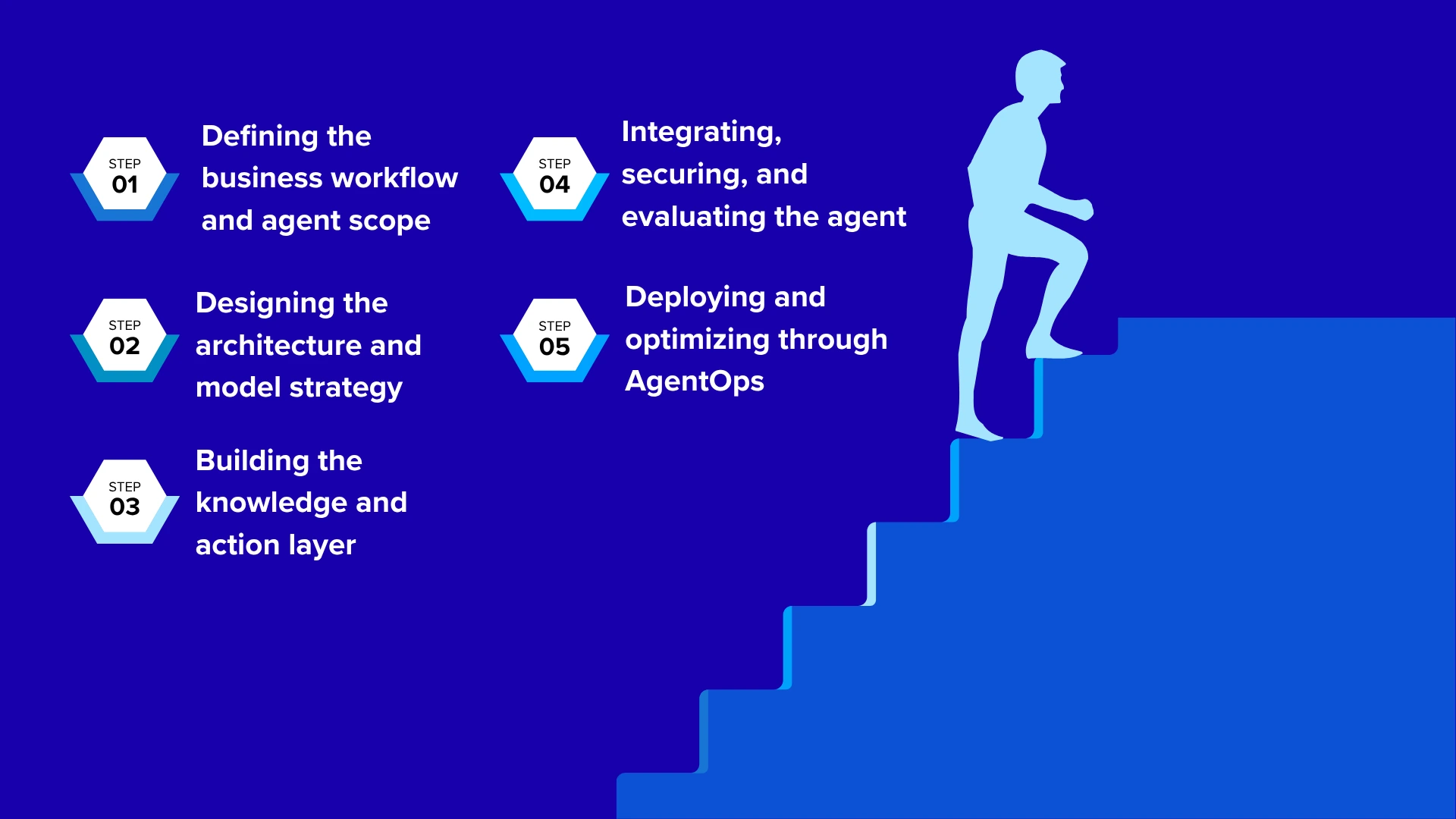
Every AI agent development company has to solve multiple engineering bottlenecks before declaring that the bot is ready for real business use. The work usually moves from the agent’s operating logic to its data, tools, infrastructure, controls, and production behavior. To help you understand what truly goes into designing a production-ready agent, below we have described how the process works.
Defining the business workflow and agent scope
It begins with you defining the agent’s role and operating environment. Based on your requirements, the vendor will study the targeted workflows, existing tools, data sources, user interactions, and business rules. Only then can they determine the agent’s objectives, autonomy level, decision boundaries, escalation conditions, and success metrics. This approach prevents the bot from being designed around an abstract AI capability instead of a specific operational requirement.
Designing the architecture and model strategy
The next stage is selecting the AI architecture and building the agent’s core reasoning system. Developers evaluate models based on parameters like:
- Task’s complexity
- Context requirements
- Latency
- Accuracy
- Cost
Then they engineer planning, reasoning, memory, tool calling, state management, and orchestration. A straightforward workflow might need just one agent, while complex processes can demand multiple specialized agents coordinated through an orchestration layer.
Building the knowledge and action layer
The development team then prepares the private business knowledge that the agent needs to work with. This often involves:
- Document ingestion
- Chunking
- Embeddings
- Indexing
- Retrieval
- Reranking for a RAG pipeline
In addition, experts also build tool and function calling simultaneously. This is done to ensure the agents can query databases, retrieve accurate customer records, create tickets, update system records, or trigger approved workflows.
Integrating, securing, and evaluating the agent
The AI agent development partner connects the bot to your business environment through APIs and controlled system interfaces. From ERP to CRM, WMS, and communication platforms, several internal apps become a part of the execution layer. Apart from this, developers also add security and governance guardrails through:
- Authentication
- Role-based permissions
- Secrets management
- Audit trails
- Human approvals
Evaluation strategy then helps them test real workflows, tool failures, hallucinations, ambiguous requests, prompt injection, and other edge cases. This way, the agents won’t fail when they encounter any out-of-the-box situation in production.
Deploying and optimizing through AgentOps
After testing, the agent gets deployed with monitoring for:
- Task completion
- Failures
- Latency
- Model usage
- Token consumption
- Operating costs
It’s the responsibility of the development vendor to use these production signals to identify where the agents need further refinement.
How We Evaluated These Companies
We assessed the AI agent development companies based on the factors that influence if the agent can move from a PoC stage into a reliable business system. We believe that choosing a proper vendor requires looking beyond portfolio screenshots and generic AI service pages. That’s why our evaluation matrix factored in:
- Technical capabilities
- Production experience
- Integration depth
- Security
- Scalability
- Ability to support complex agentic workflows
| Evaluation Criterion | What We Looked For |
| AI Agent Development Expertise | Experience building autonomous or semi-autonomous agents using tool calling, memory, RAG, planning, reasoning, and agent orchestration. |
| Technical Capabilities | Breadth across LLMs, agent frameworks, vector databases, APIs, RAG pipelines, model routing, multi-agent systems, and supporting infrastructure. |
| Production Experience | Evidence of deploying AI agents for real business workflows rather than limiting work to prototypes, demos, or experimental implementations. |
| Integration Capabilities | Ability to connect agents with CRM, ERP, databases, APIs, enterprise applications, communication platforms, and other systems required for execution. |
| Security & Governance | Approach to authentication, authorization, data protection, auditability, guardrails, human approval, and enterprise AI governance. |
| Industry Experience | Relevant experience across sectors where AI agents must operate within specific workflows, compliance requirements, or data environments. |
| Scalability & Reliability | Architecture and engineering practices that support growing workloads, multiple users, higher transaction volumes, fault handling, and dependable agent execution. |
| Evaluation & Monitoring | Use of testing, observability, agent tracing, performance measurement, failure analysis, and post-deployment optimization. |
| Client Track Record | Publicly available evidence of projects, enterprise clients, case studies, delivery history, and demonstrated implementation experience. |
Top 10 AI agent development companies
-
GMTA Software
Unlike a regular AI company, GMTA Software Solutions always adopts an outcome-first approach to develop and deploy AI agents. Its process begins with the business workflow, expected ROI, and data environment before the team settles on an agent architecture or model. Thanks to its model-agnostic mindset, the company’s technology choice will always follow your business’s specific use case, and not the other way round.
GMTA puts special focus on putting agentic bots into existing enterprise ecosystems. That’s why it plans detailed integrations with legacy platforms, CRMs, EHRs, and payment gateways from day one. If you are still validating the idea, their experts will assist you with a PoC tier. Apart from this, GMTA extends 6 months of post-launch maintenance to ensure the deployed agentic bot can work accurately in real-world scenarios.
Key capabilities:
- Custom AI agents for business-specific workflows and operational automation
- Multi-agent systems using frameworks like LangGraph, LangChain, CrewAI, and AutoGen
- RAG-based agents that retrieve information from your business’s proprietary knowledge bases
- Agentic integrations with legacy enterprise platforms, APIs, EHRs, CRMs, and other internal apps your teams use every day
- Autonomous decision agents for workflows that require limited to almost no human intervention
- LLM selection across Anthropic, OpenAI, Google, Meta, and other model ecosystems
- Monitoring and observability through tools like LangSmith, Weights & Biases, and Datadog
Notable strengths:
Rather than treating every AI agent project as a generic template-based build, GMTA publishes clear engagement tiers. Its current AI agent offering lists PoC and discovery projects at $15K-$25K, single-agent development at $30K-$75K, and multi-agent systems at $80K-$300K+.
Best for:
Startups and established organizations that need more than an AI prototype but don’t want a large enterprise consultancy
-
TechAhead
Being one of the top AI agent development companies, TechAhead has built its service principle around a specific enterprise problem: getting autonomous systems to operate safely inside existing technology environments. Its process, therefore, covers more than simply building and deploying an agentic bot. The company combines agentic AI consulting, workflow and risk mapping, architecture, governance, integration, deployment, and ongoing AgentOps.
This unique approach generates maximum value when your business needs an agent that has to interact with live enterprise systems, and not just operate in a sandbox. TechAhead also takes a partnership-led approach to delivery. Thus, you can engage a dedicated AI team, use staff augmentation, or choose a project-based development model.
Key capabilities:
- Custom agentic AI systems capable of handling complex, multi-step enterprise workflows
- Multi-agent architectures with orchestration, memory, planning, and tool use
- RAG and enterprise knowledge integration for context-aware agent responses
- Agent governance with decision boundaries, human approvals, auditability, and monitoring
- AgentOps covering production observability, performance tracking, failure analysis, and optimization
- Development using LangGraph, AutoGen, CrewAI, LangChain, and AWS Bedrock Agents
Notable strengths:
What positions TechAhead in our list is its AI partnerships combined with formal governance credentials. It holds certifications for SOC 2 Type II, ISO/IEC 27001:2022, and ISO/IEC 42001:2023, thereby signaling its credibility and accountability. In addition, it is an OpenAI Services Partner and part of the Claude Partner Network.
Best for:
Enterprises that need AI agents connected to existing tech systems and governed like other production software
-
LeewayHertz
If you are looking for an AI agent development company in the USA with a strong enterprise and platform focus, LeewayHertz is your best choice. The company covers the full agent lifecycle, from identifying suitable workflows to designing, deploying, and monitoring agentic systems in production. A notable part of its offering is ZBrain, its enterprise AI platform and agentic ecosystem. ZBrain Builders allows experts to design and manage AI-driven apps and agents around your business’s proprietary data.
At the same time, its model-agnostic architecture supports multiple foundation models. In addition, LeewayHertz places considerable emphasis on connecting agents to enterprise data and apps. Its platform includes 200+ pre-built data connectors, multi-agent orchestration, evaluation capabilities, guardrails, and observability. Alongside its flagship platform, the company also develops purpose-built agents for finance, sales, customer service, IT, legal, and marketing.
Key capabilities:
- Custom AI agents for knowledge work, decision support, research, and operational task execution
- Multi-agent systems with sequential, hierarchical, supervisory, and event-driven coordination
- Agent orchestration and workflow engineering for multi-step business processes
- Enterprise integrations using APIs, events, connectors, and microservices
- Development using frameworks and tools such as CrewAI, AutoGen Studio, and TaskWeaver
- ZBrain Builder for designing, deploying, and managing agentic AI applications using proprietary business data
Notable strengths:
LeewayHertz’s biggest distinction is its combination of a custom development approach with its own enterprise AI platform, ZBrain. In addition, the company has also delivered an LLM-powered machinery troubleshooting application for a Fortune 500 manufacturing company.
Best for:
Perfect for an organization that needs multi-agent orchestration, extensive data connectivity, and governance controls
-
Markovate
The vendor’s AI agent development services are rooted in automating business processes that involve multiple systems, decisions, and handoffs. Instead of treating an agent as a standalone assistant, it maps the workflow first and assesses where autonomous execution can generate a measurable operational impact. Its approach moves from opportunity mapping and feasibility assessment into architecture, integration, validation, and production optimization.
Markovate has also built agents for specific enterprise processes. One notable example is an ERP agent developed for a US manufacturer that handles order placement, order tracking, inventory information, pricing, and customer queries. The company has reported 95% order accuracy for that deployment. In addition, its portfolio also includes legal intelligence, insurance claims, investor reporting, and blueprint analysis systems.
Key capabilities:
- AI systems for insurance claims that can assist with document review, information extraction, validation, and claims workflows
- Legal intelligence solutions that bring case information and relevant documents into a single research workflow for legal teams
- Investor reporting agents designed to gather financial information and accelerate the preparation of recurring reports
- Blueprint analysis systems that can interpret technical drawings and extract information required for downstream business processes
- Voice-based agents for customer conversations, automated enquiries, and transaction-oriented interactions
- Feasibility assessment and workflow mapping before development to identify where agentic automation can deliver measurable operational value
- Agent testing through simulated environments and human-in-the-loop evaluation before autonomous workflows are moved into production
Notable strengths:
The company has 15+ years of experience in software development, with over 300+ projects delivered across multiple industries. Its AI practice has earned recognition from Clutch, including placement among its 2025 AI leaders. The company also holds ISO 9001:2015 and ISO/IEC 27001:2022 certifications.
Best for:
Businesses looking to automate a process rather than simply adding an AI assistant, especially for operational workflows involving documents, ERP data, financial processes, or cross-functional decisions
-
Appinventiv
Positioned as a renowned enterprise AI agent development company, AppInventiv’s offerings stand out for the breadth of its managed bot lifecycle, not for focused development. Here, the experts begin with workflow mapping and automation scans, followed by a 90-day implementation roadmap for prioritizing high-impact opportunities. They then build agents around business data and actions using MCP, smart triggers, memory, RAG, and tool integrations.
The company’s development service also includes dedicated agentic AI testing, model optimization, lifecycle management, and Agent-as-a-Service for organizations that want post-launch support. AppInventiv works across various autonomy levels, from copilots that assist employees to autonomous agents capable of executing complete workflows. Its current offering also emphasizes controlled tool access, execution tracing, prompt versioning, and runtime monitoring.
Key capabilities:
- Autonomous and multi-agent systems for executing complete processes and coordinating specialized tasks
- MCP-based agent connections for giving AI systems controlled access to business tools and data
- RAG, vector memory, semantic search, and persistent context for working with proprietary enterprise information
- Agentic AI testing covering execution accuracy, tool use, security, reliability, and multi-agent interactions
- Model optimization using performance monitoring, prompt policies, model routing, and continuous refinement
- Agent-as-a-Service for businesses seeking managed deployment and ongoing production support
Notable strengths:
AppInventiv reports 100K+ daily AI-agent interactions, a 45% reduction in repetitive workload, support for 25+ business functions, and processing of 1B+ data points. In addition, the company also handles 300+ integrations, 500+ automated workflows, and 50K+ validated execution scenarios.
Best for:
Enterprises planning a broader agentic AI program rather than one isolated automation, especially with projects where workflow discovery, strategy, development, testing, and integration need to sit within one engagement
-
Kanerika
Kanerika differentiates its AI agent development services through multi-purpose enterprise agents sitting directly on top of business data and operational systems you interact with daily. Instead of presenting every engagement as a blank-sheet custom build, it develops specialized agentic bots around concrete enterprise problems. Its flagship agent, Karl, provides natural language access to enterprise data and is now available as a native Microsoft Fabric workload.
Klara focuses on compliance, reviewing clauses against organizational playbooks and proposing compliant corrections, while DokGPT handles document intelligence and enterprise knowledge workflows. Kanerika also approaches agent development through the underlying data foundation layer, using Microsoft Fabric, Azure, governed data pipelines, and enterprise-grade RAG pipelines.
Key capabilities:
- Natural-language data agents for querying SQL, NoSQL, cloud data lakes, and real-time enterprise data
- Contract compliance agents that compare agreements against organizational playbooks and identify clause-level risks
- Document intelligence agents for extracting, interpreting, and retrieving information from business documents
- Customer service agents designed around enterprise knowledge, customer context, and defined service workflows
- MCP and A2A-enabled agents for controlled interaction between business tools, systems, and other agents
- Microsoft-focused agent development across Azure AI, Copilot Studio, Power Platform, and Microsoft Fabric
- Enterprise RAG systems connected to Fabric, Synapse, SQL platforms, and existing organizational data sources
- Governance controls including role-based access, audit trails, data masking, and controlled agent actions
Notable strengths:
Kanerika has already worked on 100+ production-ready AI agents and an 85% pilot-to-production rate on its AI development offering. Its production portfolio includes Karl, Klara, DokGPT, Alan, Mike, Susan, and Jennifer, each designed around a specific enterprise function.
Best for:
Enterprises with substantial data estates, Microsoft-heavy environments, or document-intensive workflows, especially when they need agents to work within an existing governed data architecture rather than operate as standalone assistants
-
Intuz
Known as one of the best affordable AI agent development companies, Intuz approaches this with a strong emphasis on production engineering and long-term operation. Its current agent practice is built around the idea that an agent should enter the client’s real technology environment rather than remain a successful prototype. The company works across LangGraph, CrewAI, AutoGen, and n8n, while its engagement model remains explicit about the transition from exploration to production.
Businesses can therefore begin with strategic consultation, move into a real-data prototype, and then progress to system integration and continuous optimization. Intuz also assigns senior engineers throughout the engagement, with the same team being responsible for ongoing optimization after launch. Its agent work spans healthcare, fintech, logistics, manufacturing, and retail, which justifies its experience with environments where agents need to interact with established operational systems.
Key capabilities:
- Domain-specific AI agents designed around industry workflows and operational requirements
- Multi-agent systems that coordinate specialized agents, shared goals, memory, actions, and conflict resolution
- Conversational and voice agents that retain context and connect conversations with business systems
- MCP, function calling, RAG, and tool-use architectures for agents that need to retrieve information and take actions
- Ongoing optimization and support after deployment, with the development team remaining involved in production operations
Notable strengths:
Intuz reports 12 AI agents in production, 40+ integrations, and an 80% client retention rate for clients staying three or more years. Its broader engineering practice spans 16+ years, with 100+ enterprise AI deployments, 700+ products shipped, and delivery across 40+ countries. The company also reports 54 AI systems live in production across its wider AI portfolio.
Best for:
Particularly suited to companies moving from a real-data prototype toward production, especially in healthcare, fintech, logistics, manufacturing, and other operationally demanding environments
-
Master of Code Global
Master of Code Global takes a production-first and governance-led approach to AI agent development, with particular emphasis on validating a workflow before committing to a large-scale development initiative. Its AI Compass Sprint is designed to test a focused use case and establish evidence of business value before full-scale investment. From there, the experts handle architecture, development, integration, deployment, and support through the same team rather than separating strategy and engineering into different engagements.
It also takes a platform-agnostic approach, selecting models and frameworks according to privacy, quality, infrastructure, and cost requirements. Another differentiator is the emphasis on ownership at handover. Its current portfolio includes an internal MCP solution and a real-estate voice agent, showing its focus on bots capable of performing concrete operational work.
Key capabilities:
- AI Compass Sprint for validating one focused workflow and its expected business impact before a larger build
- Single-agent, multi-agent, and hybrid architectures selected according to the complexity of the workflow
- Enterprise agents connected to CRM, ERP, APIs, proprietary data sources, and existing business processes
- Internal MCP solutions that provide conversational access to multiple enterprise tools from a unified workspace
- Voice agents for customer-facing workflows, including lead handling and real estate interactions
- Human-approval checkpoints for workflows where autonomous execution requires controlled sign-off
- Evaluation, fallback logic, observability, and monitoring for agents operating under real production conditions
- Model- and framework-agnostic development based on performance, privacy, cost, and existing infrastructure requirements
Notable strengths:
Master of Code Global has already delivered 1K+ projects and holds ISO 27001 certification. Its published real-estate voice-agent case study reports a 78% reduction in response time, a 35% increase in conversion rate, and a 42% increase in inbound leads. The company also maintains a US presence in Redwood City, California, alongside its Canadian operations.
Best for:
US businesses that want to validate an AI-agent opportunity before making a larger investment, particularly when security, enterprise integration, and production reliability are important
-
eSparkBiz
One of the best AI agent development companies for enterprises you can rely on is eSparkBiz. It brings a broad-scale product-engineering model to AI agent development rather than treating agentic AI as an isolated service. The current offering combines agentic AI consulting, architecture, development, data engineering, cloud, security, and product engineering under one delivery structure. The company starts with business-readiness assessment and use-case prioritization. Only the experts move to agent architecture, prototyping, iterative development, testing, deployment, and lifecycle management.
Its emphasis on legacy modernization is another useful differentiator for businesses that already have substantial software infrastructure but need to introduce autonomous workflows without replacing the underlying systems. eSparkBiz offers dedicated engineering teams and managed capacity, thereby allowing you to add agent expertise without creating an entirely new internal function.
Key capabilities:
- Multi-agent systems that coordinate specialized agents across interconnected business processes
- Agentic workflow automation for tasks spanning multiple teams, systems, and operational stages
- Agentic data analysis for extracting insights and supporting decisions from enterprise information
- RAG-powered agents connected to organizational documents, knowledge repositories, and structured data
- AI agent fine-tuning using domain-specific data to improve accuracy and reduce response errors
Notable strengths:
eSparkBiz brings the benefits of completing 15+ years in business, having 400+ engineers, delivering 1K+ projects, and working with 300+ clients, coupled with a 4.9/5 rating across 70 verified Clutch reviews. Its current AI practice also highlights 45+ technologies, 95% client retention, and ISO 9001:2015 and ISO 27001:2022 certifications. The company maintains US operations in Delaware alongside its engineering base in India.
Best for:
Mid-market and enterprise businesses that need AI agents as part of a larger software, data, or modernization initiative
-
Azumo
Azumo differentiates its AI agent practice through a production-focused, model-neutral engineering approach and a nearshore delivery model. It has been building AI systems since 2016 and positions the teams around the complete path, from scoping and architecture through deployment and ongoing operation. Rather than locking projects to one model provider, Azumo works across OpenAI, Qwen, Anthropic, Google, Mistral, DeepSeek, and other models. In addition, it also selects the stack according to latency, performance, privacy, infrastructure, and cost requirements.
Its agent portfolio goes beyond generic assistants. Azumo has built an autonomous SDR agent for outbound sales, research agents with source verification and human approval, workflow agents that operate across systems of record, and a predictive pricing agent for financial operations. Furthermore, the company has also developed its own AI infrastructure platform, Valkyrie, which offers a unified interface across models.
Key capabilities:
- Autonomous SDR agents that research accounts, conduct outreach, handle replies, and update CRM records
- Research agents that gather information from multiple sources, cite retrieved evidence, identify source conflicts, and escalate write actions for approval
- Workflow agents that execute processes across Salesforce, SAP, ServiceNow, and other business systems with defined approval boundaries
- Predictive analytics agents that monitor data, identify patterns, and generate forecasts for operational or financial decisions
- Voice agents for customer-facing interactions, including AI receptionists and automated call handling
- Model selection and optimization across commercial and open-weight models based on the requirements of the individual deployment
Notable strengths:
Azumo has completed 300+ successful deployments and has been delivering AI solutions since 2016. The company is SOC 2 certified and has delivered production AI systems for organizations ranging from startups to Fortune 100 companies. Its published AI work includes projects for Meta, Omnicom, Discovery Channel, Stovell, Angle Health, and Centegix.
Best for:
US businesses that want production AI engineering without being tied to a single foundation-model ecosystem
| Company | Core AI Agent Focus | Standout Differentiator | Key Capabilities | Enterprise Integration | Notable Proof Points | Best Suited For |
| GMTA Software | Business-specific single- and multi-agent systems | Outcome-first, model-agnostic approach with defined POC-to-production engagement tiers | RAG agents, autonomous decision agents, multi-agent systems, legacy-system integration, enterprise workflows | CRMs, EHRs, payment gateways, legacy platforms, APIs | 7+ years, 200+ projects, 80+ clients; published POC, single-agent, and multi-agent engagement tiers | Startups and established businesses moving from AI validation to production |
| TechAhead | Enterprise agentic AI and AgentOps | Strong focus on governance, legacy environments, and post-deployment operations | Multi-agent systems, RAG, planning, memory, governance, observability, AgentOps | ERP, CRM, databases, APIs, enterprise applications | OpenAI Services Partner; Claude Partner Network; SOC 2 Type II; ISO 27001 and ISO 42001 | Enterprises with complex infrastructure and strict governance requirements |
| LeewayHertz | Enterprise AI agents through custom development and ZBrain | ZBrain platform with extensive data connectivity and model-agnostic architecture | Multi-agent orchestration, RAG, enterprise knowledge, evaluation, guardrails, observability | 200+ prebuilt data connectors, enterprise apps, databases, APIs | ZBrain supports multiple foundation models and 200+ data connectors | Enterprises building multiple agents around proprietary data and workflows |
| Markovate | Workflow-specific enterprise automation | Strong portfolio of purpose-built agents for operational processes | ERP agents, insurance claims, legal intelligence, investor reporting, blueprint analysis, voice agents | ERP, enterprise applications, documents, financial systems | 15+ years; 300+ projects; ISO 9001 and ISO 27001; published 95% order accuracy case | Businesses automating defined operational workflows |
| Appinventiv | Managed agent lifecycle and enterprise automation | Workflow mapping, agentic testing, lifecycle management, and Agent-as-a-Service | Autonomous agents, multi-agent systems, MCP, RAG, memory, testing, optimization | CRM, ERP, collaboration platforms, cloud and internal systems | 100K+ daily AI-agent interactions; 300+ integrations; 500+ automated workflows; 50K+ validated scenarios | Enterprises seeking development plus ongoing agent operations |
| Kanerika | Product-led enterprise agents | Purpose-built agents such as Karl, Klara, and DokGPT, with strong Microsoft alignment | Data agents, compliance agents, document intelligence, customer-service agents, multi-agent systems | Microsoft Fabric, Azure AI, Copilot Studio, Power Platform, ERP, CRM | 100+ production-ready agents; 85% pilot-to-production rate; Karl available as a Microsoft Fabric workload | Data-intensive enterprises, particularly Microsoft-centric organizations |
| Intuz | Production AI agents and workflow automation | Strong emphasis on moving from prototype to production with continued engineering support | Autonomous workflow agents, multi-agent systems, voice agents, RAG, MCP, tool use | CRM, ERP, helpdesk, databases, data warehouses | 16+ years; 700+ products shipped; 100+ enterprise AI deployments; 40+ integrations | Businesses integrating agents into established operational environments |
| Master of Code Global | Production-focused agent engineering | AI Compass Sprint for validating an agent opportunity before larger investment | Workflow agents, multi-agent systems, voice agents, MCP, human approval, observability | CRM, ERP, APIs, proprietary data, business systems | 1K+ projects; ISO 27001; published voice-agent case studies | US businesses wanting to validate an agent use case before scaling |
| eSparkBiz | Enterprise AI and product engineering | AI agents positioned within broader software modernization and engineering programs | Workflow automation, multi-agent systems, RAG, data analysis, simulation, fine-tuning | APIs, databases, CRM, ERP, legacy software | 15+ years; 1K+ projects; 400+ engineers; 300+ clients; ISO 27001 | Mid-market and enterprise organizations combining AI with modernization |
| Azumo | Production AI agents and model-neutral engineering | Model-agnostic approach combined with nearshore delivery and concrete autonomous-agent deployments | SDR agents, research agents, workflow agents, predictive agents, voice agents, multi-agent systems | Salesforce, SAP, ServiceNow, cloud, private and hybrid infrastructure | 300+ deployments; AI delivery since 2016; SOC 2; work spanning startups to Fortune 100 companies | US businesses needing production agents without being locked to one model ecosystem |
AI Agent Development Companies by Use Case
Healthcare
Every AI agent designed for this highly regulated industry can operate within sensitive data environments and established operational systems. The development partner, therefore, should have substantial experience with healthcare workflows, enterprise integrations, data governance, and automation that can operate within defined boundaries.
| Company | Relevant Strength | Potential Use Cases | Best For |
| GMTA Software | EHR and healthcare-system integration | Healthcare administration, EHR workflows, patient support, data-driven automation | Healthtech companies that need agents connected to EHRs, payment systems, or existing healthcare software |
| TechAhead | Enterprise governance and secure AI integration | Patient engagement, healthcare operations, documentation, internal knowledge | Hospital networks and healthcare enterprises modernizing complex, legacy technology environments |
| LeewayHertz | Enterprise knowledge and proprietary-data integration | Healthcare research, knowledge management, administrative workflows | Healthcare organizations building internal knowledge agents across large proprietary data estates |
| Markovate | Workflow-specific enterprise automation | Claims, documentation, insurance, operational workflows | Healthcare insurers and providers looking to automate document-heavy operational processes. |
| Intuz | Production AI engineering and healthcare experience | Patient support, document processing, healthcare operations | Healthtech product companies taking an AI-enabled application from prototype to production |
Fintech
Fintech agents operate around financial information, transactions, compliance processes, and customer interactions where accuracy and traceability hold immense significance. So, you need a development partner who can connect the agentic bots with financial systems while controlling what they can access and execute.
| Company | Relevant Strength | Potential Use Cases | Best For |
| GMTA Software | Fintech experience and payment-system integration | KYC/AML, transaction monitoring, financial operations, customer support | Fintech platforms building agents around payments, KYC, transaction monitoring, or financial APIs |
| TechAhead | Security, governance, and enterprise integration | Banking operations, compliance, financial-service automation | Banks and established financial institutions integrating AI into governed core operations |
| Markovate | Financial workflow and reporting automation | Financial reporting, investment workflows, document processing | Investment and financial-services firms automating recurring research and reporting processes |
| Appinventiv | Managed agent lifecycle and enterprise automation | Financial operations, compliance, customer service | Fintech scale-ups moving from individual AI use cases toward an organization-wide agent program |
| Azumo | Model-neutral production AI engineering | Financial research, analytics, customer service, workflow automation | Fintech products that need flexibility across foundation models, infrastructure, and deployment environments |
Recommended: AI Agents Are Revolutionizing Fraud Detection
Enterprise
Enterprise-grade AI agents usually have to work across multiple applications, departments, data repositories, and approval structures. This makes integration, orchestration, governance, observability, and scalability central to the development decision.
| Company | Relevant Strength | Potential Use Cases | Best For |
| LeewayHertz | ZBrain and extensive enterprise data connectivity | Enterprise knowledge, research, operations, multi-agent workflows | Organizations planning a portfolio of AI applications that must work across many proprietary data sources |
| TechAhead | Governance, legacy integration, and AgentOps | Enterprise automation, IT operations, internal assistants | Enterprises where AI agents must operate inside existing legacy systems with formal governance |
| Kanerika | Purpose-built agents and Microsoft Fabric expertise | Data analysis, compliance, document intelligence, decision support | Microsoft Fabric users looking to turn enterprise data into governed, conversational agent experiences |
| Appinventiv | Full lifecycle management and Agent-as-a-Service | Departmental automation, multi-agent workflows, enterprise operations | Enterprises that want one partner to manage strategy, development, testing, deployment, and agent operations |
| Master of Code Global | Production validation and structured implementation | Workflow automation, research, voice agents, customer operations | Enterprise innovation teams that need to validate an agent concept before committing to a larger rollout |
SMB
For SMBs, the agentic development decision is less about building a large autonomous ecosystem and more about solving one or two expensive operational bottlenecks without creating unnecessary technical overhead. A suitable partner should, therefore, be able to validate the specific use case, integrate the tools your business already uses, and offer a practical path from an initial deployment to broader automation.
| Company | Relevant Strength | Potential Use Cases | Best For |
| GMTA Software | POC-to-production engagement structure | Customer support, sales, internal automation, operations | Startups testing a commercially viable AI agent before investing in a larger production system |
| Intuz | Production engineering with ongoing optimization | CRM automation, customer service, workflow automation | SMBs whose agents need to connect with their existing CRM, helpdesk, databases, or internal tools |
| Master of Code Global | Use-case validation before larger investment | Sales, research, customer-facing agents, workflow automation | Founder-led businesses that want to establish the business case for an agent before scaling development |
| eSparkBiz | AI development combined with broader engineering capacity | Business automation, knowledge agents, customer support | Growing SaaS and digital businesses that need both AI development and conventional product engineering |
| Azumo | Model-agnostic development and flexible production engineering | Sales agents, customer service, research, operational automation | US startups that need a lean external AI engineering team without building an in-house AI function |
AI Agent vs. Chatbot vs. Traditional Automation
An AI agent can interpret goals, make decisions, use tools, and execute multi-step tasks with limited human intervention. A chatbot, on the other hand, primarily handles conversations by responding to user inputs or prompts. That’s why it’s suitable for FAQs, customer support, and basic guidance. When we talk about traditional automation, it follows predefined rules, workflows, or triggers to perform repetitive tasks consistently.
The key difference here is autonomy. Automation follows fixed logic. Chatbots respond conversationally. AI agents can reason through changing situations and take actions across connected systems. Thus, for your business, the right choice will depend on workflow complexity, required autonomy, integration needs, risk tolerance, and how much decision-making your system must handle.
| Factor | AI Agent | Chatbot | Traditional Automation |
| Primary role | Completes tasks and manages multi-step workflows | Handles conversations and answers user queries | Executes predefined tasks and processes |
| Decision-making | Interprets context and can make decisions | Provides responses based on context and programmed logic | Follows fixed rules and conditions |
| Autonomy | High | Low to moderate | Low |
| System actions | Can call APIs, update records, trigger workflows, and use tools | Can perform limited actions through integrations | Performs predefined system actions |
| Handling exceptions | Can assess situations and determine the next action | Usually escalates complex requests | Follows predefined exception rules |
| Data access | Can retrieve and reason over business data using RAG and connected tools | Retrieves information to formulate responses | Accesses specific data required by the workflow |
| Best suited for | Dynamic, multi-step business processes | Customer support, FAQs, lead qualification | Repetitive and predictable processes |
| Example | Reviews a request, checks CRM data, creates an order, and escalates unusual cases | Answers a customer’s question about an order | Automatically sends an invoice after payment |
| Human involvement | Mainly for approvals, exceptions, and high-risk decisions | Required for complex or unsupported queries | Required when the predefined workflow cannot handle the case |
| Implementation complexity | High | Moderate | Low to moderate |
Recommended: Get more insights on AI Agent vs. AI Chatbot
What Does AI Agent Development Cost?
In 2026, AI agent development costs range between $50K and $1.5M+, depending on complexity, integrations, and deployment requirements. A basic task-specific agent can start around $50K, while enterprise-grade multi-agent systems can exceed the $400K threshold. The cost increases when an agent requires RAG, proprietary data access, CRM or ERP integrations, complex tool calling, multi-agent orchestration, security controls, human approvals, and production monitoring. Apart from the initial build costs, you also need to budget for ongoing infrastructure, model inference, maintenance, evaluation, and AgentOps.
| AI Agent Type / Project Scope | Typical 2026 Development Cost | Typical Timeline | What Usually Drives the Cost |
| Task-specific AI agent | $50K–$70K | 4–8 weeks | RAG, basic tool use, prompt engineering, UI and API integration |
| Business process agent | $70K–$160K | 8–14 weeks | CRM/ERP integrations, memory, workflow logic, tool calling, exception handling |
| RAG-based enterprise agent | $70K–$250K | 3–6 months | Enterprise data pipelines, retrieval, access controls, integrations, monitoring |
| Multi-agent system | $175K–$400K | 4–9 months | Agent orchestration, inter-agent communication, shared state, testing and observability. |
| Full enterprise agentic platform | $450K–$1.5M+ | 12–24 months | Multiple workflows, legacy integrations, governance, security, infrastructure and AgentOps |
Recommended: How to choose a software development company
How to Choose the Right AI Agent Development Company?
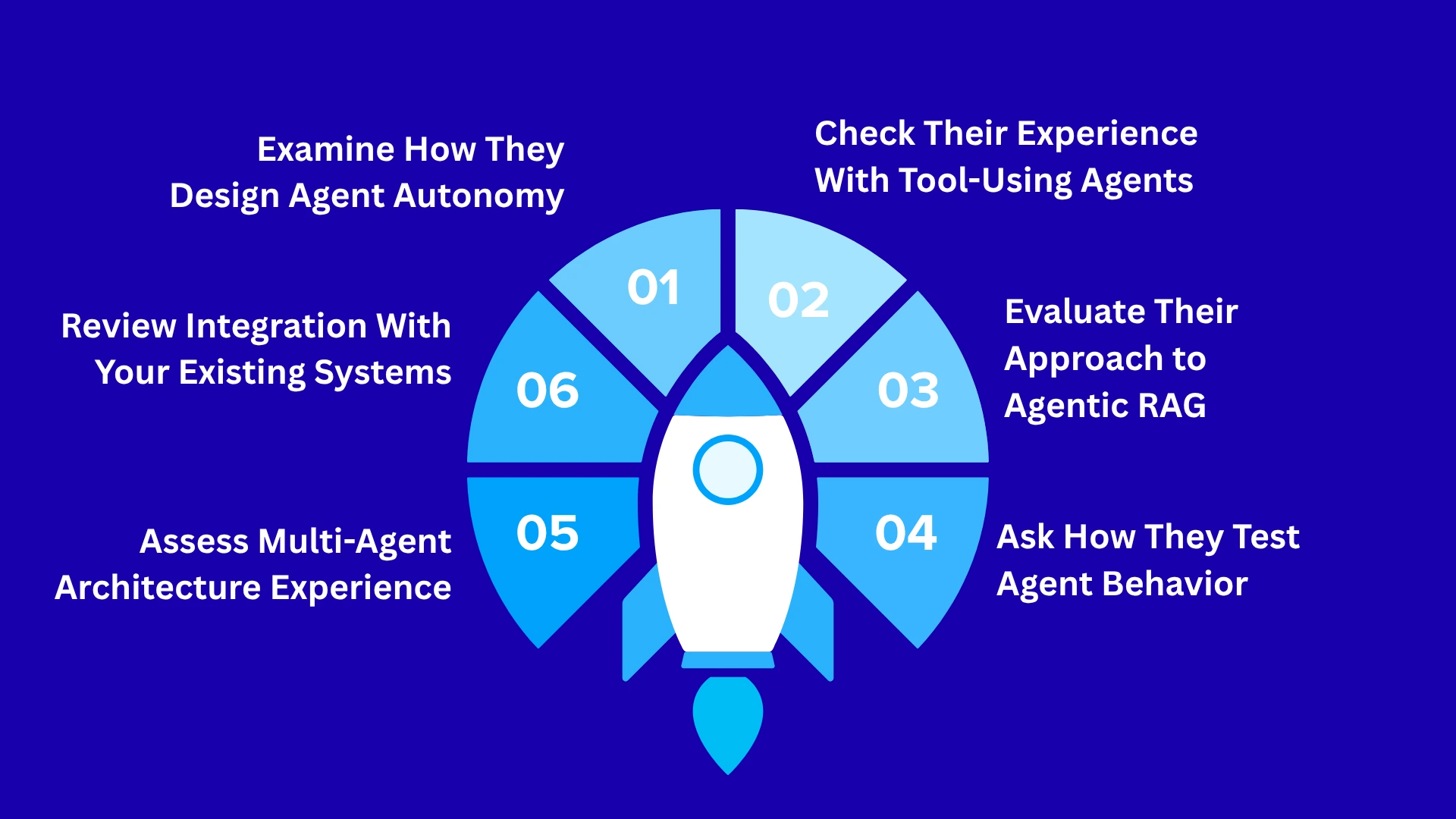
Examine How They Design Agent Autonomy
A capable AI agent development company must define what the bot can observe, decide, and execute rather than simply connecting an LLM to your application. Ask how they establish autonomy boundaries, approval checkpoints, escalation paths, memory, planning logic, and fallback behavior. For a finance agent, for example, reading transaction data and preparing a recommendation can be automated differently from actually approving a transaction.
Check Their Experience With Tool-Using Agents
The value of an AI agent stems from what it can do beyond generating text. Assess whether the company has built agents that use function calling, APIs, enterprise apps, databases, MCP servers, or other tools to complete the dedicated tasks. Look for evidence of agents that can retrieve information, perform actions, verify results, and continue a workflow rather than simply returning an answer.
Evaluate Their Approach to Agentic RAG
If your agent needs to access company-specific information, you must ask how the vendor handles the entire RAG pipeline, not just whether it supports this mechanism or not. This can include questions about document ingestion, chunking, embeddings, metadata, hybrid retrieval, reranking, access permissions, citation, or source tracking.
Ask How They Test Agent Behavior
Traditional software testing doesn’t capture agent failures. Therefore, your development partner should test incorrect tool selection, hallucinated actions, broken API responses, ambiguous instructions, prompt injection, conflicting data, and unexpected workflow states. Ask whether they use traces, simulations, evaluation datasets, human review, and production feedback to measure agent reliability.
Assess Multi-Agent Architecture Experience
If your workflow requires several specialized agents, examine if the vendor knows when not to use a multi-agent architecture. A good team should be able to justify single-agent, supervisor-worker, sequential, hierarchical, or collaborative designs based on the workflow.
Review Integration With Your Existing Systems
An AI agent becomes operationally valuable when it can work with the systems your business already operates with. Check the company’s experience in integrating agents with CRM, ERP, ticketing, payment, EHR, database, communication, and internal API environments.
FAQs
How much does it cost to hire an AI agent development company?
Hiring an AI agent development company in 2026 will cost you between $50K and $1.5M+, depending on the workflow complexity, integrations, data architecture, autonomy, and security requirements. A focused single-agent implementation usually sits at the lower end, while multi-agent enterprise systems can range from $175K to $400K. Apart from this, you should budget separately for model inference, cloud infrastructure, monitoring, maintenance, evaluation, and post-launch AgentOps.
How long does an AI agent development company take to deliver a production-ready agent?
An AI agent development company takes about 6 weeks to 6 months or longer to deliver a production-ready agent. A focused agent with limited tools and integrations can move faster. Enterprise deployments, however, take longer because teams must map workflows, build RAG pipelines, integrate business systems, establish permissions, test agent behavior, handle failure scenarios, and complete production evaluation.
How do I evaluate an AI agent development company’s technical expertise?
Evaluate an AI agent development partner through production case studies, architecture expertise, integration depth, and evaluation practices. Ask whether its teams have built tool-using agents, RAG systems, memory, multi-agent orchestration, MCP integrations, and model-routing architectures. Also examine how they test hallucinations, incorrect tool calls, prompt injection, workflow failures, latency, cost, and post-launch agent performance.
Should I choose an AI agent development company based on its industry experience?
Industry experience should influence your decision when the agent operates within specialized workflows, regulated data, or industry-specific systems. However, it shouldn’t replace technical evaluation. A healthcare company, for example, must examine healthcare workflow experience alongside EHR integration, access controls, RAG security, auditability, human approvals, and agent evaluation. The strongest fit is the company whose experience matches your workflow and risk profile.

Rishi Ram is CTO at GMTA Software, with 6+ years of experience in software architecture and technical leadership. He’s led GMTA’s work across fintech—including eWallet apps, mobile banking platforms, and Sharia-compliant fintech builds—as well as on-demand and taxi app development and AI-integrated products like fraud detection agents and workflow automation tools.