



Key Takeaways
- Choosing a software development company requires more than comparing pricing and portfolios.
- Businesses should evaluate technical expertise, AI capabilities, communication, security standards, and long-term support.
- AI adoption doesn’t automatically mean faster delivery. Independent research has found cases where AI tools slowed down experienced developers — so efficiency claims are worth pressure-testing, not taking at face value.
- A structured evaluation process helps reduce project risks, improve delivery speed, and maximise return on investment.
- Asking the right questions before signing a contract helps identify the best long-term technology partner
Software isn’t optional infrastructure anymore — it’s the operating layer of the business itself, from logistics to customer operations. Off-the-shelf tools solve part of that, but most companies eventually hit a wall where generic software doesn’t match how they actually work. That’s the moment they start asking how to choose a software development company that can actually solve the problem—and the moment when a rushed decision quietly gets expensive.
Choosing a software development partner is more than assessing their ability to write code fast or make prompt deliveries. They need a technology partner capable of building scalable, secure, and intelligent software that can adapt to your changing business needs and AI advancements.
There’s also a widespread assumption worth challenging directly: that “AI-native” automatically means faster. It doesn’t, by default. A 2025 randomized controlled trial by AI safety research group METR found that experienced developers working in codebases they already knew well were actually 19% slower when allowed to use AI coding tools—despite believing, both before and after the study, that AI had made them faster. Measuring the Impact of Early-2025 AI on Experienced Open-Source Developer Productivity (SOURCE: METR). The result is specific to experienced developers on familiar, mature codebases using a particular generation of tools—it doesn’t prove AI slows everyone down everywhere. But it makes the underlying point worth taking seriously: efficiency isn’t automatic just because AI is involved.
Being AI-native also brings the assumption that AI makes coding faster. This is a misconception debunked by studies that indicate that experienced coders who rely on AI to deliver code, in fact, see a 19% depreciation in their productivity compared to when they code themselves. In other words, efficiency cannot be the only scale used to gauge a software development company. So what is it? The right partner should align with your business objectives, understand your industry requirements, communicate transparently, and have the capabilities to support your product throughout its lifecycle.
This guide walks through a structured framework for evaluating custom software development partners—what to look for, the common mistakes to avoid, and how to tell a genuinely AI-native team from one that’s just added a chatbot to their sales deck.
How to Choose a Software Development Company: A 5-Step Framework
Before the details, here’s the sequence worth following, in order:
- Define the problem, not just the feature — write down the business outcome you need, not just “build an app.”
- Vet technical proof, not claims — ask for real architecture artifacts, not a portfolio slideshow.
- Test AI maturity specifically — ask the governance question in the AI-native section below; watch how fast and how specifically they answer.
- Match the engagement model to your internal capability gap — not to the lowest quote.
- Confirm cost, ownership, and support terms in writing before you’re emotionally committed to the relationship.
Everything below expands on each step.
Why Does the Old Evaluation Checklist No Longer Work?
The old checklist—hourly rate, years in business, company size, and portfolio volume—no longer separates good partners from risky ones, because almost every vendor today can clear that bar. The U.S. software development market has grown large and crowded—by one widely cited estimate, there are more than 500,000 software and IT services companies operating in the U.S. alone [Grand View Research]. More competition means more noise, and more companies that look identical on paper
This sudden shift can be categorized into the following:
- Speed has become redundant: Any and every company is able to deliver code promptly. So, that is not a factor anymore. The focus has shifted more towards how reliable, streamlined, and secure the final product is and, more so, whether it aligns with the business objective.
- Governance without grievance: Software governance has become particularly important as applications increasingly rely on AI models, cloud infrastructure, third-party APIs, open-source components, and interconnected data systems. A capable development partner should have clear processes for managing security, data access, architecture decisions, code quality, compliance requirements, documentation, and changes to the technology stack.
- AI is an added cost: Any AI-native software development company cannot exclude the excess cost they bear in the form of LLMs and tokenized models. The right partner must understand and streamline these costs in order to deliver a sustained pricing model that works for you in the long run.
What Should You Look for in a Software Development Company?
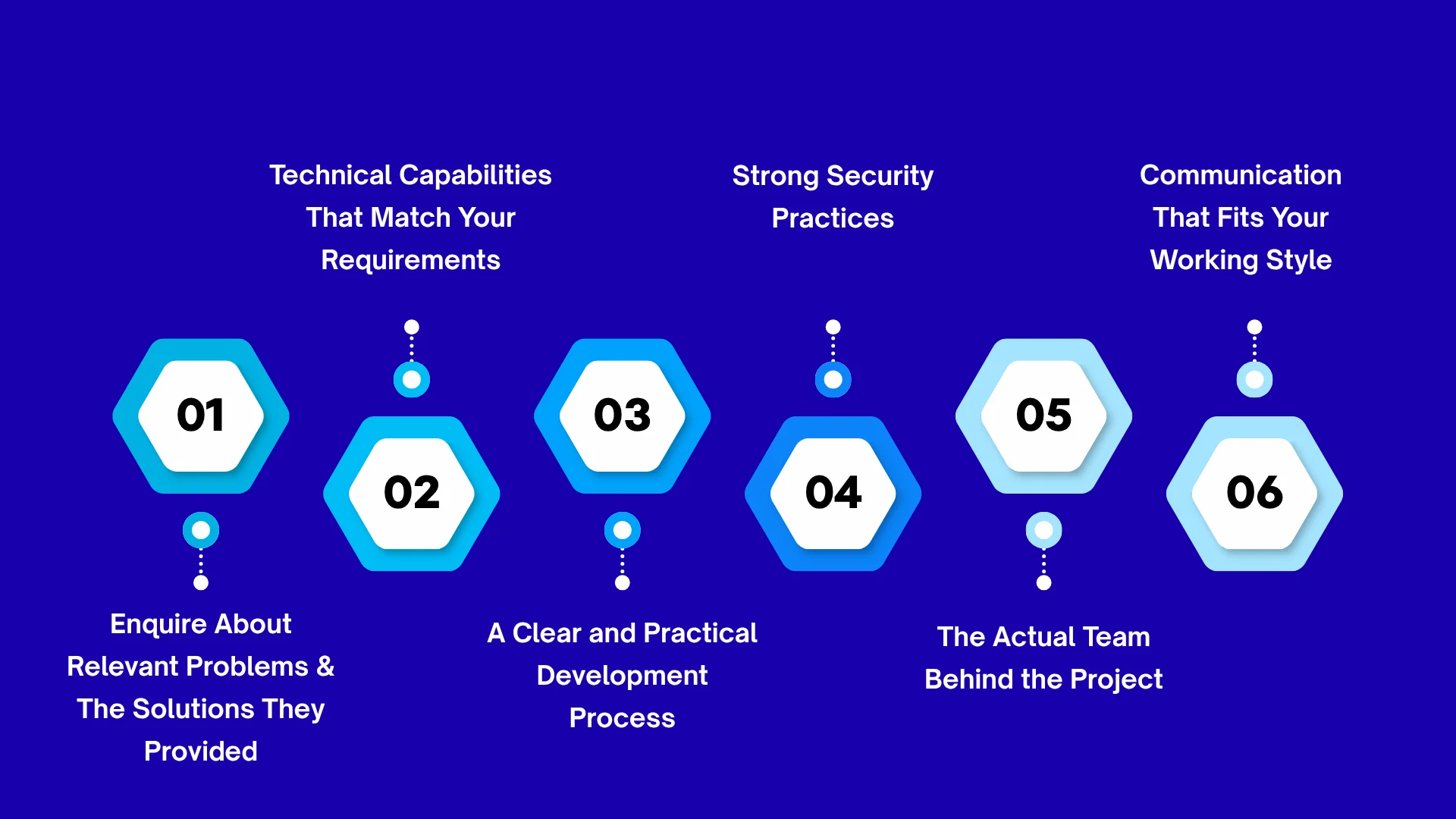
Choosing a software development company is about more than checking its portfolio or comparing hourly rates. The partner should understand your business goals, have the technical capabilities to build what you need, and be able to support the product as it grows.
Before signing a contract, look at these key areas:
1. Enquire About Relevant Problems & The Solutions They Provided
Start by looking at the company’s experience with projects that are similar to yours in terms of industry, functionality, complexity, or business model. A company may have an impressive portfolio, but that does not necessarily mean it has experience solving problems like yours.
2. Technical Capabilities That Match Your Requirements
Instead of simply relying on claims, ask the software companies for concrete proof of their work. Request API documentation, cloud architecture diagrams, or sample CI/CD pipelines to verify coding and design standards. You can also ask for database ER diagrams, testing reports, and direct links to live mobile apps and websites to truly gauge their technical expertise.
3. A Clear and Practical Development Process
You should know exactly how they take an idea from requirements to launch—discovery, planning, development, testing, review, and deployment—and how they handle change requests once work is underway. Most credible partners work in some flavor of agile methodology—ask them to explain how it actually plays out sprint to sprint, not just that they “use agile.”
4. Strong Security Practices
Security should be built in from the start, not bolted on before launch—especially if your software touches customer data, financial data, or healthcare information. If you’re in or adjacent to healthcare, this is worth checking specifically: see what HIPAA-compliant app development actually requires before you take a vendor’s compliance claims at face value.
5. The Actual Team Behind the Project
The people you speak to during the sales process may not be the people who eventually build your software. Find out who will be responsible for design, development, testing, project management, and technical decisions.
6. Communication That Fits Your Working Style
Even a technically excellent team can become difficult to work with if communication is poor. Before hiring a company, establish how often you will receive updates, who your main contact will be, and which tools you will use for communication and project tracking.
Custom Software Development Company Checklist
The following checklist can simplify your evaluation process.
| Evaluation Criteria | Why It Matters |
| Technical expertise | Ensures the right technologies are used |
| AI capabilities | Supports intelligent automation and innovation |
| Industry knowledge | Reduces compliance and business risks |
| Security practices | Protects sensitive business and customer data |
| Communication process | Keeps projects transparent and collaborative |
| Development methodology | Improves delivery speed and flexibility |
| Cloud expertise | Enables scalability and reliability |
| Post-launch support | Ensures long-term product success |
| Client references | Validates credibility and delivery quality |
| Pricing transparency | Prevents unexpected project costs |
Using a structured custom software development company checklist helps compare multiple vendors objectively instead of relying on marketing claims alone.
How Do I Evaluate an AI-Native Development Partner?
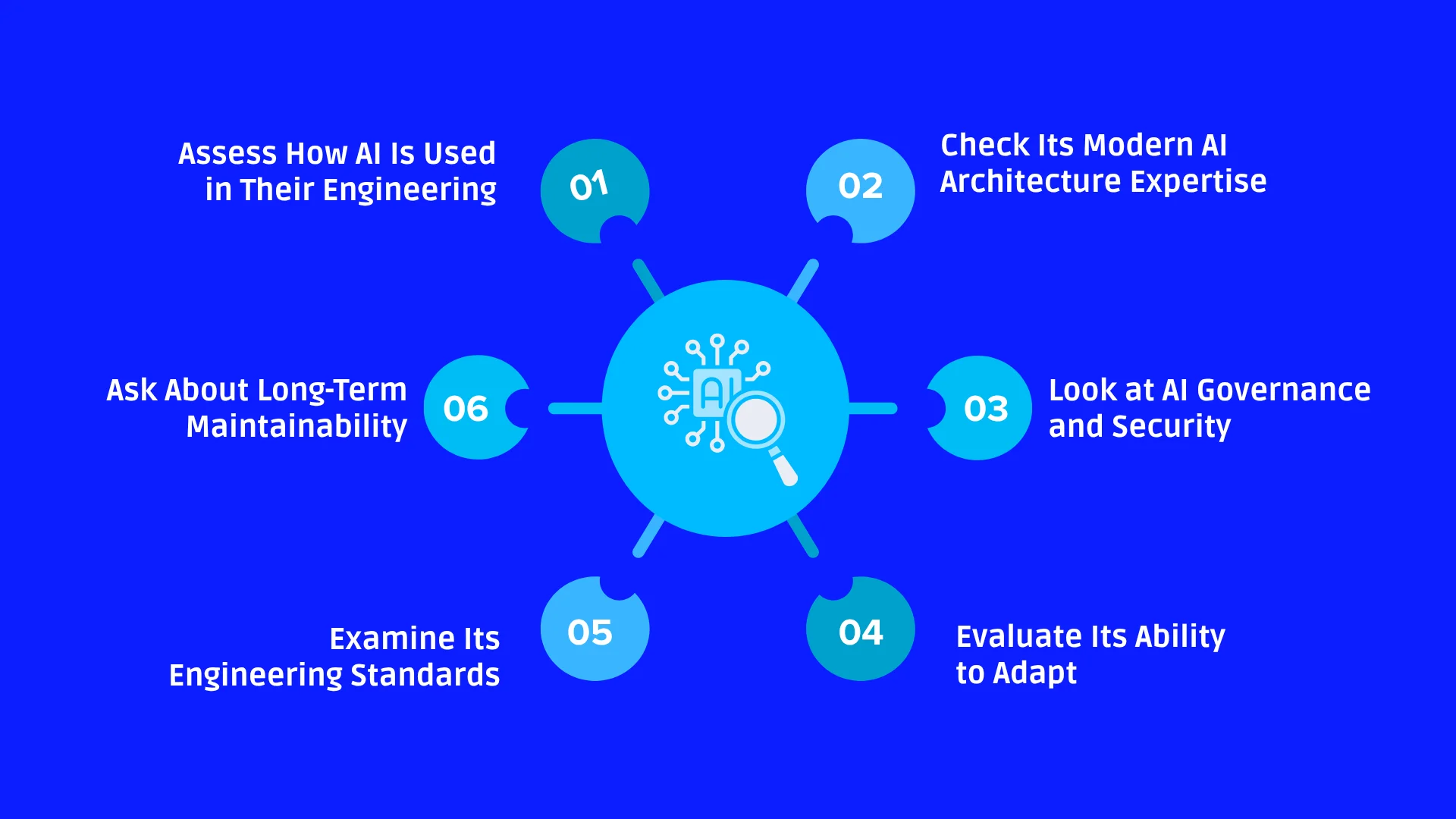
An AI-native partner should bring more than familiarity with AI tools or LLM APIs. What actually matters is whether they can integrate AI into real engineering practice while maintaining strong architecture, security, governance, and quality standards — the same discipline GMTA’s AI development services are built around. If you’re specifically vetting for AI talent or an AI-focused build, our guides on how to hire an AI developer and top AI development companies go deeper on this than we will here.
1. Assess How AI Is Used in Their Engineering
Ask how the company uses AI across development, testing, code review, documentation, and delivery. The focus should be on measurable improvements in productivity and quality, not simply using AI coding tools.
2. Check Its Modern AI Architecture Expertise
The partner should understand architectures such as RAG, AI agents, model integration, vector databases, and AI-powered automation where relevant. It should also be able to explain why a particular architecture or model fits your use case.
3. Look at AI Governance and Security
Validating AI outputs requires real safety nets: human sign-off before risky actions go live, a defined confidence threshold where the system defers to a person instead of guessing, and a standing test suite that runs every time the AI setup changes. For a deeper look at what this looks like at scale, see enterprise AI governance and compliance.
The one question that separates real production experience from a vendor who’s just tried an API: ‘Tell me about an AI feature you’ve run in production for 6 months — what broke, and what did you fix?’ A team with real experience answers fast, specifically, and without hesitation. A team that’s only prototyped will stall.
4. Evaluate Its Ability to Adapt
AI technologies and development practices change quickly. Look for a partner that regularly evaluates new models, frameworks, cloud capabilities, and engineering tools instead of relying on a fixed technology stack.
5. Examine Its Engineering Standards
AI can accelerate development, but speed should not come at the expense of software quality. Check whether the company combines AI-assisted development with code reviews, testing, documentation, security controls, and clear technical ownership.
6. Ask About Long-Term Maintainability
An AI solution should not become dependent on a single model, tool, or vendor without a clear reason. Discuss model switching, API changes, monitoring, cost management, and how the system can evolve as AI capabilities improve.
Ultimately, an AI-native partner should demonstrate AI capability, engineering discipline, and governance maturity together. That combination is a stronger indicator of whether the company can build and maintain modern AI-enabled software.
Ask Us the Production Question
Most vendors can talk about AI. Few can answer what broke in production and how they fixed it. Put us on the spot — book a 20-minute call and ask us directly.
Onshore vs. Nearshore vs. Offshore: What’s the Real Trade-Off?
Where a development team is located affects cost, time-zone overlap, and how easily you can validate the answers above in person. It shouldn’t be a proxy for quality — plenty of offshore and multi-location teams operate with the same governance rigor described throughout this guide, and plenty of onshore-only shops don’t. For a full breakdown of this decision, see our dedicated guide: Nearshore vs. Offshore Development.
| Model | Typical Cost | Time-Zone Overlap | What to Verify |
| Onshore (US-based) | Highest | Full overlap | Confirm you’re paying for genuinely senior talent, not just US location |
| Nearshore (e.g., Latin America) | Mid-range | Partial-to-full overlap | Confirm actual working hours match your team’s, not just the time zone label |
| Offshore (e.g., South/Southeast Asia) | Lowest | Limited real-time overlap | Confirm async communication process, documented handoffs, and a genuine single point of accountability |
| Multi-location (hybrid) | Varies | Can be structured for full-day coverage | Confirm this isn’t just outsourced subcontracting dressed up as “global team” |
The honest question to ask any vendor, regardless of location: is the team you’re speaking to the team that builds your software, and how will you communicate with them day to day? Location matters less than the answer to that question.
What Are the Different Engagement Models, and Which One Fits You?
The right engagement model depends on your internal engineering capabilities, project complexity, and how much responsibility you want the development partner to take. Consider the following models before choosing how to structure the partnership.
| Engagement Model | Best For | Partner’s Role | Risks |
| Full-Cycle Development | Businesses without strong in-house engineering leadership | Manages the product from planning and architecture to development, testing, and deployment | If initial requirements aren’t perfectly clear, they might build a flawless product that doesn’t actually solve your business problem, leading to expensive rework and potential vendor lock-in. |
| Dedicated Development Team | Companies with an ongoing product roadmap | Provides a dedicated team that works continuously on the product | If your internal product planning stalls or roadblocks occur, you are still paying for a full team. Communication silos can also form between their team and your internal stakeholders. |
| Staff Augmentation | Businesses with an established engineering team | Adds developers or specialists to fill specific skill or capacity gaps | The overhead of managing, onboarding, and QAing the external developers falls entirely on your internal engineering managers. External devs may also struggle to adapt to your internal codebase culture. |
| Forward-Deployed Engineering | AI projects moving from prototype to production | Helps with AI integration, infrastructure, deployment, and production challenges | They might build highly complex, custom AI infrastructure that your internal engineering team lacks the specialized expertise to maintain and troubleshoot once the partner’s contract ends. |
Full-Cycle Product Development
This model works well when you need a partner to manage the project from discovery and architecture through development, testing, and deployment. It is suitable for businesses that want one team accountable for the complete product.
Dedicated Development Team
A dedicated team is useful when you have an ongoing product roadmap and need consistent engineering capacity. A cross-functional team can work exclusively on your product and retain knowledge as requirements evolve.
Staff Augmentation
Available through GMTA’s offshore staffing program—works when your internal team already owns architecture and priorities but needs additional hands. See also: how to hire offshore mobile app developers and outsourcing app development if this is the model you’re leaning toward.
Forward-Deployed Engineering
For AI-heavy projects, this model can help when a prototype or AI model needs to become a production-ready solution. Specialists can address integration, infrastructure, deployment, and other last-mile engineering challenges.
Which Model Should You Choose?
Choose based on your actual capability gap rather than price alone. Full-cycle development suits businesses seeking end-to-end ownership, while dedicated teams work well for long-term product development. Staff augmentation is better for strengthening an existing team, and forward-deployed engineering is useful when AI projects need help moving from prototype to production.
How Much Does It Cost to Hire a Software Development Company in the USA?
Project costs vary significantly depending on the application’s complexity, development timeline, technology stack, and team composition. Instead of searching for the lowest price, businesses should evaluate the total value delivered over the product’s lifecycle.
Below are typical development cost ranges.
| Project Type | Estimated Cost (USD) |
| Basic MVP | $30,000 – $75,000 |
| Medium Complexity Application | $75,000 – $200,000 |
| Enterprise Software | $200,000 – $600,000+ |
| AI-Powered Platform | $120,000 – $700,000+ |
Building an MVP specifically? See our full MVP software development guide and AI MVP development cost breakdown for more granular numbers than the table above.
Typical hourly rate ranges by developer location and seniority
| Region | Junior | Mid-Level | Senior |
| US-based | $75–$120/hr | $100–$160/hr | $150–$220/hr+ |
| Nearshore (LatAm) | $35–$55/hr | $50–$75/hr | $70–$110/hr |
| Offshore (South/SE Asia) | $20–$35/hr | $30–$50/hr | $45–$75/hr |
Lower pricing doesn’t always mean lower total cost. Poor architecture, technical debt, and delayed delivery frequently create larger maintenance expenses down the line than a slightly higher upfront quote would have.
When evaluating a software development company in the USA, compare pricing alongside technical expertise, delivery methodology, and support services.
Get a Real Number, Not a Range
Every project is priced individually after a free requirement analysis — no generic quote, no obligation to move forward.
What Questions Should You Ask Before Signing a Contract?
Asking thoughtful questions helps validate a company’s technical capabilities, communication style, and long-term commitment.
Here are some of the most important questions to ask a software development company before moving forward.
Technical Questions
- What technologies do you recommend for our project, and why?
- How do you ensure software scalability?
- What AI capabilities do you provide?
- How do you approach software architecture?
Development Process
- Which project management methodology do you use?
- How often will we receive progress updates?
- Who will be our primary point of contact?
- How are change requests handled?
Quality Assurance
- How do you test software before release?
- Do you automate testing?
- How do you monitor production environments?
Security
- How do you protect sensitive customer data?
- What compliance standards have you worked with?
- How do you manage user access and authentication?
Long-Term Support
- What happens after launch?
- Do you provide maintenance packages?
- How quickly do you respond to production issues?
These questions support a structured software development company evaluation criteria framework, and help distinguish experienced partners from companies that rely on generic sales presentations.
Red Flags to Watch For When Evaluating a Development Partner
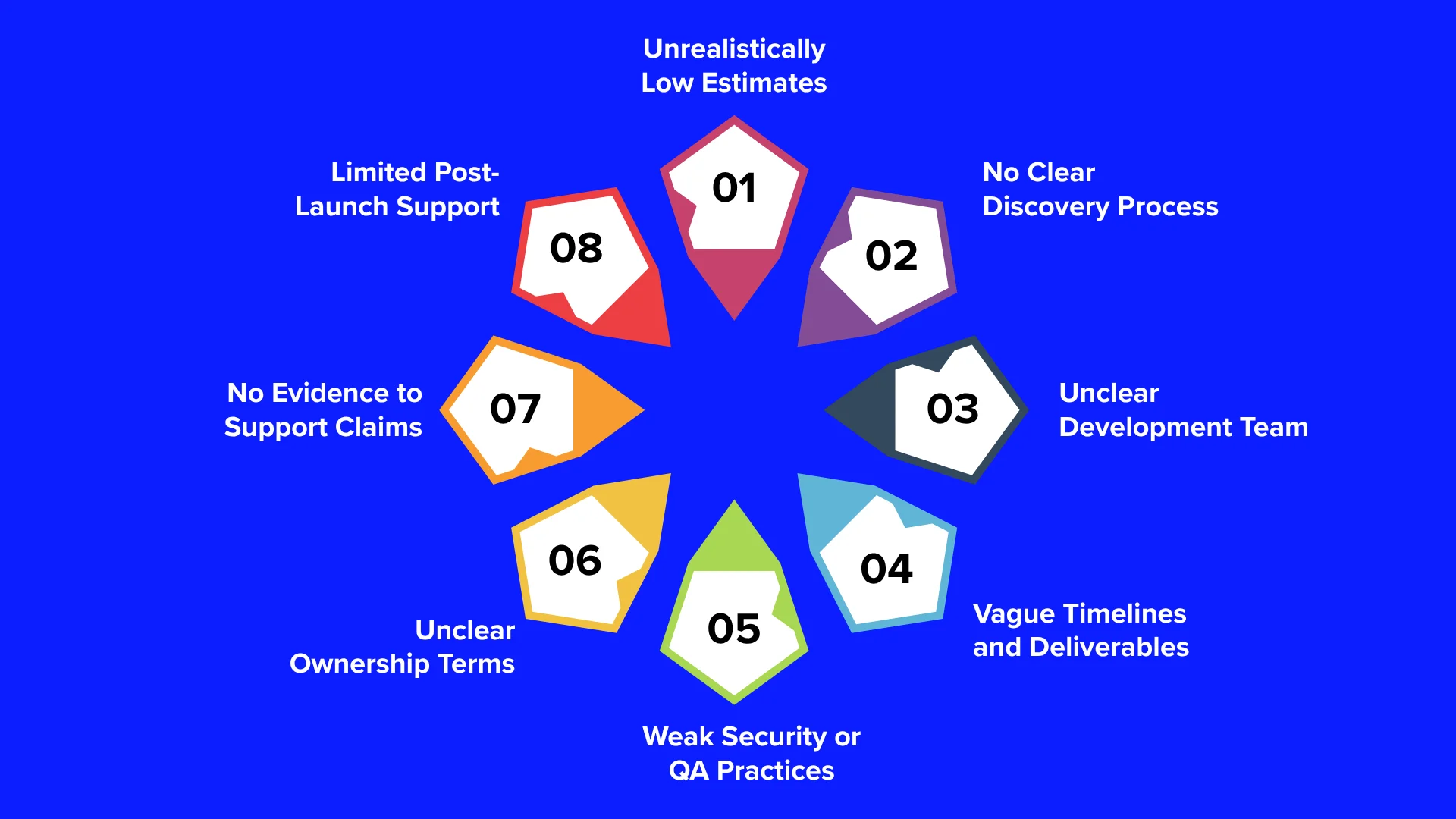
A development company may present a strong portfolio and competitive proposal, but some warning signs can appear during the evaluation process. Identifying them early can help you avoid delivery issues, unexpected costs, and long-term technical problems.
Unrealistically Low Estimates
A quote that is significantly lower than other proposals may look attractive, but it can indicate missing requirements, inexperienced resources, or additional costs later. Always understand what is included in the estimate before comparing prices. Recurring costs of tokenised AI tools can be a prime example of costs that legacy firms often overlook.
No Clear Discovery Process
Be cautious if a company starts discussing timelines and costs without first understanding your business, users, technical requirements, and project goals. A proper discovery process helps establish a realistic scope and reduces assumptions. A real discovery process should surface details that change scope — for example, a healthcare startup discovering mid-project that the vendor never asked about HIPAA requirements before quoting a timeline.
Unclear Development Team
If the company cannot clearly explain who will work on your project, what roles they will handle, or where the team is located, ask more questions. You should know who is responsible for delivering your software before signing the contract. A clear insight of who the front end, backend, and other team members are gives a transparent picture of the work flow and builds confidence in the process.
Vague Timelines and Deliverables
Promises such as “we can launch quickly” are not enough. Look for defined milestones, deliverables, dependencies, and review points so you can track whether the project is progressing as planned.
Weak Security or QA Practices
Generic answers about security and testing should raise concerns, particularly for software handling sensitive information. Ask how the company approaches secure development, testing, vulnerability management, and quality assurance. While choosing a software development firm, check who the head of security at the firm is, have a discussion with them, and get their insights.
Unclear Ownership Terms
Make sure the agreement clearly addresses ownership of source code, intellectual property, designs, documentation, and other deliverables. Ambiguous ownership terms can create serious problems when you want to change vendors or continue development internally.
No Evidence to Support Claims
A long list of clients or an impressive-looking portfolio is not enough. Look for relevant case studies, measurable outcomes, client references, and evidence that the company has delivered projects similar to yours. See examples of GMTA’s completed projects—this is exactly the kind of evidence worth demanding from any vendor you’re evaluating.
Limited Post-Launch Support
Software development does not necessarily end at launch. If a vendor has no clear plan for maintenance, bug fixes, security updates, or ongoing improvements, you may face difficulties managing the product after release.
Several of these signs appearing together should prompt you to slow down the evaluation and ask more detailed questions before committing to the partnership.
Industry-Specific Considerations
Different industries have unique technical and regulatory requirements. Choosing a development company with relevant domain expertise reduces implementation risks.
Healthcare
Healthcare software requires strict compliance, security, and interoperability.
Look for experience with:
- HIPAA compliance
- Electronic Health Records (EHR)
- Telemedicine platforms
- Medical data security
- Patient engagement applications
FinTech
Financial software demands exceptional reliability and security.
Important capabilities include:
- PCI DSS compliance
- Fraud detection
- Identity verification
- Secure payment integrations
- Real-time transaction processing
Enterprise Software
Enterprise applications often integrate with existing systems while supporting thousands of users.
Evaluate experience with:
- ERP systems
- CRM integrations
- Workflow automation
- Identity management
- Cloud migration
- API development
Industry knowledge should complement strong engineering capabilities rather than replace them. See enterprise application modernization — the evaluation criteria shift meaningfully when legacy migration is involved.
How GMTA Approaches Software Development Partnerships
At GMTA, we feel that any successful project in software must have a clear objective of business understanding instead of technology.
Before we start developing a product, we emphasise aligning product strategy, technical architecture, and quantifiable business results. All engagements start with joint discovery workshops to determine user needs, project risks, scalability requirements, and AI-driven innovation opportunities.
Rather than defaulting to a fixed technology stack, we evaluate each client’s objectives, existing systems, compliance needs, and growth trajectory before recommending an architecture. That’s the same discovery-first approach behind projects like our EasyClaims insurance claims platform, built around compliance-ready automation from day one, and our CodocCall telemedicine platform, built around HIPAA-aware architecture rather than bolted-on compliance.
See How the Framework Holds Up in Practice
You’ve got the checklist. Now see how GMTA’s own discovery process answers every question in it — no sales pitch, just a straight conversation about your project.
Conclusion: Sustainability Is the Backbone of a Strong Software Development Partnership
There’s more to choosing a software development company than hourly rates and portfolios. What you actually need is a partner that combines technical excellence, strategic thinking, transparent communication, and security-first practices — one that builds toward long-term product success, not just a shipped v1.
As AI reshapes software engineering, evaluating AI-native capability matters more every quarter. The real test isn’t whether a partner uses AI — it’s whether they can explain, govern, and stand behind how they use it.
A structured framework, a real checklist, and clear evaluation criteria won’t guarantee the right decision on their own — but they’ll get you much closer than pricing and portfolios alone.
→ If you’re evaluating partners against this framework, see how GMTA’s discovery process actually works. Book a free consultation — or if you’re not ready to talk yet, browse GMTA’s portfolio first.
Frequently Asked Questions
How do I choose the best software development company?
Evaluate technical expertise, industry experience, communication practices, security standards, AI capabilities, and long-term support. Review case studies, client references, and development methodology before deciding — and ask the specific questions in this guide rather than relying on a sales pitch.
What makes an AI-native software development company different?
An AI-native company integrates AI throughout product strategy, architecture, testing, automation, and deployment — rather than adding AI as a feature after the fact. The difference shows up in governance and process, not marketing language.
Should I choose the cheapest software development company?
Not necessarily. Lower upfront costs can lead to technical debt, security gaps, and expensive maintenance later. Focus on total value over the product’s lifecycle, not the initial quote.
How long does a custom software project take?
Timelines vary by complexity. An MVP typically takes three to six months; enterprise platforms or AI-driven applications often take nine months or more.
What should be included in a software development contract?
Project scope, deliverables, milestones, pricing, IP ownership, confidentiality, acceptance criteria, maintenance and support terms, and dispute resolution procedures.
What’s the difference between a software development company and a software agency?
The terms are often used interchangeably, but “agency” sometimes implies a narrower focus (e.g., design or marketing-adjacent work), while a software development company typically covers the full engineering lifecycle—architecture, development, QA, and long-term maintenance. Always confirm scope directly rather than relying on the label.
How do I know if a software company is legitimate?
Verify a real, checkable portfolio; request client references you can actually contact; confirm business registration and location; and ask for concrete technical proof (architecture diagrams, live product links) rather than accepting claims at face value.
Should I hire a software development company or freelance developers?
Freelancers can work well for narrow, well-defined tasks with low ongoing complexity. A development company is generally the better fit when you need accountable delivery, a full team (design, QA, PM), long-term support, and governance around security and compliance.

Uday Singh Shekhawat has 9+ years of experience covering software architecture, AI/ML development, and technology strategy at GMTA Software. He writes for founders and CTOs evaluating build complexity, technology investment, and vendor decisions — including in regulated industries such as healthcare, where his background in HIPAA-compliant and FHIR-integrated systems informs his perspective on compliance-driven cost factors.