



Key Takeaways:
- Custom software development aligns software with your processes to gear up your teams’ working speed and decrease manual steps.
- Stabilizing the budget and respecting the timelines across the build is possible with a clear scope and success metrics.
- Rebuilding isn’t needed later because the right architecture supports scale and security.
- Strong documentation and QA reduce the hassle of facing release risks and rework.
- A capable partner is much more than just a one-time delivery. It turns requirements into a maintainable product.
Custom software development is a solid solution for those who seek reliable software that doesn’t just fit the workflows but also doesn’t clash with the growth plan. Ready-made tools force workarounds, and we can’t ignore the recurring fee. Many times, essential integrations are hidden behind a paywall. Some of these tools even block integrations that matter.
What Is Custom Software Development?
Simple Definition for Business Leaders
It is rare that a pre-built software fully satisfies all of your needs. This clearly means that even after paying a fixed subscription on fixed schedules, your team will have to compromise somewhere. Understanding custom software development is simple. It’s a software designed around your business, which generally proposes a one-time investment. Such software fully takes care of your data flows and reporting, besides tens of other factors.
How It’s Different From Ready-Made Software
Ready-made products are generic, which means that they are built keeping a “one-size-fits-all” kind of approach. They serve companies with similar needs, but never fully align with a specific company’s requirements. Custom software development can match your exact processes. You select your own features and create your own roadmaps.
Why Businesses Invest in Custom Software
Problems Custom Software Solves
The market of custom software is expected to hit USD 234.70bn by 2028, as per Statista. This stat is enough to highlight the importance and impact of customer software building. Custom software development solves problems that show up as daily friction:
- Duplicate data entry across tools.
- Manual approvals that slow delivery.
- Reporting gaps that hide performance.
- Integrations that break during vendor updates.
- Security constraints that SaaS cannot meet.
When Custom Software Makes More Sense Than SaaS
You can confidently go with SaaS if you believe your process matches common patterns and you are ready to accept vendor limits. Go for a custom-built software if you require:
Unique workflows that drive revenue.
- A data model that SaaS cannot represent.
- Deep integrations across internal systems.
- Control over security, audits, and access design.
- Predictable long-term cost versus rising per-seat fees.
Types of Custom Software Development

There are a total of six types of customer software development:
Custom Web Application Development
Web platforms prove to be perfect for internal systems and partner portals. These support customer-facing workflows as well. Custom software development here usually focuses on speed and integration with existing data sources.
Custom Mobile App Development (iOS, Android, Cross-Platform)
If your workflows rely more upon field operations or customer self-service, going with a custom mobile app development works well. You can choose between cross-platform frameworks and native builds, considering your performance requirements.
Enterprise Software Development
Mostly, companies with large user bases face problems with SaaS products because of complex roles and audit-ready workflows. Even scalability proves to be a challenge, many times. Custom software development solves all these problems, besides providing integration stability.
Cloud-Based & SaaS Custom Solutions
If you are focussed towards global availability and modern deployment patterns, then Cloud-first builds will offer adequate support. Many teams build internal SaaS-like platforms with billing and multi-tenant designs when productisation is part of the plan.
API & System Integration Software
The main purpose of custom software development is to reduce manual work and maintain data consistency across systems. Integration work connects CRMs and data warehouses along with internal tools and payment systems.
Legacy Software Modernization
If your older software isn’t serving you that well, you can always opt for legacy software modernisation upgrades, which can include database migration and performance upgrades. Here, you enjoy safer deployment pipelines, and most importantly, the process does not lead to any long or brief stoppage of the business.
Applications of Custom Software Across Industries
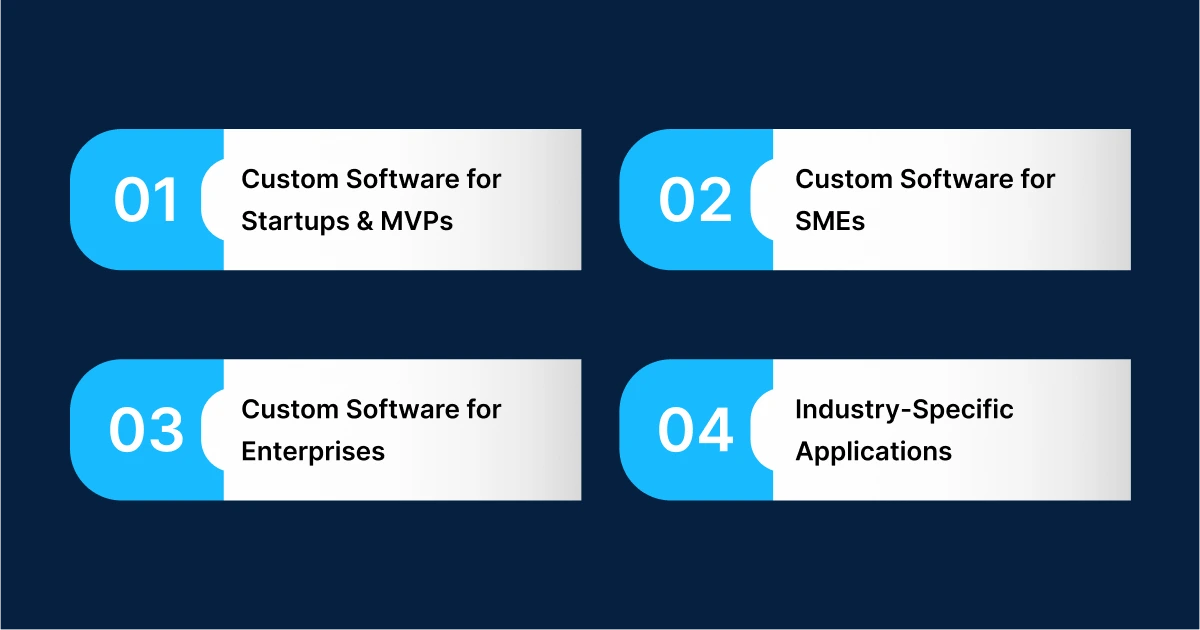
Custom Software for Startups & MVPs
Does your startup look forward to validating an MVP with real users and scaling the product in phases? Custom software development is suitable because clear success metrics matter a hundred times more than a lengthy feature list.
Custom Software for SMEs
The main reasons for which SMEs use custom software development is to reduce hassle by unifying operations and unifying operations. It’s easy to replace multiple spreadsheets and disconnected tools with one system.
Custom Software for Enterprises
Custom software helps enterprises with standardising complex workflows and enforcing access rules; the integration of various systems is possible with greater reliability.
Industry-Specific Applications
Healthcare
Healthcare teams can build patient portals for care coordination in addition to internal workflow tools and scheduling through custom software development. These help in terms of privacy protection.
Fintech & Banking
Fintech products require strong security and integration with payment rails. Fraud controls and KYC flows also need to be taken care of, and all this is possible through custom software. It supports performance and compliance needs.
Retail & E-commerce
With time, more and more e-commerce and retail segment business owners are moving towards custom software development, because there are various clear benefits. Besides supporting online workflows the way needed, this software highly helps in terms of unifying stores and managing warehouses.
Logistics & Supply Chain
Logistics systems support tracking and dispatch. Many other features can be integrated to support route planning and proof-of-delivery flows. If you are in logistics and supply chain, and want to reduce operational gaps, go for custom software development.
Education & EdTech
EdTech products support content delivery and admin workflows. Many use custom software for tasks like progress tracking and assessments. Managing learning data with clean reporting becomes far easier.
Manufacturing
Custom software development can connect machines and planning systems with consistent data in order to support production tracking. Maintaining workflows and quality checks never proves to be a tension.
Custom Software Solution Development Process

Business Requirement Analysis & Validation
Before starting the development process, we believe it’s vital to define the business goal and set success metrics. Our experts map the workflow and data requirements. We filter out constraints that affect cost and timeline for attaining smoothness in the process right from the beginning.
Product Strategy & Architecture Planning
We master in designing roadmaps that balance speed and maintainability. Security and scalability are never a problem when we plan the architecture. While working with us, you’re never locked into fragile decisions.
UI/UX Design Focused on Users
We design screens and flows that match real work patterns as well as your business goals. The user journey validation we map reduces rework during development.
Development & Technology Stack Selection
Our team is an expert at using a wide range of tools, and we select those frameworks that match your product needs. Releases always stay predictable and easy to test because we build in modules.
Testing, Quality Assurance & Security
We never move ahead without properly testing core flows and integration points across environments. Our security checks are tight enough to avoid issues from stacking up near the release.
Deployment, Scaling & Ongoing Support
We deploy using a stable release pipeline with monitoring and rollback plans. Our team also brings you solutions related to upgrades and scalability, and we’re always open to improvements with the usage growth.
Key Benefits of Custom Software Development
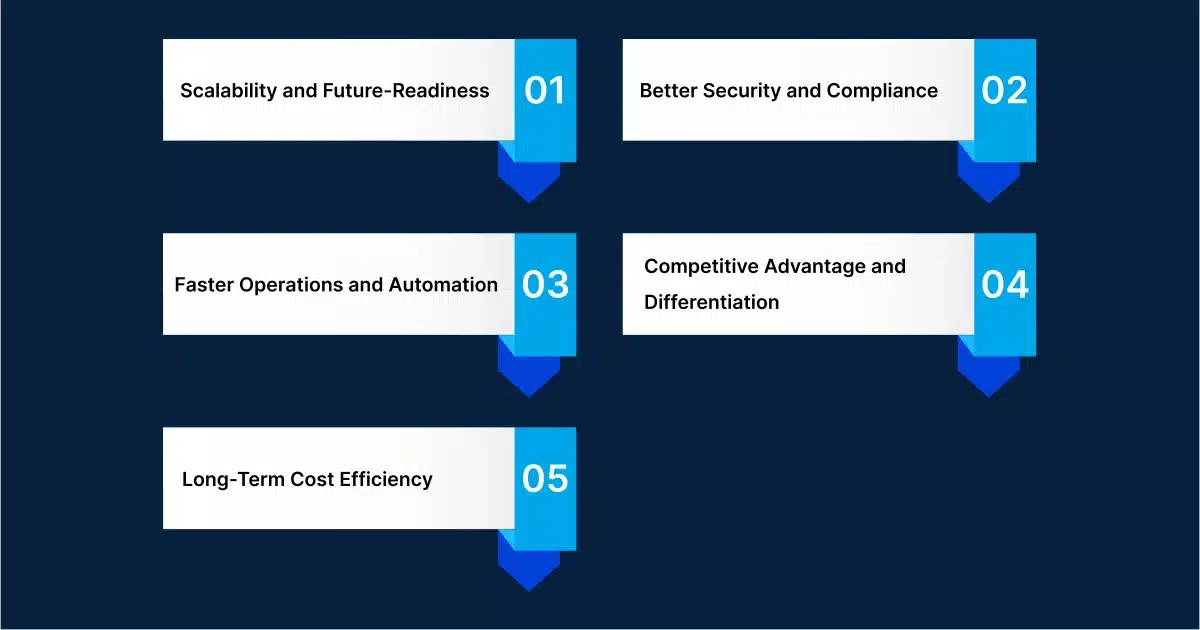
Scalability and Future-Readiness
With SaaS, all you can do is move to the next plan and pay more, knowing that all of your needs are not going to be taken care of the way you want. The reason? Those features are “one-size-fits-all.” With custom software development, you can plan for expansion early accordingly.
Better Security and Compliance
Custom software development supports access rules and encryption the way you want. Aligning with compliance needs and auditing becomes easier. Most importantly, you’re not dependent upon vendor roadmaps for security controls.
Faster Operations and Automation
You can expect a lot of time saving because Custom workflows replace manual steps with automated validations and approvals. There is a considerable improvement in the consistency across teams, as the cycle time is reduced.
Competitive Advantage and Differentiation
Unique workflows can become a business benefit when software supports them. Bespoke software development can transform process strength into product strength.
Long-Term Cost Efficiency
When directly compared to custom software building, SaaS looks cheaper initially. However, with increasing seats and add-ons can easily break the budget, and most importantly, you still compromise on a few features. Tailored software solutions help reduce recurring fees, and in this way, your costs are tied to actual value.
Challenges in Custom Software Development (and How to Manage Them)
Cost and Budget Control
The way we maintain the scope is by ensuring that we have a clear MVP and outcomes. We divide work into stages in order to get you to value what drives first.
Timeline and Scope Management
We avoid timeline drift through a realistic roadmap and stringent change control. We monitor the milestones and make decisions recorded.
Changing Business Requirements
The requirements will change during the learning of teams. We deal with change by maintaining a backlog that prioritises the change and short delivery cycles that keep the feedback flowing.
Security and Data Protection
We do not design security at the last minute. We use access controls, achieve secure coding, and conduct frequent reviews to safeguard data and IP.
Custom Software vs Off-the-Shelf Software
Cost, Flexibility, and ROI Comparison
Ready-made tools save on setup time and increase flexibility, but restrict the ability to customize and roadmap. Custom software development is more expensive in the short term, although capable of a better workflow fit and provides greater long-term control.
Performance and Integration Capabilities
Tailor-made systems are more deeply connected with data and tools. Off-the-shelf products usually need connectors, add-ons, or manual work-around-solutions which cause operational risk.
Which Option Is Right for Your Business?
Select off-the-shelf when the workflows are standard, and the constraints of the vendor are reasonable. Select bespoke software development when competitive value depends on your process or integrations or compliance needs.
How to Choose the Right Custom Software Development Company
What Founders and CTOs Should Look For
An effective custom software development firm demonstrates excellent delivery procedures, actual engineering exceptionalism, and excellent communication. They discuss their scope, QA, documentation, and post-launch support.
Questions to Ask Before Hiring
Ask questions that reveal delivery maturity:
- How do you define scope and handle change requests?
- How do you test integrations and security controls?
- How do you document architecture and handover plans?
- How do you support releases after launch?
In case you intend to go big in a short time, a partner that assists you in outsourcing custom software developers is also desired as you expand the roadmap.
Common Mistakes to Avoid
Avoid these patterns:
- Starting without a clear MVP and success metrics.
- Picking tech based on trend instead of fit.
- Skipping documentation to “move faster.”
- Treating QA as a final step instead of a continuous process.
- Ignoring support plans after launch.
Cost of Custom Software Development
Factors That Influence Pricing
Pricing depends on scope and quality expectations. These factors move cost most:
- Number of user roles and workflow complexity.
- Integrations with external systems.
- Security, compliance, and audit needs.
- UI complexity and device coverage.
- Data volume and performance targets.
Common Pricing Models
Teams usually select one model based on predictability needs:
- Fixed scope, fixed budget for stable requirements.
- Time and materials for evolving requirements with frequent changes.
- Dedicated team for long-term build and iterative delivery.
If you want ongoing delivery, a dedicated model often supports custom business software development with predictable monthly capacity.
Estimated Cost by Software Type
Here’s a practical planning table teams use to estimate custom software development budgets:
| Software Type | Typical Use Case | Typical Timeline | Typical Budget Range (USD) |
| Internal business tool | Dashboards, approvals, basic automation | 8–16 weeks | $30k–$80k |
| Customer web platform | Portals, subscriptions, workflows | 12–24 weeks | $60k–$150k |
| Mobile app (MVP) | Core features, limited integrations | 12–20 weeks | $50k–$120k |
| Enterprise platform | Roles, audits, deep integrations | 20–40 weeks | $150k–$400k+ |
| Modernisation project | UI rebuild, migration, stability upgrades | 12–32 weeks | $80k–$250k |
For decision-makers comparing vendors, this section supports intent around custom software development services and realistic budgeting.

How to Choose the Right Custom Software Development Company
What Founders and CTOs Should Look For
A strong custom software development company shows clear delivery processes and strong communication. They share how they handle various tasks.
Questions to Ask Before Hiring
Ask questions that reveal delivery maturity:
- How do you define scope and handle change requests?
- How do you test integrations and security controls?
- How do you document architecture and handover plans?
- How do you support releases after launch?
If you plan to scale fast, you also want a partner who can help you hire custom software developers as the roadmap expands.
Common Mistakes to Avoid
Avoid these patterns:
- Starting without a clear MVP and success metrics.
- Picking tech based on trend instead of fit.
- Skipping documentation to “move faster.”
- Treating QA as a final step instead of a continuous process.
- Ignoring support plans after launch.
Cost of Custom Software Development
Factors That Influence Pricing
Pricing depends on complexity and quality expectations. These factors cost the most:
- Number of user roles and workflow complexity.
- Integrations with external systems.
- Security, compliance, and audit needs.
- UI complexity and device coverage.
- Data volume and performance targets.
Common Pricing Models
Teams usually select one model based on predictability needs:
- Fixed scope, fixed budget for stable requirements.
- Time and materials for evolving requirements with frequent changes.
- Dedicated team for long-term build and iterative delivery.
Do you want ongoing delivery? A dedicated model supports custom business software development with predictable monthly capacity.
Cost of Custom Software Development
Factors That Influence Pricing
Pricing depends on scope, complexity, and quality expectations. These factors cost the most:
- Number of user roles and workflow complexity.
- Integrations with external systems.
- Security, compliance, and audit needs.
- UI complexity and device coverage.
- Data volume and performance targets.
Common Pricing Models
Teams usually select one model based on predictability needs:
- Fixed scope, fixed budget for stable requirements.
- Time and materials for evolving requirements with frequent changes.
- Dedicated team for long-term build and iterative delivery.
If you want ongoing delivery, a dedicated model often supports custom business software development with predictable monthly capacity.
Estimated Cost by Software Type
Estimated Cost by Software Type
Below is a practical planning table that teams use to estimate custom software development budgets. These ranges shift based on complexity and compliance requirements.
| Software Type | Typical Use Case | Typical Timeline | Typical Budget Range (USD) |
| Internal business tool | Dashboards, approvals, basic automation | 8–16 weeks | $30k–$80k |
| Customer web platform | Portals, subscriptions, workflows | 12–24 weeks | $60k–$150k |
| Mobile app (MVP) | Core features, limited integrations | 12–20 weeks | $50k–$120k |
| Enterprise platform | Roles, audits, deep integrations | 20–40 weeks | $150k–$400k+ |
| Modernisation project | UI rebuild, migration, stability upgrades | 12–32 weeks | $80k–$250k |
For decision-makers comparing vendors, this section supports intent around custom software development services and realistic budgeting.
AI-Driven and Data-Powered Applications
Teams build smarter workflows using predictive insights and automation. Data design matters more now because AI features depend on clean and consistent inputs.
Cloud-Native & Scalable Architectures
Modern systems use managed services and automated deployment to scale without fragile manual steps. This approach supports performance and cost control as usage grows.
Security-First Development Approaches
Security by design is becoming standard in serious builds. Teams expect threat modelling, secure coding, and continuous testing, not a checklist at launch.
Automation and Low-Code Support
Low-code tools can speed up internal tools and admin workflows. Many teams use low-code for simple modules, then use enterprise custom software solutions for complex core workflows.
Technologies and tools used in custom software development
A stable stack offers speed, security, and maintainability. Teams typically use:
- Fast UI delivery and clean state frameworks.
- Backend framework with support for modular services and understandable APIs.
- Your data creates databases suitable for your requirements.
- Monitoring and safe deployments: Cloud infrastructure.
- CI/CD pipelines that transfer updates with testing and rollback.
In situations where the teams require a single partner to design, develop, test, and maintain, they tend to go with custom application development services that revolve around a specific delivery process.
Is Custom Software Development Right for Your Business?
A good fit is the Custom software development where the software has a direct influence on revenue, customer experience, or speed of operations. When your group is hitting daily tool capacity limits, manual labour, or integration insufficiencies, one-off work can be compensated for by effectiveness and control.
Why choose GMTA for Customized Software Development
GMTA Software develops processes of delivery that are commensurate with business results and not arbitrary lists of features. To maintain predictability in delivery, we plan scope, architecture, and release cycles. We provide systems that facilitate growth, security, and integration requirements for the business functions.
We position GMTA Software as a delivery partner that can build systems that match your workflows and reporting needs and scale delivery with a dedicated team as your roadmap expands. GMTA Software can act as your best custom software development firm for long-term delivery.
Conclusion:
Key Takeaways for Business Leaders
The custom software’s meaning becomes evident in the everyday operations: it has fewer workarounds and is more visible. Planning and quality assurance make it a sustainable business asset.
Next Steps to Start Custom Software Development
While choosing to opt for custom app and software development, we recommend a simple start:
- Define the business goal and the users.
- List core workflows and success metrics.
- Prioritise an MVP that delivers measurable value.
- Select a partner with proven delivery discipline.

FAQs About Custom Software Development
How time-consuming is custom software development?
Timelines are based on integrations and compliance requirements. A lean MVP can be delivered within 816 weeks. Big platforms can require 20-40 weeks with rollouts.
Scalability of custom software How scalable is custom software?
Custom builds are easily scalable in case the architecture allows modular expansion and a clean data structure. Testing discipline and monitoring are also important to scalability.
What is the best business to use custom software?
Software that is compatible with unique workflows and powerful integrations should be advantageous to businesses. The fastest value can occur in teams that have a high manual workload and restricted tools.
What is the process of initiating a custom software project?
Begin with objectives, role assignments, and quantifiable outcomes. Next, establish MVP scope and map workflows. Verify requirements before you proceed with development.
Do I have the source code of the tailor software development?
The ownership lies in your contract. In most of the projects, the client is granted full IP ownership and documentation of handover. This sentence indicates that I am reading complex material.

Uday Singh Shekhawat has 9+ years of experience covering software architecture, AI/ML development, and technology strategy at GMTA Software. He writes for founders and CTOs evaluating build complexity, technology investment, and vendor decisions — including in regulated industries such as healthcare, where his background in HIPAA-compliant and FHIR-integrated systems informs his perspective on compliance-driven cost factors.