


Key Takeaways:
- Cloud kitchens are shifting the food business needs and their operational ways. They focus on the food delivery system, order accuracy, and functional speed.
- AI and other modern tools, such as ML and IoT, are reforming the shape of cloud kitchen technology.
- Cloud kitchen businesses are opting for an MVP at the beginning, and then after a successful implementation of technology and gathering valid user-base data, cloud kitchens go with a custom solution.
- Smart cloud kitchen solutions are more sophisticated with automation and efficient solutions.
- The success of a cloud kitchen app is ensured with a sound management system. Different functions and operations are handled efficiently with it.
A cloud kitchen is a food business that only runs for online orders. Which means it has no physical location to reach out to, no staff to welcome you, and no fancy branding tag, but still, it serves hot and delicious food. The food is prepared in a kitchen and delivered via different food delivery platforms.
The entire online food delivery management system operates in this manner. Cloud kitchens are no longer a new idea, and many are successfully building models around these kitchen concepts. Now, the cloud kitchen management systems have become an entire industry.
In the US, the cloud kitchen industry is growing rapidly. According to Allied Market Research, North America was the highest revenue-generating region for cloud kitchens in 2023. Global cloud kitchen market reveals that restaurant management software for cloud kitchen has become a magnificent technology in 2026, with the 3 key indications:-
- Lower labour costs
- Relentless or low-rented kitchens
- Smooth operations with effective automation solutions
To make a difference, food business owners or management must opt for an innovative kitchen management software development company.
The company automates your workflow, builds robust inventory tools, and makes a blueprint for your cloud kitchen success.
What is Cloud Kitchen Management Software?
With the rise of online food orders, people want more personalized food options, diverse flavors, and quick access to meals. Kitchen management software aims to streamline and structure the restaurant kitchen workflow.
A cloud kitchen management system helps simplify overall kitchen tasks such as order management, scheduling, menu creation, and more. This results in cost-cutting in staff and saves the time of the restaurant’s kitchen team.
The system connects multiple food delivery platforms, accounting tools, and a POS (point-of-sale) system to automate the workflow of a cloud kitchen. With this, every order is under review, without missing a single detail of the client’s instructions.
Why Businesses Need Cloud Kitchen Management Software?
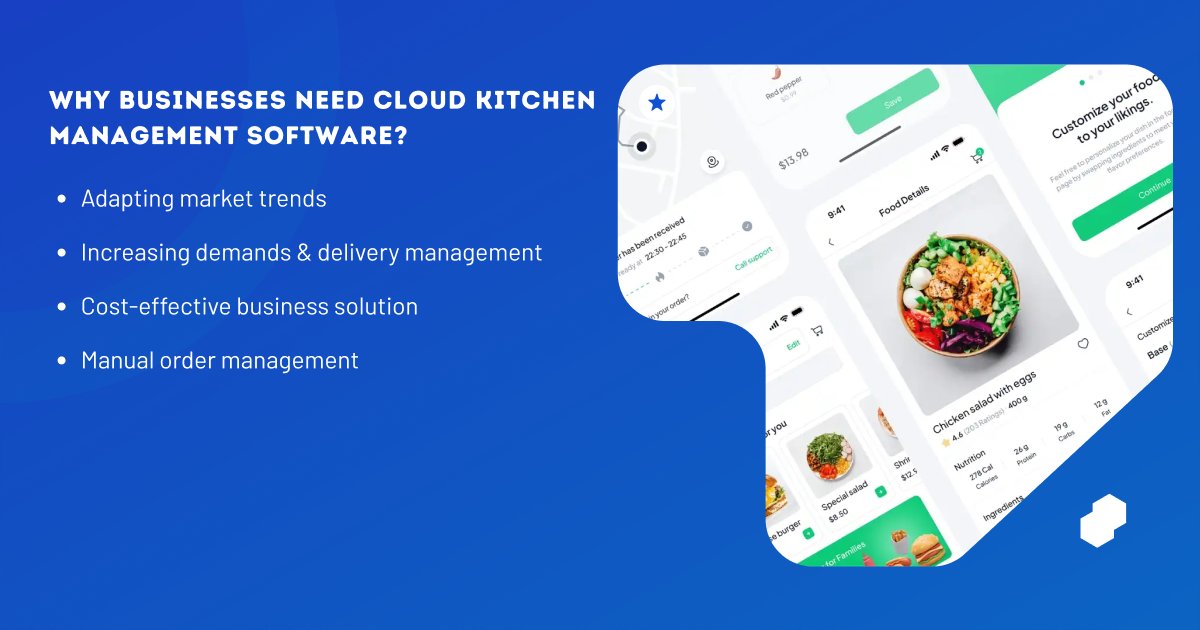
Planning for a cloud kitchen without kitchen management software? It is going to be a mess before reaching the customers. This is because: –
- Managing orders manually is tough
- Data compilation becomes hard
- Lack of team management
- Poor inventory management system
- Lack of real-time updates fails the operations
Let us break down the above points in detail to understand how and why cloud kitchen management systems are creating a massive opportunity for businesses, and if not adopted, the food businesses may lose control over their operational efforts. The reasons why businesses need cloud kitchen software.
Adapting market trends
Technology is changing every day, constantly, in every industry. Companies and businesses require new trends to stay ahead and in demand.
To manage a cloud kitchen, its workflow, operations, and other functions, intricate software is required. A complex software, with robust technologies, helps the business scale faster.
Increasing demands & delivery management
As demand for cloud kitchens increases and records are clear, it is vital to fulfil the demands. The cloud kitchen management software market revenue is projected to reach $73.18 billion by 2024, and this number is expected to grow to $141.08 billion by 2030.
In modern inventory management systems, your orders are already streamlined and assembled automatically. This process helps the kitchen to prepare the food on time and serve the meals hot and fresh, without any daunting pressure.
Cost-effective business solution
Cost control is one of the biggest challenges for any business. A cloud kitchen management system ensures efficient operations, resource allocation, and reduces food waste.
The system also enhances innovative inventory management. This way, the food delivery businesses can save on costs with a one-time investment in kitchen management software.
Manual order management
In general, a food delivery business has to manage the overall delivery management or order management manually. But by leveraging kitchen management software, a business can streamline multiple orders with a single interface.
The lack of automation in the order handling process makes it hard to scale as order volume grows. By adopting a cloud kitchen management system, restaurants and other food delivery systems can avoid missed and delayed orders and long preparation times.
Transform Your Cloud Kitchen Operations With Smart Software
Build a feature-rich cloud kitchen management system that streamlines orders, inventory, and analytics—designed for growth, automation, and higher profitability.
Key Features of Cloud Kitchen Management Software

Cloud kitchens need efficiency, and the efficiency comes along with a proper systematic approach. The amalgamation of the right technology and practical tools makes a cloud kitchen software more agile and functional. Some of the key cloud kitchen software features you must have in 2026 are listed below.
Order management
One of the core features of a cloud kitchen management system is to manage the orders from organising to fulfilling on time. Order management means every order is fed into the system and has every important order detail, such as instructions, costs, and frequency.
This information helps food businesses to be aware of which dishes are most liked by people. They can also check if a particular order is frequently being repeated in a special season, like pancakes in winter. These data insights are crucial for a business in the long run and to optimise business flow.
Streamlined operations
When orders come from different channels, it becomes arduous for the business to manage orders manually. Other than orders, a cloud kitchen has to manage many other things simultaneously, such as food listing, out-of-stock updates, offers, and social media management.
A robust kitchen management software streamlines all these operations smartly in less time. The system takes over almost all major complex tasks and solves the business goals competently.
Kitchen display system
Kitchen display systems, or KDS, are smart problem-solving tools that keep everything at your fingertips. The feature tracks order instructions one by one, including all steps, preparation time, and priority.
With this feature, the system keeps everyone on staff updated about what to deliver first and how to cook a particular order. The feature is a great help to avoid any miscommunications in the team and deliver the orders with higher user satisfaction.
Cloud kitchen inventory management
Cloud kitchen inventory management is one of the most essential features because it notifies you in advance if a grocery or ingredient is missing or of lower quality.
The feature alerts you about the number of items left in stock and continues reminding you until the next inventory update. This is how a cloud kitchen management software saves cost and time on a restaurant inventory management app, focusing on prime deliverables.
Third-party APIs integration
Third-party APIs help you connect your cloud kitchen software with other related solution providers such as payment gateways, geo-location services, and more.
The feature ensures seamless in-app payments, accurate and real-time location tracking, and multiple other functions. With API integration, the system changes the prices and menu updates in the entire system at once.
Multiple brands management
Multiple brands management with a single unit cloud kitchen is not a new story. Cloud kitchens have been fulfilling various orders on behalf of popular restaurants around. A ghost kitchen management software does this job swiftly, without mixing up the orders, maintaining the brand value and delivering the different tastes of the same dish.
The system identifies the brand quickly and simply provides pricing and menus, and pricing according to it. Each brand’s performance, orders’ frequency, and performance are clearly visible on the single dashboard.
Menu customization
One of the advanced kitchen management system software features is menu customisation. The feature customises the menu for specific groups of people based on their food preferences or any allergies mentioned beforehand in the software. The system keeps records and offers a custom menu to each individual.
CRM integration
Integrating a CRM into cloud kitchen management software allows the restaurant kitchen to store user details, preferences, and order history. This feature helps the restaurant improve its services and address any recurring fraud. With the CRM, the follow-ups become easier with smoother communication.
Delivery route optimisation
The delivery route optimisation feature improves order deliveries by reducing time and providing cost-effective solutions. Route optimisation in a cloud kitchen management system helps the drivers reach their destination without delays and maintain user satisfaction.
Multi-platform capabilities
A cloud kitchen management tool must be supportive on multiple devices like mobiles, tablets, and computers. The staff can work with more access when the cloud kitchen software is multi-tenant. This feature supports faster decision-making and remote monitoring.
Payment gateways integration
Payment gateways enable the cloud kitchen management tool for secure and transparent transactions using multiple cards, wallets, and UPI systems. Autopayments connect the orders to the billing records directly. Secure payment handling boosts user trust and fulfils regulatory compliance.
Loyal programs
Users can get benefits by using your app with the referral program feature integration. Infusing a referral and loyalty program into a cloud kitchen management app lets users engage with the app in different ways. They can earn rewards with each order and can share their coupons with others as well.
Staff management
Effective cloud kitchen management relies on a robust staff management feature, including employee management, attendance, shift scheduling, and more.
The staff is assigned their specific tasks without dependencies. The tool also monitors staff performance and provides chefs with a real-time updates dashboard.
user/customer feedback window
A fine-tuned cloud kitchen panel provides the user rating and review feature, offering the users and delivery partners a space to put their order and delivery experience. The feature helps the business to bridge the gaps of the businesses in real-time. A built-in CRM collects the reviews and user behaviour.
Regulatory compliance
Integrating regulatory compliance in kitchen management software enables businesses to rectify the breach of guidelines. It automates food safety monitoring, providing complete ingredient information for a particular packaged food.
Security
App security is a must-have feature of a cloud kitchen management development process. A cloud kitchen management development includes key security features, like end-to-end encryption and multi-layer system security.
Analytics & reporting
You can not imagine a cloud kitchen software with analytics and reporting features. A comprehensive dashboard provides real-time data and business insights, while modern kitchen management software provides the overall system report at once.
Herein, better decisions result in a lower cost of cloud kitchen management software development.
How to Develop Cloud Kitchen Management Software?

The following are some of the key steps of kitchen management software development.
Idea discussion
Building the Best cloud kitchen management system features requires a vigorous team discussion where teams have to validate the idea’s feasibility. This is the first step towards a kitchen management software development that scales faster.
Market research
Find out what others have to serve or are already serving. Conduct thorough market research before initiating the kitchen management software development. Understanding the market gaps helps you stand out in the cut-throat competition.
Design concept & prototype
Develop and create a clear and intuitive design concept for your cloud kitchen management tool. A UX/UI is a complete game-changer, where a poor design concept can ruin the entire business, and a well-crafted UX/UI establishes the brand voice.
Therefore, the next step is to design a sleek and dynamic interface for your commercial kitchen layout.
Development
The development stage involves code creation, where the cloud kitchen software app developers create creative code based on your business outline, such as UX/UI, and a list. The cloud kitchen app development process can be off-the-shelf or custom, depending on the business idea.
Testing & quality assurance
With businesses like a cloud kitchen, ongoing testing and QA are important to manage the overall software load, traffic, and orders smoothly. By conducting security audits and load testing, companies must ensure the app is capable of handling a heavy load and is scalable.
Deployment & maintenance
As the software is ready, it goes live with cloud integrations. Development is just a process that does not end at deployment. Deployment requires a backup of secure audits and app maintenance, especially as kitchens are being upgraded every time the app expands.
As the kitchen evolves, new delivery partners join the system, orders increase, and the kitchen cloud management software needs maintenance and upgradation.
Read Also: AI Food Delivery App Development Guide
Future Trends in Cloud Kitchen Management Software Development

As we have discussed above, the cloud kitchen software is rapidly moving towards automation, complexities, and modernisation. The future of cloud kitchen management systems is more inclusive and holistic.
The future trends of kitchen management software development will change the overall system performance. Some of the leading and emerging cloud kitchen technology trends are given below.
AI-driven tools
AI is not just a term among top emerging technologies; it is a necessity for modern cloud kitchens. With its advanced tools like predictive analytics, demand forecasting, a cloud kitchen can manage the broken things beforehand.
At times when order surges, predictive analytics and demand forecasting tools save the kitchen and handle operations flawlessly.
According to Resourcera, there are around 88% companies that adopt AI for their core business functions. Out of which, around 7% of the organisations are fully scaled with AI.
Cloud-native solutions
Cloud native solutions enable a commercial kitchen software backend to scale and make it flexible. The cloud native designs, including microservice architecture and serverless, enable the backend to expand horizontally.
The benefit of adopting cloud computing helps cloud kitchen businesses manage, store, and organise large amounts of user and business data on a serverless cloud, making it accessible and secure.
Internet of Things or IoT empowerment
So imagine you’re not aware of the temperature a particular recipe requires, and there’s a device that helps with this, just with a tap of a finger.
IoT technology relies on sensors, and modern kitchen equipment is equipped with sensors to enable IoT. These sensors provide information about the correct temperature and machine environment.
As long as the equipment is heated enough or the fridge is generating heat, the sensor alerts the restaurant kitchen staff, and they take prompt action to reduce any waste or loss.
Predictive maintenance tool
Predictive maintenance is a part of AI technology that informs management about potential losses or failures, where, if any kitchen tool is expected to fail, the tool predicts it. Management can fix it before it goes out of service.
This feature helps the restaurant avoid any downtime. This future trend nurtures cloud kitchen automation software.
Blockchain for transparency
To ensure transparency in the supply chain, the blockchain technology will be used to track the common ingredients in kitchen equipment.
Now, cloud kitchens are showing trustworthiness by adapting the transparent cooking process, so the customers know where their food is coming from.
Technology Stack for Cloud Kitchen Management Software Development
The technology behind kitchen management software development determines many aspects of how a food management software will perform in the future, including scalability and performance. The technology shifts from ready-made to custom software development.
Some of the tech stacks that a food production management software must integrate are defined in the table below.
| Layer | Technology | Fundamentals |
| Frontend | Angular, React, Vue.js | Sleek and smooth interface, quick actions, and responses. |
| Backend | Java, Python, Node.js | Handles heavy traffic, reduces wait-time, real-time operations. |
| Database | MySQL, PostgreSQL, Redis, MongoDB | Organize and manage orders, inventory, and customer history. |
| Cloud Hosting | Kubernetes, Docker, Azure, Google Cloud, AWS | Scalable infrastructure, uptime assurance, and data organization. |
| Mobile App Stack | React Native, Flutter | Platform-specific apps, in-house / admin apps, and cost cost-effective. |
| Third-Party Tools | Payment Gateways, Restaurants APIs, and email tools | Billing automation, connects aggregators. |
Conclusion
Cloud kitchen management software development requires proper attention from the development stages to the cost; every stage is crucial for decision makers. Why so? As the global food delivery app market has been expanding since post-COVID, the concept of cloud kitchens has become a new normal, yet a highly revenue-generating business.
We hope that we have covered all the crucial cloud kitchen software development information in this blog so that you can start your first cloud kitchen business with a team of experts like GMTA Software. Let us know what your big commercial kitchen plan is.
Remember that making an informed decision will eliminate all potential possibilities of poor product development in advance.
Ready to Build Your Cloud Kitchen Management Software?
Get expert guidance on features, technology stack, development cost, and the latest trends to launch a scalable and profitable cloud kitchen solution.
FAQs
How does a cloud kitchen work?
A rented space where more than one restaurant can do the commercial food production with delivery-optimized cuisines. The concept of cloud kitchen is old, but it has been empowered in 2026 with modern cloud kitchen software.
The cloud kitchen setup is almost like a large restaurant warehouse where different restaurants can prepare meals for different orders.
Why do businesses need cloud kitchen software?
Businesses need cloud kitchen software for overall access and control over the business. Restaurants might need different tools to manage their entire operations, from staffing to delivery.
They might need a dedicated food service accounting software or a staff management tool, or maybe another tool for food delivery operations. Still, a sophisticated cloud kitchen management software complies with everything within an intuitive dashboard. That is why businesses need cloud kitchen software.
What are the benefits of AI and ML in CKMS?
The benefits of a food service software or a cloud kitchen management software are reflected in the way restaurants and food delivery businesses are shaping the future.
Artificial Intelligence with predictive analytics and data insights is streamlining the cloud kitchen operations, whereas Machine Learning models provide the real-time user behavior data.
How much does it cost to develop a cloud kitchen software?
The cost to develop a cloud kitchen management software is uncertain, with many direct and indirect cost-affecting factors.
- A simple CKMS development cost starts from $20,000, which includes the basic or ready-made cloud kitchen software features.
- A mid-level kitchen management software development costs between $25,00-$35,000 with a moderate feature set and technologies.
- An advanced-level cloud kitchen software development starts from $35,000 and can expand to your app’s needs, from advanced features, technologies and choice of development type.

Uday Singh Shekhawat has 9+ years of experience covering software architecture, AI/ML development, and technology strategy at GMTA Software. He writes for founders and CTOs evaluating build complexity, technology investment, and vendor decisions — including in regulated industries such as healthcare, where his background in HIPAA-compliant and FHIR-integrated systems informs his perspective on compliance-driven cost factors.