


Key Takeaways:
- A DoorDash-like business needs three operational products, namely customer, merchant, and delivery partner. So, do not just budget for the number of screens, but also the three-sided marketplace.
- Charging merchants less than established platforms can accelerate adoption. But an attractive commission isn’t sustainable if delivery, promotions, refunds, payment processing, and customer acquisition consume the remaining margin.
- Sponsored listings and merchant advertising can generate incremental revenue from existing customer traffic without creating another physical delivery cost for every ad dollar earned.
- Do not add grocery and retail simply to increase your addressable market. As these introduce inventory synchronization, substitutions, larger picking baskets, and completely different workflows, expansion should follow evidence that your existing logistics network can support the demand.
- The strongest long-term strategy is buying infrastructure and building differentiation. Start with proven third-party services where they minimize risks and development time while investing in a proprietary marketplace, logistics dispatch, merchant economics, and local market intelligence.
The U.S. food delivery market’s exact size depends on methodology—estimates range from roughly $38 billion (restaurant delivery only) to well over $470 billion once grocery delivery is included, according to IMARC Group and Statista — but the market remains competitive, thanks to key players like DoorDash. So how does DoorDash make money in a market this competitive? It’s not just the business model that has helped the brand reach success within a few years after its launch. Rather, it’s the unique revenue model, which evolved over the years to ensure the company didn’t suffer from channel lock-in. So, replicating just the business model, communication interface, or services won’t give you the competitive edge. Without understanding how DoorDash makes money, you could end up scaling the wrong business: more orders, more users, and more delivery activity, but little to no profit margin.
That’s because in the US market, the challenge is not getting a customer to place an order on your app. Instead, it’s making enough from that order to cover merchant acquisition, delivery partner payouts, promotions, refunds, payment processing, technology, and customer support while keeping prices attractive.
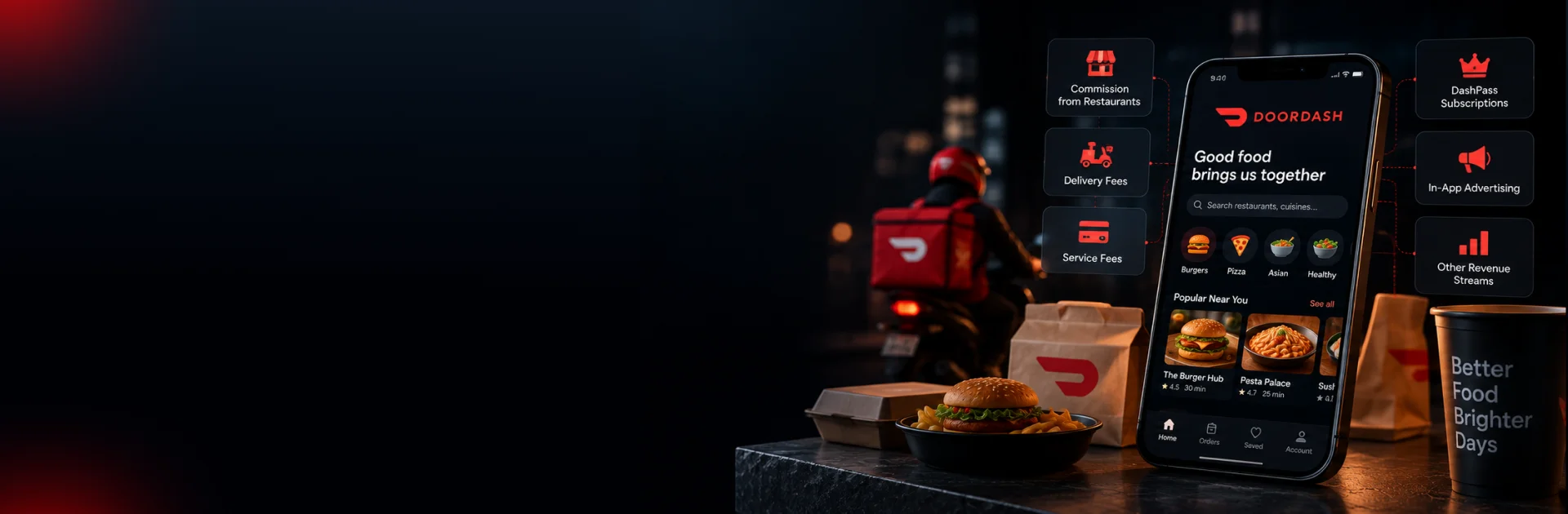
And this is exactly why DoorDash’s revenue model deserves attention before you invest in your own platform. DoorDash’s own numbers show how much this compounding of revenue streams matters at scale. For full-year 2025, DoorDash reported Marketplace Gross Order Value (GOV) of approximately $102 billion, up 27% year-over-year, and total revenue of roughly $13.7 billion, calculated from its four reported 2025 quarters — see DoorDash’s Q4 & full-year 2025 results. Rather than solely depending on a single delivery fee, its core marketplace monetization stems from merchant commissions and consumer fees. At the same time, DashPass memberships, its Commerce Platform, and advertising channels add further revenue opportunities.
Thus, understanding how DoorDash makes money before development begins will help you avoid expensive mistakes from day one. Our goal here is to give you a proper framework for designing the pricing model, commission structure, monetization channels, and unit economics around how a US delivery marketplace actually makes money in 2026.
Is a Food Delivery App Like DoorDash Still Worth Building in 2026?
Yes, building an app with a similar DoorDash business model can be worth the investment in 2026, but not when you just plan to replicate its existing architecture. That’s because the company is still expanding, with new services, innovative pricing tiers, and merchandising models — its most recent quarter shows that compounding still holding: $4.5 billion in revenue, up 36% year-over-year, on Marketplace GOV of $33.1 billion, up 36% to the same figure. Net revenue margin — revenue as a share of GOV — worked out to roughly 13.6% for the quarter, broadly in line with the 13–14% range DoorDash has held for the past several quarters. GAAP net income tells a more mixed story: $200 million for the quarter, down 30% year-over-year from $285 million in Q2 2025 — a reminder that even at this scale, profitability doesn’t move in a straight line.
At the same time, DoorDash’s success creates the biggest barrier for new players to enter the market — and that scale can look straightforward to replicate at a glance, but isn’t. By December 2025, its marketplace had 56+ million monthly active users. Also, 35 million users had exclusive access to DashPass, Wolt+, and Deliveroo Plus plans. These users, restaurants, Dashers, subscriptions, advertising relationships, and accumulated delivery density form a network that you cannot simply replicate by just launching similar features.
So, your investment will make economic sense only if your product has a specific competitive advantage over DoorDash. You can justify the costs by:
- Serving an underserved geographic market
- Creating a substantially better economic model for restaurants
- Specializing in a specific food delivery category
- Offering a differentiated membership proposition
- Building a delivery network that works more efficiently within a defined market
If your angle is geographic, starting a food delivery business in an underserved market walks through what “underserved” actually looks like in practice and where the early economics tend to break. If you already know which advantage you’re building around, our food delivery app development services page covers how we scope and build around that specific edge.
How DoorDash Works: Customer, Merchant, and Driver Roles
Customer: DoorDash owns the demand relationship.
It isn’t just an ordering interface for users. Rather, the app controls the discovery layer through which you can search for restaurants, compare different options, see promotions, receive intelligent recommendations, place orders, pay, and track fulfilment. This specific layer holds immense commercial significance because DoorDash monetizes through customer intent before the order is even completed.
On the other hand, restaurants pay for advertising that increases their visibility in DoorDash search and browse results. The company’s current ad model includes pay-per-order Sponsored Listings. It is here, merchants bid for placement and pay when an attributed order occurs. This is what sets DoorDash apart from basic food delivery apps. It doesn’t only monetize the completed transaction. Rather, it monetizes access to consumer demand.
In addition, DashPass allows the company to change customer behavior rather than simply adding discounts on individual deliveries. Eligible members receive benefits like $0 delivery fees and reduced service charges, which ultimately lowers the friction of placing another repeat order through the platform.
So, when you want to build a platform similar to that of DoorDash, you cannot simply make the customer side around checkout. The real strategic asset will be repeat purchasing behavior. Once customers start ordering frequently, subscriptions, personalized discovery, promotions, ads, and merchant-funded offers can be layered into the same customer relationship.
Merchant: DoorDash is simultaneously a sales channel and operating infrastructure
A merchant can use this online food delivery marketplace to acquire new customers for their business. In addition, DoorDash also provides them with a series of tools so that they can operate their own delivery channels easily. Its Commerce Platform includes:
- Online ordering
- Branded apps
- Customer relationship tools
- Reservations
- In-store dining technology
- Customer support
- Tableside ordering
- Its white-label delivery service, Drive
What we should highlight here is this Drive portal. A restaurant is not obliged to receive customers through DoorDash’s marketplace only. That’s because a customer can directly place an order through the concerned restaurant’s own website or mobile app. DoorDash only supplies the delivery infrastructure and Dasher. In return, the merchant pays a certain fulfilment fee based on every order.
This business model establishes a two-channel relationship between DoorDash and the same restaurant. First is the Marketplace relationship, where DoorDash brings customers, restaurants receive the order, and the fulfilment responsibility falls on DoorDash. The second is the Commerce Platform relationship. Here, the restaurant can acquire customers through its own website. DoorDash becomes responsible for providing the technology or the delivery infrastructure necessary for order fulfilment. Thus, the company can generate revenue even when the consumer never opens its app.
Dasher: DoorDash treats delivery supply as a flexible network
This particular side is structured completely differently from a conventional delivery fleet. DoorDash doesn’t own a fixed fleet or schedule drivers into shifts. Dashers are allowed to choose when, where, how frequently they work, and which tasks to accept. DoorDash then compensates them based on multiple factors, like:
- Time
- Distance
- Task desirability
When order volume increases, the platform can easily activate more delivery capacity. When demand falls, it doesn’t have to support the same fixed labor capacity that a traditional logistics company is obliged to. For your business model, this distinction will have major financial implications. The Dasher network is not just a feature that transfers goods from A to B. Instead, it forms a core part of DoorDash’s variable cost tiers. However, the platform does have to maintain a balance between two sides continuously, namely:
- Enough Dashers availability to maintain acceptable delivery times
- Enough delivery demand to make the Dasher opportunities economically appealing
Not sure which model fits your market?
See how we scope a three-sided marketplace around your specific advantage — geography, merchant economics, or category.
DoorDash Revenue Streams: Commissions, Fees, Subscriptions, Ads
Merchant Commissions: The Revenue Engine Behind Every DoorDash Order
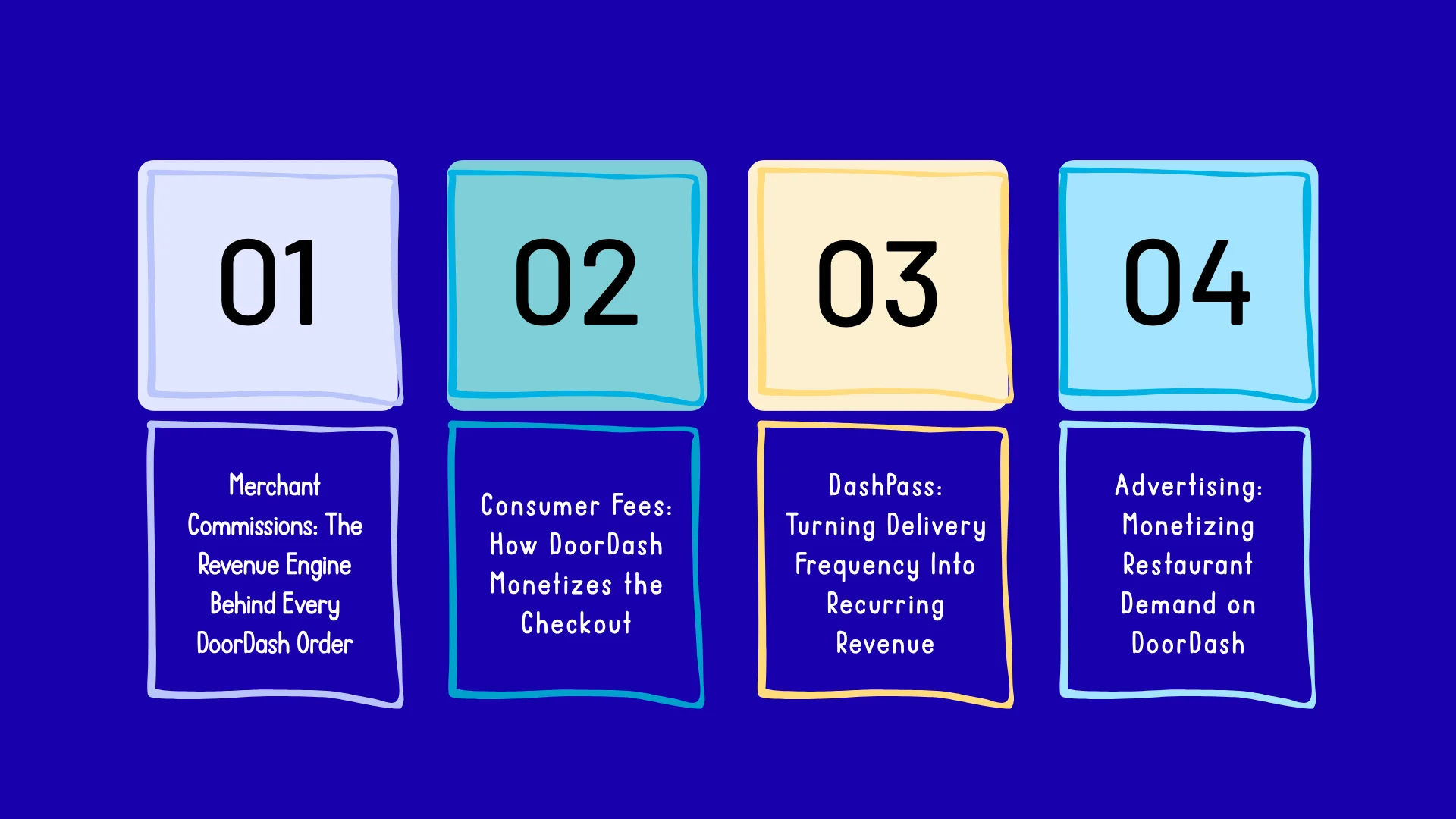
When a customer orders from a restaurant through DoorDash, it has to pay an agreed percentage of the order value. In return, it gains access to DoorDash’s customer base, marketplace discovery, ordering infrastructure, payment processing, delivery fulfilment, and customer support. DoorDash, therefore, monetizes the commercial value of bringing restaurant demand and supply together under one roof, rather than charging merchants solely for delivery.
Suppose a Chicago-based Mexican restaurant receives $40 through DoorDash under an assumed 25% commission rate. The company would generate $10 in merchant commission revenue from this order. The restaurant retains the remaining order value before accounting for its own food, labor, packaging, taxes, and other expenses. For the merchant, this $10 becomes worthwhile if DoorDash brought in a customer who might otherwise never have discovered the business. On the contrary, for DoorDash, every additional marketplace order creates commission revenue while also increasing activity across its existing consumer, merchant, and Dasher network.
This specific monetization model offers a significant scalability advantage as restaurant and platform revenues can grow together. It also becomes useful in a market where restaurants often need incremental demand but aren’t willing to build their own flagship delivery infrastructure. The commission effectively monetizes customer acquisition, marketplace access, and fulfilment in a single transaction.
In addition, businesses also achieve a practical way to manage order-level economics. You can compare your delivery platform’s commission revenue against:
- Courier payouts
- Payment processing
- Refunds
- Promotional credits
- Customer acquisition costs
- Support expenses
This becomes quite useful as fulfilment economics differ sharply across various geographies. A dense Manhattan delivery zone can support completely different order economics from a sprawling suburban market where couriers travel farther between customers and restaurants.
The trade-off, however, is the merchant margin pressure. Most US restaurants already have to bear expenses for labor, food, occupancy, and operations. So, a high commission can reduce the profit left from a delivery order. That’s why you will have to maintain a very delicate balance with commission pricing. Too low and your platform will struggle to cover delivery and acquisition costs. Too high, and merchant retention and order volume will suffer.
Consumer Fees: How DoorDash Monetizes the Checkout
This gives DoorDash a second way to monetize each marketplace transaction beyond the commission restaurants pay. Customers get charged for the order delivery and use of the company’s marketplaces and services. The amount, however, varies based on different factors, like the order and the applicable delivery conditions. This allows DoorDash to collect revenue directly from the demand side of its marketplace while the merchant commission monetizes the supply side.
Imagine a customer places a $40 restaurant order through DoorDash. Alongside the food price, the customer will see a delivery charge and a service fee at checkout, in addition to taxes and any applicable tip. One thing to note here is that the final amount that the customer has to pay to place the order isn’t the same as DoorDash’s revenue. Here, the company acts as an agent in the transaction and recognizes its applicable fees and commissions as revenue after amounts owed to merchants and other parties are accounted for.
If you rely entirely on restaurant commissions, you will end up putting more economic burden on the merchants. At the same time, charging customers will allow you to recover part of the cost of providing delivery and marketplace services to them. This becomes more valuable for your US food delivery business as the orders become more expensive to fulfil due to courier time, distance, incentives, and operational support. Besides, customer fees will give you more flexibility to manage different order economics rather than applying the same monetization approach to every transaction.
However, you must pay attention to checkout friction. A customer who sees a $40 meal has to pay way more during the final step once delivery fees, service charges, taxes, and tips are added. As US consumers compare multiple delivery platforms, you will have to balance fee revenue against conversion and order frequency. Otherwise, they will switch to restaurant pickup and first-party ordering instantly. Higher fees can increase your revenue per completed order but will potentially reduce the number of orders placed. At the same time, aggressive fee reductions can stimulate demand but will weaken contribution margins.
DashPass: Turning Delivery Frequency Into Recurring Revenue
This adds a subscription layer to DoorDash’s transaction-based model. Instead of charging members the full applicable delivery economics on every eligible order, it offers subscription benefits, like $0 delivery fees and reduced service charges on orders that qualify per the business rules. The model, therefore, changes the customer’s economic calculation from paying separately for delivery to paying for ongoing access to lower delivery expenses.
Consider a customer who orders from DoorDash four or five times every month. Without a membership, each eligible order is likely to include both delivery and service charges. However, with DashPass, the customer has to pay a recurring membership fee and receives the applicable benefits on qualifying orders. This can make additional DoorDash orders feel cheaper, encouraging customers to use the platform more frequently. For DoorDash, the same customers now represent recurring subscription revenue plus greater potential marketplace transaction activity.
For your US delivery business model, the strongest benefit of subscriptions will be in the form of retention and order frequency, not just membership revenue. A customer who has already paid for a monthly or annual membership will receive a financial incentive to keep using your platform and place orders. This will reduce dependency on repeatedly convincing customers to place the next order through discounts or paid acquisition.
Higher order frequency can also improve your marketplace economics as your app can spread customer-acquisition and technology costs across more transactions. At scale, subscriptions can therefore make customer behavior more predictable while creating a recurring revenue base alongside commission and consumer fees.
Besides, you can also support customer lifetime value through this monetization model. A high-frequency member can generate value through repeated restaurant orders, while your platform can monetize the same customer through advertising and other marketplace services.
The trade-off, however, is that subscription benefits can reduce revenue collected from individual orders. A frequent customer may save more money on delivery and service fees than a low-frequency customer. This means the subscription only works economically if the recurring membership revenue and increased order activity compensate for the discounts.
Advertising: Monetizing Restaurant Demand on DoorDash
This has become an important revenue layer for DoorDash because the platform controls a valuable point of high-intent consumer delivery. Restaurants will pay to increase their visibility when customers are browsing or searching for food on DoorDash. Sponsored Listings, for example, allow merchants to bid for placement and pay when the ads generate an order. This means DoorDash can monetize the customer traffic it has already built without relying solely on commissions from completed transactions.
Imagine a Chicago-based customer searching DoorDash for “Burgers near me”. Several restaurants might be capable of fulfilling the order. But a local burger joint can use DoorDash advertising to improve its visibility in those search results. If the restaurant spends $500 on a campaign and that ad generates incremental orders, DoorDash can potentially earn advertising revenue while also earning its applicable marketplace revenue from those transactions.
For your US delivery business, this approach will ensure that the ads generate revenue without materially increasing the physical cost of fulfilling an order. Once you invest in the consumer-side app, search infrastructure, merchant network, and audience, additional ad revenue will carry stronger incremental economics than transaction revenue.
Besides, advertising will also create a monetization flywheel. More consumers create more search and browsing activity. More activity makes ads valuable to merchants. More merchant ads can generate additional platform revenue. And that revenue will support your further investments in customer acquisition, product development, personalization, and marketplace growth.
However, if paid placements become too dominant, smaller restaurants are likely to struggle to gain visibility without continuously spending on ads. Customers may also lose trust if the most visible restaurants are not necessarily the most relevant ones. Thus, your platform needs strong relevance, disclosure, targeting, measurement, and auction controls.
Beyond Food: DoorDash Drive, Grocery, and Enterprise Logistics
DoorDash Drive: Delivering Orders the Merchant Already Owns
DoorDash Drive allows merchants to use the platform’s delivery network for orders placed through their own websites, apps, or other forms of ordering channels. For example, a Chicago pizza restaurant could receive a $50 order through its website and use DoorDash to dispatch a Dasher. The customer will never have to interact with the DoorDash marketplace, but the company still earns a fulfilment fee for completing the delivery.
This model is strategically valuable because the platform doesn’t have to acquire new customers for every transaction. Here, the merchant owns the demand, while the delivery platform monetizes the order fulfilment layer. For your food delivery business, this will create another way to utilize your courier network and technology while avoiding direct competition with the merchant’s own ordering channel.
Grocery and Convenience: Increasing Order Frequency
DoorDash has also expanded into grocery and convenience delivery, thereby moving beyond restaurant occasions into everyday household purchases. For example, a customer could use the platform to order groceries from a local supermarket or household essentials from a convenience retailer. The platform here can potentially monetize the transaction through merchant economics and customer-facing fees. At the same time, it can use much of the underlying marketplace, dispatch, payments, and delivery infrastructure.
The real business opportunity here is higher customer frequency and full-scale network utilization. More delivery occasions can help your delivery platform make better use of its courier network across different times of the day. However, grocery introduces more operational complexity than restaurant delivery. That’s because you will have to account for inventory accuracy, substitutions, picking, larger baskets, and integrations with retailer systems.
Enterprise Logistics: Turning Delivery Infrastructure Into B2B Revenue
DoorDash’s enterprise logistics strategy extends the company’s role from a consumer marketplace into a last-mile fulfilment provider for businesses. The logic here is pretty much straightforward. DoorDash has already invested heavily in its Dasher network, dispatch technology, routing, tracking, payments, and delivery operations. Rather than using that infrastructure only for orders originating on DoorDash, it made the same capabilities available to businesses that generate orders through their own channels.
Now, you will benefit the most from higher utilization of an existing logistics network. Delivery infrastructure involves substantial technology and operational investment. So, using that network across restaurant, grocery, retail, and other orders can potentially improve asset utilization and create additional revenue without requiring you to acquire a new customer for every delivery.
Features That Make a DoorDash-Style App Work
Before the economics above can work in practice, the platform needs to support them structurally. Here’s the core set of features every food delivery app needs to run a DoorDash-style revenue model, not just process orders.
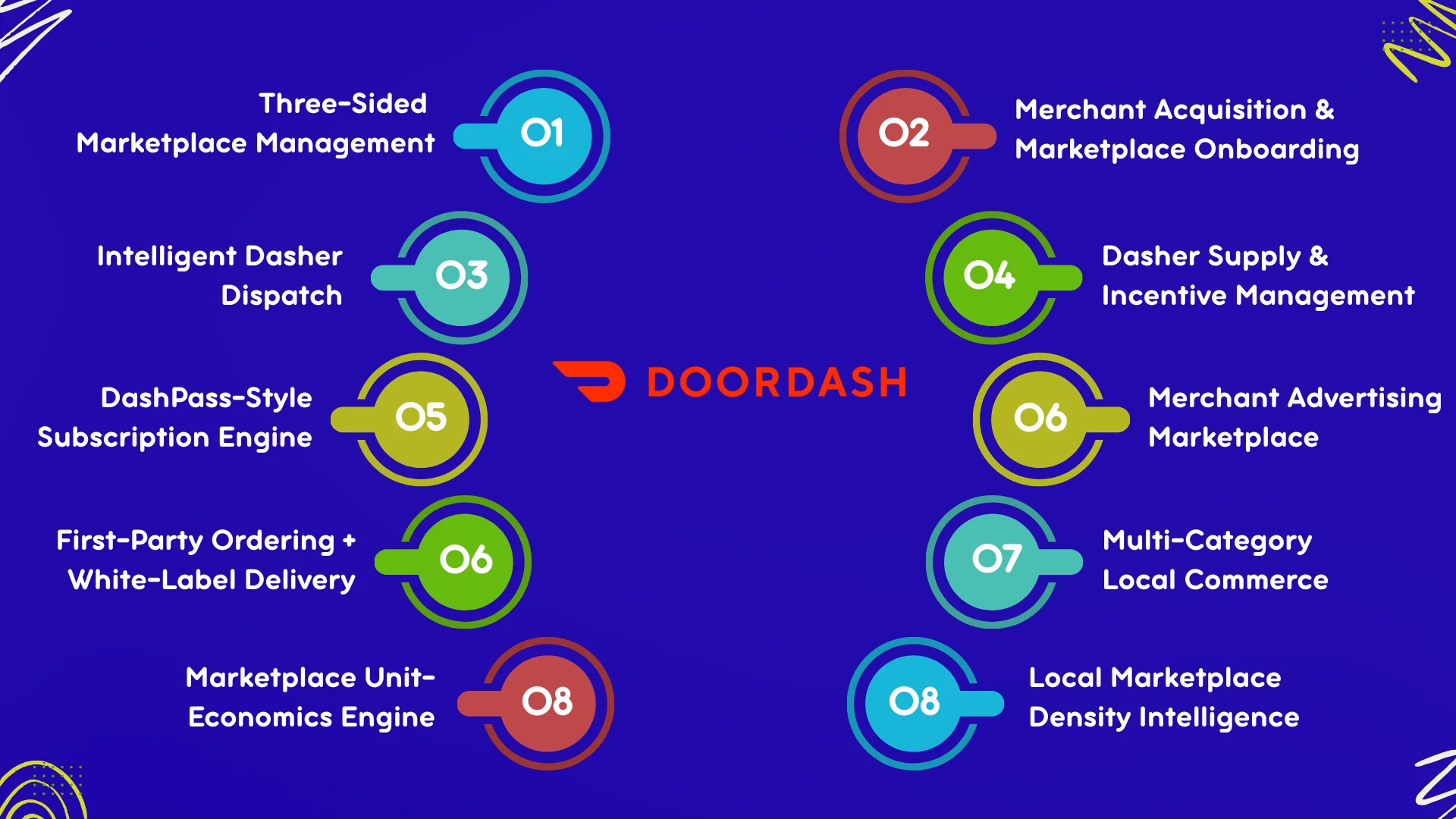
Three-Sided Marketplace Management
A DoorDash-style app must work with a three-sided marketplace model, having three distinct participants:
- Customers generating the demand
- Merchants supplying the products
- Independent delivery partners fulfilling the orders
However, for this, you will have to build a shared marketplace engine that can continuously balance these three sides. This is fundamentally different from building separate customer and delivery apps. That’s because restaurant availability, order demand, and Dasher supply will directly influence one another.
Merchant Acquisition & Marketplace Onboarding
Merchants need more than just a simple ordering dashboard. A DoorDash-style platform should allow restaurants to manage menus, pricing, operating hours, promotions, delivery settings, orders, and marketplace performance from one platform only. It should also support different commission arrangements and merchant-specific configurations. Only then can you ensure your food delivery platform supports genuine restaurant growth and a fulfilment channel, rather than simply acting as another online ordering interface.
Intelligent Dasher Dispatch
Your platform should automatically determine which Dasher receives each order using variables like:
- Courier location
- Restaurant preparation time
- Delivery distance
- Existing assignments
- Expected delivery time
DoorDash-style dispatch is designed around network efficiency, rather than simply selecting the nearest driver available. Better assignment will help you reduce courier waiting time, improve delivery reliability, and control the variable fulfilment cost attached to every order.
Dasher Supply & Incentive Management
A DoorDash-like marketplace needs special mechanisms for actively managing its delivery workforce. So, your platform should monitor courier availability and use base-pay adjustments, incentives, promotions, and delivery opportunities to attract sufficient Dasher supply during high-demand periods. This capability is particularly important because customer demand can increase much faster than courier availability. If you cannot balance both, delays will be created even when restaurants and orders are readily available.
DashPass-Style Subscription Engine
When you plan to build a DoorDash-style app for your business, use subscriptions to change customer economics from paying delivery-related fees on individual orders to paying a recurring membership fee for ongoing benefits. Your engine should manage eligibility, recurring billing, fee waivers, discounts, and membership benefits automatically. This will help you increase ordering frequency and retention, while giving your business a predictable revenue stream beyond individual marketplace transactions.
Merchant Advertising Marketplace
Make sure to build advertising directly into your marketplace rather than treating it as a separate marketing product. Restaurants can eventually pay for sponsored visibility when customers are actively searching or browsing. Your platform should also support campaign budgets, targeting, bidding or placement rules, attribution, and performance reporting. This will create an additional monetization layer from existing marketplace traffic without forcing you to invest in another customer acquisition channel.
First-Party Ordering + White-Label Delivery
A major DoorDash-style capability you should focus on is fulfilling orders that originate outside the marketplace. Restaurants should be able to receive orders through their own websites or apps while using your platform’s delivery network for fulfilment. The customer may never interact with your delivery platform directly. This will allow you to monetize logistics infrastructure without having to acquire every customer through your consumer marketplace only.
Multi-Category Local Commerce
Your platform’s underlying architecture should support expansion beyond restaurants into categories like grocery, convenience, and retail. These categories can reuse customer accounts, payments, mapping, dispatch, and delivery infrastructure while introducing category-specific workflows like inventory synchronization and substitutions. This capability mirrors DoorDash’s broader strategy of turning a restaurant marketplace into infrastructure for multiple types of local commerce and delivery models.
Marketplace Unit-Economics Engine
A DoorDash-like platform needs to measure whether individual transactions and geographic markets actually make economic sense or not. For this, make sure your system can track merchant commissions, customer fees, Dasher costs, promotions, refunds, payment expenses, and acquisition costs against the order value. This will give you management visibility into contribution margin rather than forcing you to solely rely on order volume or gross marketplace value as indicators of business performance.
Local Marketplace Density Intelligence
DoorDash-style expansion depends on achieving sufficient density among customers, merchants, and Dashers within specific geographic markets. Your platform should, therefore, analyze order demand, restaurant coverage, courier availability, delivery distances, fulfilment times, and market-level economics. These insights will help you determine where additional restaurants or Dashers are needed and whether a market can support profitable expansion before you commit your resources.
Cost to Build a Food Delivery App Like DoorDash (2026 Breakdown)
Every revenue mechanism above — tiered commissions, consumer fees, a subscription engine, an advertising marketplace, Drive-style fulfilment — adds real engineering scope on top of a basic ordering app. As a rough anchor: a focused MVP with core ordering, tracking, and payments typically starts around $30,000–$80,000; a mid-market build with all four user panels, POS integrations, and real-time dispatch runs $80,000–$200,000; and a full-scale, multi-market platform with advertising, subscriptions, and multi-category commerce can run $250,000–$850,000 or more, depending on integration depth and geographic scope.
The costs increase with marketplace and logistics complexity. That’s because a DoorDash-style app will require separate experiences for customers, merchants, and delivery partners. In addition, you will also have to invest in a shared backend framework so that your app can cater to all three audience groups uniformly. Real-time Dasher dispatch, GPS tracking, route optimization, POS integrations, multi-party payments, automated settlements, and marketplace analytics will add more development effort than a basic food ordering application.
Advanced monetization will also affect your budget. DashPass-style memberships, merchant advertising, promotions, and first-party delivery integrations require additional backend and payment logic. Similarly, expanding into grocery or retail will introduce inventory synchronization, substitutions, and category-specific fulfilment workflows.
| Cost component | What it includes | Estimated cost | Typical time | Cost impact |
| Customer app | Discovery, ordering, checkout, tracking, reviews | $8K–$20K | 6–10 weeks | Medium |
| Merchant platform | Orders, menus, promotions, analytics | $7K–$18K | 5–9 weeks | Medium |
| Dasher app | Delivery requests, navigation, earnings, status | $7K–$18K | 5–9 weeks | Medium |
| Admin platform | Users, merchants, Dashers, commissions, disputes | $5K–$12K | 4–7 weeks | Medium |
| Backend & APIs | Marketplace logic, APIs, databases, authentication | $10K–$30K | 8–14 weeks | High |
| Dispatch & routing | Dasher assignment, tracking, batching, route optimization | $8K–$30K | 6–12 weeks | Very high |
| Payments & settlements | Checkout, tips, refunds, commissions, payouts | $4K–$12K | 3–6 weeks | High |
| POS/API integrations | Menu, pricing, availability, order synchronization | $5K–$25K+ | 4–10 weeks | High |
| Membership, promotions & ads | Subscriptions, discounts, sponsored listings | $5K–$20K+ | 4–8 weeks | High |
| Analytics, security & QA | Reporting, testing, fraud controls, security | $7K–$20K | 5–10 weeks | High |
| Total | Complete DoorDash-style platform | $35K–$350K+ | 4–15+ months | Varies by scope |
Those ranges move a lot based on decisions like dispatch complexity, POS integration count, and whether you build custom or start from white-label software — which is exactly what building a DoorDash-style platform walks through component-by-component, with timelines and cost drivers for each panel, dispatch engine, payment logic, and category expansion.
If you’re earlier-stage and trying to validate the model before committing to the full build, food delivery app development built for early-stage teams covers how to scope a smaller first version without boxing yourself out of the revenue mechanics described above.
Get a real cost estimate, not a range
Tell us your market, feature scope, and integrations. We’ll give you a build plan and number specific to your business, not a blog-post estimate.
What Factors Affect DoorDash App Cost Up and Down?
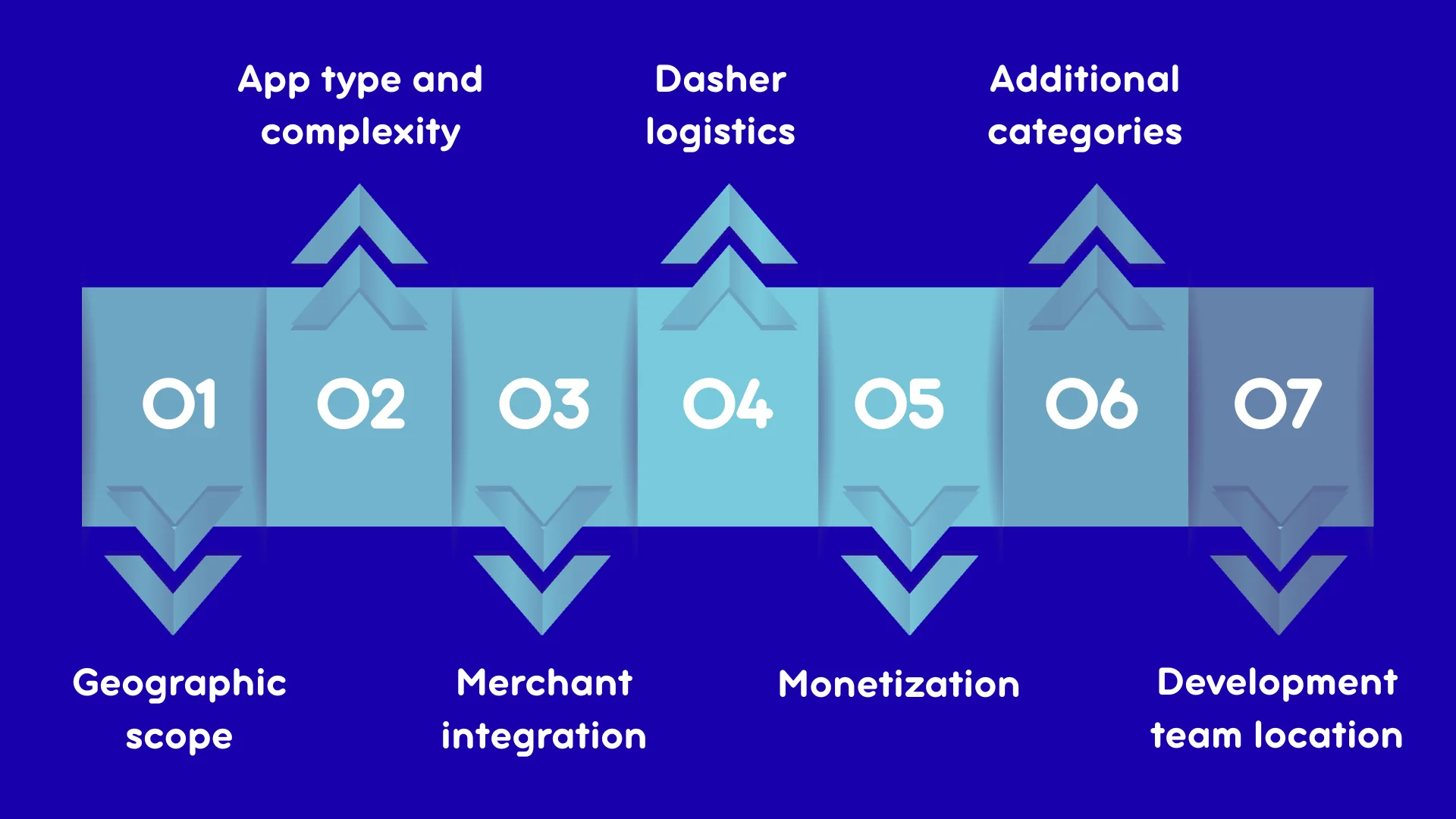
Geographic scope
This determines how much operational complexity your DoorDash-style delivery app needs to handle. A single-city launch can use defined delivery zones, a concentrated merchant network, and a relatively predictable Dasher supply model. Expanding across cities, however, introduces different merchant densities, demand patterns, delivery distances, service areas, operating hours, and local pricing strategies.
Your platform will also need location-aware controls for merchant onboarding, delivery availability, Dasher positioning, and market-level performance. A nationwide model requires the architecture to support multiple markets without allowing changes in one geography to disrupt another.
| Component | What it includes | Estimated cost | Typical timeline |
| Single-city launch | Delivery zones, geofencing, location rules | $3K–$7K | 1–2 weeks |
| Multi-zone operation | Multiple service areas and location-based rules | $7K–$15K | 2–4 weeks |
| Multi-city expansion | Market-specific configurations and coverage management | $15K–$30K | 4–8 weeks |
| Nationwide infrastructure | Large-scale geographic and market management | $30K–$50K+ | 8–12+ weeks |
App type and complexity
A DoorDash-style application is not simply a customer mobile product. It requires coordinated interfaces for customers, merchants, Dashers, and administrators, all connected through a common marketplace backend. Complexity rises the moment your platform moves beyond basic ordering into personalized recommendations, subscriptions, loyalty, promotions, sponsored listings, refunds, dispute management, and marketplace analytics.
These features will introduce additional business rules, permissions, transaction states, and data flow pipelines. Engineering effort will be needed to establish appropriate synchronization of these variables across all sides of the marketplace, which will automatically drive costs higher.
| Component | What it includes | Estimated cost | Typical timeline |
| Customer app | Discovery, ordering, checkout, tracking | $8K–$20K | 6–10 weeks |
| Merchant platform | Menus, orders, promotions, analytics | $7K–$18K | 5–9 weeks |
| Dasher app | Delivery requests, navigation, earnings | $7K–$18K | 5–9 weeks |
| Admin platform | User, merchant, Dasher, and dispute management | $5K–$12K | 4–7 weeks |
Merchant integration
This factor determines how much of the ordering process can be automated within your DoorDash-style delivery marketplace. With a standalone merchant dashboard, restaurants can manually manage menus, prices, availability, promotions, incoming orders, and preparation status. Deeper integrations with POS and restaurant-management systems allow this information to synchronize automatically.
Your platform may also need to handle menu modifiers, item availability, order acceptance, preparation updates, cancellations, and pricing changes in real time. Supporting multiple POS providers also means dealing with different APIs, authentication methods, data formats, webhooks, and synchronization failures.
| Component | What it includes | Estimated cost | Typical timeline |
| Merchant dashboard | Menu, pricing, availability, order management | $7K–$15K | 5–8 weeks |
| Menu synchronization | Menus, modifiers, prices, availability | $5K–$10K | 3–5 weeks |
| Single POS integration | Orders and operational data synchronization | $5K–$12K | 3–6 weeks |
| Multiple POS integrations | Support for several POS providers | $15K–$40K+ | 6–12+ weeks |
Dasher logistics
It forms the core part of your food delivery platform because delivery efficiency will directly affect both customer experience and marketplace economics. The dispatch engine needs to determine which Dasher should receive an order based on factors like current location, restaurant preparation time, existing assignments, delivery distance, and expected ETA.
A more advanced system can support batching compatible orders, dynamic route optimization, GPS tracking in real time, changing ETAs, delivery zone controls, and Dasher incentives. You also need to ensure your platform can handle supply and demand fluctuations so a sudden increase in orders doesn’t cause excessive delivery delays.
| Component | What it includes | Estimated cost | Typical timeline |
| Dasher workflow | Onboarding, delivery acceptance, status updates | $5K–$10K | 3–5 weeks |
| GPS tracking | Real-time Dasher and customer location tracking | $8K–$15K | 4–7 weeks |
| Automated dispatch | Matching orders with available Dashers | $8K–$15K | 4–7 weeks |
| Route optimization | Routing and dynamic delivery ETAs | $15K–$30K | 6–10 weeks |
- Monetization
The monetization model will directly influence our platform’s financial architecture. Merchant commissions require rules for calculating platform revenue and merchant settlements. At the same time, customer delivery and service fees will vary according to the order characteristics or market conditions. If you add subscription programs, investments will be needed to add features for recurring billing, eligibility rules, benefit management, and renewal handling.
Advertising is likely to introduce another layer of expense, as you will have to build campaign creators, sponsored placement logic, bidding or budget controls, attribution, and performance reporting. If your platform supports first-party delivery, it must maintain a separate commercial workflow for orders generated through a merchant’s own website or mobile app.
| Component | What it includes | Estimated cost | Typical timeline |
| Merchant commissions | Commission calculation and merchant settlements | $4K–$8K | 2–4 weeks |
| Customer fees | Delivery and service fee calculation | $3K–$7K | 2–4 weeks |
| Memberships | Recurring billing and subscription benefits | $7K–$15K | 4–7 weeks |
| Promotions | Discounts, offers, and funding rules | $5K–$12K | 3–6 weeks |
Additional categories
Adding grocery, convenience, or retail changes more than the products displayed in the marketplace. Restaurant delivery generally revolves around prepared orders with relatively predictable item availability. On the contrary, grocery and retail will need real-time inventory synchronization, substitutions, unavailable item handling, item-level picking, and different fulfillment workflows.
Merchant interfaces will also need category-specific functionality. The delivery architecture must accommodate different order sizes, preparation processes, pickup requirements, and delivery patterns while still operating through the same core marketplace infrastructure.
| Component | What it includes | Estimated cost | Typical timeline |
| Restaurant delivery | Prepared-food ordering and fulfillment | Core scope | 4–6 months |
| Convenience | Convenience products and category workflows | $15K–$30K | 4–8 weeks |
| Retail | Product catalog and retail fulfillment | $20K–$40K | 6–10 weeks |
| Grocery | Inventory, substitutions, and picking workflows | $30K–$60K | 8–14 weeks |
Development team location
Development team location affects more than the hourly rate. A DoorDash-style platform requires several areas of expertise, including mobile development, backend engineering, UI/UX, QA, DevOps, payment integration, and real-time logistics. A team with prior experience building marketplaces or delivery systems can often identify architectural and operational issues earlier than a generic development team.
Location will also affect communication overlap, project management, availability of specialized talent, and post-launch support. For a complex marketplace, evaluating technical capability, relevant experience, delivery methodology, and long-term maintenance support is therefore more important than selecting a team solely on price.
| Development model | What it includes | Typical hourly rate | Typical project duration |
| India-based team | Mobile, backend, QA, DevOps, and support | $25–$60/hour | 4–10 months |
| Eastern Europe / Latin America | Product engineering and specialist resources | $40–$90/hour | 4–10 months |
| Western Europe | Higher-cost engineering specialists | $70–$130/hour | 4–10 months |
| U.S.-based team | Local product and engineering resources | $100–$200+/hour | 4–12+ months |
Building custom? Let’s talk architecture
We design the marketplace engine, dispatch logic, and monetization layer around your competitive edge — not a copy of DoorDash’s screens.
Build vs. Buy: Should You Build Custom or Use a White-Label Solution
The custom development approach for a DoorDash-style delivery platform is more feasible when you want to build a serious marketplace rather than simply launching another food ordering app. This way, you can design it around your target geography, merchant economics, Dasher incentives, dispatch strategy, subscription model, advertising business, and future expansion into grocery or retail.
It also gives you more control over the technology behind your competitive advantage. Custom builds become suitable when you expect significant order volumes, need proprietary logistics capabilities, require complex POS integrations, or plan to expand the platform into a broader local commerce marketplace.
White-label software, on the other hand, becomes practical when speed is more important than technological differentiation. Instead of building customer, merchant, driver, and administrative systems from scratch, you license an existing platform and then customize its branding, workflows, and configuration.
This approach will give you ample scope to validate the market before committing substantial capital to engineering. The limitation is that your business needs to ultimately operate within the capabilities of someone else’s platform. If you later need proprietary dispatch, sophisticated advertising, unusual commission structures, deep POS integrations, or multi-category commerce, migrating away from one vendor can become expensive and operationally disruptive.
| Differentiation factor | Custom-built app | White-label solution |
| Cost range | $65K–$350K+, depending on complexity and scale | $10K–$50K+ in initial setup and customization, plus ongoing vendor fees |
| Initial investment | Higher upfront development investment | Lower upfront investment |
| Time to market | Typically several months | Often weeks to a few months |
| Customization | Fully tailored to business requirements | Limited to available modules and configurations |
| Dispatch & logistics | Proprietary dispatch and delivery logic can be developed | Uses the vendor’s existing logistics engine |
| Monetization | Full control over commissions, fees, ads, and subscriptions | Restricted to supported revenue models |
| Merchant integrations | Can support required POS and third-party systems | Limited to vendor-supported integrations |
| Data & analytics | Greater control over marketplace data and analytics | Data access depends on vendor terms |
| Scalability | Architecture can be designed around long-term growth | Depends on vendor infrastructure and technical limits |
| Competitive differentiation | Strong potential for proprietary features and workflows | Primarily limited to branding and configuration |
How GMTA Will Help You Build Your Delivery Platform
Building a DoorDash-style platform in the U.S. takes more than customer and delivery apps — the technology has to coordinate customers, merchants, delivery partners, payments, dispatch, and marketplace operations in real time. GMTA’s food delivery app development services are built around exactly that coordination problem, designed around your specific business model, target market, and growth strategy.
We build the core three-sided marketplace, connecting customer ordering with merchant operations and delivery partner workflows. This includes merchant onboarding, menu and order management, commission calculations, payouts, promotions, refunds, delivery assignment, and admin controls. The platform can also incorporate real-time GPS tracking, smart dispatch, ETA calculation, delivery zones, route optimization, and delivery partner availability management. Thus, you can support efficient last-mile operations across multiple geographies.
For merchants, GMTA can integrate relevant POS, restaurant management, payment, mapping, and other third-party systems to reduce manual processes and keep orders, menus, pricing, and availability synchronized. On the monetization side, we ensure the platform can support multiple revenue streams, including merchant commissions, customer fees, subscriptions, sponsored listings, promotions, and white-label delivery.
At GMTA, we also architect the backend for expansion beyond a single-city launch. Whether your roadmap includes multiple markets, grocery and convenience delivery, retail, or enterprise logistics, our underlying infrastructure can be structured to accommodate increasing transaction volumes and additional marketplace capabilities.
The objective is not to copy DoorDash screen for screen. GMTA can help you build the marketplace infrastructure, logistics capabilities, and monetization framework required to launch a differentiated delivery platform and scale it with your growing business.
FAQs
How much does it cost to build a food delivery app like DoorDash in 2026?
To build a food delivery app like DoorDash in 2026, you should budget $35K to $350K+ in 2026. A focused MVP can fall around $35K-$65K, while a more advanced marketplace with real-time dispatch, POS integrations, subscriptions, advertising, and multi-market capabilities can reach $140K-$350K+. Enterprise-grade platforms cost considerably more depending on the infrastructure and operational requirements.
How can a new delivery platform compete with DoorDash in a crowded U.S. market?
A new delivery platform should compete through market differentiation rather than scale alone. For this, you can focus on an underserved city, cuisine segment, merchant category, or customer group to create a defensible entry point. Better merchant economics, transparent customer fees, specialized delivery capabilities, stronger loyalty benefits, or superior local fulfilment can also give your new platform an advantage without matching DoorDash’s nationwide footprint.
How does a DoorDash-like app make money?
Your DoorDash-style app can make money through merchant commissions, customer delivery and service fees, subscriptions, advertising, and white-label delivery services. Merchant commissions monetize marketplace transactions, while subscriptions generate recurring revenue and encourage order frequency. Advertising will help you monetize high-intent marketplace traffic, and white-label delivery allows you to earn from orders generated through the merchants’ own websites or mobile apps.
How does real-time delivery dispatch work in a DoorDash-like app?
A real-time dispatch engine matches each order with an appropriate delivery partner using factors like Dasher location, restaurant preparation time, delivery distance, current assignments, and estimated delivery time. More advanced systems can batch compatible orders, optimize routes, update ETAs dynamically, and adjust assignments as conditions change. The objective here is to reduce delivery time while improving courier utilization and order-level economics.
How can a DoorDash-like platform manage commissions and merchant payouts?
Your platform should use a centralized settlement engine that calculates merchant commissions, customer fees, promotions, refunds, tips, taxes where applicable, payment processing costs, and delivery charges before generating payouts. Merchant-specific commission agreements can then be applied automatically. Detailed settlement reports will give restaurants visibility into gross sales, deductions, adjustments, and final amounts transferred to their accounts.
When does adding grocery or retail delivery make business sense?
Adding grocery or retail delivery makes sense when your platform has sufficient customer demand, merchant coverage, and delivery capacity to support higher-frequency orders. Grocery can increase order frequency beyond restaurant occasions, while retail will expand the addressable market. However, both will introduce inventory synchronization, substitutions, picking workflows, larger baskets, and different fulfilment requirements. That’s why your expansion plan should follow proven marketplace density rather than simply increasing category count.
What hidden costs should founders budget for after launching a DoorDash-like app?
You should budget for cloud infrastructure, mapping and location APIs, payment processing, third-party integrations, customer support, bug fixes, security, monitoring, compliance, fraud prevention, and ongoing feature development. Marketplace operations can create additional expenses through Dasher incentives, refunds, promotional credits, merchant onboarding, and customer acquisition. These recurring expenses will materially change unit economics even after the initial software development budget is exhausted.

Founder
Anjali Upadhyay is the Founder of GMTA Software Solutions, a mobile and web application development company she built from the ground up in 2019. Under her leadership, GMTA has delivered 200+ production applications across healthcare, fintech, and on-demand services for clients in the US, UK, Singapore, and UAE. She also leads GMTA’s AI practice, which has shipped production AI systems — including HIPAA-compliant healthcare workflows, LLM-integrated logistics platforms, and fintech automation tools — for US-based enterprise clients. Her writing covers AI product strategy, build-vs-buy decisions for AI systems, and the operational realities of moving AI from proof-of-concept to production at scale.