


The increase in convenience and homely facilities has given a boost to the online services sector. Every business, from kitchen to laundry, is now in the digital realm with more efficient resources and workflows. Looking at this scenario, mobile app development has become a necessity of the time.
By using mobile apps, people are able to access online services, and as a result, businesses are moving towards digitalization. The users are asking for more services to be at their fingertips, and to meet this market demand, enterprises are developing their custom mobile apps.
As per Statista, ‘around 80% of people use mobile phones globally every day’. The report indicates the successful penetration of mobile applications to a large number of people.
Herein, if you are the one who is into local business management or runs your own enterprise and wants to take it online, this guide on the mobile app development process is curated for you.
Developing an app is one of the best decisions for your business growth, for sure, and we help you understand how to create a mobile app step by step in this guide.
Mobile App Development in 2026
Do you know what a mobile app? Mobile app development is a process where skilled project managers and their team gather your business information, understand the need to bring it online, and implement the right approaches to build a platform on which you can sell your services or goods, just like you do on-site.
By leveraging suitable programming languages, frameworks, and platforms, the team of developers starts building your digital shop with all the features of modern digital platforms tailored to your industry. The whole process is a long-term and ongoing work that includes product development and maintenance.
Mobile app development works quite similarly to building a website for a business or individual purpose, with more handy and user-friendly approaches, specifically designed to be accessed on mobiles and tablets.
Why Follow a Step-by-Step Mobile App Development Process?
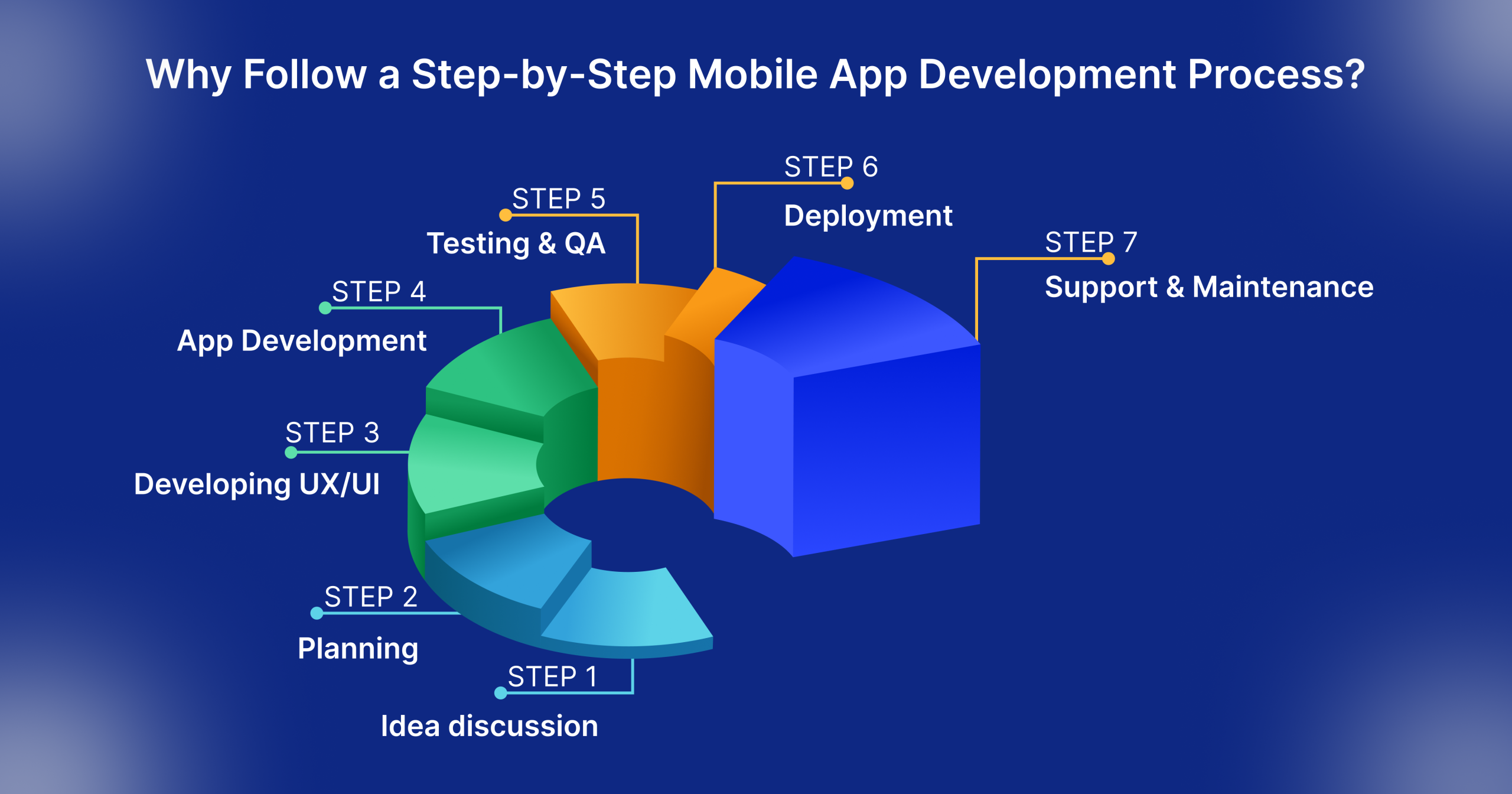
The mobile app development process involves multiple key steps where your application is built with continuous integration and continuous development cycles, minimizing the chances of faults and bugs.
However, this functionality also depends on your app development company. Here are the detailed mobile app development steps.
1. Strategizing & idea discussion
The very first step of your mobile app development is defining the purpose of the app. The process includes the idea or vision behind this app development. For your mobile app development company, it is crucial to understand your idea of a business app, its goals, end users, outcomes, and future objectives before jumping into the development phase.
A. Object identification
Identifying the purpose or object of your business app development is as important as making it scalable. Your development team or company may help you define this by asking questions such as:
- Do you have any competitors?
- What problem will this app solve?
- Who are the end-users?
- What are the outcomes that you expect from this app?
B. Competitor analysis
Identifying your competitors is another crucial part of this stage in the mobile app development process. Competitor research not only helps you understand market strategies within similar industries but also assists you in determining your unique selling points. The questions you might answer here include:
- Are there any other apps with a similar idea or intent, in the nearby region or country?
- How is their performance going?
- What are they serving or
- What is their USP?
C. Choice of platform
As the first step of your strategy, you need to decide on your app development platform. You may choose custom Android app development, iOS mobile app development, or a cross-platform approach.
All these platforms are specifically designed to serve the dedicated users of each device. However, cross-platform development reaches both device users at a high cost of development.
D. Monetization model
Once you are ready and have finalized the crucial aspects of your mobile app development process, you will have to find the models for monetizing the app. This option is for service-based business models where companies sell virtual services to their end users, who can choose any subscription type based on their preferences and needs.
Some of the top mobile app monetization ways are:-
- Paid applications
Payment is required to access the full app after a limited free trial.
- In-app advertisement
Businesses run advertisements in the relevant industries, and once a user clicks on it, a portion of revenue goes to the app owner.
- Subscription
Users can subscribe to the services, which are offered in different features and segments within a specific budget.
- Affiliate marketing
Promote the business with an affiliate marketing system, offer commission to the marketers, and earn a considerable amount.
Every mobile app development process does not necessarily have a subscription model. It depends on the business type and other factors.
2. Analysis & planning
Your mobile app development process accelerates at this step. By now, you are well aware of your application’s basic needs, from buyer persona to app monetization methods.
Once you are prepared with these details, it’s time to gather business analysis. This step is about understanding how your team of developers decodes the app functions in detail.
A. Development roadmap
This subset of phase two is about defining the app development roadmap. This process is about making a rough sketch of how your product is going to reach its goals and meet your development expectations. This phase involves the minimal viable product at first, where you can decide how you want to go with your product further.
A minimal viable product or MVP is a miniature or a bare-bones app of your fully-fledged product that defines the app services with fewer features to check the user response, get the market evaluation, and validate the idea.
At this stage of the mobile app development process, you need to jot down the services, features, and other essential elements that you want to keep in your app at the initial phase, without burdening the app with lots of unwanted features.
B. Portal requirements
Now your next initiative will be to decide on the functional and non-functional requirements of the software portal. This phase is as vital as determining your roadmap planning.
The phase is definitely connected to the previous step, where you had to decide on your app type and features. Here, you need to understand the app’s functional and non-functional features, which can help you develop a clear understanding of how your software will perform or how the product quality will be after deployment.
C. Tech Stack
Identifying your tech stacks will determine how your app reacts in specific scenarios. A strong backend infrastructure enhances the app’s capacity during high traffic periods. This works simply by the choice of your platform. Every platform has a different set of tech stacks, which are leveraged accordingly.
If your app is on iOS, it will leverage the iOS-friendly tech stacks and frameworks. If your app is built on the Android platform, it will require Android-friendly technology.
- Android: Kotlin, Java, Flutter, React Native, Python, etc.
- iOS: Objective-C, Swift, C++, JavaScript, etc.
D. Development methodology
The importance of the development approach is reflected in your final product operations. The software development methodology is the backbone of any product and helps developers and stakeholders stay aligned with the ongoing product journey.
Out of many product development approaches (Waterfall, Hybrid, or Agile), the best is Agile Methodology, where the development tasks are done in sprints that are well-built and approved at the initial stage of the development, so that there is less chance of a flawed product.
So, choosing between waterfall, agile, or a hybrid approach depends on your product requirements, budget, and similar factors.
E. App development cost
Imagine a situation where you have decided to pursue your ideal app development with all the market research and other analysis, and you find that the app development cost is higher than you expected, or maybe hiring a team is much more expensive than you thought.
The situation may put you at stake when you do not pre-define your cost estimation. The pre-defined costing of the product helps you understand what the actual or near-term costing of each feature or service is going to be. So let us find the answers to these questions beforehand.
- What professionals do you need?
- How much will it cost to create your desired mobile app?
- How long will it take to complete your project?
- What type of app do you need: the basic or the complex one?
3. Developing UX/UI
Designing is an integral part of your mobile app development process. Decide how you want your app to look or how the navigation should be when any user visits your app. You can start this by building a rough sketch of your product so that you can define it to your developers further. Here is the mobile app design process that is generally followed.
A. Workflow & App Infrastructure
If you have a blueprint of your app design, it will help you get a great app as a final product, but if you are clueless or are not prepared for the UX/UI of your app development, it is also okay. Your team of developers and designers will help you during this stage, shaping your ideas into low-fi or high–fi wireframes.
- But before getting fascinated by others’ UI, you must prioritize your app requirements that eventually lead to your user satisfaction and app accessibility.
- Define your vision and the end users’ choice to the designers.
- Take references from your competitors.
- Compare how the app will look and how, as a user, you will navigate through it.
- Ask for wireframes and once those are approved, approach for a prototype to check with app functionality if it gets finalized.
B. Style Guides
Your product banding is a non-negotiable factor that truly affects the user interaction. Build a style guide for your application that helps your designers create an impactful UX/UI. Style guides help your app look symmetric and uniform. Check for these elements of your app design.
- Buttons
- Fonts
- Widgets
- Color scheme
- Spacing & positioning
4. App Development
So far, in your mobile app development process, you have prepared many things, including designing your application. Now, the central and most significant part starts from the development stage. Mobile app development is made up of multiple elements that one needs to consider.
A. Frontend development
The frontend is like the mirror of what the app has in its backend. So the frontend is something that the users will see at first on your app. It includes the designs, navigation, functionalities, etc. The frontend is built with three major components.
- Cross-platform
Cross-platform solutions are designed and developed for multiple platform capabilities. Cross-platform solutions are compatible with various operating systems and available for each system with a single code generation. These solutions are beneficial for beginners to save on cost and also reduce the code’s reusability.
- Unique platforms
The frontend uses different code for each development platform. For example, if you want to build an app on Android, the code will be generated accordingly, and for iOS, the code will be different. This approach is costlier but gives more benefits of platform-specific features.
- Hybrid
Hybrid app solutions have the components of web apps and platform-specific apps. These applications can be operated on mobile phones and computers. Hybrid technologies are built with web app solutions with standardized codes that can run on multiple platforms.
B. Backend
The performance of your mobile application relies on your backend infrastructure that creates the essential database and server-side objects. The backend development process starts with choosing a database engine and a hosting domain. The team further chooses suitable programming languages with appropriate frameworks.
The backend part is the one that decides the app’s scalability and load-bearing capacity. It also affects the frontend majorly. Therefore, for a robust backend, you must opt for a talented team of developers.
C. DevOps
The key role of your mobile app development process is to enhance collaboration between development and operations teams, commonly known as DevOps. With the efficiency of the development team and the operational team, the common goals of your product development are accessible.
- This is how DevOps brings value to your project of a dev mobile app:
- Conducting CI/CD process for speedy delivery and app reliability.
- Automated heavier and time-consuming tasks
- Backend infrastructure management
- Modernizing and optimizing the system
- Include security norms and tools to keep your product secure.
5. Testing & QA
Once your app development is completed, yet another part of the complete app development lifecycle is to test your app against any bugs or faults in the mobile app testing process. An app tester and quality assurance person checks for the app’s security, scalability, and stability.
Before moving to the launching phase, it is wise to check it through the following essential testing steps.
- App security with all protection compliance and industry regulations, with encrypted security.
- Checking for the functioning of the app features and navigation to load smoothly.
- Test the app for responsiveness while the platform faces a concurrent increase in users.
- Testing for regression to ensure that new codes or features do not affect or compromise the current app’s performance.
6. Deployment
Now, as your app is thoroughly tested and ready to launch to the market, it must be distributed through different models appropriate for each platform, and this stage is finally called deployment. Now, in the continuation of the phases of mobile app development, your developer will submit your app to either the Apple App Store or the Google Play Store.
The process of submitting your app requires you to go through the following tests by the respective store.
- Create the developer account.
- Fill out form(s).
- Upload the app files.
- Submit the form.
- Wait for the store approval.
- Set the release date.
7. Support & maintenance
Maintenance and support are the most important final steps in your mobile app development process. The app must be monitored even after it goes live and becomes popular on the store(s). If an app is not regularly updated or tested, it could face long-term consequences.
Here are the leading key performance indicators that help you assess your app’s health.
- Number of downloads
- Conversation
- User reviews
- Average tie on the app
- Number of active users
- User retention
- Conversation
- App bugs
- App updates
- Scalability
- Overall app performance
So this is the step-by-step process to build an app. This mobile app development process for beginners can also be vital for experts to get into the development process or to know how their app will be built. Also, now you have understood how apps are developed from idea to launch.

How Long Does Mobile App Development Take?
The mobile app development process takes around 3 to 6 months, depending on your app’s type, its feature complexity, the proximity of your development company, and the efficiency of your team.
- Simple app development
Simple apps are the basic form of mobile apps with pre-built templates and pre-defined features. These apps do not require any third-party app/tools integrations, have minimal features, and are able to operate offline. Basic app development takes 2 to 4 months.
- Mid-level apps
Medium-level applications of any industry are designed more precisely with a touch of modern tools and technologies. For example, they might let users check in using social media, use native device features like GPS, camera, or notifications, and sync data with cloud databases.
Their combination of usefulness and scalability makes them the most popular category among companies. Apps of medium complexity take about 4-7 months to develop.
- Large-scale apps
These apps are one of the most costly yet highly in-demand. Large-scale apps are finely built with customized features, layouts, and add-ons. Such apps are integrated with multiple systems and offer the most advanced technological benefits, such as secure payments, real-time data access, etc.
Key Factors Affecting Mobile App Development Cost

The time of your mobile app development process is a significant factor that helps you decide on your development strategies, such as budget, marketing, and other factors.
- App complexity
The complexity of the app is one of the main factors that determines its time as well as the cost. If an app is simple, both the development time and cost decrease, while a more complex app requires more time and money to build.
- UX/UI development
The UX/UI development of your app will surely affect the app development duration. The app development time increases when the app is designed with highly detailed designs and layouts, offering a more complex user experience.
- Features
The advanced features of your app, like third-party APIs, AI, blockchain, AR/VR, etc., increase both development timeline and cost. The app feature takes more time in the testing process.
- Platform
The complexity of the development platform also affects how long it takes for your app to launch. Single-code platforms are easier and less time-consuming, while developing for different platforms with separate code takes more time.
The other hidden cost of your app is the changes in the app, post-deployment marketing, security, and the add-on features. Your mobile app development process can go in many directions, from a basic app to a complex one, depending on your business needs. Some of the most overlooked factors that can secretly affect the cost are:
- Server & hosting
- Maintenance & update
- APIs & SDKs
- Software licensing is
- App store fees
- Marketing & app promotion

Conclusion
The mobile app development process is not complex. Still, it involves many facets that have a direct or indirect impact on the overall cost, time, and your decision regarding the development.
Hence, if you are still finding the answer to, ‘what are the steps in mobile app development?’, this guide has the mobile app development process explained in detail.
We have provided this guide with complete step-by-step instructions for creating an app so you can make confident decisions as a decision maker. Mobile app planning and strategy will define how successful your app’s health will be.
The purpose of this mobile app development workflow is to educate business enthusiasts so they are informed about their decisions before they start creating their first app.
FAQs
What are the steps to develop a mobile app?
The general development steps are:-
- Planning
- Requirement gathering
- Design
- Development
- Testing
- Deployment
- Maintenance
What is the mobile app development process?
The mobile app development process is a cycle that involves creating an app, starting from an idea all the way to delivering a complete product. The method includes 5 to 7 phases that are defined with the product expectations to launch.
How to develop and process forms in mobile apps?
The mobile app development takes form with an intuitive UX/UI and a combination of appropriate development methods or approaches. Simplify the form with concise design and single-column layouts.
How will mobile apps change the development modeling processes?
With AI automation tools, cross-functional frameworks, and data-driven, user-focused designs, the mobile app development process has become more intuitive and agile.
Can I build a mobile app by myself?
Yes, you can definitely create a mobile app by yourself with the modern no-code development terminology. This is easy and the new normal of the modern mobile app development process.
How much can a 1000 downloads app make?
A 1000 downloads app can make different monthly revenue depending on the app type and complexity.
| App Size | Downloads | Monthly Revenue |
| Small size | 1000 | $10-$50 |
| Mid size | 10000 | $200-$500 |
| Large-scale app | 100000 | $5,000-$20,000 |
Do app owners make money?
Yes, most of the app owners can earn from their apps by monetizing them via third-party ads, revenue models like subscriptions, and an in-app commission model. Whenever a user clicks on an ad and installs any app via that link, a decent sum of money goes to the app owner’s account.
Can I build an app for free?
Yes, you can build an app with low-code or no-code platform(s) where AI-driven layouts and components help you build an app without any cost. Some tools provide free-trials of app development and some others are life-time free with limited features.

Uday Singh Shekhawat has 9+ years of experience covering software architecture, AI/ML development, and technology strategy at GMTA Software. He writes for founders and CTOs evaluating build complexity, technology investment, and vendor decisions — including in regulated industries such as healthcare, where his background in HIPAA-compliant and FHIR-integrated systems informs his perspective on compliance-driven cost factors.