


Key Takeaways:
- PyTorch is an excellent option in deep learning, research, generative AI, computer vision, and NLP.
- TensorFlow can still be used for large production systems, serving, mobile, and enterprise workloads.
- One of the most suitable machine learning frameworks for classical ML and structured cases is scikit-learn.
- Keras may be recommended when fast prototyping is necessary, with a simple deep-learning application.
- JAX is optimised for high-performance numerical modelling, research, and accelerator-intensive workloads.
- XGBoost, LightGBM, and CatBoost are still very viable for tabular business data.
- Hugging Face Transformers are especially helpful when dealing with pretrained language, vision, and multimodal models.
- Like MLflow, Kubeflow, and Ray, model-serving platforms are complementary and not substitutes for core ML frameworks.
- No one-size-fits-all framework exists. The best decision will be based on the information, the type of model, programming focus, the platform where they are deployed, and the experience of a team.
Machine Learning and its varied applications are constantly creating space for new ventures to sprout and existing businesses to scale at a never-before-seen rate. Whether it’s automation, fintech, logistics, or learning, the adoption of Machine Learning frameworks is expanding, and it’s expected to reach $282.12 billion by 2030. This unprecedented growth is a testament to the fact that understanding and implementing the right ML frameworks for your business is an important business decision.
Building dedicated business systems that effectively employ machine learning into its processes requires more than a development team. You need tools for data processing, model training, evaluation, deployment, and monitoring. Here, machine learning frameworks simplify these stages and help you build and scale ML applications more efficiently.
So, the question is, are you planning to automate your business? Considering the right ML framework should be one of your primary objectives. Our experts took a deep dive to research and use several machine learning frameworks to come to a select list of the best ones most effective for growing businesses. We evaluated each ML framework on multiple factors, including their accessibility, integrations and functionalities. We also cover cloud platforms, deployment and monitoring tools, and the best options for different use cases and programming languages. The end goal here is to help you make a better decision on which ML framework is best suited for your business needs.
What Is a Machine Learning Framework?
Machine learning frameworks offer tools, APIs, and building blocks to create, train, evaluate, and occasionally deploy machine learning models. The platform allows developers and ML professionals to alter and implement various machine learning algorithms’ functionalities without changing the base code.
ML frameworks employ ready-made functions for time series, NLP, and computer vision to turn complicated algorithms into simple, usable tools. They also speed up the entire ML lifecycle, covering data visualisation, model building, testing, logging, and data engineering, so teams spend less time on groundwork and more on results.
An ML framework can help with:
- Model creation
- Training and optimisation
- Automatic differentiation
- GPU and accelerator computing
- Data processing
- Model evaluation
- Distributed training
- Model export and deployment
- Experimentation and debugging
Already Know You’d Rather Skip the Research?
If you’d rather describe your project and get a direct recommendation than compare eight frameworks yourself, we’re happy to do that part for you.
Machine Learning Frameworks vs. Libraries vs. SDKs: What’s the Difference?
These terms are often used interchangeably, but they are not exactly the same. The important thing to understand is that the boundaries are not always strict. For example, scikit-learn is commonly called a library, while PyTorch is generally described as a framework or tensor library.
Therefore, you must know what a tool actually does rather than choosing it because it is labelled a “framework.”
| Type | What it does | Example |
| Machine learning framework | Provides a broad environment for developing and training models | PyTorch, TensorFlow |
| Machine learning library | Provides specialised algorithms or functionality | scikit-learn, XGBoost |
| SDK | Provides tools for interacting with a platform or service | AWS SDK, Google Cloud SDK |
| Model hub | Provides pretrained models and related tools | Hugging Face Hub |
| MLOps platform | Helps manage experiments, deployment, pipelines, and models | MLflow, Kubeflow |
| Inference framework | Helps run trained models efficiently in production | ONNX Runtime, NVIDIA Triton |
Why Machine Learning Frameworks Matter in 2026
Machine learning development is no longer limited to training a model in a notebook. As an ML engineer, understanding and deploying the right ML framework can determine how fast you prototype, test, validate, and ship ML models into the real world. A modern project can involve:
- Collecting and cleaning data
- Training multiple models
- Comparing experiments
- Fine-tuning pretrained models
- Testing model performance
- Packaging the model
- Deploying an inference API
- Monitoring accuracy and latency
- Detecting data or model drift
- Retraining when necessary
This means the framework must fit into a wider development process. They also help teams collaborate more effectively, since everyone uses the same standard tools and structure. As AI grows more advanced and businesses rely on it for real products, these frameworks save time, reduce errors, and make it easier to scale ideas into working systems. In short, they’re the foundation that makes modern AI development possible and efficient.
The Top Machine Learning Frameworks in 2026
PyTorch
PyTorch is one of the most widely used machine learning frameworks for deep learning in 2026. Meta develops it and applies it in artificial intelligence research, computer vision, natural language processing, and generative AI. It features a Python-friendly interface that eases the creation and testing of neural networks. PyTorch has capabilities like the use of accelerators, auto-differentiation, distributed model training, and model optimisation on a computer-based processor (GPU). This is also the case with modern AI models and open-source solutions.
Use case Example: In a case where a company is creating an image-recognition system, it can utilise PyTorch to train a deep neural network and make predictions using it in real-time.
TensorFlow
TensorFlow is a popular and well-developed machine learning framework developed by Google. It facilitates the creation, testing, testing and deployment of models in cloud, web, mobile, and edge setups. TensorFlow is particularly beneficial to companies that need an ecosystem for production holistically. It also provides tools such as TensorFlow Serving used to serve trained models.
Use case Example: TensorFlow can be applicable in training a computer-vision model to identify defective goods on a production line in a factory. It is a powerful option that is backed by extensive machine learning applications in a company in the form of extensive documentation, publications, and implementation options.
Scikit-learn
Scikit-learn is one of the most popular machine learning frameworks in Python, which is used for traditional machine learning. It has classification, regression, clustering, preprocessing, dimensionality reduction, and model evaluation components, which are easy to use. It is especially suitable when the data is organised or in tabular form, and it is typically used in business analytics and predictive modelling.
Use case Example: Using scikit-learn, a bank is able to make a guess about whether or not a customer will default on a loan. This is a great option to start with, with its easy API, rich set of documentation, and ease of use with the Python data-science ecosystem.
Keras
Keras is a high-level Python interface that eases and exposes the creation of a neural network. It allows developers to create, train, and test models using relatively less code. The Keras model is made simple enough to enable novices and, at the same time, researchers and developers who wish to develop prototypes in a timely manner. It works with state-of-the-art machine-learning backends and supports APIs for common deep-learning tasks.
Use case Example: Keras enables one to create an image-classification model to differentiate among different types of products that have photographs. With its simplified syntax, it is simpler to learn neural networks; it does not have to be loaded with extraneous low-level implementations.
JAX
JAX is a high-performance numerical computing and machine learning infrastructure. It was written by Google and integrates automatic differentiation with high-performance numerical operations, and runs on CPUs, GPUs, and other accelerators. JAX can come in handy, especially when researchers and developers are implementing innovative machine-learned models, optimisers, and large-scale numerical tasks.
Use case Example: A research team can use JAX to create a new deep-learning architecture and efficiently execute complex mathematical operations across GPUs. Even though JAX may demand greater technical expertise than scikit-learn or Keras, JAX has well-defined performance and is flexible enough to be important to the development of advanced machine-learning and AI.
Hugging Face Transformers
Representing one of the most popular tools, it aids in dealing with pre-trained machine-learning designs, especially within the domain of natural language processing. Hugging Face Transformers offers access to thousands of models for text classification, translation, summarisation, question answering, image processing, and multimodal AI, among others. Existing models allow developers to train everything faster by relying on them.
Use case Example: To create an automatic file-sorting system that appropriately classifies customer-support messages, a company can optimise a pretrained language model. The transformers collaborate with frameworks, including PyTorch and TensorFlow. It is an excellent option for developers of modern AI applications due to its vast model ecosystem and enabling rapid and efficient creation.
XGBoost
XGBoost is a well-established open-source machine-learning library that uses gradient-boosting algorithms. It can be applied especially with structured datasets in table form and is commonly applied to classification, regression, and ranking problems. XGBoost is capable of being quite predictive and yet still quite efficient for many business uses.
Use case Example: XGBoost can be utilised in online retailing when an online retailer needs to understand whether a customer will buy a particular product with references to the browsing history, past shopping behaviour, and demographic data. It is not aimed mainly at big neural networks but is one of the best options for numerous actual business machine-learning tasks.
CatBoost
CatBoost is an open-source gradient booster created by Yandex. Its primary strength is its effective use of categorical features, which enable developers to operate with information like product category, location, type of customer, and level of membership without people-defined heavy preprocessing. CatBoost may be applied to classification, regression, and ranking.
Use case Example: CatBoost could be applied to an e-commerce company to determine customer purchases based on their location, device type, product category, and customer segment. Its fairly easy implementation and good performance with problem sets that use categorical variables such as business variables qualify it as a powerful machine learning paradigm in most business applications.
Best Machine Learning Frameworks by Programming Language
Python dominates modern machine learning, but it is not the only option.
| Language | Popular ML Frameworks/Libraries | Typical Use |
| Python | PyTorch, TensorFlow, scikit-learn, Keras, JAX | General ML and AI development |
| JavaScript/TypeScript | TensorFlow.js | Browser and JavaScript applications |
| Java | Tribuo, DJL, Weka | Enterprise applications and JVM systems |
| C++ | LibTorch, OpenCV, ONNX Runtime | High-performance inference and embedded systems |
| Rust | Burn, Linfa, Candle | Emerging high-performance ML applications |
| .NET/C# | ML.NET | Machine learning inside Microsoft/.NET applications |
For most new ML projects, Python remains the practical starting point because of its large ecosystem of Python frameworks for machine learning.
However, language choice should follow the application. A company with an existing Java platform may prefer a Java machine learning framework rather than introducing Python throughout its production stack.
Open-Source vs. Proprietary Machine Learning Frameworks
Most major core machine learning frameworks are open source. Open-source frameworks are flexible; there is community support, as well as the possibility of operating models in alternative environments.
Proprietary cloud services go in a different direction. Managed infrastructure platforms, like Google Vertex AI, Amazon SageMaker, and Microsoft Azure Machine Learning, offer managed infrastructure to train, deploy, and run experiments and other components of the ML lifecycle.
Machine Learning Frameworks Comparison: Which One Should You Choose?
| Framework | Developer | Primary Use Case | Language | Best For | Ease of Use | Speed/Performance | Key Strength |
| PyTorch | Meta (Facebook) | Deep learning, research | Python | Research, custom neural nets, NLP, CV | Moderate | High (GPU-optimized) | Dynamic computation graphs, flexibility, huge community |
| TensorFlow | Deep learning, production | Python, JS, C++ | Large-scale production deployment | Moderate-Hard | High (GPU/TPU-optimized) | Strong deployment tools (TF Serving, TFLite), scalability | |
| scikit-learn | Community (BSD) | Classical ML | Python | Regression, classification, clustering | Easy | Moderate (CPU-based) | Simple API, great for beginners and traditional ML |
| Keras | Google (part of TF) | Deep learning (high-level) | Python | Quick prototyping of neural networks | Very Easy | Moderate-High | User-friendly wrapper over TensorFlow (and others) |
| JAX | High-performance numerical computing | Python | Research, custom gradients, scientific computing | Hard | Very High (XLA-compiled) | Autodiff + JIT compilation, functional programming style | |
| Hugging Face | Hugging Face | NLP, transformers, generative AI | Python | Pretrained models, LLMs, fine-tuning | Easy | High (with GPU) | Massive model hub, easy access to state-of-the-art models |
| XGBoost | DMLC/Community | Gradient boosting | Python, R, C++ | Structured/tabular data, competitions | Moderate | Very High | Speed + accuracy on tabular data, regularisation built-in |
| LightGBM | Microsoft | Gradient boosting | Python, R, C++ | Large tabular datasets | Moderate | Very High (faster than XGBoost) | Leaf-wise tree growth, handles large data efficiently |
| CatBoost | Yandex | Gradient boosting | Python, R | Categorical-heavy tabular data | Easy | High | Handles categorical features natively, less tuning needed |
Recommendations:
- Deep learning: PyTorch
- Enterprise production: TensorFlow or PyTorch
- Beginner: scikit-learn or Keras
- Tabular data: scikit-learn + XGBoost/LightGBM/CatBoost
- LLMs and pretrained models: PyTorch + Hugging Face
- Advanced numerical research: JAX
- Mobile/edge: TensorFlow ecosystem or specialised inference runtimes
Emerging & Cloud-Vendor Machine Learning Frameworks in 2026
Cloud providers increasingly offer managed machine learning platforms rather than requiring teams to build infrastructure themselves. Major examples include:
- AWS: Amazon SageMaker
- Google Cloud: Vertex AI
- Microsoft Azure: Azure Machine Learning
- Apple: Core ML for on-device machine learning
- NVIDIA: GPU-focused inference and acceleration technologies
These services can provide managed training, deployment, model management, monitoring, and infrastructure. The important distinction is that a cloud ML platform is usually broader than a core machine learning framework. A team might train a model using PyTorch while using Amazon SageMaker or another cloud platform to manage the infrastructure.
Frameworks for the ML Lifecycle: Pipelines, Deployment, Monitoring & Testing
A machine learning framework alone does not solve the complete ML lifecycle.
Machine Learning Pipeline Frameworks
Tools such as Kubeflow, MLflow, Airflow, and Metaflow can help organise repeatable ML workflows.
For example:
Data → preprocessing → training → evaluation → model registry → deployment
This is more reliable than manually running individual notebook cells every time a model needs retraining.
Machine Learning Model Deployment Frameworks
Once a model is trained, it needs to make predictions.
Common technologies include:
- TensorFlow Serving
- NVIDIA Triton
- Ray Serve
- BentoML
- ONNX Runtime
- Torch-based deployment tools
For example, a fraud detection model could be deployed behind an API that receives transaction information and returns a risk score.
Machine Learning Model Monitoring Frameworks
A model can perform well during testing and degrade after deployment.
A machine learning model monitoring framework can help track:
- Prediction latency
- Error rates
- Data drift
- Prediction distributions
- Model quality
- Resource usage
MLflow is another important lifecycle tool because it supports model management and integrations with frameworks including PyTorch, scikit-learn, TensorFlow, Keras, Spark MLlib, and ONNX.
Machine Learning Testing Frameworks
Testing should cover more than model accuracy.
Teams should test:
- Input data formats
- Data validation
- Model outputs
- Prediction latency
- API behaviour
- Model versions
- Edge cases
A model that achieves high accuracy but crashes when it receives missing fields is not production-ready.
LLM Inference and Serving Engines
Serving a large language model in production is a different problem from serving a traditional ML model, and it now has its own dedicated tooling.
vLLM is an open-source inference engine built around PagedAttention, a memory-management technique that treats the model’s KV cache like virtual memory rather than reserving one large block per request. It runs on any CUDA GPU with comparatively little setup, which makes it a common starting point for teams serving open-weight models.
TensorRT-LLM is NVIDIA’s compiled-engine approach. Rather than running a general-purpose runtime, it compiles a model into a kernel graph tuned to specific NVIDIA hardware ahead of time. This build step adds engineering overhead, but it can deliver the highest peak throughput on fixed NVIDIA infrastructure.
SGLang has grown quickly as an alternative optimised for structured generation and agentic workloads, where prompts frequently reuse shared prefixes.
One freshness note worth budgeting for: Hugging Face Text Generation Inference (TGI), long a default choice, entered maintenance mode in December 2025 and now receives only bug fixes. Teams starting new production work are generally better served by vLLM or SGLang instead.
| Engine | Best For | Hardware | Setup Effort |
| vLLM | Flexible, fast-iterating GPU serving | Any CUDA GPU | Low |
| TensorRT-LLM | Maximum throughput on fixed NVIDIA hardware | NVIDIA only | High (compile step required) |
| SGLang | Agentic and structured-generation workloads | NVIDIA-primary | Moderate |
| Hugging Face TGI | Existing deployments only | NVIDIA, AMD | In maintenance mode as of Dec 2025 — not recommended for new projects |
This is a distinct layer from LLM orchestration frameworks such as LangChain, which sit above the model and manage prompts, tools, and memory rather than serving the model itself — training frameworks, inference engines, and orchestration frameworks are often combined in the same production system rather than chosen from in isolation.
Teams evaluating what this looks like end-to-end — training, inference, and the surrounding infrastructure — can see how GMTA approaches LLM development and the typical LLM development costs for startups.
Choosing a Framework Is the Easy Part
Training, inference, and orchestration each need different infrastructure decisions. We help teams design the full stack — not just pick a library.
Key Trends Shaping Machine Learning Frameworks in 2026
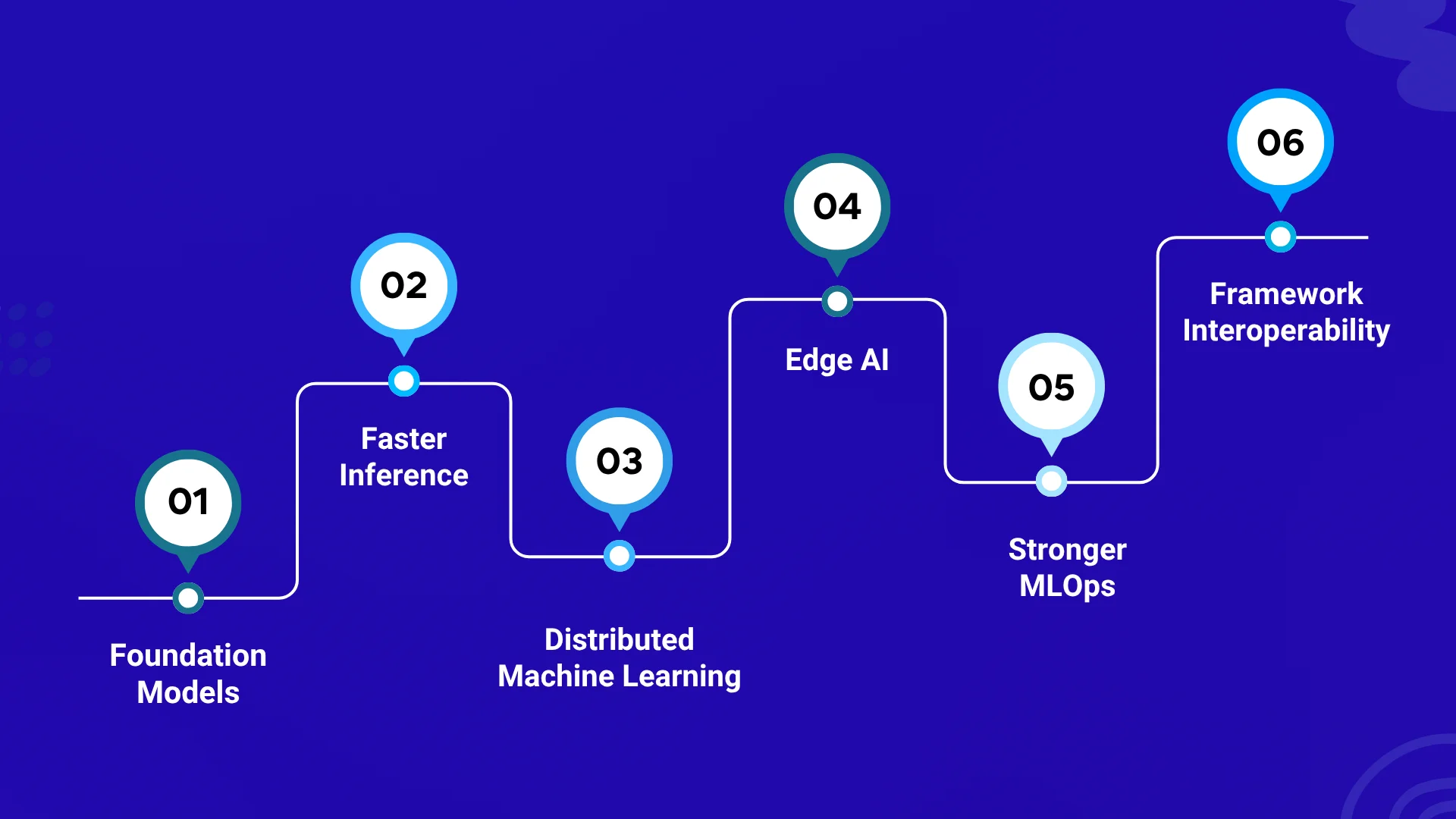
1. Foundation Models
Pretrained models have changed how developers build ML systems. Instead of training every model from scratch, teams can start with an existing model and fine-tune or adapt it.
2. Faster Inference
Production applications increasingly require low-latency predictions. This is increasing the importance of model optimisation, quantisation, compilation, and specialised inference runtimes.
3. Distributed Machine Learning
Large models and datasets often require multiple GPUs or machines. Modern frameworks increasingly provide distributed training and accelerator support. PyTorch, for example, includes distributed training capabilities and tools for large-scale workloads.
4. Edge AI
More models are running directly on phones, browsers, cameras, vehicles, and other devices. This makes model size, memory consumption, and inference speed increasingly important.
5. Stronger MLOps
Companies are moving from experimental notebooks to repeatable pipelines with versioning, testing, monitoring, and automated deployment.
6. Framework Interoperability
Organisations do not always want to remain locked into one framework. Model interchange formats such as ONNX can make it easier to move models between development and inference environments.
How to Choose the Best Machine Learning Framework for Your Project
Choosing the right machine learning framework depends on your project requirements, team skills, and deployment needs. There is no single framework that works best for every machine learning application.
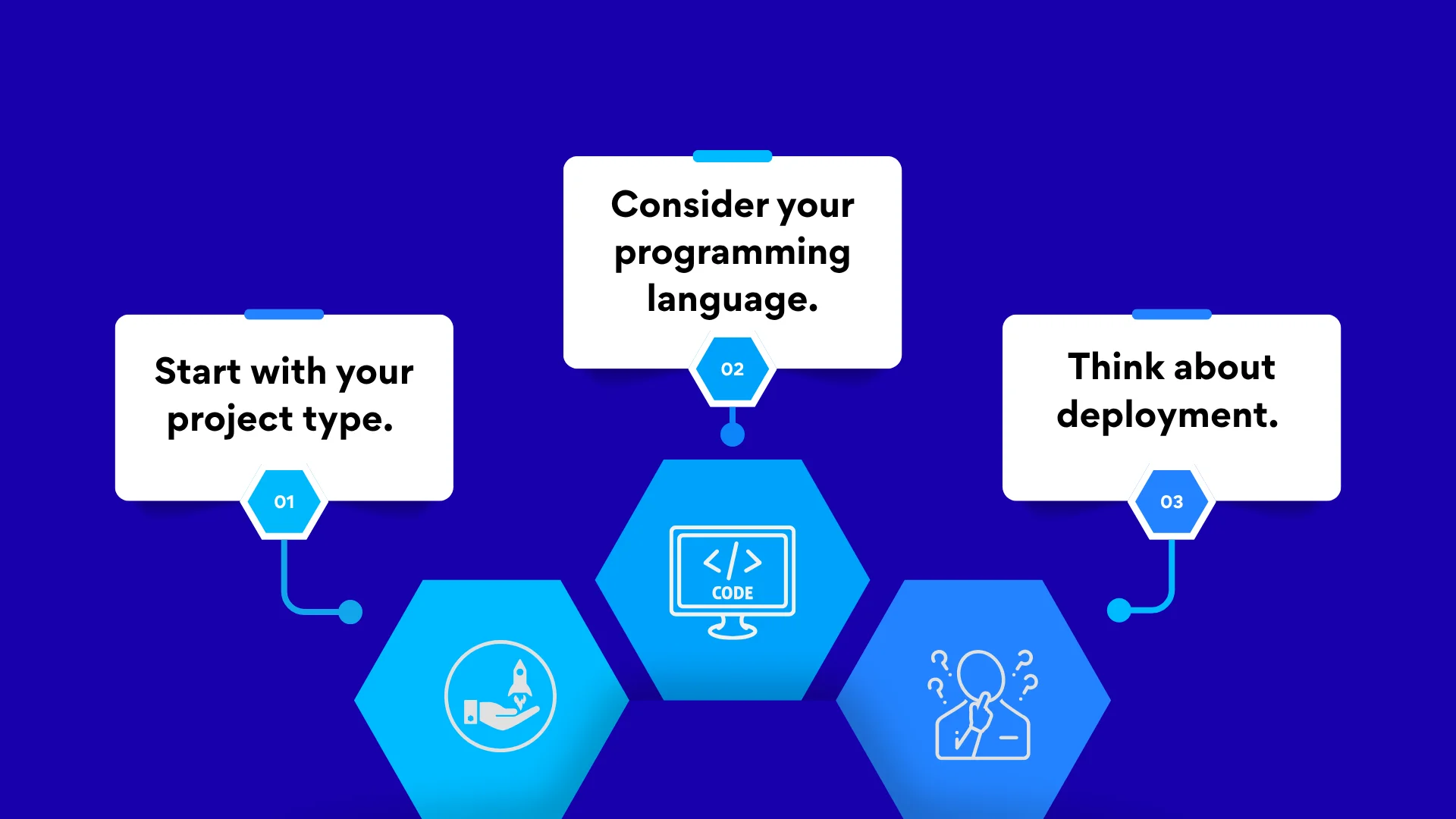
Start with your project type.
For traditional machine learning tasks such as classification, regression, and clustering, scikit-learn is a practical choice. For deep learning, computer vision, NLP, and generative AI, PyTorch and TensorFlow are strong options.
Consider your programming language.
Python has the largest machine learning ecosystem, with popular options such as PyTorch, TensorFlow, Keras, and scikit-learn. If your application is built with JavaScript, Java, C++, Rust, or .NET, choose a framework that fits your existing technology stack.
Think about deployment.
If your model needs to run on cloud servers, mobile devices, browsers, or edge hardware, check whether the framework supports your target environment.
Finally, consider documentation, community support, integrations, and long-term maintenance. A framework that your team can learn and maintain easily is often a better choice than a technically complex alternative.
Not Sure Which Framework Fits Your Project?
Tell us what you’re building and where it needs to run. We’ll help you land on a stack that won’t need rebuilding in six months.
Final Thoughts
The machine learning frameworks landscape in 2026 is broad, but choosing a framework does not have to be complicated. The most important question is not which framework has the longest feature list. It is whether the framework fits your data, model, team, infrastructure, and production requirements.
For many teams, a practical stack could be scikit-learn + XGBoost for structured data, PyTorch + Hugging Face for modern deep learning and pretrained models, and MLflow or another MLOps platform for experiment and model management.
As projects become larger, deployment, testing, monitoring, and pipeline automation become just as important as model training. In other words, the best machine learning framework is the one that helps you move from an experiment to a reliable working system with the least unnecessary complexity.
Frequently Asked Questions
What is the best machine learning framework in 2026?
There is no single best machine learning framework. PyTorch is a strong general choice for deep learning, TensorFlow remains useful for production-focused workloads, and scikit-learn is excellent for classical machine learning. The best framework depends on the project.
What are the most popular machine learning frameworks?
The most widely recognised options include PyTorch, TensorFlow, scikit-learn, Keras, JAX, Hugging Face Transformers, XGBoost, LightGBM, and CatBoost. Current 2026 ranking guides similarly highlight these tools across deep learning, classical ML, pretrained models, and production workflows.
Which machine learning framework is best for beginners?
scikit-learn is an excellent starting point for classical machine learning because its API is relatively simple. Keras is another good choice for beginners interested in neural networks.
Is PyTorch better than TensorFlow?
Neither is universally better. PyTorch is particularly strong for flexible deep-learning development, research, and modern model development. TensorFlow has a mature ecosystem and strong production and serving tools. The right choice depends on the project and existing infrastructure.
Is scikit-learn still relevant in 2026?
Yes. Deep learning does not replace traditional machine learning for every problem. scikit-learn remains highly useful for classification, regression, clustering, preprocessing, evaluation, and tabular-data workflows.
Which framework is best for LLM development?
PyTorch is a strong foundation for developing and training modern deep-learning models, while Hugging Face Transformers provides convenient access to pretrained models and tooling. For many applications, using both is more practical than choosing only one.
What is a machine learning pipeline framework?
A machine learning pipeline framework helps organise repeatable stages such as data preparation, training, evaluation, and deployment. Kubeflow, MLflow, Airflow, and Metaflow are examples of technologies used in ML workflows.
What is a machine learning model monitoring framework?
It is a tool or platform used to observe models after deployment. Monitoring can include prediction quality, data drift, latency, failures, and other production metrics.
What are the best open-source machine learning frameworks?
PyTorch, TensorFlow, scikit-learn, Keras, JAX, XGBoost, LightGBM, and CatBoost are among the major open-source choices.
Which machine learning framework should I choose?
Start with the problem rather than the framework. Use scikit-learn for traditional tabular ML, PyTorch for advanced deep learning, TensorFlow where its production ecosystem fits your needs, Keras for simple deep-learning development, JAX for specialised high-performance workloads, and XGBoost, LightGBM, or CatBoost for strong tabular-data solutions.
What’s the difference between a machine learning framework and an LLM orchestration framework like LangChain?
A machine learning framework such as PyTorch or TensorFlow is used to build, train, and run models from the ground up. An LLM orchestration framework such as LangChain or LlamaIndex sits at a different layer: it helps developers chain prompts, connect external tools, manage memory, and build applications around models that are already trained, rather than training models itself. Many modern AI projects use both — a training framework to build or fine-tune a model, and an orchestration framework to build the application on top of it.
vLLM vs. TensorRT-LLM: Which should I use for production?
Both are production-grade LLM inference engines, but they optimise for different things. vLLM is open-source, Python-first, and comparatively easy to set up, running on any CUDA GPU with minimal configuration. TensorRT-LLM is NVIDIA’s compiled-engine approach: it requires an ahead-of-time build step for each model, but can achieve higher peak throughput on fixed NVIDIA hardware. Teams that need flexibility and fast iteration typically lean toward vLLM; teams optimising a single, long-lived model for maximum throughput on dedicated NVIDIA infrastructure often choose TensorRT-LLM instead.
Can I use more than one machine learning framework in the same project?
Yes, and this is common in practice rather than an exception. A team might train a model using PyTorch or TensorFlow, manage training infrastructure with a cloud platform such as Amazon SageMaker, and then serve the trained model in production with a separate inference engine. Frameworks are frequently combined across the pipeline rather than used in isolation from start to finish.
Is Apache Spark MLlib still relevant for machine learning in 2026?
Yes, particularly for organisations working with large-scale or distributed datasets. Spark MLlib remains a common choice when machine learning needs to run directly on big-data infrastructure already built on Apache Spark, avoiding the need to build a separate data pipeline into a dedicated ML framework. It’s less commonly reached for on smaller, single-machine datasets, where scikit-learn or XGBoost are typically simpler choices.

Founder
Anjali Upadhyay is the Founder of GMTA Software Solutions, a mobile and web application development company she built from the ground up in 2019. Under her leadership, GMTA has delivered 200+ production applications across healthcare, fintech, and on-demand services for clients in the US, UK, Singapore, and UAE. She also leads GMTA’s AI practice, which has shipped production AI systems — including HIPAA-compliant healthcare workflows, LLM-integrated logistics platforms, and fintech automation tools — for US-based enterprise clients. Her writing covers AI product strategy, build-vs-buy decisions for AI systems, and the operational realities of moving AI from proof-of-concept to production at scale.