

Key Takeaways
- Every hour of avoided downtime can translate directly into recovered production capacity. IoT-based predictive maintenance helps manufacturers identify equipment degradation before it becomes an unplanned shutdown, protecting throughput without necessarily adding shifts or machinery.
- The financial impact of small operational improvements through enterprise IoT has a compounding effect. A 5% reduction in fuel, energy consumption, maintenance expenditure, or asset idle time can become a significant annual saving when applied across hundreds of locations or thousands of assets.
- IoT can make revenue leakage in physical operations visible. Fuel theft, unauthorized equipment use, excessive vehicle idling, unexplained energy consumption, inventory discrepancies, and underutilized assets can be identified by comparing real-world telemetry with expected operating patterns.
- Enterprise IoT can improve supply chain resilience by providing visibility beyond warehouse and ERP records. Tracking vehicles, containers, temperature-sensitive goods, equipment, and inventory conditions in real time helps businesses identify disruptions earlier and respond before they can affect customers or production speed.
Running an enterprise is challenging when the leadership team cannot see what’s happening inside the operations in real time. Machines fail without giving any prior warning. Assets continue to sit idle or remain underutilized for days. Energy consumption becomes unjustifiable. Inventory numbers don’t align with the orders and invoices. Maintenance teams respond to problems only after a disruption has occurred. With expanding operations across plants, warehouses, and multiple geographies, these problems don’t just become harder to control but also become too expensive.
With IoT in enterprise apps, this visibility gap can now be closed. Whether it’s a vehicle, manufacturing equipment, or any other high-value commercial or industrial asset, IoT lets you monitor these in real-time by sending a continuous data stream to the core applications. Thus, your teams can detect problems early, reduce downtime, optimize resource utilization, track asset movements, automate physical processes, and improve operational decisions. With the market expected to grow at a CAGR of 14.1% from 2023 to 2030, it’s time that you use enterprise IoT for purposes beyond operational efficiency.
That’s why we have prepared a detailed guide to take you through the benefits of IoT usage in enterprise operations, its real-time applications across different industries, and the underlying challenges to be aware of.
What is Enterprise IoT?
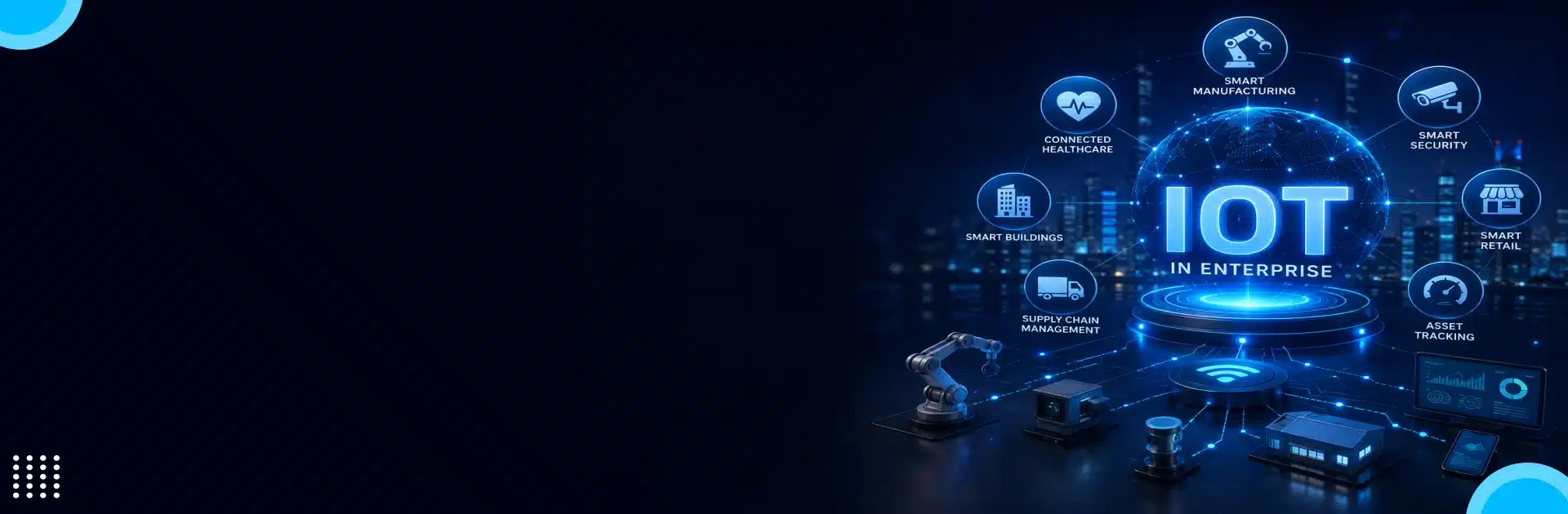
Enterprise IoT is an innovative technology framework that allows businesses to integrate connected sensors, vehicles, infrastructure, and equipment units with their core digital systems. These sensors monitor the operational and performance metrics of the devices and send continuous data streams to the integrated platforms, like the ERP, WMS, CRM, and many more. Businesses can then use the information to:
- Improve asset utilization
- Predict equipment downtime
- Automate repetitive processes
- Optimize resource consumption
- Strengthen operational visibility
Let’s assume that a manufacturer places vibration and temperature sensors on CNC machines. If the sensor data transmitted to the digital system via the internet shows unusual readings, it will automatically trigger an inspection alert. Thus, your teams can proactively inspect the issue and organize predictive maintenance, thereby extending the equipment’s lifetime and preventing unexpected downtime.
This is much different from consumer IoT, which is primarily built around home automation, smart devices, and wearables. A smart thermostat that automatically adjusts the temperature inside the living room is the best example of consumer IoT. A network of sensors monitoring HVAC systems across 50 commercial buildings and automatically identifying inefficient units is enterprise-grade IoT.
Enterprise IoT Market Size & Trends
Enterprise IoT spending is growing at a double-digit rate. The market valuation is now projected to reach $774.54 million by 2031, a straight leap from $403.69 million recorded in 2026. Several contributing factors are behind the scenes that will play a role in speeding up worldwide adoption of this technology. These include digital transformation programs, private 5G, edge-AI analytics, and smart-energy systems.
Although several industries have started investing in it, it’s the manufacturing sector that accounted for 26.82% of the 2025 revenue. This proves that connected machines can help businesses with vast datasets on vibration, temperature, pressure, energy consumption, cycle times, and other operating conditions.
The SME segment has started to catch up, growing at a CAGR of 14.88%, suggesting that enterprise IoT is now accessible beyond large infrastructure operators and multinational manufacturers. Besides, cloud-based platforms, managed services, subscription pricing, and low-code tools enable these small and medium businesses to invest in IoT without having to build their own infrastructure.
IoT is also moving closer to the point where data is generated. That’s because enterprises cannot always send every sensor reading to a centralized cloud before taking action. This is where edge and hybrid edge-cloud architectures come into play, allowing businesses to build IoT systems around specific operational requirements.
AI is also changing what businesses can expect from enterprise IoT implementation. AI-enabled sensors go further by identifying anomalies, predicting failures, finding patterns across large volumes of sensor data, and recommending or triggering actions automatically.
See where your operations lose the most to downtime and waste.
Our team can walk through your current setup and flag the highest-ROI place to start — no obligation.
How Does Enterprise IoT Work?
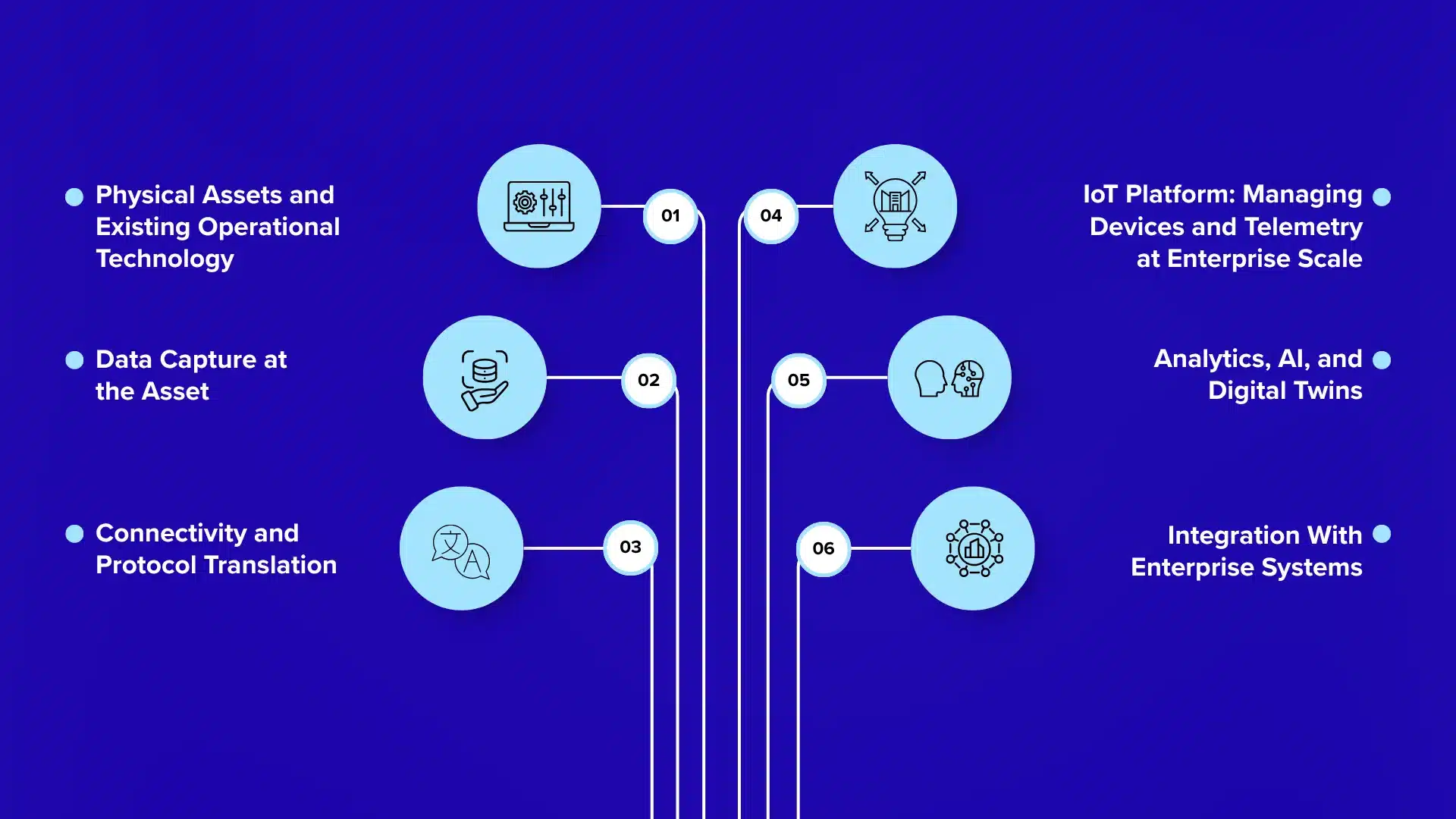
Physical Assets and Existing Operational Technology
It is the preliminary layer where the enterprise IoT ecosystem comprises different physical equipment units or assets that can produce or consume operational data. For example, a factory can have PLC-controlled machines, robots, SCADA systems, legacy motors, industrial sensors, and newer connected devices. A utility company, on the other hand, could have substations and meters installed at different times. A logistics company may have modern telematics units alongside older, outdated vehicles with limited onboard connectivity.
That’s why enterprise IoT often means working around and alongside existing OT infrastructure. New sensors are usually installed at places where older equipment units become incapable of exposing data required for the analytics platforms. Here, gateways can help collate information from older controllers and then translate industrial protocols into formats that modern IoT platforms can process.
Data Capture at the Asset
Next comes the layer with sensors and controllers, meant to convert physical parameters into a machine-readable data format. Take the example of a vibration sensor. It can generate hundreds of readings per second from a motor. Similarly, a cold-chain sensor can record the temperature of a pharma shipment at regular intervals. A smart electricity meter can report consumption over defined time periods. A fleet telematics unit can combine vehicle location with engine diagnostics and fuel information.
Thus, the IoT architecture must associate the data with an asset identity and context. A temperature reading of 8°C means little by itself. But knowing that it came from refrigeration unit #47 at Warehouse B makes the information valuable.
Connectivity and Protocol Translation
At this stage, the information collected from different physical assets or devices moves from the operational environment to the systems that can actually process it. That’s why most enterprise deployments use a mixture of connectivity technologies so that all types of assets can be connected with the digital systems, regardless of where they are operating or under which conditions.
For example, a production machine inside a factory can communicate through industrial Ethernet. Similarly, a vehicle can use a 4G or 5G cellular network to send operational data to a centralized fleet operating platform. A remote sensor, on the other hand, relies on LoRaWAN or NB-IoT for long-range connectivity with low power consumption.
It’s not just different communication methods that should be integrated within the enterprise IoT architecture. Rather, you also need to ensure it handles industry protocols, such as:
- OPC UA
- Modbus
- MQTT
- CAN
IoT Platform: Managing Devices and Telemetry at Enterprise Scale
Once data leaves the operational environment, an IoT platform provides the management and ingestion layer. It allows teams to know the following:
- Whether all the connected devices within the same network are online or not
- Whether they are transmitting all the necessary datasets as required by the platforms
- Which firmware version they are running currently and if that’s at all updated or not
- Whether a device has suddenly stopped communicating
Apart from providing such detailed knowledge, it also allows operators to handle telemetry from different asset types effortlessly. Let’s assume that your logistics company deals with temperature sensors, GPS trackers, door sensors, and vehicle telematics devices. Rather than building a separate application around every device type currently in use, the IoT platform provides you with a common layer for device identity, data ingestion, monitoring, and management.
Analytics, AI, and Digital Twins
This will help you uncover the hidden patterns and trends in the operational data received from the physical devices and assets. Traditional analytics systems can only establish normal operating ranges and identify basic behaviors. However, ML-driven models can examine historical sensor behavior to flag patterns associated with equipment failure. More advanced systems can also generate estimates about the remaining useful life of components or recommend an appropriate maintenance window.
The data collected can also support a digital twin of a machine, production line, building, or other complex asset. The key here is to make sure that the digital representation is continuously updated with live operational data. Only then can it be used to evaluate how changes in real-time conditions can affect performance.
Integration With Enterprise Systems
Most IoT platforms exchange data with EAM and CMMS platforms, ERP systems, MES platforms, supply chain applications, WMS, and business intelligence tools. This allows IoT events to trigger actions within existing business processes. For example, if sensors detect abnormal vibration in a production machine, the IoT analytics layer can identify a likely bearing failure and send it to your company’s EAM or CMMS.
The system can then create a maintenance work order, check if the replacement part is available, and provide the maintenance team with the machine’s real-time condition and service history. This layer is primarily responsible for closing the loop between physical events and business operations. Instead of IoT data sitting in a separate dashboard, it becomes part of maintenance, production, logistics, procurement, facility management, or customer-serving workflows.
Advantages of IoT in enterprise operations
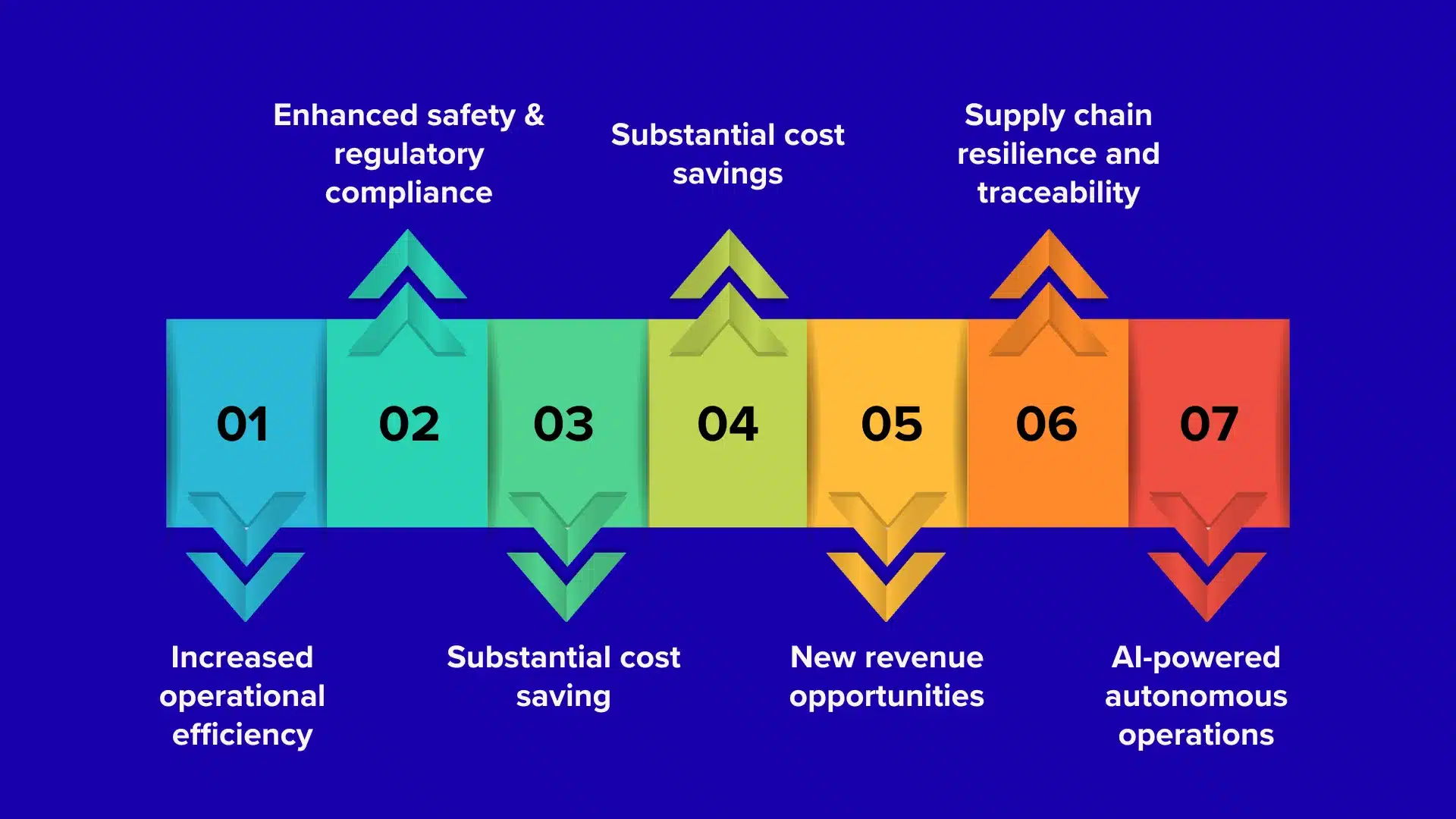
Increased operational efficiency
One of the significant benefits of IoT in business is rapid improvements in operational efficiency and teams gaining continuous visibility into equipment performance. Instead of waiting for a machine to stop working suddenly or relying only on scheduled inspections, you can use these connected sensors to track vibration, temperature, pressure, cycle time, and other operating signals. The data collected can then support condition-based and predictive maintenance, allowing you to intervene the moment critical equipment shows the first sign of deterioration.
A plant that successfully reduces unplanned downtime by even 5% can recover significant production capacity, especially when expensive equipment operates around the clock. In addition, IoT can also help detect micro-stoppages and abnormal cycle times that often get overlooked in manual production reporting.
Enhanced safety & regulatory compliance
Enterprise IoT helps strengthen compliance by continuously collecting the operational evidence necessary to manage safety, quality, and environmental obligations. Although the exact requirements would depend on the industry you are operating in, connected monitoring can support programs governed by standards and regulations like the following:
- OSHA requirements for workplace safety
- EPA requirements for environmental monitoring
- FDA 21 CFR Part 11 for electronic records in regulated environments
- FDA 21 CFR Part 211 for pharmaceutical manufacturing controls
However, you must note that IoT won’t automatically make your business compliant. The data, controls, validation procedures, cybersecurity measures, and record-retention practices must satisfy the industry regulations. The real value lies in continuous evidence your compliance teams receive from the IoT sensors of:
- What happened
- When it happened
- Which asset or location was involved
Substantial cost savings
IoT can reduce enterprise expenses by helping you identify wasted spends at their corresponding physical source. You are already spending millions on maintenance, electricity, fuel, spare parts, and equipment downtime. But you don’t have a clear picture of which assets are actually responsible for the larger losses. IoT provides the asset-level data required to identify these cost drivers.
Consider a manufacturer operating 500 machines, each consuming an average of $20K of electricity annually. This automatically represents $10M in yearly machine-related electricity utilization. If connected energy monitoring and optimization can reduce consumption by an assumed 8%, you could potentially save $800K per year.
This connected technology framework also produces similar savings through:
- Predictive maintenance
- Reduced idle time
- Optimized HVAC operation
- Lower fuel consumption
- Fewer unnecessary component replacements
Sustainable competitive edge
With the operational data generated by the IoT sensors, you can make better products, operate more reliably, and respond to customers faster than your competitors. In other words, you acquire proprietary operational intelligence accumulated from different assets and devices over time. Take the example of a manufacturing business that has deployed 50K connected machines across different customer sites within the US.
These will collect real-time information about multiple operating parameters, like:
- Component failures
- Operating load
- Environmental conditions
- Maintenance events
- Actual product performance
When fed into an analytical tool, the manufacturer can understand failure patterns, which otherwise remain hidden in conventional warranty or service records. IoT can therefore create a continuous product-improvement loop, necessary to achieve a competitive edge faster.
New revenue opportunities
New monetization channels can help generate high IoT ROI for enterprises from availability, product usage, and performance. Once you connect an asset, it will become easier for you to measure how much a customer uses it and whether it’s delivering the promised outcome or not. This supports emerging business models, such as:
- Equipment-as-a-Service
- Pay-per-use
- Usage-based pricing
- Remote monitoring subscriptions
- Predictive maintenance contracts
- Uptime guarantees
Supply chain resilience and traceability
Enterprise IoT shows where goods are and what’s happening to them while they are in transit through a supply chain network. Traditional ERP and supply-chain platforms can only record shipment status, purchase orders, inventory levels, and delivery dates. However, they lack continuous information about the physical conditions experienced between these checkpoints.
The connected sensors, thus, add location, temperature, humidity, pressure, light exposure, and other condition data wherever relevant. For supply-chain leaders, the benefits include:
- Precise batch traceability
- Recall management
- Inventory protection
- Supplier monitoring
- Disruption response
AI-powered autonomous operations
AI-powered IoT goes beyond sending alerts by using ML models to interpret multiple streams of operational data and determine what action should happen next. A predictive maintenance model, for example, can combine vibration frequency, motor current, temperature, operating load, machine age, maintenance history, and previous failure patterns. Rather than triggering an alert just because one particular sensor crossed a fixed threshold, the model can evaluate the probability of a specific failure occurring within a definite period.
More advanced systems can use computer vision to identify defects on a production line or a time-series model to forecast equipment degradation or energy demand. The architecture then connects AI predictions to enterprise workflows, allowing you to scale operational decisions easily.
Top Enterprise IoT use cases by industry
Smart manufacturing
The manufacturing industry uses enterprise IoT to connect production equipment, industrial sensors, robotics, and quality-control systems to help manufacturers establish control at both machine and process level. One of the major IoT use cases in manufacturing is predictive maintenance. Vibration, temperature, motor-current, and pressure sensors continuously monitor equipment units in production. ML models can then identify patterns associated with bearing, motor, pump, or compressor failures and create immediate maintenance alerts before a breakdown disrupts production.
Another major use case is real-time OEE monitoring. IoT can capture actual machine availability, product speed, cycle time, and quality losses instead of relying solely on manual production reports. You can also use connected cameras for automated visual inspection, detecting dimensional or surface defects as products continue to move through the production line.
Some other enterprise applications where IoT can be deployed across the manufacturing industry include:
- Energy monitoring by production line
- Tool-condition monitoring
- Digital work instructions
- Asset tracking
- Automated production alerts
Connected logistics
IoT gives transportation companies continuous information about cargo, vehicles, drivers, and delivery conditions. Fleet telematics allow effortless tracking of the vehicle’s location, mileage, fuel consumption, engine diagnostics, harsh braking, excessive idling, and route deviations. You can then use this data to identify underutilized vehicles and reduce fuel and maintenance costs.
One of the best IoT use cases in logistics and supply chains is cold-chain monitoring. Temperature and humidity sensors installed inside refrigerated trucks or containers continuously record shipment conditions. If the temperature moves outside the permitted thresholds, your logistics team can immediately intervene while the shipment is still in transit.
IoT can also help improve ETA prediction by combining GPS position, vehicle speed, traffic conditions, and historical route data. Asset trackers can locate trailers and containers that would otherwise remain invisible between warehouse handoffs.
Automotive
Automotive IoT spans the vehicle’s entire lifecycle, right from factory production to connected car services and after-sales maintenance. One key use case to consider is remote vehicle diagnostics. Connected vehicles transmit fault codes, battery information, engine parameters, and component health data to the manufacturer or fleet operator in real time. Servicing teams can then identify potential problems before a customer brings a degrading vehicle to the dealership.
For EVs, IoT helps in battery-health monitoring by tracking temperature, charging cycles, state of charge, and other battery-specific parameters. Fleet operators can also use vehicle telemetry for fuel optimization, driver safety, route management, predictive maintenance, and utilization analysis. Another major use case to consider is usage-based insurance. Here, insurers can use driving data like mileage, acceleration, or braking to calculate risks more dynamically and accurately.
Smart facilities
The use of IoT in smart buildings examples include optimization of energy consumption, equipment performance, occupancy, and maintenance. HVAC optimization continues to be the strongest use case. Occupancy sensors, temperature sensors, air-quality sensors, and building-management systems work together to adjust heating, cooling, and ventilation according to actual building space usage.
The connected technology framework also provides equipment-level energy monitoring. Instead of receiving one monthly electricity bill, facility managers can identify which HVAC units, floors, production areas, or equipment groups are consuming most power. Facilities can also deploy enterprise IoT for:
- Water leak detection
- Indoor air-quality monitoring
- Occupancy-based space management
- Smart lighting
- Access monitoring
- Emergency-condition alerts
Utilities and energy
Utility businesses can use IoT to monitor the condition and performance of distributed infrastructure, which otherwise can’t be managed effectively through periodic inspections alone. Smart meters are a major use case. They transmit frequent consumption data that teams can use for demand forecasting, billing, outage analysis, and customer energy-management programs.
On the grid side, sensors can monitor transformers, feeders, substations, distribution lines, and other critical assets. IoT is also important for renewable-energy operations. Solar farms can monitor panel output, inverter performance, temperature, and environmental conditions. Similarly, wind farms can monitor turbine vibration, gearbox condition, wind speed, and power generation.
Connected healthcare
Continuous monitoring of patients, medical equipment units, pharmaceutical inventory, and hospital environments is one of the significant IoT use cases in healthcare enterprises. These sensors capture selected health measurements and transmit them to different systems, allowing clinicians to monitor patients outside traditional clinical settings.
Hospitals can also use IoT for medical asset tracking. RFID tags or location technologies can show where infusion pumps, wheelchairs, portable monitors, and other equipment are located. This reduces the time spent for searching for equipment and can improve utilization. Another important use case is temperature monitoring for vaccines, blood products, pharmaceuticals, and laboratory materials. Sensors can continuously record storage conditions and generate alerts once thresholds exceed the safe limits.
Smart agriculture
In the agriculture industry, enterprise IoT helps businesses make decisions about irrigation, crops, livestock, and agricultural equipment units using localized field data instead of applying the same treatment across an entire operation. Soil sensors can measure moisture and temperature at different locations. Irrigation systems can use those findings to determine where and when water is required.
This supports precise irrigation, which becomes more valuable where water costs or availability are significant. Farmers can also combine soil data with weather information to improve irrigation and crop-management decisions. IoT can also improve livestock monitoring through connected collars, tags, or other devices.
Not sure which IoT platform or protocol stack fits your equipment?
Talk to our IoT engineers about your specific assets, legacy systems, and integration needs.
Real-World Examples / Case Studies
General Motors: Connected Vehicle Data for Predictive Diagnostics
Modern GM vehicles continuously generate diagnostic and telemetry data through their enterprise IoT connected architecture. The company then uses this growing stream of vehicle data to help engineers and technicians understand vehicle behavior, diagnose issues, and improve vehicle quality. GM is also using data from more than 1 million miles of real-world driving across 34 states to train and test its next-gen automated-driving technology.
Industry takeaway: Automakers can use connected vehicle data to shorten the feedback lop between real-world vehicle performance, warranty/service intelligence, and the engineering of future models
UPS: IoT-Powered Fleet and Delivery Optimization
UPS uses vehicle telematics to collect information about performance and condition across 200+ operating elements. After combining this data with driver coaching, the company has successfully addressed fuel consumption, emissions, maintenance, and safety. In addition, it has also combined the information with the ORION (On-Road Integrated Optimization and Navigation) system to determine efficient delivery sequences. UPS later integrated UPSNav, providing drivers with detailed directions to delivery points like loading docks and receiving areas.
Industry takeaway: Logistics operators can connect vehicle telemetry with route and delivery decisions to increase network capacity without expanding fleet resources at the same rate
Walmart: IoT-Enabled Inventory and Store Management
Walmart has deployed enterprise IoT for refrigeration and energy-monitoring infrastructure. It reported that this implementation generated data for more than 7M IoT data points, producing nearly 1.5 billion messages per day covering temperature, equipment operation, and energy usage. Its retail IoT also extends into inventory. The brand has experimented with cameras, sensors, and real-time analytics to identify products that need replenishment.
Industry takeaway: Retailers with large store networks can invest in enterprise IoT solutions to turn refrigeration, inventory, energy, and equipment data into centrally managed operational controls across every location
John Deere: Connected Machinery for Precision Agriculture
This US enterprise has built IoT into its agricultural machinery through connected equipment and John Deere Operations Center. The platform combines machine data with agronomic and field information, allowing farmers to plan operations, monitor equipment and fields in real time, and analyze results after work is completed. In addition, Deere’s HarvestLab 3000 technology helps measure grain characteristics, like protein, starch, and oil during harvesting, with the information available through the Operations Center.
Industry takeaway: Agricultural enterprises can connect machine activity, field conditions, input applications, and yield data to optimize decisions at the field level instead of managing entire farms uniformly
Duke Energy: IoT-Based Grid and Asset Monitoring
Duke Energy’s smart grid work includes connected equipment units such as smart meters, sensors, phasor measurement units, automated grid equipment, solar systems, battery storage, and EV charging infrastructure. At its Mount Holly, North Carolina microgrid test bed, these assets communicate through IoT-oriented technologies and can be monitored and controlled as an integrated system. Its intelligent grid services applications are designed to forecast future energy demand, determine whether the grid needs investment, and assess how much additional load the distribution network can accommodate.
Industry takeaway: Utilities can connect grid assets, distributed energy resources, and demand data to make infrastructure planning more responsive to EV adoption, renewable energy generation, storage, and changing load patterns
Honeywell: IoT-Enabled Smart Building Management
The Honeywell City Suite is an AI-enabled IoT platform designed to bring information from systems like utilities, traffic, streetlights, environmental monitoring, emergency services, and public safety into a unified operating view. Instead of managing different building systems as separate silos, connected data can be easily brought into a common operational layer. Thus, the facilities team can use real-time building data to identify abnormal spikes in energy consumption or equipment behavior and prioritize immediate intervention.
Industry takeaway: Enterprises managing large property portfolios can unify HVAC, energy, occupancy, environmental, and equipment data to manage building performance centrally
Medtronic: Connected Medical Devices and Remote Monitoring
The company’s CareLink Network has been used to remotely monitor patients with implanted cardiac devices and provide clinicians with notifications right on time without delays. In the CONNECT trial, Medtronic reported that this approach helped in clinical decision-making by 79% and reduced average cardiovascular hospital stays by 18%.
Industry takeaway: Healthcare providers can connect medical-device data directly to clinical monitoring workflows, allowing patients to be monitored continuously between hospital or clinic visits
Key Challenges in Implementing Enterprise IoT
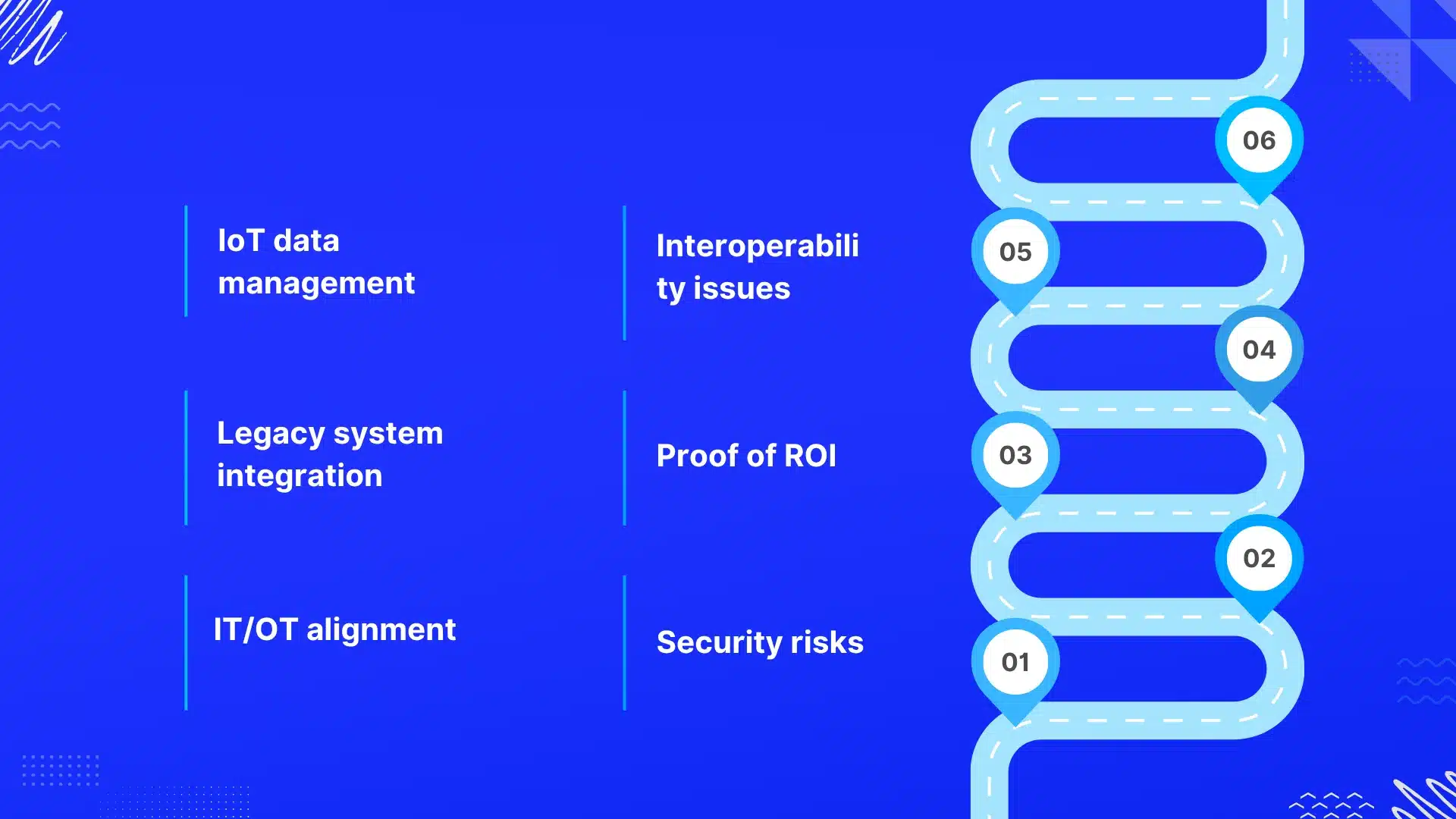
IoT data management
Managing IoT data becomes extremely challenging when your US enterprise deals with thousands of devices producing telemetry at different speeds, formats, or levels of importance. A manufacturing plant may generate vibration readings every second, while a smart meter can send consumption data every 10 minutes.
Transmitting every reading to the cloud will automatically increase unnecessary storage and processing costs. That’s why you can use edge computing for immediate decisions, stream processing for real-time analytics, and centralized storage for historical analysis. Data governance should also define ownership, retention periods, quality rules, and which datasets can be used for AI training.
Legacy system integration
This turns into one of the biggest challenges of IoT in enterprise, as the datasets need to reach systems like SAP, Oracle ERP, Siemens or Rockwell MES/SCADA environments, or CMMS tools. These platforms were not initially designed for continuous sensor data storage and processing. Replacing these is rarely financially sensible. Instead, what you can do is deploy OPC UA gateways, MQTT brokers, APIs, and integration middleware to translate operational data into formats your legacy apps can consume.
IT/OT alignment
This becomes a major challenge because cybersecurity requirements can conflict with the availability requirements of industrial operations. An IT team may want aggressive patching or network changes, while a manufacturing or utility team may not be able to restart a PLC-controlled production process without operational risks. The key here is to create joint IT/OT policies covering network segmentation, remote access, patch windows, device ownership, incident response, and data governance. Deploying a dedicated OT security architecture can also help separate critical systems from general-purpose enterprise and IoT networks.
Interoperability issues
When your US enterprise operates equipment units from multiple generations and vendors using different industrial protocols and data structures, you can encounter IoT scalability issues in the long run. One machine may expose data through OPC UA, another through Modbus, and an older asset may have no modern interface at all. Thus, you must establish a common device and data architecture using technologies such as OPC UA, MQTT, REST APIs, and standardized data models where appropriate.
Proof of ROI
Enterprise IoT ROI is difficult to prove when the project doesn’t establish a measurable baseline before deployment. A manufacturer should know its current unplanned downtime hours, OEE, maintenance cost per machine, scrap rate, and production value per hour before installing predictive maintenance sensors. This will help the business calculate the real financial value of the improvement. For example, preventing 100 hours of annual downtime on a production line worth $5K per operating hour represents a potential $500K capacity opportunity.
Security risks
The IoT security risks for business stem from limited processing power, long operating lifecycles, or outdated firmware. The risks multiply when IoT gateways connect enterprise networks to PLCs, SCADA systems, BMS, or other OT environments. Thus, you can implement unique device identities, certificate-based authentication, network segmentation, encrypted communication, secure boot, signed firmware updates, and continuous device monitoring.
Step-by-Step Enterprise IoT Application Development
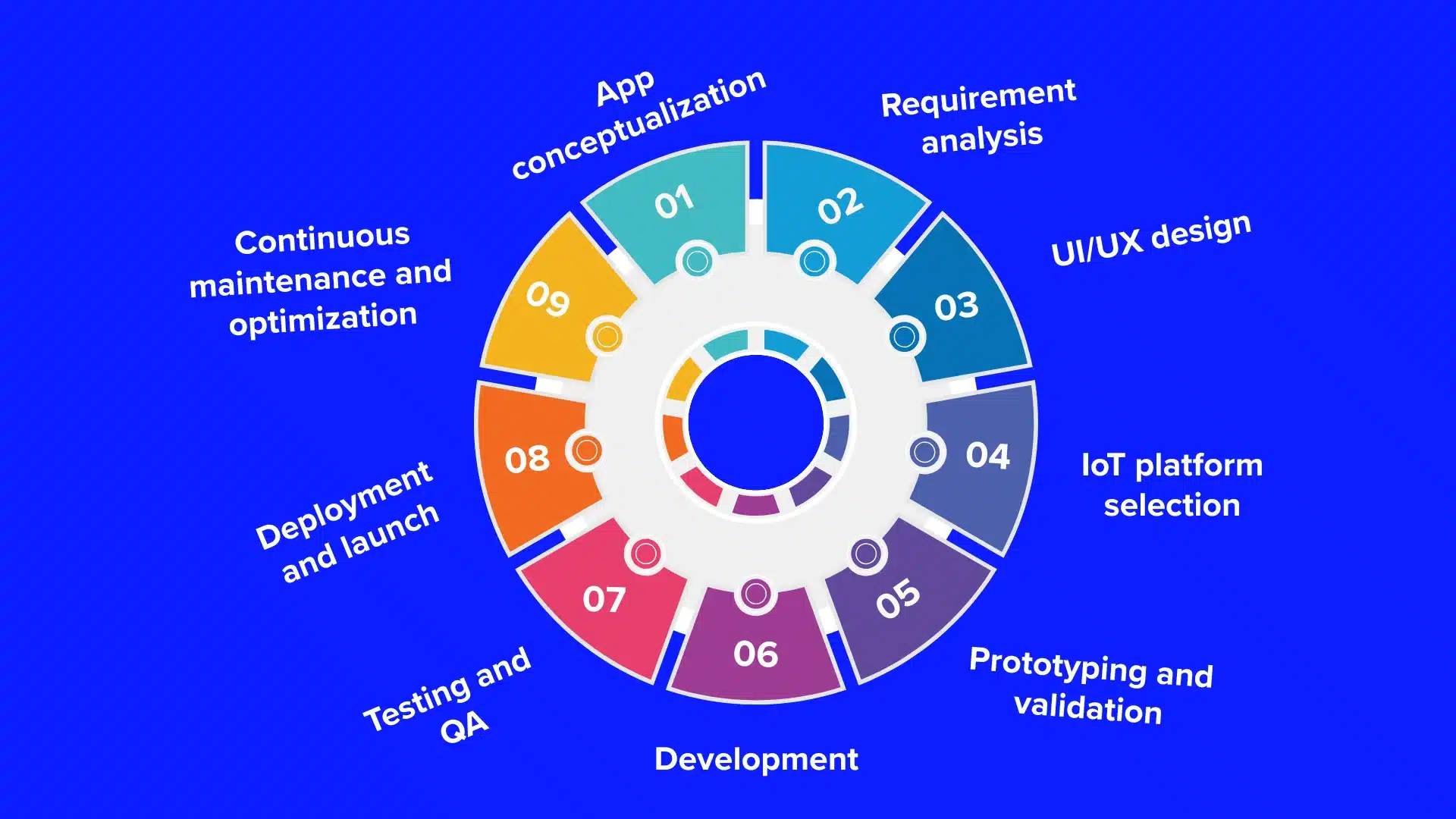
Step 1: App conceptualization
Start by defining the business problem, connected assets, target users, and expected outcome before selecting technology. Establish the business KPIs, like reducing downtime by 15%. This will ensure the application has a measurable purpose right from the beginning.
Step 2: Requirement analysis
Translate the business objective into functional, technical, and operational requirements. Determine which devices will generate data, how frequently they will communicate, what data must be processed in real time, and which enterprise systems need integration. Requirements should also cover scalability, cybersecurity, data retention, user roles, compliance, connectivity, and device-management needs.
Step 3: UI/UX design
Design the application around the decisions enterprise users need to make, rather than simply displaying sensor data on the screen. A fleet manager may need vehicle location, fuel consumption, and maintenance alerts, while a plant manager may require OEE, downtime trends, and machine-health warnings. Thus, dashboards must prioritize operation-specific actionable alerts, trends, exceptions, and drill-down information.
Step 4: IoT platform selection
Select the IoT platform based on device scale, connectivity, data volume, edge requirements, integrations, security, and total cost of ownership. Evaluate platforms like AWS IoT, Azure IoT, or Google Cloud alongside industrial platforms wherever relevant. The decision should also consider device provisioning, digital-twin capabilities, rules engines, analytics, OTA updates, and long-term vendor support.
Step 5: Prototyping and validation
Build a limited prototype using real devices, representative data, and the intended connectivity environment. Validate whether sensors provide sufficiently accurate data, whether connectivity remains reliable, and whether the application produces useful alerts or predictions. Test the complete flow from device -> gateway -> IoT platform -> analytics -> enterprise application before you commit to a large-scale deployment.
Step 6: Development
Develop the IoT application across the device, edge, cloud, data, API, and application layers. Implement appropriate device provisioning, telemetry ingestion, data processing, business rules, dashboards, alerts, APIs, and integrations with systems like ERP, MES, CRM, or CMMS. Build security controls into authentication, authorization, encryption, device management, and data handling rather than adding these later.
Step 7: Testing and QA
Test the complete IoT environment under realistic operational conditions, not just standard application scenarios. Validate device connectivity, telemetry accuracy, API performance, alert latency, data integrity, cybersecurity, device failures, network interruptions, and system recovery. Load testing will help you determine whether the platform can handle the expected number of devices and message volumes as deployment scales.
Step 8: Deployment and launch
Deploy in controlled stages rather than connecting the entire enterprise at once. Start with a pilot facility, asset group, vehicle fleet, or business unit. Monitor performance, resolve integration issues, and establish operational procedures. Once KPIs and reliability targets are met, expand deployment.
Step 9: Continuous maintenance and optimization
Enterprise IoT requires continuous management because devices, networks, software, data models, and business requirements change with time. So, monitor device health, connectivity, data quality, cloud costs, application performance, security vulnerabilities, and business KPIs. Use production data to improve alert thresholds and AI models. Replace unreliable devices and optimize data pipelines. If needed, introduce additional use cases once the original deployment demonstrates measurable value.
Tech Stack for Enterprise IoT
An enterprise IoT technology stack must connect physical assets to business applications while handling continuous telemetry, device management, real-time processing, analytics, and security. The right stack, however, will depend on the number and type of connected devices, latency requirements, existing OT infrastructure, cloud strategy, and systems like ERP, CRM, or MES that need IoT data.
| IoT Layer | Key Technologies | Enterprise Purpose |
| Connected Devices & Sensors | Temperature, vibration, pressure, GPS, RFID, cameras, PLCs | Capture equipment, environmental, location, and operational data |
| Connectivity | Wi-Fi, 5G, LTE, Ethernet, LoRaWAN, NB-IoT | Move telemetry between assets, edge devices, and enterprise platforms |
| Protocols & Messaging | MQTT, OPC UA, Modbus, AMQP, HTTP/REST | Standardize communication between heterogeneous devices and applications |
| Edge Computing | Edge gateways, local processing, containerized workloads | Process latency-sensitive data locally and reduce unnecessary cloud traffic |
| IoT Device Management | Provisioning, authentication, OTA updates, device monitoring | Register, secure, configure, update, and monitor connected assets at scale |
| IoT Platform | Device registry, rules engine, digital twins, telemetry ingestion | Manage devices and orchestrate data flows across the IoT environment |
| Data Ingestion & Streaming | Event streaming, message brokers, stream processing | Handle high-volume real-time telemetry and event-driven workflows |
| Data Storage | Time-series databases, data lakes, cloud storage | Store historical telemetry for reporting, analytics, AI, and audits |
| Analytics & AI | Machine learning, anomaly detection, predictive analytics, computer vision | Identify equipment anomalies, forecast failures, optimize operations, and generate predictions. |
| Enterprise Integration | APIs, middleware, event buses | Connect IoT insights with ERP, MES, CRM, CMMS, and other enterprise workflows. |
| Application & Visualization | Web/mobile apps, dashboards, alerts, reporting | Give managers, engineers, technicians, and operators actionable operational visibility. |
| Security | IAM, PKI, encryption, network segmentation, SIEM | Protect devices, data, APIs, cloud infrastructure, and IT/OT connections |
| DevOps & Monitoring | CI/CD, observability, logging, infrastructure as code | Maintain reliability and safely release IoT application and device updates |
How Much Does Enterprise IoT Development Cost?
The cost to build an enterprise IoT application ranges from $50K to $500K+. The exact billing amount will, however, depend on the number of connected devices, hardware requirements, IoT platforms, integrations, analytics, security and compliance, and the deployment scale. For example, if you are building a small PoC model, the expense will be minimal, ranging from $30K to $75K. On the other hand, for a production-grade enterprise IoT platform with thousands of connected devices, cloud infrastructure, real-time analytics, and third-party platform integrations can exceed $50K.
The factors that influence IoT app development pricing in 2026 include:
- Number and type of connected devices: Connecting 50 temperature sensors will be substantially cheaper than connecting 5K industrial machines, vehicles, smart sensors, or medical devices. Custom firmware, device provisioning, OTA updates, calibration, and device-health monitoring can further increase the costs.
- IoT platform and cloud infrastructure: The choice between Azure IoT, AWS IoT, Google Cloud, or an industrial IoT platform affects both development and recurring infrastructure expenses. Thus, you will have to account for device management, message ingestion, compute, storage, databases, analytics, digital twins, and data-transfer changes.
- Hardware and edge computing: Hardware becomes a major cost component if the project requires custom sensors, gateways, embedded controllers, industrial PCs, or edge devices. Edge computing, on the other hand, adds development work for offline operation, local data processing, device synchronization, and containerized workloads.
- Enterprise system integrations: Integrating IoT with existing ERP, SCADA, MES, CMMS, or supply chain systems can increase the development costs significantly. The complexity depends on API availability, legacy protocols, data transformation requirements, authentication, and the number of workflows being automated.
- Cybersecurity and compliance: Enterprise IoT development costs can rise if the project requires PKI, device certificates, encryption, zero-trust controls, network segmentation, SIEM integration, audit logging, and compliance controls.
- Deployment scale and ongoing maintenance: A pilot covering one facility is far less expensive than deploying the same architecture across 50 factories or thousands of vehicles. Scaling introduces additional requirements for device provisioning, network management, observability, automated deployments, OTA updates, and data governance, thereby increasing the costs.
| Enterprise IoT Project Type | Typical Development Cost | What It Usually Includes |
| IoT Proof of Concept (PoC) | $30,000–$75,000 | Limited devices, basic connectivity, cloud ingestion, simple dashboard, and validation of one business use case such as equipment monitoring or asset tracking |
| Single-Site IoT Application | $75,000–$150,000 | Device integration, IoT platform, edge gateway, real-time monitoring, alerts, analytics, user roles, and integration with one or two enterprise systems |
| Predictive Maintenance Platform | $100,000–$250,000 | Machine telemetry, vibration/temperature monitoring, time-series data, anomaly detection, predictive models, maintenance alerts, and CMMS/EAM integration |
| Connected Fleet Platform | $150,000–$300,000 | GPS/telematics integration, vehicle monitoring, route data, driver or asset analytics, geofencing, alerts, mobile interfaces, and fleet-management integration |
| Multi-Site Enterprise IoT Platform | $250,000–$500,000+ | Thousands of devices, centralized device management, edge computing, cloud infrastructure, enterprise integrations, analytics, role-based access, security, and multi-location dashboards |
| Industrial IoT / Smart Manufacturing Platform | $300,000–$750,000+ | PLC and machine connectivity, SCADA/MES integration, real-time telemetry, OEE monitoring, predictive maintenance, edge processing, AI analytics, and OT cybersecurity |
| Large-Scale Enterprise IoT Ecosystem | $500,000–$1M+ | Large device fleets, multiple facilities, complex IT/OT integration, digital twins, advanced AI, high-volume data processing, custom applications, cybersecurity, and enterprise-wide deployment |
Ready to put a number on this?
Get a project estimate based on your device count, integrations, and target rollout timeline.
How GMTA software will help you build Enterprise IoT?
The best enterprise IoT platforms need more than connected devices and technology platforms. They need IoT engineering, enterprise IoT software expertise, and a clear understanding of how the business actually operates. This is where GMTA Software’s experience can add value. Our experts look at the complete environment around an IoT project, including connected assets, existing applications, data flows, cloud infrastructure, and operational requirements. This helps ensure that the resulting solution is useful beyond the initial Proof of Concept.
This approach becomes more valuable when we have to work with legacy equipment and systems. For example, an enterprise may not need to replace an older machinery simply because it cannot communicate with a modern cloud platform. Depending on the equipment and data needs, our team evaluates whether an OPC UA gateway, MQTT-based architecture, protocol converter, API layer, or custom middleware is the more appropriate integration approach.
We also evaluate IoT from a business-value perspective. Before developing a predictive maintenance solution, for example, we decide if the baseline includes current unplanned downtime, maintenance expenses, equipment utilization, and production losses.
In addition, we can also connect IoT data with systems like ERP, MES, CRM, CMMS, and EAM. This helps in making an important physical device a part of the business’s existing workflows rather than remaining isolated within a separate IoT dashboard.
Our goal is to build IoT technology that fits the enterprise’s existing operations while giving it room to evolve with time.
FAQs
How many connected machines does a manufacturer need before an IoT platform becomes worthwhile?
No fixed number of machines makes IoT worthwhile. Even a single high-value production asset can justify an IoT deployment if its downtime is expensive. For example, monitoring one CNC machine that causes $5K of lost production per hour can produce more value than connecting 100 low-impact assets. Manufacturers should first calculate downtime cost, maintenance expenditure, OEE, and asset criticality. A focused pilot involving 10-50 critical machines is often a practical starting point for validating the business case before scaling across the factory.
Can a logistics company use Enterprise IoT with trucks and fleet equipment that are 10–20 years old?
Yes, logistics companies can connect older trucks using aftermarket telematics devices, OBD-II/CAN-bus interfaces, GPS units, or external sensors, without having to replace the vehicles. The available data depends on the vehicle’s electronics and diagnostic interfaces. Older vehicles may provide basic information, like location, mileage, engine status, and fuel usage, while newer vehicles can provide richer diagnostic telemetry.
How long does it take to build and deploy an enterprise IoT application?
An enterprise IoT application can take 3-6 months for a focused Proof of Concept or pilot, while a production-grade multi-site platform can take 6-12+ months. The timeline depends on device integration, hardware requirements, cloud architecture, AI capabilities, security requirements, and integrations with CRM, ERP, WMS, SCADA, or CMMS. A predictive maintenance platform connected to 20 machines will require less time than a global fleet platform supporting thousands of vehicles, real-time telemetry, mobile apps, and complex enterprise integrations.
How do businesses calculate the ROI of an Enterprise IoT investment?
You can calculate enterprise IoT ROI by comparing the measurable financial improvement generated by the solution against its total cost of ownership. For a manufacturing business, you can measure reduced downtime and maintenance expenditure, while for logistics business, you can use metrics like fuel savings and additional deliveries per vehicle. The calculation, however, should include development, hardware, connectivity, cloud infrastructure, integration, security, and ongoing maintenance.