


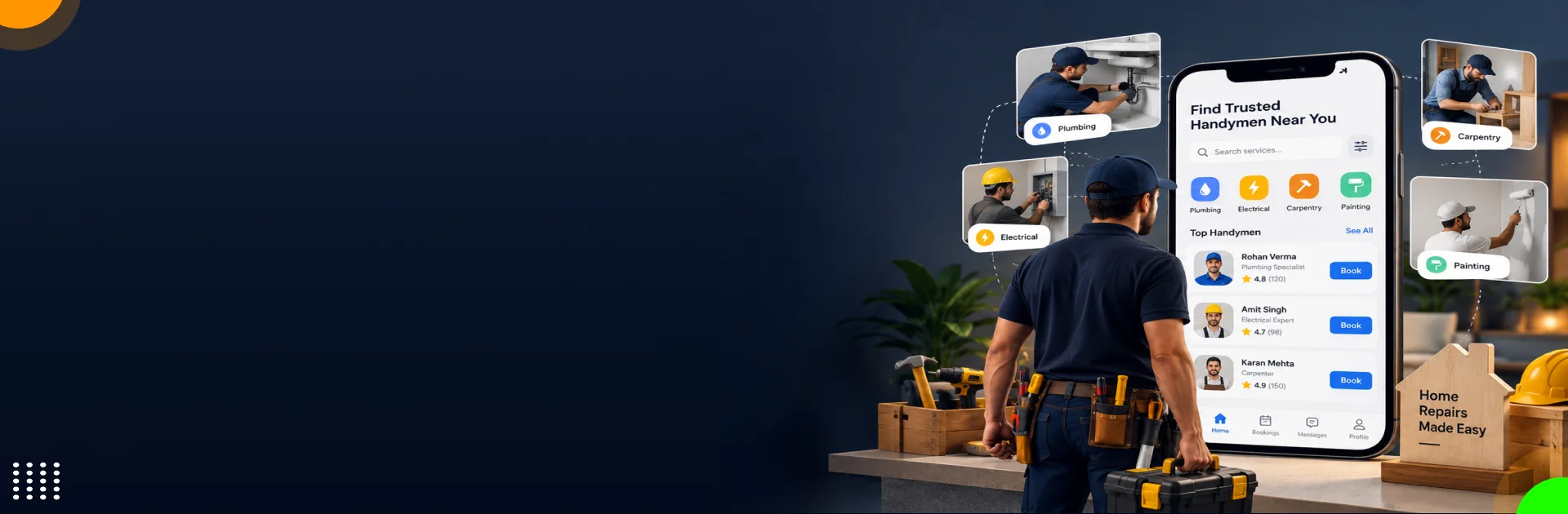
Key Takeaways:
- Start with one commercially viable local market for your handyman app marketplace. Prove that customers will repeatedly book services and providers can earn enough to stay active before you plan a nationwide expansion.
- Build different workflows for different home-service types. A $100 furniture-assembly job shouldn’t follow the same pricing, qualification, and booking process as that of electrical, plumbing, or complex repair work.
- Use a hybrid monetization strategy to prevent revenue channel lock-in. Commissions work well for standardized transactions, while qualified leads, provider subscriptions, service fees, and B2B contracts create additional revenue opportunities for more complex services.
- Introduce AI after your marketplace generates useful transaction data in ample supply. Only then can it improve matching, price recommendations, demand forecasting, and operational decision-making.
Despite the US home services market being valued at a TAM of $657 billion, it’s immensely fragmented and continues to function on offline transactions. In 2025 alone, industry studies revealed that 65.13% of home service booking requests came through offline or traditional channels, even when several companies have digitized their services. But this has created a very specific industry problem. A customer knows that the bathroom needs plumbing work but isn’t aware which professional has the right experience, serves the area, is available tomorrow, charges reasonably, and will actually arrive. At the same time, an independent plumber may have the technical skills but lack a predictable way to fill the calendar with bookings.
This fragmentation has now created a very specific marketplace opportunity. A multi-vendor handyman marketplace brings these two sides together while taking care of the friction in between. For you, operating the platform, this will help create multiple ways to capture value. The most straightforward is a commission on completed jobs, coupled with vendor subscription plans, enterprise accounts, customer service fees, and partnerships with B2B clients. The stronger opportunity comes from building enough local supply and recurring demand that your handyman marketplace can become a regular channel through which consumers purchase home services.
That’s why we’ve put together this guide — built on what we learned shipping MHome, our own multi-vendor handyman marketplace platform, not just from researching the category from the outside. After all, you need to get the balance right, and choosing just the right technology won’t be enough.
What is a multi-vendor handyman marketplace app?
A multi-vendor handyman marketplace app acts like an operating layer between people who need home services of various kinds and independent professionals skilled to offer them. Here, you won’t be just building another proprietary handyman company where you hire every plumber, carpenter, electrician, or appliance technician yourself. Instead, you will be creating a marketplace where multiple third-party providers can bring their services to your customer base, while you control how they are discovered, booked, paid, reviewed, and managed.
In short, your marketplace will have three primary sides to manage: customers, vendors, and your business model. Customers should be able to:
- Search for a service
- Compare professionals by location, price, experience, availability, and ratings
- Book an appointment
- Pay through your platform
- Communicate with the provider
- Review the completed job.
Vendors need a completely different experience. Your marketplace should act as a unified platform where they can register, submit verification documents, define their skills and service areas, set pricing and availability, receive job requests, communicate, and track their earnings.
Your role sits between these two sides. You decide:
- Which vendors are allowed onto the platform
- How bookings are matched
- How commissions on every job get calculated
- When vendors receive the payouts
- What happens when a customer cancels
- How disputes or poor-quality services are handled
In addition, you will also be in charge of mapping customer and vendor acquisition strategies and revenue streams that fit your marketplace. This is precisely the set of decisions we worked through with MHome—and the model you choose here shapes almost everything else in this guide, so it’s worth getting right before you touch a feature list or a tech stack.
Ready to Build Your Handyman Marketplace App?
From vendor onboarding to marketplace payments, we handle the complexity so you don’t have to. Get a free consultation and see how GMTA Software Solutions can turn your idea into a working platform.
Key benefits of building a multi-vendor handyman marketplace app in 2026
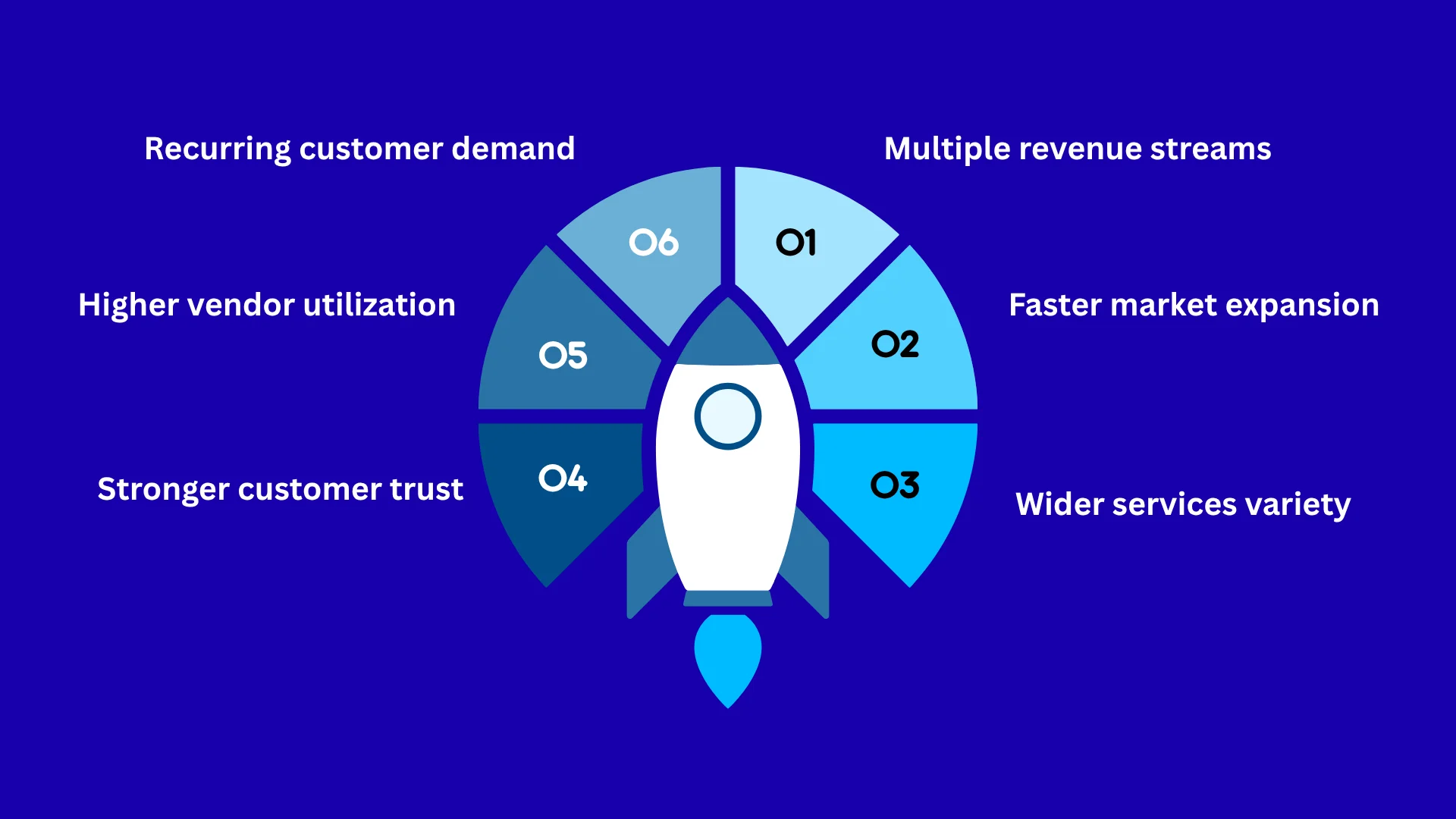
Multiple revenue streams
Your marketplace doesn’t have to depend on one standard commission percentage from each booking. You can build multiple revenue layers around the same transaction — a primary commission charged to a service provider upon job completion, plus a separate customer service fee at checkout. Once you accumulate enough vendor demand, introduce paid leads, monthly vendor subscriptions, priority placement, sponsored service listings, and premium profiles. On MHome, we structured this as a layered model from day one rather than bolting on new revenue streams later, which made it far easier to test pricing without re-architecting the payment logic.
Faster market expansion
One of the key benefits of a handyman marketplace app is that you can expand your service network without building a company-owned workforce in every US home service market. Instead of hiring 50 electricians and plumbers before entering a new city, you can recruit existing professionals, verify their credentials, define their service areas, and make them available through your platform. Your expansion model therefore becomes market-by-market supply acquisition. You can start with selected ZIP codes in Dallas, for example, and then expand into adjacent geographies.
Wider services variety
A multi-vendor model allows you to expand horizontally, where you can begin with core categories like:
- Plumbing
- Electrical repair
- General handyman work
- Furniture assembly
- Appliance installation
- Painting
- Cleaning.
Once you establish a proper balance between vendor supply and customer demand, you can introduce additional services. This matters because service variety increases customer lifetime value — a user who downloaded your app for furniture assembly can later use the same account for TV mounting, repair, or painting.
Stronger customer trust
Trust is particularly essential for the US market because a single transaction involves giving an unfamiliar professional access to a customer’s home. So, a simple five-star rating won’t be enough to solve the problem. What you can do instead is build trust directly within the booking process through:
- Identity verification
- Background checks
- License verification
- Proof of insurance
- Completed job counts
- Transparent pricing
- Secure payments
- Formal dispute resolution
In addition, you can also display the relevant credentials directly on each provider’s profile so that customers have more information in hand before booking.
Higher vendor utilization
For US contractors, your handyman marketplace becomes more valuable the moment it helps them convert unused working hours into paid jobs. A professional may have several open appointment slots due to cancellations or seasonal demand fluctuation. Your marketplace can then identify customers looking for the same service within the provider’s service radius and offer those jobs to the available vendor. This will help create a stronger value proposition than simply promising “more visibility”. For your business, higher utilization can improve vendor retention. This is a stronger value proposition than simply promising “more visibility,” and it’s the lever with the clearest effect on vendor retention.
Recurring customer demand
A handyman marketplace can generate substantially more value once you turn one-time repair requests into ongoing customer relationships. Your platform can use previous booking data to encourage repeat transactions. Suppose that after an appliance installation, the customer could rebook the same professional. After a plumbing repair, your app could generate follow-up alerts for maintenance. Apart from these, you could also offer membership plans that include priority booking, discounted service fees, or scheduled maintenance. This will change your economics from one-time customer acquisition to recurring account revenue, while giving vendors a steadier workflow.
How does a multi-vendor handyman marketplace app work?
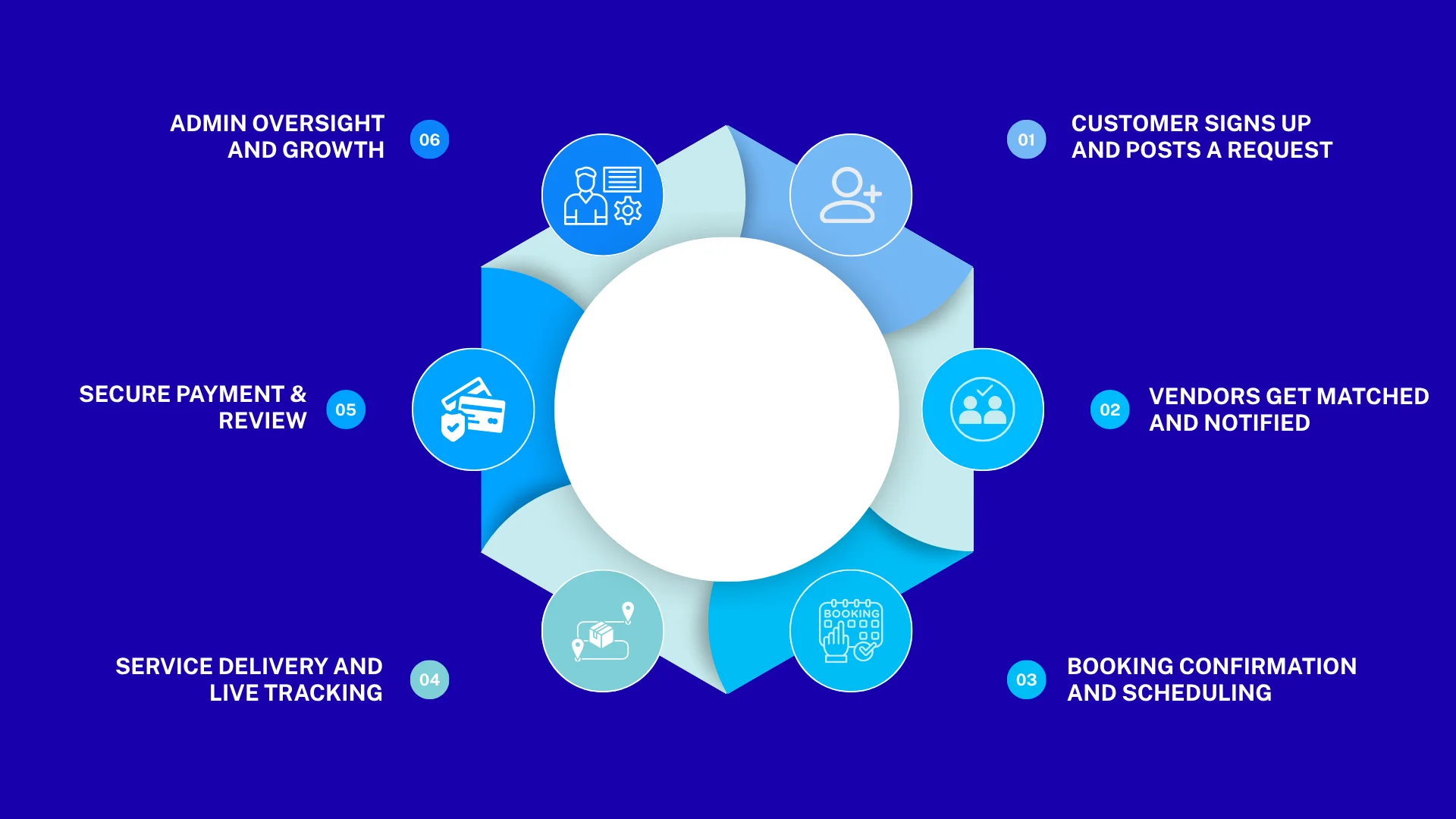
Step 1: Customer signs up and posts a request
The journey begins with the customer creating an account and entering the property address or ZIP code. This will help your marketplace’s backend engine to determine which vendors are available for the service in that specific location. After this, the customer selects a specific service and enters key details that are likely to influence price, duration, skill requirements, and vendor eligibility.
Suppose you received an “install a ceiling fan” request. It will become more useful only when the customer specifies information like:
- The fan type
- Ceiling height
- Existing wiring
- A preferred appointment window.
Similarly, for a leaking pipe, the customer could upload photographs and describe where the leak is occurring. At this stage, your marketplace app can decide whether the job is suitable for fixed-price booking, instant booking, or vendor quotes. At this stage, your marketplace app decides whether the job is suitable for fixed-price booking, instant booking, or vendor quotes — the same three-way branch we built into MHome’s request flow, since forcing every job type into one booking pattern is where a lot of handyman marketplaces run into trouble early.
Step 2: Vendors get matched and notified
The market won’t just notify vendors in the area once the customer logs a service request. Your matching engine will first eliminate the providers who are unsuitable for the job. After that, it should apply appropriate business logic to align the supply and the demand after considering:
- Service category and specific skill
- Service ZIP codes and travel radius
- Availability
- Insurance and background check status
- License and certification requirements
- Rating and completed job history
- Current workload
- Price or minimum job value
You can then use different allocation models, which can include:
- Open marketplace where several vendors receive the request
- Ranked matching where your algorithm prioritizes the best-fit provider
- Instant assignment where the first eligible provider can accept the request
- Quote marketplace where selected vendors submit their estimates, and the customer can choose one
Step 3: Booking confirmation and scheduling
Once the customer selects a provider, your handyman marketplace automatically creates a booking record. It contains all the essential details that the vendor will need to make arrangements on their behalf, like:
- Job scope
- Agreed price or an estimate
- Confirmed appointment window
- Service address
- Vendor details
- Cancellation policy
- Payment status
Automated, rule-based scheduling becomes important when a vendor handles multiple jobs every day. To do so, make sure your system can account for the expected job duration, travel and buffer times, and the existing appointments, rather than simply displaying an empty calendar slot throughout the day.
Suppose an electrician finishes an appliance repair in Brooklyn at 2:00 PM and has another appointment in Queens at 2:30 PM. So, if your marketplace has just a basic availability calendar, it’s highly likely that the second slot will be offered incorrectly. A marketplace-level scheduling engine, therefore, needs to consider location and travel time before confirming the booking.
Step 4: Service delivery and live tracking
The vendor will receive the job request through the provider’s platform, reach the property, and update the job status from accepted -> en-route -> arrived -> work started -> completed. For services where arrival visibility matters the most, you can notify the customer of the estimated arrival time or limited live location information when the vendor is still traveling. Once the vendor arrives, your marketplace will automatically record the check-in time and capture job evidence, like photographs or an initial inspection report.
This will help you in dealing with cases where the final price isn’t fixed. Suppose a customer living in Dallas books a plumbing inspection at $150. However, the plumber discovers a larger repair that will need another $300 in work. Here, the vendor shouldn’t just add this additional expense to the final invoice. Instead, your platform will create a change order, explain the work required and the cost, and request customer approval before the repair is performed.
Step 5: Secure payment & review
Make sure to integrate the payment into your marketplace rather than allowing the customer and vendor to handle it directly. Here, your marketplace app should be capable of appropriately distinguishing between:
- Customer’s total payment
- Your platform’s commission
- Applicable fees
- Refunds, if any
- Vendor’s eventual payout
The actual percentage will, however, depend on your business model. You could charge the vendor a commission, the customer a certain percentage of the service fee, or combine both. Your payment system should also account for failed payments, cancellations, partial refunds, disputes, chargebacks, and payout timing.
After the job is completed, the customer reviews the vendor. This review should automatically feed back into your handyman marketplace ranking and vendor=quality system, and not just simply appear on the profile.
Step 6: Admin oversight and growth
Your admin panel acts as the control center of the entire handyman multi-vendor marketplace. You must be able to see every stage of the transaction without any hidden information, like:
- Which customer requested the service
- Which vendors received it
- Who accepted it
- The agreed price
- Appointment and payment status
- Customer rating
- Vendor payout
If customers in Austin frequently request application installation but only a few qualified vendors accept those jobs, you have a prominent supply problem. If one ZIP code has strong demand but high cancellation rates, you should investigate vendor availability or service explanations. This data will allow you to make decisions about multiple parameters affecting your platform’s growth curve, like:
- Vendor recruitment
- Service pricing
- Commissions charged
- Geographic expansion opportunities
- Customer acquisition
- Service categories that can be launched next
This is the data layer that drives decisions on vendor recruitment, service pricing, commissions, geographic expansion, customer acquisition, and which service categories to launch next — and it’s the layer we’d point to first if you asked us what actually determines whether a multi-vendor marketplace scales past its first city or stalls there.
What are the top handyman app monetization models?
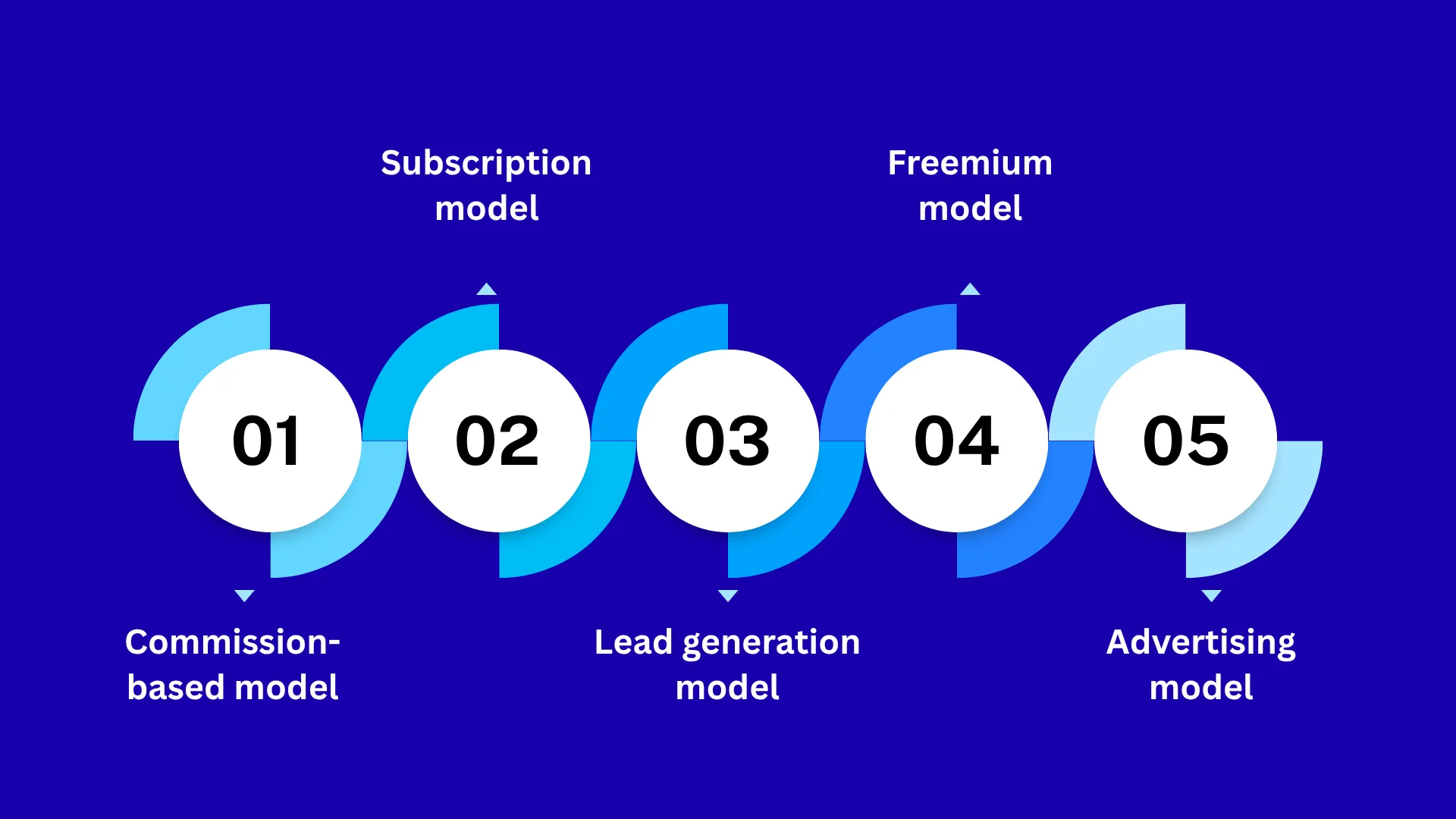
Commission-based model
This handyman app revenue model allows you to charge a percentage of each completed service transaction. Suppose a customer has paid $200 for electrical work. Given that your platform is meant to retain a 15% commission, you will be able to generate $30 from one job. The rest, $170, will be paid out to the vendor before applying any fees or adjustments. This model helps you align your revenue with marketplace activity: more completed jobs means more earnings.
Since there are multiple tiers of US home services, you can structure your commission differently depending on the category. For example, a standardized $100 furniture-assembly job can use one specific rate, while a high-value home repair can have another. In addition, you can also charge your customer a platform or service fee at checkout. This will ensure the entire commission burden isn’t placed solely on the vendor.
Subscription model
Here, you will be charging vendors a recurring fee for access to premium marketplace capabilities rather than levying a certain commission percentage on completed transactions only. Begin with tiers such as a free plan with limited leads, a $49/month professional package with more booking tools and visibility, and a $99/month tier with priority placement, analytics, or access to commercial jobs.
With this approach, you will have a predictable monthly recurring earning, ensuring your financial model isn’t too dependent on individual bookings. The only trade-off, however, is that you need to show enough economic value to the vendors to justify the recurring payment. If a contractor has to pay $99 every month but receives only a handful of quality job requests, retention will suffer.
Lead generation model
Under this model, customers submit service requirements, and you sell the resulting qualified leads to relevant professionals. Suppose a homeowner has requested a roof repair. It automatically generates a lead containing the service type, ZIP code, property details, preferred timing, and other associated details. You will charge an eligible contractor a fixed amount to access the business opportunity through your handyman marketplace.
This model becomes relevant to the US market because most home services require a quote before work begins. You won’t have to wait for the job to be completed to monetize the customer request. The major challenge, however, is lead quality. If contractors continue to receive inaccurate, duplicated, unqualified, or low-intent leads, they will immediately stop paying.
Freemium model
This monetization model will allow vendors and customers to use your marketplace’s core platform for free, but they will have to pay a certain subscription fee to access premium functionalities. For vendors, the free tier can offer a basic profile and limited job opportunities. A paid tier, on the other hand, can unlock higher search visibility, more leads, advanced scheduling, business analytics, promotional tools, priority support, and lower transaction fees.
For customers, basic service discovery and booking can remain free, while premium membership can offer reduced service fees, priority appointments, exclusive offers, and extended service guarantees. However, make sure the free tier is designed to demonstrate value without giving away the features that generate your revenue.
Advertising model
Once your marketplace has substantial US traffic, you can monetize visibility by allowing relevant businesses to pay for placement. Vendors can pay to appear higher in category results or within specific service areas, while complementary businesses can purchase advertising inventory.
However, ads shouldn’t become the primary monetization mechanism too early. Without significant traffic and booking intent, advertising inventory will have limited to almost no value. Besides, you will also need to invest in clear labeling and ranking safeguards, so paid placement doesn’t undermine customer trust.
| Stage | Primary model | Supporting model |
| Launch | Commission | Lead generation |
| Local traction | Commission | Vendor subscriptions |
| Multi-city growth | Commission + subscriptions | Lead fees |
| Established marketplace | Commission + subscriptions | Advertising + B2B |
| Large-scale platform | Multiple revenue streams | Enterprise partnerships |
On MHome, we launched on a straight commission model and layered in vendor subscriptions once local vendor density was high enough to justify the recurring fee—the sequencing above is drawn directly from that build, not a generic best-practices list.
We’ve Already Built This — See How
MHome is our own multi-vendor handyman marketplace, built end-to-end by our team. Explore the case study to see the real features, challenges, and decisions behind it..
What are the must-have key features in a handyman marketplace app in 2026?
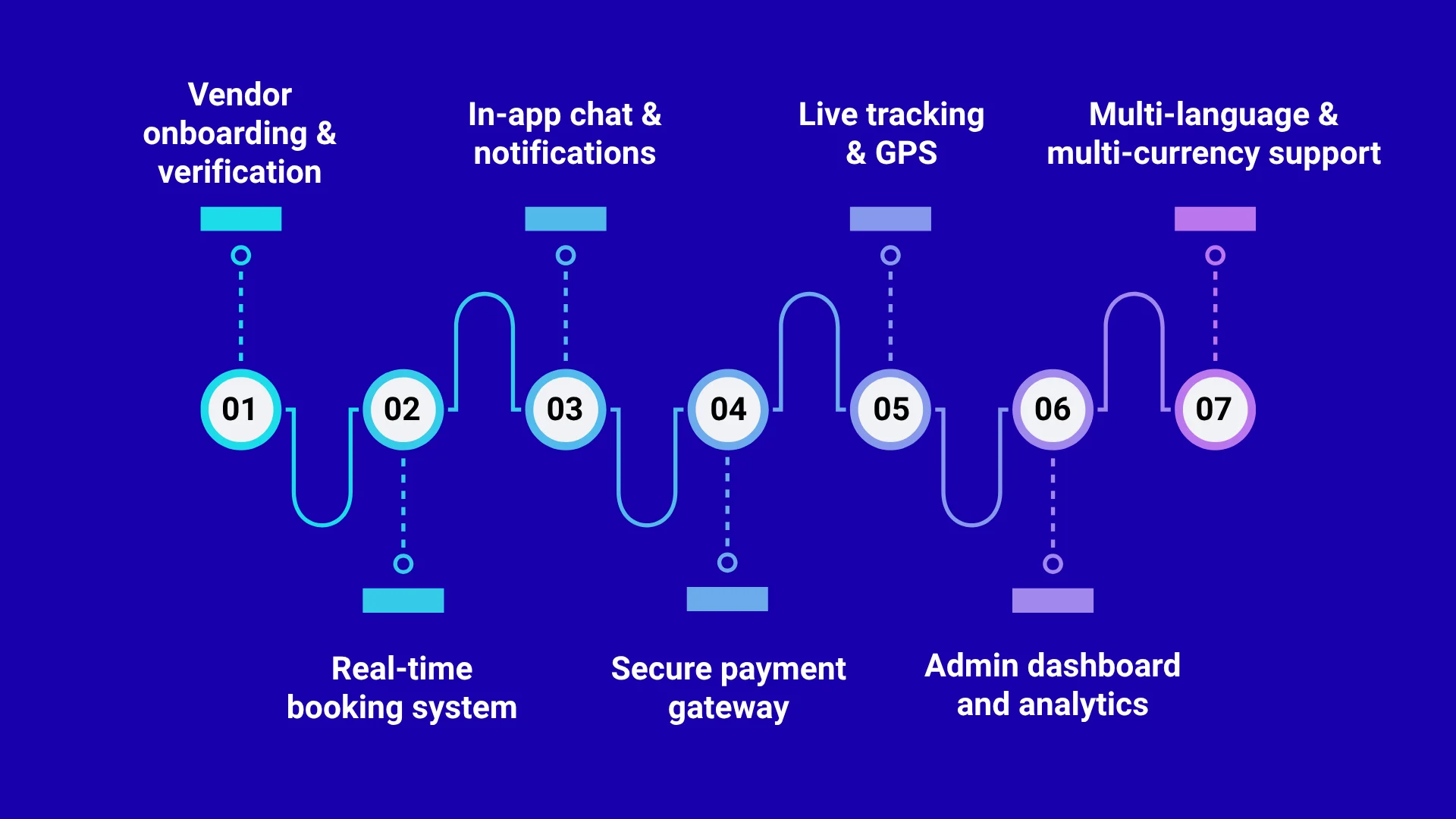
Vendor onboarding & verification
Vendor onboarding should create a complete professional profile rather than simply registering a handyman. So, you need to design a workflow that can collect service categories, ZIP codes served, hourly or fixed pricing, insurance, availability, experience, and licenses or certifications required for specific states or trades. Also, identity and background verification must happen before the profile becomes searchable. This gives your marketplace a controlled supply base and lets customers compare providers using verified credentials, ratings, service coverage, and job history.
Real-time booking system
A real-time booking system should match each request with vendors who actually meet the job requirements and have an available appointment window. A customer requesting furniture assembly in a specific ZIP code, for example, must be able to see eligible providers based on the service area, availability, pricing, and estimated job duration. Also, your marketplace needs to reserve the selected slot immediately, prevent double booking, and support instant booking for standard jobs alongside quote requests for more complex plumbing, electrical, or repair work.
In-app chat & notifications
Handyman jobs require frequent information that otherwise is difficult to capture through a booking form alone. Customers should be able to send photos, describe the problem, confirm property access, and discuss job requirements with the assigned vendor through in-app chat. In addition, you should also ensure the notifications can cover booking acceptance, quote changes, appointment reminders, cancellations, rescheduling, vendor arrival, payment, and review requests. Keeping these conversations inside the platform will give your support team an auditable record when customers dispute pricing, scope, or service completion.
Secure payment gateway
Payment processing should be built around the marketplace transaction rather than treating the app as a simple checkout. When a customer pays $250, the system should record the customer charge, your commission or service fee, the vendor’s payable amount, and any applicable refund or adjustment separately. It should also support saved payment methods, failed transactions, cancellations, partial refunds, chargebacks, and vendor payouts. This will give you automated commission collection and a reliable financial ledger for every booking.
Live tracking & GPS
GPS will become useful once a vendor has accepted the job and needs to travel to the customer’s property. The app can show statuses as:
- En-route
- Arriving
- Arrived
- Completed
In addition, location data can support accurate ETAs, which is crucial to maintaining customer trust and retention. For your business, the live geographic data will help you control marketplace economics. For example, if a vendor regularly travels 20 miles for low-value jobs, you can adjust service-radius rules, minimum booking values, or the vendor matching algorithm.
Admin dashboard and analytics
Your admin dashboard should give you a real-time view of the marketplace across vendors, customers, bookings, payments, commissions, cancellations, disputes, and verification status. The analytics layer should go further by showing performance trends based on service, vendor, ZIP code, city, booking value, and repeat customer rate.
Multi-language & multi-currency support
Although for the initial launch, you can keep English and USD as the core configuration, your platform should be architected for localization. Multi-language support, therefore, must cover customer and vendor interfaces, service descriptions, notifications, onboarding, and support rather than translating only menu labels. Multi-currency support should separate currency from pricing and payment logic. This way, you can easily introduce additional currencies later.
How to build a multi-vendor marketplace app?
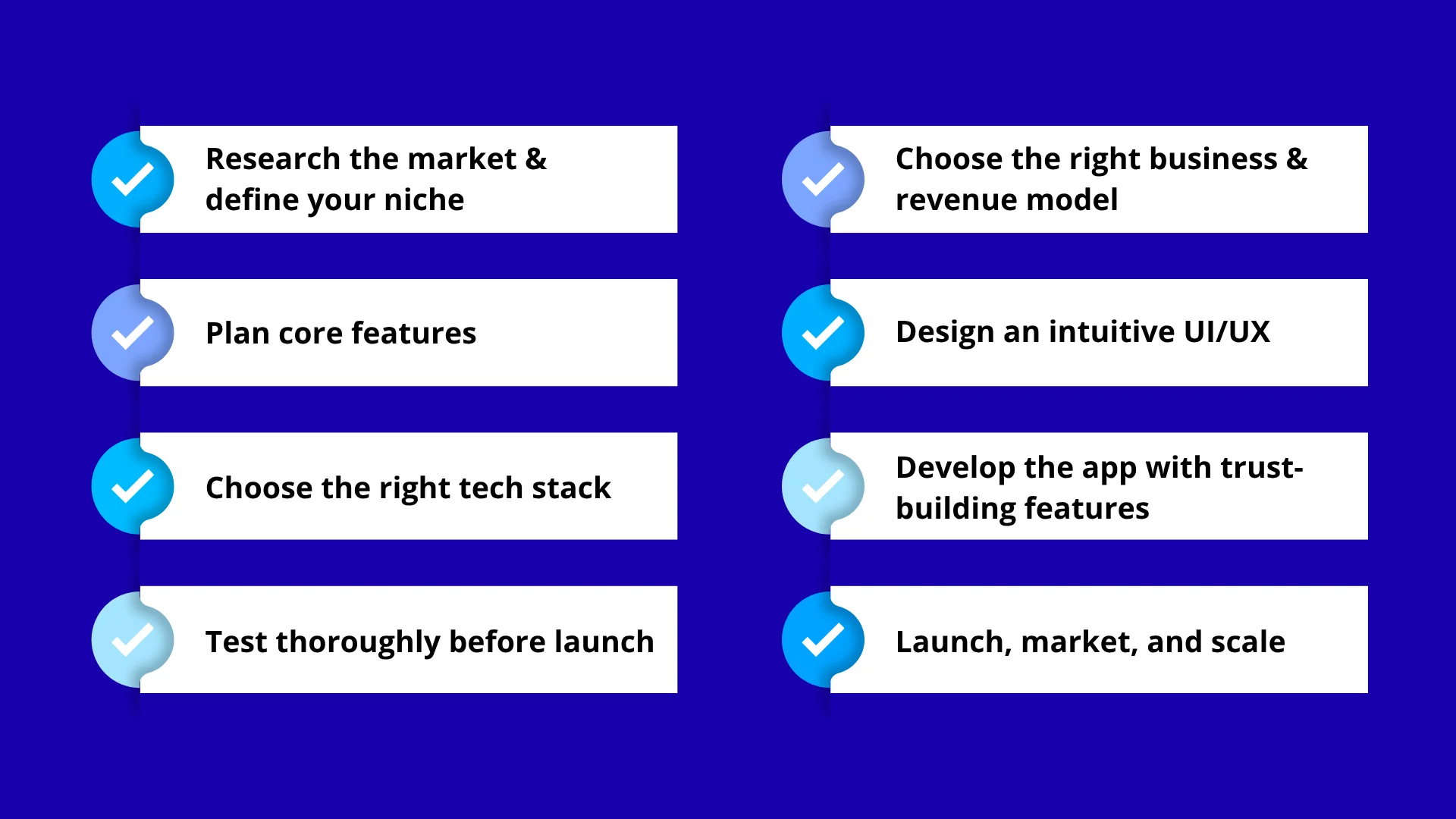
Step 1: Research the market & define your niche
Start by identifying where the marketplace will operate, who will use it, and which handyman categories you will support. Here, you should begin by analyzing demand by city or ZIP code, local competition, average job values, vendor availability, and licensing requirements for special trades. For the initial launch, focus on services like furniture assembly, drywall repair, painting, mounting, appliance installation, or general repairs, instead of launching all categories at once. The goal here is to identify a service-market combination where you can build sufficient customer demand and vendor density.
Step 2: Choose the right business & revenue model
Once the niche is defined, determine how money will move through the handyman marketplace. You can charge vendors a commission on completed jobs, customers a service fee at checkout, vendors for qualified leads or subscriptions, or combine different monetization models. Your choice should, however, match the type of service you are selling. Fixed-price furniture assembly works well with transaction commissions. At the same time, quote-driven plumbing or electrical repair is better suited with lead generation.
Step 3: Plan core features
Your feature set should reflect the actual workflow between a customer, handyman, and marketplace operator. The customer side will need service discovery, ZIP code-based availability, booking or quote requests, chat, payments, tracking, and reviews. Vendors, on the other hand, will need onboarding, verification, service areas, availability calendar, job management, earnings, and payouts. Your admin panel will depend on vendor approval, booking management, payment oversight, and dispute handling. At this stage, you should separate MVP features from later enhancements so that you can invest first in functions required to complete and monetize a transaction.
Step 4: Design an intuitive UI/UX.
Design the experience around the decisions customers and vendors are likely to make during an actual service booking. A customer should be able to select a service, enter their ZIP code, describe the job, upload photos, compare eligible vendors or receive a quote, choose an appointment, and pay without unnecessary screens. Vendors will, however, need a faster workflow for reviewing jobs, accepting or declining them, navigating to the property, updating job status, and checking earnings.
Step 5: Choose the right tech stack
Your technology choice should support location-based matching, real-time availability, marketplace payments, notifications, in-app messaging, and scalable vendor management. A typical architecture can use React Native or Flutter for mobile applications, React.js or Next.js for the web/admin interface, and PostgreSQL or another relational database for transactional data. A typical architecture uses React Native or Flutter for mobile, React.js or Next.js for the web/admin interface, and PostgreSQL or another relational database for transactional data — this is close to the stack we used to build MHome’s customer, vendor, and admin apps.
Step 6: Develop the app with trust-building features
Development should prioritize the mechanisms that make customers comfortable in hiring an independent professional and allowing them to enter the property. Build vendor identity verification, background-check integration, insurance and license documentation, verified profiles, ratings, secure payments, in-app communication, booking records, and dispute workflows into the core platform. For regulated services, your system should accommodate the relevant state or local credential requirements, and not just assume every handyman category will follow the same rules.
Step 7: Test thoroughly before launch
Before releasing the handyman marketplace app, test the complete transaction lifecycle, rather than checking the screens individually. A customer should be able to create a request, receive an appropriate vendor match, book a time, communicate with the vendor, receive arrival updates, and leave a review without breaking the workflow. In addition, test vendor cancellations, customer rescheduling, failed payments, refunds, duplicate bookings, poor connectivity, GPS errors, notification failures, and disputed jobs.
Step 8: Launch, market, and scale
Launch the marketplace in a defined US geographic market rather than spreading supply and demand across dozens of cities immediately. Recruit enough verified vendors in selected ZIP codes before spending heavily on customer acquisition. That’s because people who repeatedly find no available provider are unlikely to return. Track booking conversion, completed jobs, average order value, vendor acceptance, cancellation rate, and customer acquisition costs. Once one market reaches a healthy liquidity threshold, replicate the operating model in the next city instead of expanding purely by geography.
Key technology needed for multi-vendor marketplace app development
For handyman marketplace app development, the technology stack should support three connected environments, namely customers, vendors, and admin operators. At the same time, it should allow you to build features like location-based matching, scheduling, marketplace payments, communication, and vendor verification.
| Technology Category | Recommended Technologies | Purpose in a Handyman Marketplace | Marketplace Application |
| Mobile App Development | Flutter, React Native | Build customer and vendor mobile applications. | Booking, job acceptance, vendor availability, chat, payments, tracking, and notifications. |
| Web & Admin Development | React.js, Next.js | Build web interfaces and the administrative portal. | Vendor approval, booking management, commissions, disputes, customer support, and reporting. |
| Backend Development | Node.js, Java, Python | Manage APIs and marketplace business logic. | Vendor matching, booking allocation, pricing, commissions, reviews, and account management. |
| Database | PostgreSQL, MySQL, MongoDB | Store structured marketplace and transaction data. | Customer profiles, vendor records, services, bookings, availability, payments, and reviews. |
| Cloud Infrastructure | AWS, Microsoft Azure, Google Cloud | Host and scale the marketplace infrastructure. | APIs, databases, file storage, backups, monitoring, and multi-city expansion. |
| Maps & Location | Google Maps Platform, Mapbox | Provide location and routing capabilities. | ZIP-code search, service-radius matching, distance calculation, routes, and vendor ETAs. |
| Payment Processing | Stripe Connect, Adyen | Handle marketplace transactions and vendor payouts. | Customer payment, platform commission, refunds, vendor earnings, and payout processing. |
| Authentication & Security | OAuth 2.0, JWT, MFA | Secure user accounts and application access. | Separate access for customers, vendors, support staff, and administrators. |
| Real-Time Communication | WebSockets, Firebase | Enable real-time communication and status updates. | Customer-vendor chat, booking changes, job status, and arrival updates. |
| Notifications | Firebase Cloud Messaging, APNs, Twilio | Deliver timely customer and vendor communications. | Booking confirmations, reminders, cancellations, payment alerts, and appointment updates. |
| Vendor Verification | Persona, Stripe Identity, Checkr | Automate identity and background verification. | Vendor identity checks, background screening, and verification status management. |
| Analytics & Monitoring | Mixpanel, Amplitude, Firebase Analytics, Sentry | Measure marketplace activity and application performance. | Booking conversion, repeat bookings, vendor utilization, cancellations, revenue, and technical errors. |
This is the same stack category-by-category that we used for MHome, adjusted per project for the specific handyman categories and regulatory requirements in play.
How much does it cost to build a handyman marketplace app?
The cost to build a handyman marketplace app in 2026 ranges from $ 55k to $ 600K+, depending on the platform’s complexity, feature scope, integrations, security, and real-time performance. For an MVP, the estimated development timeline is about 12-18 weeks, while for a full-scale enterprise platform, it’s 24-34 weeks.
| Development stage | Estimated cost | Timeline | What you get |
| Basic MVP | $55K–$95K | 12–18 weeks | Customer app, vendor app, profiles, service discovery, booking, basic matching, chat, payments, ratings, and admin panel |
| Full marketplace | $150K–$240K | 24–34 weeks | Everything in MVP plus vendor verification, advanced scheduling, GPS, dispatch, recurring bookings, sophisticated analytics, refunds, disputes, and automated workflows |
| Enterprise marketplace | $350K–$600K+ | 38–50 weeks | Multi-city/territory management, advanced dispatch, multi-property accounts, enterprise billing, deeper automation, complex marketplace rules, and high-scale infrastructure |
For any handyman marketplace app, the number of screens you plan to design won’t determine the exact cost estimate. Instead, it’s the complexity of the marketplace operations behind those interfaces. Below, we have discussed the major cost drivers you should factor in while preparing the budget.
- Number of platforms: Building separate iOS, Android, web, vendor, and admin applications will increase the development effort. You can opt for the cross-platform build approach to reduce the costs,
- Marketplace workflow complexity: A basic fixed-price booking system is cheaper than supporting quote negotiation, vendor bidding, instant matching, recurring appointments, rescheduling, and other complex features.
- Location and dispatch functionality: ZIP-code matching is pretty simple and inexpensive to develop. However, costs will increase when you plan for routing, real-time GPS, travel time calculations, service-radius rules, dynamic vendor matching, and dispatch optimization.
- Payment and payout architecture: A handyman marketplace needs more than a customer checkout. Supporting commissions, vendor onboarding, split payments, refunds, chargebacks, failed transactions, and tax handling will increase both development and integration costs.
- Number of handyman categories: Supporting furniture assembly and general repairs requires less specialized logic than simultaneously handling plumbing, electrical, HVAC, appliance installation, painting, and other categories with different pricing, credentials, and job requirements.
- Third-party integrations: Maps, payment gateways, background checks, ID verification, SMS, email, and customer support systems will add integration work and, in many cases, ongoing usage fees.
- Development team location: A US-based project team generally costs more than an offshore team.
Custom development vs. white-label/no-code platforms: which is right for you?
A white-label/no-code platform can get a basic handyman marketplace live faster and with less upfront investment. However, you will be working with someone else’s feature set and architecture. Custom development, on the other hand, costs more and takes longer. But it will give you complete control over vendor matching, pricing, payments, verification, geographic expansion, and the overall customer and vendor experience. The decision, therefore, comes down to how much control you need over the marketplace model and how quickly you need to validate it.
| Factor | Custom Development | White-Label / No-Code |
| Upfront cost | $55K–$240K+, depending on scope and complexity | $5K–$50K+ initially, depending on platform and customization |
| Development timeline | Approximately 3–12+ months | Approximately 2–12 weeks for a basic launch |
| Custom features | Full control over marketplace workflows and features | Limited to available features and platform extensions |
| Vendor matching | Can build ZIP-code, skill, availability, rating, distance, and pricing-based matching | Usually limited to the platform’s existing matching capabilities. |
| Payment model | Supports customized commissions, service fees, vendor payouts, refunds, and complex transaction rules | Usually uses built-in payment and commission structures. |
| Vendor verification | Can integrate identity, background-check, insurance, and license verification workflows | Depends on available integrations and platform capabilities |
| Scalability | Architecture can be designed around your expected U.S. market expansion | Scaling depends on the provider’s infrastructure and plan limitations |
| Brand & UX control | Complete control over customer, vendor, and admin experiences | Branding and interface customization are usually constrained |
| Data ownership | Greater control over marketplace data and architecture | Data access and portability depend on the provider |
| Third-party integrations | You decide which APIs and services to integrate | Restricted to supported integrations or available APIs |
| Ongoing costs | Maintenance, cloud infrastructure, integrations, security, and development resources | Platform subscription, transaction fees, add-ons, and customization costs |
| Best suited for | Founders building a differentiated, long-term marketplace | Founders validating demand or launching a relatively standard marketplace quickly |
Common pitfalls while building a handyman marketplace app
Building trust between strangers
Trust becomes a fundamental marketplace constraint because the transaction happens inside a customer’s home. Your platform isn’t simply helping someone order a service. It’s deciding which independent professionals get access to the property. U.S. competitors already treat verification as a core marketplace mechanism. A weak trust layer will, therefore, increase booking hesitation, complaints, refunds, and customer acquisition costs. So, what you should do is build verification directly into the vendor onboarding workflow. These can include:
- Identity and background checks
- Insurance records
- Applicable state/local licenses
- Service-specific skills
- Verified reviews
- Job history
- Documented damage/ dispute procedures
In addition, you should also make credential status visible to customers before booking. This will help you build trust with your customers and increase repeat orders and retention rate at the same time.
Treating Every Handyman Service as the Same
A handyman marketplace app becomes difficult to control when every service follows the same onboarding, pricing, and booking rules. Whether it’s furniture assembly, drywall repair, appliance installation, or plumbing, each service has different skill requirements, job durations, risks, and licensing considerations. A provider qualified for one category should not automatically become eligible for every other category.
So, create category-level eligibility rules. During onboarding, assign each provider specific service categories and collect the qualifications relevant to the same. Store licenses, certifications, service radius, tools, and document expiry dates against the provider profiles. The matching engine should only show a provider for jobs they are actually approved to perform.
Building the Marketplace Before Creating Local Supply Density
Having 1K registered providers doesn’t automatically mean that you have sufficient marketplace supply. If only two qualified providers serve a particular ZIP code and both are unavailable when a customer requests a job, your marketplace won’t be able to fulfill the specific demand at all. This leads to failed bookings, wasted customer acquisition spend, and low repeat usage.
What you should do is measure liquidity at the ZIP code and service-category level before expanding. Track how many verified providers are active in each area, their available hours, acceptance rate, average response time, service radius, and completed jobs. Set a minimum supply threshold for each launch market. Expand customer marketing only after those supply metrics reach the required level.
Failing to Control Scope Changes
A customer may initially book a small repair but can request additional work after the provider arrives. Without a formal process, the provider might quote extra work through chat, request payment outside the platform, or complete additional work without documented approval. This will automatically create disputes over what the customer actually agreed to pay.
The solution is to build a formal change-order workflow into the booking process from day one. The provider should be able to submit additional work with a description, additional labor cost, material cost, and revised total. The customer must explicitly approve the change inside the platform before the additional amount becomes billable. In addition, make sure your system retains the original booking, revised scope, approved timestamp, messages, photos, and completion status.
Designing Payments Without the Full Dispute Lifecycle
A marketplace payment has several stages beyond charging the customer’s card. The platform needs to calculate its commission, determine the provider’s payout, handle cancellations and refunds, and manage disputes or chargebacks. If these states aren’t connected to the booking record, finance operations quickly become difficult to reconcile.
The most feasible approach here is to build a marketplace payment ledger rather than treating the payment gateway as the source of truth. For every booking, record the customer charge, platform fee, provider earnings, taxes or applicable fees, refunds, adjustments, payout status, and dispute status. Define rules for when a provider becomes eligible for a payout. This will give your finance and support teams a complete transaction history when a customer challenges a charge.
Underestimating Multi-Location Complexity
A handyman marketplace that works well in one US city cannot simply be duplicated across 20 cities just by changing the service-area setting. Travel distances, provider availability, local requirements, customer demand, pricing, and service economics will change from one market to another.
So, make location a core part of your business model. Store provider service areas at the ZIP code or geographic-zone level rather than just relying on a city name. Calculate travel distance and ETA when matching jobs. Maintain location-specific service availability, category eligibility, provider density, and pricing rules. Your expansion dashboard should then display metrics by market, like available providers, requests, acceptance rate, cancellations, average order value, and provider travel distance.
What to look for in a development partner?
A handyman marketplace has multiple workflows that a normal booking app doesn’t. Different job types require different provider qualifications. Many jobs need quotes instead of instant prices, providers travel to customer properties, work scope changes after arrival, and payments must account for commissions, refunds, and disputes. Your development partner should demonstrate an understanding of these mechanics before work begins. Here’s what to look for:
- Experience building a two-sided home-service marketplace: Ask for examples where the platform had separate customer, service-provider, and admin workflows, rather than a simple appointment booking application
- Ability to model handyman-specific services: The team should know how to structure categories, like plumbing, electrical, mounting, painting, and general repairs, with different requirements, pricing, and booking flows
- Strong quote and estimation workflows: The partner should support both instant-booking services and jobs where providers need to review photos, inspect the property, submit a quote, and wait for customer approval
- Provider-side operational expertise: The vendor app should handle job acceptance, availability, navigation, arrival, work progress, additional work, completion evidence, earnings, and cancellations as one connected workflow
- Marketplace payment architecture: Look for experience with customer payments, platform commissions, provider payouts, refunds, cancellation fees, and disputes within the same transaction lifecycle
Marketplace payment architecture — experience with customer payments, platform commissions, provider payouts, refunds, cancellation fees, and disputes within the same transaction lifecycle.
Every item on that list is something we had to solve directly while building MHome—not a checklist we assembled afterward. Here’s how that experience translates into how we work:
Still Scoping Your Idea? Let’s Talk First.
Whether you’re weighing monetization models or picking a tech stack, our team can help you map the right approach for your market, budget, and timeline — no commitment required.
How does the GMTA Software solution help build a handyman marketplace app?
At GMTA Software Solutions, we approach a handyman marketplace as an operational platform rather than simply a service booking app. Our experience with the MHome handyman platform gives us an understanding of the workflows that sit behind each transaction. This foundation allows GMTA to shape the product around the way you intend to make money and manage supply, rather than starting with a generic marketplace template.
The development can be structured around the specific service model you choose, whether you begin with fixed-price jobs, provider quotations, scheduled appointments, or a combination of all these. GMTA”s MHome work included customer and provider apps alongside an administrative system, with functionality covering service categories, provider management, scheduling, real-time status tracking, geolocation, notifications, and chat.
What becomes particularly valuable as the marketplace grows is the ability to evolve the matching and operational layer. GMTA will help incorporate factors like provider skills, availability, location, service type, and job requirements into smarter assignment workflows. At the same time, we also work on AI capabilities that can later support automated matching and pricing. This gives you room to start with a focused MVP and progressively build the intelligence required for a larger, multi-location marketplace rather than overengineering the first release. Ready to validate your idea? Get in touch with our team, or explore our portfolio of marketplace builds.”
FAQs
What is the best way to launch a handyman marketplace in one U.S. city before expanding nationwide?
The strongest launch strategy is to establish a repeatable ordering model in one market before adding geographic complexity. Choose a city where your target customers, service categories, and provider acquisition channels are accessible, and then define a narrow initial proposition. For example, you could focus on property maintenance for homeowners and landlords, instead of trying to serve every type of home service customer. Use the first market to determine your actual CAC, average job value, support cost, provider economics, cancellation patterns, and repeat-purchase behavior.
What is the difference between a handyman marketplace and a traditional home-service company?
A traditional home-service company primarily sells its own operational capacity. On the other hand, a handyman marketplace creates an infrastructure through which multiple independent providers can sell their services. This difference changes the business economics. A traditional company has greater control over workforce scheduling, pricing, service standards, and customer experience, but carries more workforce and administrative overhead. A marketplace, on the contrary, can offer a broader provider network without employing every professional. However, it must solve problems like provider acquisition, quality consistency, transaction leakage, and supply availability.
How much provider supply is needed before launching customer acquisition in a new market?
Instead of setting an arbitrary provider budget, calculate the capacity required to fulfill your expected customer demand. Estimate the number of customers you expect to acquire, bookings per customer, average job duration, operating hours, and the percentage of provider capacity realistically available to the platform. Then add a capacity buffer for cancellations, peak periods, and uneven demand.
What is the biggest challenge in achieving marketplace liquidity for handyman services?
The fundamental challenge is balancing fragmented, irregular demand with fragmented provider availability. A customer may need one plumber once, while a provider needs enough profitable jobs throughout the week. Unlike marketplaces for highly standardized products, handyman demand varies by urgency, job size, location, and season. Your business, therefore, needs a mechanism that increases transaction frequency, like recurring maintenance, property management accounts, scheduled services, and repeat customer workflows.
When should a handyman marketplace introduce AI-powered matching and pricing?
AI becomes valuable when the handyman marketplace app has enough historical transactions to identify patterns that simple rules cannot capture effectively. Before that point, a rules-based system is easier to audit and adjust. Once your platform accumulates data on actual job duration, quoted versus final prices, provider acceptance, cancellations, travel, service categories, and outcomes, AI can begin improving specific decisions.