

Key Takeaways
- Custom IoT software connects devices to business systems through five layers: device, connectivity, edge/gateway, backend platform, and application—weaknesses in any one layer limit the whole system.
- Businesses choose custom development over off-the-shelf platforms when they have non-standard hardware, domain-specific logic, regulatory requirements, or need to control cost at high device scale.
- There’s no fixed price for IoT software — planning ranges run from roughly $15,000 for a pilot to $400,000+ for an enterprise or OEM platform, driven mainly by device count, connectivity type, and compliance needs.
- Security has to be designed in from the architecture stage — device authentication, encrypted transport, and signed firmware updates are far more expensive to retrofit than to build in from day one.
- Scaling from 100 to 10,000 devices is mostly infrastructure tuning; scaling from 10,000 to millions usually requires rearchitecting data pipelines, not just adding servers.
Most IoT projects don’t fail because the sensors don’t work. They fail because the software connecting those sensors to a business decision was never designed to handle real-world conditions — devices going offline, message volumes spiking 50x during a launch, or a security gap nobody caught until a pen test found it.
A practical guide to how custom software development for IoT is architected, what it costs, and when it’s worth it over an off-the-shelf platform.
What Is Custom IoT Software Development?
Custom IoT software development is the process of designing and building the software layer that connects physical devices—sensors, machines, wearables, vehicles—to the applications and data systems a business actually runs on, built specifically around that business’s devices, protocols, scale, and compliance requirements rather than adapted from a generic template.
It typically spans four to five layers of work: firmware or device-side logic, the connectivity and communication layer, a backend platform for device management and data ingestion, and the applications (dashboards, mobile apps, admin tools) that people actually use. “Custom” doesn’t mean building everything from raw code — most custom IoT projects still use managed cloud services (AWS IoT Core, Azure IoT Hub) underneath. What’s custom is how those services are configured, integrated, and extended around your specific hardware and business logic.
This is different from IoT product development, which includes the physical device and hardware engineering. Custom IoT software development assumes the device exists (or is being developed in parallel) and focuses on the code that makes it useful. If you’re weighing custom development against off-the-shelf software more broadly, not just for IoT, our custom software development guide covers the decision framework in more depth.
Already know you need custom IoT software and want to skip?
Tell us your device count, connectivity type, and use case — we’ll size the architecture and give you a real cost range, not a guess.
How Does Custom IoT Software Work?
An IoT system is a pipeline. Data moves from a physical sensor through several distinct layers before it becomes something a person or another system can act on. Each layer solves a different problem, and weaknesses in any one of them will limit what the whole system can do.
Device → Connectivity → Edge/Gateway → Platform/Backend → Data & Analytics → Application
Device Layer
This is the hardware and its embedded software — the firmware that reads sensor values, manages power consumption, and decides what to transmit and when. Even in a “software-only” custom IoT project, decisions made at this layer (how often a device reports data, whether it buffers readings when offline) directly shape what the backend has to handle.
Connectivity Layer
This is how data physically leaves the device: Wi-Fi, cellular, Bluetooth Low Energy, LoRaWAN, or Zigbee. The connectivity choice is often the single biggest architectural decision in an IoT project, because it constrains everything downstream—protocol choice, power budget, and cost per device at scale. We cover the trade-offs in detail below.
Edge/Gateway Layer
Not every deployment needs this layer, but many industrial and high-device-count deployments do. A gateway or edge device aggregates data from multiple sensors, does local processing (filtering noise, detecting anomalies, compressing data), and forwards only what matters to the cloud. This matters for two reasons: it cuts bandwidth and cloud costs, and it lets critical decisions (like shutting down a machine on an anomaly reading) happen in milliseconds instead of waiting on a round trip to the cloud.
IoT Platform and Backend
This is where device identity, authentication, message routing, and data ingestion happen. A device connects to this layer using a lightweight protocol (usually MQTT), authenticates with a certificate or token, and streams telemetry. The backend is responsible for knowing which devices exist, whether they’re online, what firmware version they’re running, and where their data should go next. This is also where device provisioning and over-the-air (OTA) firmware update management typically live.
Data and Analytics Layer
Raw telemetry isn’t useful on its own — a temperature reading means nothing without context. This layer handles storage (usually a time-series database for telemetry plus a relational or document store for device metadata), stream processing for real-time alerts, and batch analytics for trends and reporting. This is also where machine learning models for predictive maintenance or anomaly detection typically get deployed.
Application Layer
This is what people interact with — dashboards for operators, mobile apps for field technicians, admin panels for device fleet management, or APIs for third-party integrations. The application layer is often underinvested in during IoT projects, because teams spend most of their budget getting data flowing and treat the interface as an afterthought. That’s usually a mistake: if the people using the system can’t act on the data quickly, the rest of the architecture doesn’t matter.
Why Businesses Choose Custom IoT Software Over Off-the-Shelf Platforms
Off-the-shelf IoT platforms (ThingsBoard, Particle, LoRaWAN, and similar) are genuinely good options for standard use cases—fleet tracking, basic environmental monitoring, and simple asset tracking. Businesses move to custom development when one or more of these becomes a hard constraint:
- Proprietary or unusual hardware. Off-the-shelf platforms are built around common device profiles. Custom hardware, non-standard sensors, or legacy industrial equipment often can’t be integrated without custom firmware and backend work.
- Domain-specific business logic. A generic platform can show you a dashboard of readings. It can’t encode “if vibration exceeds X and temperature exceeds Y within a 10-minute window on this specific machine class, trigger this specific maintenance workflow” without significant customization — at which point you’re paying for a platform’s licensing and building custom logic on top of it.
- Regulatory or data residency requirements. Healthcare, industrial safety, and financial services deployments often need control over exactly where data is processed and stored, which multi-tenant SaaS platforms don’t always allow — see our HIPAA-compliant app development guide if health data is involved.
- Cost at scale. Per-device licensing on commercial IoT platforms can become more expensive than owning the infrastructure once a deployment crosses a few thousand devices.
- Long-term product strategy. If IoT connectivity is core to your product (a connected fitness device, a smart building product line) rather than an internal operations tool, owning the software stack avoids being structurally dependent on a vendor’s roadmap, pricing changes, or shutdown risk.
The honest counterpoint: custom development takes longer to reach a working system and carries more ongoing maintenance responsibility. Businesses that need to validate a use case quickly, or whose IoT need is genuinely simple and well-served by a template, are usually better off starting with a configured platform and revisiting custom development once the use case is proven.
What Can You Build With Custom IoT Software?
Custom IoT software supports a wide range of systems, including:
- Remote device monitoring and fleet management dashboards
- Predictive maintenance systems that flag equipment issues before failure
- Real-time asset tracking and supply chain visibility platforms
- Smart building systems (HVAC, lighting, access control, energy management)
- Connected consumer and wearable product ecosystems (companion apps, cloud sync, health tracking)
- Industrial process monitoring and control systems
- Agricultural monitoring systems (soil, irrigation, livestock tracking)
- OEM white-label platforms that device manufacturers license to their own customers
Predictive maintenance systems, in particular, often evolve into full digital twin implementations as sensor data and modeling mature — see our breakdown of digital twin cost in healthcare for how that progression works in a regulated setting.
Key Features of Custom Software Development for IoT
Regardless of industry, most well-built custom IoT systems include:
| Feature area | What it does |
| Device provisioning & identity | Securely registers new devices and assigns unique credentials |
| Real-time telemetry ingestion | Accepts continuous data streams from potentially thousands of devices simultaneously |
| Device management | Tracks device status, firmware version, connectivity health, and configuration remotely |
| OTA firmware updates | Pushes firmware updates to deployed devices without physical access |
| Rules engine / alerting | Triggers actions or notifications based on defined conditions |
| Data storage & historization | Stores time-series and metadata for reporting, auditing, and analysis |
| Dashboards & visualization | Presents live and historical data to operators and stakeholders |
| APIs & integrations | Connects the IoT platform to ERPs, CRMs, or other business systems |
| Security & access control | Manages authentication, authorization, and encrypted communication |
IoT Technologies and Protocols to Consider
There’s no universally “correct” protocol stack — the right choice depends on power constraints, range, data volume, and latency requirements. Here’s how the common options actually compare:
| Protocol/Technology | Best for | Trade-off |
| MQTT | Most device-to-cloud telemetry; lightweight, low-bandwidth, reliable | Requires a broker; not ideal for large binary payloads |
| HTTP/HTTPS | Simple, infrequent data transmission; easy to debug and integrate | Higher overhead per message than MQTT; less efficient for constant streaming |
| CoAP | Constrained devices with very limited power and memory | Smaller ecosystem and tooling than MQTT/HTTP |
| WebSockets | Real-time bidirectional communication, e.g., live dashboards | Not typically used device-to-cloud; more common for app-to-backend |
| BLE (Bluetooth Low Energy) | Short-range, battery-powered devices (wearables, sensors) | Limited range (tens of meters); needs a gateway/phone as bridge to internet |
| Wi-Fi | Devices with reliable power and indoor connectivity | Higher power draw than BLE or LoRaWAN; not ideal for battery-only devices |
| Zigbee | Mesh networks of many low-power devices in close proximity | Requires a hub/coordinator; smart-home focused ecosystem |
| LoRaWAN | Long-range, low-power, low-data-rate use cases (agriculture, utilities) | Very low bandwidth; not suited for frequent or large payloads |
| Cellular (4G/5G/LTE-M/NB-IoT) | Mobile or remote assets without fixed infrastructure | Recurring connectivity cost per device; higher power draw than LPWAN options |
For most business applications with devices that have stable power, MQTT over Wi-Fi or cellular is the default starting point. LoRaWAN and NB-IoT become relevant when devices are battery-powered and geographically distributed. BLE and Zigbee dominate short-range, in-building deployments.
How to Develop Custom IoT Software
1. Define the business problem before the tech
Most IoT projects go sideways for one simple reason: teams start with “we need to add sensors” instead of “we need to know when a machine is about to fail.” Before any hardware or software decisions get made, pin down exactly what problem you’re solving and what it costs you today. Fewer unplanned breakdowns. Less time spent manually checking equipment. Faster response when something goes wrong. If you can’t name the number this project is supposed to move, you’re not ready to start building yet.
2. Figure out what you’re actually working with
How many devices are you connecting? How often do they need to send data? What’s the connectivity like where they’ll actually sit — a factory floor, a remote field, a delivery truck? Do your current devices even support this, or do they need upgrading first? Getting these answers wrong early is the single most common reason IoT budgets blow past their original estimate. A device that reports once a day and a device streaming data every second need completely different infrastructure, and it’s much cheaper to plan for that now than to rebuild for it later.
3. Design the system around where you’re headed, not just where you’re starting
This is the stage where the real decisions get made: how devices talk to the cloud, whether you need local processing at the device level, which cloud provider fits your needs, and how you’ll store all this data. Here’s the mistake most teams make: they design for their pilot of 50 devices and assume scaling to 5,000 later is just a matter of adding more servers. It usually isn’t. Plan the architecture for where the business is going, not just where the first test run sits.
4. Build the backend that keeps everything running
This is where the system learns to recognize each device, keep data flowing in reliably, and know when to send an alert. Every device needs its own secure ID — sharing one login across your whole device fleet is a common and serious security gap. The backend also needs to handle messy real-world situations: devices going offline and coming back, data arriving out of order, and sudden spikes in traffic during busy periods. And the rules that trigger alerts should be easy to adjust, because you will need to tweak them once real data starts coming in.
5. Build something people will actually use
This is the part teams most often shortchange. All that sensor data means nothing if the person looking at the dashboard can’t quickly tell what to do about it. A screen full of raw numbers isn’t useful — people need clear signals: what’s wrong, how urgent it is, and what to do next. Whether you need a mobile app, a web dashboard, or both depends entirely on who’s using it and where they’ll be standing when they check it.
6. Test it with real devices in real conditions
Lab Wi-Fi is not the real world. Once devices are connected, test them where they’ll actually be used — with the connectivity gaps, interference, and unpredictability that come with it. Deliberately disconnect a device mid-transmission. See what happens when the network drops. This is where you find out if your system can recover gracefully or if it falls apart the first time something goes wrong.
7. Lock down security before launch, not after
Check that device logins can’t be faked or shared. Confirm data is encrypted the whole way through, not just partway. Make sure software updates sent to your devices are verified, so nobody can hijack that channel to push something malicious. Fixing security gaps after a system is live is far more expensive and disruptive than catching them now. This step should be a hard stop before rollout, not a box to check on the way out the door.
8. Run a small pilot first
Roll the system out to a limited number of devices in real conditions before going all-in. A good pilot’s job is to surface the problems you didn’t catch in testing — a dead zone your lab didn’t have, devices running different firmware versions, more data than your system expected. Give yourself time to actually fix what the pilot finds instead of treating it as a formality on the way to full launch.
9. Roll out fully, and make sure you can see what’s happening
Once you scale to your full device count, you need visibility into the fleet, not just an uptime check. You want to know when a group of devices starts behaving strangely before a customer calls to complain about it. Without that visibility, your first warning of a real problem is usually a support ticket, not a dashboard.
10. Plan for the long haul, not just launch day
IoT software isn’t a one-and-done build. Devices need firmware updates. Fleets need ongoing health checks. And growing from a few thousand devices to millions isn’t just “add more servers” — it usually means rethinking how your data moves through the system. Budgeting only for launch is one of the most common and costly mistakes in IoT projects. Plan for this from the start, and it’s far cheaper than retrofitting it later.
How Much Does Custom IoT Software Development Cost?
There’s no fixed price for IoT software development, because the cost is driven by architecture decisions, not a simple feature checklist. A single-purpose monitoring dashboard for 50 sensors and a multi-tenant OEM platform supporting 100,000 devices are both “IoT software,” but they’re different orders of magnitude in cost.
If you’re not yet sure whether to start with a pilot or commit to a fuller build, our general MVP software development guide covers how to scope that first release regardless of platform. That said, here’s a directional planning range based on scope
| Project type | Typical scope | Rough planning range* |
| Pilot / proof of concept | Single use case, limited device count (10–100), basic dashboard | $15,000 – $40,000 |
| Mid-complexity deployment | Full device management, real-time alerting, mobile + web app, moderate device count | $50,000 – $150,000 |
| Enterprise / industrial platform | Multi-tenant, high device volume, edge processing, compliance requirements, integrations with existing enterprise systems | $150,000 – $400,000+ |
| OEM / white-label platform | Multi-customer platform license-ready for a device manufacturer’s own customers | $200,000 – $500,000+ |
These are planning ranges, not quotes. Actual cost depends on the factors below, and a proper estimate requires scoping your specific device count, protocol requirements, and compliance obligations.
What Factors Affect IoT Development Cost
- Number and complexity of devices — more device types and firmware variations increase integration work
- Connectivity choice—cellular connectivity adds recurring per-device costs that platform choice like Wi-Fi don’t
- Real-time requirements — sub-second alerting and edge processing cost more than batch/periodic reporting
- Backend scale—architecture built for 100 devices doesn’t automatically work at 100,000; scaling for high device counts adds engineering cost upfront
- Security and compliance—HIPAA, industrial safety standards, or data residency requirements add development and testing overhead
- Integrations—connecting to existing ERP, CRM, or business intelligence systems is often underestimated in early scoping (this is a common gap; see how it plays out for AI systems connecting to legacy infrastructure)
- AI/ML requirements—predictive maintenance or anomaly detection models require data science work beyond standard backend development, similar in scope to what we outline in AI MVP development cost
- Team composition and location—Offshore or nearshore delivery models typically reduce cost per hour without necessarily reducing quality, though this depends heavily on the vendor (see our breakdown of nearshore vs. offshore delivery models)
- Ongoing maintenance—IoT systems require continuous device fleet management, firmware updates, and infrastructure scaling; budgeting only for initial build is a common and costly mistake
For a broader look at how software cost estimation works across project types, see our software development cost guide.
Not sure where your project lands in these ranges?
Device count, connectivity choice, and compliance needs swing the estimate by six figures — a quick scoping call gets you a real number instead of a range.
How Long Does IoT Software Development Take?
A focused pilot with a limited device set typically takes 8–14 weeks from discovery to a working proof of concept. A mid-complexity production deployment usually runs 4–7 months. Enterprise-scale or multi-tenant OEM platforms commonly take 9–14 months for the initial production release, with continued iteration afterward.
These timelines assume hardware is already selected or in parallel development. Projects where hardware design is still unresolved should expect the software timeline to be gated by hardware readiness, not the other way around.
Custom IoT Software vs. Off-the-Shelf IoT Platforms
| Factor | Custom IoT Software | Off-the-Shelf Platform |
| Customization | Full control over logic, workflows, and integrations | Limited to what the platform supports |
| Upfront cost | Higher | Lower |
| Time to first working system | Longer | Faster |
| Cost at scale (thousands of devices) | Often lower long-term (no per-device licensing) | Can become expensive as device count grows |
| Vendor dependency | Low — you own the stack | High — tied to vendor pricing, roadmap, and uptime |
| Security/compliance control | Full control over architecture and data residency | Limited to what the vendor allows |
| Maintenance responsibility | Falls on your team or delivery partner | Largely handled by the vendor |
| Best fit | Core product differentiation, custom hardware, regulated industries, long-term scale | Validating an idea, standard use cases, limited internal engineering capacity |
Practical guidance: if IoT connectivity is central to your product or competitive advantage, or your hardware and compliance needs are non-standard, custom development is usually the right call despite the higher upfront investment. If you’re testing whether an IoT use case has business value at all, start with an off-the-shelf platform and treat custom development as the next phase once the use case is proven.
How to Scale an IoT Software Solution
Scaling IoT software isn’t linear — the architecture that works for a pilot often needs real rework, not just “more servers,” once device counts grow by orders of magnitude.
Scaling from 100 devices to 10,000 devices usually means moving from a single database instance to a properly indexed time-series database, introducing message queuing so ingestion doesn’t block on downstream processing, and adding basic device fleet monitoring so failures are visible before they become outages. Most of this is achievable by tuning the existing architecture rather than redesigning it.
Scaling from 10,000 devices to millions is a different problem. At this scale, systems typically need horizontal scaling across ingestion, regional deployment to reduce latency and comply with data residency rules, stream processing frameworks (like Kafka or cloud-native equivalents) to handle message volume, and automated device provisioning since manual onboarding becomes impossible. This level of scale also demands serious investment in observability — you need to know a subset of devices is misbehaving before customers report it.
The practical mistake we see most often: teams architect for their pilot’s scale and assume growth is “just infrastructure.” It’s usually also a data model and processing pipeline redesign.
IoT Security Considerations
IoT security failures are disproportionately common because connected devices expand the attack surface in ways traditional software doesn’t — a compromised device isn’t just a data risk, it can be a physical safety risk. NIST’s Cybersecurity for IoT Program is the most current authoritative source on this, and its foundational guidance for manufacturers (NIST IR 8259 series) is a useful baseline even for teams not selling to the federal government, since it increasingly shapes enterprise procurement and security review expectations.
A meaningful IoT security program covers:
- Device authentication and identity. Every device should have a unique, verifiable identity — shared credentials across a device fleet are a common and serious vulnerability.
- Encryption in transit and at rest. Telemetry data should be encrypted end-to-end, not just at the network layer.
- Certificate and key management. Devices need a lifecycle process for credential rotation and revocation, especially at fleet scale.
- Secure firmware updates. OTA updates must be signed and verified so a compromised update channel can’t push malicious firmware.
- API security. Backend APIs need the same rigor as any other production API — rate limiting, authentication, input validation.
- Access control. Role-based access for who can view device data, push updates, or change device configuration.
- Monitoring and anomaly detection. Unusual device behavior (unexpected data patterns, unusual login locations) should trigger alerts, not go unnoticed until an incident.
- Vulnerability management. A documented process for identifying, disclosing, and patching vulnerabilities across the device fleet — NIST’s guidance on this is aimed specifically at manufacturers.
Security isn’t a phase at the end of development. Retrofitting authentication or encryption into an already-built system is significantly more expensive than designing it in from the architecture stage.
Security gaps in IoT systems are expensive to fix after launch, not before.
If you’re scoping a project and want architecture designed around device authentication, encrypted transport, and signed firmware updates from day one, our team can walk through what that looks like for your device fleet.
Common IoT Software Development Challenges
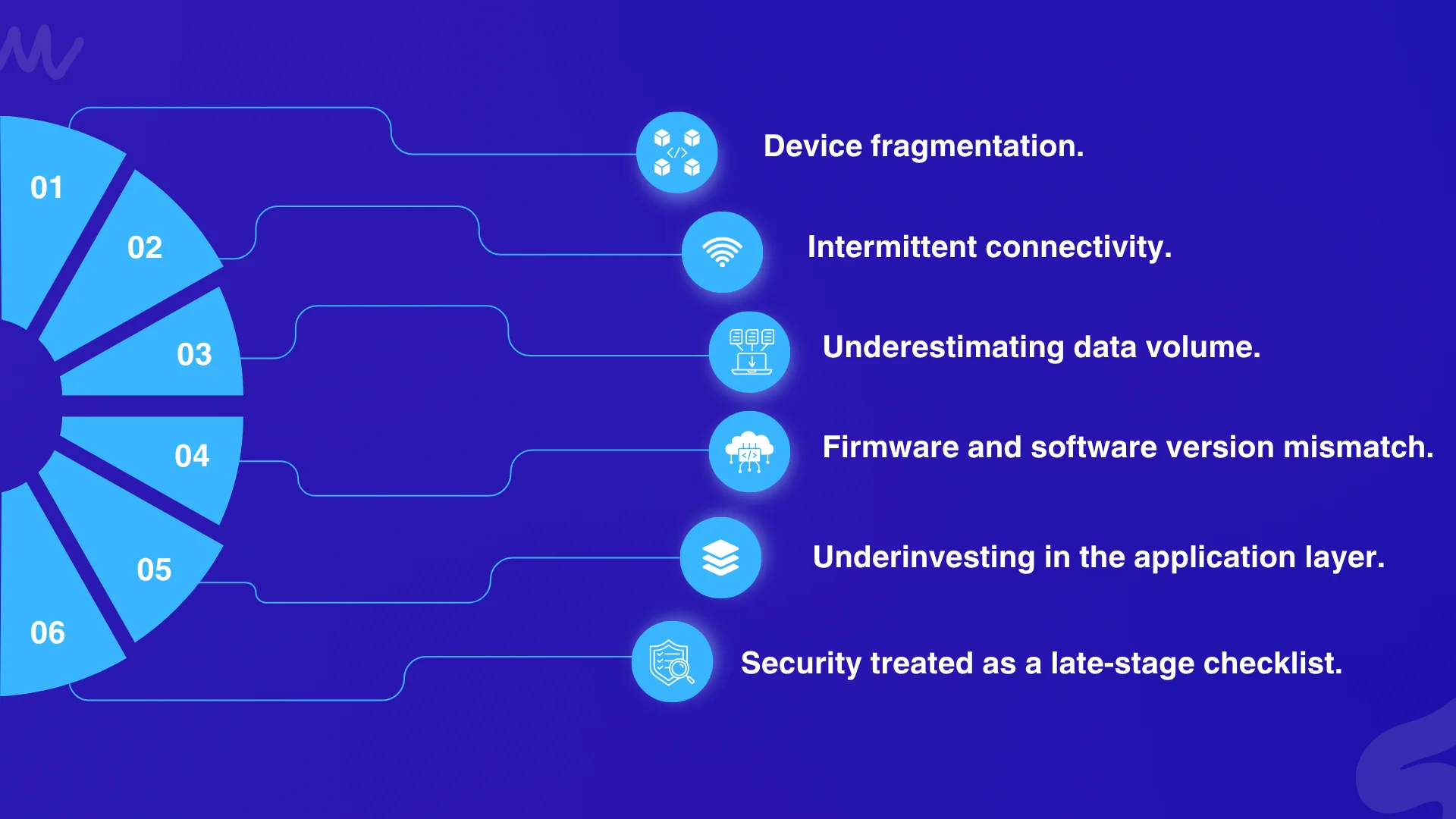
Device fragmentation
Supporting multiple hardware revisions or third-party device types multiplies testing and maintenance overhead.
Intermittent connectivity
Real-world deployments deal with devices going offline—the system needs to handle buffering, retries, and reconciliation gracefully, not assume constant connectivity.
Underestimating data volume
Teams often plan for average data load and get surprised by peak load during specific events (a manufacturing shift change or a weather event triggering simultaneous sensor readings).
Firmware and software version mismatch
Devices in the field running older firmware need to remain compatible with an evolving backend, which constrains how aggressively the backend can change its APIs.
Underinvesting in the application layer
As noted earlier, teams often spend a disproportionate budget on data pipelines and treat the user-facing dashboard as an afterthought—even though it’s what determines whether the system actually gets used.
Security is treated as a late-stage checklist
Covered above, but worth repeating: this is the most common and costly mistake in IoT projects.
How to Choose an IoT Software Development Company
A few questions are worth asking any vendor before committing, whether you’re evaluating a full delivery partner or looking to hire IoT developers to extend your own team:
- Have they built systems handling your approximate device volume? A company experienced with 200-device deployments may not have the architecture experience needed for 50,000 devices.
- Do they have direct experience with your target protocols and connectivity type? Cellular/LPWAN experience is meaningfully different from Wi-Fi/BLE experience.
- How do they approach security by default, not as an add-on? Ask specifically how they handle device authentication and firmware update security.
- What’s their approach to post-launch maintenance? IoT systems need ongoing device fleet management — ask what happens after go-live, not just during the build.
- Can they show real examples of handling scale or connectivity failure scenarios? Ask how a past project handled devices going offline or a sudden spike in message volume — the answer reveals more than a feature list.
- Do they understand your industry’s compliance requirements? Healthcare, industrial, and financial IoT deployments each carry different regulatory considerations that a generalist team may not anticipate.
GMTA Software Solutions builds custom IoT software across industrial, healthcare, and consumer product deployments, with delivery teams handling device connectivity, cloud backend architecture, and application development end to end. If you’re scoping an IoT project, our IoT development services team can walk through architecture and costs specific to your device and connectivity requirements.
Conclusion
Custom IoT software development is a real investment, and it isn’t the right starting point for every use case—but for businesses where connected hardware is core to the product or operation, owning the software stack pays off in flexibility, cost control at scale, and independence from a vendor’s roadmap. The projects that go well are the ones where security, scalability, and the application layer get real attention from day one, not treated as things to fix after the pilot works.
If you’re scoping a custom IoT project and want to talk through architecture, protocol choices, or realistic cost ranges for your specific device count and use case, GMTA’s IoT development team can walk through it.
Frequently Asked Questions
What is the difference between IoT software development and IoT product development?
IoT product development includes the physical device — hardware design, sensor selection, manufacturing. IoT software development is the code layer: firmware logic, connectivity, backend platform, and applications. Most real IoT projects involve both, often with separate teams or vendors for each.
Can I add IoT connectivity to an existing product without rebuilding it?
Often, yes — retrofitting connectivity onto an existing product usually means adding a connectivity module and building the backend/software layer around the existing hardware, rather than redesigning the product itself. The complexity depends on whether the existing hardware has the processing headroom and power budget to support it.
Do I need a mobile app for an IoT project, or is a web dashboard enough?
It depends on who’s using the data and where. Field technicians and consumer-facing use cases usually need a mobile app; internal operations monitoring is often better served by a web dashboard. Building both without a clear justification adds cost without proportional value.
What cloud provider is best for IoT projects — AWS, Azure, or Google Cloud?
All three have mature IoT-specific services (AWS IoT Core, Azure IoT Hub, Google Cloud IoT). The right choice usually comes down to what the rest of your infrastructure already runs on, rather than a meaningful technical gap between the platforms for most use cases.
How do you handle IoT devices with no internet connectivity in remote locations?
This typically requires edge processing (so the device or a local gateway can operate autonomously) combined with a store-and-forward pattern, where data is buffered locally and synced once connectivity is restored — common in agriculture, utilities, and remote industrial deployments using LoRaWAN or satellite connectivity.
Is MQTT the best protocol for all IoT projects?
No. MQTT is the right default for most device-to-cloud telemetry because it’s lightweight and reliable, but it’s not universal — constrained devices may need CoAP, short-range battery devices often use BLE, and geographically distributed low-power sensors are often better served by LoRaWAN.