

Key Takeaways:
- Choose prompt engineering for instruction and output issues, RAG for changing or proprietary information, and fine-tuning for consistent, repeatable task behavior
- RAG and fine-tuning can work together when your AI application needs both current external information and specialized, consistent model behavior
- Start with the simplest architecture that meets your performance target and add complexity only when measurable business value justifies the additional cost
- The cost difference between RAG and fine-tuning depends on data complexity, training requirements, infrastructure, scale, and how frequently the AI app needs updates.
For a startup watching every dollar spent in development, RAG is usually the first move; fine-tuning earns its place when the product demands specialized behavior. When you plan an AI product for the $42 billion US market, finding an LLM isn’t the most difficult decision. Whether your AI SaaS is expected to answer questions from thousands of customer forms or the agentic workflow has to return the same structured output every time, these problems aren’t something you can resolve with a basic foundation model.
Instead, a question surfaces: how should the AI be adapted to the job your customers are actually paying for?
If your customers’ information changes every day, building that knowledge into a model through training creates a maintenance problem. When the product’s value depends solely on getting a specialized task right consistently, simply retrieving the documents can never address the underlying requirement. In both cases, the wrong approach means more development work without improving the part of the product customers actually care about.
Then comes the cost of changing direction. Suppose you initially build the app around one AI architecture, only to discover later that the model needs a completely different approach. Here, the change will directly reach into your data pipelines, application logic, evaluation process, customer workflows, and integrations.
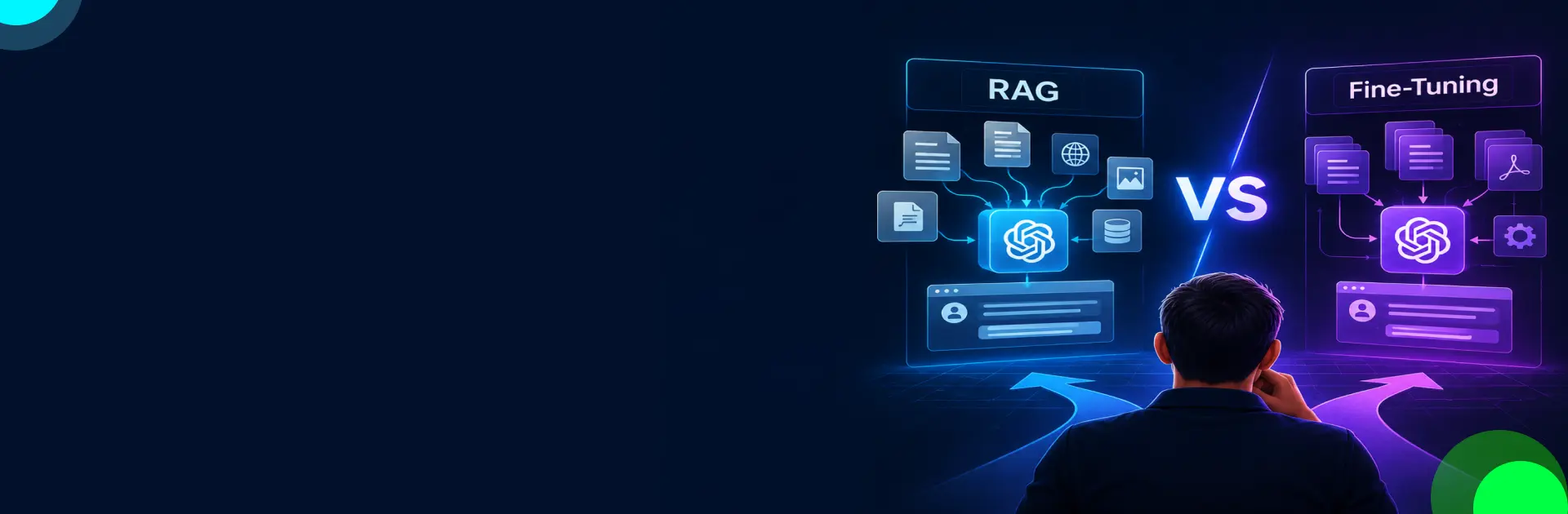
This is why fine-tuning vs. RAG becomes both a product and business decision, not simply an LLM configuration choice. In this guide, we will walk you through what exactly sets these two approaches apart from one another and how you can decide which one is feasible for your specific business use case. After all, a useful comparison is never about which technology is more advanced!
Weighing RAG vs. fine-tuning for your AI product?
Skip the trial and error. Talk to our AI team before you commit to an architecture — we’ll tell you honestly which one (or both) your product actually needs.
RAG vs Fine-Tuning vs Prompt Engineering: The 3 Options You Actually Have
Prompt engineering sits across the workflow. Even when RAG or fine-tuning is involved, the AI model still asks for clear instructions on facts like:
- What to do with the information it receives as input
- How to properly structure the response to maintain consistency
- Which business rules and application logic to follow
- When to refuse or escalate a request
In these scenarios, prompts can help you instruct the model to answer only from retrieved company documentation and prepare the response in the defined format.
The RAG, on the other hand, addresses a completely different business requirement. Suppose the assistant bot needs current product documentation, customer-specific account information, contracts, governance policies, or internal knowledge. The RAG pipeline can then retrieve the relevant content at runtime, which usually lives outside the model and tends to change over time. Putting the information directly into the retrieval layer is fundamentally different from teaching the model a new behavior.
Fine-tuning addresses another problem, especially in cases where the AI needs to perform a specialized task consistently across repeated interactions. This becomes relevant for your business when prompting alone cannot produce sufficiently consistent outputs, like the below use cases:
- Classification
- Structured extraction
- Domain-specific response patterns
- Tightly controlled workflows
The three approaches aren’t competing technologies from which you just have to pick one. That’s because in a production scenario, all three come together and work cohesively, solving a different layer of the AI problem you might be facing.
Consider an AI insurance claims assistant, for example. Fine-tuning will help improve consistency in extracting claim details into a defined structure as per your business workflow. RAG can help in retrieving the customer’s policy terms and current coverage rules. Prompt engineering, on the other hand, can instruct the system to compare the claim against the fetched policy information, produce the necessary fields, and route uncertain cases for further human review.
However, you have to remember that each approach has a huge flaw too. Prompt engineering doesn’t add missing knowledge. RAG never teaches the LLM a new task behavior. Similarly, fine-tuning doesn’t provide a practical replacement for a live knowledge base. If your AI product has more than one of these problems, the layers can work together rather than compete. The right architecture is therefore the smallest combination of layers that solves the specific failure points without adding infrastructure your product doesn’t need yet.
| Decision question | Layer to consider | What it solves | What it does not solve | Estimated cost | Estimated timeline |
| Is the model capable but inconsistent with instructions, tone, workflow rules, or output format? | Prompt Engineering | Improves instruction-following, response structure, tone, and workflow adherence. | Does not add missing knowledge or fundamentally change model capabilities. | $5K–$20K | 2–6 weeks |
| Does the AI need current, private, proprietary, or customer-specific information? | RAG | Retrieves relevant information from documents, databases, knowledge bases, and other sources at runtime. | Does not fundamentally change learned model behavior or fix poor source data. | $15K–$50K for a focused RAG pipeline; $40K–$120K for a production multi-source system | 4–12 weeks for a focused pipeline; 8–18 weeks for production complexity |
| Does the AI need highly consistent specialized behavior? | Fine-Tuning | Improves repeatable task behavior such as classification, extraction, formatting, or specialized response patterns. | Does not provide a live knowledge base or make frequently changing information current. | $20K–$80K | 6–16 weeks |
| Does the product have both a knowledge problem and a behavior problem? | RAG + Fine-Tuning | RAG supplies current context while fine-tuning handles specialized behavior. | Adds complexity and cost when either layer alone would solve the problem. | $50K–$150K+ | 10–20+ weeks |
| Does every request require precise instructions regardless of the architecture? | Prompt Engineering + RAG/Fine-Tuning | Controls how the model uses retrieved information or applies specialized behavior. | Does not independently solve missing knowledge or specialized model behavior. | Included within the implementation cost of the selected layer | Adds roughly 1–3 weeks of iterative prompt/evaluation work |
| Are you still validating the MVP? | Start with the simplest viable layer | Keeps the initial AI architecture proportional to the validated business requirement. | Does not eliminate the need to add infrastructure later if usage proves it necessary. | $5K–$20K for a prompt-led PoC | 2–6 weeks |
What is RAG?
RAG, or Retrieval-Augmented Generation, connects an LLM to external information sources so that it can fetch relevant business context before generating a response. In this architecture, your AI product won’t rely completely on what the model learnt during training. Instead, it can directly retrieve key details from various information sources, which ideally sit outside the model’s ecosystem, like:
- Company documentation
- Product databases
- Contracts
- Policies
- FAQs
- Support records
- Internal knowledge bases
Consider a US B2B SaaS company building an AI assistant bot for the customer support team. It needs to answer questions about the product features, troubleshooting procedures, subscription rules, and customer-specific configurations. Now, these sources are proprietary to your business, likely to change over time, and can differ from one customer to another. A general-purpose LLM won’t have access to these details automatically.
With RAG, however, the AI app can retrieve relevant information and supply the same to the LLM for further processing once the customer asks a question. The model then generates its answer depending on the context. All you have to do is update your documentation or knowledge base. There’s no need to retrain the foundation LLM model every time a policy changes, a new product spec is added, or the customer changes the address.
However, this architecture doesn’t guarantee accurate answers. Suppose the source information is outdated, contradictory, incomplete, or poorly structured. In this case, the model receives flawed context, which further creates room for hallucinations, irregularity in the responses, and misguidance. That’s why you will need controls around who can access the information, especially if the app serves multiple customers.
How does it work?
This architecture works by connecting your AI application to external, third-party business information systems and retrieving the relevant data, depending on the input. It’s the responsibility of the LLM to use the information and generate an appropriate response. To help you understand the working mechanism of RAG, here’s a brief sequential overview.
- First, your AI app connects to approved information sources, like product documentation, policies, contracts, databases, or internal knowledge pools.
- The RAG layer processes the information and organizes it into searchable sections. Large documents get divided into smaller pieces so that relevant information can be identified immediately when needed.
- A customer then asks the AI app a question, like “Does the enterprise subscription plan include priority support?”
- Instead of sending the question directly to the LLM, the RAG layer searches your connected knowledge sources and identifies the information having maximum relevance to the question.
- It then selects specific sections that will help form an appropriate answer. For the billing example we mentioned, this includes your enterprise-plan documentation and current support policy.
- Your AI app sends the user’s question to the LLM together with the relevant information the RAG layer fetched. It gives the model enough business-specific context for generating the response.
- The LLM interprets both the question and the knowledge sections and then produces the response based on that context rather than relying only on its general training.
- The final answer is returned to the user, with your app’s rules governing what information can be displayed and how the response needs to be presented.
For example, let’s assume your SaaS pricing has changed from $99 to $129. You will just have to update the relevant pricing information in the connected knowledge base. When a customer later asks about the pricing, the RAG layer retrieves the updated information and passes it to the LLM. The model can then generate an answer using the new pricing without requiring retraining.
RAG vs. a plain LLM
A plain LLM is a model-first architecture. Your application sends instructions and whatever context is available to the model. It then generates the response using its pretrained capabilities and the information included in the request. This approach is sufficient for tasks like general writing, summarization, classification, coding, and reasoning. That’s because these do not rely on proprietary or constantly changing data.
RAG, on the other hand, creates a model-plus-knowledge architecture. Your app retrieves relevant information from external sources before asking the LLM to generate the corresponding response. This gives your product access to information that sits outside the model. However, it also creates additional responsibilities that you have to factor in, like:
- Data ingestion
- Indexing
- Retrieval quality
- Permissions
- Security
- Monitoring
- Source freshness
- Governance
Your decision ultimately comes down to whether external business knowledge is central to the AI experience or not. If it primarily needs to reason, generate, classify, or transform data already available in the interaction, a plain LLM will be better, as you can keep the architecture simpler. However, if it needs to work from changing company knowledge, customer records, contracts, policies, or other controlled sources, RAG will provide the infrastructure necessary to keep the information available at runtime.
| Business factor | Plain LLM | RAG |
| Core architecture | Application → LLM → response | Application → retrieval layer → LLM → response |
| Knowledge access | Relies on pretrained knowledge and supplied context | Adds external knowledge retrieved at runtime |
| Proprietary information | Must be supplied as context | Can retrieve from authorized business sources |
| Frequently changing information | Your application must provide current information | Your knowledge base can be updated independently of model training |
| Customer-specific information | Your application must explicitly supply relevant data | Retrieval can select authorized customer-specific information |
| Privacy responsibility | Protect prompts, inputs, outputs, and provider interactions | Protect the entire retrieval and knowledge pipeline as well |
| Multi-tenant isolation | Primarily handled by your application and data layer | Must also prevent cross-tenant retrieval from the knowledge layer |
| Data governance | Comparatively simpler | Requires source ownership, classification, provenance, freshness, retention, and access policies |
| Accuracy dependency | Depends heavily on model capability and supplied context | Depends on model capability, source quality, and retrieval accuracy |
| Hallucination control | Can be constrained through prompting and application controls | Retrieved evidence can ground responses, but bad retrieval can still produce incorrect answers |
| Security exposure | Prompt and model interaction risks | Adds retrieval-layer risks, including unauthorized retrieval and malicious content entering the knowledge base |
| Infrastructure | Relatively lightweight | Requires ingestion, indexing, retrieval, storage, monitoring, and security controls |
| Operating cost | Primarily model inference and application infrastructure | Model inference plus retrieval, storage, indexing, processing, and potentially larger context windows |
| Updating knowledge | Your application needs to provide new information | External sources can be updated and re-indexed |
| Maintenance burden | Lower | Higher because the knowledge pipeline becomes a production dependency |
| Best suited to | General-purpose AI features | Knowledge-intensive products requiring current, proprietary, or customer-specific information |
What is fine-tuning?
Fine-tuning is the process of training an existing LLM on a specialized dataset so that it can learn to perform a specific task, follow a particular pattern, or produce outputs more consistently. This is where it differs from RAG. While the former changes the learned behavior of the model, the latter focuses on the retrieval mechanism without changing the underlying model.
Consider an AI-powered recruitment platform. You want it to analyze job applications and classify the candidates depending on specific hiring criteria sets. If you only use a general-purpose LLM, it will simply go through the submitted resumes and understand the job descriptions. However, it won’t be able to scan those applications based on the evaluation framework you designed consistently.
So, what you can do is create a highly specialized training dataset containing varied examples of resumes, job requirements, and the classification your system expects. These examples will further demonstrate how your business logic needs to be applied across different use cases. Fine-tuning uses these to adjust the model’s behavior so it can perform the classification task more accurately without hallucinating.
The key point here is that the foundation model is learning a specific pattern from examples you have picked, and not simply memorizing a document and retrieving it later. If you provide hundreds or thousands of high-quality examples showing how different inputs need to be handled, the LLM can even learn the recurring relationships between the inputs and the output responses. This is what makes fine-tuning useful when you have a repeatable task in hand with a clear definition of what a good response looks like.
However, there’s a limitation you have to consider. This approach isn’t a convenient substitute for a live knowledge base. If your recruitment platform’s hiring criteria, salary bands, company policies, or job openings change regularly, you cannot treat them as training datasets. Rather, you will have to build an appropriate mechanism through which these modified datasets can be fed to the LLM when it is in use. The quality of your training dataset will also affect the outcome directly. Thus, examples need to be accurate, representative, consistent, and sufficiently varied.
How does it work?
In fine-tuning, you take an existing LLM and train it further on examples that clearly demonstrate the behavior you want as an outcome. Below is a brief explanation of its working mechanism to help you understand better.
- Start by identifying the specific task or behavior the base LLM is unable to handle consistently. It can be classifying insurance claims, extracting information from documents, or producing a standardized output across different use cases.
- Once you have identified it, collect examples that show what a correct response should look like. For an insurance app, this can be claim descriptions paired with their correct categories or decisions.
- You will then have to clean and structure those examples into a training dataset. The examples need to be accurate, consistent, and diverse enough to represent real-life scenarios.
- The existing LLM is then trained on these datasets. During training, the model adjusts its internal parameters based on the examples you provide. By doing so, it becomes better at recognizing patterns represented in them.
- Once done, you can begin evaluating the model using examples that weren’t included in the training dataset. This will help you determine whether the LLM has actually learned the desired behavior, instead of simply reproducing its training examples.
- If performance meets the requirements, you can integrate the fine-tuned model into your AI app and test it with real-world inputs.
- Make sure to monitor the model behavior after deployment because user inputs can expose edge cases you didn’t consider while preparing the specialized training datasets.
Fine-tuning vs. a plain LLM
A plain LLM relies solely on the capabilities and behavior it learned during its original training. You provide the instructions, context, and appropriate prompts when your application uses it. But here, the underlying foundation model is never trained to perform the specialized business task. That’s why it’s suitable for broad, generic use cases where it doesn’t need any extra information, like document summarization, categorization, and reasoning.
A fine-tuned LLM starts with the same general-purpose model. However, the difference is that it receives additional training using examples that represent the specific output behavior you need. Rather than relying on external instructions at runtime, it learns patterns from the training examples you feed as input. That’s why fine-tuning holds maximum relevance when your AI needs to perform a specialized, repeatable task with greater consistency. The only trade-off you need to be aware of is the additional work around dataset preparation, training, evaluation, model management, and future updates.
Suppose you are building an AI platform that processes insurance claims. A standard LLM can read a claim and provide a summary or suggest a category based on what prompts you give it. However, your business can have a specific classification framework that considers factors like:
- Claim type
- Policy conditions
- Documentation
- Case severity
If you have a large set of correctly classified historical claims, you can easily use those examples to fine-tune the base LLM so that it can learn how further categorization logic needs to be applied.
| Business factor | Plain LLM | Fine-tuned LLM |
| Model behavior | Uses general behavior learned during initial training | Adjusted through additional task-specific training |
| Training | No additional model training required | Requires a specialized training dataset and additional training |
| Best use | Broad, flexible AI tasks | Specific, repeatable tasks requiring consistent behavior |
| Customization | Primarily through prompts and application logic | Through training examples that shape model behavior |
| Consistency | Can vary depending on instructions and context | Better suited to consistent task-specific outputs |
| Business knowledge | Does not automatically know your private information | Fine-tuning does not automatically make current private information available |
| Changing information | Updated through prompts, application context, or external data | Still requires external context or another data source for frequently changing information |
| Training data requirement | No specialized dataset required | Requires relevant, high-quality examples |
| Development complexity | Relatively simpler | Higher because training and evaluation are added |
| Maintenance | Primarily prompt and application maintenance | Includes model versions, training data, evaluation, and retraining when behavior requirements change |
| Cost structure | Primarily inference and application costs | Adds dataset preparation, training, evaluation, and ongoing model-management costs |
| Flexibility | Easy to adapt by changing prompts or application logic | Changes to learned behavior generally require further training |
| Example | General AI assistant answering varied customer questions | Claims-processing AI trained to classify insurance claims according to a defined framework |
RAG vs Fine-Tuning: Head-to-Head Comparison Table
The real RAG vs fine-tuning decision starts once you move away from the basic distinction. That’s because the question here isn’t simply whether your AI needs knowledge or specialized behavior. Instead, it’s the question of whether the requirement should continue to exist outside the model as a controlled runtime dependency or inside the LLM as a learned behavior. This choice alone affects:
- How much control you can retain over the model’s responses
- How your team diagnoses production failures
- How easily you can roll out changes in your AI product
With RAG, you can inspect the information reaching the LLM for a specific response. Suppose the answer generated violates your company principles, governance policies, or product features. Your team can then investigate if the document retrieved was wrong or the information source was outdated. They can also determine whether the permissions you have built within the RAG pipeline filtered out the unnecessary details. Thus, you get an observable failure chain.
However, with fine-tuning, things become different. Once the LLM learns and adapts a specific behavior through training, it’s harder to tell if a specific output is dependent on one training example or a learned pattern. Here, evaluation turns statistical. You judge the model performance across a representative test set rather than tracing a single retrieved source.
There is also a distinction in how you handle mistakes. A RAG failure can be addressed by improving the:
- Source content
- Retrieval strategy
- Rankings
- Permissions
- Prompts
A fine-tuning failure, however, will require changes to the training dataset and another model-training cycle. Conversely, if your problem is genuinely rooted in behavior, like inconsistent classification across thousands of similar cases, continually adding retrieved examples won’t help you address the model’s behavior.
| Decision Factor | RAG | Fine-Tuning |
| Where the customization lives | Outside the model, through the information and context supplied at runtime. | Inside the model’s learned parameters through additional training. |
| Changing business information | Update the underlying knowledge source without retraining the model. | Changes to business information are not automatically reflected; retraining is generally required when that knowledge is part of the learned behavior. |
| Controlling what the model sees | You can control retrieved information by customer, role, permissions, source, or document status. | The learned behavior is embedded more broadly in the trained model. |
| Customer-specific experiences | Strong fit when different customers need different documents, records, policies, or product information. | Better suited when customers share the same task behavior rather than requiring entirely different knowledge. |
| Debugging failures | You can inspect whether retrieval returned the wrong, incomplete, outdated, or unauthorized information. | Diagnosis relies more heavily on evaluation datasets because the learned behavior is not directly traceable to one retrieved source. |
| Data deletion or correction | Correcting or removing a source directly changes what can be retrieved. | Removing the influence of training data generally requires another training process or model version. |
| Training-data requirement | Requires reliable business documents or structured data, but not necessarily thousands of labelled examples. | Requires a sufficiently large, accurate, representative set of examples showing the behavior you want. |
| Consistency of specialized tasks | Adds relevant context but does not fundamentally change the base model’s learned behavior. | Useful when repeated task patterns remain inconsistent despite strong prompting and context. |
| Development flexibility | Knowledge sources, retrieval rules, prompts, and access controls can be changed independently. | Changes to learned behavior require dataset, training, evaluation, and model-version changes. |
| Model switching | The knowledge layer can remain largely separate from the underlying LLM. | Fine-tuned behavior is more closely tied to the model and training approach used. |
| Governance and auditability | Easier to associate an answer with the information supplied at runtime and enforce access controls around it. | Requires stronger controls around training-data provenance, model versions, evaluation, and what learned behavior persists between versions. |
| Operational investment | More investment goes into ingestion, retrieval, permissions, monitoring, and knowledge maintenance. | More investment goes into dataset creation, training, evaluation, versioning, and repeated training cycles. |
| When the investment becomes justified | When external business knowledge is central to the product and needs frequent control or updating. | When you have a stable, measurable task and repeated performance problems that prompting and context management do not adequately solve. |
RAG vs Fine-Tuning by Industry: Fintech, Healthcare, and On-Demand
Fintech & eWallet
Fintech puts a premium on current regulatory information, transaction context, and auditable decision-making. This makes RAG particularly relevant when an AI agent has to work from regulations, internal compliance policies, customer jurisdiction, transaction signals, or investigation records.
That’s because these datasets change independently of the model. Fine-tuning, on the other hand, yields value when the task is stable and repetitive, like consistently classifying compliance cases or structuring investigation outputs.
Stripe provides a direct example of this split. Its production-grade financial compliance agents currently use RAG through tool calls to retrieve dynamic compliance information during investigations. In addition, the company is also exploring fine-tuning to adapt model behavior specifically for financial-compliance tasks. In fact, studies have shown that this approach has helped reduce median review handling time by 26% while maintaining human review and audit trails.
The architectural lesson here is pretty straightforward. You shouldn’t fine-tune information that your compliance team needs to update continuously. Keep regulations, policies, and case-specific evidence in a controlled retrieval layer. Consider fine-tuning only when you have identified a repeatable compliance task where the model’s behavior itself remains inconsistent despite providing strong prompts and adequate context.
Healthcare
In this industry, the decision between RAG and fine-tuning shifts towards data control, task reliability, and clinical workflow. RAG becomes relevant when your app needs to work with information that changes or differs by organization, like:
- Patient records
- Formulary data
- Clinical protocols
- Payer policies
- Hospital-specific policies
Here, the advantage is completely operational: you can update or restrict that information without creating a new model version.
Fine-tuning becomes relevant when the healthcare workflow itself is highly repetitive and measurable. Consider medical coding, clinical document classification, information extraction, or converting unstructured notes into a defined output format. Here, you can generate maximum value by teaching the LLM a consistent pattern across a large volume of examples rather than repeatedly supplying the same instructions through prompts.
A real-life example to refer to here is Epic’s use of Generative AI, coupled with Microsoft’s Azure OpenAI Services. It has integrated GenAI capabilities into its EHR environment for tasks like summarizing clinical information and drafting responses to patient messages. This architecture illustrates why healthcare apps require access to organization- and patient-specific information at runtime, instead of solely relying on what an LLM learned during training.
On-demand/ logistics
On-demand and logistics products have completely different constraints. Here, the operational information changes continuously, while some processing tasks remain mostly repetitive and monotonous. RAG becomes useful when an AI needs current shipment information, delivery policies, service-area rules, carrier documentation, customer records, or operational procedures. Fine-tuning adds advantage when the same task is performed thousands of times, and the objective is to make it faster, cheaper, and more consistent.
Delhivery provides a concrete fine-tuning example. The logistics company fine-tuned a Llama 3.2 1B model specifically for high-precision address matching. The resulting model handled up to 8K requests per minute at 160 ms latency, while Delhivery reported an approximately 80% reduction in model-serving costs.
One thing to notice here is that Delivery didn’t train its model to memorize its entire logistics operation. Instead, the model was adapted for one well-defined, high-volume task, which is address matching, and the approach paid a measurable operational payoff.
When to Choose RAG / When to Choose Fine-Tuning?
Choose RAG when your AI’s value depends on information that changes, varies by customers, or needs to remain under your control. This becomes relevant the moment you need current business knowledge, customer-specific records, source attribution, permission-based access, or frequent updates without retraining the model. RAG also gives you a clearer way to investigate incorrect answers because you can examine what information was fetched to generate the concerned response. If the core business problem is “the model needs access to the right information at the right time”, RAG is the appropriate layer to evaluate first.
Choose fine-tuning when the model repeatedly performs a defined task and prompting plus contextual information fail to produce the consistency you expect. This approach holds a compelling case when you have a substantial, representative dataset of high-quality examples, a measurable performance target, and enough task volume. Only then can you improve the consistency to justify training and model management costs. If the core problem is “the model knows enough, but it doesn’t perform this work properly and consistently”, fine-tuning is the best approach.
The Hybrid Approach: Why Most Production Systems Use Both
Combining both RAG and fine-tuning becomes a practical solution when your product has two separate AI problems that neither RAG nor fine-tuning can solve properly on its own. One concerns access to continuously changing information, while the other concerns the consistency of the model’s performance for a defined task. Keeping these responsibilities gives you more control over how the product is likely to evolve post-launch.
However, combining both will give you more benefits than if used standalone, like:
- Separate update cycles: Change business knowledge without retraining the model, while behavioral improvements can be released through a new model version without rebuilding the entire knowledge base
- Better control over customer data: Runtime retrieval allows information to remain separated by customer, account, role, region, or permission level, instead of embedding the same into a shared model behavior
- More targeted optimization: Fine-tuning will help you focus on training the model on specific tasks where performance is weak, rather than using training just to solve a broader knowledge issue
- Stronger troubleshooting: Retrieval failures and model-behavior failures can be evaluated separately, making it easier for you to identify what actually needs a fix
- Independent versioning: You can version the knowledge base and model separately, test changes independently, and roll back one layer without automatically reverting the other
- Better governance: Sensitive or frequently changing information can remain in controlled data sources, while the model is trained only on data that’s appropriate to influence its learned behavior
The trade-off is operational complexity. You will be maintaining both a retrieval pipeline and a model training/ evaluation process. Hence, your product’s architecture will need stronger monitoring, testing, data governance, access controls, and version management.
Cost Comparison: RAG vs Fine-Tuning
Building an RAG pipeline will cost you around $15K to $120K+, while fine-tuning will cost you around $20K to $80K+ for an initial implementation. Here, the difference isn’t simply in the development quote. Each approach creates a different ongoing expense structure. RAG needs investment in data ingestion, retrieval infrastructure, storage, embeddings, permissions, monitoring, and knowledge base maintenance. Fine-tuning shifts most of the investment towards dataset creation, labelling, training runs, evaluation, model testing, and version management.
| Cost Factor | RAG | Fine-Tuning |
| Initial development | $15K–$120K+ | $20K–$80K+ |
| Focused MVP implementation | $15K–$50K | $20K–$40K |
| Production-grade implementation | $40K–$120K+ | $40K–$80K+ |
| Data preparation | $3K–$20K+ | $5K–$30K+ |
| Infrastructure setup | $2K–$15K+ | $3K–$20K+ |
| Ongoing updates | $500–$10K+/month | $2K–$20K+ per retraining cycle |
| Scaling costs | Increase with users, queries, document volume, storage, and retrieval frequency | Increase with inference volume, model size, hosting, evaluation, and retraining |
| Primary cost driver | Data complexity, retrieval architecture, integrations, and governance | Training-data quality, dataset size, training cycles, and model management |
| Best cost justification | Current, customer-specific, or frequently changing information | High-volume, repetitive tasks where improved consistency creates measurable savings |
Not sure which architecture fits your budget and timeline?
Every AI product has a different mix of knowledge problems and behavior problems. Tell us about yours and we’ll recommend RAG, fine-tuning, or both — with a cost estimate specific to your use case.
Decision Checklist: 5 Questions Before You Build Anything
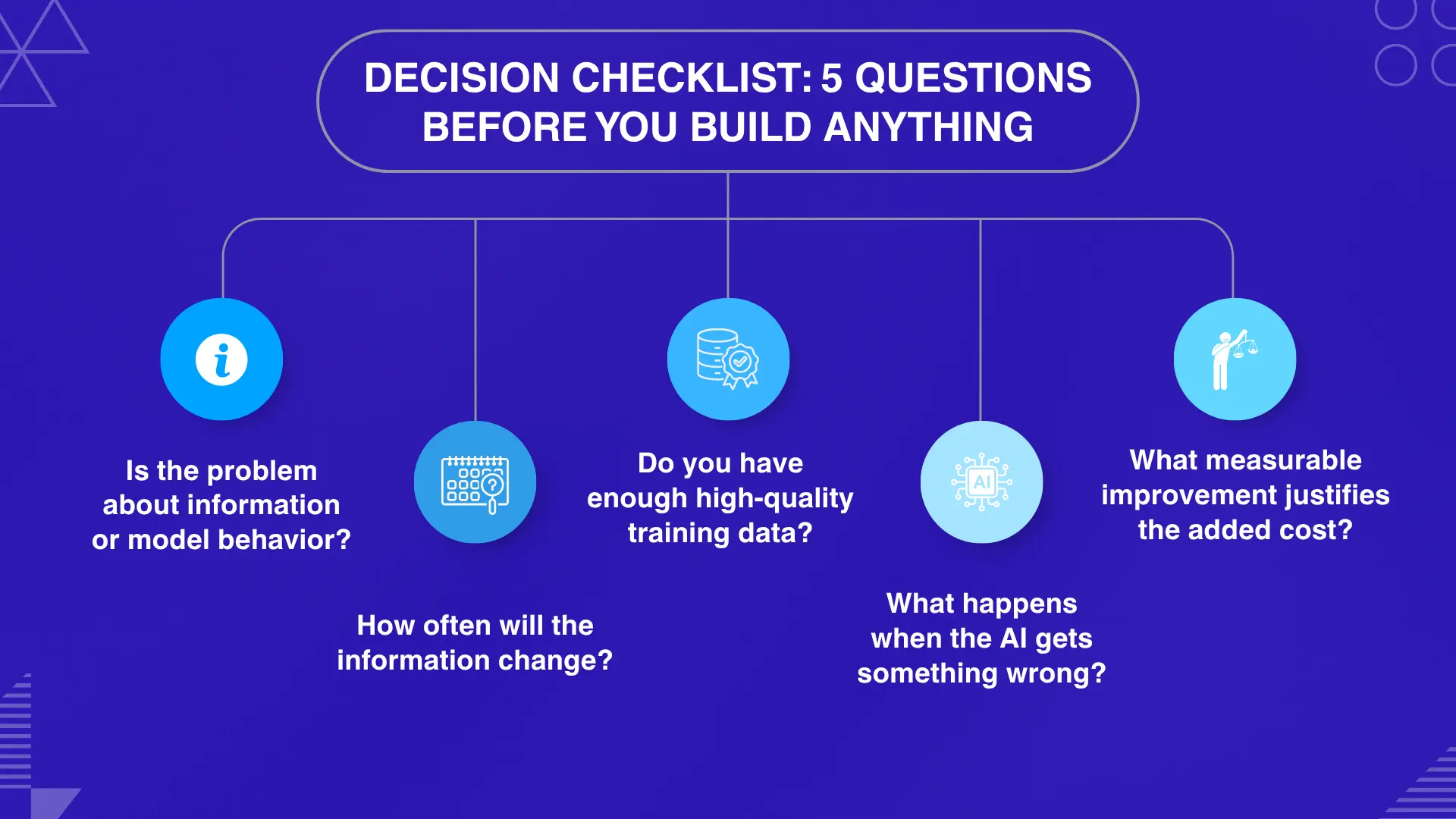
Is the problem about information or model behavior?
If your AI application needs unhindered access to current, proprietary, customer-specific, or frequently changing information, start by investigating RAG first. However, if the information is readily available but the model performs the same task inconsistently, evaluate fine-tuning. On the contrary, prompt engineering becomes feasible when the issue is mainly instruction-following or output format.
How often will the information change?
If policies, pricing, regulations, customer records, inventory, product documentation, or other business data change regularly, avoid making that information dependent on a model training cycle. In such cases, a retrieval layer keeps these updates separate from the model behavior and reduces the need to retrain the underlying LLM once the information changes.
Do you have enough high-quality training data?
Fine-tuning requires more than a collection of documents. You will need representative examples that can show the task, expected output, and edge cases clearly for further evaluation. If you do not have reliable labeled examples or cannot establish a measurable performance baseline, fine-tuning is difficult to justify at the outset.
What happens when the AI gets something wrong?
Define the failure costs before you select an architecture for the AI product. A wrong answer in a casual content tool has a different business impact from an incorrect compliance classification, financial decision, medical workflow, or customer-specific response. Your risk level will help determine how much you need source control, permissions, evaluation, human review, auditability, and monitoring.
What measurable improvement justifies the added cost?
Do not add RAG or fine-tuning simply because the architecture appears more sophisticated. Instead, establish the baseline first using metrics like:
- Accuracy
- Task completion
- Manual review time
- Support workload
- Latency
- Cost per request
Once you have it prepared, estimate whether the expected improvement justifies the additional development and operating costs or not. If prompting already meets the target, you should stop there. Only when it doesn’t yield anything of value for your business should you add the RAG or the fine-tuning layer, depending on what failure you want to address.
Ready to build the right AI architecture for your product?
From RAG pipelines to fine-tuned models to hybrid systems, our team helps startups build the smallest architecture that actually solves the problem — not the most impressive one.
FAQs
Is RAG more cost-effective than fine-tuning for a startup AI product?
RAG is cost-effective when your startup needs to access frequently changing, proprietary, or customer-specific information. Here, you can avoid repeated model training the moment business data changes. However, you should factor in the retrieval infrastructure and ongoing data-management costs with RAG. Fine-tuning becomes financially relevant when a high-volume, repetitive task needs greater consistency. Here, the resulting efficiency gains will help you justify dataset preparation, training, evaluation, and model management expenses.
Can RAG and fine-tuning be used together in the same AI application?
Yes, RAG and fine-tuning can be used together when your AI application needs both current external information and consistent task-specific behavior. Fine-tuning will handle repeatable behaviors, like classification, extraction, or structured output generation. On the other hand, RAG will supply changing business information at runtime. This hybrid architecture also lets you update knowledge independently from the model, thereby supporting separate testing, versioning, governance, and rollback processes.
Does RAG reduce AI hallucinations more effectively than fine-tuning?
RAG addresses hallucinations caused by missing or outdated business information by giving the model relevant source material at runtime. It doesn’t guarantee factual answers because retrieval quality and source accuracy will continue to matter. Fine-tuning primarily improves the learned task behavior rather than supplying current facts. Therefore, RAG is generally the relevant layer when unsupported answers result from insufficient access to business-specific information.
How does RAG handle customer-specific data in a multi-tenant AI application?
RAG handles customer-specific data by retrieving information according to tenant, user, role, permissions, and other access rules before sending relevant context to the model. Each customer’s documents and records remain in controlled data sources rather than becoming shared model knowledge. Strong tenant isolation, authorization, encryption, data classification, audit logging, and retrieval filtering are essential for preventing cross-customer data exposure.

Founder
Anjali Upadhyay is the Founder of GMTA Software Solutions, a mobile and web application development company she built from the ground up in 2019. Under her leadership, GMTA has delivered 200+ production applications across healthcare, fintech, and on-demand services for clients in the US, UK, Singapore, and UAE. She also leads GMTA’s AI practice, which has shipped production AI systems — including HIPAA-compliant healthcare workflows, LLM-integrated logistics platforms, and fintech automation tools — for US-based enterprise clients. Her writing covers AI product strategy, build-vs-buy decisions for AI systems, and the operational realities of moving AI from proof-of-concept to production at scale.