
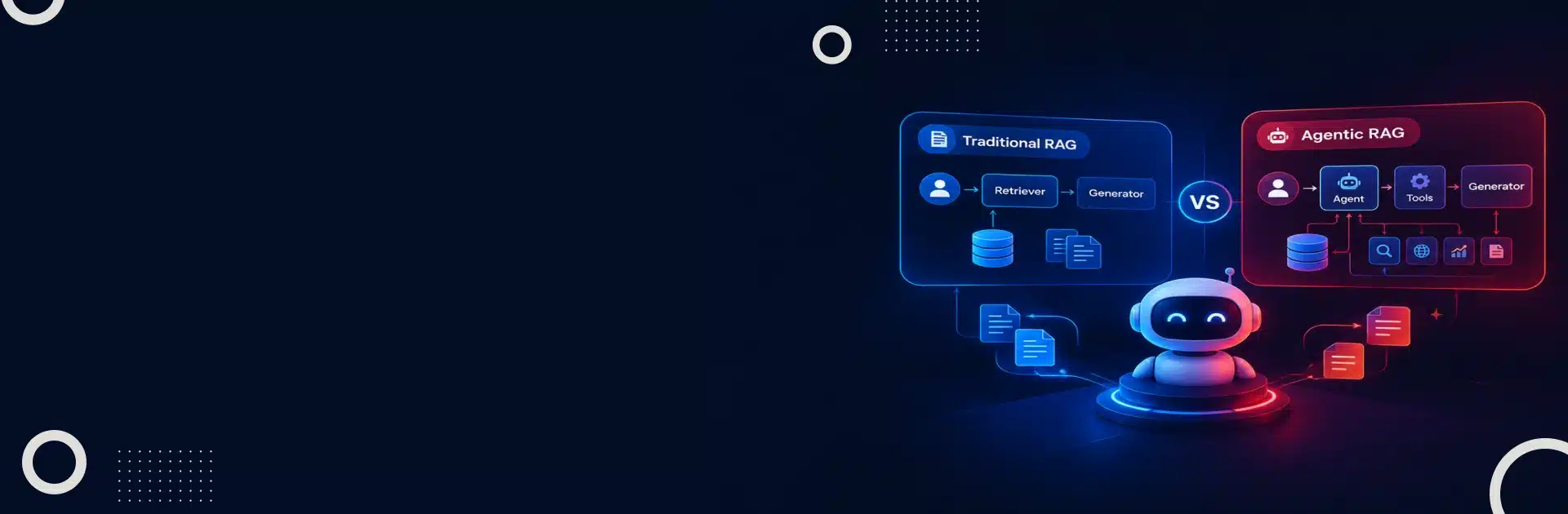
Key Takeaways
- Traditional RAG retrieves documents once, then writes an answer. It is fast, cheap and predictable.
- Agentic RAG puts an AI agent in charge of retrieval. The agent plans, picks sources, checks what came back, and searches again if needed.
- Agentic RAG wins on multi-step, multi-source,e or vague questions. It loses on speed, cost, and predictability.
- Start with the simplest design that meets your accuracy target. Many teams route easy questions to traditional RAG and hard ones to an agent..
- The main risks of agentic RAG are runaway cost, slow answers, weak testing, and loose access control. Step limits, test sets,s and audit logs manage each one.
- Gartner predicts that over 40% of agentic AI projects will be cancelled by the end of 2027, mostly because of cost, unclear value, and weak risk controls.
Traditional RAG vs. Agentic RAG comes down to who controls retrieval. Traditional RAG finds the best-matching documents once and hands them to a language model to write the answer. Agentic RAG adds an AI agent that plans the search, picks which source or tool to use, checks the results, and searches again if the evidence is weak. If your questions are simple lookups, traditional RAG is usually enough. If they span several documents, systems or steps, agentic RAG is worth testing.
That short answer hides a real decision. Agentic designs cost more per question and respond more slowly. Anthropic’s engineering team advises finding the simplest solution possible and adding complexity only when it clearly improves results, and notes that for many applications a single model call with retrieval is enough. Gartner, meanwhile, predicts that over 40% of agentic AI projects will be cancelled by the end of 2027 because of rising costs, unclear business value or weak risk controls.
This guide is for CTOs, founders and product leads who need to choose between the two. It explains how each approach works, compares them side by side, shows how to choose, walks through the architecture and the pipeline, covers a real production example, lists the challenges, and looks at where RAG goes next.
What Is RAG (Retrieval-Augmented Generation)?
Retrieval-augmented generation (RAG) is a method where a language model looks up relevant information from an outside knowledge source before it writes an answer. The model no longer relies only on what it learned in training, so answers can use current, private or company-specific data.
The term comes from a 2020 research paper by Patrick Lewis and colleagues. It combined a pre-trained language model with a searchable index of documents, and the authors found the answers were more specific, diverse, and factual than a model without retrieval. Today the same idea powers most enterprise assistants that answer from company documents.
How Traditional RAG Works
Traditional RAG follows a fixed path, often described as retrieve, augment, generate:
- The user’s question is turned into a numeric embedding and matched against a vector database to find the closest passages.
- The best passages are added to the prompt.
- The language model writes an answer based on those passages.
You will also see this called basic, standard, vanilla, or naive RAG. They all mean the same single-pass pipeline.
Why Teams Use Traditional RAG
- Answers can cite sources, which helps with trust and audits.
- Updating knowledge means updating documents, not retraining a model. We compare the two routes in RAG vs fine-tuning for startups.
- Cost is low and steady. Each question needs one retrieval step and one model call.
Where Traditional RAG Struggles
Weaviate names two limits. A typical pipeline searches one knowledge source and retrieves once, with no check on whether the retrieved text is good. It breaks down on questions that need several lookups or comparisons across documents. That gap is what agentic RAG tries to close.
If you want to build the traditional version first, see our guide on how to build a RAG chatbot for your business.
What Is Agentic RAG?
Agentic RAG is retrieval-augmented generation where an AI agent controls the retrieval process. IBM describes it as adding AI agents to the RAG pipeline to improve adaptability and accuracy, so the model can pull from several sources and handle more complex workflows. In plain terms, the system can think about how to find the answer, not just fetch the nearest text.
What an Agentic RAG System Can Do
In an agentic RAG system, the agent can, according to Weaviate:
- decide whether it needs to retrieve anything at all
- choose which tool or source to use, such as a vector search, a database, a web search or an API
- rewrite or split the question into better queries
- check whether the retrieved text really answers the question, and retrieve again if it does not
Single-Agent and Multi-Agent Designs
The simplest agentic RAG system is a router: one agent, two or more knowledge sources, and a decision about where to look. A multi-agent design adds a lead agent that coordinates specialists, for example, one for internal documents, one for email or chat, and one for public web search.
Common Agentic RAG Patterns
Neo4j lists four single-agent patterns you will see most often, plus multi-agent designs:
| Pattern | What it does |
| ReAct RAG | The agent loops through thought, action, and observation until it can answer |
| Router RAG | The agent picks the right source or tool for each question |
| Corrective RAG | The agent checks retrieved results and falls back to another source, such as web search, when the evidence is weak |
| Adaptive RAG | The agent adjusts how much retrieval effort a question gets |
Benefits of Agentic RAG
- Multi-step questions. The agent splits a complex question into smaller lookups and combines the results.
- More than one source. IBM notes that traditional pipelines usually connect to a single dataset, while agentic systems pull from several knowledge bases and tools.
- Evidence checks. Traditional RAG does not validate its own results. An agent can grade the evidence and try again before it answers.
- Action, not only answers. Through tool calls, the system can check live data or open a ticket as part of the same flow.
Agentic RAG is not the same as a fully autonomous agent
Anthropic draws a useful line. Workflows run LLMs and tools through predefined code paths. Agents let the LLM direct its own process and tool use. Many systems sold as “agentic RAG” are really workflows with extra steps. That is often the safer choice. Gartner calls the relabeling of ordinary tools as agentic products “agent washing” and estimates that only about 130 of the thousands of vendors claiming agentic AI are real.
For the wider picture of what agents are and how they differ from chatbots, read our guide to AI agents vs AI chatbots.
What Are the Core Components of RAG Architecture?
A traditional RAG architecture has five parts: a knowledge source, an embedding model, a vector index, a retriever, and a language model. An agentic RAG architecture keeps all five and adds a control layer on top: a planner, tools, memory, an evidence checker, and a full activity log.
Components Compared
Weaviate describes a basic RAG pipeline as a retrieval part (an embedding model plus a vector database) and a generation part (the language model). It describes an AI agent as a language model with a role, memory, planning and tools. Agentic RAG joins the two.
| Component | In traditional RAG | What agentic RAG adds |
| Knowledge sources | Documents are cleaned, split into passages and indexed | Several sources: databases, APIs, web search, more than one index |
| Embedding model | Turns passages and questions into numbers that can be compared | Same job; each source may have its own index |
| Vector index and retriever | Returns the closest passages for one query; a reranker is optional | The retriever becomes a tool the agent can call many times, with different queries and filters |
| Language model | Writes the answer from the passages | Also plans, picks tools and judges the evidence |
| Planner or router | None | Splits a question into steps and chooses where to look |
| Tools | None | Search, calculators, business APIs, ticketing systems |
| Memory | Each question stands alone | Short-term memory across steps, long-term memory across sessions |
| Evidence checker | Tested offline, before release | Runs inside the loop and decides: answer, or retrieve again |
| Guardrails and access control | Filters on which documents can be retrieved | Applied at every tool call, plus step limits and human approval points |
| Logging | Basic request logs | A full trace of every thought, tool call and result |
The step limit is not optional. Anthropic recommends stopping conditions, such as a maximum number of iterations, to keep an agent under control. Without one, an agent can keep searching long after the extra results stop helping.
Frameworks and Managed Options
Most teams do not write the agent loop from scratch. Weaviate lists LangChain and LangGraph, LlamaIndex, CrewAI and DSPy among the frameworks used for agentic RAG, and IBM points to LangChain, LlamaIndex and LangGraph for low-cost experiments. Anthropic adds a caution: frameworks can hide the prompts and responses underneath, which makes debugging harder, so understand the code you adopt. We compare three of these tools in LangGraph vs CrewAI vs Claude Agent SDK.
Managed services are also appearing, though Microsoft’s own quickstart lists the query-planning feature as preview. Microsoft’s agentic retrieval in Azure AI Search uses a language model to break a complex query into subqueries, runs them against one or more knowledge sources, and returns the results with metadata. Billing has two parts: Azure AI Search and Azure OpenAI for query planning and answer writing.
How Is Agentic RAG Different from Traditional RAG? The Real Comparison
The core difference is who controls retrieval. In traditional RAG, a fixed pipeline decides: one search, then one answer. In agentic RAG, an agent decides at runtime how many searches to run, where to run them, and whether the results are good enough.
| Dimension | Traditional RAG | Agentic RAG |
| Retrieval flow | Fixed: retrieve, augment, generate, once | A loop: plan, retrieve, check, retry |
| Who decides the steps | The developer, in advance | An agent, at runtime |
| Data sources | Usually one index | Several: vector stores, databases, APIs, web |
| Query handling | The question is used as it is, or lightly rewritten | The question is rewritten or split into sub-questions |
| Quality check on results | None | The agent grades the evidence and retrieves again |
| Tool use | Not typical | Yes: search, calculators, business APIs |
| Memory | Each question stands alone | Can keep context across steps and turns |
| Speed | Fast: one model call | Slower: several model calls |
| Cost per question | Low and steady | Higher and variable |
| Predictability and debugging | Easy to trace | Harder; needs full trace logs |
| Best for | FAQs, policy lookup, document Q&A | Multi-step, multi-source or vague questions |
| Main risk | Misses on complex questions | Loops, cost overruns, compounding errors |
Speed and Cost Gaps
It depends on your setup, so treat published numbers as rough guides. One vendor guide gives a rough illustration: a 200 ms one-shot RAG call can become 2 to 5 seconds once an agent adds retrieval rounds and model calls. A 2026 arXiv study that compared an enhanced RAG pipeline with an agentic one found higher cost for the agentic setup, driven by extra reasoning steps and repeated tool calls. On one financial Q&A dataset in the January 2026 version, the agentic setup used about 2.7 times the input tokens and ran about 1.5 times slower. Measure both on your own questions before you decide.
Same Question, Two Paths
This is an illustrative example. An analyst asks: “Compare our refund terms for EU and US customers and flag what changed since last year.”
- Traditional RAG runs one search and returns the closest passages. It may find the US policy but miss the EU version or the older one, then write a confident but partial answer.
- Agentic RAG splits the question into three lookups (EU terms, US terms, last year’s version), runs each, checks that all three came back, and only then writes the comparison.
A Spectrum, Not a Switch
Between the two sits advanced RAG: query rewriting, hybrid search and reranking, but still no agent. Progress treats the move from traditional to agentic RAG as a spectrum you move along, not a switch you flip. A sensible ladder is traditional RAG first, advanced RAG next, and agentic RAG only for the questions the first two cannot handle.
RAG or Agentic RAG? How to Choose the Right One for Your Business
Choose traditional RAG when most questions can be answered from one well-organized source in a single lookup. Choose agentic RAG when answers need several steps, several sources, or live actions, and your users can wait a little longer. If you are unsure, start with traditional RAG, measure where it fails, and add an agent only there. That matches Anthropic’s advice to find the simplest solution possible and add complexity only when it clearly improves results.
Six Questions That Decide It
| Question | A “yes” points to |
| Can most questions be answered from one source in one lookup? | Traditional RAG |
| Do answers need facts combined from several documents or systems? | Agentic RAG |
| Does the system need to call tools or take actions, such as checking live data or opening a ticket? | Agentic RAG |
| Must answers come back in a second or two, as in live chat? | Traditional RAG, or a routed design |
| Is traffic high and the budget tight? | Traditional RAG for most traffic, agentic only for the hard slice |
| Do you already have a test set to measure accuracy? | You can test an agentic upgrade safely. If not, build the test set first |
For a wider view of when agents pay off, see our AI agent development guide.
Route Instead of Replace
Many teams run both. A router sends simple questions to traditional RAG and hard ones to an agent. Anthropic describes routing as a standard workflow pattern: classify the input, then send it down the path built for it, for example, easy questions to a smaller, cheaper model. Roll an agentic path out on a small slice of real traffic first, and compare accuracy, speed, and cost against your current setup.
Choice by Industry
These are illustrative examples, not client projects.
| Industry | Traditional RAG fits | Agentic RAG fits |
| Healthcare | Looking up a hospital policy or a formulary page | Checking whether a procedure needs prior authorization by combining a payer policy, the patient’s plan and clinical notes |
| Fintech | Answering “What documents does our KYC policy require?” | Reviewing a case by pulling transaction history, screening results and policy rules, then drafting a summary for a human reviewer |
| Logistics and on-demand | Finding the SLA clause in a carrier agreement | Working out why a shipment was held by checking tracking data, SLA terms and the escalation policy |
Agentic RAG for Enterprise: Three Extra Requirements
- Access control at every step. The agent should only retrieve what the asking user is allowed to see, from every source it touches.
- An audit trail.Log each step, tool call, and reason, so a reviewer can replay how an answer was made.
- Human approval where it matters. For decisions with real consequences, the agent prepares the work and a person decides. The production example below follows this pattern.
Budget for Build and Cost per Question
Agentic designs raise the cost per question, because one question can trigger several model calls. Ask for both numbers, the build cost and the cost per question, before you commit.
How Do Agentic RAG Pipelines Work, Step by Step?
An agentic RAG pipeline runs as a loop, not a straight line. The agent reads the question, plans the search, retrieves, checks the evidence, and then either answers or tries again, until it reaches a step limit.
The Nine Steps
- Read the question and check access: The system works out what is being asked, who is asking, and which data that person may see.
- The agent decides whether retrieval is needed at all. If the question is complex, it splits it into smaller sub-questions. Welists this decision as the first choice an agent makes.
- For each sub-question, the agent picks a source or tool: a vector search, a database query, an API call, or a web search.
- The queries run. Independent sub-questions can run at the same time, which is how Microsoft’s agentic retrieval handles subqueries.
- Grade the evidence: The agent asks whether the results are relevant, complete and consistent. This is the check that traditional RAG does not have.
- Retry or fill the gap: If the evidence is weak, the agent rewrites the query, tries another source or adds a missing lookup. A hard step limit ends the loop.
- Write the answer: The language model answers only from the checked evidence and shows its sources.
- Verify and hand off: A final check looks for claims the evidence does not support. Low-confidence or high-impact cases go to a person; IBM notes that agentic RAG systems can escalate demanding requests to human staff.
- Log everything: The full trace is saved so a reviewer can replay how the answer was built.
The Loop Behind Steps 2 to 6
Many agentic RAG systems use the ReAct pattern that Weaviate describes. The agent writes a thought about what to do next, takes an action such as a tool call, reads the observation that comes back, and repeats until it can answer. Each pass adds a model call and at least one retrieval, so cost and delay grow with every loop.
That is why production teams set budgets before launch. One practitioner guide recommends explicit limits on steps, queries, retrieval calls, reranking calls and context size, and measuring cost-adjusted accuracy rather than accuracy alone. If the loop stops on a hunch instead of a clear rule, quality and cost both become unpredictable.
What Is a Real-World Example of Agentic RAG?
Stripe’s financial compliance review system is a well-documented production example. AI agents gather evidence through tool calls and retrieval, human reviewers make every final decision, and Stripe reported a 26 percent drop in median review handling time with over 96 percent helpfulness ratings from reviewers.
One note on labels: in the AWS write-up co-authored with Stripe (June 26, 2026), Stripe calls this an AI agent system and says it uses RAG for dynamic knowledge injection through tool calls. It does not use the phrase “agentic RAG”, but the pattern matches: an agent decides what to look up, reads what comes back, and decides what to do next.
The Problem
Stripe processes about $1.4 trillion in payments a year across 50 countries. Its compliance analysts were spending up to 80 percent of their time moving through fragmented systems to collect documents, instead of assessing risk.
What Stripe Built
- Small tasks, not one big agent. A single agent handling a whole review would lose focus. Stripe split each review into bite-sized sub-questions arranged in a dependency graph, and tested the quality of each one before use.
- A ReAct agent for each question. The agent calls tools to pull only the signals that matter for that question, then proposes follow-ups until it is confident enough to answer.
- Humans decide. Agent answers appear as research for the reviewer, who answers each sub-task. The agent never makes the final call.
- A dedicated agent service. Agents mostly wait on model and tool calls, so they behave differently from traditional machine learning services. Stripe built separate infrastructure, which grew from a few agents to well over 100 in under a year.
- A full audit trail. Every agent action, decision, and rationale is logged and can be retrieved later.
Lessons for Your Project
| Stripe’s choice | Lesson for an enterprise team |
| Narrow, tested sub-tasks | Start with one well-defined question type, not a general assistant |
| Humans keep final authority | In regulated work, design the agent as an assistant to reviewers |
| Prompt caching | Input tokens are the main cost, so reusing prompt prefixes matters; the article credits caching with a 60 percent cost reduction |
| Full logging | Build the audit trail before launch, not after |
| Track cost per agent run | Forecast spend as volume grows |
The 26 percent figure is, in Stripe’s own words, early progress. Treat it as proof that the pattern works under strict oversight, not as a benchmark your first project will match.
What Are the Challenges in Building Agentic RAG Solutions?
The main challenges are cost, speed, runaway loops, compounding errors, hard-to-test quality, weak source data, security and governance. Each has a known fix, and most fixes are decided in the design stage, not after launch.
Technical and Operational Challenges
| Challenge | Why it happens | How to manage it |
| Higher cost per question | One question can trigger several model calls and retrievals | Set limits on steps, queries and context size; send simple questions to traditional RAG; reuse prompt prefixes with caching; track cost per run |
| Slower answers | Weaviate notes that using an LLM for sub-tasks adds latency | Run independent lookups in parallel; use agentic paths for tasks, not live chat; show progress to the user |
| Loops that never end | An agent can keep searching after the results stop improving | Hard step limit, a fallback answer, and a hand-off to a person |
| Compounding errors | Anthropic warns that agent autonomy brings higher cost and the chance of errors adding up | Grade evidence at each step, answer only from retrieved sources, test in a sandbox first |
| Hard to test | The path changes from one run to the next | Build a test set of real questions before the build; score retrieval and answers separately; save full traces |
| Weak source data | Retrieval is only as good as the documents behind it | Remove duplicates and outdated files; add metadata such as owner, date and region |
| Security and access | The agent touches several systems, and retrieved text can contain hidden instructions | Check permissions on every tool call; filter retrieved content; log every action |
| Governance and audit | Regulators and reviewers need to see how an answer was made | Immutable logs, approval steps, documented ownership. See enterprise AI governance and compliance |
Business Risk
Gartner predicts that over 40% of agentic AI projects will be cancelled by the end of 2027, citing escalating costs, unclear business value, and inadequate risk controls. Gartner recommends pursuing agentic AI only where it delivers clear value or return on investment.
In practice, that means three habits. Pick one use case with a number you can measure, such as minutes per review or tickets resolved without escalation. Compare the agentic version against your current system on the same questions. And stop the project early if it does not beat the baseline on cost-adjusted accuracy.
What Is the Future of RAG and Agentic RAG?
Agentic retrieval is moving into search platforms and enterprise software, while traditional RAG stays the right tool for simple lookups. Expect most serious systems to use both, with stronger testing, cost control, and audit trails than today’s prototypes. Each point below is labeled as fact, forecast or trend.
- Agentic retrieval is becoming a platform feature (fact): Microsoft offers agentic retrieval in Azure AI Search, where a model plans subqueries and searches one or more knowledge sources. Microsoft’s quickstart marks query planning and answer synthesis as preview features that are not recommended for production, so check the current status. If they mature, teams will configure this instead of building every loop by hand.
- Agents are spreading across enterprise software (forecast): Gartner predicts that 33% of enterprise software applications will include agentic AI by 2028, up from under 1% in 2024, and that at least 15% of day-to-day work decisions will be made autonomously by then.
- Routing becomes the default design (practice): Anthropic describes routing as a standard pattern, such as sending easy questions to smaller, cheaper models and hard ones to more capable models. Applied to RAG, that means traditional retrieval for easy questions and an agent for hard ones.
- Tool connections get simpler (trend): Standards such as the Model Context Protocol, which Anthropic describes as a way to connect third-party tools through a simple client, make it easier to give an agent more sources. That raises the stakes for access control, because more connections mean more places to leak data.
- Search itself runs on RAG (fact): Google states that AI Overviews and AI Mode use retrieval-augmented generation over its Search index, and its guide now covers AI agents that visit websites for users.
- Fine-tuning and retrieval work together (trend): Stripe says it uses RAG through tool calls today and is considering fine-tuning to lock in model behavior for compliance tasks. Our guide to RAG vs fine-tuning covers when to combine them.
How Does GMTA Software Build an Agentic RAG System?
Our agentic RAG development starts with the simplest design that meets your accuracy target. We add agent steps only where testing shows traditional RAG fails, and we build controls such as access rules, logs, and human approval into the first version, not the last.
Our Seven-Stage Process
- Scope one use case: We pick one question type with a result you can count, such as minutes saved per review, and record today’s numbers as the baseline.
- Audit the knowledge: We find the sources, remove duplicates and outdated files, and add metadata such as owner, date, and region. Messy data causes more RAG failures than the model does.
- Build the baseline first: A traditional or advanced RAG version goes live in a test setting, with a set of real questions to measure faithfulness, answer relevance, and retrieval quality.
- Add agent steps where the baseline fails: Typical additions are routing between sources, splitting multi-part questions, grading evidence, and calling business tools. Every loop gets a step limit and a fallback.
- Add guardrails: Role-based access, source citations, personal-data filtering, protection against prompt injection, and audit logs. For regulated work, we plan for HIPAA, SOC 2, or PCI DSS requirements from the start, and keep people in charge of high-impact decisions.
- Roll out gradually: We send a small share of real traffic to the agentic path and compare accuracy, speed, and cost against the baseline before widening it.
- We re-index as your documents change and review low-confidence answers. Every GMTA project includes 6 months of free post-launch maintenance and support.
The same stages apply across healthcare, fintech, and logistics, but the controls differ by industry. Read more about our AI agent development services and our LLM development work, or talk to our AI team about whether your use case needs an agent at all. We will tell you if traditional RAG is enough.
FAQs
What is the main difference between traditional RAG and agentic RAG?
Traditional RAG retrieves documents once and then writes an answer, following a fixed path. Agentic RAG adds an AI agent that controls retrieval. It plans the search, picks sources and tools, checks the results, and searches again if the evidence is weak. The key difference is who controls retrieval: a fixed pipeline or an agent.
RAG vs agentic RAG: which one is better?
Neither is better in every case. Traditional RAG is faster, cheaper, and easier to debug, so it suits simple lookups from one source. Agentic RAG handles multi-step, multi-source or vague questions better, but costs more and responds more slowly. Choose by the type of question your users ask, and test both on real examples.
When should I use agentic RAG instead of traditional RAG?
Use agentic RAG when answers need several steps, several sources or live actions, such as combining policy documents with account data, and users can wait a few extra seconds. Stay with traditional RAG when most questions are single lookups. Many teams start with traditional RAG and add an agent only for the questions it cannot answer.
Is agentic RAG more expensive and slower than traditional RAG?
Usually yes. One question can trigger several model calls and retrievals, which raises cost and response time. Anthropic notes that agentic systems often trade latency and cost for better task performance. Step limits, caching, and routing simple questions to traditional RAG keep both under control. Measure on your own questions.
Will agentic RAG replace traditional RAG?
Not soon. Traditional RAG remains the better fit for fast, simple, high-volume questions. The more common pattern is routing: a classifier sends easy questions down the traditional path and hard ones to an agent. Platforms are adding agentic retrieval as a feature, but the single-pass approach still has a clear place.

Founder
Anjali Upadhyay is the Founder of GMTA Software Solutions, a mobile and web application development company she built from the ground up in 2019. Under her leadership, GMTA has delivered 200+ production applications across healthcare, fintech, and on-demand services for clients in the US, UK, Singapore, and UAE. She also leads GMTA’s AI practice, which has shipped production AI systems — including HIPAA-compliant healthcare workflows, LLM-integrated logistics platforms, and fintech automation tools — for US-based enterprise clients. Her writing covers AI product strategy, build-vs-buy decisions for AI systems, and the operational realities of moving AI from proof-of-concept to production at scale.