


Key Takeaways
- A PayPal-like app costs approximately $150K–$500K+ to build in the US, with the final investment depending on payment infrastructure, product scope, compliance requirements, security, integrations, and platform complexity
- Compliance is a product cost, not simply a legal expense. KYC/AML, transaction monitoring, sanctions screening, reporting, and audit trails, therefore, need to be planned from day one for better cost control
- Building your own proprietary payment infrastructure offers greater control but substantially increases complexity. Using established financial APIs can lower upfront investment, but you will have to account for recurring fees and ongoing maintenance
- Trying to reproduce PayPal feature-for-feature is not the right MVP strategy. You should focus on identifying the specific problem you want to solve and the revenue model you plan to validate.
A PayPal-like app costs roughly $150K–$220K for a focused P2P MVP built on licensed partners, and $400K–$500K+ for a broader platform with its own ledger, merchant payments, and multiple payment rails. These figures can quickly jump once your product includes a wider range of payment, wallet, merchant, credit, fraud, or financial services. However, for you, as a fintech startup founder, the development quote is a small part of a much bigger picture. The main question is how much capital qaz’ii srok to move your product from a prototype to a stage where your business can rvgjeak real-time transactions.
The US fintech market is estimated at $66.82 billion in 2026 (Mordor Intelligence), and you won’t be simply building a wallet with a few impressive payment features. Rather, you will be deciding which parts of the financial stack you will build in-house and which you will access through sponsor banks, payment processors, KYC/KYB providers, fraud platforms, and other infrastructure partners. Your choices here won’t just affect the funding aspect, but also licensing and compliance requirements. After all, PayPal operates under money-transmitter licenses across several US jurisdictions. So, the real challenge is working out where your first investment needs to go without taking on unnecessary cost or complexity too early.
Underestimate the cost, and you will have major architecture changes, additional compliance work, or stronger fraud controls in hand once development is underway. On the other hand, overbuilding means more spend on features and infrastructure before even validating whether they can improve CAC, transaction volume, or revenue. That’s why we have prepared a detailed guide on the cost to build an app like PayPal in 2026. With this, not only can you figure out the accurate estimates, but also identify the major cost drivers and avoid capital lock-in.
How much does it cost to build an app like PayPal?
For the US market, a PayPal-like app costs $150K–$500K+, depending on the business you intend to operate. At $150K–$250K, you can build a focused payment product on top of a licensed processor or sponsor bank that holds the funds. Move your budget to the bracket of $250K-$500K, and you can build a more differentiated platform with stronger risk controls, merchant capabilities, deeper integrations, and greater control over the payment experience.
The broader your financial ecosystem is, the higher the capital investment will be. That’s because you won’t be just funding the underlying technology. Instead, you also need to budget for compliance, licensing, fraud management, payment processing, infrastructure, security, and operational capacity simultaneously.
Should you build an app like PayPal or use PayPal’s API?
The decision of whether you can build an app resembling PayPal or use PayPal’s API should be grounded in your monetization and control needs. If payments are primarily a way to complete transactions inside another product, PayPal’s API will give you a head start. By doing so, not only can you reduce the upfront development time but also can test your business idea before committing a significant capital to a proprietary payment infrastructure. Your investment can then stay focused on:
- Customer acquisition
- Product-market fit
- Features that can help differentiate your offering
However, if your revenue depends directly on the payment volume, the economics will change. With an API-led model, you will remain dependent on PayPal’s processing abilities, pricing, policies, supported payment methods, and technical availability. These costs will become substantial once transaction volume grows. You will also have less control over the payment experience and the underlying transaction layer. For your business expecting millions in annual payment volume, even small differences in processing economics can affect your gross margin.
When you build your own payment platform, you gain much greater control over:
- Transaction routing
- Pricing
- Wallet functionality
- Merchant relationships
- Risk rules
- Customer data
- Future financial products
What’s more, you will be investing in a technological and payment infrastructure that can be further turned into a strategic business asset, instead of being dependent on external partners. But there’s a catch! The upfront development cost of having your own system that resembles PayPal will be pretty high. You will also take on compliance obligations, chargebacks, and fraud losses.
That’s why the best approach will be to find a middle ground between building your own platform and using PayPal’s API. If your product involves regulated or complex components, you can use PayPal or other fintech infrastructure. But when it comes to customer experience, ledger, business rules, and differentiated workflows, plan to have them developed in-house.
What are the key factors affecting the development cost of an app like PayPal?
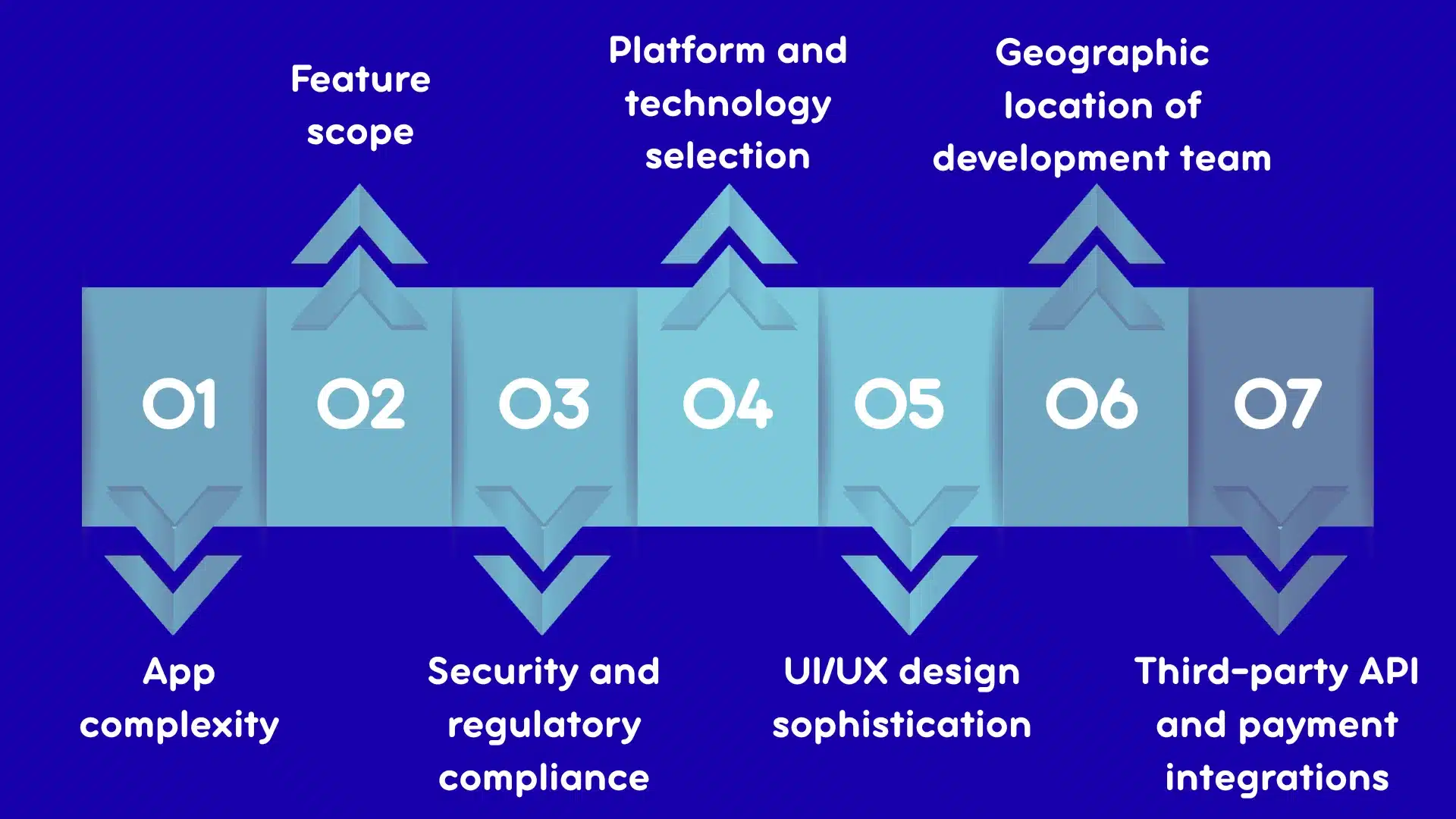
App complexity
When you work on estimating the overall development cost for an app like PayPal, start by measuring how much of the financial transaction your company is responsible for. This is what defines the complexity level, and not the number of screens your app has.
A $150K–$220K product is realistic only when a payment processor and banking partners handle most of the underlying transaction infrastructure. But the moment your app starts controlling the ledger, settlement logic, or movement of stored funds, your budget can rise to the bracket of $300K-$500K+. That’s because you won’t be just building a customer-facing payment app in the latter case.
This distinction matters when you set the MVP budget. Spending $400K on infrastructure that a third-party provider can handle reliably will automatically consume your runway. But a $150K build on untested assumptions can cost more in the end, because you may have to rebuild the transaction architecture. So, before development begins, decide which financial operations are likely to create competitive value for your US fintech startup and which can be outsourced.
| Complexity level | What changes | Indicative development cost | Founder implication |
| Focused P2P MVP | Processor handles most payment processing; limited wallet functionality | $150K–$220K | Lower entry cost and faster validation |
| Wallet-based product | Internal ledger, balance management, reversals and reconciliation | $200K–$300K | More backend investment and financial-control requirements |
| Merchant payments | Merchant balances, settlement workflows, refunds and disputes | $275K–$350K | Justified when merchant transaction fees drive revenue |
| Multi-rail payments | Cards combined with ACH or instant bank transfers | $325K–$425K | Higher engineering cost but broader payment coverage |
| Broader fintech platform | Multiple transaction models, financial accounts and advanced risk workflows | $400K–$500K+ | Requires substantially more capital and operational capacity |
Feature scope
This particular factor will help you determine the number of finance-specific workflows your engineering team has to implement and validate for the PayPal-like app. An MVP sitting between $150K-$220K can have a highly limited feature scope, including
- Card- or bank-funded P2P payments (funds move through the processor, with no stored balance)
- P2P payments
- Transaction history
- Basic KYC module
If you want users to hold a balance inside your app, you need an internal ledger, which moves the build into the $200K–$300K wallet-based tier.
The moment you add merchant payments and settlement, your budget will increase by another $50K-$90K roughly. Recurring payments add roughly $25K–$50K, and dispute handling and refunds add another $20K–$40K, so expect $45K–$90K for both together.
The important cost jump usually occurs when a feature is likely to change the underlying transaction model. Suppose you want to add a wallet balance feature to your system. It will then need an internal ledger, and not a display screen for the payment provider responses. Adding ACH alongside card payments means your application has to accommodate different failure states and settlement timelines. Another layer of currency and settlement logic will be added once you plan for international and cross-border transfers.
As these are architectural changes, a $200K MVP will quickly become a $300K+ build, especially when your initial development scope tries to reproduce PayPal’s breadth. The key here is to keep the scope limited to a small transaction model so that you can prove your revenue thesis easily. If merchant fees are your business model, your investment must cover merchant settlement workflows. Similarly, if the first revenue comes from consumer P2P transactions, building a full-fledged merchant ecosystem will unnecessarily lock in your capital.
| Scope decision | Cost impact | Why the cost changes | Business consideration |
| P2P payments only | Baseline | One primary transaction workflow | Suitable for proving consumer payment demand |
| Add merchant payments | +$50K–$90K | Settlement, merchant reporting and payment states | Worth funding when merchant fees are core revenue |
| Add recurring payments | +$25K–$50K | Recurring billing, failed payments and retries | Adds monetization but also ongoing transaction logic |
| Add disputes and refunds | +$20K–$40K | Case management and transaction reversals | Important when transaction volume creates support exposure |
| Add international payments | +$50K–$100K+ | Currency, settlement and country-specific requirements | Avoid early unless cross-border volume is part of the plan |
Security and regulatory compliance
Depending on whether your fintech startup is simply connecting customers to licensed financial infrastructure or taking responsibility for moving and holding funds, this factor can add roughly $65K–$160K to your build when you rely on licensed partners, and another $50K–$150K+ if you take on the US money-transmission model. The primary reason for such a vast variation is due to the fact that the latter can bring your product into the US money transmission and Bank Secrecy Act compliance framework. Based on the underlying regulatory acts, you will have to decide what guardrails to implement around the payment workflow.
For example, let’s assume that your startup operates through a sponsor bank or a licensed payment provider. In that case, you can outsource identity verification and parts of transaction processing. However, your app will still need to enforce the results. An unverified customer may need restricted transaction capabilities. At the same time, you may have to hold transactions triggering risk controls for further human review. The moment your fintech startup becomes the money transmitter, the compliance architecture will broaden substantially.
Data security further creates development obligations. If your company falls within the regulatory landscape of the FTC’s Safeguards Rule, you will have to invest more in establishing appropriate controls rooted in:
- Access management
- Encryption
- Application security assessment
- Multifactor authentication
Hence, for you, the biggest cost question will be deciding the regulatory responsibilities your organization will assume once you start building an app like PayPal. A $200K product using established financial infrastructure will have a completely different compliance profile compared to a $200K app intending to hold balances and transmit funds.
| US compliance scope | Indicative added cost | What drives the cost | Founder implication |
| Basic fintech security | $20K–$40K | MFA, access controls, encryption, and security testing | Necessary even when regulated infrastructure is outsourced |
| KYC/KYB integration | $10K–$30K | Identity/business verification workflows and account restrictions | Provider fees continue after launch |
| AML/risk controls | $20K–$50K+ | Transaction monitoring, alert handling and audit trails | Cost rises with the company’s regulatory responsibility |
| PCI/security requirements | $15K–$40K+ | Card-data architecture, testing and compliance controls | Tokenization can reduce the card-data environment you own |
| US money-transmission model | $50K–$150K+ | Regulatory/legal work, licensing support and compliance infrastructure | State-level requirements can materially increase launch capital |
Platform and technology selection
Depending on the number of applications and technology layers you have to build, test, and maintain, your initial budget will vary between $40K and $140K+. When we talk about a PayPal-like product, cross-platform mobile implementation will keep the budget minimal, around $40K-$80K. On the other hand, separate native iOS and Android deployments can push your expenses into the bracket of $80K-$140K+. Here, the difference isn’t constrained to the app’s interface. Instead, your investment will cover areas like:
- Payment flows
- Authentication
- Device security
- Notifications
- Transaction states
If you are dealing with moderate transaction volumes, there’s no need to spend unnecessarily on a microservice-based app architecture. Investing in a well-designed modular backend will help you reduce both engineering effort and development cost, especially during the MVP stage. Once the transaction volume grows and the product scope expands, you can plan for a migration.
This means your choice of the platform and tech stack should be rooted in the first 12-24 months of expected product requirements. For example, if iOS and Android users are equally important for your business, you can justify the additional investment required to build and deploy two native codebases. However, if your objective is to validate the payment model with limited capital, a cross-platform development approach will be economically sustainable.
| Technology decision | Indicative cost | Cost difference | Founder consideration |
| Cross-platform mobile | $40K–$80K | Lower initial mobile cost | Useful when validating both iOS and Android demand |
| Separate native apps | $80K–$140K+ | Higher engineering and QA cost | Makes sense when platform-specific capability is commercially important |
| Modular backend | $60K–$120K+ | Lower operational complexity | Often appropriate for an early-stage fintech product |
| Distributed/microservices backend | $120K–$250K+ | Higher engineering and DevOps cost | Justify only where scale or service isolation requires it |
| Premature enterprise architecture | $200K+ incremental potential | More infrastructure before revenue | Can consume runway without improving the initial business case |
UI/UX design sophistication
The development budget for your PayPal-like app will depend on how you design the interface around transaction clarity, trust, error handling, and account states. A basic fintech UX will cost about $15K-$30K, while a more sophisticated, polished design can push costs beyond $60K. However, higher upfront capital in UI/UX design will be justified only when your product has multiple:
- Transaction types
- Merchant workflows
- Financial dashboards
- Complex payment states
Here, the business impact becomes clearer when your app introduces financial products that compete on experience. Suppose it charges merchants for payments. In this case, designing a poor onboarding flow will automatically delay activation and increase sales or support expenses. Similarly, if your product targets consumers, confusing wallet balances or payment status can quickly increase abandonment rate.
The key here is to ensure that you don’t copy every interaction in PayPal while building the sophisticated UI. In other words, your investment should go towards workflows affecting conversion, transaction completion, trust, and support volume.
| UX investment | Indicative design cost | What the investment covers | Business impact |
| Basic fintech UX | $15K–$30K | Core payment and account journeys | Keeps initial design spend controlled |
| Transaction-state design | $25K–$40K | Pending, failed, reversed, and refunded states | Reduces payment confusion and support issues |
| Advanced onboarding | $30K–$45K | KYC flow, verification exceptions and account activation | Can improve onboarding completion |
| Merchant UX | $35K–$50K | Merchant onboarding, payments and financial reporting | More relevant when merchants drive revenue |
| Full product UX system | $45K–$60K+ | Research, prototypes, usability testing and design system | Appropriate when UX itself is a competitive differentiator |
Geographic location of development team
This can change the cost of building a PayPal-like fintech app by 2-4x for comparable engineering capacity, depending on the team’s seniority, fintech experience, and engagement model. A US-based product team can charge you $100-$200+ per hour, while experienced teams based in India or other offshore locations can charge $30-$70 per hour. Assuming your project involves 5K engineering hours, US-based development will cost you $500K to $1M, while offshore outsourcing can keep the budget within $150K-$350K.
Now, here’s a catch! Comparing only the hourly rates won’t help you choose the best development team and control costs accurately. That’s because PayPal-like products require engineers proficient in:
- Transaction integrity
- Payment provider integrations
- Secure authentication
- Reconciliation
- Failure states
So, when you hire a cheaper team lacking fintech experience, you will end up consuming the apparent savings through additional architecture work, supervision, security remediation, or rebuilding integrations. In other words, a team charging $50 per hour that needs 9K hours ($450K) costs more than a stronger team charging $80 per hour that completes the same scope in 5K hours ($400K). These figures are illustrative.
The key here is to compare the total delivery cost, and not just focus on the developer’s quoted rate. When you evaluate different vendors, compare the proposed team against its fintech experience, senior engineering involvement, expected delivery hours, security practices, and post-launch support. A low quote will only create value if your product can reach production without consuming the savings through rework.
| Team model | Indicative rate | Example project economics | Founder implication |
| US-based fintech team | $100–$200+/hr | 5K hrs = $500K–$1M+ | Higher cost but easier US timezone/regulatory collaboration |
| Nearshore team | $50–$100/hr | 5K hrs = $250K–$500K | Middle ground for cost and collaboration |
| Experienced offshore team | $30–$70/hr | 5K hrs = $150K–$350K | Can materially extend startup runway |
| Offshore fintech specialist | $40–$80/hr | 5K hrs = $200K–$400K | Higher rate can be justified by domain expertise |
| Blended US + offshore team | Mixed | Often $200K–$400K+ | Keeps product/regulatory leadership close while controlling engineering cost |
Third-party API and payment integrations
Budget around an additional $20K-$100K+ for building a PayPal-like app, depending on the number of financial providers your product connects to and the extent of transaction logic sitting between them and your application. A focused MVP using one payment processor, KYC provider, and banking connection requires about $20K-$40K of integration work. However, if your product has to support multiple payment rails, providers, or financial services, the integration expenses will increase to $60K-$100K+.
The cost difference isn’t just due to the number of APIs your product has to deal with. Each provider has its own:
- Authentication method
- Rate limits
- Transaction states
- Webhook behavior
- Error handling
- Reconciliation requirements
- Versioning
Your app will have to translate these differences into one reliable financial workflow. This is why you need to tie the integration expenses to transaction volume, payment economics, and dependency risks. Integrate only those providers who are needed to launch the initial business model. It’s better if you avoid an architecture that makes changing providers significantly expensive.
| Integration scope | Indicative integration cost | Main cost driver | Founder consideration |
| Single payment processor | $10K–$20K | Payment flow and webhook handling | Lowest integration complexity |
| Processor + KYC provider | $20K–$40K | Payment plus identity workflows | Common starting point for a fintech MVP |
| Add banking/ACH infrastructure | $35K–$60K | Bank-account linking and transfer states | Adds reconciliation and settlement complexity |
| Multiple payment processors | $50K–$80K | Provider abstraction and routing logic | Can reduce vendor dependency as volume grows |
| Multi-provider fintech stack | $60K–$100K+ | Several integrations plus unified transaction handling | Higher upfront cost but greater infrastructure flexibility |
Hidden cost factors affecting the cost of PayPal app development
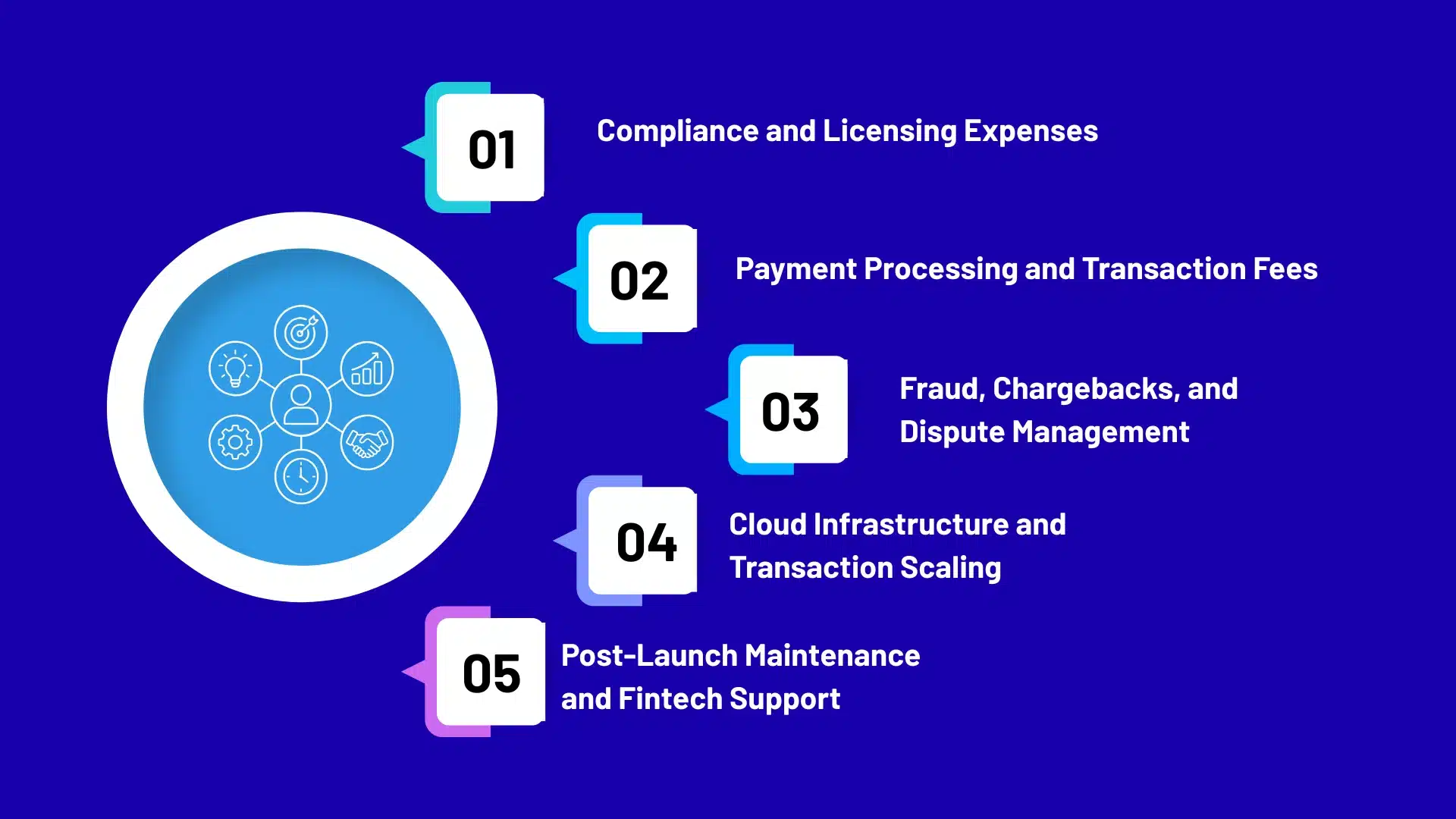
Compliance and Licensing Expenses
When you are building a PayPal-like fintech app, do budget separately for legal, licensing analysis, and advisory costs (roughly $25K–$150K+, depending on your operating model) on top of the compliance engineering costs above. The cost usually includes:
- Regulatory legal work
- Licensing analysis
- Compliance program development
- Ongoing advisory support
If you use a licensed banking or payment partner, it will be easier for you to minimize the regulatory burden. However, this won’t remove these additional compliance expenses. In case your product behaves like a nationwide money transmitter, the costs can increase further.
Payment Processing and Transaction Fees
This often turns into a recurring expense once customers start moving money through your platform. Card transactions usually cost around 1-3% of the transaction value, depending on the payment method, provider, and commercial terms. At the same time, ACH and other financial rails follow completely different pricing tiers. At $10 million in annual payment volume, a 0.25%-point difference in processing costs equals $25K a year. It means processing pricing will directly affect your gross margin once your business starts scaling.
Fraud, Chargebacks, and Dispute Management
Fraud usually creates hidden expenses through both technology and actual transaction losses. Your growing fintech startup may have to spend $20K-$75K+ annually on fraud tools, transaction monitoring, dispute workflows, and related operations before accounting for money lost to fraudulent transactions. Chargebacks will add another layer because your business can lose the original payment while absorbing dispute-related costs simultaneously. As volume increases, you won’t be able to rely completely on automated controls. Rather, you will have to invest more in additional risk guardrails and support staff.
Cloud Infrastructure and Transaction Scaling
Cloud infrastructure can start around $2K–$10K per month for your PayPal-like app during the early stages. It then increases significantly as transaction volume, data retention, monitoring, and availability requirements grow. Here, the expense is not limited to application servers only. Your fintech product will also need investments for reliable databases, backups, logging, security monitoring, and redundancy. Overengineering for millions of transactions before your business has that volume can waste runway. At the same time, under-provisioning can create reliability problems when transaction activity suddenly increases.
Post-Launch Maintenance and Fintech Support
A PayPal-like app needs roughly 15%–25% of its original development cost each year for maintenance and technical support. On a $200K–$500K build, this represents approximately $30K–$100K annually before you can plan to add major new features. Payment-provider API changes, operating-system updates, security remediation, transaction failures, reconciliation problems, and production monitoring all require engineering attention. Fintech maintenance is therefore an ongoing operating requirement rather than a small budget reserved for fixing occasional application bugs.
| Hidden Cost Factor | Typical Cost Range | Cost Trigger | Budget Risk |
| Compliance and Licensing Expenses | $25K–$150K+ | Direct money transmission | State-by-state regulatory costs |
| Payment Processing and Transaction Fees | 1%–3%+ per transaction | Transaction volume | Margin erosion at scale |
| Fraud, Chargebacks, and Dispute Management | $20K–$75K+ annually | Fraud and dispute volume | Direct transaction losses |
| Cloud Infrastructure and Transaction Scaling | $2K–$10K+ monthly | Users and transaction volume | Rising infrastructure bills |
Core features of an app like PayPal
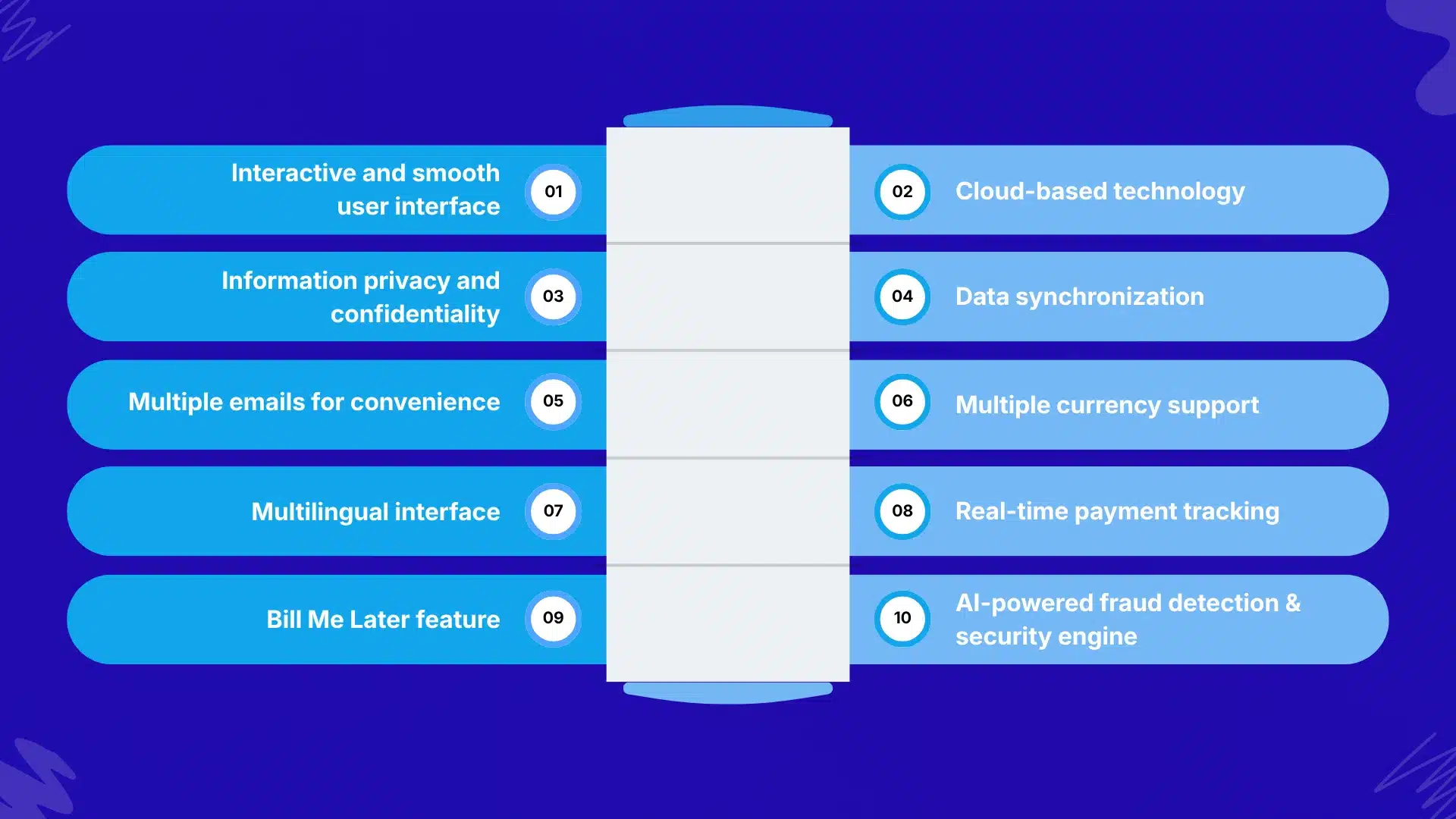
Interactive and smooth user interface
The interface of a PayPal clone app needs to accommodate both sides of the transaction without making your product feel like two separate, disconnected systems. A consumer should be able to send money using an email, phone number, or saved recipient. At the same time, a merchant will need a fast checkout process and easy access to payment history. In addition, you will also need to focus on building prominent screens for wallet balances, pending funds, refunds, and payment confirmation. This will allow your users to manage actual money, and not just browse account information.
Cloud-based technology
Invest in a cloud infrastructure for your PayPal-like fintech app to keep wallet, payment processing, merchant accounts, and transaction records available as one interconnected system. The key here is not to put the application on AWS or another cloud provider. Instead, you need an architecture that can handle a payment moving through several stages while preserving one authoritative transaction record. For example, when a buyer pays a merchant, you need to record authorization, wallet movement, settlement, fees, and the resulting merchant balance without creating conflicting information.
Information privacy and confidentiality
With a PayPal-like model, you can make the platform valuable partly by keeping the payer’s financial credentials away from the recipient. When a user pays a merchant, the person should receive confirmation that the payment was authorized rather than gaining access to the payer’s underlying card or bank account information. You, therefore, need to isolate payment credentials from the customer-facing account and only expose the transaction information each party needs.
Data synchronization
You need synchronization across the customer wallet, merchant account, transaction ledger, notifications, and external payment providers. That’s because a single payment can change several records at once. Suppose you send $500 and the recipient immediately attempts to withdraw it. Your system cannot show the recipient a $500 available balance while the underlying payment remains pending. Transaction events therefore need reliable propagation and reconciliation. Only then can users see balance updates that correspond to the funds they can actually spend or withdraw.
Multiple emails for convenience
For a PayPal-style product, multiple emails are more than an account-setting feature because email can serve as a payment identifier. You can let a customer attach several verified addresses to one wallet. This will allow another user to send money to any of those addresses without knowing the recipient’s bank details. You also need clear ownership rules when an email is added, removed, or transferred between accounts. By doing so, you can easily prevent payments from being routed to an unintended wallet simply because an address was reused.
Multiple currency support
If you want your product to behave like PayPal internationally, make sure to decide whether users can merely pay in foreign currencies or actually hold multiple currency balances. The second model is substantially more complex. You will need separate ledger balances, currency-specific transaction records, conversion logic, and rules for determining when an exchange occurs. For example, a US customer paying a EUR-denominated merchant may need to see both the dollar amount they will be charged and the euro amount the merchant receives.
Multilingual interface
Build multilingual support at the transaction level, not just translated navigation. If you target international PayPal-like usage, a customer may receive a payment request, checkout confirmation, refund notice, or dispute communication in one language while the merchant operates in another. Your content architecture therefore needs localized transaction messages and receipts without changing the underlying payment data. This becomes especially important when you expand beyond the US because financial instructions cannot become ambiguous through poor translation.
Real-time payment tracking
For a PayPal-like product, you should show users what has happened to their money after they press Send or Pay. A transaction may be authorized but waiting for settlement, completed and available to the recipient, refunded by the merchant, or reversed after a failed payment. You should expose these states directly in the transaction timeline. This will then give the payer and merchant the same view of the payment and prevent support teams from having to reconstruct the transaction manually.
Pay Later and credit at checkout
If you want to replicate PayPal’s credit-oriented capabilities, move beyond a wallet into embedded financing. A customer should be able to choose a credit option at checkout, receive an eligibility decision, see the repayment terms, and manage the resulting balance separately from ordinary wallet funds. You also need to keep the credit account connected to the original purchase so that refunds, partial payments, and repayments are reflected correctly. The key here is to treat this as a separate product scope, not a minor payment feature.
AI-powered fraud detection & security engine
You need fraud detection that understands the payment relationship, not just whether a single transaction looks unusual. A PayPal-like engine can evaluate whether a new device is suddenly sending money to unfamiliar recipients, whether an account’s payment behavior has changed, or whether several accounts are exhibiting connected suspicious activity. Your risk engine can then decide whether to approve the payment, request additional verification, delay settlement, or send it for review. This is particularly valuable because P2P payments can move funds quickly and become difficult to recover.
How to build an app like PayPal — step-by-step process
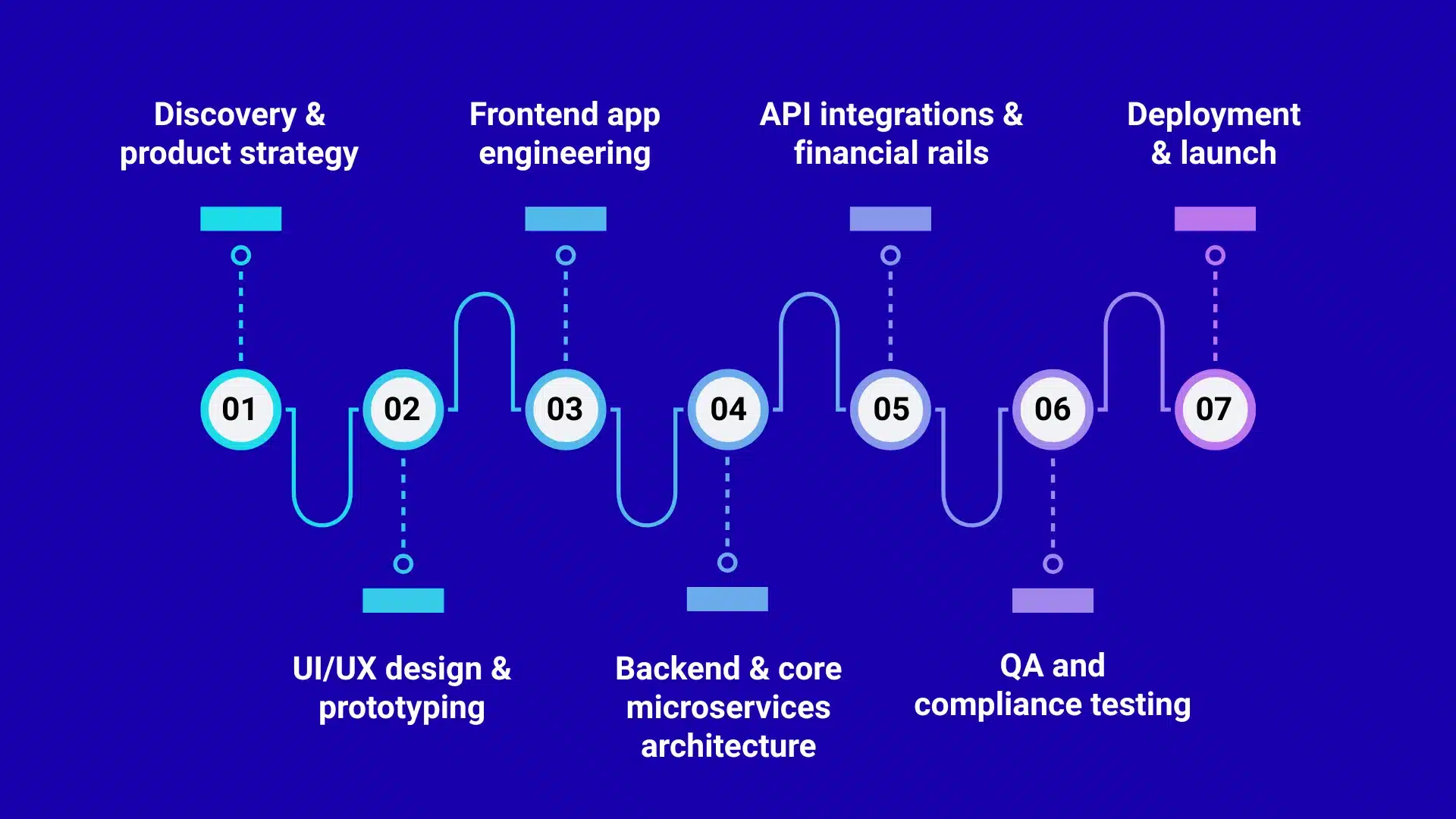
Step 1: Discovery & product strategy
Start by defining exactly what you want your PayPal-like financial product to own. Decide whether the first release will focus only on P2P transfers or will also include merchant payments, wallet balances, or a combination. At this stage, you also have to map:
- Who holds customer funds
- Which payment rails you will use
- Where revenue will come from
- Which compliance responsibilities will remain with you
These decisions will help you further in selecting the right architecture, integrations, development scope, and ultimately the initial investment.
Step 2: UI/UX design & prototyping
Always design the PayPal-like product around the specific financial journeys users perform rather than individual screens. Map the complete experience for sending money, receiving payments, checking wallet balances, linking funding sources, requesting payments, and handling failed or reversed transactions. Your prototypes should also show what happens when KYC validation fails, a payment gets stuck in pending status, or a refund is issued within the system. Validating these states early will prevent expensive frontend and backend changes after development is underway.
Step 3: Frontend app engineering
Build the customer-facing application around the transaction workflows established during prototyping. Your frontend needs to communicate with the backend services securely. At the same time, it should securely display key details like:
- Wallet balances
- Payment history
- Recipient information
- Transaction status
- Account verification
If you plan to launch on both iOS and Android, decide whether a cross-platform development approach will provide you with the consistency and cost efficiency you need for your product. Merchant-facing interfaces, however, will need a separate experience for payment acceptance and transaction management.
Step 4: Backend & ledger architecture (modular first)
Your product’s backend should be built around the financial events the platform has to control. A PayPal-like app needs services or modules for identity, wallets, transaction processing, ledger management, notifications, risk control, and merchant operations. Your ledger, therefore, should remain the authoritative record of money movements, including:
- Pending transactions
- Fees
- Reversals
- Refunds
- Settlements
You should also include microservices when transactions scale or service isolation justifies them. Do not straightaway jump into creating a distributed infrastructure simply because PayPal operates at an enormous scale.
Step 5: API integrations & financial rails
Connect your fintech application to the infrastructure that actually enables money movement. Depending on your model, this can include:
- Payment processors
- ACH or bank-transfer rails
- Card networks
- KYC/KYB providers
- Fraud platforms
- Banking partners.
Each integration needs more than a basic API connection because your system must interpret provider webhooks, reconcile transaction states, handle failures, and record fees correctly. Decide early which financial capabilities you will outsource and which transaction logic you want to control internally.
Step 6: QA and compliance testing
Test financial scenarios rather than limiting QA to conventional functional testing. You need to verify that balances remain accurate when payments fail, duplicate webhooks arrive, refunds are issued, transactions are reversed, or a customer becomes restricted after verification. Security testing should cover authentication, APIs, privilege boundaries, and sensitive data handling. Compliance testing should also verify that KYC restrictions, transaction monitoring, audit records, and applicable payment-security controls operate correctly before real customer funds enter the system.
Step 7: Deployment & launch
Deploy the platform gradually instead of exposing every payment capability to the market on day one. Start with controlled transaction limits, a defined customer segment, and close monitoring of payment failures, reconciliation exceptions, fraud alerts, and support issues. Before expanding transaction volume, confirm that your payment and banking partners are operating reliably and that operational processes can handle disputes and account restrictions. Once the core payment flow proves stable, you can progressively add merchants, currencies, credit products, or additional payment rails.
Technologies that you need to build an app like PayPal
For a PayPal-like app, your technology stack should support ledger accuracy, real-time money movement, third-party financial integrations, and high transaction reliability. For mobile apps, Swift and Kotlin offer native iOS and Android development, while Flutter or React Native can help you reduce the upfront engineering cost of maintaining two separate codebases. For the backend, you can rely on Java, Kotlin, Go, or Node.js to handle transaction and account-related services. PostgreSQL is more suitable for financial records where transactional consistency matters.
For the financial layer of your product, you need an internal double-entry ledger or equivalent accounting system rather than relying on processor records entirely. REST APIs and Webhooks will help you connect payment processors, ACH/ bank-transfer providers, KYC/KYB services, fraud platforms, and sponsor banking partners. Redis, on the other hand, can support low-latency data access, while Kafka or a similar type of event streaming technology can handle transaction events at a larger scale.
For infrastructure, AWS, Azure, or Google Cloud, combined with containers, encryption, monitoring, automated backups, and CI/CD, you will get the operational foundation for scaling reliably.
| Technology Layer | Recommended Technologies | Role in a PayPal-Like App | Why You Need It |
| Mobile & Web | Swift, Kotlin, Flutter, React Native, React.js | Customer wallet, P2P payments, merchant dashboard, checkout | Supports fast, responsive payment experiences across platforms |
| Backend | Java, Kotlin, Go, Node.js | Account, payment, wallet, merchant and transaction services | Handles financial workflows and high-concurrency transaction processing |
| Database & Ledger | PostgreSQL, Redis | Transaction records, balances, account data and caching | PostgreSQL supports consistent financial records; Redis reduces latency for frequently accessed data |
| APIs & Financial Integrations | REST APIs, Webhooks, API gateways | Connects payment processors, ACH rails, KYC/KYB, banks and fraud services | Enables money movement without building every financial service internally |
| Event & Messaging | Kafka, RabbitMQ | Transaction events, notifications, asynchronous processing | Keeps payment events reliable as transaction volume increases |
| Cloud & DevOps | AWS, Azure, GCP, Docker, Kubernetes, CI/CD | Hosting, scaling, deployment, monitoring and failover | Provides the infrastructure needed for reliable financial transactions at scale |
How does the PayPal app make money — the monetization model?
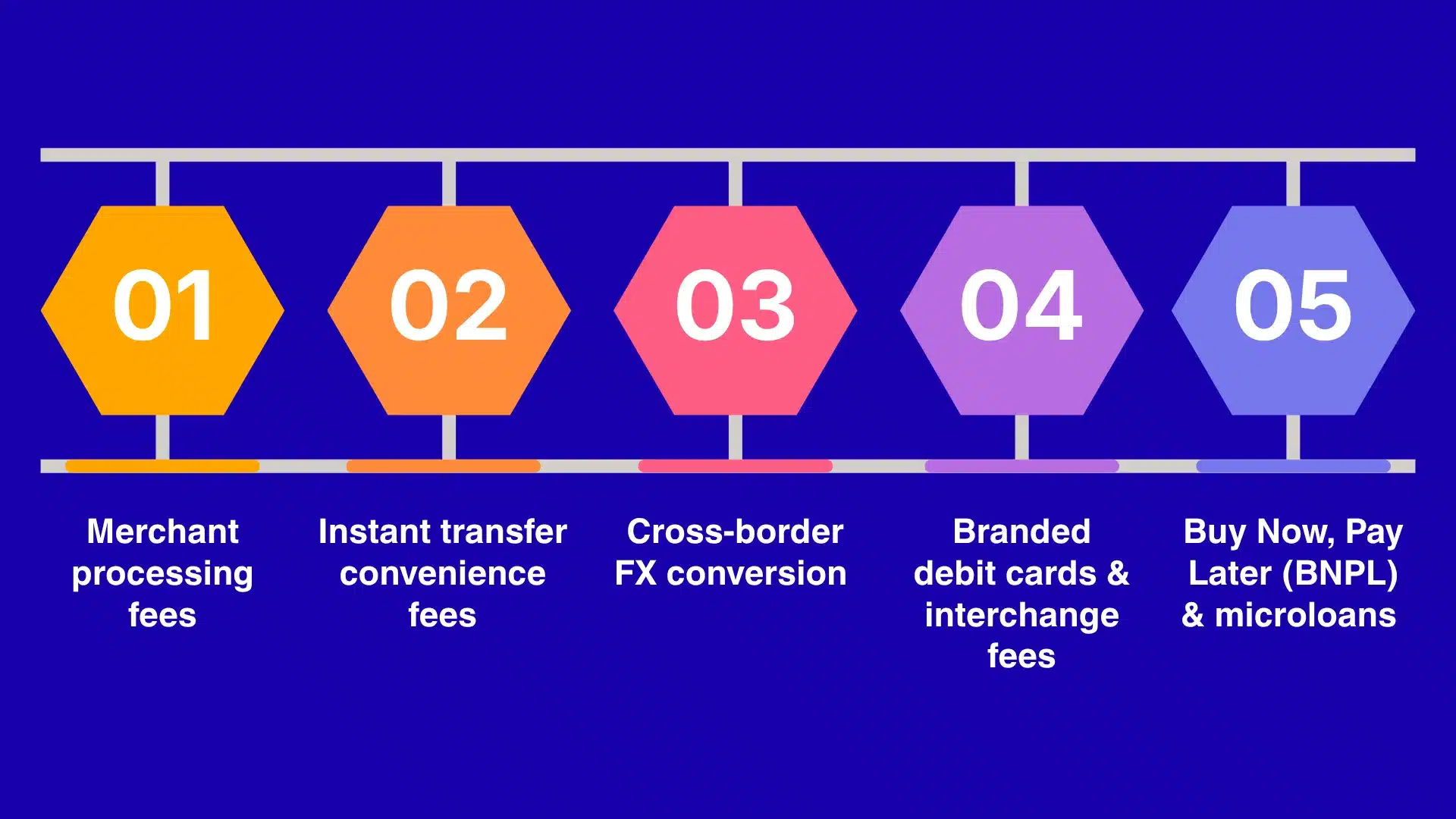
Merchant processing fees
This forms one of the strongest monetization layers because a PayPal-like app can earn repeatedly as transaction volume passes through the checkout network. Here, the merchant pays a processing fee when a consumer uses your app, with the economics varying by:
- Transaction type
- Merchant agreement
- Payment method
- Market
If you plan to build this monetization model, your priority shouldn’t be simply replicating PayPal’s proprietary checkout mechanism. Instead, you will have to focus on merchant acquisition, payment acceptance, settlement, refunds, disputes, reporting, and pricing that leaves sufficient margin after you consider processor and network expenses.
Instant transfer convenience fees
You can rely on this PayPal-specific monetization model to charge customers who want faster access to money instead of waiting for a standard withdrawal. This monetizes an existing wallet balance without requiring another purchase. For your product, the economics will depend on the difference between your underlying transfer cost and the convenience fee you charge. Therefore, you would need to distinguish eligible balances, supported debit cards or bank accounts, transfer limits, fraud checks, and failed transfer handling. Only by doing so can you turn high-frequency users into recurring fee revenue sources.
Cross-border FX conversion
International payments will give your PayPal-like app another revenue opportunity because currency conversion happens alongside the underlying payment. When a customer pays in one currency, and the merchant receives another, your platform can incorporate a foreign exchange margin into the conversion rate. For your app, profitability will depend on transaction volume and the spread you retain after wholesale FX costs. Supporting this model, however, will require currency ledgers, exchange rate feeds, conversion rules, settlement handling, and clear disclosure of the applicable exchange rate and fees.
Branded debit cards & interchange fees
A PayPal-branded debit card will help you monetize the wallet even when customers aren’t using the checkout mechanism. When they spend their wallet balance through the card, the transaction will generate interchange economics through the card-issuing and payment-network structure. For your fintech startup, the opportunity depends on active cardholders and spending frequency rather than simply the number of cards issued. You would need an issuing-bank relationship, card processing infrastructure, authorization controls, transaction monitoring, wallet integrations, and card lifecycle management.
Buy Now, Pay Later (BNPL) & microloans
PayPal’s credit products turn payment activity into a financing business. Pay Later allows eligible customers to split purchases, while merchants can receive payment through the checkout flow, creating monetization opportunities around financed transactions. If you add this to your product, merchant acquisition alone is insufficient. You will need credit underwriting, eligibility decisions, repayment servicing, delinquency management, and a funding model. Your economics then depend on merchant fees, financing costs, credit losses, and the regulatory structure of the lending arrangement.
How GMTA Software will help you build an app like PayPal?
GMTA Software brings a combination of fintech engineering and AI capabilities that can be applied specifically to the transaction-heavy architecture of a PayPal-like platform. On Cashfee, a digital wallet and payment platform, we built native iOS and Android apps and a web admin panel with JWT-based authentication, wallet and transfer flows, transaction monitoring, user management and dispute tools. Before writing code, we mapped every transaction state from initiation to confirmation to failure. We apply the same approach to the financial infrastructure behind a PayPal-like app, not just the mobile front end.
Our approach also gives you flexibility in deciding what should be built into the platform and what should come through established financial providers. We can integrate payment and banking infrastructure while building the application-specific logic around wallets, transaction states, reconciliation, merchant workflows, and risk controls. This helps avoid rebuilding regulated infrastructure where a third-party service already provides a stronger foundation.
AI is another area where we can extend the product beyond conventional payment functionality. Once the core payment flows are stable, we can add AI-assisted fraud monitoring or support tooling where it has a clear operational purpose. Our experience delivering AI-enabled systems alongside conventional software engineering allows these capabilities to be incorporated without treating AI as a standalone feature.
For a PayPal-like product, this combination lets us address the payment architecture, fintech integrations, security controls, administrative workflows, and AI-enabled operations within one development strategy, while keeping the initial product scope aligned with your business model.
FAQs
Can a startup build a PayPal-like app without becoming a bank?
Yes, a startup can build a PayPal-like app without becoming a bank by structuring the product around licensed financial partners. A sponsor bank or regulated payment provider can hold funds, provide accounts, and facilitate money movement while your company owns the application, customer relationship, transaction ledger, and product logic. The distinction matters because your regulatory exposure changes depending on whether you control customer funds or simply orchestrate services that licensed fintech entities offer.
How long does it take to build and launch an app like PayPal?
A focused PayPal-like MVP can take around 4-8 months to develop. However, the complete journey to a US production launch can take longer.
Engineering is only a part of this timeline. Banking partner onboarding, KYC/KYB integration, payment certification, ledger reconciliation, fraud-rule validation, compliance preparation, and operational readiness can introduce delays at different phases of the development lifecycle. Therefore, your product can be completed in technical terms but might not be commercially ready for market launch.
What licenses are required to launch a PayPal-like app in the US?
The licenses required will depend on how your PayPal-like app handles money, and not on the platform’s features alone. If your company receives and transmits customer funds, state money transmitter licensing will become mandatory, alongside applicable federal obligations. Other activities like lending or card issuance can introduce additional regulatory requirements. Working through licensed partners can, however, alter the obligations your startup assumes. But it won’t automatically eliminate regulatory compliance altogether.
How can a startup reduce the cost of building a PayPal-like app without compromising financial security?
The strongest cost-saving strategy is to reduce the amount of regulated infrastructure you build, not the security controls protecting it. You can use established providers for KYC, bank connectivity, payment processing, and card-data tokenization while retaining your own transaction ledger, authorization logic, reconciliation layer, and customer experience. Starting with one payment rail also limits integration and testing costs. Security controls should remain intact even when product scope is reduced.
When does building proprietary payment infrastructure make financial sense for a PayPal-like startup?
Proprietary payment infrastructure becomes economically attractive when transaction volume makes external processing costs, routing restrictions, or vendor dependency materially affect margins. For example, a small startup may rationally accept processor fees while validating demand, whereas a platform processing $100 million annually has far more to gain from even modest improvements in transaction economics. Ownership also becomes valuable when proprietary routing, settlement, ledgering, risk decisions, or new financial products create meaningful competitive differentiation.

Founder
Anjali Upadhyay is the Founder of GMTA Software Solutions, a mobile and web application development company she built from the ground up in 2019. Under her leadership, GMTA has delivered 200+ production applications across healthcare, fintech, and on-demand services for clients in the US, UK, Singapore, and UAE. She also leads GMTA’s AI practice, which has shipped production AI systems — including HIPAA-compliant healthcare workflows, LLM-integrated logistics platforms, and fintech automation tools — for US-based enterprise clients. Her writing covers AI product strategy, build-vs-buy decisions for AI systems, and the operational realities of moving AI from proof-of-concept to production at scale.