


Key Takeaways
- Your astrology methodology is a major cost decision. Using an established astrology API can keep an initial build around $50K–$80K, while proprietary calculation logic can push development toward $120K–$200K+.
- Do not build the consultation marketplace before proving paid astrology demand. Practitioner onboarding, availability, bookings, payouts, communication, and marketplace administration can add $50K–$100K+ beyond the core app.
- Your monetization model should influence the architecture from day one. Building all revenue models simultaneously increases development cost before you know which one produces sustainable customer revenue.
- AI needs to interpret astrology data, not simply generate horoscope text. The commercially stronger implementation connects AI responses with the user’s actual chart, planetary movements, or Vedic periods.
Quick answer: Astrology app development costs range from $40K to $400K+ in 2026. A basic horoscope or birth-chart app using a third-party astrology API typically runs 40K–80K. A consultation marketplace with astrologer onboarding, bookings, and payouts runs 150K–250K+. The biggest cost driver is how much astrology logic — chart calculations, Vedic rules, AI interpretation — you build yourself versus license from a provider.
The moment you start budgeting an astrology app for the US market, your focus immediately shifts to what developers would charge. However, the numbers that should actually concern you are how quickly your product scope can turn a mere $50K build into a $150K one, and that too without creating a proportionate increase in revenue potential. The interesting fact that most founders miss is that astrology apps sit right at the convergence of consumer subscriptions, personalized content, digital payments, and, in some models, two-sided marketplaces.
Each layer introduces varying development and operational expenses, causing the 2026 astrology app development cost to range between $40K and $400K+. The diversity is because you aren’t just paying a developer to build an app. Rather, you are deciding how much of the customer journey, personalization, payment infrastructure, and revenue model you want the technology to support from day one. Underbudget the figures wrongly, and you won’t have enough leverage to compete in the $1.365 billion US market. Overbudget, and you will be locking in your capital in features that aren’t validated against the user demand.
That’s why we have prepared a detailed guide on how much it actually costs to build an astrology app once you factor in all the necessary determinants. From what drives the budget upward to the scope decisions that can protect your initial investment, we will give you a complete walkthrough as per the 2026 market landscape.
How much does it cost to build an astrology app?
Whether you build an astrologer marketplace or a simple mobile app, the overall costs siGet my scoped estimatet between $40K and $400K+. However, you can only justify this range when you understand what the exact drivers are working behind the scenes. A $60K product and a $250K product can both be categorized as “astrology apps”. The difference is whether you are funding a narrow consumer experience or building a technology required to support:
- Personalization
- Recurring revenue
- High user volumes
- A marketplace
The level of astrological intelligence you want for your product, therefore, becomes the primary expense driver. Suppose you rely excessively on third-party calculation and content services. This will indeed help you reduce the initial upfront effort. But you will end up with API costs, vendor dependency, usage limits, and migration considerations once your user base starts growing. Meanwhile, when you plan to build more of the calculation and interpretation layer internally, your upfront development costs will increase. However, you will gain greater control over the product and its unit economics.
Your monetization model will then come into the picture, determining where the additional capital actually makes sense. A subscription-based product will need investment in the retention loop and billing architecture. On the contrary, a consultation marketplace needs infrastructure that can reliably manage astrologer availability, commissions, transactions, and customer interaction. The moment you consider an AI-led product, you will have to bear inference costs that often continue after launch.
Therefore, a useful budget is not the cheapest development quote. Instead, it’s the capital you need to reach your first meaningful revenue milestone without paying for infrastructure that’s not yet needed. It’s this distinction that will help you shape the scope, architecture, and development roadmap right from the start.
What types of astrology apps can you build?
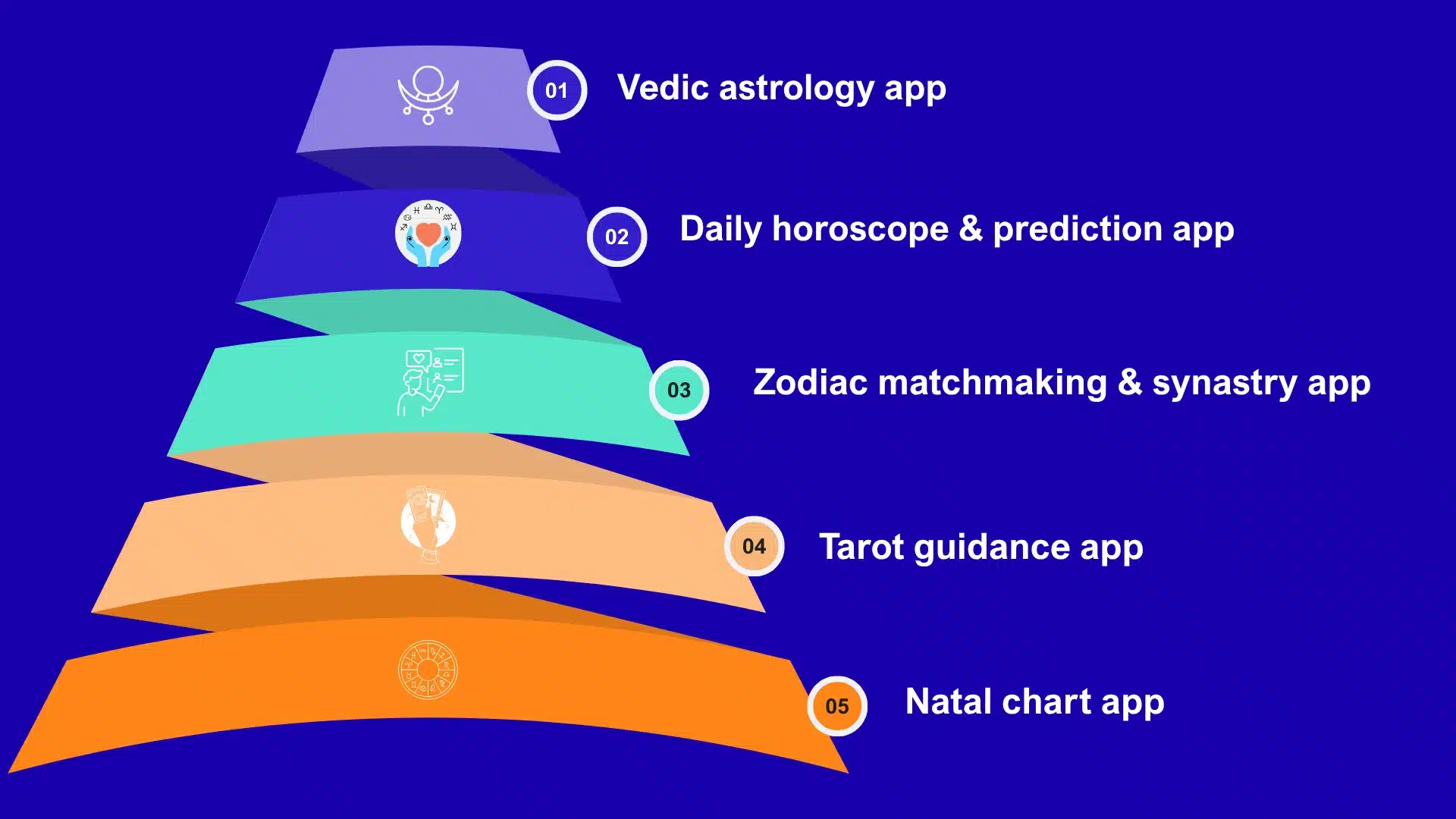
Vedic astrology app
It brings the traditional Jyotish experience into a digital product, allowing users to receive a Kundali chart. Once they have it, your app will then allow them to explore what it says about different areas of life, like marriage, finances, career, and many more. Here, the user experience is progressive by default. One can start by learning about planetary placements, and then purchase a detailed reading or eventually seek guidance from an astrologer through your app.
That’s why the economics depend a lot on where you draw the line between licensed astrological capability and the technology you own. Suppose your Kundali app uses an established calculation engine. Since you will be primarily building the UX around calculations performed by another party, you can keep the investment low, between $50K-$70K. Now imagine your product’s differentiator depends on:
- Proprietary dasha analysis
- Detailed Vedic predictions
- AI-generated interpretations
In this case, your upfront development cost will increase to $120K-$150K+ as you will be building a much larger intellectual and technical layer. Hence, for your business, the key consideration is to decide if the calculation and interpretation system is central to why customers choose you over other market players.
Daily horoscope & prediction app
It isn’t equivalent to a once-in-a-lifetime use case. Rather, it helps you convince users to return tomorrow, next week, and eventually every day. This retention strategy begins with zodiac-based forecasts and gradually evolves into personalized guidance around various life areas. That’s why personalization plays a critical role in determining whether your product can move beyond a digitized horoscope column.
Now, when we talk about the economics, the numbers vary based on how excellently you convert recurring engagement into premium readings, subscriptions, ads, or another repeat-revenue model. For example, a daily horoscope tracker uses the same content to serve a large number of users. So, you just need to invest about $40K-$55K for editorial content and scheduled delivery. Once you move towards a personalized prediction app, the dynamics are flipped. Here, the $75K-$100K+ investment will go towards:
- Determining what each user receives from your app
- Processing more data in real time
- Generating or selecting individualized predictions
- Potentially paying an AI provider for every interaction
Zodiac matchmaking & synastry app
Instead of acting as a generic horoscope, this type of astrological product focuses on answering one question with a much stronger purchase intent: “What does this relationship mean?” The user begins by entering details about both their birth and the other person’s birth with whom they want to check compatibility. A calculator engine then works by displaying a match percentage, often highlighting which areas are best-suited and which carry red flags. This is what makes your product suitable for paid reports and repeat purchases, as one platform allows a user to analyze a partner or friend.
The development economics start changing once you move beyond an entertainment-style compatibility checker to an advanced analyzer users are willing to pay for. Take the example of a Love Compatibility App that functions on predefined rules only. For this, you can budget around $50K-$70K. But when we talk about an advanced Synastry app that needs calculation and interpretation logic of its own, your investments will quickly climb to $100K-$130K+. So, the key here is to decide if you are selling astrological insight or trying to create a network of people who met through astrology.
Tarot guidance app
Instead of simply displaying textual information about different tarot cards, this app offers an interactive reading platform to the users. You can design your product in a way that it can interpret the combination of the user’s question, selected spread, and the card drawn accurately. By doing so, you can successfully create repeat engagement as users can return to your product with different situations and questions. As for monetization potential, the best options you can choose include:
- Premium spreads
- Individual readings
- Subscriptions
- Conversational guidance
A simple tarot reading app uses a structured card library and predetermined interpretation pathways, thereby allowing you to keep your investments within $35K-$50K. However, the figures will shift higher once your users expect the product to understand their questions and respond conversationally. For example, a tarot & mystical combo app often needs $75K-$100K+ because it combines astrology and AI-generated guidance.
Natal chart app
Here, you will make the user’s birth chart the foundation for an ongoing personal astrology product. The initial experience is pretty straightforward to build. A user will have to enter the birth information so that your app can generate a chart explaining planetary placements, houses, and aspects. The commercial opportunity comes from what you can do with the chart afterwards. Rather than treating it as a one-time report, you can use the same profile to provide:
- Transit updates
- Relationship analysis
- Personality insights
- Premium reports
- Other personalized experiences
Suppose you want to build a basic natal chart app, grounded in accurate calculations and paid reports. Since its architecture remains pretty simple, your investments will remain low, ranging between $45K and $65K. However, once you plan for an advanced chart & insights app capable of continuously processing planetary movements and supporting compatibility analysis, your budget will reach $100K-$120K+. Here, the additional spend isn’t just due to the extra features you have to add. Instead, it’s to create a foundation that can support multiple monetization paths for your business.
What features drive astrology app cost?
Core features of an astrology app
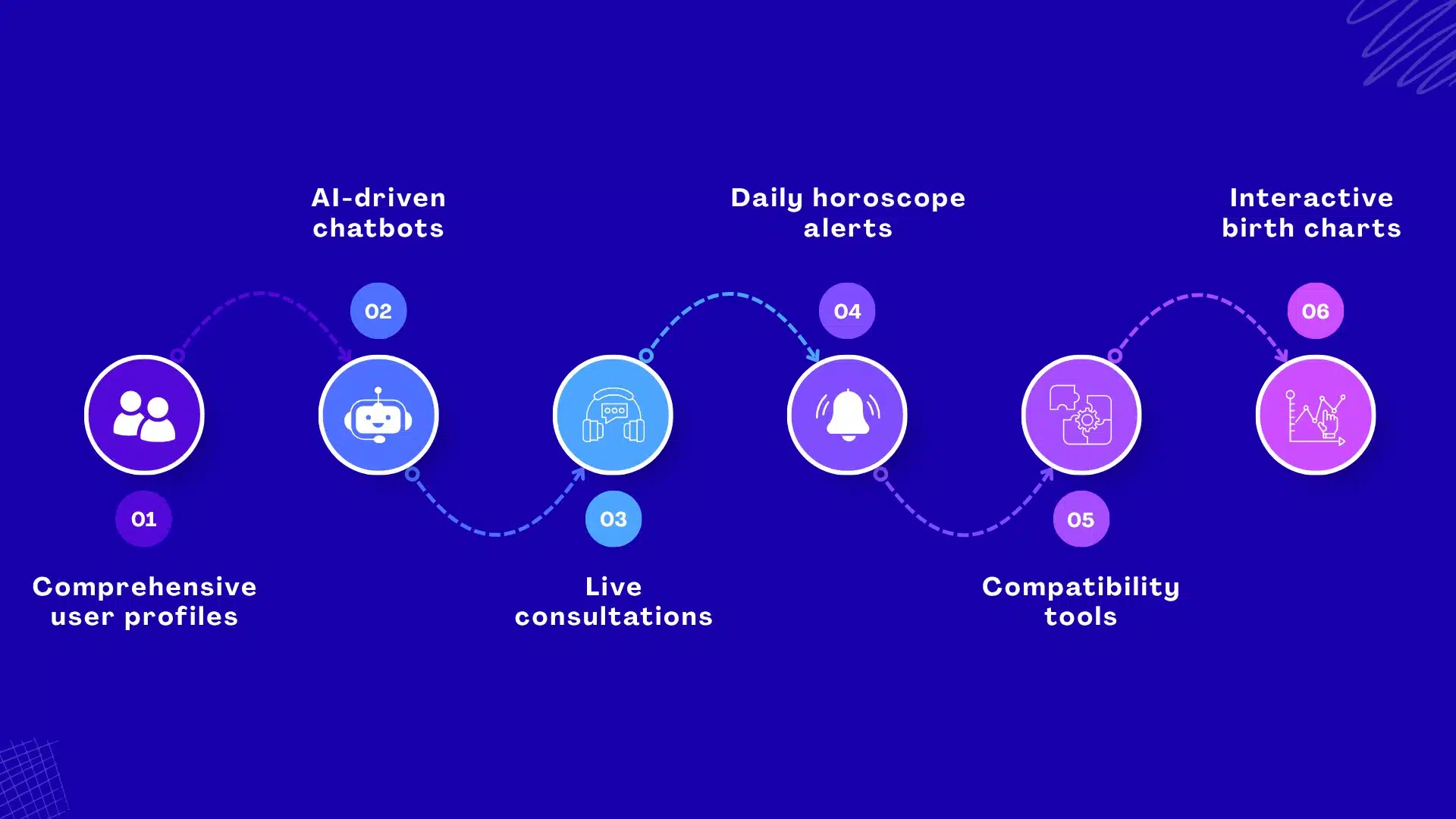
Comprehensive user profiles
This isn’t just another account page for your astrology app. Instead, it serves as a permanent record from which your product can accurately generate astrological experiences for the concerned user. Once someone saves the birth time, date, place, chart, and other relevant details, you get the chance to reuse the data for various purposes, including:
- Daily horoscope predictions
- Transit readings
- Compatibility reports
- Paid astrological consultations
Thus, every user profile gives your target audience a stronger reason to return, as your app focuses on personalization and does not behave like any other free horoscope website.
AI-driven chatbots
An AI-driven astrological bot becomes valuable for your product only when it can actually reason over the user’s context. Suppose a user has asked the bot, “Why has my career felt unstable this year?” It’s natural that their expectation would be an answer derived from their birth chart and relevant planetary period. If your app produces a generic AI response about career anxiety, it wouldn’t create enough value for your business. This is what makes a chatbot a potential subscription feature or a paid usage layer. However, there’s an underlying challenge you must address. It’s connecting the LLM to reliable chart data and astrology rules so that the personalized responses generated feel genuine and not superficial.
Live consultations
This particular feature can turn your astrology app from a digital-content business into a transaction-based marketplace. Imagine a user receives an automated prediction about marriage or career on your platform. However, the person still wants an astrologer to interpret:
- A difficult relationship
- Marriage timing
- Career decision in greater depth
If your app captures that transaction, you can earn through booking fees, commissions, or practitioner subscriptions. However, this feature becomes commercially valuable only when automated readings generate demand for human guidance. At least then, you can create a revenue path that a horoscope-only app does not have.
Daily horoscope alerts
Daily notifications matter for your product because astrology is naturally suited to habitual consumption. A notification such as a generic “Your horoscope for today is ready” gives users little reason to stay loyal to your app when similar content is already available somewhere else. On the other hand, an alert based on the user’s chart, current transit, or personal astrological period can create a much stronger retention loop. This distinction affects what you need to build. But remember, the latter version will need the backend to determine which prediction belongs to which user and when it should be delivered.
Compatibility tools
These give users a specific reason to spend money on your product, and not force them to simply consume free horoscope content. For example, when we talk about a basic zodiac match, attracting casual users won’t be difficult for you. At the same time, a detailed synastry experience will help users compare two complete birth charts and explain planetary relationships between them. This is what makes the output suitable for a paid relationship report. What’s more, it also creates repeat usage potential. The same customer can analyze a partner, prospective partner, or another important relationship without acquiring a completely new product.
Interactive birth charts
A birth chart can either be a visual that’s ignorable or the core data asset of your entire astrology product. If users can select a planet, house, or aspect and immediately understand its significance, the chart becomes an exploration interface, and not just a static report. What’s more important is that the same chart can power transits, synastry, personalized predictions, and premium reports. So, the real revenue potential lies in the fact that one accurate chart can support several monetization paths instead of generating revenue from a single download.
AI-driven astrology features
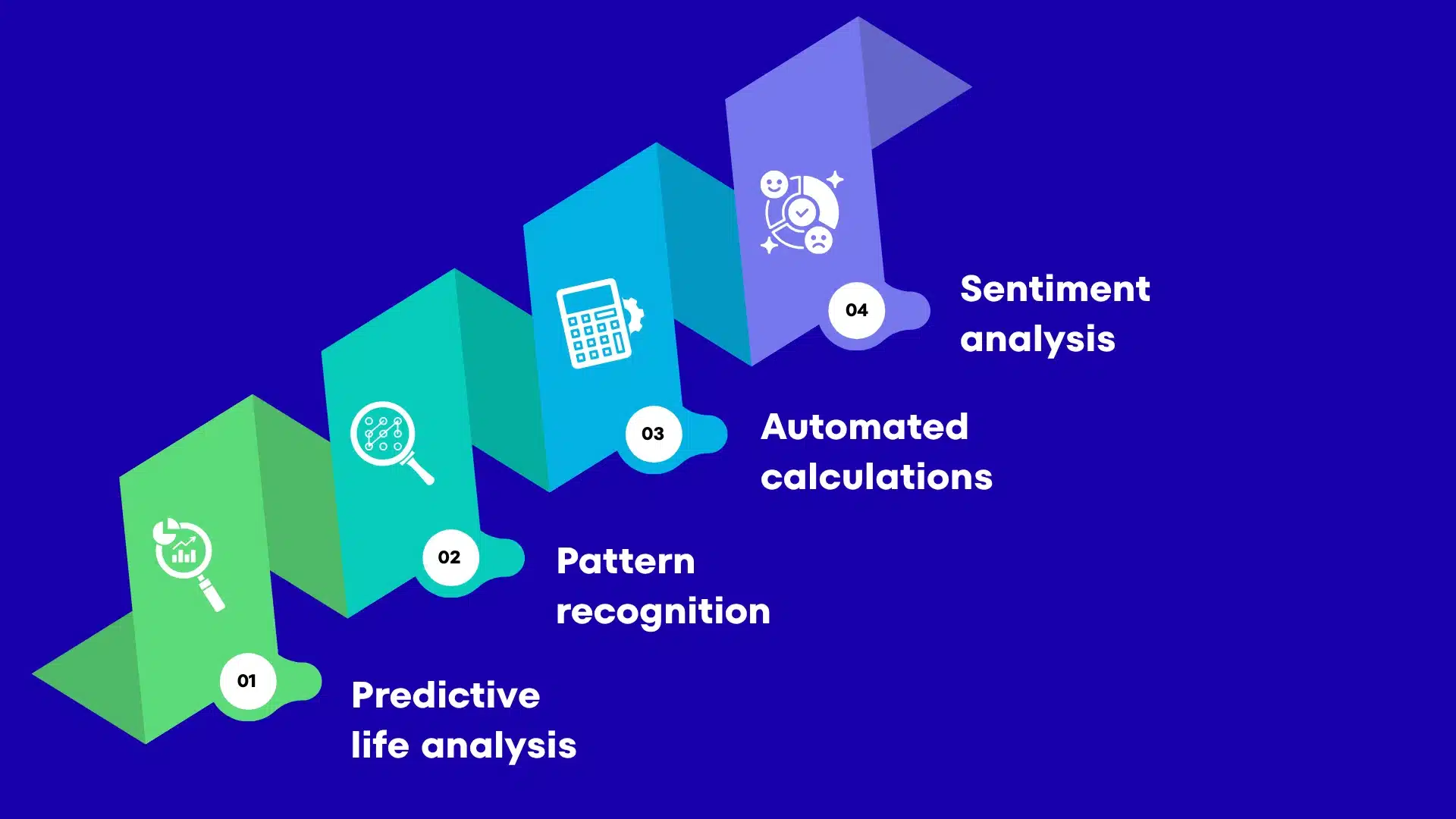
Predictive life analysis
Once your astrology app moves from describing a user’s natal chart to answering when and why specific zodiac or planetary influences may matter, this advanced AI feature will start generating commercial value. Take the example of a user purchasing a personalized report that covers upcoming relationship or career periods based on their chart and relevant planetary movements. This will position your product in the premium category that’s substantially different from a daily horoscope generator. However, building such a feature will need a significant upfront investment. That’s because your app will then need:
- Underlying astrological methodology
- Calculation engine, either third-party or proprietary
- Interpretation layer for the incoming data
Pattern recognition
This AI-driven feature will become commercially feasible for your astrological app only when it identifies relationships that otherwise demand manual interpretation. Consider your product detecting a particular combination of planetary placements, aspects, or transits. It can use the specific parameter combination to determine which interpretation should surface and become available for the user. Only by doing so can your app make personalized readings more consistent at scale. Furthermore, it also creates an opportunity for your business to build proprietary interpretation logic that differentiates your product from apps that just connect the LLM to a generic astrology prompt.
Automated calculations
Although rarely noticed, users do pay attention once your astrological app generates a wrong prediction or incorrect compatibility percentage. Whether it’s the planetary positions, birth charts, or Vedic predictions, most calculations, including those of dashas, depend on accurate astronomical and astrological computation. So, every premium feature you build on top of these results will automatically inherit the dependency. Hence, for you, the decision is larger than simply considering the API cost while budgeting. Here, you will have to license an external engine to accelerate launch. At the same time, you also need to ensure that your business owns most of the calculation layer so that you can have greater control over accuracy, customization, and future product enhancement.
Sentiment analysis
This AI-driven feature has a specific role when astrology guidance is delivered conversationally. A user asking, “Will my relationship survive this?” is not interacting with your product in the same way as someone asking for a general compatibility reading. Recognizing this fundamental difference will allow you to adjust your app’s tone, avoid overly definitive responses, and route users toward appropriate human support or paid consultation when necessary. The business value is stronger conversational retention, while the technical cost comes from processing context safely and consistently rather than merely detecting positive or negative sentiment.
How Can I Estimate My Astrology App Cost?
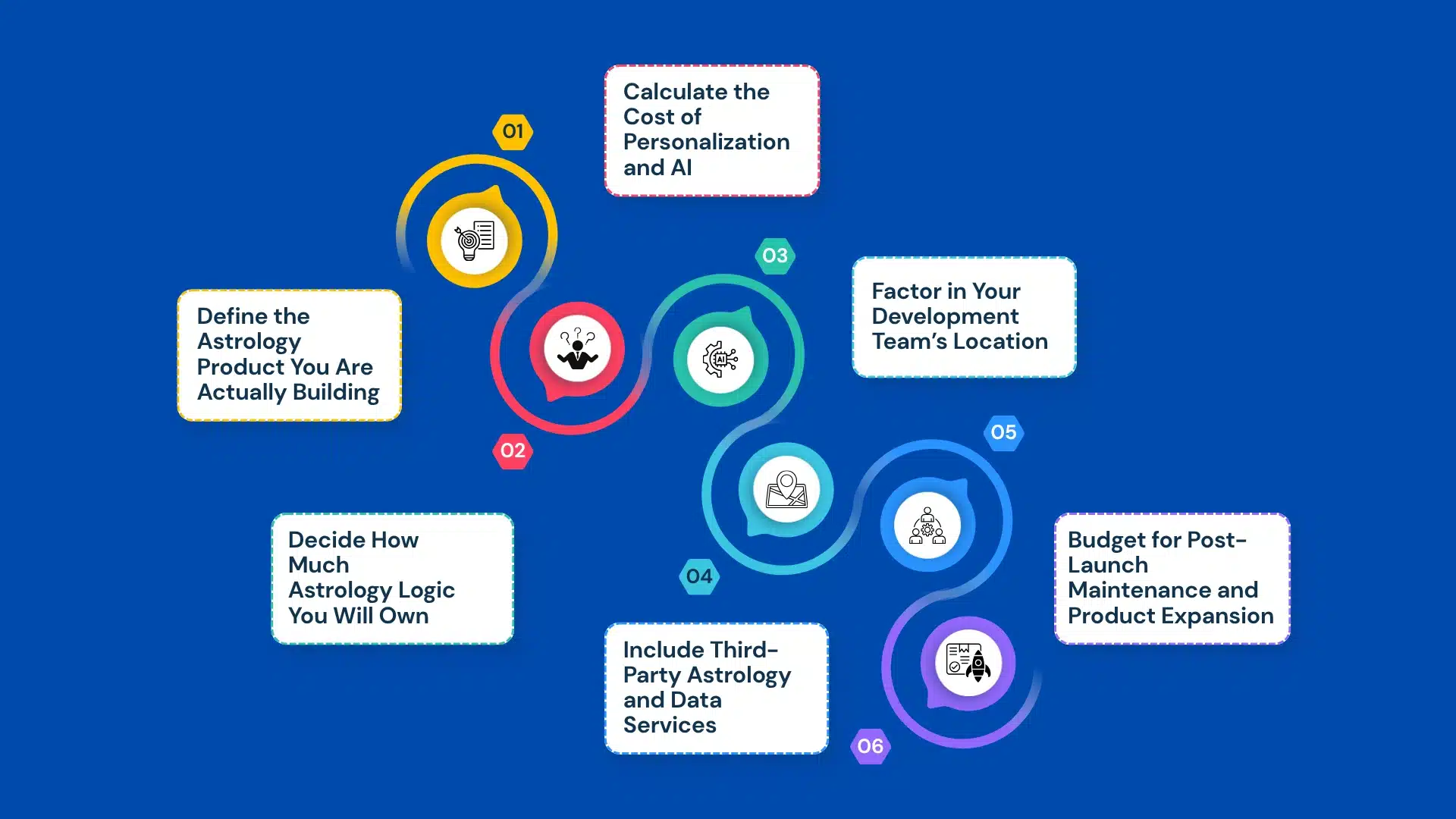
Define the Astrology Product You Are Actually Building
Begin by pricing the astrological experience that shapes the experience, and not the app itself. Suppose your app generates zodiac-based daily forecasts only. So, while building it, you will be paying for content delivery, user accounts, notifications, subscriptions, and the underlying astrology engine. On the other hand, an app that generates a complete natal report, interprets transits, sells compatibility reports, and lets users ask chart-specific questions will need several additional systems and infrastructure components.
It is this distinction that will move your initial build from roughly $40K-$60K for a horoscope-led product to $100K-$180K+ for a personalized astrology platform. So, before you accept a quote, make sure to define exactly what a customer will receive after entering their birth details and paying the charge.
| Astrology product type | Cost range | Timeline | What changes the estimate |
| Horoscope MVP | $40K-$60K | 10-14 weeks | Zodiac content, user accounts, basic personalization, push notifications, subscriptions |
| Birth Chart App | $50K-$80K | 14-18 weeks | Chart calculations, birthplace/time-zone handling, interactive chart, paid reports |
| AI Astrology App | $80K-$140K | 18-26 weeks | Chart-aware AI, prompt/RAG layer, conversational memory, personalized interpretations |
| Astrology Consultation Marketplace | $150K-$250K+ | 26-36+ weeks | Astrologer onboarding, availability, booking, chat/video, commissions, payouts, reviews |
Decide How Much Astrology Logic You Will Own
The calculation layer deserves its own cost estimate, as it determines how much of your product’s intelligence sits inside your technology versus a third-party service. If a birth chart app only needs planetary positions, houses, aspects, and chart generation, integrating an established engine will keep your budget relatively contained.
However, for a Vedic product requiring Lahiri ayanamsa, divisional charts, nakshatras, planetary periods, and Vedic-specific interpretations, you will have to work on a much deeper calculation and rules layer. Using licensed technology will cost several thousand dollars initially, in addition to recurring API fees. That’s why building a proprietary calculation engine often needs $30K-$80K+, depending on the scope.
| Astrology logic approach | Cost range | Timeline | What changes the estimate |
| Third-party astrology API | $40K-$70K | 10-16 weeks | Number of calculations, API integrations, chart types, report generation, and provider capabilities |
| API + proprietary interpretation layer | $60K-$100K | 14-22 weeks | Custom rules for interpreting planetary placements, houses, aspects, transits, or compatibility results |
| Advanced Vedic astrology engine | $100K-$160K | 20-30 weeks | Dashas, nakshatras, divisional charts, ayanamsa, planetary periods and validation against established calculation methods |
| Proprietary astrology engine + AI | $150K-$250K+ | 28-40+ weeks | Custom calculations, prediction methodology, proprietary interpretation framework, AI grounding, testing and ongoing model refinement |
Calculate the Cost of Personalization and AI
Price the complete astrology-to-AI pipeline, and not just estimate the intelligent layer as another “ChatGPT integration”. Suppose a user asks why their career has been unstable over the past years. Your system will first need to correct the natal chart, relevant planetary transits or dashas, an astrology interpretation framework, and rules determining which information should be passed to the model. Only then can the LLM generate the response accurately.
Building this layer can add $20K-$60K+ to your development budget, depending on how much proprietary logic you need for the astrology app. Apart from this, you also need to factor in model usage. If 10K subscribers each generate 20 readings monthly, it becomes 200K AI interactions per month. Hence, both inference cost and gross margin will become a part of your product pricing decision.
| Personalization/AI approach | Cost range | Timeline | What changes the estimate |
| Rule-based personalization only | 15k – 30K | 4-8 weeks | Static logic mapping chart data to pre-written interpretations, no AI model involved |
| AI with single use case (e.g. one chatbot feature) | 20k – 45K | 6-10 weeks | One chart-aware AI feature, basic prompt/RAG layer, limited conversational memory |
| AI across multiple features (chatbot + personalized reports) | 45k – 90K | 10-16 weeks | Chart-aware AI applied to several touchpoints, expanded RAG layer, persistent conversational memory |
| Full AI personalization pipeline at scale | 80k – 150K+ | 14-22 weeks | High-volume inference handling, continuous evaluation/monitoring, multi-feature AI grounding across chart, transits, and consultations |
Include Third-Party Astrology and Data Services
Calculate the third-party costs against actual astrology events, and not simply the number of users your app has. One user generating a natal chart once will be quite different from a user repeatedly requesting transit calculations, synastry reports, planetary period updates, and AI readings. Suppose your app reaches 25K users and 30% of them generate two new chart-based requests every month.
This means your app receives 15K calculation requests monthly, before accounting for additional API calls within each reading. So, make sure to ask the provider whether they charge per chart, API request, user, or subscription tier. A seemingly inexpensive API can become a significant operating expense once personalization increases your app’s usage.
| Third-party service approach | Cost range | Timeline | What changes the estimate |
| Basic astrology API stack | $40K-$65K | 10-14 weeks | Natal chart generation, planetary positions, zodiac data, API integration and request limits |
| Advanced chart + location data | $55K-$85K | 14-18 weeks | Houses, aspects, geocoding, historical time zones, daylight-saving rules and accurate birthplace coordinates |
| Vedic astrology data stack | $75K-$120K | 16-24 weeks | Nakshatras, dashas, divisional charts, ayanamsa options and the provider’s supported Vedic calculations |
| Multi-service astrology platform | $100K-$170K+ | 20-30 weeks | Astrology APIs, transit data, geolocation, AI services, content feeds, and the number of external systems that must remain synchronized |
Factor in Your Development Team’s Location
Make sure to estimate the cost of building the astrology app depending on the developer rates, as they vary by market. For an app with Android, iOS, backend, integrations, UI/UX, and astrology-engine expertise, a US development team can put the blended rate around $100-$180+ per hour. This means that a 3000-hour build will need an investment of around $300K-$540K.
However, an experienced Indian team can work at roughly $25-$60 per hour. This would put the same build at $75K-$180K. Here’s a catch, though. You shouldn’t assume the development hours to be identical across all use cases. A lower-cost team may still need additional hours if your project involves unfamiliar Vedic calculations, complex synastry, AI grounding, or marketplace payments.
| Development team model | Cost range | Timeline | What changes the estimate |
| U.S.-based development team | $120K-$250K+ | 20-32 weeks | Higher engineering rates, senior product/technical roles, U.S.-based project management and specialist availability |
| India-based development team | $60K-$140K | 20-32 weeks | Team seniority, astrology-domain experience, AI expertise, development methodology and quality-assurance coverage |
| Hybrid U.S. + offshore team | $80K-$170K | 18-30 weeks | U.S. product ownership combined with offshore engineering, QA, UI development and backend resources |
| Specialized astrology + AI team | $100K-$200K+ | 22-36+ weeks | Availability of engineers experienced with astrology engines, AI orchestration, chart calculations and domain-specific validation |
Recommended: choosing between Flutter and React Native
Budget for Post-Launch Maintenance and Product Expansion
Maintenance should be tied to the technology you actually deploy. A content-led horoscope app doesn’t have the same maintenance burden as a product dependent on an astrology calculation engine, AI models, subscriptions, and multiple external APIs. For a $120K app, allocating around $18K-$0K annually for technical maintenance will provide you with a justifiable planning baseline.
| Post-launch work | Cost range | Timeline | What changes the estimate |
| Core maintenance | $8K-$20K/year | Ongoing | OS updates, bug fixes, dependency updates, security patches, and app-store requirements |
| Astrology engine/API maintenance | $5K-$15K/year | 1-4 weeks per update | API version changes, calculation-provider migration, new planetary data and changes to chart calculations |
| AI maintenance | $10K-$30K/year | 2-6 weeks per major update | LLM provider changes, prompt optimization, response testing, model upgrades and increasing inference volume |
| New product capabilities | $20K-$75K+ per release | 4-12+ weeks | Adding synastry, transit analysis, AI readings, tarot, subscriptions or new astrology calculation systems |
What costs aren’t included in the development quote?
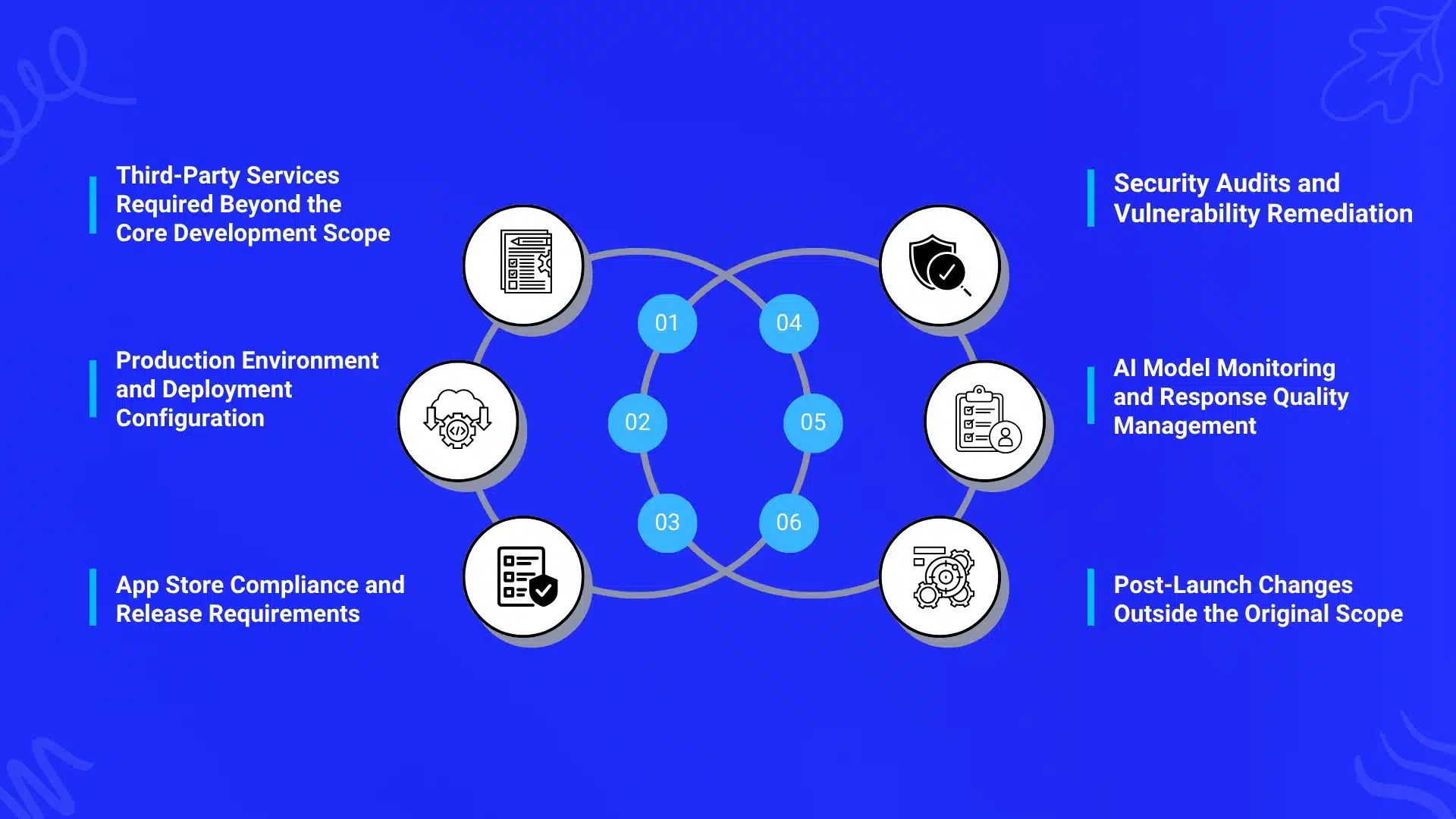
Third-Party Services Required Beyond the Core Development Scope
Your astrology app MVP might rely on external services for more than basic chart generation. You may need separate providers for capabilities like:
- Planetary calculations
- Ephemeris data
- Geocoding
- Historical time zones
- Location coordinates
- AI interpretation
While the initial development quote might include integrating these services, their commercial usage doesn’t. So, depending on the providers and usage volume, expect roughly $100-$2K+ per month initially, with costs increasing as users start generating more charts, reports, and readings.
Production Environment and Deployment Configuration
Unlike simple content-generating apps, your astrology app will need more production infrastructure. That’s because user profiles are likely to store birth date, exact time, birthplace, generated natal charts, saved readings, consultation history, and compatibility results permanently. So, once you move your app to production, you may need separate databases, backups, monitoring, encryption, staging, and production environments. Therefore, production setup can add about $2K-$8K to your initial budget depending on your app’s architecture.
App Store Compliance and Release Requirements
Once you combine paid readings, subscriptions, digital reports, astrologer consultations, user-generated content, or AI-generated guidance, your astrology software might require additional release work. Subscription disclosures, account deletion, privacy information, age ratings, payment configuration, and policy-related revisions often need additional development before approval. A practical budgeting tip would be to allocate $1K-$5K for store-specific adjustments and rejection-related rework. The final amount will depend on your monetization model and how many changes Apple or Google requires before accepting the application.
Security Audits and Vulnerability Remediation
Security becomes more consequential when your astrology app stores a user’s exact birth information, birthplace, relationship details, private questions, consultation conversations, and personalized readings. A standard development quote usually includes authentication and basic security controls. However, it often excludes the expense necessary to carry out independent penetration testing. A security assessment can cost approximately $3K-$15K+, depending on the app’s backend, APIs, user accounts, payment flows, and consultation features. If testing exposes vulnerabilities in APIs or data access, remediation becomes an additional cost before you can confidently scale the product.
AI Model Monitoring and Response Quality Management
For your AI astrology app, the cost won’t stop when the chatbot or reading generator is integrated. Instead, you need to monitor whether the model correctly uses natal-chart data, planetary positions, transits, houses, aspects, or Vedic periods rather than producing generic horoscope language. Evaluation, prompt refinement, output testing, model changes, and quality monitoring can add around $500-$3K+ per month, separate from AI inference costs. At higher usage, maintaining consistent personalized readings becomes an ongoing operating expense tied directly to your subscription or report revenue.
Post-Launch Changes Outside the Original Scope
Your horoscope app or the astrology marketplace can reveal scope gaps only after users start generating charts and purchasing readings. For instance, you may find that users want more detailed transit reports, additional compatibility calculations, saved chart comparisons, different report formats, or deeper AI interpretations. These are product changes rather than maintenance. Hence, you will have to bill them separately. Reserving 15%-25% of the original development budget is sensible. On a $100K astrology app, this creates a $15K-$25K post-launch budget for commercially valuable improvements discovered after launch.
| Hidden cost | Typical additional cost | What drives the cost | Budget impact | Consequence if overlooked |
| Third-party services beyond core development | $100-$2K+/month | Number of charts, API calls, AI requests, users, and provider pricing model | Becomes a recurring operating expense that rises with usage | Your initial budget can look affordable while per-user costs gradually erode margins as chart generation and personalized readings increase |
| Production environment and deployment configuration | $2K-$8K | Architecture complexity, traffic, data volume, backup requirements, and environments | Adds to the cash required before launch | The app may be technically complete but not properly prepared for production traffic, creating launch delays or emergency infrastructure spending. |
| App Store compliance and release requirements | $1K-$5K | Monetization model, subscriptions, account features, privacy requirements, and rejection cycles | Can create unplanned development costs before revenue begins | A rejection can delay launch, postpone subscription revenue, and require additional development outside the original scope |
| Security audits and vulnerability remediation | $3K-$15K+ | APIs, authentication, payment flows, sensitive data, and audit depth | Creates a separate pre-launch or periodic security budget | Security weaknesses involving birth data, readings, accounts, or consultations can force expensive remediation and undermine user trust |
| AI model monitoring and response quality management | $500-$3K+/month, excluding AI usage | Reading volume, model complexity, evaluation frequency, personalization depth, and AI workflows | Creates a recurring expense that grows alongside AI usage | Inconsistent or generic AI readings can reduce user trust, increase refunds or cancellations, and weaken the value proposition of a paid astrology subscription |
| Post-launch changes outside the original scope | 15%-25% of development cost | User feedback, conversion data, monetization changes, and astrology workflow improvements | A $100K build may require another $15K-$25K for commercially important changes. | Without a post-launch reserve, necessary improvements can compete directly with your marketing budget or force you to delay features that affect retention and revenue. |
How long does it take to build an astrology app?
An astrology app typically takes 3-9 months to build, depending on the depth of astrology logic, personalization, AI, and monetization. A basic daily horoscope or birth-chart app can reach launch in 12-16 weeks, especially if you use an established astrology API. On the contrary, a more advanced app with proprietary calculations, AI-generated readings, compatibility analysis, subscriptions, and personalized reports generally requires 5-7 months.
At the same time, a consultation marketplace with astrologer profiles, scheduling, payments, chat, video calls, reviews, and practitioner payouts can take 7-10 months or longer. Your timeline also depends on whether you are building the astrology engine yourself, integrating third-party services, and how much scope you reserve for testing and post-launch refinement.
| Astrology app type | Typical timeline | What determines the timeline |
| Daily horoscope & prediction app | 3-4 months | Content engine, user profiles, personalized predictions, notifications, and basic monetization |
| Natal chart & birth chart app | 3-5 months | Chart calculations, planetary data, interactive charts, reports, and birth-location/time-zone handling |
| Vedic astrology / Kundali app | 4-6 months | Vedic calculation rules, dashas, planetary periods, Kundali generation, interpretation, and regional requirements |
| Zodiac compatibility & synastry app | 4-6 months | Compatibility calculations, synastry logic, relationship profiles, reports, and premium comparison features |
| AI astrology app | 5-8 months | Astrology calculation layer, chart-aware AI, personalized interpretations, conversation flows, model evaluation, and usage controls |
| Live astrologer consultation marketplace | 7-10+ months | Practitioner onboarding, profiles, availability, booking, payments, payouts, chat/video, reviews, moderation, and marketplace operations |
Why do astrology marketplaces struggle after launch?
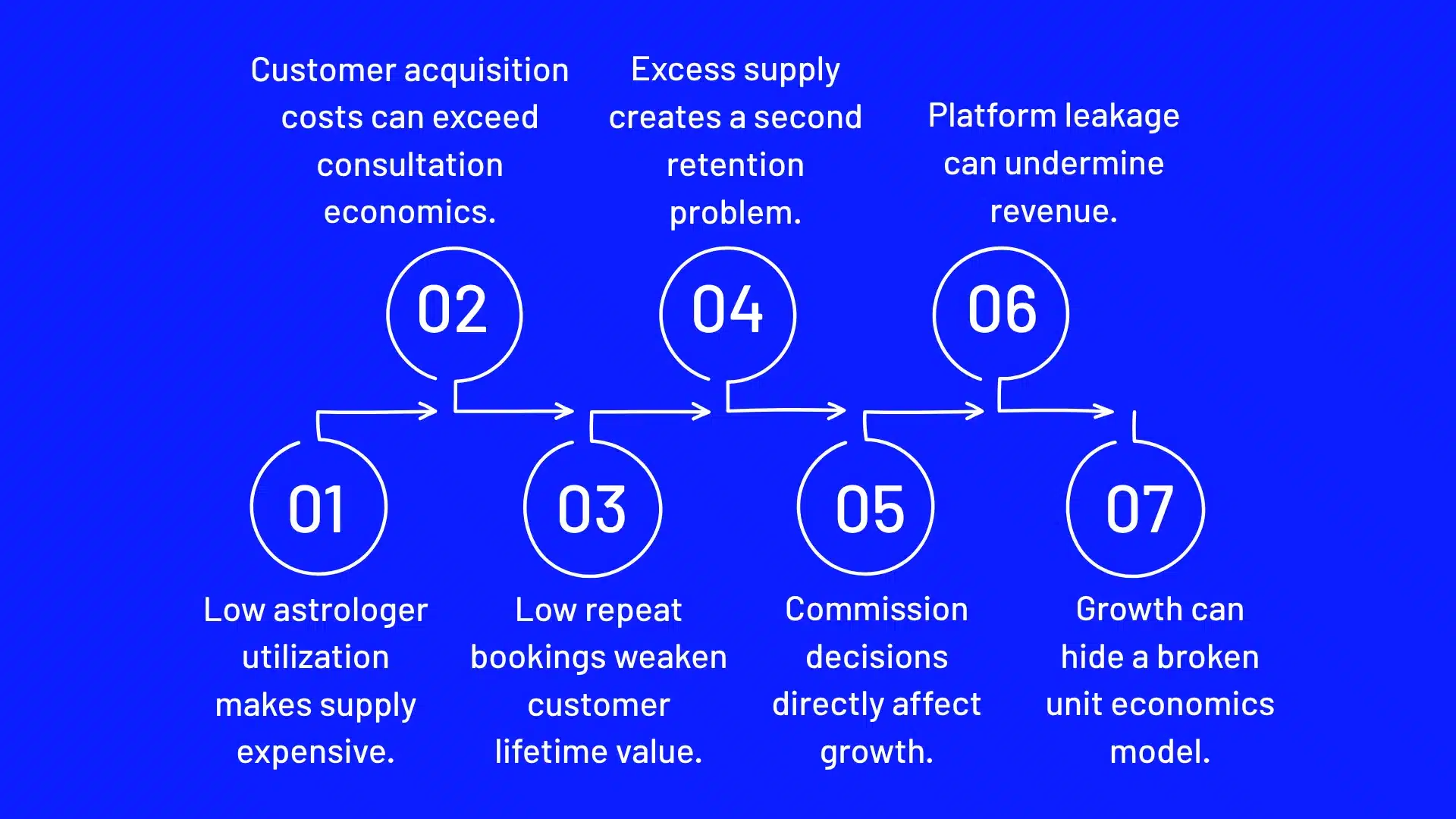
Low astrologer utilization makes supply expensive.
Recruiting 200 astrologers for your astrology marketplace won’t create much value if most receive only a few bookings every month. You still have to carry onboarding, verification, support, scheduling, and marketplace management costs. So, supply should expand according to the actual booking demand, and not a target practitioner count.
Customer acquisition costs can exceed consultation economics.
Suppose you spend $30 acquiring a customer who books one $60 consultation. At the same time, your astrological marketplace retains a 20% commission. As per the calculations, you generate only $12 in platform revenue before payment processing, refunds, support, and infrastructure. Unless that customer books repeatedly, scaling paid acquisition can destroy your contribution margin.
Low repeat bookings weaken customer lifetime value.
A one-time astrological consultation rarely provides enough revenue to justify aggressive acquisition spending. Your marketplace, therefore, needs mechanisms that can bring users back for follow-up readings, transit updates, relationship consultations, annual forecasts, or ongoing astrologer relationships. Increasing booking frequency will matter more than simply increasing the number of first-time users for your app economics.
Excess supply creates a second retention problem.
Too many astrologers competing for too few bookings means low practitioner earnings. High-quality practitioners may leave when they cannot generate sufficient income, forcing you to spend repeatedly on recruitment. Your marketplace then enters a costly cycle of replacing supply rather than improving liquidity.
Commission decisions directly affect growth.
A higher take rate improves your platform revenue per booking but can reduce astrologer willingness to participate. A lower commission, on the other hand, can improve supply retention while leaving insufficient margin to fund customer acquisition and operations. Your take rate therefore has to be designed around the entire transaction P&L, not selected simply as a percentage of the consultation price.
Platform leakage can undermine revenue.
Once a user establishes a relationship with an astrologer on your marketplace, both parties have an incentive to move future consultations outside the platform if it adds little ongoing value. Secure payments alone do not solve this. Booking history, verified profiles, follow-up services, loyalty benefits, dispute protection, and continuity of records can give both sides a reason to keep transactions on-platform.
Growth can hide a broken unit economics model.
Increasing GMV is not the same as building a profitable astrological marketplace. If every additional customer requires disproportionate spending on acquisition and every additional astrologer requires incentives to remain active, your revenue growth can coexist with worsening losses. Before scaling, measure CAC, average booking value, take rate, repeat booking rate, practitioner utilization, contribution margin per customer, and customer lifetime value.
Should I use an astrology API or build my own engine?
If your primary objective is to validate demand and launch the product within a controlled budget, use an astrology API. But if your product’s differentiation depends on proprietary calculations, interpretation rules, or a specific astrological methodology that you need to control, it’s better if you build your own engine. This decision will affect more than the development costs. It will determine how much control you have over:
- Accuracy
- Methodology
- Pricing
- Feature expansion
- Dependence on a third-party provider
An API-driven astrology app can keep your initial build cost around $50K-$80K. That’s because the complex work of calculating planetary positions, houses, aspects, or other astrological metrics will be outsourced. But this approach will only make sense when the commercial value of your product comes from the experience built around these calculations, like personalized reports, subscriptions, AI interpretation, consultations, or compatibility. The capital you save can then be allocated to customer acquisition and monetization, rather than rebuilding the calculation infrastructure.
Building your own calculation engine becomes financially justifiable when the layer itself creates a competitive advantage for your product. If you are developing a sophisticated Vedic product with proprietary dasha logic, specialized predictive methodology, or calculations that will power several paid tiers, relying on an API can constrain future differentiation. However, with this, development costs will move to the bracket of $120K-$200K+. Even though it’s much higher, you, at least, will gain greater control over the underlying logic and reduce dependence on a provider’s pricing, roadmap, and availability.
| Decision factor | Astrology API | Custom Astrology Engine |
| Initial investment | Lower; typically $50K-$80K for an API-based product | Higher; often $120K-$200K+ depending on calculation depth |
| Time to market | Faster because core astronomical calculations are already available | Longer because calculation logic, validation, and testing must be developed |
| Calculation control | Limited to the methodology and capabilities supported by the provider | Full control over calculation rules, methodologies, and interpretation logic |
| Product differentiation | Differentiation comes mainly from UX, personalization, AI, reports, and services built around the API | Can differentiate through proprietary calculations, predictive models, Vedic logic, or specialized methodologies |
| Third-party dependency | High; pricing, API limits, uptime, and roadmap remain outside your control. | Low after development; your core calculation layer is owned and controlled internally. |
| Feature expansion | Limited when new requirements are not supported by the provider | Greater flexibility to develop calculations and astrology capabilities specific to your roadmap |
| Ongoing economics | Recurring API costs increase as chart generation and user activity grow | Higher upfront investment, but less dependence on per-request or subscription-based API pricing |
| Best business case | Validate demand, launch faster, and invest capital in monetization and customer acquisition. | Build long-term IP when astrology methodology itself is central to your competitive advantage. |
How do astrology apps make money?
In-app purchases
This monetization model is the most valuable when your astrology app has high-intent, low-frequency use cases that do not justify a subscription. Here, you won’t be charging your users for access to your entire app. Instead, you can monetize moments when a user is willing to pay to get a definite answer, be it a marriage prediction or a detailed transit analysis.
So, a $9.99 reading can help you convert users who would otherwise never agree to pay $12.99 every month. The trade-off is that revenue depends on continuously creating new purchase options. It means that your product will have to have enough distinct paid outcomes to increase purchase frequency without making the free experience feel deliberately incomplete.
Subscription model
If your astrology product has a continuing data advantage, you can generate maximum ROI with this monetization model. Once you have users’ birth details, previous readings, preferences, and changing planetary positions, your app will then become valuable over time rather than resetting the experience with every session.
This further creates a stronger reason for recurring payments. At $12.99 per month, however, you will need retention long enough to recover acquisition costs and app-store fees. So, model the subscription revenue against monthly churn, trial-to-paid conversion, and average subscriber lifetime.
Live consultation fees
Consultations change the economics completely because your platform won’t be selling software alone. Instead, it will facilitate a high-value service transaction. The important pricing decision here is whether to compete on low-cost consultations or allow astrologers to establish differentiated pricing based on expertise, reputation, language, and demand.
If a consultation costs $75 and your platform retains 20%, you will earn $15 before transaction and operating costs. The stronger model is, therefore, not necessarily the one with the highest commission. Rather, it’s the one that maximizes completed bookings, repeat consultations, and astrologer utilization without making practitioners leave the platform.
Non-intrusive advertisement
Advertising is usually considered a scale monetization model, not a primary revenue-generating strategy for your early astrology startup. Its value will come from users who generate engagement but have no immediate willingness to pay. This makes free daily horoscope traffic commercially important even when those users never purchase a reading.
The strategic opportunity, therefore, is to use free content as the acquisition layer and paid services as the monetization layer. An ad-free subscription can then help you monetize the most engaged portion of the free audience.
How can I reduce astrology app cost without hurting quality?
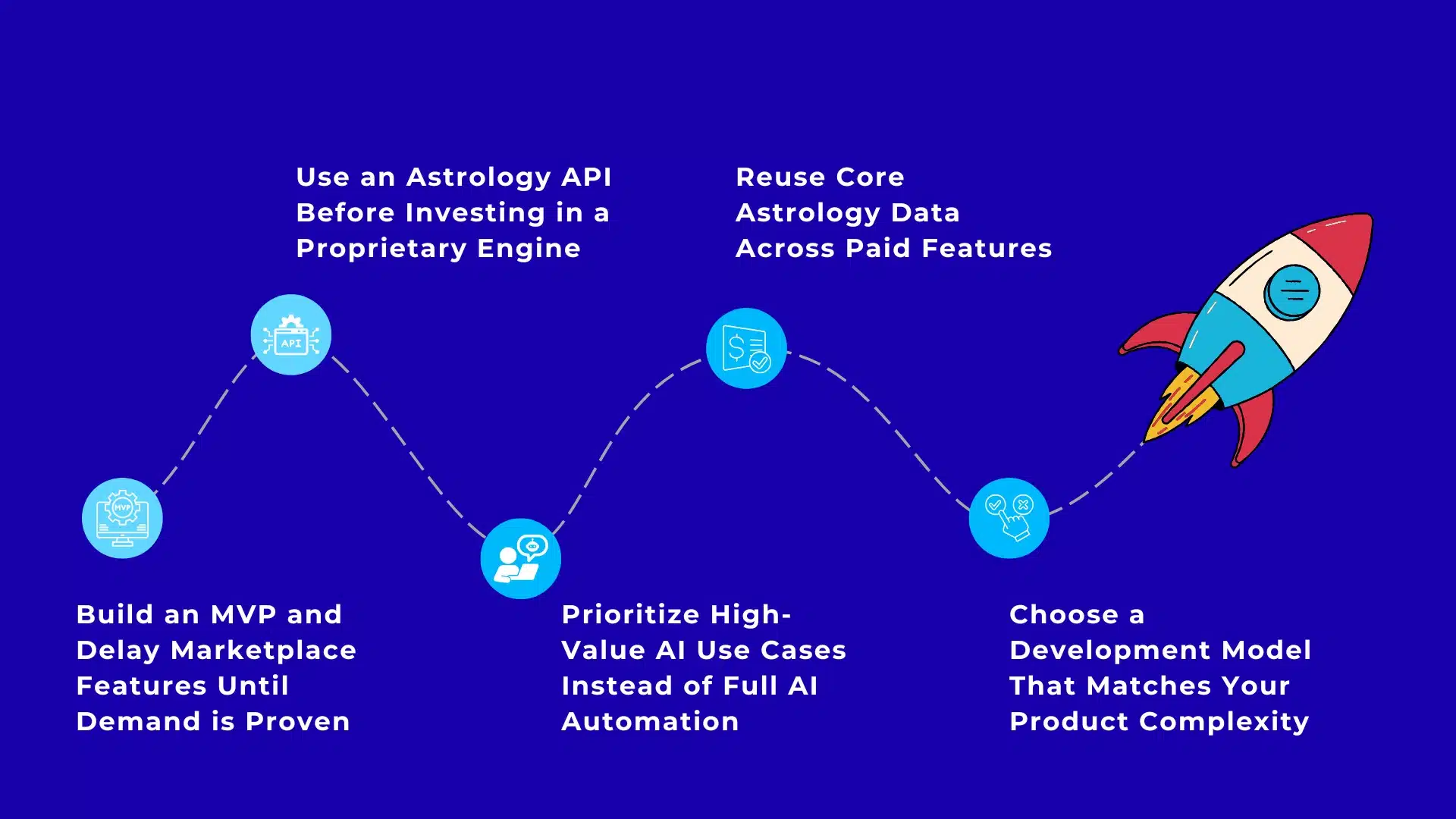
Build an MVP and Delay Marketplace Features Until Demand is Proven
If your initial astrology product or the MVP version can validate paid demand without live consultations, do not absorb marketplace complexity immediately. Profiles, practitioner onboarding, scheduling, payouts, availability management, and dispute handling can add substantial development and operating costs.
Launching with just digital readings or subscriptions first lets you measure whether users will actually pay before committing another $50K-$100K+ to marketplace infrastructure. You can then build the practitioner side around proven booking behavior instead of assumptions about future supply and demand.
Use an Astrology API Before Investing in a Proprietary Engine
A third-party astrology engine can remove a major upfront development burden while you validate the commercial model. You can use an established API for planetary calculations, charts, houses, and related data, and then invest in your own calculation engine once proprietary methodology becomes financially important.
This will help you keep the initial build around $50K-$80K instead of pushing calculation-heavy development substantially higher. It also gives you enough time to determine whether your customers actually value proprietary calculations enough to justify the additional engineering investment.
Prioritize High-Value AI Use Cases Instead of Full AI Automation
Apply AI only where it increases revenue or retention, not simply because your astrology app can use it. A chart-aware AI reading or personalized follow-up will help you justify premium pricing. At the same time, automating every piece of content may add inference and monitoring costs without improving conversion.
So, start with one measurable use case and expand after usage data shows that AI is affecting paid engagement. This is especially important when AI costs continue after launch, because every additional reading can create a variable expense rather than a one-time development cost.
Reuse Core Astrology Data Across Paid Features
Your birth data, natal chart, planetary positions, transits, and calculated astrological attributes should become reusable product infrastructure rather than being rebuilt for every feature. The same underlying calculations can support personalized forecasts, compatibility, reports, alerts, and AI interpretation.
Designing this data layer properly at the beginning costs less than rebuilding it later when multiple revenue-generating features depend on inconsistent calculation or storage structures. It also allows you to introduce new paid experiences without creating an entirely separate astrology-data pipeline for each one.
Choose a Development Model That Matches Your Product Complexity
Do not pay for a large engineering team simply because the product is intended to scale eventually. A focused team can build an API-based astrology MVP much more efficiently than a large team building proprietary calculations, AI, and marketplace infrastructure at once. So, compare U.S., offshore, and hybrid delivery models against the actual technical scope.
This will help materially reduce initial development cost without reducing quality where specialist expertise is required. A hybrid approach will become more feasible when your project needs senior product or architecture oversight but does not require every development role to be U.S.-based.
How can GMTA Software help you build your astrology app?
At GMTA Software, we approach astrology app development as a product problem, not simply a mobile app build. We start by understanding whether you are monetizing personalized predictions, premium reports, subscriptions, consultations, or a combination of these. That’s because this decision affects how we structure the product from the beginning.
We can integrate established astrology APIs for birth charts, planetary positions, houses, aspects, transits, and Vedic calculations when using an existing engine makes better commercial sense. If your product requires proprietary calculation methodology, we can instead develop a customized astrology engine that gives you greater control over the underlying logic and future feature development.
For AI astrology products, we can build the intelligence layer around your actual astrology data. Rather than returning generic AI-generated horoscope text, the system can use a user’s birth information and calculated chart to produce personalized interpretations, predictive insights, and conversational responses.
Our objective is to give you an astrology product that can launch with the capabilities you need today while leaving room for the calculation, AI, and monetization layers you plan to add as demand grows.
FAQ
How much does it cost to build an astrology app in 2026?
Building an astrology app in 2026 costs between $40K and $400K+ in the US market. A focused birth-chart or horoscope product can stay roughly around $40K-$80K, while AI interpretation, proprietary calculations, advanced Vedic functionality, or a consultation marketplace can push the investment above $150K-$250K. So, the key decision here is how much astrology technology you own versus integrate.
What factors have the biggest impact on astrology app development cost?
The largest cost driver is the depth of astrology logic behind the user experience. An app using an external engine for chart calculations requires considerably less development than one implementing proprietary Vedic rules, dashas, transits, or predictive methodology. AI adds another layer when responses must interpret calculated chart data rather than generate generic horoscope text.
How much does it cost to maintain and scale an astrology app after launch?
Annual maintenance of an astrology app commonly falls around 15-25% of the original development cost However, your product can exceed this when AI or marketplace activity becomes significant. Maintenance isn’t limited to fixing bugs only. You will have to budget for API changes, ongoing validation of AI responses, new calculation requirements.
Is it cheaper to use an astrology API or build a custom calculation engine?
Yes — an API-driven astrology app typically costs $50K–$80K to build, since the planetary calculations are outsourced to a third-party provider. A custom calculation engine, needed when proprietary Vedic logic or predictive methodology is central to your product’s differentiation, runs $120K–$200K+. Most founders should start with an API unless the calculation layer itself is their core competitive advantage.
Can I build an astrology app on a smaller budget?
Yes. An MVP-focused approach — a horoscope or birth-chart app using a third-party astrology API, without live consultations or proprietary calculations — can launch for $40K–$80K in 10–18 weeks. Delaying marketplace features (astrologer onboarding, payouts, scheduling) until paid demand is proven is the single biggest way to reduce upfront investment without cutting quality.
How much does adding AI increase astrology app development cost?
Adding AI typically adds $20K–$60K+ to a development budget, depending on how much proprietary interpretation logic is required. The commercially stronger implementations connect AI responses to the user’s actual chart and planetary data rather than generating generic horoscope text, which requires a prompt/RAG layer and ongoing inference costs that continue after launch.
What’s the difference between a horoscope app and an astrology consultation marketplace?
A horoscope or birth-chart app delivers automated content — daily predictions, natal charts, compatibility reports — typically costing $40K–$100K+. A consultation marketplace is a two-sided platform connecting users with live astrologers through chat, call, or video, requiring practitioner onboarding, scheduling, and payment infrastructure, which pushes costs to $150K–$250K+. Many founders launch the content app first to validate demand before building the marketplace layer.

Founder
Anjali Upadhyay is the Founder of GMTA Software Solutions, a mobile and web application development company she built from the ground up in 2019. Under her leadership, GMTA has delivered 200+ production applications across healthcare, fintech, and on-demand services for clients in the US, UK, Singapore, and UAE. She also leads GMTA’s AI practice, which has shipped production AI systems — including HIPAA-compliant healthcare workflows, LLM-integrated logistics platforms, and fintech automation tools — for US-based enterprise clients. Her writing covers AI product strategy, build-vs-buy decisions for AI systems, and the operational realities of moving AI from proof-of-concept to production at scale.