


Key Takeaways
- A basic fleet management MVP may require $30K–$50K, but enterprise platforms with multi-location operations, advanced dispatch automation, and extensive third-party integrations can exceed $300K.
- Your product must account for driver hours-of-service limits, equipment availability, pickup deadlines, and empty-mile reduction. The more business rules your dispatch team follows, the more complex the assignment logic becomes.
- If your fleet already uses compatible GPS devices, fuel cards, and ELD systems, integrating those providers may cost less than replacing hardware or building proprietary tracking capabilities.
- Retaining established tracking and compliance platforms while building custom dispatch or reporting functionality allows you to address specific operational gaps without financing an entirely new system.
If we talk about an MVP, building a fleet management software in 2026 will need a potential budget of $30K-$150K. The moment you shift your focus to an enterprise-grade platform with telematics, ELD, electrification, and other major features, the budget moves beyond $300K. The adoption of digital fleet management technologies and advanced telematics infrastructure has pushed US market share to $4.08 billion in 2025. AI adoption has become a key concern now, especially after Fleetio reported that only 5.6% of companies have actually integrated this technology for real use cases. So, you cannot just blindly jump into building custom fleet management software, especially when your US business is already functioning on tighter margins.
Committing the capital means pitting your product against commercial platforms that charge a recurring per-vehicle fee. The decision further gets complicated as your fleet grows. Subscription bills increase with vehicle count. But at the same time, custom software demands a substantial upfront investment before it can actually generate savings. Thus, the bottom line here is to establish what your fleet can realistically save before deciding what its software should cost.
Having said that, we have illustrated here an investment assessment to help you align the quoted development spending with your existing software expense, operational inefficiencies, and expected fleet growth. With this, you can rest assured that you will have a clearer basis for deciding whether to customize an existing platform, build a focused MVP, or invest in a proprietary system designed for your long-term operating model.
What Is Fleet Management Software Development?
You build a system to control your US business’s day-to-day fleet operations without having to rely on manual updates, fragmented tools, and costly workarounds. When your dispatchers use platform A to track vehicle locations and your maintenance team tracks repairs on platform B, you simply lack a reliable view of trucks’ availability. What’s more confusing is that you literally don’t have any updates on which vehicles need immediate servicing and which can be scheduled for later maintenance.
With fleet management system development, you create a centralized platform and bring these workflows together under one roof. Every feature, whether it’s telematics tracking, preventive maintenance scheduling, or geofencing, is grounded in your real business operations, and not some hypothetical script.
How Much Does Fleet Management Software Cost to Build in 2026?
For an MVP-based fleet management software, you can rely on a quote estimate of $30K-$150K, while for a more complex enterprise platform, it will be $300K+. The final numbers, however, depend on multiple internal business and external market factors, including:
- Development hours required to move the prototype to production
- Integration requirements that can help the software connect with existing business tools
- The extent of operational logic the software needs to handle on its own
When you are operating your business in the US, just the difference between connecting existing GPS data and automating dispatch decisions can end up adding tens of thousands of dollars to your project. Let’s assume your trucking company already has GPS trackers and ELD devices across 100 vehicles. The initial software build requires 500 engineering hours at an illustrative blended rate of $75 per hour, plus $8K for testing and deployment. This will make your initial capital investment go up to $45.5K.
Now, let’s suppose you want to automate load assignments that account for:
- Drivers hours-of-service limits
- Truck availability
- Empty miles
- Pickup deadlines.
If this adds another 350 engineering hours at the same rate, your budget will increase by $26.25K. This means the total investment then required will be much higher, amounting to $71.75K. Remember, this amount is exclusive of ongoing hosting, API charges, and maintenance expenses.
| Development Level | Estimated Cost | Development Timeline | Key Functionality | Best Suited For |
| Basic MVP | $30K–$50K | 2–3 months | GPS tracking, vehicle records, basic dispatch, reporting | Small fleets testing a custom solution |
| Mid-Level Software | $50K–$100K | 3–5 months | Driver management, maintenance scheduling, fuel tracking, ELD integration | Growing regional fleets |
| Advanced Platform | $100K–$180K | 5–8 months | Route optimization, automated dispatch, telematics integration, analytics | Mid-sized trucking and delivery businesses |
| Enterprise Platform | $180K–$300K | 8–12 months | Multi-location management, advanced automation, accounting and TMS integrations | Large, multi-terminal fleet operators |
| AI-Enabled Platform | $250K–$400K+ | 9–15+ months | Predictive maintenance, demand forecasting, AI-assisted routing, fleet performance intelligence | Large fleets with substantial operational data |
Build, Buy or Hybrid? A Five-Year Cost Comparison
Buying an existing fleet management platform makes the most sense when its subscription costs are much less than developing and maintaining equivalent functionality yourself. Let’s assume you operate 50 trucks and need features like:
- ELD connectivity
- GPS tracking
- Maintenance scheduling
- Intelligent inspection
At a subscription rate of $50 per vehicle per month, your five years of service cost will be around $150K, before you even consider add-on expenses or price inflation. Now, if building these capabilities in your proprietary software costs you $100K upfront, buying will be cheaper on subscription costs alone.
Investing in a fleet management application development project is justifiable when you need high-end customizations or connections between fragmented systems your business relies on currently. Let’s consider that you work with dispatchers who manually match loads to:
- Available drivers
- Equipment restrictions
- Hours-of-service limits
- Delivery windows
If the existing platforms you use cannot handle these rules fairly, custom dispatch logic will help you improve truck utilization and minimize manual effort. Assuming a capital investment of $120K for a 100-truck fleet, it will cost you $24K annually when spread across 5 years. Now, if automation helps you save $25 per vehicle, your annual savings will be around $30K. Based on this, you can save $6K every year with custom fleet management software.
Choose a hybrid approach when your existing technology landscape works but has specific gaps that can be bridged with custom software. For example, you can retain your ELD and GPS systems and only invest in building a proprietary dispatch layer. Let’s consider that you need to invest $45K for this project. Now, if it helps you reduce manual work by 40 hours a month, your business can save $16.8K annually at a fully loaded labor cost of $35 per hour.
| Comparison Factor | Buy (Off-the-Shelf) | Build (Custom Software) | Hybrid Approach |
| Initial investment | Low upfront cost; subscription-based pricing | High upfront development investment | Moderate investment focused on custom modules |
| Illustrative cost | $50/truck/month; $150K over five years for 50 trucks | $120K for a custom platform | $45K for a custom dispatch layer |
| Implementation time | Faster deployment using existing functionality | Longer development, testing, and deployment | Faster than a complete custom build |
| Customization | Limited to vendor-supported configurations and add-ons | Full control over workflows and business logic | Customization of selected workflows |
| System integrations | Depends on available vendor integrations and API access | Built around your required integrations | Connects existing platforms with custom modules |
| Scalability | Additional vehicle subscriptions and vendor pricing apply | Scaling depends on your architecture and infrastructure | Existing systems scale alongside custom components |
| Maintenance responsibility | Primarily handled by the software vendor | Your development team or technology partner manages updates and support | Shared between existing vendors and your development team |
| Best suited for | Fleets with standard operational requirements | Businesses with specialized workflows and a strong case for software ownership | Fleets that need targeted customization without replacing functioning systems |
| Main financial risk | Subscription costs and add-on fees accumulate as the fleet grows | High upfront investment and ongoing ownership expenses | Integration dependencies and maintenance across multiple systems |
Core Features of Fleet Management Software (and What Each Adds to Cost)
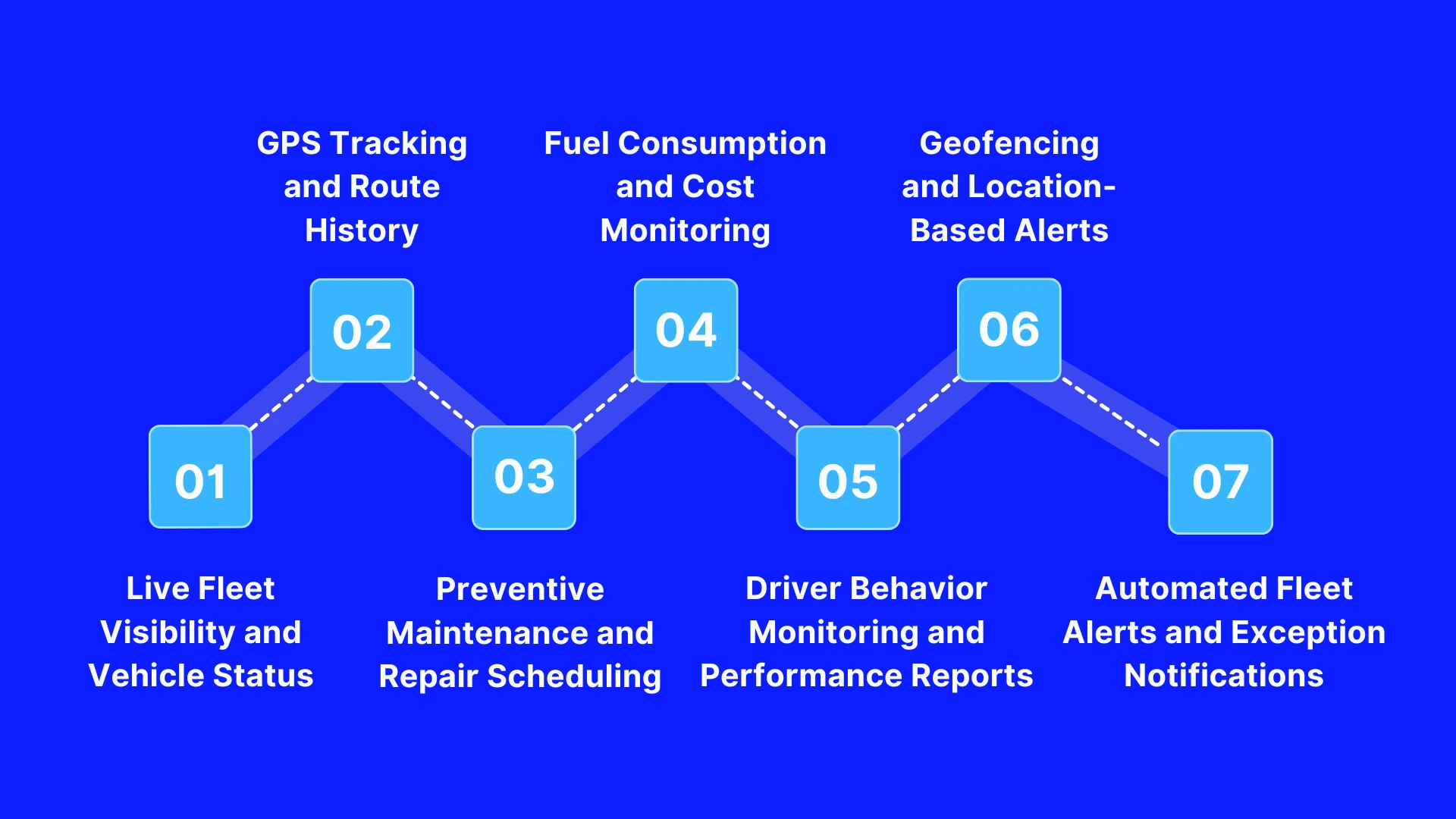
Live Fleet Visibility and Vehicle Status
Imagine a driver finishing a delivery beyond the planned schedule. In such a case, your next dispatch decision will depend on whether the vehicle can realistically make the next pickup, or you will have to arrange for another vehicle. This is where live visibility comes into play, giving your team a current view of:
- Vehicle’s exact location
- Load status
- Availability for the next pickup schedule
This further helps you reassign work before the delay can affect your customer. When your business manages tight appointment windows and multiple loads per truck, this software feature can eliminate avoidable dead time and help protect revenue-generating hours.
GPS Tracking and Route History
A truck arriving late at its destination doesn’t automatically mean the driver took a poorer route. Factors like traffic congestion, shipper delays, road restrictions, and unplanned stops can all contribute to the delay. So, building the GPS tracking feature into the fleet management software lets you monitor the truck’s real-time location with maximum accuracy. As for the route history feature, it helps you understand what exactly went wrong along the way. If the lane in question repeatedly causes delays or consumes excess mileage, you can review routing decisions and customer appointment commitments based on actual trip data.
Preventive Maintenance and Repair Scheduling
Even when it’s just one truck out of 100, an unscheduled breakdown will cost your fleet more than what the repair bill would have been. A disabled vehicle means:
- Missing a pickup
- Leaving a driver stranded
- Forcing a load reassignment
- Disrupting the next day’s schedule
With fleet maintenance software, however, you can plan the service journey around engine hours, mileage, inspection dates, and repair history. At least then you won’t have to wait for the failure to take the vehicle out of service. The commercial benefit here is having better control over downtime, especially when your fleet business balances equipment availability with applicable FMCSA maintenance needs.
Fuel Consumption and Cost Monitoring
This always deserves closer attention, especially as diesel prices continue to change and your business needs to operate on tighter margins. A fleet-wide average usually hides the trucks that are consuming more fuel than what their mileage and workload can justify. That’s why having this feature in the fleet management software is crucial for your team. They can then investigate unusual readings or deteriorating miles per gallon by comparing factors like:
- Odometer readings
- Fuel purchases
- Route data
- Vehicle performance graphs
The payoff here is a more informed cost-per-mile calculation and a transparent view of where corrective action is needed across your entire fleet.
Driver Behavior Monitoring and Performance Reports
Truck specifications alone can never determine fuel efficiency and vehicle wear. Whether it’s excessive idling or repeated harsh braking, multiple actions cause a sudden spike in operational expenses and signal coaching needs. With fleet management software, you can generate driver performance reports as and when required. These will help you identify patterns across trips instead of relying solely on a complaint or one isolated event. The strongest use case here for your US fleet business is targeted intervention. You can:
- Address recurring risks with your vehicles
- Track if coaching can help change driver behaviors
- Recognize drivers who perform well consistently
Geofencing and Location-Based Alerts
Time spent waiting at a shipper or a receiver will automatically disrupt your next truck’s assignment, especially when you are running tighter appointment slots. Geofencing will then help you record the entering and leaving time of every vehicle at a defined location. Thus, dispatchers will have a more reliable timeline for facility arrivals and departures. Your team can then utilize the information to:
- Follow up on extended stops
- Update customers in case there’s a delay
- Identify facilities where dwell time repeatedly affects productivity
This feature will also help you strengthen detention analysis and customer discussions. However, one thing you should know is that geofence timestamps won’t tell you the exact moment when loading/unloading begins or ends.
Automated Fleet Alerts and Exception Notifications
A maintenance warning will matter only when you can act on it before the truck is dispatched into a preventable failure. Similarly, you can apply the same principle to missed checkpoints or unexpected vehicle movements that unknowingly threaten a load’s schedule. So, you can configure fleet alerts in a way that each issue is directed to the person responsible for its resolution, with enough context to help determine the next actionable steps. This particular feature becomes way more helpful when your US business operates a fleet across multiple time zones or outside normal office hours.
Fleet Management Software Architecture and Tech Stack
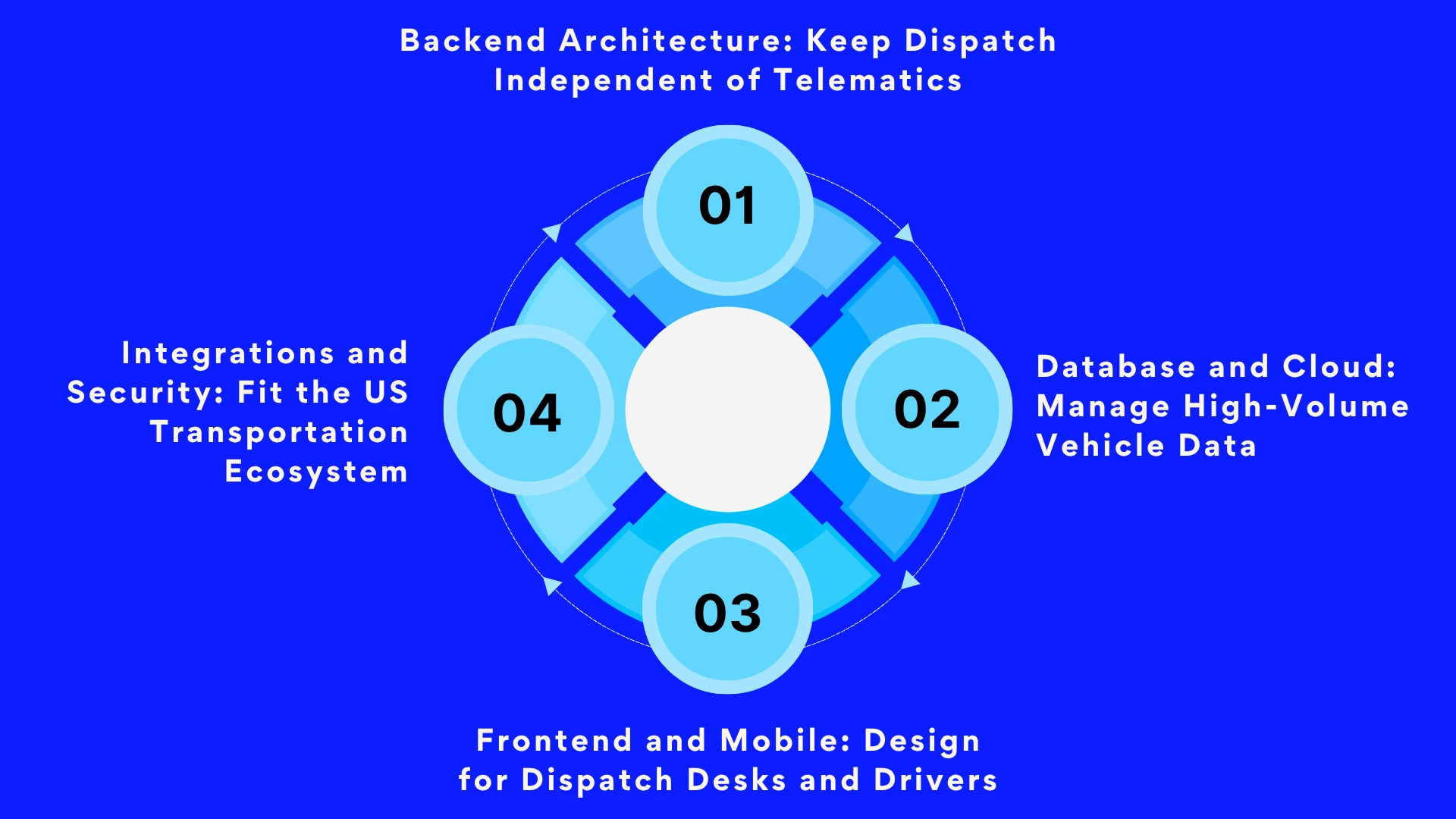
Backend Architecture: Keep Dispatch Independent of Telematics
When you are planning for fleet management software development, make sure its backend accounts for the relationship between:
- A shipment
- Its assigned tractor-trailer
- The driver responsible for completing it
Suppose a carrier moves freight between Texas and California. Now, if a driver approaches their available HOS limit before reaching the receiver, the dispatch team needs to know whether they have to reassign the load or revise the delivery plan.
So, the backend must be capable of using ELD data to inform these decisions without altering the driver’s official records. Node.js with NestJS or Java with Spring Boot will help support this logical implementation. One thing to note here is that you must keep both dispatch and compliance-related workflows separate. By doing so, you can ensure that no operational change can compromise regulated driver records.
Database and Cloud: Manage High-Volume Vehicle Data
Your US fleet management software should preserve more than the GPS coordinates. IFTA reporting requires carriers to substantiate mileage traveled in individual jurisdictions. This makes trip history and original location records more important. Therefore, you need a database that can retain all these pieces of information required to trace a truck’s journey across state lines, rather than storing only the last position.
PostgreSQL is the perfect database platform to manage vehicle and trip records at large scale. At the same time, you can also use TimescaleDB to handle historical GPS records. AWS or Azure can provide you with managed storage and backups. In addition, you must design retention and retrieval around applicable recordkeeping requirements your business has to deal with.
Frontend and Mobile: Design for Dispatch Desks and Drivers
A dispatch dashboard must be capable of distinguishing a truck’s location from its actual availability for another load. A vehicle approaching a receiver in Chicago might not be ready for another assignment. That’s because multiple factors will affect this decision, including:
- The driver’s remaining HOS
- The next pickup appointment
- Unloading
To design this operational interface, you can use React with TypeScript. Meanwhile, Mapbox or Google Maps Platform will help you with mapping APIs for real-time location tracking of your vehicles.
Integrations and Security: Fit the US Transportation Ecosystem
You need to ensure that the fleet management software you plan to build can accommodate carriers already using Motive, Samsara, or other ELD providers. By doing so, you can fetch existing vehicle and driver data into your system and ensure your customers won’t have any problems adopting your product. When you are working with freight brokers and shippers, EDI integration will come in handy as it minimizes manual coordination between transportation partners.
Which Telematics, ELD, and Fuel-Card Integrations Do You Need?
Your fleet management software must support the hardware that most US trucking companies use to monitor tractors and trailers during day-to-day operations. This will include:
- Plug-in telematics devices
- Hardwired GPS trackers
- Connections to onboard diagnostic systems that capture odometer readings, the vehicle’s real-time location, engine hours, and fault codes
In case your product manages refrigerated fleets, make sure it can support trailer temperature sensors and reefer monitoring devices. Only when it’s compatible with existing hardware from ELD providers like Samsara and Motive will carriers be able to bring their current vehicle data into your platform. At least then they won’t have to purchase an entirely new tracking setup.
ELD integration is equally essential, especially when your product will serve motor carriers covered by FMCSA requirements. Make sure your platform retrieves relevant hours-of-service information. This will help dispatchers plan loads around driver availability. Fuel-card integrations with Comdata and WEX can further connect purchase records with vehicle activity. This way, fleet managers can effortlessly monitor fuel expenses and prepare accurate IFTA reports.
You must also plan for TMS and freight-industry integrations. EDI 204, 214, and 210 will help you support:
- Load tendering
- Shipment updates
- Freight invoicing
Together, these integrations will determine how easily your software fits into a carrier’s existing fleet operation.
Compliance Rules by Region: US, EU/UK, UAE, India and Australia
North America: FMCSA, DOT, ELD, IFTA, and Regional Transport Regulations
In the US, every fleet management software catering to covered motor carriers should support the FMCSA Electronic Logging Device (ELD) Rule under 49 CFR Part 395. Every ELD should record driving time by synchronizing with the vehicle engine. At the same time, carriers must retain records of duty status and supporting documents.
Your software also needs to preserve these information pieces and support HOS calculations, including the 11-hour driving limit and the 14-hour driving window. As for IFTA, it must capture each qualified vehicle’s distance by jurisdiction and maintain supporting mileage and fuel records for quarterly tax returns. IFTA distance records have specific data requirements, which is why an ELD connection alone cannot establish IFTA compliance.
Europe and the UK: GDPR, Tachograph and Drivers’ Hours Regulations
In the EU, Regulation (EC) No. 561/2006 governs rest periods and driving time for covered commercial road transport. Drivers usually cannot drive for more than 4.5 hours without taking a 45-minute break. Regulation (EU) No. 165/2014 governs tachographs, including recording, storage, and access to real-time data.
Therefore, your fleet software should correctly import tachograph records and flag infringements against the applicable rules. GDPR applies when your platform processes identifiable driver information, including location and driving records. You also need to provide a lawful basis for processing, restrict access, establish retention periods, and support data-subject rights.
Middle East: UAE Transport Regulations, RTA Requirements and Vehicle Tracking
In the UAE, Cabinet Resolution No. 95 of 2021 establishes the National System for Tracking Trucks and Shipments. Every vehicle and shipment covered by the system needs to be registered and fitted with the required electronic tracking devices. Transport operations also need to follow the registration and tracking requirements.
Therefore, when you design fleet management software for UAE companies, you need to ensure the product supports the necessary vehicle and shipment identification and tracking-data exchange. Make sure it accounts for all authority-specific requirements, like the Asateel System of Abu Dhabi.
Asia-Pacific: Country-Specific Transport, Driver Safety and Data Protection Regulations
In India, Rule 125H of the Central Motor Vehicles Rules requires AIS-140-compliant vehicle location tracking devices and emergency buttons in specified public vehicle services. If your software serves regulated vehicle categories, it needs to support the required device data and relevant state monitoring arrangements. Similarly, in Australia, the Heavy Vehicle National Law (HVNL) governs fatigue management for covered heavy vehicle operations. Therefore, your software should support the applicable work and rest limits, diary records, and fatigue-management scheme requirements.
How Long Does It Take to Build Fleet Management Software?
Building fleet management software takes around 3–6 months for a focused first release and 6–12 months for a platform with complex integrations and automation. The biggest timeline drivers are rarely the screens themselves. Connecting ELD data, synchronizing load updates from a TMS, importing vehicle and driver records, and testing dispatch workflows require substantial engineering.
For example, a system that only tracks tractors and assigns drivers is considerably simpler than one that also reconciles fuel-card transactions, schedules maintenance, and calculates fleet-level operating costs. We recommend releasing core workflows first, then adding advanced modules based on how your dispatchers and fleet managers use the software.
| Type of fleet management software | Core capabilities | Estimated development time | Development complexity |
| Basic fleet tracking software | GPS tracking, vehicle location, trip history, and geofencing | 2–3 months | Low |
| Fleet operations management software | Vehicle records, driver management, dispatch, maintenance scheduling, and fuel tracking | 4–6 months | Moderate |
| Integrated fleet management platform | ELD and TMS integrations, HOS monitoring, route planning, fuel-card data, and operational reporting | 6–9 months | High |
| AI-powered fleet management software | Predictive maintenance, intelligent routing, fuel anomaly detection, and AI-assisted dispatch | 9–12+ months | Advanced |
Where AI Adds Value in Fleet Management Software (and Where It Does Not Yet)
Predictive Maintenance That Identifies Vehicle Problems Before Breakdown
If your fleet management software manages less than 8 tractors, don’t stop just at displaying the engine fault codes. Use AI to connect J1939 engine data with repair orders, component replacement history, and engine hours. When multiple vehicles show recurring DPF regeneration failures, your software can flag the pattern and help teams identify the affected tractors. You can then give maintenance managers a repair priority list instead of another hard-to-analyze dashboard.
AI-Powered Route Optimization for Traffic, Delivery Windows and Fuel Costs
Build route intelligence that considers more than traffic and mileage. The AI model can help you check bridge clearances, truck weight restrictions, tolls, hazmat routes, delivery appointments, and remaining driver HOS before recommending a route. For example, let’s consider a dispatcher who has accepted a multi-stop LTL load. Your software can then help by comparing stop sequences depending on estimated operating cost and appointment feasibility. This will further help carriers avoid accepting freight whose routing requirements consume more money and driver time.
AI Dashcam Analysis That Strengthens Driver Safety and Claims Management
Integrate AI-enabled dashcams to detect cellphone use, tailgating, distracted driving, and unsafe lane changes. Your software can link each event to the corresponding video, GPS position, vehicle speed, and driver record. This gives safety managers evidence for targeted coaching rather than relying on generic driver scores. After an accident, searchable footage and incident timelines will also help carriers prepare documentation for insurers and legal teams. Existing Samsara and Motive hardware integrations can make adoption easier.
Freight Forecasting That Helps You Avoid Unnecessary Fleet Expansion
Give your AI access to TMS load histories, customer contracts, lane demand, and equipment utilization. It can identify recurring capacity shortages and model whether a carrier should purchase tractors, lease trailers, or use owner-operators during seasonal peaks. For example, before accepting a new refrigerated freight contract, management can compare projected shipment revenue with reefer availability, financing, and operating expenses. This helps prevent long-term equipment commitments based on temporary increases in freight demand.
AI Dispatch Agents That Resolve Load Disruptions Faster
Instead of limiting AI to driver recommendations, connect dispatch agents with ELD, GPS, TMS, and driver communication systems. If a tractor breaks down before pickup, the agent can check nearby available equipment, verify driver HOS, identify compatible trailers, and prepare a replacement assignment. It can also draft an EDI 214 shipment update for the customer or broker. By doing so, you can reduce repetitive dispatcher coordination while retaining human approval for reassignment, rate changes, and delivery commitments.
Fuel Intelligence That Detects Suspicious Transactions
Connect WEX and Comdata transactions with GPS, odometer readings, vehicle assignments, and tank capacity. Your AI model can then flag specific discrepancies, such as a fuel purchase recorded when the assigned truck was kilometers away or a transaction exceeding its tank capacity. It can also compare consumption against idling and route history to identify unusual fuel expenditure. This gives carriers an investigation trail for potential card misuse and more accurate fuel-cost reporting instead of relying on monthly statements.
AI Profitability Analysis That Shows Which Loads Actually Make Money
Connect freight invoices and TMS records with fuel expenses, driver settlements, tolls, detention, and maintenance costs. Your software can then show whether a lane, customer, or individual load generates an acceptable margin. For example, it could flag a shipper whose recurring loading delays increase driver costs and affect subsequent deliveries. This gives carriers evidence to renegotiate rates, introduce detention charges, or reconsider unprofitable contracts. Without accounting and settlement integrations, these profitability calculations remain incomplete.
5 Costly Mistakes When Building Fleet Software
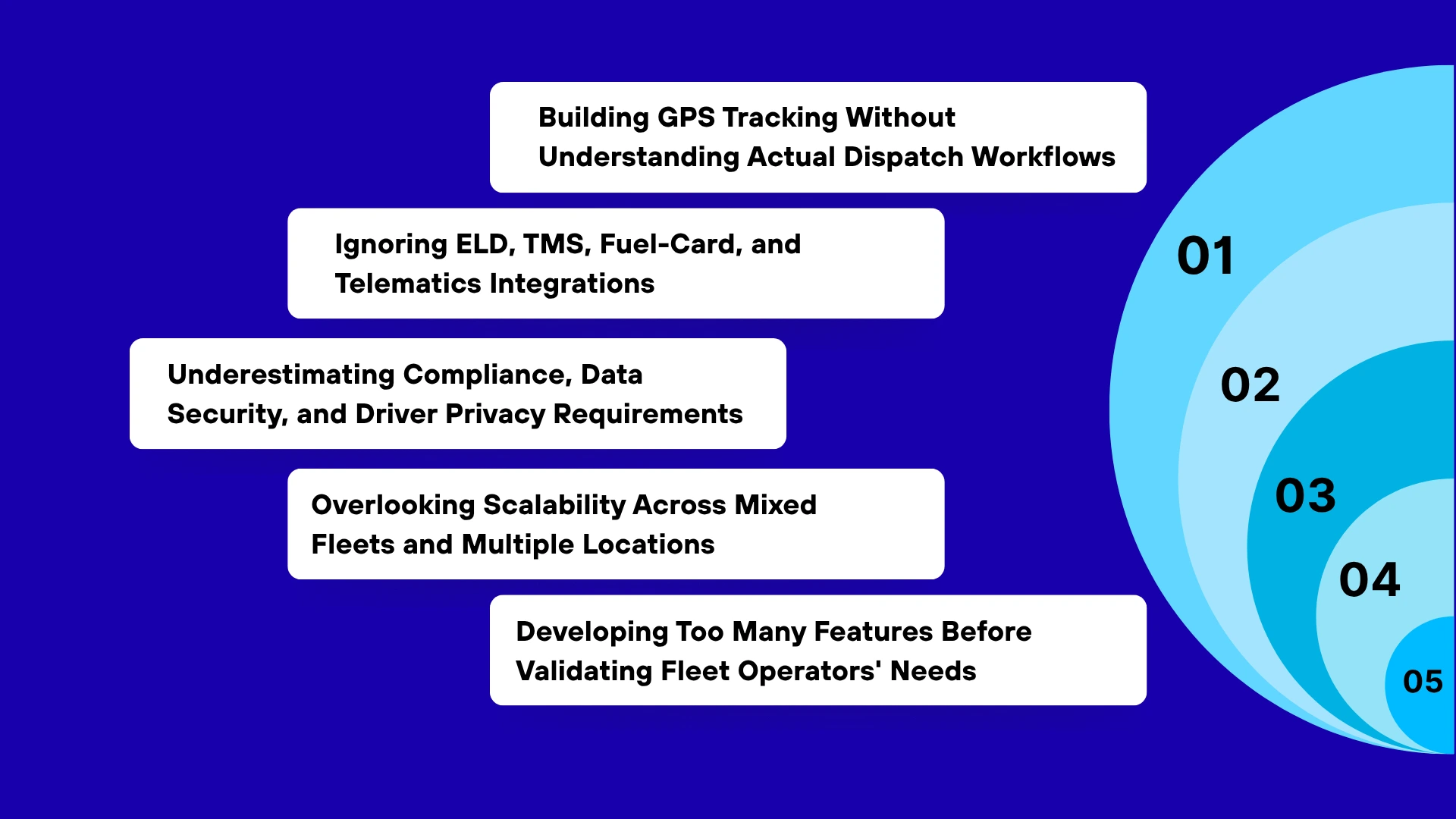
Building GPS Tracking Without Understanding Actual Dispatch Workflows
Don’t build your platform around vehicle locations alone. Dispatchers also need to know whether a tractor has an assigned load, whether its driver has remaining HOS, and whether the attached trailer suits the next shipment. Without these connections, your software shows where trucks are but cannot support reliable load allocation.
Ignoring ELD, TMS, Fuel-Card, and Telematics Integrations
Requiring carriers to replace existing systems creates an expensive adoption barrier. Your software should integrate with established providers such as Samsara, Motive, WEX, and Comdata, alongside commonly used TMS platforms. Without these connections, operators will have to enter information repeatedly, and your product becomes another disconnected system rather than part of their workflow.
Underestimating Compliance, Data Security and Driver Privacy Requirements
Treating compliance as a feature added after development creates expensive redesigns. Your platform must account for FMCSA ELD requirements, HOS records, access permissions, and driver data protection from the architecture stage. If you process location records or video footage, define retention, authorized access, and audit controls before deploying the software.
Overlooking Scalability Across Mixed Fleets and Multiple Locations
A platform designed around one vehicle type or depot can struggle when carriers add refrigerated trailers, owner-operators, or additional terminals. Build configurable vehicle records, location-based permissions, and centralized reporting from the beginning. Otherwise, expanding customers may outgrow your architecture and require costly changes to databases, workflows, and access controls.
Developing Too Many Features Before Validating Fleet Operators’ Needs
Building predictive maintenance, AI dispatch, and advanced analytics before validating demand can consume your development budget without securing adoption. Start by testing a specific operational problem with actual fleet managers, such as fuel reconciliation or maintenance scheduling. A focused MVP gives you evidence about workflow fit, integration requirements, and willingness to pay before expanding.
How GMTA Builds Fleet Management Software
At GMTA, we begin fleet management software development by understanding your fleet’s operating model, existing systems, and biggest operational bottlenecks. A long-haul carrier, an LTL operator, and a refrigerated fleet need different workflows. That’s why we shape the architecture around your actual requirements rather than forcing a ready-made solution.
Our strength lies in connecting complex systems. We develop custom integrations with TMS platforms, ELD devices, telematics providers, and fuel-card systems, helping your team work with connected operational data. We also apply AI where it solves a defined problem, whether that means predicting vehicle faults, identifying fuel discrepancies, or supporting dispatch decisions.
We build for expansion, with configurable modules, secure data access, and performance testing built into development. You retain ownership of the delivered code, and our six months of free post-launch maintenance help address bugs, security patches, and performance issues as your fleet begins using the platform.
Fleet Management Software Cost FAQs
How much does it cost to develop custom fleet management software in the USA?
Custom fleet management software development in the USA can cost anywhere from $30K to over $200K, depending on the scope. A basic platform with GPS tracking, vehicle records, and dispatch management requires less development than a system with ELD integrations, automated driver workflows, predictive maintenance, and advanced analytics. Your final budget depends on integrations, user roles, compliance requirements, and long-term scalability.
Can custom fleet management software integrate with existing ELD and TMS platforms?
Yes, custom fleet management software can integrate with existing ELD and TMS platforms through APIs and supported data interfaces. This allows you to retrieve driver hours, vehicle locations, load assignments, delivery updates, and maintenance records without replacing your current systems. Before development, check each provider’s API access, authentication requirements, data limits, and integration costs to avoid unexpected restrictions.
How do you ensure fleet management software meets FMCSA and ELD compliance requirements?
Fleet management software supports FMCSA compliance by integrating with FMCSA-compliant ELD solutions and correctly handling Hours of Service (HOS) data, driver records, and supporting documentation. The ELD itself must meet applicable technical requirements and be registered with FMCSA. Your software should preserve accurate records, control access, maintain audit trails, and support required data transfers. A custom platform does not become FMCSA-compliant simply by including an ELD dashboard.
Can AI be integrated into fleet management software for predictive maintenance and route optimization?
Yes, AI can support predictive maintenance and route optimization by analyzing vehicle diagnostics, repair history, traffic conditions, delivery schedules, and driver availability. For example, the system can flag recurring engine faults before they lead to breakdowns or compare routes against vehicle restrictions and delivery windows. Reliable results depend on accurate historical data, quality integrations, and models suited to your fleet’s operating conditions.

Founder
Anjali Upadhyay is the Founder of GMTA Software Solutions, a mobile and web application development company she built from the ground up in 2019. Under her leadership, GMTA has delivered 200+ production applications across healthcare, fintech, and on-demand services for clients in the US, UK, Singapore, and UAE. She also leads GMTA’s AI practice, which has shipped production AI systems — including HIPAA-compliant healthcare workflows, LLM-integrated logistics platforms, and fintech automation tools — for US-based enterprise clients. Her writing covers AI product strategy, build-vs-buy decisions for AI systems, and the operational realities of moving AI from proof-of-concept to production at scale.