


Limousine app development is a different problem from taxi app development. A taxi app matches a passenger to the nearest vehicle. A premium limousine platform has to match a chauffeur to a flight. This case study shows how the GMTA team built Li-nk, a native iOS and Android limousine reservation platform, and what founders planning similar limousine app development services should learn from it.
Demand for chauffeured and premium transport is growing in several of the markets GMTA serves. Dubai’s Roads and Transport Authority recorded 21.8 million limousine trips in the first half of 2024, up 50% from the same period a year earlier. In the US, Census Bureau data show limousine service firms earned $4.77 billion in 2022, above the $4.54 billion of 2019 after a fall to $2.28 billion in 2020. Japan received a record 42.7 million foreign visitors in 2025, and England’s licensed private hire fleet reached 290,000 vehicles in April 2026, up 13% since 2024. Airport transfers are a large part of this demand: at Dubai Taxi Company, 62% of limousine trips in 2025 were airport trips. That is where flights, terminals, and chauffeur timing make limousine app development more complex than ordinary ride-hailing.
At a Glance
- Client need: a premium limousine platform for airport transfers in multiple cities
- Project start: 2021
- Built by: the GMTA team
- What we built: passenger app, chauffeur app, and a multi-city admin panel
- Stack: Swift, Kotlin, Laravel (PHP), Node.js with WebSockets, PostgreSQL, MongoDB
- Results in the first month of live operation:
- 40% less manual reservation-management time
- Flight-aware dispatch live at four airports at launch
- 100% of dispatch, tracking, and chat automated
Li-nk is a native iOS and Android limousine reservation platform built by GMTA Software. The client’s insight was simple but underserved: an airport transfer is not ride-hailing with a premium limousine. It is a scheduling problem driven by flight data, terminal layout, and chauffeur timing that most taxi apps never model.
Off-the-shelf ride-hailing scripts could not represent a flight that lands early or a passenger who clears customs late. So we built the platform from the backend up:
- A flight-aware dispatch engine.
- A Laravel-based admin panel that lets non-technical operations staff configure new cities and airports without the development team.
- A Node.js WebSocket real-time layer with a load balancer, so live tracking and dispatch stay responsive when several cities hit peak hour together.
Within the first month of live operation, the platform cut manual reservation-management effort by 40%. Flight-aware dispatch ran at four live airports. Dispatch, tracking, and chat were fully automated. You can also read the shorter Li-nk case study on our site.
Why Is Limousine App Development Different From Taxi App Development?
Every ride-hailing app treats a pickup the same way: a passenger opens the app, requests a limousine, and a chauffeur comes.
That model works when the passenger is already at the curb. An airport transfer starts earlier, while the passenger is still on a flight that may land early or late.
Airport transfer software depends on flight status, terminal layout, gate changes, customs time, and baggage time. A distance-and-ETA model cannot represent any of these, because a flight’s actual arrival time is not a function of where the passenger is when the reservation is made.
That difference was the entire brief. The client was not asking for a taxi app with a limousine skin. They wanted a platform where the arrival experience was the default: a chauffeur positioned and briefed by the time the passenger clears the terminal.
Departure reservations needed to work against a flight’s scheduled time, not the passenger’s current location. Each new market also had to bring its own airports, terminals, and chauffeur pools without becoming a separate software project.
That last requirement is easy to state but complex to build. It is the difference between “we support Singapore” and “we support any city, configured by an operations person, not the development team.” It shaped almost every architectural decision that followed.
Why Off-the-Shelf Ride-Hailing Scripts Were Already Ruled Out
By the time this project reached us, the client had already evaluated white-label ride-hailing scripts and rejected them. That decision was correct. Most founders in this space ask the same question first, so it is worth explaining why.
Can you build a limousine or airport transfer app on top of an existing ride-hailing script? Not if flight-aware dispatch, terminal-level configuration, or scheduled departure logic are core requirements. Standard ride-hailing scripts are built around on-demand, distance-based trip matching. Retrofitting flight data or terminal logic onto that model creates more technical debt than building the dispatch layer correctly from the start.
| White-label ride-hailing script | Custom-built airport transfer platform | |
| Dispatch trigger | Manual request or immediate proximity match | Flight status, gate, buffer time |
| Departure scheduling | Basic future-dated reservation, no flight link | Scheduled against flight departure time |
| City/airport configuration | Code changes per market | Admin-configurable, no code |
| Limousine categories | Often flat or single-tier | Per-city rules (sedan, MPV, charter) |
| Communication | Usually phone-number exchange | In-app chat tied to the specific reservation |
| Currency/language | Frequently single-market | Configurable per market at runtime |
Forcing flight-aware logic onto a taxi-script foundation is not a cosmetic problem. It shows up operationally. Dispatch tied to a manual trigger means a chauffeur waits unnecessarily, which is a cost. Or the chauffeur arrives late, which is a service failure. Neither is acceptable in premium transport, where the value is that the limousine is there when the passenger is.
What Is Flight-Aware Dispatch?
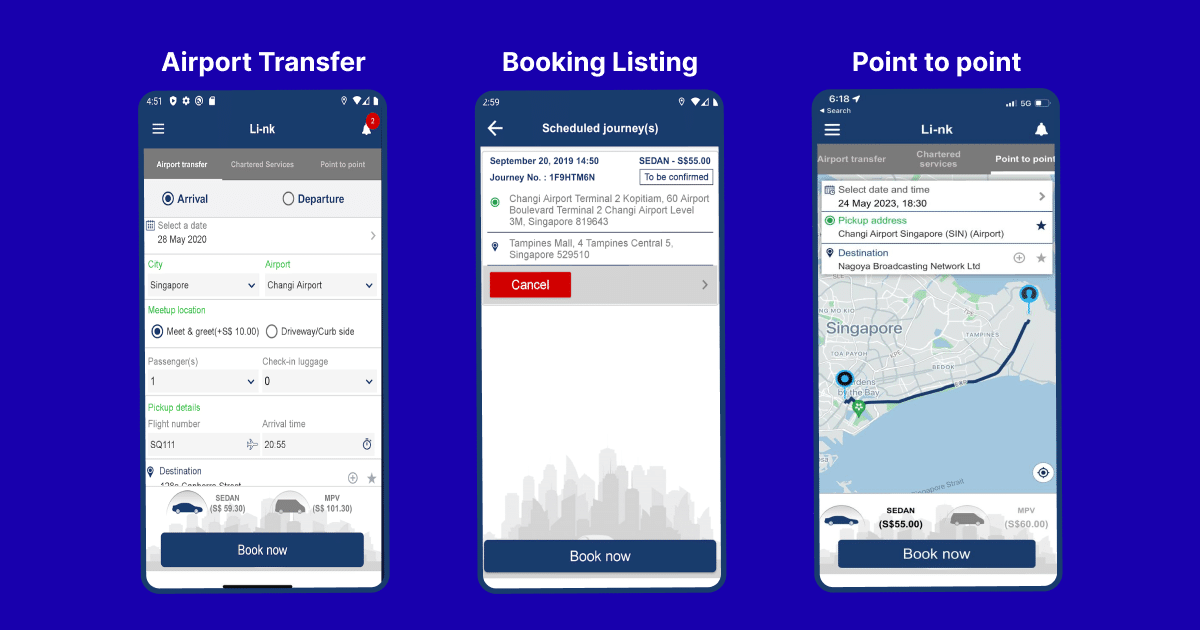
Flight-aware dispatch is a reservation system that calculates a chauffeur’s departure time by working backward from the flight’s terminal and gate, plus the expected customs and baggage buffer. It does not simply match a chauffeur to a passenger by distance. The chauffeur is timed to the passenger’s actual walk-out, not a static appointment time.
This sounds like a small addition to a reservation form. It is not. It is the mechanism the entire product depends on, which is why we started the project by mapping an airport, not a user journey.
Before any interface design began, we worked through how an arrival transfer behaves from the moment a flight lands to the moment the passenger is in the limousine. What changes if the flight is early? What changes if it is delayed by two hours? What does the chauffeur need to know, and exactly when? Is it twenty minutes before touchdown, or when the passenger reaches the curb?
Answering these questions before any screen existed meant the reservation logic was correct before the interface had to accommodate it. We did not adjust the logic afterward to fit the screens.
At reservation confirmation, the system calculates the chauffeur’s departure time from gate, terminal, and estimated customs or baggage buffer data. That calculation separates an arrival transfer from a ride request. The trigger for chauffeur movement is the flight’s actual behavior, not the passenger tapping a button.
How Do You Scale Airport Transfer Software to New Cities?
Separate operational configuration from the application codebase entirely. Airports, terminals, limousine categories, and city-level rules live in an admin panel, so a new city is activated by configuration, not a development cycle.
Every city Li-nk operates in has different airports, different terminal layouts, and different limousine category rules. If any of that lived in application code, opening a new city would involve the development team, a deployment, and a delay. That is the opposite of what a business trying to expand quickly needs.
We built a Laravel-based admin panel to take the development team out of that loop. From the panel, the operations team can:
- Activate a new city
- Configure its airports and terminals
- Assign limousine categories per location
- Monitor active chauffeurs on a live map
- Review reservation distribution across markets
This was not just a convenience feature. A configuration error cascades directly into dispatch logic, because a misconfigured terminal mapping sends a chauffeur to the wrong gate for a real passenger. So access control had to sit at the API level, not only in the interface. A city operations manager can manage their own city’s configuration but cannot touch global settings. That boundary is enforced server-side, not just hidden in the UI.
Real-Time Dispatch and Tracking Under Load
Why does live tracking break down in multi-city ride platforms during peak hours? Basic proximity matching ignores limousine category, zone, and simultaneous demand across cities. If the real-time layer does not distribute connections across server instances, peak-hour load in several cities at once slows dispatch and location updates at the moment reliability matters most.
Matching a passenger to the right chauffeur is not just “nearest available vehicle.” It must account for limousine category (a passenger who reserved an MPV should not be matched to a sedan), zone, and chauffeur availability at the same time. It must also keep working when several cities hit peak hour together, the scenario most likely to expose weaknesses in a real-time architecture.
We built this layer with Node.js and WebSockets. Persistent connections stay open between the server, the chauffeur apps, and the passenger apps for the duration of an active reservation. Reservation assignments, live location updates, and in-app chat messages all travel through the same connection layer, so none needs its own polling request. Polling at scale is what usually produces the lag passengers notice as “the map isn’t updating.”
A load balancer sits in front of this layer to distribute incoming connections across server instances. We tested it against simulated multi-city peak-hour load before launch, because that is the condition under which a system either holds up or does not. An architecture that works until three cities hit rush hour together earns no partial credit.
In-App Chat: A Trust Decision, Not a Convenience Feature
Why build in-app chat instead of sharing phone numbers between the passenger and the chauffeur? Sharing phone numbers exposes both parties’ privacy, leaves no record if a dispute arises, and handles real-time changes (a moved gate, a delay) through a channel not tied to the reservation.
For a premium service, this is also brand consistency. A limousine passenger exchanging personal numbers with a chauffeur they have never met does not match the professionalism the rest of the product establishes.
We built socket-based chat tied to each active reservation: private, logged against that trip, visible only while the ride is in progress. Access to the conversation closes with the reservation. That limits ongoing exposure between passenger and chauffeur after the trip, while still leaving a reference record if a dispute needs resolving.
Multi-Currency, Multi-Language Reservation Flows
What does it take for a reservation platform to serve passengers across multiple countries? Currency conversion and language localization must both apply from the reservation stage through to the receipt, not just at payment display. Both must be configurable per market from an admin panel, without a new deployment for each region.
A passenger reserving in one currency and receiving a receipt in another is not a translation problem. It is a data-modeling problem. Pricing, confirmations, the admin panel’s own reporting: each needs consistent currency and language at every stage.
We built runtime currency conversion into the reservation flow. Language switching sits in the confirmation flow too. Both are configurable per market from the admin panel, without a code deployment.
To be precise rather than promotional: the platform’s architecture supports activation in new cities and countries as the business expands. That multi-city, multi-currency capability works in production. The platform was designed so that expanding to a new market is an operations and business-development task, not a rebuild.
Native iOS and Android for Limousine App Development
Why native iOS and Android instead of a cross-platform framework? Background GPS tracking, push notifications when the app is closed, smooth map rendering during live tracking, and reliable camera access all behave more consistently in native builds. For a premium transport product, those behaviors are inseparable from the perceived quality of the service.
This was a client requirement from the first conversation, and we agreed with it rather than pushing back toward a faster cross-platform build. The trade-off genuinely favored native for this product:
| Consideration | Cross-platform | Native (Swift/Kotlin) |
| Background GPS accuracy | Inconsistent across OS versions | Reliable, OS-level integration |
| Push notifications (app closed) | Can be delayed or dropped | Handled at the OS level |
| Live map rendering | Can lag under frequent updates | Smoother under continuous updates |
| Development effort | Lower, single codebase | Higher, two parallel codebases |
| Long-term maintenance | Simpler for basic apps | More effort, no framework-layer constraints |
The extra development effort, two codebases built in parallel against the same backend API, was a deliberate trade-off. In a category where “the app felt slightly laggy” is a service failure, product quality justified it.
Full stack used:
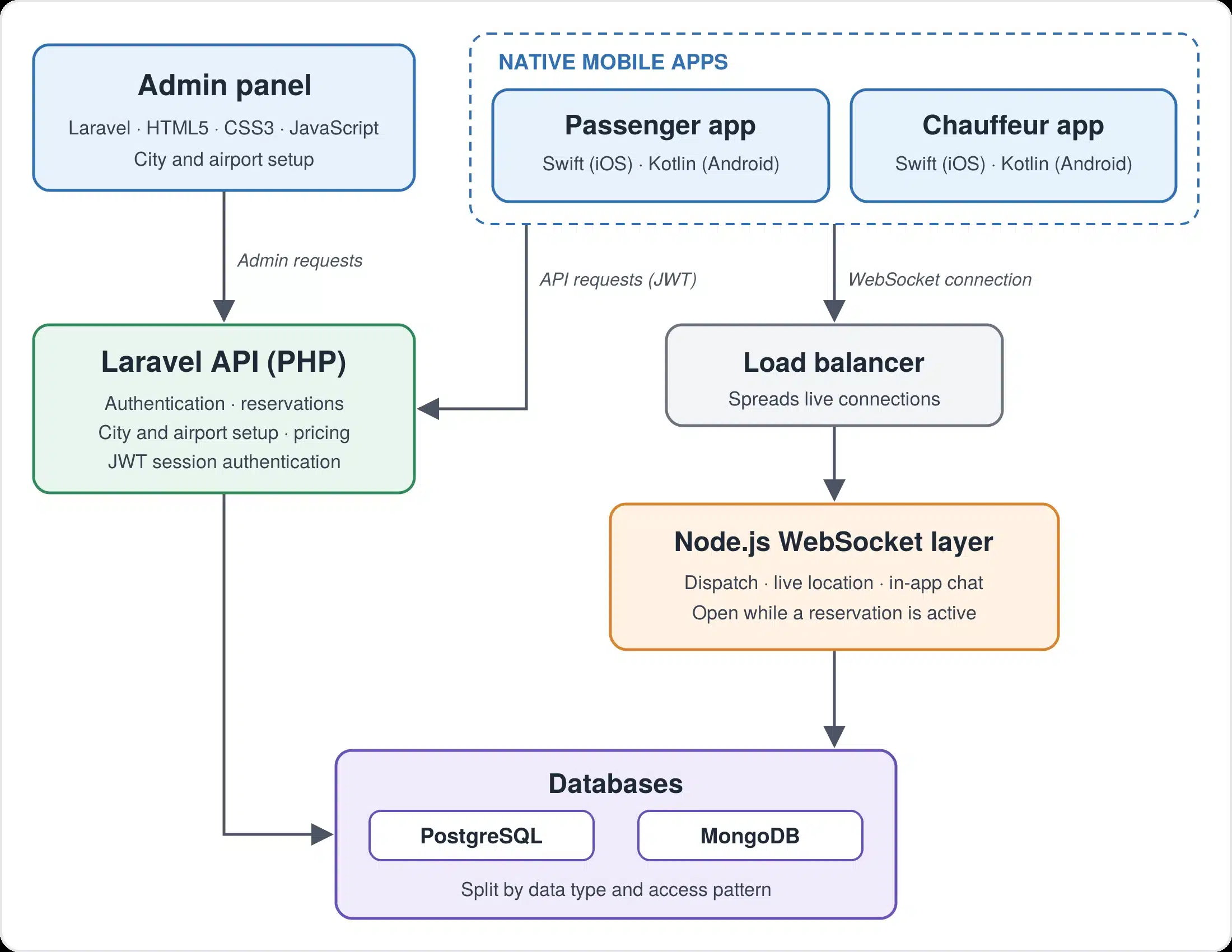
- Mobile: Swift (iOS), Kotlin (Android)
- Backend API: Laravel, PHP: authentication, reservations, city/airport configuration, pricing
- Real-time layer: Node.js, WebSockets: dispatch, live location, in-app chat
- Databases: PostgreSQL, MongoDB, split by data type and access pattern
- Security: JWT for API session authentication
- Infrastructure: load balancer for distributing real-time connections
- Maps/location: [CONFIRM WITH GAURAV: Google Maps API or OpenStreetMap]
- Admin panel front end: Laravel, HTML5, CSS3, JavaScript
Challenges We Navigated
Being direct about where the difficulty lived matters more than listing features. The five most complex problems were:
- Modeling dispatch against a variable, a flight, instead of a fixed distance. Standard reservation logic assumes the passenger’s location is known and stable. A flight’s arrival time is not fixed until it happens.
- Making city configuration independent of the development team, not just simpler. The test was not “can an engineer configure a new city faster” but “can an operations manager do it without the development team.”
- Keeping real-time performance consistent across simultaneous cities. That meant testing for the failure condition (concurrent peak load), not the average condition.
- Enforcing access boundaries at the API level. Role-based admin permissions could not be bypassable through the interface.
- Handling edge cases that only appear in production. Examples: WebSocket reconnection after a dropped connection, chauffeur reassignment after a rejection, currency switching mid-session.
Process: How We Approach Limousine App Development
The Li-nk project started in 2021 and was delivered by the GMTA team in three phases. The passenger app, the chauffeur app, and the admin panel were built and tested together, not one after another.
- Discovery and system architecture. We mapped the airport transfer workflow end to end, defined the multi-city configuration model, planned the PostgreSQL/MongoDB database split, and wrote the complete API contract for all three surfaces before development began.
- Core development. The Laravel API, the Node.js real-time layer, the load balancer, and both native apps were developed concurrently, with weekly integration checkpoints. Dispatch logic, live tracking, chat, and multilingual currency flows were built in parallel rather than one surface at a time, so every part of the system stayed consistent as it evolved.
- QA, load testing, and phased launch. Testing targeted the scenarios most likely to break in production: flight-delay rescheduling, peak-hour concurrent load across cities, mid-session currency switching, chauffeur reassignment after rejection, and WebSocket reconnection after dropped connections. The platform launched with a controlled chauffeur pool, then rolled out in phases. That validated the operational model at small scale before expanding it.
Results: What Changed After Launch
The platform produced three measurable outcomes within the first month of live operation:
- 40% reduction in manual reservation-management time. Dispatch, assignment, and tracking ran automatically instead of through manual coordination.
- Flight-aware dispatch live across four airports at launch. This proved the terminal and gate configuration model worked in production, not just in testing.
- 100% of dispatch, tracking, and chat automated. The operational effort previously spent on coordination could shift toward growth and chauffeur network management.
What Founders Should Take From This Limousine App Development Project
A few principles from this project apply beyond Li-nk:
- Start with the operational workflow, not the interface. Reservation logic that is correct before design begins does not need retrofitting later. Retrofitting dispatch logic around a finished UI is a common source of technical debt in this category.
- If your growth model depends on new markets, configuration has to be a business capability, not an engineering task. The cost of getting this wrong stays invisible until your second or third city, when every new market becomes its own mini development project.
- Test for your worst-case load, not your average. Peak-hour concurrent demand across cities decides whether a real-time architecture holds up.
- Let service quality drive native-platform decisions, not development speed alone. This matters most where background location tracking and notifications are core to the experience.
- Plan your budget with real numbers. Our taxi app development cost guide explains what drives cost in on-demand mobility platforms.
Talk to Us About Your Limousine App Development Project
Premium limousine services, airport transfers, executive transport, and charter networks are not problems a generic ride-hailing script solves well. If you are planning a limousine platform, our limousine app development services team has already worked through flight-aware dispatch, multi-city configuration, and real-time architecture. We would like to hear what you are building.
FAQs
What is limousine app development?
Limousine app development is the design and build of software for premium chauffeured transport: reservation apps for passengers, apps for chauffeurs, and an admin panel for operations. It differs from taxi app development because it has to handle scheduled reservations, flight data, and per-city rules.
What makes airport transfer software different from a standard ride-hailing app?
It has to account for flight status, terminal layout, gate details, and scheduling against a flight’s departure or arrival time. A standard on-demand, distance-based model does not handle these inputs.
Can a white-label ride-hailing script be adapted for airport transfers?
It can be modified, but flight-aware dispatch, terminal-level configuration, or scheduled departure logic usually require rebuilding the core reservation logic, because those scripts are built around proximity, not flight data.
What features does a limousine reservation app need?
Core features include scheduled reservations, flight-aware dispatch, a chauffeur app with live navigation, live tracking, in-app chat tied to the reservation, multi-currency and multi-language support, and an admin panel for city, airport, and limousine category setup.
How long does limousine app development take?
It depends on scope: the number of apps, the dispatch logic, the number of cities, and the integrations. A platform like Li-nk, with native passenger and chauffeur apps, flight-aware dispatch, and a multi-city admin panel, follows three phases: discovery and architecture, core development, and QA with a phased launch. Share your scope and the GMTA team will give you an estimate.
Why use native app development instead of cross-platform frameworks for a limousine app?
Native development is typically chosen when background GPS accuracy, reliable push notifications, and smooth live-map rendering are critical to service quality. All three tend to behave more consistently in native builds.
What technology is used for real-time chauffeur tracking and dispatch?
Chauffeur tracking and dispatch run on persistent connections, commonly Node.js with WebSockets, paired with a load balancer that distributes connections across server instances under concurrent demand.

Founder
Anjali Upadhyay is the Founder of GMTA Software Solutions, a mobile and web application development company she built from the ground up in 2019. Under her leadership, GMTA has delivered 200+ production applications across healthcare, fintech, and on-demand services for clients in the US, UK, Singapore, and UAE. She also leads GMTA’s AI practice, which has shipped production AI systems — including HIPAA-compliant healthcare workflows, LLM-integrated logistics platforms, and fintech automation tools — for US-based enterprise clients. Her writing covers AI product strategy, build-vs-buy decisions for AI systems, and the operational realities of moving AI from proof-of-concept to production at scale.