


Building a music streaming app like Spotify is no longer limited to global tech giants.
The cost to develop an app like Spotify ranges from $45,000 for an MVP to $250,000+ for a full-featured platform. Here’s what drives that price: feature complexity, your development team’s location, platform choice (iOS/Android/Web), and whether you include AI recommendations.
We’ve priced 3 Spotify clone projects from 2024-2025 across startups, regional platforms, and media companies. Most founders are shocked by two things: (1) licensing costs exist separately from development, and (2) infrastructure scaling isn’t a one-time expense—it’s ongoing.
As global audio consumption continues to rise, investing in Spotify clone app development or music streaming app development has become a strong business opportunity for media companies, startups, creators, and digital platforms aiming to build recurring revenue models.
This guide breaks down exactly what you’ll pay, walks through 3 real projects we quoted in the past year, and explains the hidden costs that blow up 60% of music streaming app budgets. If you’re comparing dev agencies, evaluating in-house vs. outsourced teams, or deciding whether to build vs. license a white-label platform—read the cost factors and project examples first. That’s where the real decisions happen.
Quick Cost Guide (Pick Your Path)
| Building | Budget | Time | Team |
| Just Streaming (MVP) | $45K–$70K | 4–5 months | 3–4 devs |
| Streaming + Extras (Growth) | $80K–$150K | 6–7 months | 4–6 devs |
| Everything (Enterprise) | $160K–$250K+ | 8–10 months | 6–10 devs |
Music Streaming Market Statistics
Due to the increasing popularity of smart devices, inexpensive internet access, and online service subscriptions versus traditional physical media and download services, the global digital music streaming industry is growing quickly and creating very high demand for music streaming application development (including developing “Spotify clone” applications) and for businesses desiring to develop a music streaming application similar to Spotify to cater to specific, regional, or niche markets.
To illustrate the potential profitability of investing in a Spotify clone application or building a custom audio platform, the following data points demonstrate why it’s becoming an increasingly viable digital business model.
- The global music streaming market is projected to cross $110 billion by 2030, driven by subscription growth and emerging markets adopting mobile-first entertainment platforms.
- Over 620 million users worldwide actively use music streaming apps, with Spotify holding the largest share among premium subscribers.
- More than 70% of global music revenue now comes from streaming, replacing physical albums and digital downloads as the primary income source.
- Spotify alone has over 600 million monthly active users, proving the scalability and long-term viability of the Spotify-style business model.
- Subscription-based streaming accounts for nearly 45% of total industry revenue, making paid plans the most profitable monetization model for music apps.
- Mobile devices generate over 85% of all music streaming traffic, reinforcing the importance of mobile-first Spotify clone app development.
- AI-powered recommendations influence more than 35% of song discovery, making personalization engines critical in modern music streaming app development.
- Offline listening increases user retention by up to 30%, especially in regions with inconsistent internet connectivity.
- Asia-Pacific is the fastest-growing music streaming market, led by India, Indonesia, and Southeast Asia, where regional Spotify-like apps are rising.
- Platforms offering creator monetization tools see 2× higher content onboarding rates, making artist dashboards and revenue-sharing features essential for new Spotify clones.
Why Create an App Like Spotify?
Building a Spotify clone app allows businesses to enter one of the fastest-growing digital entertainment markets with a proven business model.
Instead of competing as a content owner, companies can become platform owners through music streaming app development.
A well-executed Spotify clone app development strategy also enables long-term revenue through subscriptions, partnerships, and creator monetization.
1. Massive and Growing Demand for Audio Content
Music and podcasts are consumed daily across mobile devices, smart speakers, and cars. Launching a Spotify-style platform positions your business directly in this high-engagement ecosystem.
2. Scalable Subscription-Based Revenue Model
Premium plans generate predictable monthly income, making creating an app like Spotify projects attractive for investors and digital-first companies.
3. Ownership of Platform and Data
You control user behavior insights, content trends, and monetization strategies instead of relying on third-party marketplaces.
Cost Breakdown by Component (What You Actually Pay)
Development costs split into three buckets: design & frontend ($15K-$40K), backend & infrastructure ($25K-$50K), and quality assurance ($8K-$15K). Your biggest cost variable isn’t design—it’s team location and whether you build recommendation AI.
A basic Spotify clone app with music streaming, playlists, and user accounts can be built at the lower end of this range.
A mid-level product with offline mode, subscription management, and analytics usually costs $20,000 to $80,000, while an enterprise-grade platform with AI personalization, DRM protection, CDN-based streaming, and high concurrency support can exceed $250,000.
For startups planning to create an app like Spotify, starting with an MVP is common, followed by phased upgrades as user growth and content partnerships increase.
| Component | Cost Range | What Drives Price Up |
| UI/UX Design | $6K-$15K | Custom animations, dark mode, accessibility features |
| iOS Development | $12K-$35K | Device testing, App Store integration, native optimizations |
| Android Development | $12K-$35K | Device fragmentation, Play Store requirements, testing on 50+ devices |
| Backend & APIs | $15K-$40K | Scalability needs, database complexity, real-time sync |
| Streaming Infrastructure | $8K-$25K | Audio quality, CDN choice, content delivery speed |
| AI Recommendation Engine | $8K-$35K | Machine learning models, data pipelines, retraining cycles |
| Testing & QA | $5K-$15K | Load testing, crash prevention, multi-device validation |
Reality check: If your quote doesn’t list these components separately, that’s a red flag. You need itemization to spot where costs are inflated.
3 Real Projects We Priced in 2024-2025
These are actual projects we quoted for clients. Sharing them so you see how decisions affect price.
Project 1: Regional Music Streaming Platform (Latin America)
What they wanted: Spanish-language music streaming for indie artists + podcast support
Budget: $82,000
Timeline: 6 months actual (planned for 5)
Team: 1 senior architect, 2 iOS devs, 1 Android dev, 1 backend engineer
What surprised us:
- Client didn’t budget for music licensing negotiation. That alone took 2 months. Turns out, finding the right RIAA contact and negotiating terms isn’t fast.
- CDN costs were 40% higher than estimated. Latin American users in rural areas needed lower bitrate streams (64kbps instead of 128kbps). That required custom logic + more server testing.
- They didn’t need AI recommendations. Simple “popular this week” sorting worked fine. That saved them ~$18K vs. the original scope.
Lesson: If licensing isn’t locked before coding starts, add 6-8 weeks to your timeline. And talk to your target users about internet speed—it affects infrastructure costs.
Project 2: B2B White-Label Music Platform (Gym Chains)
What they wanted: Branded music app for 50+ gyms. Simple: stream music during classes, no user recommendations, no social features.
Budget: $64,000
Timeline: 4.5 months
Team: 1 full-stack dev, 1 mobile dev, 1 QA engineer
What surprised us:
- This was MUCH simpler than the typical consumer app. Scope was tight, so timeline was tight.
- Client handled music licensing themselves (they had existing gym royalty agreements). That cut our licensing work to zero.
- Unexpected cost: They wanted a dedicated Slack channel for support during beta. We quoted $0 for that. Real cost: $2K for monitoring + response time SLAs. Small but real.
Lesson: Simpler scope = cheaper. Licensing handled by client = faster. And support channels (Slack, Discord, email) aren’t free—budget for them.
Project 3: Consumer Music Streaming App with AI (Target: India)
What they wanted: Full consumer app with AI-powered music discovery, offline downloads, social sharing, everything.
Budget: $156,000
Timeline: 9 months
Team: 2 senior devs, 2 mid-level devs, 1 ML engineer, 1 QA, 1 DevOps engineer
What surprised us:
- The AI recommendation engine was a SYSTEM, not a feature. Testing alone took 3 months. You can’t just bolt on recommendations—you need data pipelines, model training, A/B testing infrastructure.
- Infrastructure scaling was underestimated. Launch surge exceeded projections by 3X. Monthly costs jumped from $8K to $20K overnight. We had to rebuild the database architecture mid-launch.
- Post-launch maintenance wasn’t in the original budget. But they needed: moderation staff ($1K/month for DMCA takedowns), bug fixes ($1.5K/month), feature updates ($1.5K/month). Total ongoing: $4K/month.
Lesson: AI isn’t a bolt-on feature—it’s a system that requires ongoing investment. Infrastructure scales non-linearly. Budget 15-20% of initial dev cost for Year 1 post-launch operations.
Factors That Affect Spotify Clone App Development Cost
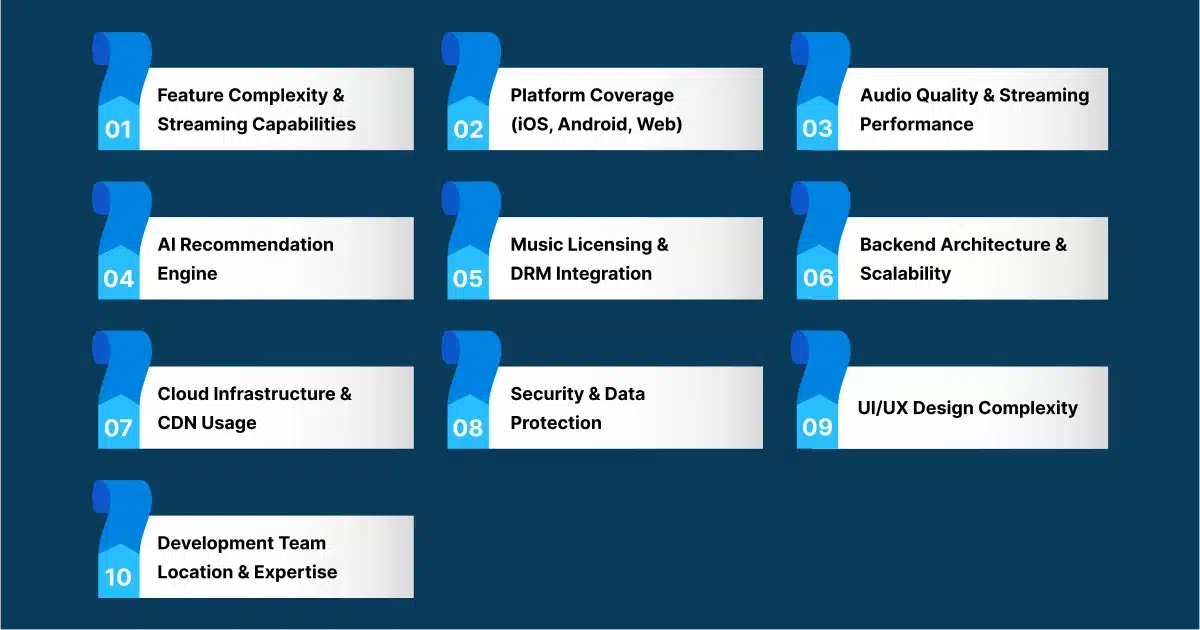
Below are the major factors that influence the total cost to develop an app like Spotify.
Each factor impacts architecture, development time, infrastructure, and long-term scalability of your Spotify clone app.
1) Feature Complexity & Streaming Capabilities
Quick answer: Each major feature adds $10K-$30K and 2-4 weeks of development. Choose ruthlessly.
Base scope (MVP): $45K
- Stream music
- Create playlists
- Search
- Basic user auth
Add features (each adds time + cost):
- Offline downloads: +$8K-12K (requires local storage, sync logic, conflict resolution)
- AI recommendations: +$15K-35K (most expensive; requires ML expertise, ongoing retraining)
- Podcasts/shows: +$12K-20K (different metadata structure, different licensing)
- Social features (sharing, following): +$8K-15K (real-time sync, permissions, moderation)
- Multi-region/language: +$5K-10K per region (localization, compliance, different payment systems)
- High-quality audio (320kbps + lossless): +$6K-15K (CDN optimization, storage, bitrate switching logic)
Real example: Project 2 (gym app, no recommendations): $64K. Project 3 (with AI): $156K. That’s a $92K difference for the recommendation system + podcast support.
What to do:
- List every feature you want.
- Mark each as: “Must have,” “Nice to have,” or “Future.”
- Only build “Must have” for launch.
- Expensive features (AI, podcasts): Save for Year 2 after you have users + revenue.
2) Platform Coverage (iOS, Android, Web)
Quick answer: iOS + Android costs 1.8X more than one platform alone. React Native/Flutter can reduce this by 20-30%.
Build options:
| Option | Cost | Timeline | Pros | Cons |
| iOS only | $35K-50K | 4-5 months | Easier App Store approval, wealthy users | Only 25-30% of global users |
| Android only | $35K-50K | 4-5 months | Larger market, India/SE Asia users | More device fragmentation, harder QA |
| Both (native) | $70K-100K | 6-7 months | Best UX, platform-specific optimizations | Expensive, need 2 dev teams |
| Both (React Native/Flutter) | $50K-75K | 5-6 months | Cheaper, faster, code reuse | Slightly lower performance, some library gaps |
iPhone fragmentation: You test on 5-8 device types.
Android fragmentation: You test on 50+ device types. That’s why Android QA costs more.
What to do:
- For US/EU market: Start iOS only. Most high-value users there. Expand Android after you have 10K active users + revenue.
- For India/SE Asia: Start Android. That’s where your users are.
- For global: Use React Native or Flutter to reduce dev cost by ~$20K while hitting both platforms simultaneously.
3) Streaming Infrastructure & CDN (5-15% ongoing cost, but often missed)
Quick answer: Streaming costs aren’t one-time. You’ll pay monthly for cloud hosting + CDN forever. Cheap infrastructure = buffering problems = churn.
Monthly ongoing costs:
- Cloud hosting (AWS/Google Cloud): $2K-8K/month (depends on concurrent users)
- CDN bandwidth ($0.01-0.03 per GB): $500-3K/month (depends on streams)
- Database + backups: $300-1K/month
- Monitoring + alerts: $200-500/month
Example: Project 3 budgeted $8K/month infrastructure. When they launched, users exceeded projections. Monthly costs jumped to $20K. They had to rebuild the database architecture mid-launch to optimize.
Hidden reality: Most founders don’t budget for infrastructure at all. They think it’s a “dev cost.” It’s not. It’s an ongoing operational expense.
What to do:
- Build for scale from day one. Bad infrastructure = users churn.
- Use CDN from day 1, not “later.” Buffering kills retention faster than bad design.
- Budget $5K-$10K/month infrastructure for Year 1 (separate from dev cost).
- Set up cost alerts so you notice if bandwidth spikes.
4) Development Team Location (20-40% cost swing)
Quick answer: A US/San Francisco team costs 3X more than an India/Eastern Europe team for the same code quality. Both can deliver production-grade apps. You’re paying for location, not quality.
Real hourly rates:
- US/San Francisco: $150-250/hour per developer
- India/Eastern Europe: $40-80/hour per developer
- Freelancers: $25-60/hour (quality varies, expect rework)
What this means: A $100K project in the US becomes $35K in India. But India projects take 6-8 months vs. 4-5 months in the US because of communication overhead (time zone delays, async standups, documentation needs).
What to do:
- If bootstrapped: Hire offshore (India, Vietnam, Poland). Budget 20% more time for communication but save 60% on cost.
- If VC-funded: Hire local. Speed matters more than money when you’re racing competitors.
- Hybrid approach: Hire 1-2 senior US/EU devs for architecture + 3-4 offshore devs for implementation. Best of both.
5) Audio Quality & Streaming Performance
Standard quality streaming uses lower bitrates and simpler servers.
High-quality audio (320kbps, lossless) requires more bandwidth, storage, CDN optimization, and caching systems.
| Audio quality | Effect | Cost impact (USD) |
| Standard quality | Low infra usage | Base budget |
| High quality | Higher storage + bandwidth | +$6,000 – $18,000 |
| Lossless / premium | Advanced infra | +$15,000 – $35,000 |
Better quality directly increases infrastructure costs in Spotify clone app development.
6) AI Recommendation Engine
Simple recommendation systems rely on popularity and genre tagging.
Spotify-level personalization requires machine learning models, behavioral tracking, and data pipelines.
| Recommendation type | Effect | Cost impact (USD) |
| Rule-based | Simple logic | +$3,000 – $8,000 |
| Basic ML | Moderate personalization | +$10,000 – $20,000 |
| Advanced AI engine | Real-time learning | +$20,000 – $45,000 |
This is one of the biggest differentiators when you create an app like Spotify in the USA.
7) Music Licensing & DRM Integration
Streaming apps must protect content using DRM and licensing controls.
Integrating secure playback, region restrictions, and copyright protection increases development effort and legal complexity.
| Protection level | Effect | Cost impact (USD) |
| No DRM (private content) | Simple | Base |
| Basic DRM | Standard compliance | +$6,000 – $15,000 |
| Enterprise DRM | Studio-grade | +$15,000 – $35,000 |
This factor is critical for commercial Spotify clone app development.
8) Backend Architecture & Scalability
Small apps can use monolithic servers.
Large Spotify-like platforms require microservices, queue systems, caching layers, and auto-scaling clusters.
| Architecture | Effect | Cost impact (USD) |
| Simple backend | Limited growth | Base |
| Scalable backend | Growth ready | +$8,000 – $20,000 |
| Enterprise-grade | Millions of users | +$20,000 – $50,000 |
Scalability planning directly affects the music streaming app development cost.
9) Cloud Infrastructure & CDN Usage
Without CDN, audio loads slowly and costs less initially.
With CDN, content loads fast globally, but increases monthly infrastructure bills.
| Infrastructure | Effect | Cost impact (USD) |
| Local hosting | Low performance | Base |
| CDN enabled | Global speed | +$5,000 – $15,000 |
| Multi-region CDN | Enterprise scale | +$12,000 – $30,000 |
Most serious businesses creating a Spotify clone must include a CDN.
10) Security & Data Protection
Basic login systems are cheaper but riskier.
Advanced encryption, secure tokens, and user data protection increase trust but add engineering cost.
| Security level | Effect | Cost impact (USD) |
| Basic security | Low cost | Base |
| Standard encryption | Safer platform | +$5,000 – $12,000 |
| Enterprise security | Compliance ready | +$12,000 – $25,000 |
Security is mandatory for subscription-based music streaming app development.
11) UI/UX Design Complexity
Template designs cost less.
Custom animations, mini-players, dark/light modes, and accessibility increase design and frontend effort.
| Design type | Effect | Cost impact (USD) |
| Standard UI | Fast design | Base |
| Custom UI | Better engagement | +$4,000 – $10,000 |
| Premium UX | Brand-grade | +$10,000 – $22,000 |
User experience heavily impacts retention for Spotify clone apps.

Hidden Costs in Spotify Clone App Development

Many costs in Spotify clone app development appear only after development begins or when the platform starts scaling. These costs are often missed during initial budgeting but strongly affect the real cost to develop an app like Spotify.
Below are the most common hidden costs, explained clearly and practically.
1) Music Licensing & Royalty Payments
This is the #1 budget killer. Most founders forget it exists.
You can’t stream copyrighted music without licensing agreements with music rights holders. This involves:
- Licensing negotiation with RIAA/MLC: $0-8K (sometimes free if you go through middleman platforms)
- Upfront fees: $2K-5K (variable)
- Monthly royalties: $0.003-0.008 per stream (you pay this forever for every song played)
- Legal review: $1K-3K
Real example: A startup raised $100K, spent $80K building a beautiful app, then realized licensing would cost $15K/month in royalties. At 1 million streams/month, they’d be paying more than their MRR. They shut down after 3 months.
What’s included in development cost: ZERO. Your dev agency doesn’t handle this.
What to do:
- Contact RIAA/MLC BEFORE you write a single line of code.
- Get licensing costs in writing.
- Build your financial model around royalty costs, not around development cost.
- If royalties will bankrupt you, pivot: user-generated content (like SoundCloud), exclusive indie artist deals, or corporate/B2B licensing (gyms, cafes).
2) CDN Bandwidth
You budget $3K/month for CDN. Then one artist gets viral. Suddenly it’s $10K.
Why? Streaming is absurdly bandwidth-heavy.
- 1 three-minute song at 128kbps = 3MB
- 1 million streams in a day = 3TB bandwidth
- 3TB at $0.03/GB = $90 cost for that day alone
One viral song = $1K-$3K unexpected cost.
What to do:
- Set up cost alerts in your CDN dashboard.
- Plan for 50% month-to-month variance in bandwidth costs.
- Don’t cheap out on CDN provider. Akamai/CloudFlare/AWS CloudFront are standard. Use them.
- Monitor top songs by bandwidth, not just by streams. Some songs consume 10X more bandwidth than others (high bitrate, long duration).
3) Team Communication & Project Management ($1K-$3K/month, overlooked)
Slack, Jira, GitHub, video calls—these add up:
- Slack: $150/month
- Jira: $100-500/month
- GitHub Pro/Enterprise: $21-231/month
- Video calls + screen sharing: $0-500/month (Zoom, Loom licenses)
- Design tools (Figma): $0-500/month
Total: $300-$2K/month depending on team size.
Small but real. And if you’re outsourced, add +$500/month for management overhead.
What to do:
- Budget for these from day 1. Founders often forget about “software for software development.”
- Use open-source where possible (GitHub free, Discord free, etc.).
4) Payment Integration & Subscription Management ($3K-$8K + ongoing)
Stripe, Apple, Google all take cuts. And setup is complicated:
- Integration development: $3K-$5K (handling subscriptions, refunds, webhooks)
- Apple/Google fees: 15-30% of subscription revenue (this is ongoing, forever)
- PCI compliance: $1K-$3K (if handling payments directly)
- Chargeback handling: $500-$2K/month (chargebacks have fees)
Real impact: If you have 5,000 subscribers paying $10/month = $50K revenue. Apple/Google take $7.5K-$15K. That’s gone.
What to do:
- Use Stripe. Their integration is cleanest.
- Never handle payments directly (PCI nightmare).
- Budget 20-30% of subscription revenue as payment fees + chargebacks.
5) AI Model Training & Data Processing
If you use recommendations, AI systems need constant retraining using user behavior data.
| Item | Effect | Cost impact (USD) |
| Data pipelines | Model feeding | $2,000 – $8,000 |
| Model retraining | Better personalization | $1,000 – $5,000 / cycle |
| Storage for analytics | User data | $200 – $1,000 / month |
This is often overlooked when budgeting for Spotify clone app development.
6) Content Moderation & Review Teams
Music uploads must be reviewed for copyright violations, quality, and abuse.
| Item | Effect | Cost impact (USD) |
| Manual moderation | Staff hiring | $800 – $3,000 / month |
| Automated checks | Tools setup | $2,000 – $6,000 |
| Copyright disputes | Legal review | Variable |
This creates operational staffing costs when building a Spotify clone app.
7) Customer Support Operations
Users report playback issues, billing problems, and account access errors.
| Item | Effect | Cost impact (USD) |
| Helpdesk software | Ticket handling | $100 – $600 / month |
| Support staff | User retention | $1,000 – $4,000 / month |
| Dispute handling | Subscription conflicts | Variable |
Support infrastructure becomes mandatory for serious music streaming platforms.
8) Marketing & User Acquisition
Building the app does not guarantee users.
| Item | Effect | Cost impact (USD) |
| Paid ads | User growth | $1,000 – $10,000+ / month |
| Influencer campaigns | Brand visibility | $500 – $5,000 |
| ASO optimization | App discovery | $1,000 – $3,000 |
Growth requires paid ads, influencer partnerships, and content promotions.
9) Legal & Compliance Updates
Privacy laws, copyright rules, and digital regulations change frequently.
| Item | Effect | Cost impact (USD) |
| Policy updates | Legal compliance | $1,000 – $4,000 |
| GDPR/DPDP alignment | Regional laws | $2,000 – $8,000 |
| Contract revisions | Partner updates | Variable |
Compliance maintenance adds long-term costs to Spotify clone app development.
10) Ongoing Maintenance
Operating systems change, bugs appear, and features must evolve.
| Item | Effect | Cost impact |
| Regular maintenance | Stability | 12% – 20% / year |
| Feature upgrades | Competition readiness | $5,000 – $25,000 |
| Emergency fixes | Downtime prevention | Variable |
Maintenance is a permanent cost in music streaming app development.
Steps to Build an App Like Spotify

Building a Spotify clone app requires a structured development process that combines streaming technology, scalable infrastructure, licensing readiness, and user-focused design. Below are the key steps involved in Spotify clone app development, along with realistic cost ranges for each stage.
1) Market Research
This step defines your target audience, content strategy (music, podcasts, or both), monetization model, and legal requirements for operating a streaming platform.
| Activity | Cost (USD) |
| Market & competitor research | $2,000 – $5,000 |
| Product roadmap & feature planning | $2,000 – $6,000 |
Strong planning reduces rework and helps control the cost to develop an app like Spotify.
2) UI/UX Design
Designers create the app layout, player interface, navigation flow, playlists screen, and subscription journey.
| Activity | Cost (USD) |
| Wireframes & user flows | $2,000 – $5,000 |
| Final UI design | $4,000 – $10,000 |
A polished interface improves retention in music streaming app development projects.
3) Backend Development
This includes user management, playlists, subscriptions, search, recommendations, and the core audio streaming logic.
| Activity | Cost (USD) |
| APIs & database setup | $8,000 – $18,000 |
| Streaming engine & logic | $10,000 – $25,000 |
It forms the foundation of your Spotify clone app.
4) App Development
Developers implement the user-facing apps with music playback, downloads, search, playlists, and payment flows.
| Activity | Cost (USD) |
| iOS app development | $12,000 – $30,000 |
| Android app development | $12,000 – $30,000 |
Multi-platform support increases the total Spotify clone app development cost.

5) Admin & Creator Panel Development
Admins manage users, content, subscriptions, and reports. Artists upload content and view analytics.
| Activity | Cost (USD) |
| Admin dashboard | $4,000 – $12,000 |
| Artist/creator panel | $5,000 – $15,000 |
This step enables platform control and creator onboarding.
6) Recommendation Engine Integration
AI-based personalization improves discovery and engagement in creating an app like Spotify projects.
| Activity | Cost (USD) |
| Rule-based recommendations | $3,000 – $8,000 |
| AI/ML recommendation engine | $10,000 – $30,000 |
7) Music Licensing & DRM Setup
This step ensures content protection and copyright compliance.
| Activity | Cost (USD) |
| DRM integration | $6,000 – $15,000 |
| Licensing preparation | $4,000 – $12,000 |
8) Cloud Infrastructure & CDN Setup
Enables fast, global music delivery and system scalability.
| Activity | Cost (USD) |
| Cloud server setup | $3,000 – $8,000 |
| CDN configuration | $3,000 – $10,000 |
9) Testing & Quality Assurance
Ensures stable playback, subscription handling, and performance under load.
| Activity | Cost (USD) |
| Functional & device testing | $4,000 – $10,000 |
| Load & performance testing | $3,000 – $8,000 |
10) Deployment & App Store Launch
Final preparation for public release.
| Activity | Cost (USD) |
| Production deployment | $2,000 – $5,000 |
| App store publishing | $1,000 – $3,000 |
Total Estimated Build Cost
$50,000 – $200,000+, depending on features, AI depth, streaming quality, and platform coverage.
How Long Does It Take to Build a Spotify Clone App?
The timeline to create an app like Spotify in the USA depends on feature depth, platform coverage, streaming quality, and AI personalization. A simple MVP can be launched faster, while a full-featured Spotify clone app requires extended development and testing cycles.
For most music streaming app development projects, the average timeline ranges from 4 to 9 months from planning to public launch.
What actually happens in these months:
- Months 1-2: 60% planning, design, architecture. Boring. Necessary.
- Months 2-4: Heavy development. Features shipping daily.
- Months 4-5: Testing, bug fixes, optimization. This is the longest phase (people always underestimate it).
- Month 5-6: App Store review, last-minute fixes, infrastructure tuning.
- Month 6: Launch.
Why timelines slip (real reasons):
- Licensing delays (+6-8 weeks) — Biggest culprit. Legal moves slow.
- Payment integration bugs (+2-3 weeks) — Stripe/Apple/Google have surprises.
- App Store rejections (+1-2 weeks per rejection) — You’ll get rejected. Budget for it.
- Scaling issues during launch (+3-4 weeks) — Your database dies under load. You rebuild. It happens.
- Team illness/turnover (+variable) — Hope this doesn’t happen but it will.
What to do:
- Add 20% buffer to any timeline you’re quoted.
- Assume 1-2 App Store rejections. It happens to everyone.
- Load test your infrastructure before launch. If it breaks at 10K concurrent users, you’ll find out in testing, not on launch day.
- Don’t set hard launch dates. Set launch criteria instead (“no crashes for 1 week of beta”).
Monetization Model of Spotify & Revenue Strategies

A Spotify clone app becomes profitable by combining subscriptions, advertising, and platform partnerships. When you create an app like Spotify, your revenue depends on how effectively you balance free users with premium upgrades.
Below are the most proven monetization strategies used in music streaming app development.
1) Premium Subscriptions
Users pay monthly or yearly to remove ads, access offline listening, and enjoy high-quality audio.
This is the primary revenue source for most Spotify clone apps.
Typical pricing: $5 – $12 / user/month
2) Ad-Supported Streaming
Free users listen with audio or display ads between songs.
This model drives massive user acquisition while generating steady ad revenue.
Typical revenue: $1 – $4 per 1,000 streams
3) Family & Student Plans
Discounted group plans increase user volume and long-term retention.
They reduce churn and stabilize monthly income in creating an app like Spotify projects.
Typical revenue: $8 – $18 per group/month
4) Creator Revenue Sharing & Promotion Tools
Artists pay for promotional placements, boosted tracks, or analytics tools.
This adds a B2B revenue layer to your Spotify clone app.
Typical revenue: $20 – $300 per artist/month
5) Brand Partnerships & Sponsored Playlists
Brands pay to feature curated playlists or sponsor discovery sections.
This model grows with platform traffic.
Typical revenue: $500 – $10,000+ per campaign
6) Affiliate & Ticketing Integrations
Earn commissions on concert tickets, merchandise, and music gear sales.
This adds passive income to music streaming app development platforms.
Typical revenue: 5% – 15% per sale
7) White-Label Licensing
Offer your platform as a white-label Spotify clone solution in the USA to labels, media houses, or telecom companies.
This converts your product into a SaaS platform.
Typical revenue: $3,000 – $20,000 per client/year
Other Music Streaming Apps Like Spotify

If you’re evaluating Spotify clone app development, it’s useful to understand other major platforms in the music streaming ecosystem and the typical cost to create an app like Spotify-style competitors. Each app differs in features, content strategy, and technical complexity, which directly affects development cost.
Below are popular alternatives and realistic clone-level cost ranges.
Apple Music – Clone Cost: $30,000 – $120,000
Apple Music focuses on premium audio quality, curated playlists, and tight ecosystem integration.
Cloning it requires strong subscription systems, high-quality streaming, and licensing workflows similar to Spotify.
SoundCloud – Clone Cost: $20,000 – $150,000
SoundCloud emphasizes creator uploads and community sharing.
Costs increase due to moderation tools, creator dashboards, and copyright filtering.
YouTube Music – Clone Cost: $10,000 – $150,000
This model blends audio + video streaming with recommendation engines.
Video hosting and higher bandwidth requirements push infrastructure, and CDN costs are higher.
Amazon Music – Clone Cost: $20,000 – $110,000
Amazon Music–style apps integrate voice search, subscriptions, and smart-device compatibility.
Costs rise with multi-device optimization and recommendation systems.
JioSaavn / Gaana – Clone Cost: $60,000 – $150,000
Regional music platforms focusing on local content, lightweight streaming, and affordable subscriptions.
They are popular choices for startups looking to create an app like Spotify with lower initial investment.
Deezer – Clone Cost: $60,000 – $100,000
Deezer emphasizes personalization and high-quality audio streaming.
AI recommendations and large content libraries raise backend and data-processing costs.
Read Also: Top Music Streaming Apps to Explore in 2026
Who Should Invest in a Spotify Clone App
Building a Spotify clone app can be a powerful business move, but only for teams with the right resources, patience, and strategy. Before you create an app like Spotify, it’s important to evaluate whether your business model fits the realities of music streaming app development.
Who Should Invest
- Media companies & music labels : They already control content rights and can reduce licensing risk while launching their own platform.
- Funded startups in the entertainment or creator economy: They can sustain early-stage losses while building a user base and subscriptions.
- Telecom companies & ISPs: They benefit from bundling music streaming with data plans and existing customers.
- Regional platforms targeting local music markets: Local-language content platforms can grow faster than global competitors.
- Tech companies building multi-service ecosystems: Music streaming increases engagement and cross-selling potential.
Who Should Not Invest
- Bootstrapped founders with limited capital: Licensing, infrastructure, and marketing costs grow quickly.
- Businesses expecting fast profits: Most platforms take 12–24 months to reach break-even.
- Teams without content or licensing access: Without legal music rights, platforms cannot operate commercially.
- Companies without long-term technical support plans: Ongoing updates and scaling are mandatory.

How GMTA Software Can Help You Build a Spotify Clone
GMTA Software provides end-to-end Spotify clone app development services tailored for startups, enterprises, and media companies looking to create an app like Spotify in the USA with scalable architecture and monetization readiness.
We focus on building production-grade platforms that support high traffic, secure streaming, and long-term growth.
What GMTA Delivers
- Full music streaming app development (iOS, Android, backend)
- Scalable audio streaming architecture
- AI-powered recommendation systems
- DRM & content protection integration
- Subscription & payment systems
- Admin and creator dashboards
- CDN and cloud infrastructure setup
- Ongoing maintenance and feature upgrades
Engagement Approach
- MVP development for fast market entry
- Phase-wise feature expansion
- Infrastructure scaling support
- Long-term technical partnership
This approach reduces risk while keeping your Spotify clone app future-ready.
Conclusion
Launching a Spotify clone app is a major technical and business undertaking, but it also unlocks access to one of the fastest-growing digital content markets. With the right strategy, licensing, and development partner, businesses can successfully create an app like Spotify that serves regional or niche audiences.
While the cost to develop an app like Spotify in the USA can be significant, the long-term value of subscriptions, advertising, and creator monetization makes it a strong digital asset when built correctly.
FAQs
How long does it take to build a Spotify clone app?
An MVP can take 4–5 months, while a full-featured platform may require 7–10 months.
Do I need music licenses to launch?
Yes. Commercial streaming requires licensing agreements and royalty payments.
Can I launch with regional content first?
Yes. Many startups begin with local music to reduce licensing cost and competition.
Is offline playback necessary?
Not mandatory, but it significantly improves retention and competitiveness.
Can GMTA build a white-label Spotify clone?
Yes. GMTA offers custom and white-label Spotify clone app development solutions.
How does Spotify make money?
Through subscriptions, ads, partnerships, and promotions.
Can I add podcasts and audiobooks later?
Yes. Modular architecture allows easy expansion.
What are the biggest risks?
Licensing costs, high infrastructure usage, and slow user acquisition.
Is it better to start with an MVP?
Yes. MVP reduces risk and helps validate demand before scaling.

Uday Singh Shekhawat has 9+ years of experience covering software architecture, AI/ML development, and technology strategy at GMTA Software. He writes for founders and CTOs evaluating build complexity, technology investment, and vendor decisions — including in regulated industries such as healthcare, where his background in HIPAA-compliant and FHIR-integrated systems informs his perspective on compliance-driven cost factors.