

Mobile app development languages like Java, Kotlin, Swift, Dart, JavaScript, and Python power modern Android, iOS, and cross-platform apps. This guide compares each language by features, performance, use cases, and scalability to help you pick the best technology for your 2026 app project.
There is no longer a feat reserved for tech giants or venture capital-backed startups to build a mobile app.
Nowadays, even a small business, a solo founder, or a college student with an innovative idea can bring an app to life.
But before you ever draw your first screen or even dream about launch day, there’s one decision that will affect everything: choosing the right mobile app development language.
By the end of this blog, you’ll be able to choose the best language for developing mobile applications with complete confidence, devoid of any guesswork, based on clear information.
Whether it’s a personal project, a business application, or your first full-time tech product, this guide is designed to help you get started in the right direction.
What is a Mobile App Development Programming Language?
A programming language for developing mobile apps is a core technology that is employed in the development of applications for smartphones, tablets, and wearables.
Buttons, animations, data processing, and screen layout are all made with code.
Developers are selecting more than just tools when selecting a programming language for mobile app development.
They are also selecting how users will interact with the finished product.
The mobile app development programming language is also crucial in influencing how quickly features can be created, incorporating modifications into an app easily, and managing heavy loads effectively.
It can also be seen affecting the smoothness, speed, and responsiveness of your software, along with the pace at which it operates.
On pointing out, mobile app development languages impact several important aspects of your app, such as:
- Speed: How well and fast your application processes information and reacts to events
- Smoothness: How stable are the animations, transitions, and interactions?
- Compatibility: Which platforms, whether Android or iOS, can you deploy on?
- Security: Check whether the app can protect user information.
- Scalability: How easily are you able to incorporate new features in the app over time?
Type of Mobile Apps

Prior to selecting the best language for mobile app development, detect the niche of your app or business. Various types of applications work well with different technologies; therefore, the three categories of mobile app development languages are as follows:
Native Apps
These apps are developed for only one particular platform. Their quick performance, smooth animations, and direct hardware access are highly renowned.
If you want to create fast and reliable mobile apps, native mobile app development languages are the ideal choice. They can handle large amounts of data and are easier to manage.
The following languages are supported:
- Android: Java, Kotlin
- IOS: Objective-C and Swift
Strengths: It provides complete hardware access and improved performance
Best suited for: Gaming apps, fintech apps, AR/VR apps, and high-performance apps
Cross-Platform Apps
Using this most common program for app development, apps can be built once and then deployed across various platforms.
This reduces development time, hence reducing cost, but still maintaining high performance. Most startups adopt these tools since they enable quick prototyping and consistent design for various platforms.
In choosing a cross-platform approach, development teams mostly compare different mobile application development languages, especially when there is a need to reduce timelines or when features must behave the same across devices.
Popular ones include:
- Flutter (Dart)
- React Native (JavaScript)
- Xamarin (C#)
Strengths: Speed up development and reduce cost
Best suited for: Startups, MVPs, and several other business apps
Hybrid Apps
These combine web technologies with native containers to provide the best languages for developing mobile apps. It allows applications to work on different platforms and provides a simpler code structure.
Hybrid apps are effective for content-heavy applications, business dashboards, and simple tools.
For beginners interested in learning about what programming languages are apps written in, hybrid tools provide an easy entry point without needing extensive platform knowledge.
Common stacks:
- Ionic
- Apache Cordova
Strengths: Quick builds and affordable
Best suited for: Content-based apps and simple tools
A Complete Guide to Top 20 Mobile App Development Languages
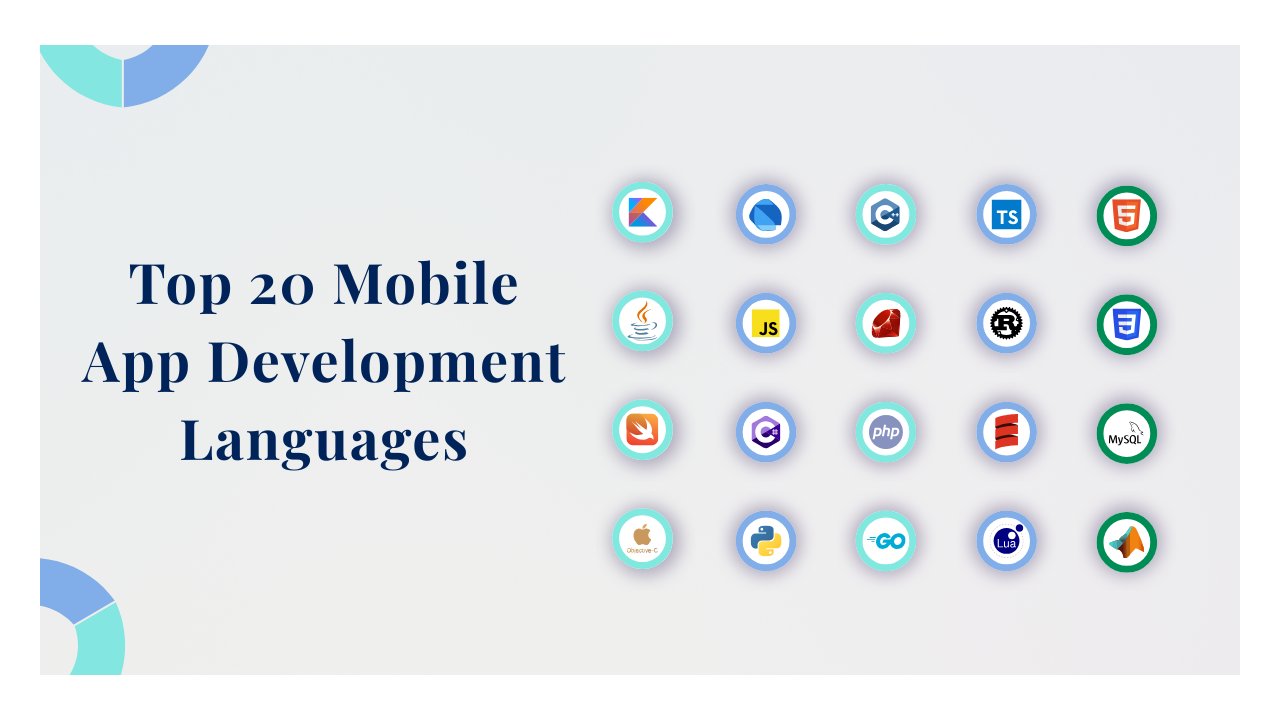
Often wonder what language apps are written in? A practical breakdown of the leading mobile app development languages, along with their strengths and ideal use cases, is given below:
Kotlin
Kotlin is Google’s preferred programming language for mobile apps concerned with Android development.
These applications are generally smoother, more easygoing to maintain, and tend to have fewer development problems.
For many developers, it’s simply the best language to make an application when they focus on Android, as it supports both older devices and the newest Android versions.
That’s why teams choose it when looking for reliable programming languages for mobile app development that can scale.
The flexibility and stability of this language make it a go-to choice for all those teams that want their mobile applications to grow and scale without facing constant technical issues.
Why choose Kotlin?
- Works well with Java
- Reduces extra code
- Highly stable and secure
Usage: Android-first businesses and long-term app projects
Java
Java has powered Android apps for over a decade. It has one of the most mature ecosystems and is often seen as the best programming language for app development that works tremendously on Android.
Since Java works on many platforms, it enables developers to create apps that connect with web servers, cloud systems, or enterprise tools.
Its solid documentation and vast developer community make Java suitable for complex or feature-rich applications. Companies with long-standing systems usually prefer Java to ensure compatibility and durability.
Why choose Java?
- Large community
- Extensive library support
- Works across multiple platforms
Usage: Enterprise apps, legacy systems, and scalable products
Swift
Swift makes iOS development more reliable and quicker. It was created by Apple to replace Objective-C and offers programmers a contemporary, secure, and simple method of creating programs.
Everything from basic utilities to the most complex, graphically demanding games is made possible by its powerful performance, and the new syntax helps avoid many typical errors.
For brands that want fluid animations, fast reactions, and a sophisticated Apple-native experience, it’s ideal. It also aligns well with long-term product plans, which explains why most modern iPhone and iPad apps utilize this.
Why choose Swift?
- Fast performance
- Safe memory handling
- Modern syntax
Usage: iPhone apps, iPad apps, watchOS apps, and scalable iOS solutions
Objective-C
This language still has value for teams working on older iOS systems. It is reliable and widely supported in Apple’s ecosystem despite being older than Swift.
Also, many older applications still prefer Objective-C over Swift. Developers who understand its structure can keep older apps stable and functioning without compromising compatibility.
Why choose Objective-C?
- Mature and proven
- Long-standing Apple support
Usage: Maintaining older iOS applications
Dart (Flutter)
Dart powers Flutter, one of the most rapidly growing cross-platform frameworks.
The fact that it creates almost-native interfaces with a single codebase makes it very popular with startups and speed-focused companies. Flutter’s widget-driven system allows developers to create attractive, consistent designs across both iOS and Android.
Dart is amongst those application coding languages that help businesses to shorten their development cycles without losing the visual quality of the app. With features like hot reload, it’s also great for quick prototyping and UI-heavy applications.
Why choose Dart?
- Great UI toolkit
- Hot reload for quick updates
- One codebase for multiple platforms
Usage: Startups, prototypes, and visually rich apps
JavaScript (React Native)
JavaScript is essential to React Native. It allows developers to apply their existing web development skills. With its component-based architecture, developers can achieve code reusability, fast iterations, and scaling of the app by adding more features over time.
A lot of apps are using it to ensure consistency across web and mobile versions. This allows having a shared logic and design across platforms.
Therefore, apps that require multi-platform compatibility, maintenance, and quick delivery are ideal candidates for using React Native.
Why choose JavaScript?
- Strong community
- Reusable components
- Works with web development skills
Usage: Hybrid teams, cross-platform apps, and MVPs
C# (Xamarin)
C# has the benefit of allowing developers to work within Microsoft’s robust .NET ecosystem while still producing cross-platform applications.
The benefit of using C# over other languages is that it allows .NET developers to work within Microsoft’s .NET framework, even for multiple platforms. One can then use the same language for IOS and Android.
Why choose C#?
- Works well with .NET
- Reliable performance
- Easy learning curve for Windows developers
Usage: Enterprise apps and apps with Microsoft ecosystem integration
Python
Even though Python was not designed for Android mobile app development, one can still use packages like Kivy, Flet, etc. to create a mobile app. Also, Python is especially useful for applications that plan to incorporate AI. Hence, Python is a good option for quick and creative tasks.
Why choose Python?
- Easy-to-read syntax
- Extensive library ecosystem
- Strong community support
Usage: Prototypes, data-driven apps, and AI/ML-powered mobile apps
C++
After all these years, C++ is still one of the top choices among other mobile application development languages. Many powerful game engines and heavy-duty applications rely on it, owing to the high speed and precise memory management it offers.
It is the right choice when an app requires performance levels that cross-platform development tools just can’t match, or deeper control over backend processes and how the app interacts with device hardware is required by the developers.
Why choose C++?
- Lightning-fast execution
- Strong control over hardware
- Ideal for complex logic
Usage: Gaming apps, performance-intensive apps, and real-time applications
Ruby
Ruby is well known for its sophisticated and user-friendly design. Development is thereby made easy, even for massive projects. Although Ruby isn’t a native mobile language, developers usually use it alongside frameworks like RubyMotion to make lightweight, useful mobile apps. This combination allows teams to write simple code that communicates with native APIs.
Community-driven gems fasten payments, integrations, and authentication. In mobile applications, Ruby is especially useful for complex server-side logic, dashboards, or analytical features that must grow over time.
Why choose Ruby?
- Simple, clean syntax
- Fast development cycles
- Strong Rails ecosystem
Usage: Rapid MVPs, business apps, and early-stage startups
PHP
Although PHP doesn’t actually create any mobile applications, it does play a significant part in the background. In essence, robust server-side logic is essential to many mobile applications. PHP frameworks such as Laravel and Symfony support millions of efficient backends in the world.
Its simplicity and affordability, together with great community support, make PHP a practical choice for startups in developing a stable and scalable backend without complicated overhead. PHP would be used when built to serve as the layer of communication between a mobile application and a database, payment gateways, or authentication systems through REST APIs or GraphQL.
Why choose PHP?
- Easy to integrate with databases
- Fast development
- Large support community
Usage: Backend-heavy apps, eCommerce platforms, and scalable app ecosystems
Go (Golang)
Go was developed by Google to be used as a free, non-proprietary mobile app development language. It is well known for being general-purpose, fast, and user-friendly. Using tools like Gomobile, developers can create apps for IOS and Android.
Creating cloud-connected apps that require streaming, chat, or real-time data updates can also benefit from it. It is particularly suited for mobile apps, which should grow in response to user demand, thanks to its straightforward design and robust multitasking capabilities. Because it’s easy to learn and maintain, many companies use Go in support of mobile backends or to share business logic across platforms.
Why choose Go?
- Exceptional speed
- Built-in concurrency
- Easy to deploy
Usage: Large-scale systems, cloud-powered mobile apps, and real-time services
TypeScript
Static typing is a feature that TypeScript adds to JavaScript. This lowers the possibility of errors and makes managing large mobile projects easier. Most cross-platform frameworks, such as React Native and NativeScript, allow developers to integrate TypeScript into their projects for easier and more manageable mobile coding.
The scalability and structure of the language both increase. It is therefore frequently the best option while working on the same project with a mid-sized to large team. Additionally, it works well with contemporary development tools, which facilitate the creation and debugging of intricate features.
Why choose TypeScript?
- Strong type system
- Reduces bugs
- Works with JS-based frameworks
Usage: Large cross-platform apps and enterprise apps needing reliability
Rust
Although Rust is not specifically used for mobile development, it is becoming more and more popular for parts of mobile apps where speed and security are crucial.
It helps prevent memory leakage. Also, it is especially helpful for applications that handle sensitive data or need simultaneous data analysis. Apart from it, it serves as an advantage while creating cross-platform apps.
Why choose Rust?
- No-cost abstractions
- Highly secure
- Very fast execution
Usage: Security-focused apps and system-level mobile components
Scala
Scala runs on top of the Java Virtual Machine (JVM), and hence incorporates the Java-style programming methodology. It is not typically used on its own in mobile apps; it works with Java and Kotlin to build the backend.
For expressive, concise code and to support complex business logics in mobile applications, Scala is preferred by developers. Strong performance combined with great compatibility makes it suitable for teams that need to manage very large applications.
Why choose Scala?
- Highly scalable
- Good for big data apps
- Works with Java libraries
Usage: Enterprise mobile apps, analytics apps, and complex logic workflows
Lua
Lua is a lightweight scripting language that is often used to develop mobile games. Examples of popular game engines are Corona SDK (Solar2D), which relies on Lua to create 2D games.
Lua uses a simple design methodology, which makes it suitable for mobile environments, especially for games on low-budget devices. It is also one of the easiest languages to use, which allows developers to customize game behavior without dealing with heavy C or C++ code.
Why choose Lua?
- Very fast
- Easy to embed
- Popular in the gaming world
Usage: Mobile games, embedded app scripts, and real-time features
HTML5
HTML5 is often central to hybrid and web-based mobile applications. Although it is not a “programming” language in the strict sense, it plays a big role in structuring app interfaces and ensuring responsive layouts across devices. Developers often use HTML5, selected among various app-building languages that need to run smoothly in WebView-based frameworks like Ionic, Cordova, and PhoneGap.
This is the best programming language for mobile apps as it works well for light apps, dashboards, web apps, and less intricate apps.. Since HTML5 works effortlessly with CSS3 and JavaScript, teams often prefer it.
Why choose HTML5?
- Easy to learn
- Works with CSS and JavaScript
- Simplifies UI creation
Usage: Web-to-mobile apps, content-based apps, and hybrid products
CSS3
CSS3 is a styling language that can be used with mobile and web apps to enhance their visual appearance.
With Modern CSS3, one can develop apps that scale smoothly across devices. It is especially useful when building apps that need to look consistent on phones, tablets, and foldable devices.
Why choose CSS3?
- Adaptable layouts
- Smooth animations
- Lightweight
Usage: UI-heavy hybrid apps and mobile-first web apps
Do you know? :
Developers who want a solid front-end foundation often use CSS3 to build polished dashboards, visually engaging learning apps, and mobile-friendly business tools.
SQL
SQL is the foundation of data storage in many mobile applications. Although it is not the best programming language for building apps for UI, SQL is important for structuring app databases, querying data, and ensuring efficient offline features.
Mobile apps often use SQL through systems like SQLite, Room (Android), or Core Data (iOS wrappers). Developers rely on SQL when building apps that need reliable data organization, syncing, or user history tracking.
Why choose SQL?
- Fast data handling
- Reliable storage
- Works with almost any tech stack
Usage: Apps needing offline functionality and data-driven features
MATLAB
MATLAB is the best language for coding apps, widely used in engineering, simulations, and scientific calculations. With specialized toolboxes and code generation, it can help in developing the mobile apps that require complicated mathematics.
MATLAB is used for incorporating complicated and math-heavy algorithms that apps usually depend on, especially in healthcare, scientific research, and machine learning.
Why choose MATLAB?
- Powerful numeric computation
- Ideal for algorithm-intensive apps
- Great for visualization
Usage: Engineering apps, scientific apps, and signal-processing tools
Build High-Performance Mobile Apps With the Right Technology
Why Choosing the Right Mobile App Development Language Matters?
Selecting the right development language for an app to know which languages phone apps are written in is not just a technical choice. It affects how your product performs, grows, and connects with users. Here are the main reasons emphasizing the importance of this decision:
- Overall Performance & User Experience: The language you choose has a direct impact on how quickly and smoothly your application will load. Existing mobile app programming languages like Swift or Kotlin usually provide the best performance because they are deeply integrated with the hardware of the device.
- Development Time & Cost Efficiency: Some languages and frameworks help teams build faster by allowing them to write a single codebase for multiple platforms like Android or IOS. This reduces both the time and the budget.
- Long-term Maintenance & Scalability: A clean, well-structured codebase is much easier to maintain and expand. Choosing a language that has strong community support, good documentation, and reliable libraries makes it easier to maintain and expand.
- Platform Compatibility & User Reach: Your requirement decides whether you are aiming at Android, iOS, or both. For further reach in a quick time, cross-platform tools can be helpful. However, when your app requires intricate usage of the device itself, a native mobile app development language is usually the better pick.
- Security & Data Protection: Every application handles some level of user data. Most modern languages contain built-in safety features that help reduce weaknesses. Using good language supports better agreement and reduces prolonged risks.
- Availability of Skilled Developers: Some languages have large communities of developers, whereas others are niche-based. Picking one that is more popular keeps hiring easy and helps to deliver quickly.
- Access to Native Features & Libraries: Native environments usually provide the most direct access to the device itself. Cross-platform solutions have become better, but some of their features still need additional modifications.
Tips for Choosing the Best Language for App Development
Having a good idea is not enough without the proper language.
A proper language can speed up development, help with easier maintenance, and improve user experience.
Before you choose to proceed with a language, you should look at the objectives of the app. There are many options for mobile app development languages, and each one has its own benefits. Here are some practical points to help you decide the best language for app development:
Identify which platform you are going to target
- Decide if your app is going to run on iOS, Android, or both. The platform plays a crucial role in deciding the language.
- The best language for application development on iOS platforms is Swift, and for Android, it is Kotlin or Java.
Look at your team’s current skills.
- Make use of the skills you already have. For example, if your team is experienced with JavaScript, a cross-platform tool like React Native is likely to speed up development.
- Choosing a familiar programming language also reduces learning time.
Understand your performance expectations
- High-performance apps, such as games, AR, or finance apps, often require native languages.
- Simple apps can work well on a cross-platform framework without major drawbacks.
Consider long-term flexibility
- Select a language that allows your app to grow in the long run
- Clean structure, scalable frameworks, and good documentation are much more important than quick fixes.
Think about your development budget and timeline
- Using one codebase for multiple platforms could lower costs, but it comes with some limitations.
- Native development may take longer initially, but it usually provides better stability for complex apps.
Why Should GMTA Software Solutions Be Your Tech Partner in This Journey?
Choosing the right development team is just as important as selecting the best programming language to develop mobile apps for your business, and that is where GMTA Software Solutions excels above all.
This team ensures that every project is successful from the beginning by combining our technical expertise, industry knowledge, and ability to tackle intricate problems. They assist brands in creating quick, safe, and adaptive apps by understanding the platform requirements and incorporating the appropriate tech stack.
GMTA Software Solutions walks you through every step of the process in addition to developing apps.
Their approach is essentially about combining strategy and execution, whether it is for long-term maintenance, UI/UX choices, or cross-platform versus native possibilities.
GMTA Software Solutions transforms from a vendor into a dependable technology partner in turning your concepts into tangible, significant goods through dependable communication, prompt delivery, and scalable solutions.
Choose the Right Tech Stack for Your Mobile App
Not sure whether Java, Kotlin, Swift, Dart, or JavaScript suits your project? Our experts help you validate your idea and pick the perfect language to build fast, secure, and scalable mobile apps.
Summing Up!!
A successful mobile app does not start with design or features; it starts by choosing the right language it will be built.
Every programming language chosen affects performance, security, and cost, including the very growth of your app.
Every choice that you make early affects the future success of your application, from knowing how various mobile app development languages behave to using them for your objectives.
Choosing a path that enables prolonged growth is crucial, regardless of whether you prefer cross-platform tools for flexibility and fast development or already existing solutions for speed and performance.
The best language for mobile app development should be a perfect fit, something that goes along with your concept, adapts as per your user base, and guarantees a smooth experience across all platforms.
Now, you have enough information on what programming languages are apps written in, which will definitely help in making your selection easier.
FAQs
Which is the best language for developing mobile apps for beginners?
It is recommended to start with JavaScript with React Native or Dart with Flutter because both of them provide easy syntax, active and helpful communities, and the ability to create apps for iOS and Android without writing duplicate code.
Should I write my program in a cross-platform or native language?
One can choose native languages like Kotlin or Swift if application performance is the most important factor. However, if you want to avoid writing duplicate code, then Cross-platform solutions like Flutter or React Native are more useful.
What should I consider before selecting programming languages for app development among a huge variety?
The following should be kept in mind:
- Long-term strategies
- Target platform, whether Android or IOS
- Performance requirements
- Money
- Time
Do Native Applications Outperform Cross-Platform Applications?
Yes, for tasks like gaming, augmented reality, and high-security applications, native apps continue to outperform Cross-Platform Applications.
What language are apps programmed in concerned with Android app use today?
Google now favours Kotlin for Android development. It is also compatible with Java and, hence, ideal for new Android projects.
Is it feasible to use a single language to develop an iOS and Android application?
Yes, you can develop an app that uses a single codebase to run on both iOS and Android. Examples of such frameworks are React Native and Flutter. This lowers the development costs and also saves time.

Uday Singh Shekhawat has 9+ years of experience covering software architecture, AI/ML development, and technology strategy at GMTA Software. He writes for founders and CTOs evaluating build complexity, technology investment, and vendor decisions — including in regulated industries such as healthcare, where his background in HIPAA-compliant and FHIR-integrated systems informs his perspective on compliance-driven cost factors.