



Key Takeaways
- Start modular, not distributed. Most early-stage startups should begin with a modular monolith: one deployable app with strict internal module boundaries.
- Team size drives the decision. With roughly 4-8 engineers, microservices add deployment, monitoring, and failure-handling work on top of the product roadmap.
- Microservices earn their cost only with a specific driver. Look for a workload that needs independent scaling, a revenue-critical path that needs isolation, or multiple teams blocked by shared releases.
- A distributed monolith is the worst of both. Services that share databases and require coordinated deployments add network complexity without real independence.
- Put the decision in numbers. Compare migration cost (6 engineers for 6 months is 36 engineer-months) with infrastructure savings, recovered capacity, and revenue protected.
- Migrate one capability at a time. API boundary, data separation, parallel run, controlled traffic shift, then full ownership. Avoid a full rewrite.
- Decide with six questions. Team size, product stability, scaling and security needs, distributed-systems experience, release frequency, and infrastructure budget.
- Short answer: Most startups should start with a modular monolith: one deployable application with strict internal module boundaries. Move to microservices only when a specific module needs independent scaling, its own release cycle, or stronger isolation, and your team can run distributed systems in production. Before that point, microservices add cost and failure modes without measurable return.
A monolith keeps your app’s core functionalities in a single codebase and deployable unit, while microservices split those into smaller, decoupled deployable services. On paper, the difference lies within the architecture. For a startup, however, it translates into a business decision faster than you comprehend. That’s because the architecture you choose affects how fast your team can ship features, how much infrastructure you need to operate, and what happens when your user base starts growing.
Martin Fowler’s MonolithFirst argues that teams should start with a monolith, partly because microservices only work well when you can draw stable service boundaries, which is hard before you understand the product.
Choosing microservices too early can leave a small engineering team managing multiple aspects at a time way before you have enough scalability to justify this. This often includes distributed databases, service communication, monitoring, deployment pipelines, and failure points. Staying with a monolith for too long creates a completely different problem. You end up with tightly coupled components that are harder to change, riskier releases, and inefficient scalability.
And this is where the real pain point surfaces for your startup. Every additional architectural layer consumes engineering time and operational resources. That’s why the practical decision comes down to what your startup needs from its architecture today and what it realistically expects to need as it grows. After all, a 5-person team launching an MVP will never encounter the same requirements as a company processing millions of transactions across multiple product modules. If you get this decision wrong, the consequences can extend well beyond the codebase.
That’s why this article breaks down monolith vs microservices from a startup perspective, covering every aspect you should know, whether it’s architectural differences or maintenance needs. Our goal is to give you a practical decision framework for the approach that fits your product now, and when you may need to change your decision.
Monolith vs Microservices at a Glance
| Factor | Monolith | Modular Monolith | Microservices |
| Deployment unit | One | One | Many, independently deployable |
| Best team size | Very small, early MVP | Up to ~10 engineers, extendable to ~30 | Multiple autonomous teams |
| Time to first release | Fastest | Fast | Slower (platform setup first) |
| Operational overhead | Lowest | Low | High (observability, CI/CD, secrets, networking) |
| Scaling | Whole app together | Whole app together; extract modules later | Per service |
| Failure modes | Process-level | Process-level | Process, network, and partial failures |
| Data | One shared database | One database, module-owned data access | Data owned per service; eventual consistency |
| Debugging | Simplest | Simple | Needs distributed tracing |
| Best for | Prototype and validation | Most early-stage products | Proven, independent domains and workloads |
Not sure which architecture fits your product?
Talk to GMTA’s architects about your team size, roadmap, and budget.
What Are the Pros and Cons of Microservices vs. Monolith?
Pros and cons of a monolith
Pro 1: You Can Get the Product Into Customers’ Hands Faster
For an early-stage startup, you can never underestimate the value speed has. With a monolith, your team can build the authentication, dashboards, payments, admin panels, APIs, and core business logic within one app. They won’t have to establish separate services and communication layers for each function. This level of simplicity becomes crucial for faster iterations, especially when customer feedback tends to change the product roadmap frequently.
Pro 2: Your Engineering Budget Goes Into the Product, Not the Platform
Working with five developers means every engineering hour has an opportunity cost. A monolith is known for:
- Less infrastructure
- Fewer deployment configurations
- Less operational tooling
Hence, you can allocate most of your funds to features that customers will actually see and use. For your startup operating with a limited runway, this matters because you won’t be spending heavily on infrastructure designed for a scale your product is yet to reach.
Pro 3: You Keep Architectural Decisions Reversible While the Product Is Still Uncertain
Early in your startup’s life, you hardly have any clear idea about which features will become central to your product’s success. A workflow that generates revenue today might lose its significance 6 months later. So, with a monolith, you can avoid creating permanent service boundaries prematurely around assumptions yet to be validated. You can, though, keep the application modular internally and monitor where bottlenecks actually emerge.
Con 1: You May Eventually Scale More Infrastructure Than You Actually Need
Suppose your marketplace receives heavy traffic on its search functionality out of the blue, while bookings and account management remain relatively light. In a monolithic setup, scaling the app means adding capacity at a broader level, not on the resource-intensive components. Although it’s manageable at moderate scale, the efficiency gaps become more prominent when different parts of your product have varying computing requirements.
For a 5-person team, keep the architecture simple initially, but continue to monitor the workloads consuming disproportionate resources.
Con 2: A Fast-Growing Codebase Can Start Slowing Your Team Down
The bigger concern here is that the business logic becomes tightly coupled in a monolith architecture. Your payments developer might build something unknowingly that can affect order processing. Similarly, changing a table’s definition in the database might force you to run a huge regression test suite.
Working with a small, 5-person team means developers will have to understand the entire system before touching one particular workflow.
Con 3: One Release Can Tie Unrelated Product Changes Together
A monolith gives you just one deployment unit. Although it’s convenient in the initial phase, you start facing restrictions once the product demands different release schedules. A critical payment fix may have to go through the same deployment process as a new reporting feature.
This disadvantage will force your 5-person team to watch whether regression testing and deployment coordination are consuming more time or not, especially when release frequency increases.
Pros and cons of microservices
Pro 1: You Can Give Your Most Important Business Functions Their Own Scaling Strategy
Microservices suit the product’s architecture when different components behave differently. Consider a delivery platform where order matching, payments, location tracking, notifications, and analytics have varying traffic patterns and infrastructure needs. With separate services, you can easily scale these capabilities independently. At least then, you won’t be forced to increase capacity for the entire application simply because one business function has suddenly become resource-intensive.
Pro 2: A Change in One Business Area Does Not Have to Mean a Release of Everything
Independent deployment becomes a significant advantage once your product and engineering organization grow. Your payment service can evolve without requiring a full application deployment. At the same time, another team can continue working on search or customer accounts. With this, you get more control over release timing. Also, it will become easier for you to minimize the blast radius of certain changes.
Pro 3: The Architecture Can Reflect How the Business Actually Operates
Once your product matures enough, it will have clear domains, like identity, billing, orders, inventory, communications, analytics, and recommendations. Microservices offer explicit ownership of these domains, while allowing you to establish clear, stricter technical boundaries. This way, your system can easily evolve, especially when each of the capabilities has different requirements.
Con 1: You Are Taking on a Platform-Engineering Problem
This is one of the biggest trade-offs every startup founder needs to evaluate. Microservices isn’t just splitting your code into smaller repositories. You will need:
- Reliable service communication
- Deployment automation
- Observability
- Centralized logging
- Secrets management
- API versioning
- Failure handling
- Intermediary service security layers
While working with a 5-person team, it’s best to ask if they have the engineering capacity to operate a distributed system and still deliver the product roadmap before opting for microservices.
Con 2: Your Product Can Fail in Ways a Monolith Never Had to Consider
With multiple services, the network becomes a part of your application. Despite your payment system being completely functional, the order service might fail to access it internally or inject the dependencies. Similarly, a notification service can fail even though the corresponding transaction event is successful. Therefore, you will be stuck with retries, timeouts, idempotency, circuit breakers, queues, and inappropriate failure-handling strategies.
For a 5-person team, therefore, you will be responsible for designing around partial failures instead of only handling failures inside individual application components.
Con 3: Independent Services Make Data Ownership Much More Important
Microservices work best when the modules have clear ownership of data. However, this means you won’t be able to query everything from one shared database whenever a new feature requires information from another domain. For this, you will need APIs, events, replicated data, or asynchronous workflows. While it helps improve architectural boundaries, you may end up with consistency and synchronization concerns that a centralized data pool often hides.
If your 5-developer team is still figuring out the product’s core data model, introducing distributed data ownership too early can create complexities before your business requirements can be stabilized.
Why Should an Early-Stage Startup Start with a Monolith?
Your Product Requirements Will Change More Than You Expect
Being an early-stage startup, you should start with a monolith when your product is still in the evolving phase. That’s because your first release is unlikely to represent the product you plan to operate in the next 2 years. Once customer feedback is factored in, you may have to push changes for the onboarding flow, pricing model, user permissions, payment processes, or even the core transaction model.
So, keeping these functions within one application will make it easier for you to deploy these changes rapidly. Suppose your product was originally built around one-time payments only. Now, when you want to introduce subscription logic, the monolith will allow you to test billing, account, checkout, and access control all together.
Here, the important benefit is change velocity. Until your business’s underlying model stabilizes, your architecture must allow the product to change easily.
You Need to Maximize What Five Developers Can Actually Deliver
With a 5-person engineering team, the constraint isn’t in the code volume they can write. Rather, it’s the percentage of the entire production system they can build and operate reliably. A microservice setup will certainly create additional work around service deployment, inter-service authentication, API versioning, monitoring, distributed tracing, logging, and failure recovery. None of these tasks create a customer-facing feature, and yet they demand engineering ownership.
A monolith will give your team a much smaller operational interface. The same developers can work on the backend, integrations, testing, deployment, and production support. They won’t have to maintain multiple independent runtime environments. For your startup, this means you can easily ship the next set of customer-facing features within days.
Your Runway Should Fund Product Learning, Not Premature Infrastructure
Keeping the product’s architecture simple will give you a financial advantage: you can avoid paying for operational complexity before the business demonstrates a need for it. Running multiple services will increase cloud consumption. You will also need to invest separately in additional tooling for deployment, monitoring, networking, security, and observability.
Suppose your application currently serves 20K users and one instance can handle the workload with comfortable headroom. Splitting the app into 8 services doesn’t automatically create a better product. If those distributed services fail to solve a scaling, reliability, or deployment problem, you will only end up increasing your operating burden without creating equivalent business value.
You Do Not Yet Have Enough Evidence to Define Every Service Correctly
A monolith gives you the opportunity to measure before separating. At the MVP stage, you often make guesses about which parts of the application will eventually demand independent scaling or deployment. However, there’s an uncertainty about those assumptions being right.
Consider an MVP logistics app. You might initially assume that driver management, orders, payments, tracking, notifications, and reporting should all become separate services. Once the platform onboards real users, you can discover that real-time location tracking creates 80% of the backend workload while reporting barely affects performance. This will automatically change the architectural priority.
So, you can rely on the monolith to determine where the actual technical pressure exists. You won’t have to spend unnecessarily or handle excessive operational burden just because of some assumptions.
What Is a Distributed Monolith, and How Do Startups End Up with One?
A distributed monolith is what you get when your startup splits the application into multiple separate services but retains the dependencies that initially defined the monolith’s tight coupling. Now, these services can have independent:
- Containers
- Repositories
- APIs
- Deployment pipelines
However, when you plan to develop a feature, your developers may have to change multiple services at a time. This is where microservices are different, as the architecture focuses on services able to operate with meaningful autonomy. So, the real distinction lies in the level of independence the services have for evolution, deployment, failure handling, and scalability.
Consider a 5-person team building a marketplace for your startup. They separate the application into user, provider, booking, payment, and notification services. On paper, you now have five microservices. In practice, suppose changing the booking workflow requires updates to the user schema, provider availability logic, or the payment API, followed by three coordinated deployments. This is what a distributed monolith looks like. You are successful in segregating the application physically, but you couldn’t become operationally independent.
The same problem appears when the services share infrastructure resources too closely. Let’s assume the booking and payment modules write to the same database tables. In that case, developers won’t be able to safely change one data model without considering the other. If every booking request synchronously calls four downstream services, a temporary failure in payment or provider availability is likely to prevent the entire booking flow from being completed. Your startup, thus, ends up creating a network of dependencies rather than genuinely separating the business capabilities.
What Is a Modular Monolith, and Is It Enough for a Startup?
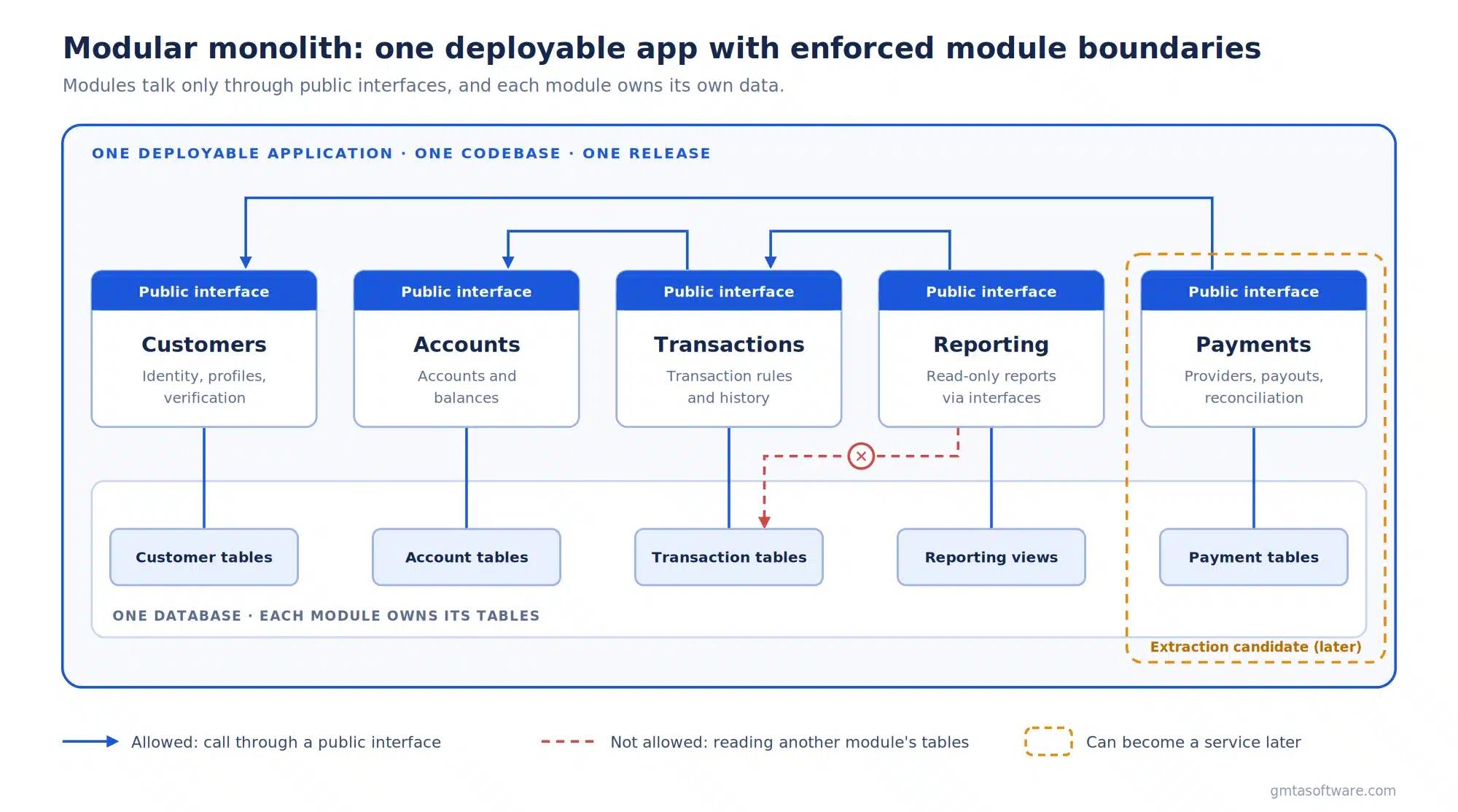
Shopify started as a monolith and later moved to a modular monolith, keeping one codebase but enforcing boundaries between components. Its core application now exceeds 2.8 million lines of Ruby.
How Does a Modular Monolith Actually Work?
A modular monolith keeps the application in a single deployable unit, with the internal architecture being deliberately divided into business modules having defined responsibilities and dependency rules. Here, the modules we just mentioned aren’t merely folders or separate sections of one large codebase. Rather, each owns a particular part of the domain and exposes only the operations other modules are allowed to use.
Suppose your fintech startup has structured one application around customers, accounts, transactions, payments, and reporting. The transaction module will therefore own transaction rules and data access. The reporting module can request transaction information through an approved interface. It won’t be allowed to query the transaction module’s tables directly. This prevents reporting requirements from gradually becoming embedded throughout the transaction logic.
A five-person team builds a fintech wallet as a modular monolith. Months in, reporting starts querying transaction tables directly, and a schema change breaks it. An automated boundary check catches the next violation before release. Later, payments need compliance isolation and a separate release cycle, so the team extracts only that module, an effort assumed here at about six engineer-months.
This architecture can also enforce dependency direction. A payments module can depend on customer identity information through an interface. However, this doesn’t make the customer module dependent on the payment implementation details. This peculiar hierarchy and dependency mapping help you make changes more contained. When you plan to add a new payment provider, any type of configuration or code change will affect the concerned module only. You won’t have to plan modifications across the entire application.
The bottom line: everything still runs and deploys together, but the internal coupling is intentional and controlled
When Is a Modular Monolith Enough for a Startup?
Your Business Domains Are Clear
A modular monolith becomes an excellent choice as an architecture only when your product has clearly distinct domains, like billing, accounts, orders, reporting, and inventory. However, you don’t have to accommodate multiple runtime environments, each for the domains currently in existence. You can enforce ownership and controlled dependencies in code while deploying everything in a single package. This gives the architecture a meaningful structure without forcing every business capability into an independently operated service prematurely.
One Release Cycle Still Makes Sense
If your product’s core features naturally move through the same release process, a modular monolith will be enough. A startup selling subscriptions, for example, might change accounts, plans, billing, and access rules together. Once you separate each function into different services, you simply add coordination requirements. There isn’t much operational value to consider, especially when independent deployments are not yet a genuine business requirement.
Your Team Needs Internal Boundaries, Not Distributed Systems
A growing codebase can become difficult long before it needs microservices. Modular monolith architecture addresses this problem by giving your developers clear ownership over business logic and limiting direct dependencies between domains. For a small team, this makes parallel development safer and code reviews more focused. In addition, you can also avoid extra infrastructure and operational responsibilities created by distributed services across environments and deployments.
Your Workloads Scale at Similar Rates
A modular monolith remains practical when major functions have broadly similar performance requirements. If customer accounts, orders, billing, and administration all fit comfortably within the same infrastructure, separating them will limit the scaling benefit. You can continue measuring database load, response times, and resource consumption while keeping the application unified until one module develops a genuine capacity requirement that warrants isolation.
Planning an MVP? Start with a structure you can grow.
GMTA builds modular monoliths designed so the right modules can be extracted later
When Should a Startup Move from Monolith to Microservices?
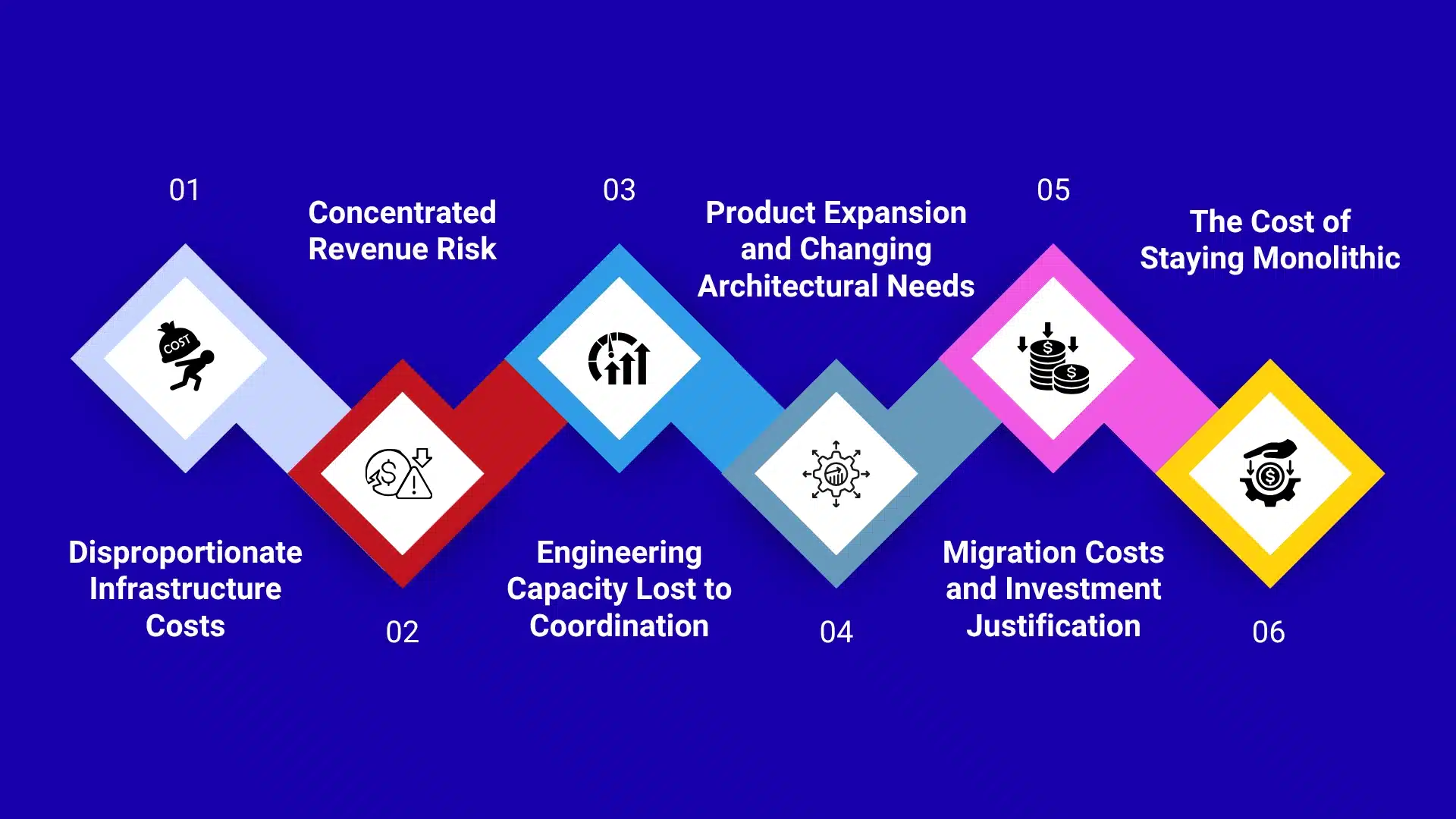
Disproportionate Infrastructure Costs
Do not decide when to move to microservices based on your app’s total size, but based on how much marginal infrastructure cost gets created by growth in one business function. Suppose a high-volume workload is responsible for 60-70% of your compute or database consumption, while the remaining modules account only for 30-40%.
So, if you scale the entire monolith, you will be paying for capacity that your app doesn’t need. The key here is to track infrastructure cost per 1K transactions per 1K users.
Concentrated Revenue Risk
Look at your revenue through the product’s failure boundaries. If 70-80% of transaction value passes through one capability, like checkout, payment processing, or subscription renewal, a small failure can have a disproportionately large financial impact.
A monolith can allow an unrelated deployment or resource problem to affect that same workflow. So, separating critical revenue paths can reduce the blast radius. If the isolated capacity represents only 5% of the revenue, the additional operational complexity of microservices won’t justify your investment.
Engineering Capacity Lost to Coordination
Track how much engineering time disappears into architectural coordination. Suppose developers are spending 20-30% of their capacity dealing with shared releases, cross-team dependencies, deployment coordination, or waiting for changes somewhere else. You should, therefore, calculate what it means in product capacity.
For a 10-person engineering team, this will represent roughly 2-3 engineers’ worth of annual capacity being consumed unnecessarily. So, moving into microservices becomes more feasible as they can independently work without having to waste time and effort in coordination.
Product Expansion and Changing Architectural Needs
When you enter a new market or plan to launch a new product, you are likely to discover that the original monolith built around assumptions no longer fits your business. Microservices allow the capabilities most likely to evolve independently to be separated from the older product logic.
You don’t have to rebuild the entire platform. All you have to do is extract the business capability that needs a different growth path while allowing the stable parts of the monolith to continue operating.
Migration Costs and Investment Justification
If the migration requires 6 engineers for 6 months, you are effectively investing 36 engineer-months in architecture rather than customer-facing development. For your early-stage startup, this would mean six months of delayed features, integrations, experiments, or market expansion. Microservices help resolve the underlying architectural constraint, but only if the resulting service boundaries generate enough value to compensate for that investment.
The Cost of Staying Monolithic
Ultimately, you have to put the decision in numbers. Suppose the monolith is:
- Costing you $15K per month in avoidable infrastructure
- Consuming 25% of engineering capacity through coordination
- Contributing to incidents affecting $50K of transactions per hour
- Adding $10K to annual enterprise implementation costs
Now compare these with the proposed migration: engineering cost, additional infrastructure, platform tooling, testing, security, observability, and ongoing operational ownership. Microservices resolve the problem by allowing the specific capabilities responsible for these expenses to scale, deploy, fail, secure, and evolve independently.
How Do You Move from a Monolith to Microservices Without a Rewrite?
Start With the Business Capability Creating the Largest Constraint
Begin with the part of the product where the monolith is creating the clearest business problem. It could be a high-traffic checkout, an order management function needing frequent changes, or a customer-facing capability consuming a disproportionate share of infrastructure.
Choosing this extraction carefully matters because it determines whether the migration delivers a measurable return or not. If separating a capability is likely to reduce infrastructure waste, improve release speed, or protect a revenue-critical workflow, you have a business case for going ahead with the migration.
Map Dependencies Before Extracting Anything
Before you separate the capability, understand how deeply it’s connected to the rest of your product. Identify the customer journeys it supports, data it uses, other functions that depend on it, and any third-party systems involved.
This will give you a realistic view of the migration effort and prevent an apparently small extraction from becoming a much larger project. From a business perspective, dependency mapping will help you estimate how much engineering time and customer risk the move will involve.
Create an API Boundary Inside the Existing Monolith
Establish a clear way for the rest of the application to interact with the functions you plan to migrate to the microservices architecture. The monolith should start treating the capability as a distinct business function rather than allowing different parts of the application to access its internal logic directly.
This creates a clean separation that can later be moved outside the monolith. For your startup, the benefit is reduced migration risk. You can establish the new structure while the existing product continues to operate safely.
Separate the Service’s Data From the Shared Database
The application logic is only part of what needs to be separated. If the new service still depends heavily on the monolith’s database, your startup won’t gain much from this independence. So, decide which information belongs to the new business capability and gradually establish it as the owner of the data.
This stage requires particular care when customer accounts, orders, payments, or critical workflows are involved. The business objective, here, is to ensure the new service can eventually operate and evolve without creating constant dependencies on the old application.
Build the New Service Alongside the Existing Capability
Now build the independent service while the existing monolith continues serving customers. Keep the business rules and customer experience as consistent as possible during this stage. Remember, the goal here is to change how the product is operated, and not unexpectedly change what customers receive.
Running the two approaches alongside each other gives your team enough time to validate performance, costs, reliability, and data accuracy before making the new service responsible for real customer activity.
Redirect a Controlled Portion of Production Traffic
Once the new service is ready, don’t immediately move our entire customer base. Rather, start with a limited share of the incoming traffic or a controlled customer segment. This will help you with a real-world comparison between the existing and new approaches. At the same time, it will also limit the financial and customer impact in case the newly isolated service fails.
Make sure to monitor metrics that matter to your business as well as technology, including:
- Transaction completion
- Customer complaints
- Response times
- Infrastructure costs
- Support incidents
Transfer Full Ownership to the New Service
Once the new service successfully demonstrates that it’s reliable to handle the workload, make it the primary owner of the concerned business feature. This way your team can develop, release, monitor, and improve it without depending on the monolith for routine changes.
This is where your startup will begin seeing the return on the architectural migration plan. From faster changes to more targeted scaling and better isolation of a critical business function, the newly isolated service will deliver proper value in production.
Monolith or Microservices: 6 Questions to Answer Before You Choose
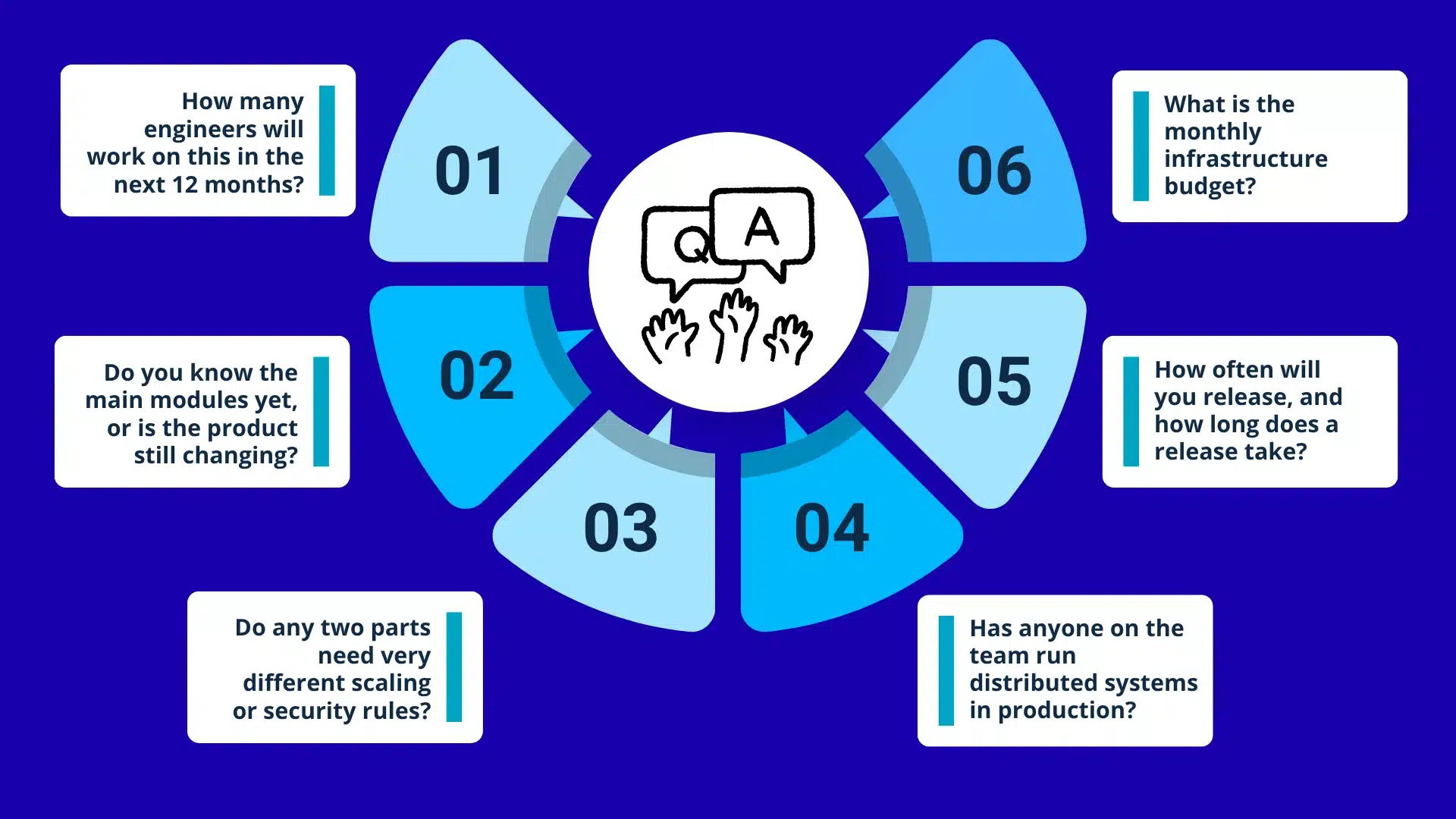
How many engineers will work on this in the next 12 months?
Team size matters because microservices create meaningful organizational value when there are enough engineers to own services independently. If 4-8 developers will build and maintain the product, splitting the app into 10-15 services can leave your team responsible for multiple repositories, deployments, databases, and failure points.
However, this calculation will change completely when you plan to work with more engineering teams. For example, three teams of 6-8 developers can require independent ownership of payments, marketplace operations, and customer-facing functionality. If you work with a monolith, everyone will be forced to coordinate on releases and changes even when their work is independent.
That’s why you must ask whether your expected team structure can create enough parallel ownership to justify the distributed architecture or not.
Do you know the main modules yet, or is the product still changing?
This question is specifically about whether your future service boundaries are based on validated business domains or assumptions. Suppose you are building a marketplace and assume that users, providers, booking, payments, reviews, and notifications should become separate services. Six months later, however, you discover that payment authorization, booking, cancellation, refunds, and provider payouts constantly change together. Splitting them early won’t remove the coupling.
Here, a monolith will give you more freedom to reorganize these boundaries while the product is still changing. Once the concerned business capability becomes stable, is used heavily, or can be scaled independently, extracting it will become easier to justify.
Do any two parts need very different scaling or security rules?
This is where microservices can produce a concrete advantage over a monolith. Imagine 95% of your application has moderate traffic, while real-time delivery tracking experiences extreme peaks during lunch and dinner. In a monolith, scaling the tracking workload can mean adding capacity to the entire app. With a separate service, however, you can scale the workload independently.
The same applies to security. A payment or healthcare-data component may need tighter access controls, encryption, auditing, and deployment restrictions than a public content module. Separating the component will help you create a clearer security boundary rather than forcing every part of the application through the same operating model.
Has anyone on the team run distributed systems in production?
When your app runs on a monolith architecture, the probability of a database failure, application failure, or deployment issue is more concentrated. But when we talk about microservices, you will have more failure paths to worry about. Service-to-service calls can time out. Queues can back up. Data can become temporarily inconsistent.
This means that the comparison is not simply monolith development cost vs. microservices development cost. Instead, you should also account for the cost of operating the entire architecture. If your team has never operated distributed systems, budget for the additional capabilities like:
- Observability
- Automated deployments
- Incident response
- Service-level monitoring
- Access management
- Failure recovery
How often will you release, and how long does a release take?
Microservices become a practical solution when the monolith’s release coupling starts consuming engineering capacity. Suppose your team releases twice a month and a deployment takes about 30-60 minutes with minimal coordination. In such a situation, independent deployments won’t justify the additional infrastructure. However, if four teams are deploying multiple times a week and every release requires cross-team testing, scheduling, regression checks, and coordination, the cost of keeping everything together will become measurable.
What is the monthly infrastructure budget?
This question matters because microservices change the cost structure of running the application. A monolith can operate with one primary application deployment, a smaller number of supporting components, and shared infrastructure. Microservices, on the other hand, can introduce additional compute, databases, queues, networking, API gateways, observability, logging, CI/CD pipelines, secrets management, and security tooling.
If your startup has a $3K-$5K monthly infrastructure budget, adding numerous independently operated services can consume a meaningful portion of it before traffic has generated corresponding revenue. So, you should compare the total operating cost, not just cloud compute. If you are deciding the architecture while also estimating your first-year development budget, GMTA Software can help you evaluate the monolith vs. microservices trade-off against your expected team size, product roadmap, workload profile, and operating budget.
Ready to choose your architecture with confidence?
Start with a project discovery workshop. We review your roadmap, team, and workloads, then recommend a path with clear extraction triggers.
How Does GMTA Approach Monolith vs Microservices for Startups?
At GMTA, we don’t treat microservices as the default architecture for a startup simply because it is easier to associate them with scale. We first look at various aspects, including:
- What your product needs to achieve in its first 12–24 months
- Which workflows will carry the most traffic or revenue
- How quickly the product is expected to change
- How many engineers will own it
- Where independent scaling or deployment will actually create value
For an early-stage product, we often recommend a modular monolith when your business model and product boundaries are still being validated. This keeps infrastructure and operational overhead under control while allowing the codebase to be structured around clear business domains. As usage patterns become clearer, GMTA experts identify the modules that justify extraction rather than forcing the entire application into a distributed architecture from day one.
Where your product has genuinely independent workloads, like high-volume payments, real-time logistics, AI processing, or customer-specific enterprise integrations, we assess those areas separately. The objective is to introduce microservices where they solve a measurable problem, like:
- Reducing release dependencies
- Isolating failures
- Scaling an expensive workload independently
- Giving different teams clear ownership
FAQs
What is the real cost difference between building a monolith and microservices for a startup?
A monolith application usually costs less during the early stages of your startup because your teams operate fewer deployments, databases, network layers, and monitoring systems. Microservices, on the other hand, require a huge upfront and operating budget. That’s because each service adds infrastructure and engineering overhead. Hence, for your startup, the relevant comparison is the total cost of ownership, not the development cost alone.
At what stage of startup growth does migrating from a monolith to microservices become financially worthwhile?
Migrating from a monolith to microservices becomes financially justifiable when the former creates measurable costs that exceed your migration investment. Common signals that you should look out for include independently scaling workloads, frequent release conflicts, multiple engineering teams blocking one another, recurring reliability issues, or enterprise requirements for isolation. You should, therefore, compare the migration cost with the engineering capacity recovered, infrastructure savings, reduced incident impact, and revenue protected by greater service independence.
Can a modular monolith provide the scalability a startup needs without adopting microservices?
Yes. A modular monolith can support substantial growth for your startup when the business domains are clearly separated, and the application does not require independent scaling or deployment. It can reduce infrastructure and operational overhead while preserving the ability to extract specific modules later. For your early-stage product, this provides a more economical path to scale than introducing distributed services before workload patterns are validated.
How do microservices affect a startup’s development speed, release cycle, and engineering costs?
Microservices can accelerate development when multiple teams need to release different business capabilities independently. They can reduce cross-team release coordination and allow one service to change without redeploying the entire application. However, they also increase engineering costs through service management, testing, monitoring, deployment automation, and distributed-system troubleshooting. The benefit appears when reduced coordination and greater ownership outweigh these additional operating demands.
What additional infrastructure and operational costs should startups budget for when using microservices?
You should budget for additional compute, service-specific databases, API gateways, networking, queues, centralized logging, monitoring, tracing, CI/CD infrastructure, secrets management, security controls, backups, and incident-response tooling. Engineering time is another major cost because distributed systems require ongoing operational management. The more services your startup operates, the more important it becomes to calculate these recurring costs alongside application development expenses.