


Key Takeaways
- Budget $30K–$150K for most custom CRM projects. Complex enterprise implementations can exceed $300K, particularly when multiple business systems and business units are involved.
- Allow 3–7 months for many small-to-mid-sized CRM projects. If your team cannot test workflows, approve requirements, or provide usable customer data promptly, the launch date and internal resource costs can both increase.
- Do not fund AI features before establishing their financial value. If call summaries cost $10K to implement, calculate whether the time saved by your sales team justifies that investment after API fees and maintenance.
- A 50-user SaaS CRM at $100 per user monthly costs $180K in subscriptions over three years. Compare that with your custom CRM’s build, maintenance, hosting, and integration costs before deciding which model is cheaper.
The wrong CRM investment can cost you far more than what the initial quote proposed. Your capital will get tied up in a product that either does too little or costs too much to maintain. In the US market, where most businesses are focusing on transforming customer interactions and enhancing personalization, custom CRM development costs fall between $30K-$150K, with complex enterprise systems crossing the $200K+ mark. At this level, choosing between building and buying becomes a capital allocation decision, not just a software procurement exercise.
An off-the-shelf CRM indeed offers you a lower entry price for the $51.63 million market. But the moment you factor in per-user licensing, premium integrations, implementation fees, and paid add-ons, your 3-to-5-year costs get pushed beyond the advertised subscription rate. A custom build, however, presents the opposite risk. An initial attractive quote that seemingly looked justifiable could exclude data migration, security requirements, third-party integrations, and post-launch support.
The key here is to establish where customization creates enough business value to justify its additional cost, and where an established platform can deliver the same outcome with less financial exposure. That’s why this guide will explore custom CRM pricing in 2026, the factors that shape your budget, and the expenses that continue after launch. What’s more, you get to compare the long-term economics of building vs. buying and have a stronger basis for deciding where to commit your capital.
How Much Does Custom CRM Development Cost?
In 2026, an MVP-focused CRM development cost sits between $30K-$60K. At the same time, a more integrated business system can reach the bracket of $60K-$150K. The moment you plan for an enterprise-grade platform, your budget’s starting point will be $200K. That’s because the product is most likely to feature:
- Complex permissions
- Multi-entity reporting
- Extensive external platform integrations
Thus, for your US business, the cost depends on the integration depth your product needs with the existing sales and revenue pipelines. Let’s assume you want to build a CRM for your B2B company to manage lead qualification, account ownership, sales pipelines, and commission tracking. Your product’s requirements will differ a lot from one built specifically for a financial firm handling sensitive customer records and audit trails.
US-specific requirements can also influence the CRM software development cost, including:
- Integrations with QuickBooks or NetSuite
- Connections to email and calendar systems
- Support for SOC 2-aligned security controls
- Migration of years of customer data from Salesforce
What you need to ensure is that the estimate you prepare must draw a clear line between the initial implementation expenses and recurring ones covering cloud hosting, maintenance, and third-party listings. Only then will you have a more reliable view of both the initial budget and the cost of owning the CRM for the next 5 years.
Custom CRM Development Cost by Complexity
The difference between a $40K CRM and a $250K platform isn’t simply the number of features they have. Instead, it’s the extent to which the products can support your business’s day-to-day operational workflows, without requiring manual intervention, forcing rework, or causing data to sit in fragmented silos. That’s why the cost range varies so much the moment you start categorizing the software by complexity.
A basic custom CRM will need $30K-$60K, where the investment makes sense economically for a small-scale B2B company. With the product in hand, it can then establish superior control over its sales pipelines and customer records without having to bear the unnecessary overheads for an enterprise platform. The business value comes from the team gaining consistency in the already established sales process and management having a more dependable view of the revenue forecast.
The moment you move to the $60K-$150K bracket, you get a mid-level CRM. It can connect sales activity with other business systems supporting key functions your organization is involved with, like:
- Customer retention
- Billing
- Lead generation
- Fulfilment
Let’s assume that your team is mostly tasked with managing negotiated pricing, recurring contracts, and lengthy sales cycles manually. Here, the CRM will generate maximum value by allowing you to access automation and integrations. You can, therefore, minimize the risks associated with manual handoffs and prevent fragmentation of customer information across departments.
Enterprise CRM customization cost can, however, exceed $200K. That’s because these systems are supposed to facilitate smooth, cohesive work across:
- Multiple business units
- Complex permissions
- Legacy systems
- Company-wide reporting pipelines
In addition, your investment at this scale will also cover governance, reliability, and scalability without having to rebuild the core workflows.
| CRM Complexity | 2026 Estimated Cost | Typical Timeline | Key Capabilities |
| Basic | $30K–$60K | 2–4 months | Contact management, lead tracking, sales pipeline, basic reporting |
| Mid-Level | $60K–$150K | 4–7 months | Workflow automation, custom dashboards, role-based access, accounting and marketing integrations |
| Enterprise | $150K–$300K+ | 6–12+ months | Multi-team workflows, advanced permissions, legacy-system integration, audit trails, consolidated reporting |
Custom CRM Development Cost for Startups vs. Enterprises
For your US startup, a $40K custom CRM becomes a significant capital decision. But for an enterprise, you can justify a $250K build only when it replaces costly manual work across several departments without imposing any additional overhead. It’s only when you calculate what each business entity gains and what they can afford to lose that the difference becomes much clearer.
When we talk about a startup, the priority is protecting runway while building a system that supports revenue growth simultaneously. Suppose your B2B SaaS company has 8 sales representatives. They have to spend 10 hours per week on:
- Reconciling lead records
- Updating deal stages
- Preparing pipeline reports
Considering an hourly labor cost of $45, you will have to bear an annual spend of $18.72K, provided each representative spends 5 hours a week on these tasks. A $40K CRM will then take more than two years to recover its initial cost through labor savings alone. Based on this illustration, custom development will be economically feasible for your startup only if it improves conversion rates or supports a sales process that an off-the-shelf tool cannot handle. If that’s not the case, it’s better if you configure an established CRM. At least then you can preserve funds for customer acquisition.
Now, let’s talk about enterprises. Here, the economics change with scale and integration complexity. Consider a company with 250 CRM users paying $150 per user per month for its existing platform. This amounts to $450K annually in seat fees alone. A custom CRM costing $250K might look attractive at the beginning, but replacing the subscription isn’t the same as replacing the entire platform. Migration, support, integrations, security updates, and ongoing development need to be included in the comparison. If annual ownership expense reaches $75K, you can save $125K per year on paper before transition expenses are factored in.
Therefore, your decision should rest on a 3-to-5-year TCO comparison, with realistic estimates for:
- Adoption
- Maintenance
- Implementation
- Measurable business benefits
| Comparison Factor | Startups | Enterprises |
| Typical development cost | $30K–$60K | $200K–$500K+ |
| Development timeline | 2–4 months for a focused CRM | 6–12+ months for complex, integrated systems |
| Primary financial priority | Preserve runway for customer acquisition and product development | Improve operational efficiency and manage long-term technology costs |
| Typical user base | Around 5–20 initial users | Hundreds or thousands of users |
| Potential labor savings | Eight sales reps saving five hours weekly at $45/hour could free up $18,720 in annual labor capacity | 100 employees saving three hours weekly at $50/hour could free up $780K in annual labor capacity |
What Factors Affect Custom CRM Development Cost?
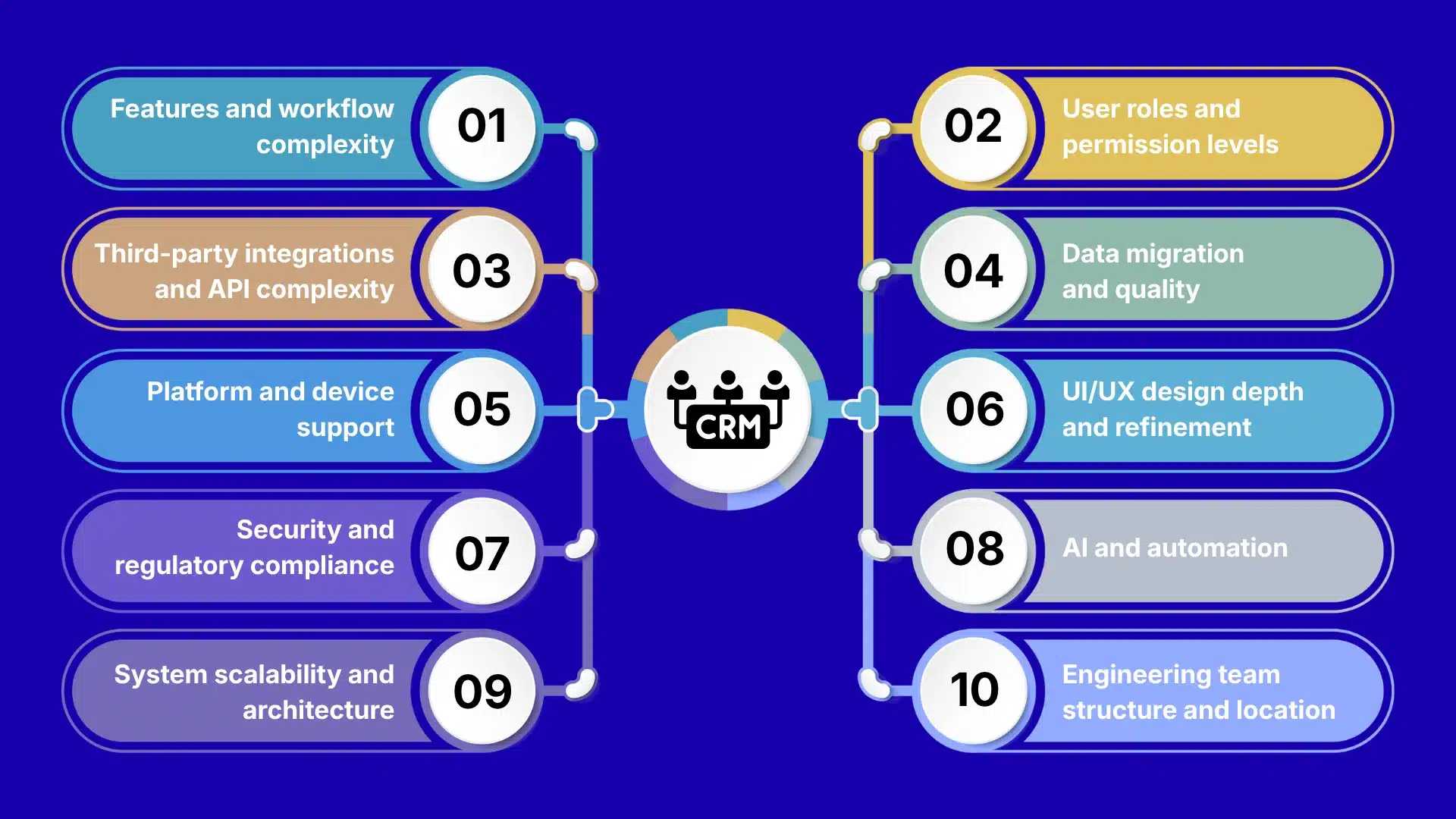
Features and workflow complexity
Your CRM development cost estimate depends heavily on how closely the system must reflect your business’s actual sales process. Standard lead tracking is relatively straightforward to build. However, it isn’t the same for features or capabilities like:
- Custom forecasting rules
- Territory-based lead assignment
- Multi-stage deal approvals
- Contract renewals
That’s because these require additional backend logic and testing effort, which ultimately drives up the cost enough. Consider a US B2B SaaS company that wants to manage its pipeline, from lead qualification to contract renewal, with different approval thresholds for deals above $25K. A CRM covering core sales activities will then cost around $35K-$50K, while adding specialized workflows will push the quote to the bracket of $75K-$100K. That’s why, while reviewing estimates, make sure to ask which business rules will be included in the quoted scope and which will be treated as chargeable change requests.
| CRM Scope | Estimated Cost | Complexity | Typical Timeline |
| Core CRM | $30K–$50K | Low | 2–3 months |
| Custom sales workflows | $40K–$70K | Moderate | 3–4 months |
| Workflow automation | $50K–$90K | Moderate–High | 3–5 months |
| Advanced approvals and forecasting | $70K–$120K | High | 4–6 months |
User roles and permission levels
CRM costs spike when access rules start depending on factors like:
- Account ownership
- Sales territories
- Reporting lines
- Sensitivity of customer information
Setting up a simple role within the platform is considerably inexpensive. However, ensuring that representatives can view only their assigned accounts while regional managers can access consolidated forecasts has a different story. That’s because your investment then has to cover more detailed authorization logic and testing.
To understand this better, let’s consider that your US startup has 50 sales representatives across 5 territories. When you want to build custom account visibility, manager-level reporting, and restricted access to discount approvals, your CRM build cost will be around $8K-$18K on top of the base quote. Hence, the key question is whether your estimate covers the real organizational structure, including employee transfers and reassignment of accounts. If not, you will have to invest additionally in making routine administration changes after launch.
| Access Model | Estimated Cost | Suitable For | Complexity |
| Basic role-based access | $2K–$5K | Small sales teams | Low |
| Team-level permissions | $5K–$10K | Multiple sales teams | Moderate |
| Territory-based access | $8K–$15K | Regional sales organizations | High |
| Granular, multi-level permissions | $12K–$25K | Enterprises with sensitive data | Very high |
Third-party integrations and API complexity
For this factor, the costs depend on the volume of customer and transaction data your CRM will have to exchange with other interconnected systems and the level of reliability you expect from the process. Connecting the product to QuickBooks Online to retrieve customer and invoice information is a completely different undertaking from synchronizing other details across multiple platforms, which include:
- Account information
- Sales opportunities
- Invoices
- Payment statuses
For your US business, therefore, building QuickBooks integration will cost around $5K-$12K. But multiple bidirectional integrations involving NetSuite or Stripe can add $20K-$40K+. That’s why what you need to ensure is that the proposal you commit to specifies:
- Synchronization frequency
- Duplicate handling
- Error recovery
- The systems that will act as the source of truth for every record
| Integration Scope | Estimated Cost | Example | Complexity |
| Single basic integration | $5K–$12K | QuickBooks Online | Low–Moderate |
| Payment integration | $5K–$15K | Stripe | Moderate |
| ERP integration | $10K–$25K | NetSuite | High |
| Multiple bidirectional integrations | $20K–$40K+ | CRM, ERP, billing, and support systems | Very high |
Data migration and quality
Depending on the transferable data volume of your existing customer information, the overall CRM development costs will vary a lot. In case the data needs to be cleaned, reconciled, or restructured first, you should account for additional expenses. Moving 10K organized contacts from a single CRM is much easier than consolidating customer records across spreadsheets, Salesforce, and legacy databases at the same scale. That’s because in the latter case, you will have to factor in:
- Account ownership
- Deal histories
- Duplicate record conflicts
When the data migration initiative is simple, your US startup can complete the task within $5K-$8K only. However, for consolidating and validating datasets across multiple systems, you may have to budget $15K-$30K+. The key here is to establish whether the initial quote you received includes the following activities or will be charged separately:
- Data cleansing
- Historical activity migration
- Test imports
- Reconciliation
| Migration Scope | Estimated Cost | Data Volume / Sources | Effort |
| Basic contact migration | $3K–$8K | One organized CRM | Low |
| Data cleansing and deduplication | $3K–$10K | Existing customer records | Moderate |
| Historical activity migration | $5K–$15K | Notes, tasks, and deal histories | Moderate–High |
| Multi-system consolidation | $15K–$30K+ | Multiple CRMs, spreadsheets, or databases | High |
Platform and device support
As each additional interface introduces separate development, testing, and maintenance work, your CRM build expenses will greatly differ by your platform and device choices. Suppose your sales team works primarily from desktop browsers. In such cases, investing in a responsive web-based CRM will suffice. On the other hand, let’s consider that your field sales representatives need to perform tasks like:
- Updating sales opportunities
- Capturing customer notes
- Accessing account information between client visits
For this, you will then have to invest in a CRM product that can be accessed from both iOS and Android devices. If we talk about the numbers, $5K-$15K will be required to deliver a well-designed mobile web experience. The moment you want to build a separate native experience, costs will quickly climb to $30K-$70K. So, before you commit to the proposed estimate for mobile development, decide if your team will need features like:
- Offline access to the CRM records
- Push notifications and event-driven triggers
- Device-level security protocols
| Platform Scope | Estimated Cost | Deployment Approach | Best Fit |
| Desktop web CRM | $0–$5K incremental | Browser-based | Office-based teams |
| Responsive mobile web | $5K–$15K | Mobile-friendly web application | Teams needing mobile access |
| Native iOS app | $15K–$35K | Dedicated iPhone application | iOS-dependent workflows |
| Native Android app | $15K–$35K | Dedicated Android application | Android-dependent workflows |
UI/UX design depth and refinement
Your CRM development investment will depend a lot on the amount of work involved in transforming your business’s complex sales operations into efficient workflows that people use on a day-to-day basis. A simple interface with standard contact and pipeline screens by default needs less design effort than a CRM product with:
- Configurable dashboards
- Dense account records
- Forecasting views
- Workflows tailored to different departments
Let’s consider a US sales organization with 60 representatives as an example. It will have to spend $5K-$12K only on a straightforward UI design. But the moment it factors in extensive user research, interactive prototypes, usability testing, and multiple rounds of refinement, the design costs will automatically climb to the bracket of $15K-$30K.
| Design Scope | Estimated Cost | Design Approach | Typical Use Case |
| Standard interface | $5K–$12K | Core screens and established patterns | Basic CRM |
| Custom dashboards | $8K–$15K | Role-specific layouts and reporting views | Sales teams and managers |
| Interactive prototyping | $3K–$7K | Clickable designs before development | Complex workflows |
| Research and usability testing | $5K–$12K | User interviews and task-based testing | Large or diverse user groups |
Security and regulatory compliance
For any US business, regardless of the entity’s size or type, CRM security costs depend on the customer data to be stored and the obligations the concerned industry and contracts impose. A B2B product holding ordinary sales contacts has requirements that are poles apart from one managing patient records or nonpublic financial information. For instance, healthcare-specific implementations mandate HIPAA safeguards and BAAs where applicable.
At the same time, financial institutions covered by the FTC Safeguards Rule need to invest in security controls, risk assessments, and safeguards for customer information. That’s why you will have to reserve about $10K-$30K in your CRM budget for implementing:
- Stronger access controls
- Encryption
- Audit trails
- Security testing
If enterprise customers require independent penetration testing or SOC 2 examination readiness, budget for those separately. SOC 2 is not a universal legal requirement, and the applicable obligations depend on your business and customers.
| Security Scope | Estimated Cost | Applicable Context | Additional Consideration |
| Core security controls | $5K–$12K | Most custom CRM projects | Authentication, encryption, and access controls |
| Audit trails and monitoring | $3K–$10K | Sensitive customer or business data | Log retention and alerting |
| Industry-specific safeguards | $5K–$20K+ | Applicable healthcare or financial requirements | Depends on legal and contractual obligations |
| Independent penetration testing | $5K–$15K | Higher-risk or enterprise deployments | Remediation may cost extra |
AI and automation
When it comes to AI CRM development cost, you will have to factor in the extent of automation and the business data volume needed to perform it reliably. Automatically routing leads by territory is much cheaper when compared to predicting which opportunities will close. That’s because for the latter, you will have to invest in:
- Historical pipeline data management and migration
- Consistent sales outcomes
- Model validation
For a US B2B sales team, custom lead scoring or AI-generated call summaries will add $15K–$40K to development, depending on integrations and safeguards. At the same time, building a CRM assistant capable of answering account questions using customer records, call notes, and approved sales documents will need additional retrieval infrastructure and permission checks. The key here is to budget separately for model API usage, monitoring, and human review. Also, remember that these recurring expenses will continue even after launch, usually depending on factors like:
- Usage volume
- Model selection
- The complexity of the AI workflow
| AI Capability | Estimated Cost | Data Requirement | Implementation Effort |
| Rule-based lead routing | $3K–$8K | Lead and territory data | Low |
| AI call summaries | $5K–$15K | Call transcripts or recordings | Moderate |
| Predictive lead scoring | $10K–$25K | Historical sales outcomes | High |
| AI sales assistant | $15K–$40K+ | CRM records and approved documents | High |
System scalability and architecture
Scalability affects your CRM budget when growth changes how the system must process data, run integrations, or generate reports. A platform serving 30 salespeople with a few thousand active opportunities has different demands from one supporting 800 users across US regions, with dashboards drawing on millions of activity records. The larger system will then require:
- Database optimization
- Background processing
- Caching
- Monitoring
- Load testing
These ultimately end up adding approximately $15K–$40K to development. Thus, your objective shouldn’t be to purchase enterprise-scale infrastructure before you need it. Instead, ask your developer how the system will handle a tenfold increase in users and data, which components would need upgrading, and what those upgrades might cost. A documented scaling path can help you avoid paying for excess capacity now or funding an expensive redesign later.
| Architecture Scope | Estimated Cost | Intended Scale | Main Priority |
| Production-ready foundation | $5K–$15K | Small to mid-sized deployment | Reliability |
| Database optimization | $5K–$15K | Growing customer and activity records | Query performance |
| Background processing and caching | $5K–$15K | Integration-heavy workflows | Responsiveness |
| Load and performance testing | $3K–$10K | Moderate to high concurrent usage | Capacity validation |
Engineering team structure and location
Your CRM budget depends on the team’s blended hourly rate, seniority, and total delivery effort. A US development agency might charge $100–$200 per hour or more. Meanwhile, an experienced India-based team might quote $25–$60 per hour, depending on expertise and the engagement model. For 1K hours of work, that creates a substantial difference in the initial estimate. However, compare the actual delivery teams, not just their rates.
A CRM project needs sound architecture, business analysis, integration development, testing, and post-launch support. Ask vendors to break down hours by role, identify who owns data migration and integration failures, and specify what’s included in the maintenance agreement. A lower rate only creates a genuine saving if the team delivers comparable quality without costly rework or delays.
| Delivery Model | Estimated Cost | Typical Hourly Rate | Main Trade-Off |
| US-based development team | $100–$200+ per hour | $100–$200+ | Higher cost, easier domestic time-zone alignment |
| India-based development team | $25–$60 per hour | $25–$60 | Lower rates, requiring clear coordination and oversight |
| Business analysis and project management | $5K–$15K per project | Varies by role | Better scope control and delivery coordination |
| Quality assurance and release testing | $5K–$20K per project | Varies by role | Fewer defects and more reliable releases |
Custom CRM Development Cost by Feature
When you try to prepare your estimate of CRM development cost by feature, you need to consider that each capability requires completely different levels of engineering, integration, and testing. As a standard benchmark, a CRM with basic content management and sales pipeline tracking costs $30K-$50K, while a platform with advanced automation, analytics, and AI capabilities can exceed $100K. The key here is to prioritize features according to their contribution to your revenue, productivity, and customer retention.
For example, content management and lead tracking form the foundation of a CRM platform, as these help your team centralize customer records and monitor prospects. Adding workflow automation will cost another $5K-$20K, depending on the number and complexity of rules governing processes like:
- Automated lead assignment
- Follow-up reminder triggers
- Deal-stage updates
So, adding these features will become justifiable only when manual administration slows down your sales team or causes leads to fall through the cracks. Similarly, when you consider adding custom dashboards and reporting, your initial budget will increase by another $5K-$15K. At this scale, the product can have features like:
- Sales performance comparators
- Territory-level forecast engines
- Reporting tools combining data from multiple source systems
If your CRM needs integrations with accounting software, an ERP, or a customer support platform, an additional thousands or tens of thousands of dollars will be required. More advanced capabilities require a completely separate business case. AI-powered lead scoring, call summaries, and sales assistance can add $10K-$40K more. Here, the amount doesn’t include recurring model usage and monitoring expenses. That’s why you should opt for these features only when your business has reliable customer data and a clear operational problem to solve.
| CRM Feature | Estimated Cost (US, 2026) | Estimated Timeline | Business Benefit | Illustrative Annual Financial Impact |
| Contact and account management | $5K–$12K | 2–4 weeks | Centralizes customer records and account history | $5K–$12K in recovered staff capacity |
| Lead tracking and sales pipeline | $5K–$15K | 2–5 weeks | Improves lead visibility and follow-up consistency | $10K–$25K in additional gross profit from improved conversions |
| Workflow automation | $5K–$20K | 2–6 weeks | Reduces repetitive administration and missed follow-ups | $8K–$20K in recovered staff capacity |
| Custom dashboards and reporting | $5K–$15K | 2–5 weeks | Reduces manual reporting and improves sales visibility | $4K–$10K in recovered staff capacity |
| Email and calendar integration | $3K–$8K | 1–3 weeks | Reduces duplicate data entry and fragmented customer communication | $3K–$8K in recovered staff capacity |
| Accounting software integration | $5K–$12K | 2–4 weeks | Reduces manual reconciliation between sales and billing | $5K–$15K in recovered staff capacity |
| ERP integration | $10K–$25K | 3–8 weeks | Connects sales, orders, and fulfillment | $10K–$30K in reduced administrative and processing costs |
| Customer support integration | $5K–$12K | 2–4 weeks | Gives teams shared customer and support history | $5K–$15K in avoided service costs and retained gross profit |
| AI-powered lead scoring and call summaries | $10K–$25K | 3–8 weeks | Helps prioritize leads and reduce manual call documentation | $8K–$20K in recovered staff capacity |
| AI sales assistant with CRM data retrieval | $15K–$40K+ | 4–10+ weeks | Reduces time spent searching customer records and sales documents | $10K–$25K in recovered staff capacity |
How Much Do AI Features Add to CRM Development Cost?
AI can add $10K–$50K+ to custom CRM development in the US in 2026. However, the final investment figure will depend on how deeply it must interact with your sales operation. Adding an LLM to summarize calls is relatively straightforward. Building AI that recommends which enterprise accounts deserve attention, explains stalled opportunities, or retrieves contract and customer history without exposing restricted data requires considerably more engineering.
Consider a B2B company with 20 sales representatives. An AI call-summary feature will cost $5K–$15K to implement. If each representative saves 20 minutes per working day, the team recovers approximately 1,667 hours annually across 250 working days. At a labor cost of $45 per hour, this translates into roughly $75K in annual staff capacity, provided the saved time is redirected to productive work. Transcription, model usage, and monitoring still reduce the net benefit.
More complex capabilities demand a different budget. Predictive lead scoring can cost $10K–$25K when historical opportunity data is reliable enough to train and validate a model. If sales outcomes are inconsistently recorded, data preparation and evaluation can push costs higher without guaranteeing better predictions. An AI assistant using retrieval-augmented generation (RAG) may cost $15K–$40K+, especially when it must search CRM records, call transcripts, and internal documents while enforcing existing permissions.
The decision is not simply whether AI can be added. Instead, it’s whether the model can outperform your current workflow enough to justify its lifecycle cost. So, make sure to budget for:
- LLM evaluation
- Failure handling logic
- Role-based access controls
- Ongoing model expenses
For each use case, define a baseline, such as time spent on call administration, lead-to-opportunity conversion, or sales-cycle duration, and then measure the change after deployment. If the improvement cannot be tied to a business metric, the added engineering cost is difficult to justify.
New wpDataTable
| AI Feature | Estimated Cost (US, 2026) | Estimated Timeline | Primary Business Application | Example of Measurable ROI |
| AI-generated call summaries | $5K–$15K | 2–4 weeks | Automates call notes and follow-up documentation | 20 reps saving 20 minutes daily at $45/hour recover approximately $75K in annual staff capacity. |
| Predictive lead scoring | $10K–$25K | 3–8 weeks | Prioritizes leads using historical conversion patterns | If scoring generates 10 additional deals annually at $3K gross profit per deal, that adds $30K in gross profit. |
| AI email and follow-up drafting | $5K–$15K | 2–5 weeks | Assists with personalized sales outreach | 10 reps saving 30 minutes daily at $40/hour recover approximately $25K in annual staff capacity across 250 working days. |
| AI sales assistant using RAG | $15K–$40K+ | 4–10+ weeks | Retrieves information from CRM records and approved internal documents | 25 employees saving 15 minutes daily at $40/hour recover approximately $31.25K in annual staff capacity across 250 working days. |
| Opportunity risk prediction | $12K–$30K | 4–8 weeks | Flags stalled deals and accounts at risk of slipping | Recovering 3 deals annually with $8K gross profit each adds $24K in gross profit. |
| AI-driven recommendations | $10K–$30K | 3–8 weeks | Suggests next actions, relevant products, or account priorities | 10 additional upsells annually at $2.5K gross profit each generate $25K in additional gross profit. |
| AI evaluation and monitoring setup | $3K–$10K | 1–3 weeks | Tracks answer quality, failures, and model performance | Preventing five costly errors annually at $2K each avoids $10K in losses. |
How Much Does Compliance (HIPAA, SOC 2, GDPR) Add to CRM Cost?
Compliance can add $5K–$50K+ to custom CRM development in the US, depending on the data you handle, the controls required, and whether independent assessments are necessary. Here’s how the costs typically break down.
| Compliance Requirement | Estimated Additional Cost | Typical Cost Drivers |
| HIPAA safeguards | $10K–$30K | PHI access controls, audit logs, encryption, risk assessments, and business associate requirements where applicable |
| SOC 2 readiness | $10K–$30K+ | Security policies, control implementation, evidence collection, and readiness work |
| Independent SOC 2 examination | Additional cost; often $10K–$30K+ | Auditor fees, examination scope, system complexity, and evidence quality |
| GDPR requirements | $5K–$20K+ | Data-subject request workflows, retention controls, lawful-basis records, and cross-border data safeguards |
Costs overlap when requirements share security controls, and independent assessment fees should be distinguished from development work. HIPAA applies to covered entities and business associates within its scope, not every healthcare-related business. SOC 2 is an assurance framework rather than a universal legal requirement. GDPR, on the other hand, applies to US businesses processing personal data within its territorial scope.
So, before approving your CRM budget, establish which laws and customer-contract requirements apply. Account separately for implementation, legal advice, independent assessments, and recurring compliance activities so your launch estimate reflects the full cost of maintaining the required controls.
Custom CRM Development Cost by Region and Team Model
The location of your development team will influence the cost to build custom CRM software. However, the lowest hourly rate doesn’t always translate into the lowest project cost. US-based development agencies typically charge $100–$200+ per hour, while experienced teams in India charge $25–$60 per hour. Eastern European teams often fall around $40–$90 per hour, depending on specialization and engagement structure.
For a 1K-hour CRM project, these rates translate into approximately:
- $100K–$200K+ for a US-based team
- $25K–$60K for an India-based team
- $40K–$90K for an Eastern European team
These figures represent engineering effort at indicative blended rates, not guaranteed end-to-end project prices. Business analysis, project management, QA, infrastructure, and post-launch support may be priced separately. Your team model matters just as much. Here’s how!
- A fixed-price contract can help control spending when requirements are clearly defined, but changes outside the agreed scope may trigger additional fees.
- Time-and-materials arrangements offer flexibility for evolving requirements, although you need sprint-level budget tracking to prevent scope creep.
- A dedicated team can suit longer projects requiring ongoing development and maintenance.
When comparing proposals, examine who handles architecture, integrations, testing, security, and production support. Also assess time-zone overlap, communication practices, and accountability for defects. An offshore team may offer substantial savings, but unclear requirements or weak delivery management can erase the rate advantage through rework and delays.
What Are the Hidden Costs of Custom CRM Development?
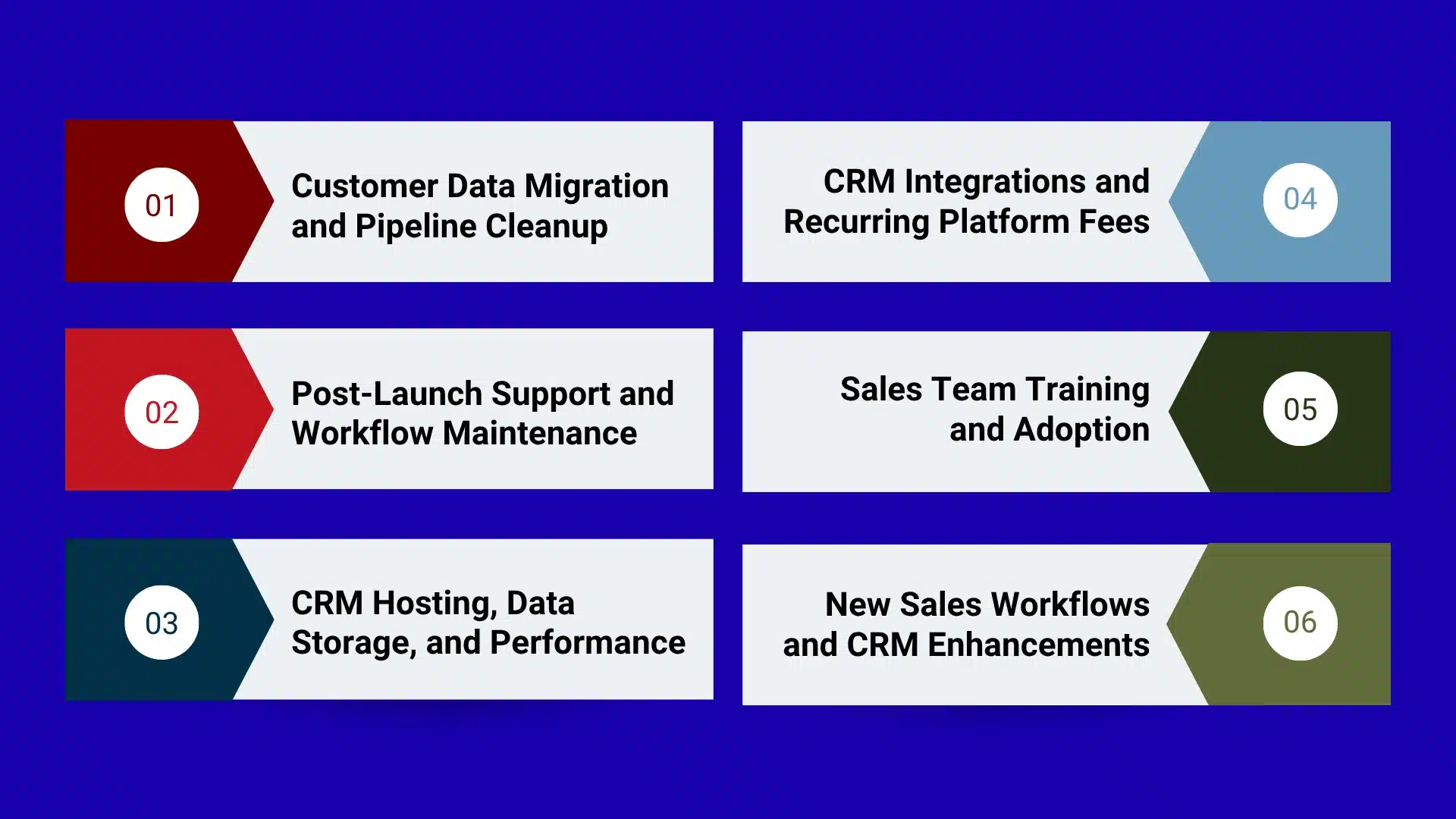
Customer Data Migration and Pipeline Cleanup
Migrating contacts is just one part of a CRM transition. Your team will also have to preserve account ownership, deal stages, sales activities, contact histories, and follow-up tasks. Cleaning and reconciling records across multiple systems can add about $5K-$20K+ to your initial implementation budget. In case deal histories or ownership rules are lost, your sales representatives may end up duplicating outreach, missing follow-ups, or inheriting inaccurate pipeline forecasts.
CRM Integrations and Recurring Platform Fees
Your CRM will have to exchange data with email marketing platforms, accounting software, customer support tools, calendars, and e-signature platforms. Each connection will then involve development, API limitations, and recurring subscription fees. For example, an integration that fails to sync deal values or customer status correctly can leave your sales and finance teams working with conflicting records. So, make sure to price each integration separately and confirm ongoing API or connector changes.
Post-Launch Support and Workflow Maintenance
CRM workflows often support lead assignment, sales approvals, follow-up reminders, pipeline reporting, and customer handoffs. The moment these stop working after an API update or a change to your sales process, deals can stall or reporting can turn unreliable out of the blue. For a $100K CRM, an annual maintenance allowance of $15K-$20K will then be a reasonable planning estimate. However, before you commit, make sure to confirm whether this will cover workflow fixes, integration failures, security updates, and production support.
Sales Team Training and Adoption
If sales representatives keep updating spreadsheets alongside your CRM, pipeline reports will remain incomplete, and managers will lose visibility into actual deal progress. For a 50-person sales team, four hours of training per employee at a loaded cost of $40 per hour represents $8K in staff time alone. So, budget for role-specific training and a phased rollout of the custom CRM platform across several departments. Track CRM usage, missing deal updates, and follow-up completion to identify any type of adoption challenge early.
CRM Hosting, Data Storage, and Performance
CRM infrastructure costs grow with customer records, email and call histories, attachments, reporting queries, and automated workflows. A system storing years of sales interactions across multiple teams will likely need more database capacity, backups, monitoring, and performance optimization than what an initial estimate assumes. Ask for projected monthly infrastructure costs at launch and at your expected user and data volumes. Include backup retention and recovery requirements so cost-cutting doesn’t compromise access to the stored customer records.
New Sales Workflows and CRM Enhancements
Your initial CRM may support today’s pipeline, but expansion into new territories, product lines, or sales channels will definitely need additional fields, approval rules, dashboards, and integrations. A $100K build would then require $10K-$20K annually for planned enhancements, depending on how frequently your processes change. Define which workflows belong in the original scope, price likely additions, and maintain a prioritized roadmap so feature requests won’t quietly inflate your budget.
How Long Does It Take to Build a Custom CRM?
Building a custom CRM usually takes 3-6 months for a small or mid-sized business and 6-12 months or longer for a complex enterprise system. However, the timeline you must plan must be rooted in the extent of the existing sales operations that the new CRM will have to replace and automate. Suppose you are building the product for a 15-person sales team. If you need lead tracking, contact management, deal pipelines, follow-up reminders, and a few standard integrations, a 3-4-month timeline will be realistic.
In case your sales process includes territory-specific assignments, custom approval rules, commission calculations, management dashboards, and synchronization with your account software, expect a longer build, often taking 4-7 months. The schedule can also stretch when your current customer data is spread across spreadsheets and multiple platforms. In such cases, your teams will have to decide:
- Which records to retain
- Resolve duplicate accounts
- Verify that deal histories and ownership transfer correctly
New wpDataTable
| Development phase | Timeline | Key CRM deliverables | Estimated effort (hours) | Typical cost (USD) |
| Requirements and workflow mapping | 2–3 weeks | Lead stages, assignment rules, permissions, reporting requirements | 60–100 | $3K–$8K |
| UI/UX design and architecture | 2–3 weeks | CRM screens, navigation, database design, integration architecture | 80–140 | $4K–$12K |
| Core CRM development | 5–7 weeks | Contacts, leads, deal pipelines, activity tracking, dashboards | 250–450 | $12K–$35K |
| Integrations and data migration | 2–4 weeks | Accounting and marketing connections, customer records, deal histories | 100–220 | $5K–$18K |
| Testing and user acceptance | 2–3 weeks | Workflow testing, permissions, reporting validation, defect fixes | 80–140 | $4K–$12K |
| Deployment and onboarding | 1–2 weeks | Production launch, user training, monitoring, initial support | 40–80 | $2K–$7K |
Custom CRM vs. SaaS CRM: 3-Year Cost and Break-Even
For a 50-person sales team, a SaaS CRM is likely to cost more than its advertised subscription once you add premium licenses, integrations, and implementation costs. A custom CRM, on the other hand, demands higher capital upfront. However, the economics change when your business has to pay for features it barely uses or needs expensive workarounds to manage its sales process.
Consider a SaaS plan at $100 per user per month. This automatically translates to $60K annually or $180K over 3 years, before you consider implementation expenses and add-ons. Add $15K for setup and $12K annually for premium integrations and administration, and the 3-year cost reaches $231K.
Now consider a custom CRM costing $100K to build, $15K for migration and launch, $20K annually for maintenance, and $10K annually for hosting and third-party services. In this case, the platform’s 3-year cost will reach a total amount of $225K. The initial savings here are modest, amounting to just $6K over three years, before accounting for internal ownership and enhancement expenses.
The break-even calculation reveals further details. The custom CRM costs $115K upfront and $30K annually to operate, compared with $72K in annual SaaS and add-on expenses. It recovers the upfront premium in approximately 2.7 years, assuming comparable functionality and stable costs.
How Can You Reduce Custom CRM Development Cost?
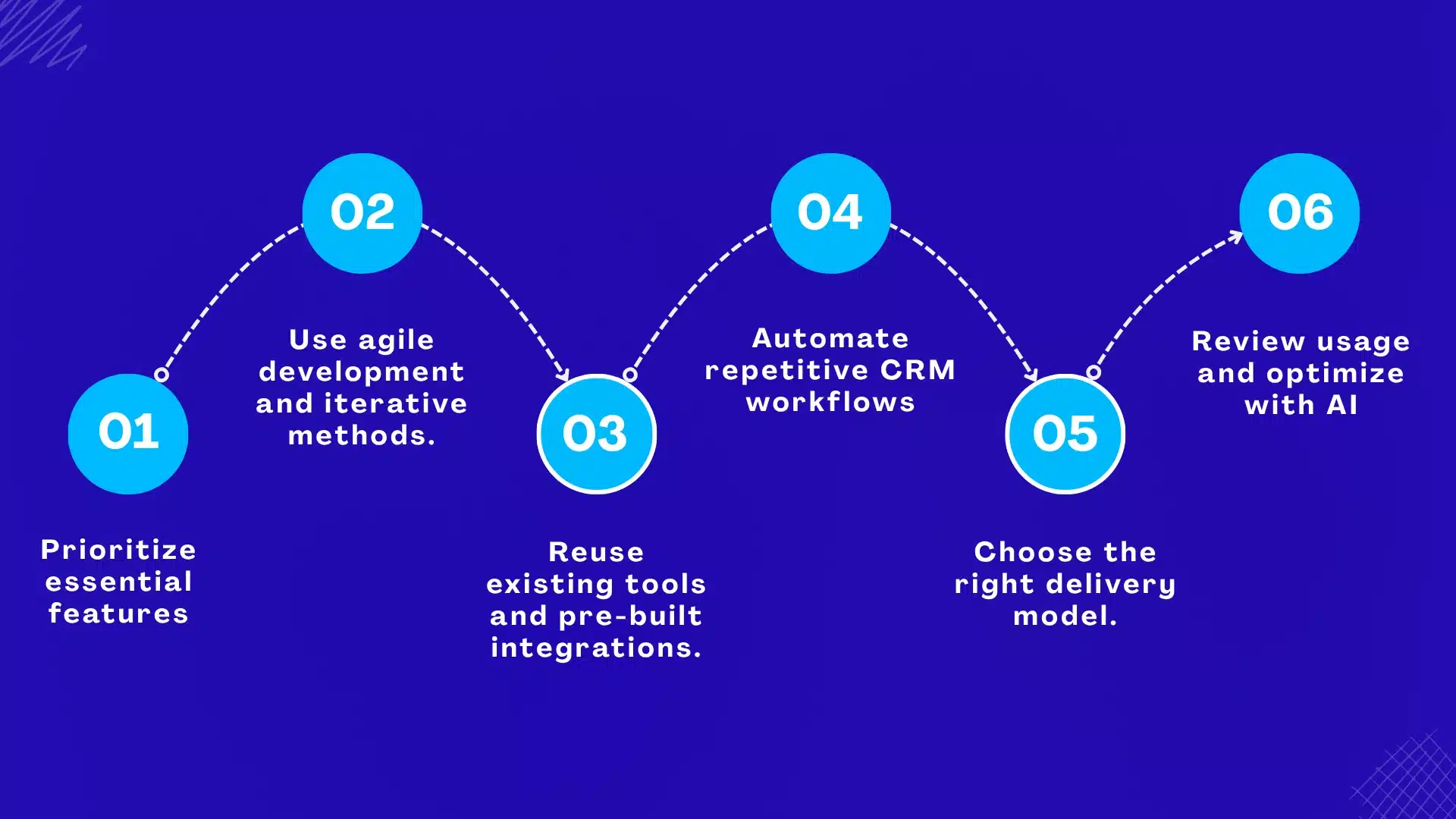
Prioritize essential features
Start by identifying which CRM functions directly support your current sales process, like:
- Lead capture
- Account ownership
- Deal-stage tracking
- Follow-up scheduling
- Pipeline forecasting
If your team can manage commissions in an existing system, don’t rebuild that module in the first release. Deferring non-essential features will help lower the initial development costs and protect cash for workflows that influence your revenue directly.
Use agile development and iterative methods.
Build your CRM in short sprints, starting with the lead-to-deal workflow your sales team uses daily. Have representatives test lead assignments, opportunity updates, and follow-up reminders before developers move to forecasting or management dashboards. Catching workflow gaps early will help you prevent rework across connected CRM modules. In addition, make sure to tie payments to accepted sprint deliverables rather than elapsed development time alone.
Reuse existing tools and pre-built integrations.
Keep established systems for email campaigns, invoicing, and e-signatures instead of recreating them inside your CRM product. Use supported connectors or APIs to sync customer records, deal values, and activity histories. For example, integrating the existing accounting software your finance team currently uses can avoid the need to build a separate invoicing module. However, make sure to compare connector fees and synchronization limits against the cost of custom integration development and maintenance.
Automate repetitive CRM workflows
Start with sales tasks that consume measurable staff time, like:
- Assigning inbound leads by territory
- Triggering follow-up reminders
- Updating deal stages
- Notifying managers about stalled opportunities
Automate one workflow at a time and measure its effect on response times and administrative hours. This will help you avoid paying to automate low-volume processes that deliver little to almost no commercial value.
Choose the right delivery model.
For a CRM with agreed lead stages, user roles, reports, and integrations, a fixed-price contract can make spending more predictable. If your sales process is still undergoing a transformation, use time-and-materials with capped sprint budgets and written approval for scope changes. Evaluate vendors on CRM delivery experience, integration testing, migration accountability, and support teams, and not just hourly rates alone.
Review usage and optimize with AI
Review CRM data to identify where sales representatives spend time on administration, which leads receive delayed follow-ups, and where opportunities repeatedly stall. Consider AI call summaries if manual note-taking is expensive or lead scoring if you have reliable historical conversion data. Pilot one use case, compare results against existing performance, and expand only when measurable gains justify model fees and maintenance.
FAQs
How much does it cost to upgrade or rebuild an existing CRM?
Upgrading an existing CRM typically costs $10K–$50K for targeted improvements, while rebuilding a complex or outdated system can cost $50K–$150K or more. The price depends on code quality, database structure, integrations, and required functionality. A technical audit costing $2K–$8K can help determine whether upgrading is cheaper than rebuilding before you commit.
What should a custom CRM development contract include to protect the budget?
Your CRM development contract should define the project scope, feature specifications, milestones, payment schedule, acceptance criteria, and change-request rates. Specify who owns the source code, how defects are handled, and what post-launch support includes. For a $100K project, milestone-based payments tied to approved deliverables can limit exposure. Also clarify exclusions, third-party fees, and termination terms before signing.
How can a startup evaluate whether a CRM development proposal is overpriced?
Compare at least three proposals against the same CRM requirements, not just their headline prices. A $40K quote may exclude integrations, migration, or testing that another $60K proposal includes. Request estimates by feature, engineering hours, team roles, and deliverables. For US projects, compare the quoted scope against a preliminary $30K–$60K budget for a basic custom CRM, then investigate significant deviations.
Should we build a custom CRM in-house or hire an external development company?
Hiring an external development company can cost approximately $30K–$150K for a custom CRM, depending on complexity. An in-house team requires salaries, benefits, recruitment, and management overhead. For example, three engineers costing $120K annually each represent $360K in annual base salaries alone. Outsourcing often suits startups needing faster access to specialists, while in-house development can make sense when CRM engineering is a long-term core capability.

Founder
Anjali Upadhyay is the Founder of GMTA Software Solutions, a mobile and web application development company she built from the ground up in 2019. Under her leadership, GMTA has delivered 200+ production applications across healthcare, fintech, and on-demand services for clients in the US, UK, Singapore, and UAE. She also leads GMTA’s AI practice, which has shipped production AI systems — including HIPAA-compliant healthcare workflows, LLM-integrated logistics platforms, and fintech automation tools — for US-based enterprise clients. Her writing covers AI product strategy, build-vs-buy decisions for AI systems, and the operational realities of moving AI from proof-of-concept to production at scale.