

Key Takeaways
- Prioritize developers with proven experience in your education segment; building a K–12 platform requires different workflows from a tutoring marketplace or test-preparation app
- Finalize your monetization model early because subscription billing, institutional licensing, and per-student pricing require different access and payment architectures
- Check integration experience with Canvas, Google Classroom, LTI 1.3, and OneRoster, particularly if schools or districts are your target customers
- Assess AI capabilities beyond chatbot development. Reliable tutoring requires subject-specific answer validation, contextual recommendations, and educator oversight
- When outsourcing, retain control over source code, student records, intellectual property, and future product decisions to avoid long-term vendor dependency.
Choosing an education app development company is harder than choosing a general software agency. An LMS for school districts needs SSO, LTI 1.3, and OneRoster support. A tutoring marketplace needs scheduling and payments. An AI tutor needs answer validation and educator oversight. This guide compares 10 education app development companies in 2026 by what they have actually built, how they handle integrations and student-data compliance, and who each is best suited for. The EdTech market has flourished at an exceptional pace globally, expected to grow at a CAGR of 10.28%. To say that this has created immense pressure on newcomers would be an understatement. Your competitors might already be working on AI-based adaptive learning or gamified learning experiences, while you are still stuck building a basic LMS platform. It’s not just your product idea that matters here! You might be having an excellent, next-gen education app idea. But if your development partner isn’t familiar with an institutional platform or LMS interoperability, giving your plan a realistic structure in 2026 would be next to impossible. A partner who treats these as post-launch enhancements will simply leave you with an architecture that needs an expensive future rebuild.
Integration capability is yet another important differentiator to evaluate if your vendor can actually deliver production-ready edtech products or not. Whether it’s Canvas, Moodle, or payment gateways, the education app development service provider must understand data synchronization, API interoperability, and user provisioning. Security expertise deserves equal scrutiny, if not more. Frontline Education released an official statement, declaring how a breach put PII data of 80K+ schools at risk. Therefore, you will have to focus on vendor-level security practices without fail, whether it’s compliance with COPPA and FERPA or role-based access controls.
That’s why we have shortlisted the top education app development companies in 2026 that are specialized in EdTech projects, and not just another generalist software agency. Not sure which category your product falls into yet? Our guide to the types of education apps can help you narrow the scope before you approach vendors.
What is shaping the education industry in 2026?
The current US education industry is advancing towards more accountable technology procurement, flexible learning models, and workforce-aligned education. CoSN’s 2026 State of EdTech report surveyed 600+ district tech leaders, only to find that about 55% of districts ask vendors to clarify product safety information with absolute transparency. This automatically changes the outlook towards institutional customers. To ensure a stronger proposition during procurement, your product should document:
- Security controls
- Accessibility standards
- Interoperability
- Evidence of effectiveness
As for your development partner, the agency must be able to engineer and document these capabilities, and not simply deliver the features you include in the initial roadmap. Online education has also become a trendsetter in 2026. As per NCES data, about 54.7% of US postsecondary students opted for at least one distance education course in fall 2024, representing 10.76 million students on average. This creates an opportunity for edtech companies that go beyond standalone eLearning apps through:
- Institutional LMS platforms
- Hybrid learning solutions
- Continuing education
If institutional contracts are a part of your software strategy, make sure the education app development partner is familiar with SSO, centralized admin controls, and LMS interoperability. Workforce reskilling has changed the dynamics of education revenue completely in 2026. It’s further evident from the OECD’s report that about 74% of employed US adults aged between 25 and 44 participated voluntarily in non-formal education training. Whether it’s corporate learning or professional certification, you can plan for B2B revenue rather than depending solely on individual course subscriptions. However, make sure that your chosen software development vendor can demonstrate their technical proficiency in developing features like:
- Skill assessment dashboard
- Progress reporting
- Certification management
- Employer dashboards
Responsible AI governance and cybersecurity, too, are influencing the purchasing decisions. CoSN reported that 79% of US districts have established stringent AI guidelines in 2026 for various learning platforms. At the same time, 65% of them have identified underlying challenges in the form of security staffing and dedicated budgets. Therefore, you will have to work alongside your technology partner to strengthen your eLearning product in terms of security and data privacy.
If AI tutoring is on your roadmap, our overview of AI edtech software development is a useful starting point, and our piece on the future of data privacy in AI applications covers how to protect user data in AI-powered products.
How did we select the top education app development companies?
The education app development companies that we have featured in this list were evaluated on their education app development experience, verified project portfolios, technical capabilities, and range of EdTech solutions. We paid more attention to their work across learning platforms, school management systems, tutoring apps, and AI-powered education products, alongside their ability to address real business requirements and support long-term product growth.
| Evaluation criteria | What we looked for |
| Education app development experience | A proven portfolio of education products, including LMS platforms, tutoring apps, school management systems, and digital learning solutions. |
| Relevant project portfolio | Completed projects demonstrating the company’s ability to solve specific EdTech challenges rather than showcasing generic mobile applications. |
| Technical expertise | Practical experience with mobile and web technologies, cloud infrastructure, AI/ML, learning analytics, and education-specific integrations. |
| Learning technology capabilities | Experience implementing adaptive learning, digital assessments, virtual classrooms, student progress tracking, and interactive learning environments. |
| Third-party integrations | Ability to connect education apps with LMS, SIS, payment gateways, content platforms, and established learning ecosystems. |
| Data security and compliance | Understanding of student data protection, FERPA, COPPA, access controls, and secure handling of educational records. |
| Client experience and industry reputation | Available client feedback, documented project outcomes, long-term partnerships, and evidence of successful education product delivery. |
| Post-launch support and scalability | Capacity to maintain applications, manage growing user volumes, support new institutional requirements, and evolve products after launch. |
The top 10 education app development companies
GMTA Software
If your EdTech product needs to establish perfect synchronization between learner engagement and platform administration, GMTA Software is a strong fit when your product centers on structured courses, subscriptions and quiz-based assessment, with a custom admin backend. Instead of approaching an edtech platform as a collection of screens, the experts consider course structure, learner journey, and operational requirements behind the product. By doing so, GMTA can design software that will help you redefine the learning experience for your target audience, whether it’s individual students or corporate employees. Its capability is further defined through Volorex, a mobile and web-based learning platform that reported an 80% increase in course enrollment and a 60% reduction in administrative overload. Another noteworthy project the company delivered is Quiziere, an interactive quiz application. You can see how the project came together in our Volorex case study.
Key capabilities:
- Course-based LMS and mobile learning development, with course discovery, enrollment, subscriptions, and lesson-level progress tracking
- Laravel administration systems that let you manage instructors, course pricing, student records, permissions, and platform analytics from one backend
- Learner dashboards that make course completion and recent learning activity visible, helping students track their progress without relying on manual updates
- Swift-based iOS development and MongoDB-backed data management for mobile edtech apps that involve both dynamic user activity and real-time interactions
- Firebase synchronization and JWT-secured APIs for keeping application data current and managing authenticated user sessions
- Node.js and socket-based development for live quiz participation, player tracking, scheduled sessions, and in-app communication
- Interactive quiz development with drag-and-drop creation tools, giving you a way to offer assessment-led products alongside conventional courses
- Course subscription and payment integrations that support paid learning access and recurring revenue models
Best for:
EdTech startups, online course providers, coaching businesses, and training companies developing custom learning platforms or interactive assessment applications with connected mobile and web systems, custom backend administration, and real-time learning interactions. To talk through your own platform, explore our education app development services.
Techahead
Founded back in 2009, TechAhead brings forth 16+ years of experience and 1.2K+ clients onboard. Its education technology mindset is rooted in building and modernizing learning platforms where learner engagement, app performance, and institutional workflows have a direct impact on product adoption. Whether it’s outdated architecture, fragmented learning experiences, or the maintenance burden of separate tech stacks, it addresses these key bottlenecks by combining product engineering with cloud and mobile development approaches.
The company clearly demonstrated this capability through YourAccess. This proprietary edtech platform consolidates native iOS and Android features into a React Native codebase, allowing TechAhead to redesign UX and integrate Zoom for virtual classrooms. By doing so, it ensured an 85% increase in daily active user volume and a 60% reduction in app load time.
Key capabilities:
- React Native migration for edtech apps to consolidate iOS and Android codebases while preserving the platform’s existing features
- Extending learning apps into HD video classes and breakout rooms through Zoom SDK integration and improving direct student-teacher collaboration
- Offline content caching combined with AWS infrastructure and .NET/MySQL backend architecture to support learning in varying network bandwidths
- Predictive learning analytics to turn student interaction data into intervention alerts and completion-probability insights
- Education-focused AI engineering using NLP for response analysis and computer vision for assessment integrity
- FERPA- and COPPA-guided development approach, backed by SOC 2 Type II security to protect student information stored within the edtech platforms
Best for:
Universities, medical education institutions, established EdTech businesses, and online learning providers modernizing existing applications or developing collaborative learning products
JP LOFT
With 16+ years of engineering experience, JP LOFT is the best education app development company you can rely on to build and increase learners’ engagement through your product. Its client portfolio includes 1.8 million users, spanning multiple platforms, including edtech software and LMS apps. From video-led instruction to regional language learning and alternative teaching methods, the agency develops education apps around the way students absorb information. Building a language-learning product? Our breakdown of the cost to build an app like Duolingo shows how features like speech practice and gamification affect the budget.
Learn EC Learn, a Malayalam e-learning platform, is one of its notable projects. It has successfully onboarded 50K students, comes with a library of 2.5K+ expert-led video classes, and delivered over 1M learning hours. For Brainywood, however, the company has adopted a completely different approach by focusing on brain-science-based mnemonic training, holistic skill development, and live classrooms. For your business, JP LOFT will bring maximum value when your product’s economic growth depends on sustained learner participation, course completion, and reaching audiences beyond mainstream English-language learning.
Key capabilities:
- Four-camera video capture for chiropractic education, allowing students and professors to record practical demonstrations and compare their techniques from multiple angles
- Next.js, Node.js, MongoDB, and TypeScript-based development for video-led learning platforms, supporting structured course libraries and expert-led online instruction
- AI-driven learning paths that adapt lesson recommendations to student behaviour and performance rather than relying on a fixed sequence of course material
- React Native and Laravel-based development for mnemonic-learning applications, bringing brain-science-based exercises and skill development into mobile learning experiences
- Voice- and vision-based learning interactions, including speech recognition and visual quizzes, for education products that extend beyond conventional text and video lessons
Best for:
EdTech startups, regional-language learning businesses, professional course providers, and coaching companies developing video-led or instructor-supported education platforms.
Octal
When your education software is meant to serve students, specialist instructors, parents, and teachers simultaneously, it’s not just delivering course content that will prove to be a huge bottleneck. Rather, you will need the right set of workflows tailored for each participant group, without making academic administration complicated. This is where Octal IT Solution brings its 19+ years of software engineering experience, 900+ clients, and a team of 300+ professionals. Its education portfolio demonstrates experience with two distinct business models.
It developed Kytabu around the coordination needs of students, parents, and teachers, including private communication and support for Kenya’s Competency-Based Curriculum. Another project it worked on is VivaLing, which required a more personalized language-learning experience. This platform connects students with language experts through localized interfaces, flexible lesson scheduling, and progress tracking. Therefore, Octal proves to be the best e-learning app development company for businesses that want to build more than a digital course catalog.
Key capabilities:
- Private parent-teacher chatroom built into the LMS platform to ensure both can discuss a child’s academic progress without feeling the risk of their conversations being exposed
- Competency-based curriculum workflows that can help teachers manage the additional academic and admin responsibilities
- Minimal-detail student onboarding process to reduce registration friction and allow learners access to courses without having to fill long forms
- Localized instructor dashboards for multilingual teaching teams so that experts can work through a personalized interface tailored to their preferred language
- Automated learning-roadmap tracking to record a student’s progress and provide instructors with a consistent basis for reviewing development
Best for:
Schools, online education providers, language-learning businesses, and EdTech companies developing multi-user learning platforms with localized language experiences and curriculum-specific admin workflows
Appinventiv
Known as one of the best edtech app development companies in the USA, AppInventiv builds connected learning platforms for businesses, corporate training providers, schools, and universities across the country. What distinguishes its approach is the company’s focus on bringing the wider academic ecosystem into one centralized platform, rather than developing an isolated student-facing app only. What’s more, its solutions account for the accessibility and scalability requirements of learners, administrators, and institutional systems.
Take the example of the learning platform Appinventive developed for Dr. Reddy’s Foundation. Not only did it have dedicated support for visually and hearing-impaired learners, but it also achieved 5K+ downloads in just 2 months after its launch. Gurushala also stands out in the market, proving the agency’s unique approach of bringing live classrooms, curriculum-aligned resources, and assessments in a cloud-based learning platform.
Key capabilities:
- Engineers AR/VR- and IoT-enabled skill development products with practical simulations, gamified learning journeys, and certification tracking
- Integrates Zoom SDK, Microsoft Teams, BigBlueButton, and Jitsi Meet into LMS platforms, in addition to an attendance tracker, interactive whiteboards, and session recorder
- Connects edtech platforms with 45+ institutional systems through LTI 1.3, SIS APIs, SCORM, and xAPI to support unhindered data exchange with existing tools
- Builds learning recommendation engines capable of processing 6 million signals monthly and student success analytics system monitoring 220+ engagement and performance metrics
- Engineers blockchain-based credential management products for tamper-resistant academic record issuance and verification
Best for:
Whether it’s a school, a coaching business, or a corporate training provider, Appinventiv is the best solution to build a specialized learning product, modernize an existing LMS, or develop AI-assisted assessments and accessibility-led learning
MindInventory
Whether it’s a school administration portal, a corporate training app, or a professional education LMS, MindInventory has become a renowned online tutoring platform development company in the US. With 15+ years in business, 60+ edtech apps delivered, and a team of 100+ technical experts, it can work on both customer-facing learning products and institutional education systems. Its long-running partnership with Simon Sinek’s Optimism Company is a noteworthy aspect of its edtech development services.
The agency introduced subscription functionality, promotional offers, and a gamified learning experience to improve engagement, contributing to a 60x increase in subscriptions and 44% growth in gross sales. Apart from this, it also handled several other edtech projects, each showcasing the agency’s distinct expertise spanning various domains of the education industry.
Key capabilities:
- Develops native Android learning apps including expansion-file mechanisms to deliver large educational media libraries
- Engineers mentor-led learning platforms with Go-based server-side optimization, direct mentor-learner messaging, group discussions, and interactive assessments
- Builds paid learning platforms with WordPress and WooCommerce, including features like subscription management, time-bound discount coupons, HubSpot integration, and GA4 analytics migration
- Implements SCORM and xAPI integration in custom LMS platforms, alongside multimedia course delivery, gamification, and online course management
- Develops online examination systems with AI-based proctoring, fraud detection, randomized question pools, and automated grading
Best for:
Children’s learning brands, edtech startups, mentorship platforms, and universities considering building a paid learning platform, a media-rich kid’s learning app, or a mentor-led education product
Simform
If you are looking for a virtual classroom software development company skilled in application modernization and data-intensive products, Simform is your best option. Instead of focusing on learner-facing apps, the agency has demonstrated its ability to bring fragmented academic and operational data into a centralized decision-making platform. Considering its past projects, the experts rebuilt a school-district analytics platform, which was used by 2K+ schools.
The solution consolidated information from over 50 disconnected systems, giving district leaders a centralized view of attendance, school operations, and assessments. Simform even reported 10x faster data processing and a 70% reduction in infrastructure costs following the modernization. Therefore, for your business, this experience will matter if you are building a SaaS product or an institutional platform where data consistency, reporting speed, and secure access matter a lot.
Key capabilities:
- Rebuilds legacy school analytics platforms using modular cloud architecture and centralized data warehouses to replace fragmented reporting infrastructure
- Implements real-time ETL pipelines that ingest and standardize academic and operational data from 50+ disconnected school systems
- Engineers unified data access layers with RBACs and policy-driven visibility for administrators and other institutional layers
- Implements CI/CD pipelines with automated testing, deployment, and rollback safeguards to support frequent platform updates
- Develops education-focused mobile apps with secure content delivery, assessment workflows, accessibility, and academic data management
Best for:
Education technology companies, school networks, district administrators, and institutional SaaS providers building data-intensive platforms or modernizing legacy academic systems
Citrusbug Technolabs
Citrusbug Technolabs offers custom LMS development services, combining personalized edtech products with AI, machine learning, and voice technology. Its education portfolio stands out for addressing specific learning challenges through specialized apps rather than solely relying on conventional LMS functionality. Ello, for example, is a screen-free voice tutoring system for children that the agency developed. It uses conversational AI to deliver lessons and adapt various learning paths.
BotPenguin takes a completely different approach, though. It functions as an AI-powered academic advisor, recommending courses based on students’ interests and career goals. Citrusbug has reported 500+ projects delivered and a 98% client retention rate for various edtech products it has worked on. If combining AI engineering and education-specific product experience is valuable for your business, this agency will help you develop a differentiated learning app easily.
Key capabilities:
- Develops voice-first tutoring systems with speech recognition, accent detection, fluency scoring, natural-language feedback, and adaptive learning paths
- Builds AI course recommendation engines using NLP-based intent recognition, student preference analysis, and asynchronous processing
- Implements SCORM 1.2, SCORM 2004, xAPI, and LTI 1.3 to connect custom learning platforms with content-authoring tools and existing institutional systems
- Integrates Zoom SDK and WebRTC into virtual classroom products, supporting live instruction, collaborative whiteboards, breakout rooms, and attendance tracking
- Develops EdTech MVPs around a defined core learning journey, with its service page quoting an 8–12-week delivery timeline for validated initial products
Best for:
EdTech startups, children’s learning businesses, online tutoring providers, schools, and education SaaS companies that depend on AI tutoring, voice-based instruction, personalized course discovery, social-emotional learning, or a cross-platform MVP
ScienceSoft
With 37 years of IT experience and 4.3K+ completed projects, ScienceSoft is a renowned AI edtech app development company in the US. Whether you want to validate complex AI functionality, improve an existing LMS’s economics, or expand your product features without rebuilding it from scratch, they will help you achieve your goal in no time. What’s more, the company goes beyond standard course delivery apps, thanks to its experience in handwritten assignment recognition, multilingual speech-based learning, and long-term LMS product development.
ScienceSoft built a 6-month MVP for an educational technology startup, using separate AI models to recognize handwritten mathematical assignments and evaluate students’ solutions. The company also demonstrated its decade-long experience in building tailored LMS platforms by building a product for a European learning platform provider serving schools in Sweden and Iceland.
Key capabilities:
- Develops multi-model AI tutoring systems using Gemini 3 for handwritten assignment recognition and Qwen3.5 for mathematical reasoning
- Builds multi-tenant education SaaS applications with distinct student, teacher, school, and administrator interfaces
- Modernizes children’s mathematics applications built with Cordova, Angular, C#, and Microsoft SQL Server
- Provides ongoing feature development for established LMS products using .NET, MS SQL Server, Oracle, and React.js
- Modernizes compliance-heavy training platforms through headless architecture and AWS-native infrastructure, including a documented 10-month LMS transformation
Best for:
EdTech startups developing AI tutors, established LMS vendors, language-learning businesses, children’s education providers, and organizations modernizing legacy learning applications
Hyperlink Infosystem
Founded in 2011, Hyperlink InfoSystem works with a global team of 1.2K+ professionals and delivers education app development services spanning school management portals, eLearning platforms, skill development apps, and STEM learning products. What makes its offering interesting is the combination of these specialized learning formats with its AI and game development capabilities. Therefore, your edtech business will get enough room to build products that go beyond conventional video lessons and course libraries.
Its published AI learning management case study, for example, demonstrates a platform blending personalized learning paths, intelligent content recommendations, automated assessments, and virtual tutoring. The company even reported a 55% increase in student engagement and a 45% improvement in course completion.
Key capabilities:
- Builds AI-powered learning applications with performance-based content recommendations, instant academic assistance, learner progress dashboards, and early identification of students at risk of dropping out
- Develops educational gaming applications using Kotlin and Android, with its ATB portfolio project demonstrating a dedicated mobile gaming approach to educational content
- Develops offline-capable eLearning applications with gamified modules, multimodal content delivery, live progress tracking, and adaptive learning paths
- Creates STEM learning applications around assignment-based instruction, virtual experiments, simulations, and problem-solving activities for practical subject learning
Best for:
EdTech startups, schools, vocational training providers, coaching businesses, and education companies building interactive learning products with AI-assisted learning personalization, educational gaming, skill-based certification, or a school management dashboard
Types of education apps these companies build
The top edtech software development companies we talked about above build different eLearning apps depending on how you plan to deliver the education experience and who will use your product. Whether it’s an LMS portal, a virtual classroom platform, an online tutoring app, or a language learning app, they will help you launch a next-gen edtech product tailored to your audience groups and future growth goals.
| Education app category | Primary purpose | Key features | Main users | Business use case | Estimated development cost (USD) |
| Learning Management System (LMS) | Organize, deliver, and track structured learning programs | Course management, progress tracking, assessments, certificates, reporting | Schools, universities, training providers | Centralize course delivery and monitor learner performance | $40K–$150K |
| eLearning apps | Provide on-demand digital learning | Video lessons, downloadable resources, quizzes, learning paths | Students, independent learners, professionals | Sell courses and expand access to self-paced learning | $25K–$100K |
| Virtual classroom apps | Enable live, instructor-led online teaching | Video conferencing, screen sharing, chat, digital whiteboards, attendance | Schools, tutors, universities | Deliver remote classes and interactive training sessions | $40K–$150K |
| Online tutoring apps | Connect learners with tutors for personalized instruction | Tutor profiles, scheduling, one-to-one sessions, payments, feedback | Students, tutors, tutoring businesses | Run online tutoring services and manage tutor bookings | $30K–$100K |
| Language-learning apps | Help users develop speaking, reading, listening, and writing skills | Vocabulary exercises, speech recognition, pronunciation feedback, spaced repetition | Language learners, schools, training providers | Offer subscription-based language courses and practice tools | $35K–$120K |
| Test preparation apps | Prepare learners for competitive and academic examinations | Mock tests, question banks, timed assessments, performance analytics | Exam candidates, coaching institutes | Deliver digital test-prep programs and track readiness | $25K–$90K |
| School management apps | Manage academic and administrative operations. | Student records, attendance, fee management, timetables, parent communication | Schools, administrators, teachers, parents | Reduce manual administration and improve parent-school coordination | $40K–$130K |
| Corporate training apps | Deliver employee training and professional development | Training modules, skill assessments, learning paths, completion tracking | Businesses, HR teams, employees | Standardize workforce training and monitor employee development | $30K–$100K |
| Educational gaming apps | Teach concepts through interactive gameplay | Game-based lessons, challenges, rewards, simulations, progress tracking | Children, students, educators | Improve learner engagement through interactive educational content | $40K–$180K |
| AI-powered tutoring apps | Provide personalized, adaptive learning support. | AI tutors, instant explanations, adaptive recommendations, automated feedback | Students, educators, EdTech companies | Scale individual learning support without relying entirely on live instructors | $60K–$250K+ |
What to look for when choosing an education app development company?
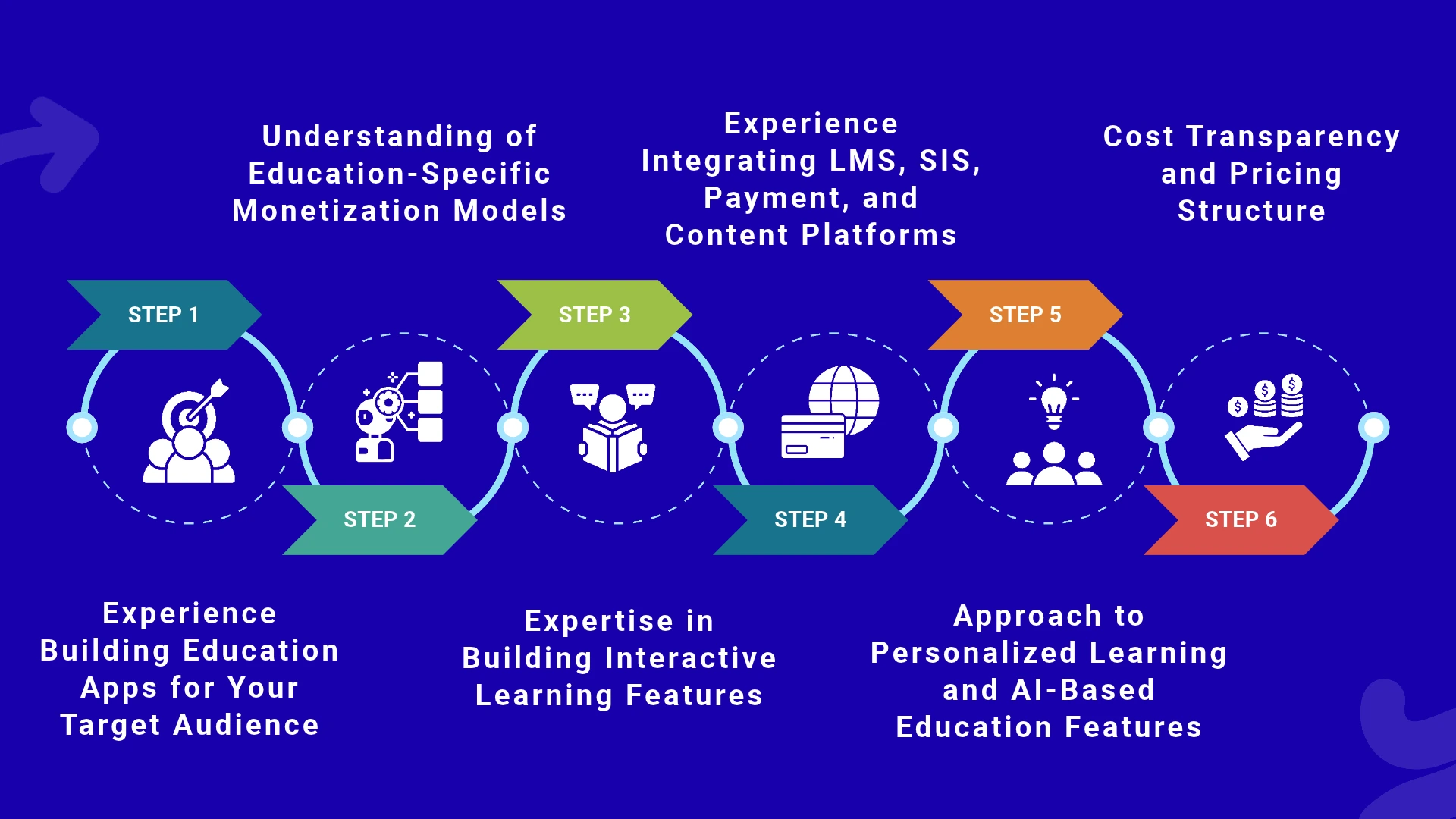
Experience Building Education Apps for Your Target Audience
When choosing an education app development agency for your startup, examine if its experience is aligned with your intended market. A platform sold to school districts will have completely different requirements and feature roadmap compared to a D2C consumer tutoring app. So, make sure to ask for examples showing how the agency handled student and teacher accounts, district-level administration, age-specific interfaces, and deployment across multiple schools.
Understanding of Education-Specific Monetization Models
The vendors you shortlist must understand how your edtech app will generate revenue once you move it to production. For example, a tutoring app earns through lesson bookings, while a K-12 platform sells annual licenses to schools or districts. What you need to do here is ask how the proposed billing architecture handles student seat limits, institutional contracts, subscription renewals, and access after payment lapses. Our guide to education app monetization models covers the revenue models worth discussing with any vendor.
Expertise in Building Interactive Learning Features
The best custom edtech development companies should understand how learning activities translate into product functionality. For a test-preparation app, for example, the agency should be capable of building more than timed quizzes. That’s because your targeted learners will need topic-level performance insights, explanations for incorrect answers, and practice suggestions for weak areas. Make sure to ask to see these workflows working in an actual education product, and not simply rely on verbal claims.
Experience Integrating LMS, SIS, Payment, and Content Platforms
If your education app is meant to target schools and colleges, integration experience will help you determine whether the institutions will adopt your product in the future or not. That’s why you must ask if the LMS or AI tutoring app development company has implemented LTI 1.3, OneRoster, or connections with platforms like Canvas and Google Classroom. If you’re planning adaptive tutoring or other AI features, our AI development services team can help scope them. Connections to LMS, SIS and payment systems are largely API work, so ask how a vendor approaches API integration.
Approach to Personalized Learning and AI-Based Education Features
You must ask the education app developer to demonstrate how your product changes instruction when a learner repeatedly struggles with a concept. The recommendation should reflect actual assessment performance, and not some arbitrary content suggestions. For AI tutoring, examine answer validation, age-appropriate responses, educator oversight, and safeguards against exposing student information.
Cost Transparency and Pricing Structure
A credible agency should help you distinguish the initial education app development cost from the expenses of operating it. So, make sure to ask whether the quote includes content migration, school-system integrations, accessibility testing, security reviews, and deployment support. Also request projected recurring expenses for video streaming, cloud infrastructure, AI services, and maintenance before calculating your expected return. If you’re comparing partners beyond education, our guide on how to choose a software development company covers the general evaluation criteria.
Red flags when hiring an edtech development partner
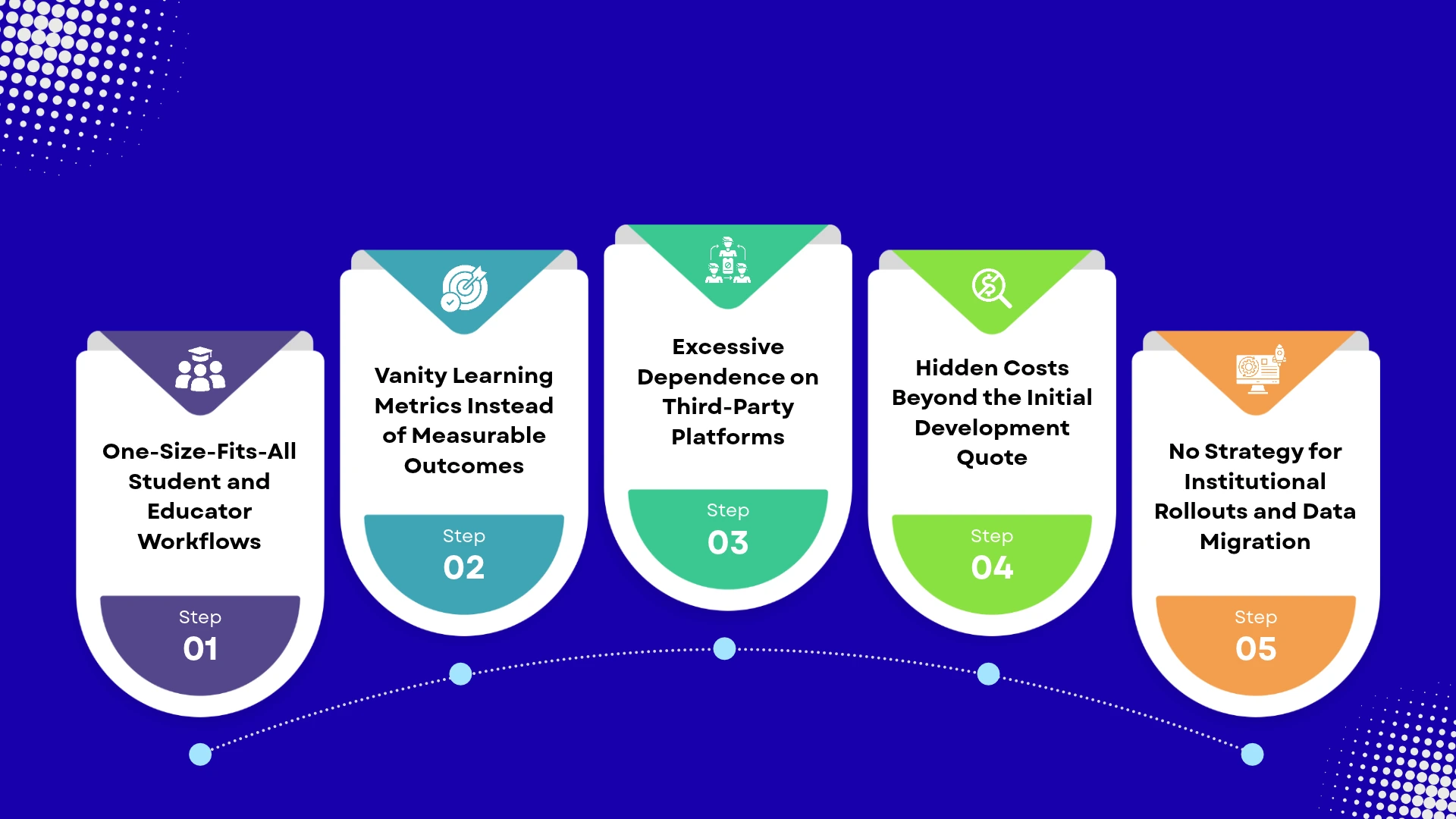
One-Size-Fits-All Student and Educator Workflows
A major red flag when hiring an EdTech development partner is a product design that gives students, teachers, and administrators essentially the same experience. Remember that each role has different responsibilities and access requirements. If the developer overlooks these distinctions, you risk launching an app that creates extra work for educators instead of improving learning delivery.
Vanity Learning Metrics Instead of Measurable Outcomes
You need to be extra cautious if a developer focuses on dashboard views, logins, and time spent in the app without connecting them to learning progress. These numbers rarely explain whether students understand a concept or complete a course. Your analytics should track assessment improvement, topic-level weaknesses, and learner retention to support meaningful decisions.
Excessive Dependence on Third-Party Platforms
An education app that relies heavily on external LMS providers, video services, or proprietary content tools can leave your business exposed to changing API access, licensing fees, and service restrictions. Ask which components your company actually owns and what happens if a provider changes its pricing, discontinues a feature, or limits integration access.
Hidden Costs Beyond the Initial Development Quote
A low development estimate can conceal substantial operating expenses. Video streaming, cloud storage, AI inference, content licensing, accessibility remediation, and institutional integrations can increase your total investment after launch. So, discuss the projected first-year cost of ownership, not just the initial build price, before committing your budget. Plan for ongoing upkeep from the start. Our app maintenance guide outlines what post-launch support typically involves.
No Strategy for Institutional Rollouts and Data Migration
A developer who has never planned a school or district-wide deployment might end up underestimating the complexity of moving existing student records, mapping academic terms, and provisioning accounts in bulk. Without a rollout strategy, onboarding delays can disrupt classes and leave administrators managing inconsistent records across old and new systems.
Conclusion
The right education app development partner depends on your segment, your buyers, and your compliance exposure. Use the comparison table to shortlist two or three vendors, then ask each for a working demo of your core workflow, their integration approach, and a first-year cost of ownership. If your product centers on courses, subscriptions, or quiz-based assessment, talk to GMTA’s EdTech team about an architecture review.
FAQs
How much does it cost to hire an education app development company?
Hiring an education app development company typically costs $25K–$100K for a focused app and $100K–$250K or more for a complex platform. The final price depends on user roles, custom learning features, integrations, accessibility requirements, and AI functionality. What you need to do here is ask for separate estimates for development, launch, infrastructure, and post-launch support. This way, you can ensure the initial quote does not hide operating costs and testing upfront.
What should an education app development company include in its project proposal?
An education app development proposal should define the product scope, target users, technical approach, delivery milestones, and itemized costs. It should also explain how the company will handle learning workflows, integrations with existing school or learning systems, accessibility, testing, and student data protection. Check that assumptions, exclusions, change-request rates, post-launch support, source-code ownership, and handover responsibilities are stated, with timelines.
How do education app developers handle student data privacy and FERPA compliance?
E-learning app developers should build privacy into the product architecture rather than treat compliance as a final checklist. For apps used by children under 13, COPPA requirements affect parental notice, consent, and data collection. FERPA applies when an app handles education records for covered schools. Your contract should define data access, retention, deletion, security controls, and breach responsibilities contractually.
Is outsourcing EdTech development more cost-effective than hiring an in-house team?
Outsourcing EdTech development is often more cost-effective when you need a defined product delivered without carrying engineering salaries between releases. An in-house team offers closer day-to-day control but adds recruitment, benefits, management, and specialist hiring costs. Compare the full 12–24-month cost, including maintenance, product changes, and team-management overhead, rather than comparing vendor quotes with developer salaries alone, including recruitment delays.

Founder
Anjali Upadhyay is the Founder of GMTA Software Solutions, a mobile and web application development company she built from the ground up in 2019. Under her leadership, GMTA has delivered 200+ production applications across healthcare, fintech, and on-demand services for clients in the US, UK, Singapore, and UAE. She also leads GMTA’s AI practice, which has shipped production AI systems — including HIPAA-compliant healthcare workflows, LLM-integrated logistics platforms, and fintech automation tools — for US-based enterprise clients. Her writing covers AI product strategy, build-vs-buy decisions for AI systems, and the operational realities of moving AI from proof-of-concept to production at scale.