
Key Takeaways
- Do not overbuild wearable integrations at launch. Fund the platforms your target customers actually use, then expand based on adoption. Every additional integration creates authentication, synchronization, testing, API changes, and maintenance obligations.
- Use AI where it creates measurable product value. AI should interpret structured sleep data, personalize recommendations, and support behavioral programs rather than becoming an expensive chatbot layered over basic tracking.
- Sleep tracker development can cost $40K–$250K+ in 2026, with wearable integrations, proprietary sleep intelligence, AI personalization, healthcare functionality, and compliance requirements being the major cost drivers.
- HIPAA compliance is not automatically required for every consumer sleep tracker. Whether HIPAA applies depends largely on whether your app is a covered entity or business associate handling PHI for a covered entity.
The short answer: A sleep tracker app costs roughly $40,000 to $250,000+ to build in 2026. A simple tracker with a sleep score starts around $40,000 to $70,000. Connecting several wearables, adding AI coaching, or selling to clinics pushes the budget to $130,000 to $250,000+. The biggest cost drivers are how many wearables you connect, how much of the sleep scoring you build yourself, and which privacy and health rules apply to you.
This guide is for founders deciding what to build first and who should build it. It covers cost, whether to hire a partner or a team, which wearables to connect, where AI is worth paying for, and the rules to check before you launch.
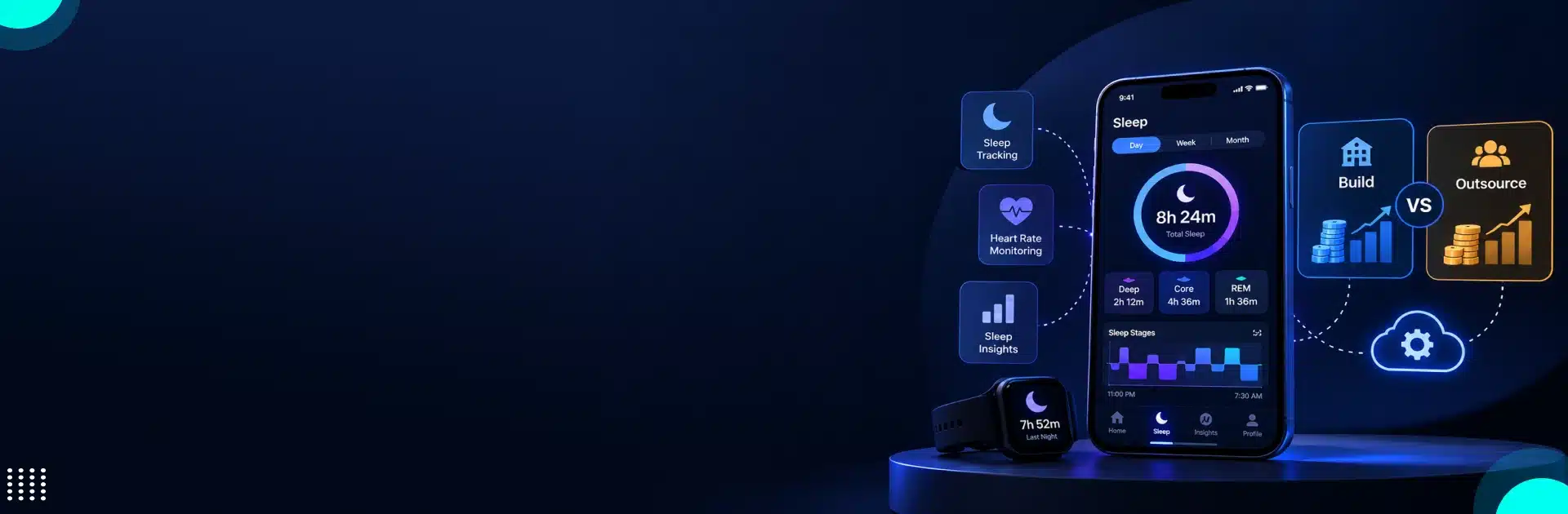
The moment you decide to enter the $1.23 billion market, building even a basic sleep tracker can quickly turn into a $40K to $100K+ investment. The worst part is you may not know if users will at all pay for it. The real business problem you, as a founder, are likely to come across is deciding what percentage of the capital should go where. Your product might need wearable integrations, data synchronization, sleep scoring, subscriptions, and a secure backend. But this doesn’t mean you should build every underlying capability yourself just to gain the competitive edge. Choosing the wrong development model won’t just inflate your initial spend. It would cause you to overlook the opportunity to strengthen the part of the product that users will happily pay for.
Next comes the second financial risk layer: the cheapest development quote isn’t always the cheapest product to operate. A development partner can deliver an MVP at a much lower upfront cost, around $40K to $50K. But there will be a risk of vendor lock-in. That’s because you will be fully dependent on its developers for simple API changes or production bug fixes after the launch. Meanwhile, building everything internally means carrying specialist salaries and infrastructure expenses as unnecessary overheads. What’s worse is that you wouldn’t be able to validate retention or subscription revenue at the time of decision-making.
Compliance can alter the calculation further. Suppose the tracking app will collect information about sleep patterns, heart rate, SPO2, and other physiological metrics. If that’s the case, you will have to invest in appropriate guardrails right from day one. It can be consent, permissions, encryption, third-party sharing, and data governance, right from day one.
That’s why we have prepared a detailed guide on how to allocate your sleep tracker app development budget between internal capability, outsourced execution, proprietary sleep technology, and compliance needs.
Is a sleep tracker app worth building in 2026?
The US health market continues to face a major problem that sleep-tracking products need to address. In 2024, the CDC reported that 30.5% of US adults, roughly three in ten, slept less than 7 hours every day. It also revealed that 15.4% had trouble falling asleep and 18.1% couldn’t stay asleep most or every day.
Also, 13% of the surveyed people had to use some sort of sleeping aid almost regularly. For your business, these aren’t just mere health statistics, but rather numbers that will help you expand your product’s reach beyond people who are just curious about their sleep cycle. You can target a substantial population that’s already dealing with a recurring sleep problem that needs to be monitored and improved.
The technology adoption that’s needed to serve the market is already in place. That’s because the number of users relying on wearable apps increased significantly from 79 million in 2020 to 108 million in 2024. This means that at least two in five US adults have been using this health-tech to monitor their physiological metrics already. As the foundation is already laid, you just need to get the app right and launch it into the market with appropriate differentiators.
Consumer behavior is another attribute that supports a recurring revenue model for a sleep tracking app. In June 2026, Oura reported 5 million paid members, up from 1.5 million at the end of 2024. Users have already demonstrated their willingness to pay repeatedly for ongoing interpretation of sleep and physiological data points, not merely for a one-time sleep report. So, you won’t have to start from the ground level and convince people to use your sleep tracker app, as the demand is already prominent.
These facts completely flip the table and give a new direction to the 2026 product opportunity. Building another app that simply records sleep duration and produces a basic score won’t help you justify the cost. Rather, the stronger opportunity here is to build your product around a specific problem that existing platforms fail to solve adequately, whether it’s personalized sleep improvement or shift-worker sleep management.
Should you build a sleep tracker app in-house or outsource it?
Outsourcing sleep tracking app development becomes a practical starting point for your US healthcare startup when you want to use the app to validate demand without committing to a permanent health-tech engineering team. Such a digitized product often requires components like:
- Wearable integrations
- Sleep-data processing engines
- Personalization logic
- Robust backend infrastructure
- Compliance controls
These need to be put in place before you expect your product to generate revenue. And that’s what makes the cost of building every healthcare capability internally difficult to justify at the validation stage.
Outsourcing shifts much of that execution cost into a project-based investment and can shorten the path to an MVP. However, if proprietary sleep algorithms, longitudinal user data, or continuous personalization are likely to become your product’s competitive advantage, keeping those capabilities in-house can protect long-term IP and reduce dependence on a development vendor.
The right choice therefore depends on the exact capabilities you plan to own permanently and the ones that just need expertise to help you penetrate the health tech market further.
| Decision Factor | Build In-House | Outsource |
| Initial investment | $120K–$250K+ | $40K–$100K for a focused MVP; $120K–$250K+ for a more advanced product |
| Time to MVP | 6–12 months | 3–6 months for a focused MVP, and 6–10+ months for advanced integrations and personalization |
| Long-term engineering cost | $150K–$350K+/year for a small product team | $30K–$100K+/year for maintenance and incremental development |
| Wearable integrations | Full ownership, but ongoing API changes and device compatibility become an internal responsibility. | Vendor manages implementation and updates, subject to the contract and support scope. |
| Proprietary algorithms | Strongest control over sleep scoring, personalization logic, and related IP | Ownership depends on contract; algorithms developed specifically for the product should be explicitly assigned to the client. |
| Vendor dependency | Low | Higher unless source code, repositories, cloud accounts, documentation, credentials, and deployment access remain under your control. |
What features make a sleep tracker app valuable?
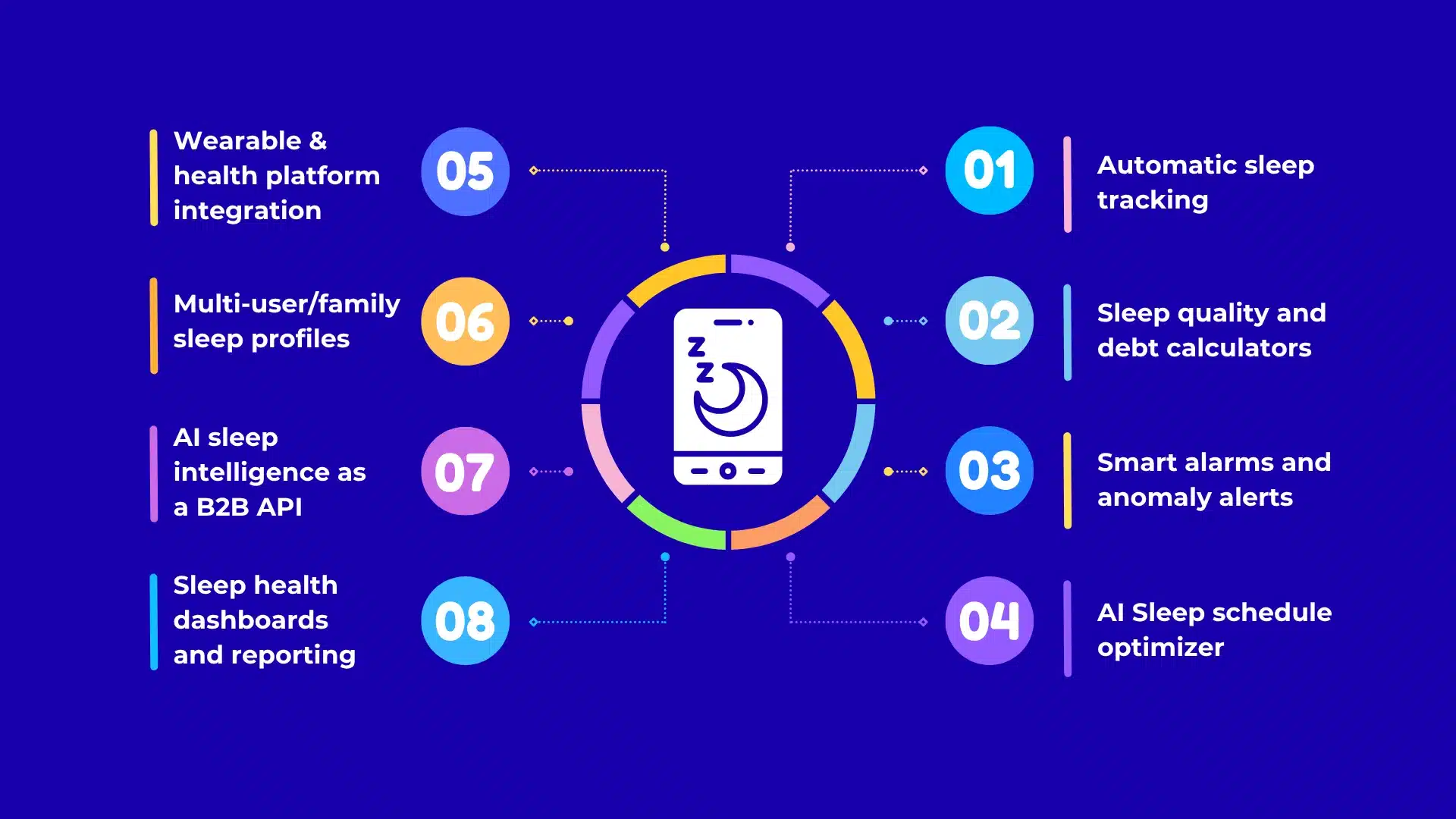
Automatic sleep tracking
This feature forms the data acquisition layer for your business, capturing sleep duration, timings, awakenings, and other available signals. Users don’t have to manually type in every detail each night. Adding an automated sleep stage tracking module will ensure your product has enough data volume to build personalization, longitudinal insights, and AI recommendations.
The real business value, therefore, lies in having data continuity that supports paid features. Suppose a user has 3 months of reliable sleep history within your app. In that case, they will have a much stronger reason to continue using your product compared to someone who only receives a nightly duration number.
However, there’s a trade-off you shouldn’t overlook. Integration costs can quickly soar, especially if your product is meant to support wearables like:
- Apple Health
- Fitbit
- Health Connect
- Oura
- Garmin
So, prioritize data sources that your target customers use the most and invest the saved capital in the interpretation layer.
Sleep quality and debt calculators
These modules will help your sleep tracking product turn fragmented nightly measurements into a product-owned interpretation layer. Rather than just displaying “6 hours 42 minutes”, it can explain whether the sleep pattern recorded is consistent at all with the user’s recent baseline or not. This is where you get the maximum business value, as raw sleep data is difficult to monetize when competing apps already provide it for free.
It’s the interpretation logic from which you can harvest the real commercial opportunity. A basic score can become a part of the free product to drive acquisition. At the same time, longitudinal analysis, historical comparisons, personalized explanations, and deeper reports can become the strongest subscription-driving features.
However, adding these calculators to your sleep tracking app can create a completely different product liability. Once users decide based on the score, inconsistencies will start damaging your profit margins. Changing the scoring formula later can alter historical results and undermine trust. Besides, if your product doesn’t have enough evidence, you should position these calculators as a wellness metric.
Smart alarms and anomaly alerts
On the one hand, you can include an intelligent alarm system to create a day-to-day product dependency among your target users. On the other hand, the anomaly flagging workflow will help you create justifiable reasons for users to return to the app when something changes. When you combine them, you get something more than a simple sleep dashboard. A smart alarm can easily become a part of a user’s daily routine. Suppose your app consistently controls the wake-up experience every morning. In that case, it won’t take long for the app to replace the phone’s default alarm, thereby creating a habit of opening your product.
Anomaly alerts can then extend the engagement beyond morning by flagging meaningful deviations from the user’s established sleep pattern. This behavioral shift will matter a lot for your subscription economics. If users only open your sleep tracking app when they are curious about data, you are bound to face retention problems. But embedding a feature in recurring daily behavior will give your product more opportunities to demonstrate its value.
AI Sleep schedule optimizer
When you develop a sleep tracker app with this intelligent optimizer, you create a stronger direct monetization potential as your product moves from measurement into ongoing intervention. Rather than charging users to access their sleep history, you charge them for a system that continuously translates that historical data into a personalized schedule. The underlying commercial logic here is pretty straightforward. A static sleep report usually has a declining value once the user reads it.
But when we talk about the optimizer, it can recalculate recommendations after factoring in the user’s schedule, sleep behavior, and goals change. This is what creates an ongoing reason to remain subscribed to your product. In addition, it also generates a differentiation opportunity against basic health dashboards. Apple Health or a Garmin wearable can tell how long a person slept. The optimizer can then build a recommendation around the user’s actual behavior and measure if that suggestion actually worked.
However, you do need to consider the cost distinction here. Adding an LLM isn’t the most expensive part. Rather, it’s building the underlying personalization system, consisting of:
- Historical data normalization
- Recommendation rules
- Adherence tracking
- Outcome measurement
- Safety constraints
- Mechanisms for handling missing or contradictory data
Wearable & health platform integration
With wearable integration for sleep tracking apps, you can determine if your product can become an intelligent software without first becoming a hardware company. It can easily pull data, like sleep, heart rate, or activity, from various ecosystems, including Apple Health, Oura, Garmin, and Health Connect. Once there is enough data volume, it runs a normalization protocol to turn the information into a consistent user profile. With integration, you can reduce the biggest entry barrier still prevalent in the market: asking customers to collect data from scratch.
Someone who already has 6 months of sleep history can easily see value on the first day. They won’t have to wait for weeks for your app to accumulate enough information. This will not only improve activation but also minimize the time between installation and the first meaningful smart recommendation. Besides, you won’t have to invest in developing proprietary sleep hardware any longer. An integration-first strategy will help your business focus on the software, where recurring subscription revenue and personalization can be developed easily.
However, there’s a catch. Integration with wearables will create dependencies on companies your business has no control over. APIs will change. Permissions will evolve. And certain metrics might not be available consistently across devices. If you build the product entirely around one provider’s proprietary metric, even a small change in the provider API can become a product-level problem.
Multi-user/family sleep profiles
This functionality will change the entire economics of your sleep tracker app by turning it from an individual subscription into a household product. Each person needs a separate sleep history, goals, recommendations, permissions, and potentially connected devices. At the same time, the account owner can manage the subscription from one household master account. Therefore, the real financial value for your business lies in the fact that you can easily increase the number of users attached to each paying relationship.
A couple that tracks sleep together has a different retention dynamic from an individual subscriber. That’s because your product becomes part of a shared wellness routine, which is why canceling the subscription can affect more than one person’s experience. A family plan can, therefore, increase account value without requiring the company to acquire every additional user through a separate paid acquisition funnel.
But adding this feature is way more complex than just a simple button stating “family plan”. Your product will need a clear ownership model:
- Who will pay the subscription plan
- Who can invite another user
- Who can see what
- What happens when someone leaves the household
- How historical data is retained or transferred
In case minors are included, you need to pay attention to consent and privacy requirements while building your sleep tracker app.
AI sleep intelligence as a B2B API
Once you turn sleep intelligence into a B2B API, you create a fundamentally different business opportunity. Your sleep tracking app no longer has to be the only product through which the company’s technology can generate revenue. Instead of requiring a wellness platform, employer, healthcare app, coaching service, or connected-device company to build its own sleep analysis engine, the API could provide structured capabilities, like:
- Sleep summaries
- Longitudinal trend interpretation
- Personalized recommendations
- Behavioral insights
- Sleep-related report generation
The customer pays for access to the intelligence while keeping its own user interface and customer relationship. A sleep intelligence engine that costs you substantial money to develop will have limited financial leverage if it only supports a consumer subscription. An API, however, creates the possibility of reusing the same technology across multiple customer segments.
Sleep health dashboards and reporting
A commercially useful sleep dashboard turns longitudinal data into a detailed but accurate explanation for your users. For example, it can display if sleep has become inconsistent over the last four weeks or if late bedtimes are associated with poorer nights for a particular user. It’s by this that the dashboard becomes a decision surface rather than a collection of simple charts, implicating your retention strategy directly. A simple nightly metric has limited incremental value after the user sees it hundreds of times.
Longitudinal reporting, here, holds more value, especially with growing dataset size. A 90-day report can reveal patterns that a single-night screen cannot, thereby giving the customer a reason to maintain the subscription and continue supplying data. Reporting, on the other hand, supports tiered monetization. When free, your app can offer basic nightly or weekly information. But when paid, it can expose deeper historical comparisons, personalized interpretations, downloadable reports, advanced trend analysis, and reports designed for coaches and wellness professionals.
How does wearable integration work in a sleep tracker app?
With wearable integration, your sleep tracking app can use data from smartwatches, rings, and other connected devices without requiring its own proprietary hardware or sleep-sensing technology. For your startup, its value isn’t just tied to giving users more device choices. Instead, it’s in shortening the time needed to generate meaningful insights, reducing the cost of collecting sleep data, and allowing the product to compete on interpretation and personalization rather than sensor technology.
But before you invest in learning how to integrate wearables into a sleep tracker app, let’s learn its workflow first.
- The user first connects a supported health platform or wearable ecosystem, like Health Connect, Apple HealthKit, Oura, or Garmin, and grants permission to access specific sleep and health records.
- The wearable collects data during sleep, including sleep duration, bedtime, wake time, sleep stages, and other metrics the device supports.
- It then synchronizes this information with the associated health platform. Your sleep tracker app can retrieve the permitted records through the relevant APIs rather than communicating directly with the wearable’s sensors.
- The app imports the records into its backend and converts them into a standardized sleep-data model. This layer holds enough significance because different providers can structure, label, and calculate similar measurements differently.
- Your system reconciles the incoming data by handling duplicate records, overlapping sleep sessions, missing measurements, delayed synchronization, revised records, and changes when users connect or disconnect the devices.
- The normalized information is added to the user’s longitudinal sleep profile. This historical dataset can then support sleep scores, sleep debt calculations, trend analysis, anomaly detection, personalized recommendations, and AI-based sleep optimization.
The business value comes from what the integration enables after the data enters your product. If the sleep tracker only imports sleep duration and displays the same metrics users already receive from their wearable, the integration adds development cost without creating a compelling reason to switch or subscribe. Its commercial value only increases when imported data becomes the foundation for proprietary sleep scoring, longitudinal analysis, personalized recommendations, AI coaching, or premium reports.
This also affects your development budget: spending heavily on ten device integrations before proving the intelligence layer can leave substantial capital tied up in compatibility work rather than differentiation. For an MVP, the stronger investment is to support the highest-value data sources, build a robust normalization layer, and use the resulting data to create features that competitors cannot reproduce simply by connecting to the same APIs.
Where does AI actually add value in sleep tracker apps?
AI becomes commercially valuable in your sleep tracking app only when it enables your business to sell something beyond raw sleep data. In other words, you get the strongest opportunity by turning AI into a monetizable intelligence layer that can support premium consumer plans, professional services, and eventually B2B licensing.
Let’s first talk about consumer subscription. In this revenue mode, AI sits behind the premium “personal sleep coach” experience. Instead of charging your users for access to sleep duration, stages, or historical charts that they may have received from wearables, your paid plan focuses on delivering:
- Continuously updated recommendations
- Personalized sleep schedules
- Behavioral experiments
- Explanations based on the user’s own history
The commercial advantage your business achieves is recurring value. That’s because the recommendation changes as the user’s behavior and sleep patterns change, thereby giving subscriptions a reason to continue beyond the first month.
The second revenue model you can use with AI is premium personalized reporting. Your app can easily generate monthly or quarterly sleep reports that identify:
- Persistent patterns
- Changes from the user’s baseline
- Successful interventions
- Areas requiring further attention
These reports can be further included in a higher subscription tier or sold as individual purchases. This will work better when your target customer needs measurable progress rather than another nightly score. You can also use an AI-powered professional reporting feature to monetize your sleep tracking app. From wellness companies to coaches, authorized professionals can pay for tools that summarize a customer’s longitudinal sleep data and present structured reports. Here, pricing moves from consumer subscription economics towards per-seat, per-user, or usage-based B2B pricing, depending on the underlying workflow.
AI can also reduce the cost of delivering personalized coaching at scale. If a human coach is required to review every user’s history and prepare recommendations manually, customer growth creates a corresponding staffing expense. Automating routine analysis can increase your product’s gross margin, provided human review remains available where the use case requires it.
What tech stack do you need to build a sleep tracker app?
A commercially valuable tech stack for sleep tracker app development includes mobile frontend, backend infrastructure, health data integrations, database, analytics layer, and AI/ML components. The right stack depends on whether your product relies on smartphone sensors, wearables, or platforms like Apple HealthKit and Health Connect. For your startup, the priority should be choosing technology that supports reliable health data synchronization without creating unnecessary infrastructure costs.
| Tech Stack Layer | Recommended Technology | What It Handles in a Sleep Tracker App | Business Consideration |
| Mobile App | Flutter / React Native | Cross-platform iOS and Android application, sleep dashboards, reports, onboarding, notifications | Reduces duplicated mobile development for an MVP; native development is preferable when deep device-health integration is central. |
| iOS Health Integration | Apple HealthKit | Imports sleep duration, sleep stages, heart rate, and other authorized health records | Gives access to Apple’s existing health ecosystem without building proprietary hardware |
| Android Health Integration | Health Connect | Retrieves authorized sleep and health data from supported Android devices and apps. | Provides a scalable Android data layer while avoiding separate integrations for every compatible device |
| Wearable APIs | Oura, Fitbit, Garmin and other supported APIs | Retrieves device-specific sleep and physiological data | Each integration adds development, testing, API-maintenance and data-normalization costs, so prioritize devices used by the target market |
| Backend | Node.js / NestJS or Python / FastAPI | Authentication, user management, data processing, APIs, sleep calculations and recommendation workflows | A modular backend makes it easier to add new integrations and premium capabilities without restructuring the product. |
| Primary Database | PostgreSQL | Stores user profiles, sleep sessions, historical metrics, preferences, and recommendation data | Relational storage provides consistency for longitudinal sleep records and supports analytical queries. |
| Cache & Queues | Redis | Caching, background jobs, synchronization tasks and notification workflows | Useful when large volumes of wearable data need to be processed without slowing the user-facing application |
| Cloud Infrastructure | AWS / Google Cloud / Azure | Application hosting, databases, storage, monitoring, and scalable infrastructure | Managed cloud services reduce infrastructure overhead and allow capacity to scale with user adoption. |
| AI/ML Layer | Python, PyTorch / scikit-learn, LLM APIs | Personalized recommendations, sleep-pattern analysis, coaching and natural-language insights | AI should be funded around monetizable intelligence rather than basic sleep calculations that can be handled through deterministic logic. |
| Notifications | Apple Push Notification Service / Firebase Cloud Messaging | Smart alarms, reminders, sleep-plan notifications and anomaly alerts | Notification frequency needs careful control because excessive alerts can reduce engagement rather than improve it |
| Analytics | Amplitude / Mixpanel | Tracks feature usage, subscription behavior, retention, and user interaction with sleep insights. | Helps determine whether expensive features such as AI coaching actually contribute to conversion and retention |
| Security & Compliance | OAuth 2.0/OIDC, encryption, RBAC, audit logs | Protects health data, user accounts, and access permissions | Security architecture should be designed before development; compliance requirements can materially change infrastructure and vendor costs |
Which compliance rules apply in sleep tracker app development?
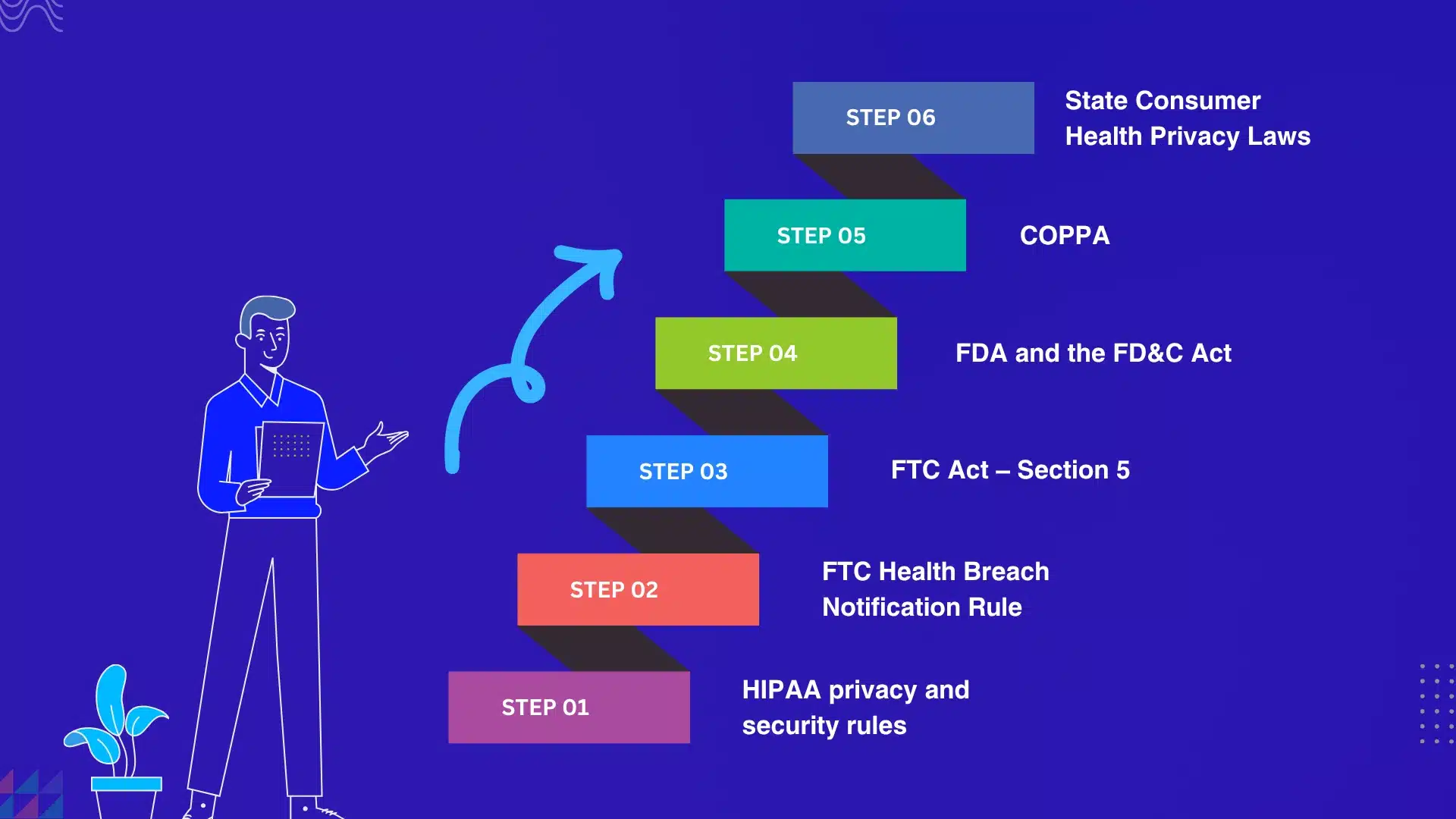
HIPAA privacy and security rules
For your sleep tracking app, adhering to the HIPAA compliance rules becomes imperative when your product handles PHI on behalf of a covered entity, like a hospital or a physician practice. In such cases, your company becomes a Business Associate under 45 CFR §160.103, thereby mandating a BAA under 45 CFR §164.504(e).
In addition, the HIPAA Security Rule also needs safeguards covering risk analysis, access controls, authentication, audit controls, and transmission security as per 45 CFR §§164.308–164.312. HIPAA is not applicable when your product acts as a D2C app, where users independently connect Apple Health, Fitbit, or Oura. HIPAA covers health information held by providers, health plans, and similar organizations, and the companies that handle that information for them. If a clinic or hospital pays you to collect or manage its patients’ sleep data, you are likely a “business associate.” You will need a signed agreement with them and strong security controls. If people download your app on their own and connect their own devices, HIPAA usually does not apply. Our guide to HIPAA-compliant app development covers the build requirements, and our CodocCall telemedicine case study shows how we handled a healthcare product.
FTC Health Breach Notification Rule
The 16 CFR Part 318 section applies to your consumer sleep app when it maintains identifiable health information and draws data from multiple sources. This becomes relevant in cases when your product combines manually entered sleep records with Oura, Fitbit, Garmin, or other connected health data ecosystems.
The rule covers breaches involving unauthorized acquisition or disclosure of unsecured PHI, not only database hacking. Your app, therefore, will need documented data flows, processor oversight, breach detection protocols, and incident response procedures.
Many consumer sleep apps fall outside HIPAA but inside this FTC rule. It can apply when your app holds identifiable health information and can pull data from more than one source, for example, a person’s own entries plus a wearable. The rule was updated in 2024 (effective July 29, 2024) to cover health apps, including sleep trackers. A breach is not only a hack. Sharing a person’s identifiable health data without their permission can count too. That makes it worth checking exactly what your analytics, advertising and AI tools receive. (FTC rule: 16 CFR Part 318)
What you say about your app (FTC Act)
Your claims must be true. Saying the app “tracks sleep patterns” is very different from saying it can “detect insomnia” or “diagnose sleep apnea.” Stronger health claims need scientific proof. If you say you never share sleep data, your analytics and AI vendors must not be receiving identifiable data. Your website, store listing, sign-up screens and ads should all match what the app does.
FTC Act – Section 5
Section 5 of the FTC Act becomes relevant when your sleep tracking app makes health or privacy representations that are deceptive or unsupported. Claims such as “tracks sleep patterns” differ substantially from claims that AI can “detect insomnia,” “diagnose sleep apnea,” or “treat sleep disorders”. Stronger health claims require appropriate scientific substantiation.
That’s why the FTC often scrutinizes privacy representations. If your app says sleep data is never shared while an analytics, advertising, or AI provider receives identifiable information, the actual data flow conflicts with the promise. Your website, App Store listing, onboarding screens, advertisements, and in-app claims should therefore match both the evidence and technical implementation.
FDA and the FD&C Act
FDA requirements depend on the specific function and intended use of your sleep tracking app. Recording sleep duration, bedtime, wake time, and general trends doesn’t automatically make the software a medical device. The regulatory position can change when it is designed to diagnose, monitor, treat, mitigate, or prevent a medical condition.
FDA specifically identifies mobile software using sensor data to monitor sleep apnea as a function that can fall under medical-device oversight. Therefore, an AI feature that reports poor sleep consistency is fundamentally different from one that identifies probable sleep apnea. Clinical functionality can require additional validation, documentation, and potentially FDA premarket requirements.
Recording sleep time, bedtime, and trends does not by itself make an app a medical device. The picture changes when the app is built to diagnose, treat, or prevent a medical condition. An AI feature that says “your sleep has been irregular this month” is a different thing from one that says “you likely have sleep apnea.” The FDA revised its General Wellness policy in January 2026. Among other limits, a wearable-based product cannot claim to replace an FDA-cleared device or claim clinical accuracy or medical-grade performance and still be treated as general wellness. (FDA General Wellness policy) Choose your claims before you design the features.
COPPA
COPPA applies when your healthcare product tracking sleep patterns is directed to children under 13 or knowingly collects personal information from this specific user group. This regulation treats persistent identifiers, including certain device or user identifiers, as personal information. That’s why avoiding names doesn’t necessarily remove you from this compliance requirement.
Covered collection will need verifiable parental consent before collecting, using, or disclosing the child’s information. Parents must also be able to review and delete their child’s data and refuse further collection. Your architecture should therefore maintain age status and parental-consent status before processing a child’s sleep data.
If your app is aimed at children under 13, or you knowingly collect their information, you need a parent’s verifiable consent first. Parents must be able to review and delete the child’s data. Device and user identifiers can count as personal information even without a name, so your system needs to know a user’s age status and consent status before it processes their sleep data.
State Consumer Health Privacy Laws
Washington’s My Health My Data Act (RCW Chapter 19.373) will be applicable to your consumer sleep app as it regulates covered consumer health data outside the HIPAA framework. Requirements usually include:
- Disclosures about the categories of health data collected
- Purposes and sources
- Third parties receiving the information
In case you plan to add new purposes or categories, additional affirmative consent will become necessary. The law also treats sale of consumer health data separately. If your sleep app plans to monetize health information through data sales or partnerships, this must be addressed in the product’s consent architecture.
Washington’s My Health My Data Act (RCW chapter 19.373) covers consumer health data outside HIPAA. It requires clear notices about what you collect, why, and who receives it, and fresh consent if you add new purposes. Selling health data is treated separately. Other states have their own rules, so ask your lawyer which states your launch plan touches.
Step-by-step process to develop a sleep tracker app
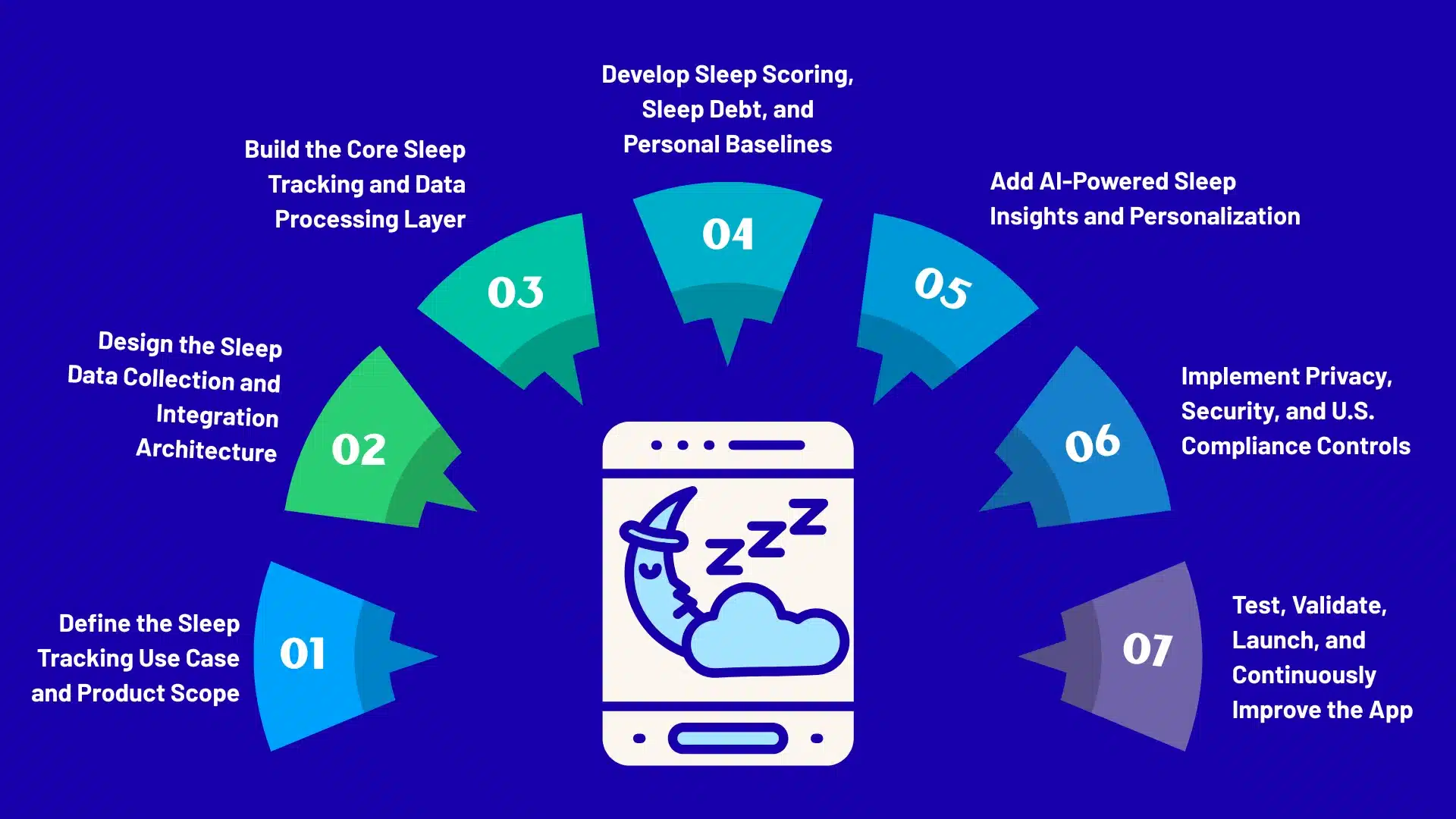
Step 1: Define the Sleep Tracking Use Case and Product Scope
Start by deciding whether your deep sleep tracker app will compete on tracking, interpretation, or intervention. Tracking alone has very limited differentiation because users can already access sleep duration, stages, and trends from their wearable ecosystems. So, to make your product stronger, you need to own an interpretation layer by turning fragmented sleep data into personalized recommendations or behavioral programs.
Set the commercial model around the differentiation. For example, a basic tracker app can support freemium acquisition, while personalized coaching, advanced reports, or AI-driven sleep programs can support subscriptions. The scope should, therefore, be built around the revenue-generating sleep outcome, not around how many tracking features you can fit into the MVP.
Step 2: Design the Sleep Data Collection and Integration Architecture
Decide how much of the data pipeline your business needs to control. Using Apple Health, Health Connect, Oura, Garmin, Fitbit, and other similar platforms will reduce the need to develop proprietary sensing technology. However, it also means your product won’t be able to control the underlying measurement logic. What you have to do here is build an internal normalized sleep-data model.
It can combine records from these sources without tying scoring logic to any single provider. This will further create a significant business advantage for your startup. Your app can change wearable integrations without having to demand a rebuild of its core intelligence model. For the first release, it’s better if you prioritize integrations that cover the target customers, instead of paying to maintain every available device connection.
Step 3: Build the Core Sleep Tracking and Data Processing Layer
Build a robust and scalable sleep-data engine, and not a database that stores nightly records. It must:
- Reconcile differences between device-generated sleep sessions
- Distinguish naps from primary sleep cycle
- Handle overlapping records automatically
- Preserve historical changes when a wearable later revises its measurements
This approach will become commercially valuable the moment your sleep tracking app starts generating longitudinal insights. If the underlying history is unreliable, premium sleep scores and AI recommendations will be hard to trust. So, keep the raw source measurements alongside the normalized dataset. This will help your business change its scoring methodology later without requesting the data again. In addition, it will also give your product an owned data foundation for future analytics, personalization, and B2B offerings.
Step 4: Develop Sleep Scoring, Sleep Debt, and Personal Baselines
Create proprietary logic around how your app interprets sleep. That’s because third-party tracking data can help create a differentiation for your product when used wisely. Define how duration, consistency, timing, interruptions, and individual sleep requirements influence the score rather than copying a wearable’s methodology. Establish personal baselines from historical behavior so that your product can identify meaningful deviations.
This will help you create monetizable intelligence for the sleep tracking app. You can offer basic sleep records for free to your users, while deeper trend analysis, recovery reports, sleep debt projections, or custom recommendations can be offered under a premium pricing tier.
Step 5: Add AI-Powered Sleep Insights and Personalization
Use AI once your product has enough structured sleep data to support accurate and meaningful personalization. Instead of building a generic sleep chatbot, use the LLM to interpret established metrics, explain recurring patterns, recommend schedule adjustments, and run personalized behavioral experiments. For example, your system can compare a user’s baseline with periods of late caffeine intake, shortened sleep, or inconsistent bedtime.
Keep the underlying calculations deterministic and let AI handle interpretation and conversation. This will create a clearer path to monetization. That’s because personalized coaching can sit behind a subscription while the underlying tracking remains an acquisition feature.
Step 6: Implement Privacy, Security, and U.S. Compliance Controls
Determine the regulatory model from the way your sleep tracker operates, and not from the fact that it handles health-related information. A D2C product receiving data through Apple Health won’t be subjected to the entire HIPAA framework by default. It’s only when your platform receives PHI from a healthcare provider that will create the need for a business-associate relationship.
Meanwhile, a consumer app may instead face FTC health-data and state privacy requirements. The key here is to establish this distinction before finalizing architecture, contracts, or monetization. Only when you are clear about this, implement the controls demanded by the actual model, including:
- Appropriate consent
- Access management
- Auditability
- Retention and deletion logic
- Vendor controls
- Breach procedures.
Step 7: Test, Validate, Launch, and Continuously Improve the App
Validate whether your product’s sleep intelligence is commercially credible, not merely whether it works. Test the same user’s data across different supported sources. Make sure to determine whether changes in device measurements produce unreasonable changes in the product’s interpretation of sleep-related metrics. During beta testing, measure whether users return because the app tells them something actionable that their wearable does not already provide.
Track paid conversion, retention, recommendation engagement, and churn against specific features to identify the actual revenue driver. If users ignore advanced sleep-stage visualizations but repeatedly use personalized schedule recommendations, development spending should move accordingly. The post-launch roadmap should follow demonstrated customer value rather than expanding the feature catalogue.
How much will a sleep tracker app cost in 2026?
The sleep tracker app development cost in 2026 ranges between $40K and $250K+, depending on your product’s complexity, data integrations, AI capabilities, proprietary sleep algorithms, and compliance requirements. The budget increases when your app needs advanced features, like:
- Multiple wearable integrations
- Real-time synchronization
- Personalized sleep scoring
- AI-driven recommendations
- Healthcare-provider functionality
Third-party platforms such as Apple Health and Health Connect can reduce the need to build proprietary data-collection capabilities. However, they also introduce integration and maintenance costs, which you should factor in from day one. In addition, building custom sleep intelligence will need more development and validation. That’s because your business will own the logic behind scoring, baselines, and recommendations. Also, make sure to include ongoing expenses for cloud infrastructure, API maintenance, security, compliance updates, and post-launch enhancements when calculating the total investment.
| Sleep Tracker App Type | Estimated Cost in 2026 | Development Timeline | Typical Scope | Main Cost Driver |
| Basic Sleep Tracker | $40K–$70K | 3–5 months | Sleep/wake tracking, manual logging, basic sleep score, trends, reminders, and core dashboard | Mobile development and core tracking logic |
| Mid-Level Sleep Tracker | $70K–$130K | 5–7 months | Wearable integrations, sleep debt, personalized insights, advanced analytics, smart alarms, and subscriptions | Wearable integrations and proprietary sleep analytics |
| Advanced AI Sleep Tracker | $130K–$200K | 7–10 months | AI sleep coaching, personalized recommendations, behavioral experiments, multiple wearable integrations, and proprietary sleep intelligence | AI personalization, data intelligence, and integration complexity |
| Enterprise / Healthcare Sleep Platform | $200K–$250K+ | 9–14+ months | Provider dashboards, EHR integrations, B2B APIs, advanced analytics, multi-tenant architecture, and stronger compliance requirements | Healthcare integrations, compliance, security, and enterprise architecture |
| Wearable-First Sleep Platform | $100K–$180K | 6–9 months | Deep integration with smart rings/watches, continuous sleep data, device synchronization, advanced metrics, and personalized insights | Multiple wearable APIs and continuous data processing |
| Sleep Tracking B2B API Platform | $150K–$250K+ | 8–12+ months | Sleep-data APIs, partner integrations, analytics dashboards, developer access, organization management, and enterprise controls | API architecture, data normalization, security, and partner integrations |
What should you ask a sleep tracker app development company before hiring?
Which Sleep Product Model Would You Recommend We Build First—and Why?
Do not accept a recommendation based only on technical complexity. Instead, look at whether the proposed model gives you a realistic path to revenue or not. If the sleep tracking app developer company recommends AI coaching, for example, it should explain why users would pay for it when existing wearables already provide sleep metrics. In short, every recommendation should also fit your budget and launch timeline.
Which Wearable Integrations Should We Fund in the MVP—and Which Should Wait?
Do not assume that supporting every major wearable will make the product more attractive. Compare each integration against your intended customer base and the quality of data it provides. If two platforms cover most of your target users, funding five integrations initially can simply increase development and maintenance costs without improving your commercial position.
Which Sleep Intelligence Should We Own Instead of Buying or Outsourcing?
Treat sleep intelligence as a potential source of long-term differentiation. You should understand which calculations, scoring methods, personal baselines, and recommendation logic will remain your intellectual property. You can purchase infrastructure components for hosting your sleep tracking app. However, your core interpretation layer should not leave you dependent on a vendor that could later control your product’s most valuable functionality.
Which Features Should We Cut to Keep the First Release Commercially Viable?
Expect a good development partner to challenge your requirements. If the first release includes every wearable, advanced AI coaching, social features, clinical reporting, and multiple subscription tiers, the budget can rise before you know what users value. So, check if the partner helps you prioritize the smallest product capable of proving whether users will repeatedly use and pay for your sleep intelligence.
Which U.S. Compliance Requirements Apply to Our Specific Product Model?
Do not approve a large compliance budget simply because the app handles sleep data. First ask the technical expert about how they establish the mechanism through which data will enter your platform, the potential sources, the claims your app can make, and whether healthcare organizations will be involved. These details will then help you determine when HIPAA, FTC rules, state health-data laws, COPPA, or FDA requirements become relevant.
What are the common pitfalls in sleep tracker app development?
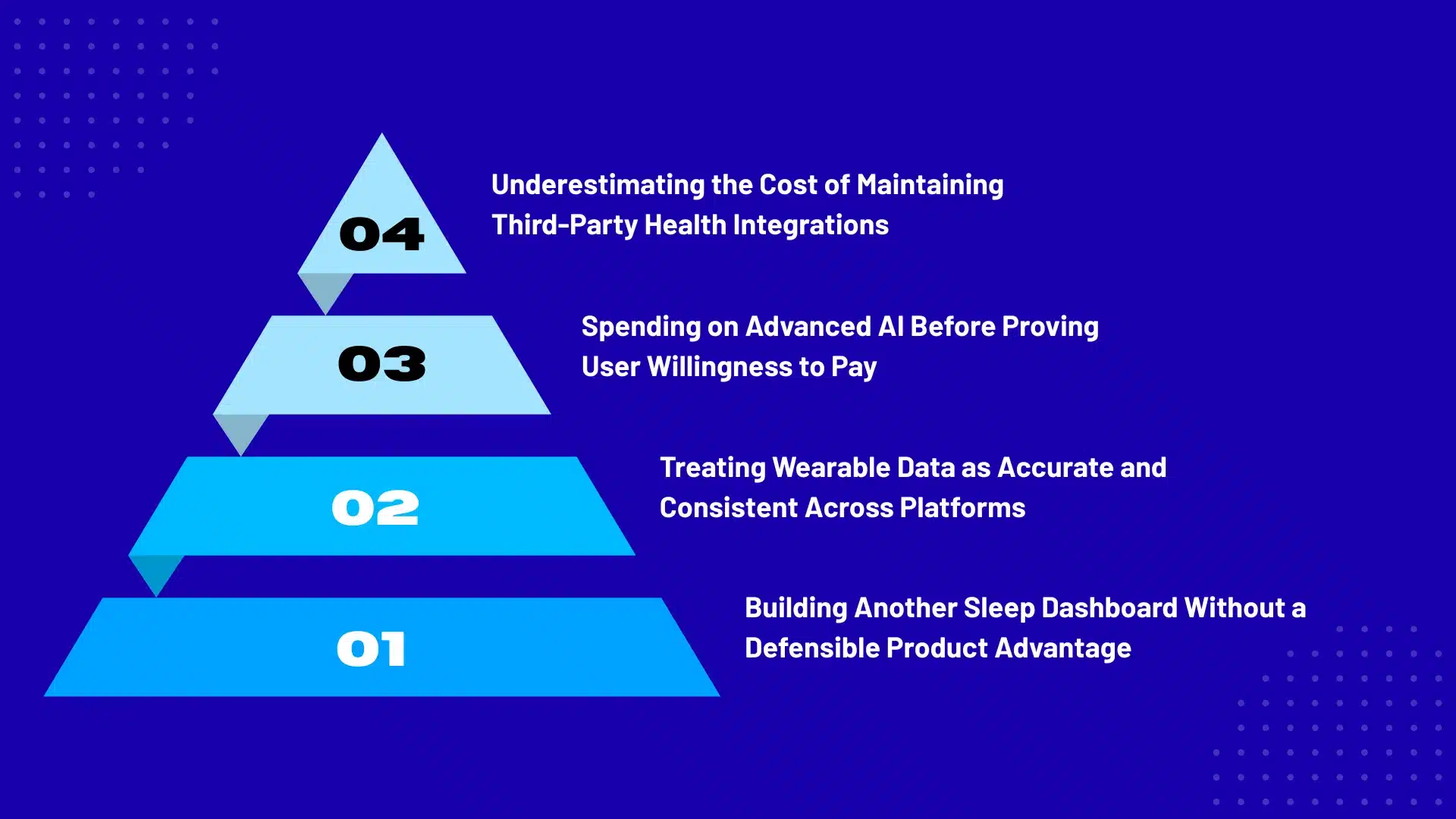
Building Another Sleep Dashboard Without a Defensible Product Advantage
If your sleep tracking app only displays sleep duration, stages, scores, and trends, the data won’t hold any value. That’s because most users already have access to similar functionalities through different wearable ecosystems. The consequence here is weak differentiation. Customer acquisition will turn out to be way more expensive than you comprehended. Also, engaging users so that they won’t switch to your competitor will become difficult. So, build your product around a specific advantage, and not just reproduce commodity tracking features.
Treating Wearable Data as Accurate and Consistent Across Platforms
A user’s sleep pattern often looks different across Apple Health, Oura, Garmin, Health Connect, or Fitbit, due to the differences in sensors and measuring algorithms. Treating these records as equivalent is one of the common challenges in sleep tracker app development. Your product will then produce inconsistent scores, contradictory insights, and sudden changes once a user switches devices. If you plan to correct this later, you will have to change the underlying data models, scoring logic, historical records, and AI recommendation engine. So, it’s better to build source-aware normalization before your app starts generating proprietary sleep intelligence.
Spending on Advanced AI Before Proving User Willingness to Pay
Putting an AI chatbot into your sleep app won’t automatically create a premium product. If the underlying system only contains generic sleep metrics, the LLM will have limited information from which to generate genuinely personalized insights. This will result in high AI operating costs, while you won’t have stronger retention or subscription conversion.
The better approach here is to establish reliable historical sleep data, personal baselines, and proprietary calculations first. AI can then interpret those signals, identify patterns, and personalize recommendations. This creates a stronger reason for your users to pay rather than making AI an expensive interface layered over commodity tracking.
Underestimating the Cost of Maintaining Third-Party Health Integrations
A wearable integration is not a one-time development expense. API changes, authentication updates, permission changes, new data fields, synchronization problems, and platform-specific bugs often require ongoing engineering work. Supporting too many devices can therefore turn a seemingly affordable product into a continuously expanding maintenance commitment.
The business consequence you can face is margin pressure. So, what you need to do is start with platforms that cover your target users and isolate each integration from the core sleep engine. This will allow you to maintain or replace individual connections without destabilizing the entire product.
What trends will shape sleep tracker apps beyond 2026?
Beyond 2026, sleep tracker apps will move away from simply recording sleep and toward interpreting health data, influencing behavior, and connecting with broader digital-health ecosystems. The strongest products will compete on the intelligence they create from sleep data rather than the number of metrics they display. So, below we have explained a few trends you should keep an eye on while developing a sleep tracking app.
- AI is expected to turn longitudinal sleep data into personalized explanations, recommendations, and behavioral programs rather than simply generating another sleep score.
- Sleep data will be combined with HRV, heart rate, activity, stress, metabolic information, and medical history to provide broader health insights.
- Smart rings, bands, bedside sensors, and other unobtrusive devices will expand continuous monitoring without requiring users to interact with a smartwatch.
- Consumer sleep technology will move closer to identifying potential sleep-related risks and directing users toward appropriate clinical evaluation, creating opportunities but also greater validation and regulatory requirements.
- Apps will increasingly focus on changing bedtime behavior, circadian routines, and sleep environments rather than encouraging users to optimize individual sleep scores.
How does GMTA help you build a sleep tracker app?
As a renowned sleep tracker app development company, we at GMTA will help you ground the major product and engineering decisions around your actual business model rather than simply implementing a feature list. Our focus remains on what your app will do better than existing wearables, which data sources are worth integrating, and which sleep intelligence should become proprietary.
For the MVP, we can help scope the tracking experience, mobile application, backend data architecture, wearable integrations, and analytics. Hence, you won’t have to spend heavily on features before validating demand. Our experience spans mobile, wearable, healthcare, and AI development, which becomes relevant if your product combines continuous health data with personalized recommendations.
In case you want to expand into AI coaching, healthcare workflows, or provider-facing functionality later, we can add these features without rebuilding the core platform.
We help founders decide what to build first, which wearable connections are worth paying for, and which parts of the sleep logic should be yours. Here is what you can check for yourself:
- Healthcare. We built CodocCall, a telemedicine platform with HIPAA-aware architecture covering consultations, booking, video calls, e-prescriptions, and patient management.
- Health-tracking MVPs. Weighlog is a daily weight-tracking app we built for iOS and Android as a small first version.
FAQ
Can a sleep tracker app work without a wearable device?
Yes, a sleep tracker app can work without a wearable by using phone-based signals, manual sleep logs, bedtime and wake-time inputs, motion sensing, or connected health-platform data. However, phone-only tracking generally provides less continuous physiological data. Hence, your product should clearly define what it can reliably measure without dedicated wearable sensors.
What makes users pay for a sleep tracker app when Apple Health and wearables already track sleep?
Users will be willing to pay when your app provides interpretation rather than simply displaying sleep metrics. Personalized sleep plans, longitudinal pattern analysis, behavioral experiments, actionable recommendations, and deeper reporting will help you create value beyond commodity tracking. Also, if you are offering a subscription plan, make sure your product can tell users what their existing wearable cannot.
How should a sleep tracker app handle conflicting data from multiple wearable devices?
A sleep tracker app should preserve the original source records, normalize data into a common model, identify overlapping sleep sessions, and apply defined source-priority or reconciliation rules. It should not silently average conflicting measurements. Maintaining source attribution also allows scoring algorithms to account for differences between wearable platforms and prevents unreliable records from distorting historical insights.
Does a consumer sleep tracker app need to be HIPAA compliant?
Not necessarily. A D2C sleep tracker is not automatically subject to HIPAA simply because it collects health information. HIPAA generally applies when the app operates as a covered entity or business associate handling PHI for a covered entity. Consumer apps may instead face FTC requirements, including the Health Breach Notification Rule, and applicable state privacy laws.
Should I build a sleep tracker app in-house or outsource its development?
Build in-house when sleep algorithms, proprietary data infrastructure, or long-term product control justify maintaining a dedicated engineering team. Outsourcing can reduce initial hiring costs and accelerate MVP development when specialist mobile, wearable, AI, or healthcare expertise is unavailable internally. For either model, retain ownership of source code, data architecture, algorithms, integrations, and cloud accounts.

Rishi Ram is CTO at GMTA Software, with 6+ years of experience in software architecture and technical leadership. He’s led GMTA’s work across fintech—including eWallet apps, mobile banking platforms, and Sharia-compliant fintech builds—as well as on-demand and taxi app development and AI-integrated products like fraud detection agents and workflow automation tools.