

Key Takeaways
- Outsourced AI app development typically costs $60K–$120K for an MVP, compared with $150K–$250K for an equivalent initial in-house setup in the US
- Outsourcing is financially attractive when you need specialist AI expertise without committing to permanent engineering payroll
- In-house development offers stronger control over proprietary AI workflows, model evaluation, and continuous product optimization
- A hybrid model can cost approximately $180K–$300K annually, balancing internal technical ownership with external engineering capacity
- API-powered AI apps using ChatGPT or Claude do not automatically require a permanent AI engineering department
Decision-making will be difficult because AI app development rarely follows a fixed specification. Your first model may not deliver the accuracy you initially planned. Retrieval quality might degrade once you introduce more customer data. API costs can silently eat your margins as the model usage multiplies. Each of these events will substantially affect your development budget, delivery commitments, and future hiring requirements.
An in-house engineering team will give you the benefit of continuity to handle sudden model changes or retain absolute control over your product’s proprietary data. But at the same time, you will have to carry the cost of sustaining specialized talent. What’s worse is that you won’t have the flexibility to alter your budget even when the development workload fluctuates. An outsourced team, on the other hand, gives you easy access to broader technical expertise. However, there, you need to consider how much control you want to retain over the app’s architecture, model configurations, and subsequent releases.
The objective here, therefore, is to determine which model makes better business sense at different stages of your AI product’s lifecycle. To help you out, we have illustrated in-house vs outsourcing software development so that you can make a better choice with respect to what your future growth plans actually need. Whether it’s the accurate cost commitments, engineering capabilities, delivery implications, or long-term ownership considerations, our comparative study will guide you through the twists and turns of this decision-making journey. The build-vs-buy decision is increasingly about talent and delivery risk, not only cost. In Deloitte’s 2024 Global Outsourcing Survey of more than 500 business and technology leaders, improved access to talent was the top reason for outsourcing (42%), while cost reduction was cited by 34%, down from 70% in 2020. Hiring in-house is not cheap either: the US Bureau of Labor Statistics reports a median of $135,980 for software developers (May 2025), and $140,300 for computer and information research scientists, a category it ties to AI and machine learning work. Delivery risk is real too. Gartner predicted that at least 30% of generative AI projects would be abandoned after proof of concept by the end of 2025, citing poor data quality, weak risk controls, rising costs and unclear business value. In MIT’s NANDA study, externally partnered AI projects reached deployment about twice as often as internal builds (roughly 67% vs 33% in an interview sample of 52 organizations, self-reported).
In-house vs outsourcing AI app development: The short answer
When you are planning to launch your next AI brainchild, outsourcing the build and rollout tasks to a third-party vendor is definitely an economical starting point. It will prove more valuable when you want to:
- Validate your idea
- Acquire early customers
- Establish a revenue model before committing your budget to a large, permanent engineering team
But if your app’s competitive advantage stems from proprietary AI workflows, continuous model optimization, or deep integration with your business systems, the story will be different. In this case, building and sustaining an internal engineering capacity will provide you with a long-term investment.
What Makes AI App Development Different From Standard Software Development?
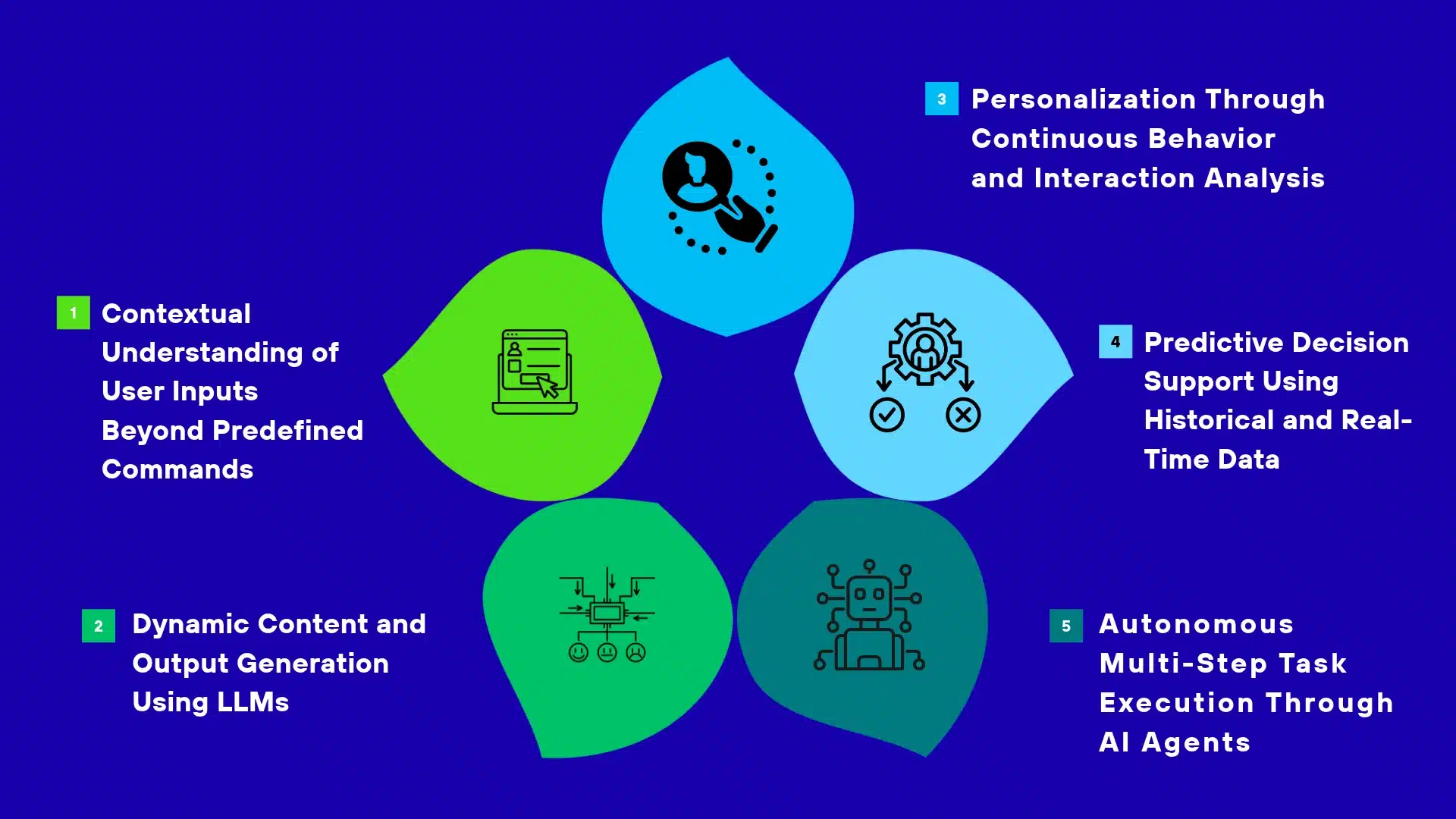
Contextual Understanding of User Inputs Beyond Predefined Commands
The commercial difference here is that your product won’t need a separate, hard-coded interaction path for every customer requirement. When powered by AI, it can easily perform tasks that otherwise would have been difficult, like:
- Interpreting the true user intent
- Resolving ambiguity
- Retrieving relevant information from multiple sources
This behavior completely changes how you scope product functionality. You won’t have to continuously add new screens, filters, or conditional rules. Instead, you can build a context-aware interface rooted in a broader set of user needs. However, to achieve this level of flexibility, you will have to invest in context management, retrieval accuracy, and safeguards against incorrect interpretations.
Dynamic Content and Output Generation Using LLMs
Once you plan for LLM integration, you can change the economics of building features that are meant to produce customer-specific outputs. You no longer have to create and maintain hundreds of templates, rules, and content variations. Rather, the LLMs will give you an opportunity to build a generation layer that intelligently responds to varying inputs and business contexts.
Thus, you can offer capabilities that would otherwise require substantial manual configuration work. However, one thing you need to consider is the variable inference expenses, output validation requirements, and model dependency. Your pricing model will then have to account for usage intensity, and not just the number of registered users or subscription seats.
Personalization Through Continuous Behavior and Interaction Analysis
Only when it improves with proprietary interaction data can you consider AI-driven personalization to be your product’s differentiator in the competitive market. The primary distinction you have to consider here is between customizing an interface based on customer data and building product intelligence meant to become more relevant with repeat use.
The latter will give you an upper hand in strengthening retention and increasing vendor switching costs. That’s because customers will automatically accumulate preferences, historical context, and workflows within your application. However, this advantage will depend on four primary factors:
- Data rights
- Consent to use, store, and transfer LLM’s feedback quality
- Your ability to convert interaction data into measurable improvements
Predictive Decision Support Using Historical and Real-Time Data
This will help you move your application from being just a reporting tool to becoming a key part of the customer’s decision infrastructure. Here, you won’t have to sell access to different dashboards. Rather, you will be able to help your customers anticipate financial exposures, operational bottlenecks, and demand fluctuations based on accurate, real-time data.
By doing so, you get the opportunity to create a stronger commercial proposition, as the value can then be measured against:
- Avoided losses
- Improved utilization
- Faster decisions
Autonomous Multi-Step Task Execution Through AI Agents
Agentic functionality creates a completely different product opportunity. Here, you can sell completed workflows rather than isolated software features. An AI app can coordinate actions across multiple connected platforms, whether it’s the CRM, ERP, internal systems, or accounting software. Therefore, the need for users to switch between tools will automatically be minimized. This will also help you a lot in supporting:
- Transaction-based pricing
- Workflow-based subscriptions
- Enterprise contracts tied to operational outcomes
However, there’s a trade-off. Autonomy will increase your engineering obligations. You will then have to implement permission boundaries, execution monitoring, exception handling, rollback mechanisms, and auditable action histories.
When Does In-House AI App Development Win?
Benefits of building an AI app in-house
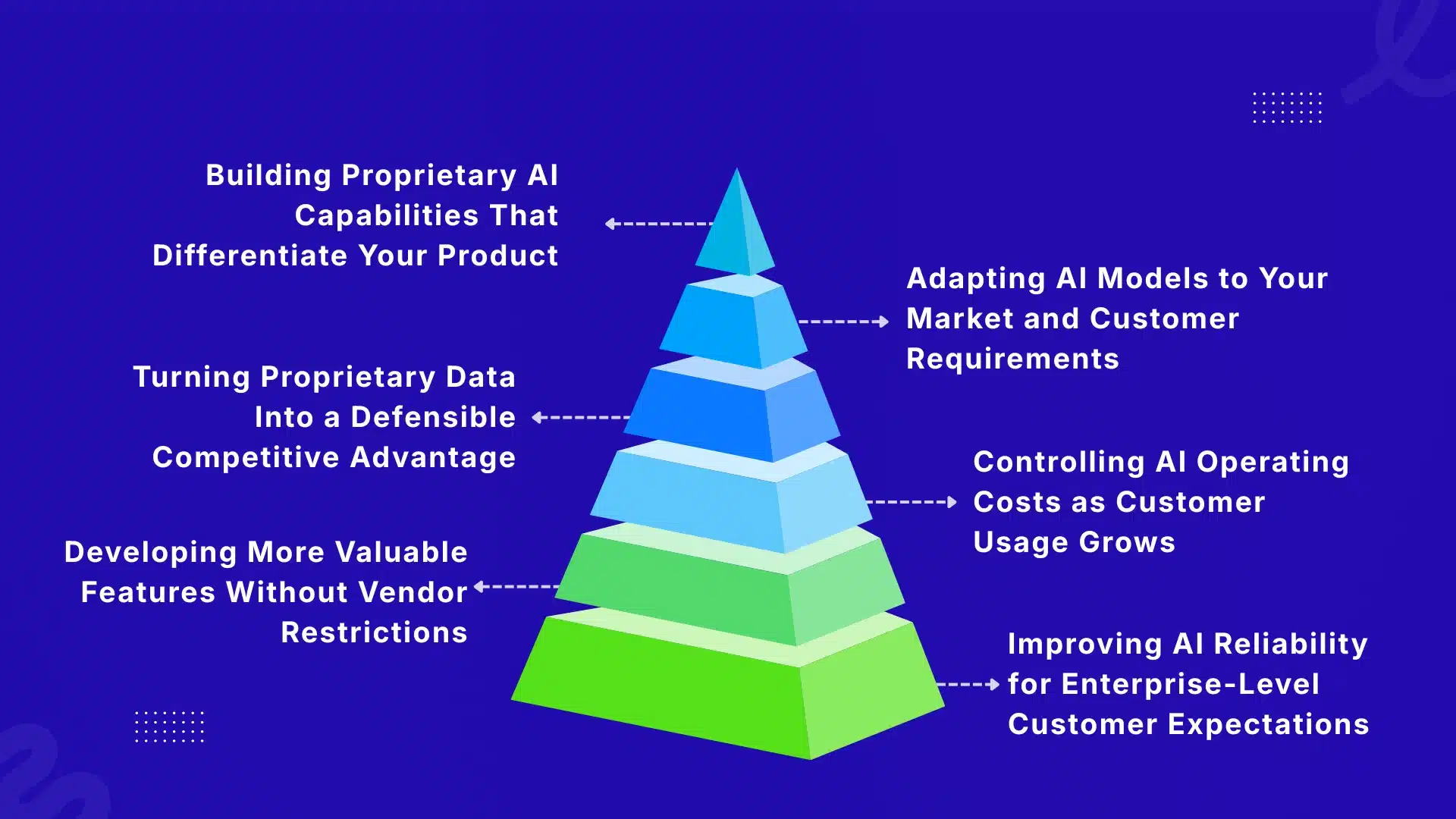
Building Proprietary AI Capabilities That Differentiate Your Product
You cannot differentiate your product by just relying on model access, especially when your competitors may have already invested in the same LLM. This is where an in-house team will come into play, helping you build the entire app around your target market by:
- Developing proprietary decision logic
- Specializing AI workflows
- Implementing domain-specific processing capabilities
Let’s suppose you plan to develop a vertical SaaS product. Your own engineering team can then help you build your own risk-scoring methodology, instead of offering generic LLM-generated assessments. The result? You get greater control over product differentiation, premium feature packaging, and the reason customers renew.
Adapting AI Models to Your Market and Customer Requirements
With in-house development, you can move beyond the capabilities of a generic-purpose model and pursue users with specialized requirements. Consider entering the highly regulated healthcare or insurance market. Whether it’s the document structures, terminology, or accuracy expectations, almost every metric is the polar opposite when pitted against a general consumer app.
That’s why investing in an in-house team will help you easily invest in:
- Domain-specific fine-tuning
- Retrieval pipelines
- Evaluation datasets
The result? You can expand the addressable market and pursue higher-value enterprise contracts. There’s no need to compete exclusively for low-priced subscriptions.
Turning Proprietary Data Into a Defensible Competitive Advantage
The commercial advantage stems from how effectively you can convert proprietary information into product improvements. An internal team will help you build feedback pipelines to capture:
- Accepted recommendations
- Corrected responses
- Failed model predictions
- Completed workflows
You can then use these signals to improve retrieval relevance, specialized models, and ranking logic over successive sprint releases. Take the example of a B2B AI platform. It can use customer-authorized historical transaction outcomes to improve the accuracy of the risk assessment logic.
Controlling AI Operating Costs as Customer Usage Grows
Your AI app’s profitability depends on the cost of completing individual customer tasks, and not simply the monthly subscription pricing tier. Here, an in-house engineering team can measure inference expenditure with respect to feature, workflow, and customer segment. You then get the opportunity to optimize costly operations through techniques like:
- Model routing
- Caching
- Batching
- Smaller specialized LLMs
The real commercial value will surface when enterprise clients tend to negotiate annual contracts with high usage allowances. What’s more, you can accurately forecast contribution margins and identify unprofitable usage patterns.
Developing More Valuable Features Without Vendor Restrictions
Whether it’s a missing integration or a deployment capability, these issues can cost you an enterprise contract worth millions of dollars. With in-house engineering, you can at least assess if a prospect’s requirements deserve an investment in your core product or not. Once you move your AI app to production, you can target an entirely new customer segment through private cloud deployment or custom CRM integration. The following are the three major advantages you will unlock with in-house AI app engineering:
- Building reusable capabilities
- Spreading development costs across future accounts
- Avoiding turning every enterprise deal into an isolated custom project
Improving AI Reliability for Enterprise-Level Customer Expectations
When you deal with enterprise AI buyers, just having a convincing product demonstration won’t help you establish whether your app is safe enough to be deployed across thousands of sensitive business records. But with an in-house team, you will get the opportunity to:
- Maintain evaluation datasets
- Document model changes
- Test output consistency
- Measure failure rates across specific workflows
Your compliance and sales team will then have enough evidence to address technical due diligence, security audits, and contractual performance requirements.
Challenges of in-house app development
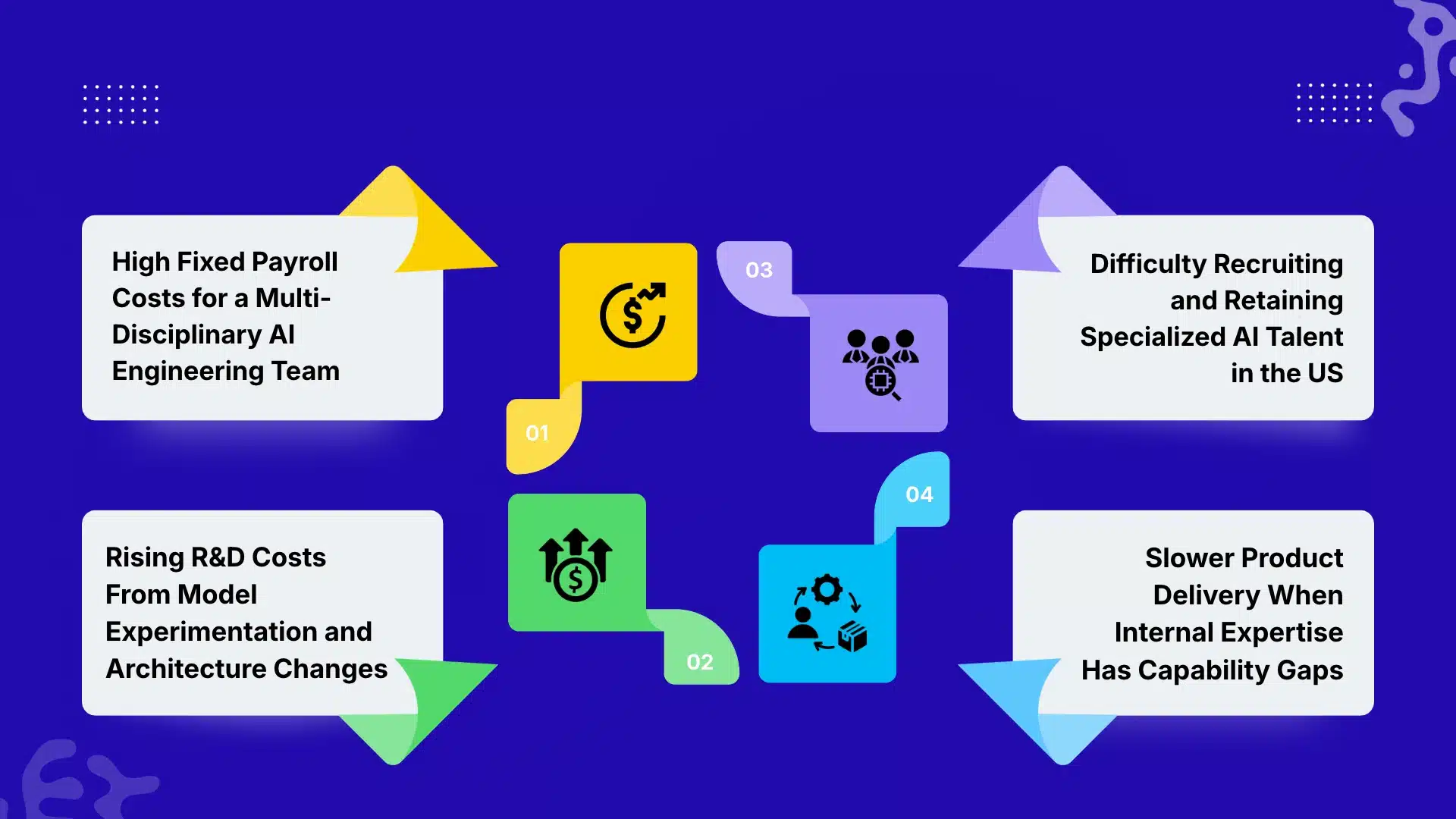
High Fixed Payroll Costs for a Multi-Disciplinary AI Engineering Team
When you are building an AI product, every specialist in your in-house team will be working at full capacity throughout the development lifecycle. Yet your payroll remains fixed, regardless of whether the team is:
- Building the initial RAG pipeline
- Resolving model evaluation issues
- Waiting for the next product release
In the US market. This automatically creates an expensive mismatch between engineering utilization and actual development demand, especially before you can use recurring revenue to support your team.
Difficulty Recruiting and Retaining Specialized AI Talent in the US
The main challenge lies in finding engineers who have taken AI systems beyond experimentation and operated them under production workloads. Experience with model evaluation, retrieval optimization, LLM observability, and inference infrastructure becomes more valuable here. As there’s already a huge competition for these skills, you will be dealing with high recruitment costs. At the same time, losing a senior engineer means only a few people will be left with critical architectural decisions and undocumented technical knowledge.
Rising R&D Costs From Model Experimentation and Architecture Changes
Once real customer workloads expose your first architecture’s limitations, it can prove to be commercially inefficient. Then, the options you will have in hand are to:
- Replace an expensive model
- Restructure the retrieval pipelines
- Introduce a reranking layer
- Redesign inference routing
Each change will create additional engineering and testing expenditure, causing your R&D budget to continue increasing without a parallel improvement in customer retention.
Slower Product Delivery When Internal Expertise Has Capability Gaps
An in-house engineering team can struggle when your roadmap moves faster than its existing technical capabilities. Consider introducing multi-agent workflows. For this, you will need:
- Orchestration expertise
- Evaluation frameworks
- Safeguards for the original LLM integration
Building these capabilities internally is time-consuming. On the other hand, if you delay a major release, you might end up affecting enterprise deal closures and contractual delivery commitments.
When is the right time to go in-house?
Consider moving AI development in-house when your product has achieved sufficient market validation. Another strong use case is when the app’s engineering requirements have become a continuous business function, and not limited to being just a one-time build. Let’s assume your enterprise contracts require:
- Proprietary model adaptations
- Frequent RAG improvements
- Dedicated data pipelines
- Tighter control over inference margins
In each of these situations, permanent engineering ownership will become much easier to justify. However, before you go ahead, make sure there’s enough recurring revenue or committed funding. Only then can you sustain specialist salaries beyond the initial development cycle. The strongest signal is when external development costs, vendor dependencies, or delayed product decisions begin restricting revenue growth and product differentiation.
When Does Outsourcing AI App Development Win?
Benefits of outsourcing AI app development
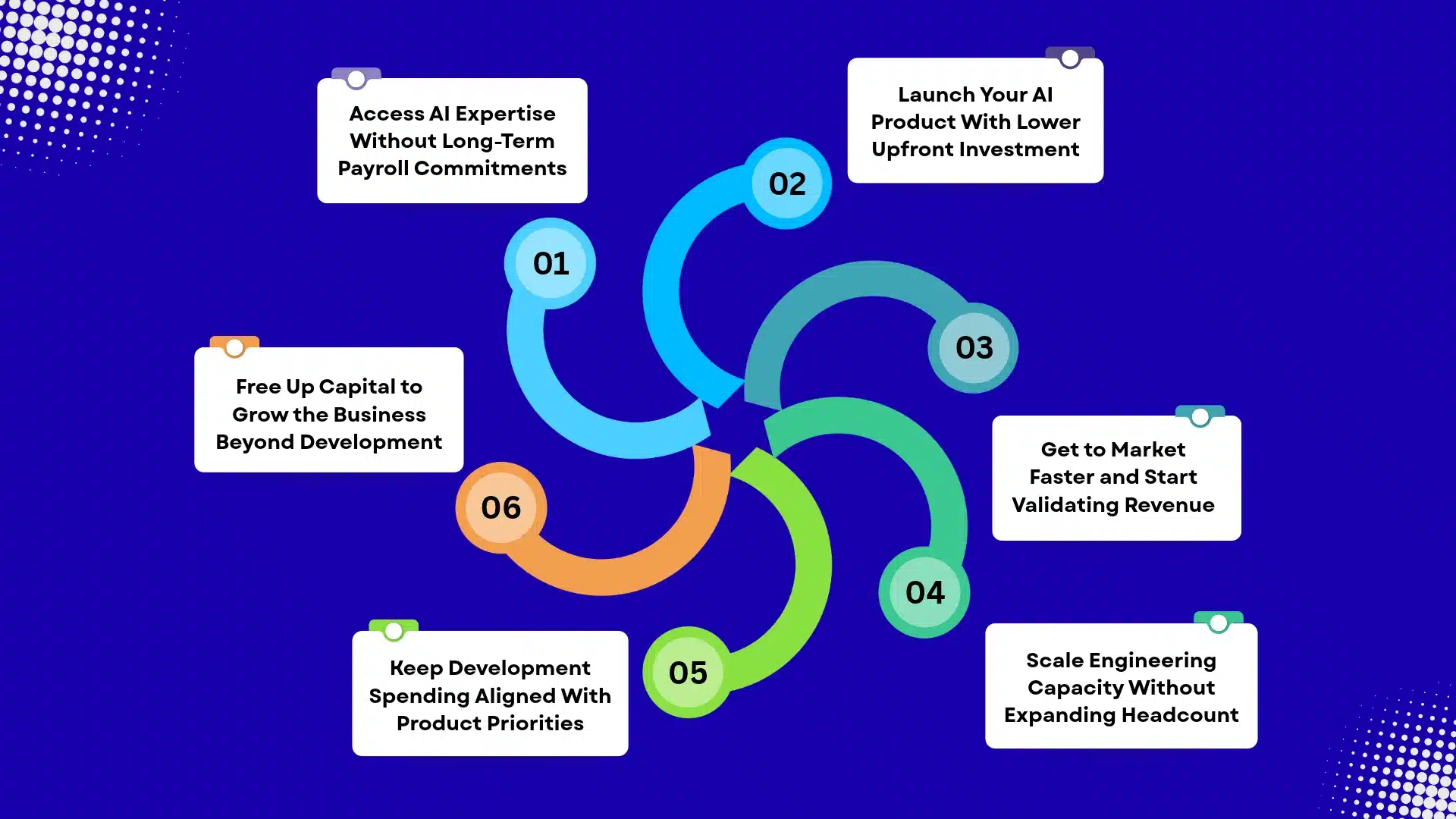
Access AI Expertise Without Long-Term Payroll Commitments
Once you outsource AI app development to an external vendor, you get easy access to engineers who have already worked with production-grade LLMs, and not just conventional app stacks. This simple distinction will matter a lot when your product depends on:
- Retrieval quality tuning
- Model evaluation
- Inference optimization
As these capabilities usually become critical at different stages of your product’s roadmap, outsourcing will help you bring in the relevant expertise. What’s more, you won’t have to maintain a permanent team whose skills and workload might change with evolving AI infrastructure, orchestration frameworks, and model providers.
Launch Your AI Product With Lower Upfront Investment
The early investment in an AI product isn’t limited to building just its interface and backend. Rather, you will have to consider activities like:
- Testing model providers
- Preparing evaluation datasets
- Establishing retrieval pipelines
- Measuring inference costs
Outsourcing will help you run this technical validation without having to fund an internal AI research function or commit to GPU infrastructure first. At least then, you will have ample opportunities to compare implementation approaches, identify expensive assumptions, and make larger infrastructure investments.
Get to Market Faster and Start Validating Revenue
An experienced AI development partner will help move your product beyond a convincing demo into a system that performs consistently with real customer data. This transition might look simple on the surface. But it actually requires more than connecting an LLM. For example:
- Retrieval must return relevant evidence
- Outputs need evaluation
- Failure cases need handling
Only by using established implementation approaches for these AI-specific problems can you shorten the gap between prototype and paid deployment. The result? You start testing customer willingness to pay before committing further capital to unproven capabilities.
Scale Engineering Capacity Without Expanding Headcount
AI workloads never scale in the same way as ordinary application traffic. A rise in usage can increase token consumption, retrieval load, and inference latency. At the same time, a new enterprise account will put demands for a separate data pipeline or model deployment. Outsourcing gives you access to specialists who can address these requirements as and when they surface. By doing so, you can adjust engineering capacity around actual workload, deployment complexity, and contract requirements instead of hiring ahead of uncertain AI usage.
Keep Development Spending Aligned With Product Priorities
You will have to judge AI development spending against output quality and the cost of producing it. A model upgrade that improves answer quality but doubles inference expense is likely to weaken your gross margin. With an outsourced team, however, you can define milestones around measurable thresholds, such as:
- Retrieval relevance
- Response latency
- Cost per completed task
This will further make each development phase accountable to product performance and unit economics, rather than simply the number of features delivered or experiments completed.
Free Up Capital to Grow the Business Beyond Development
For your AI business, the lasting advantage is rarely access to a foundation model that competitors can also license. Instead, it stems from proprietary workflows, customer-authorized data, and feedback. That’s because these assets make your system more useful in a specific market, whether it’s healthcare, insurance, or retail.
Outsourcing execution will leave more capital available to secure these. You can invest in domain-specific evaluation datasets, stronger data rights, and customer feedback loops that improve product performance and create differentiation beyond the underlying model.
Challenges of outsourcing app development
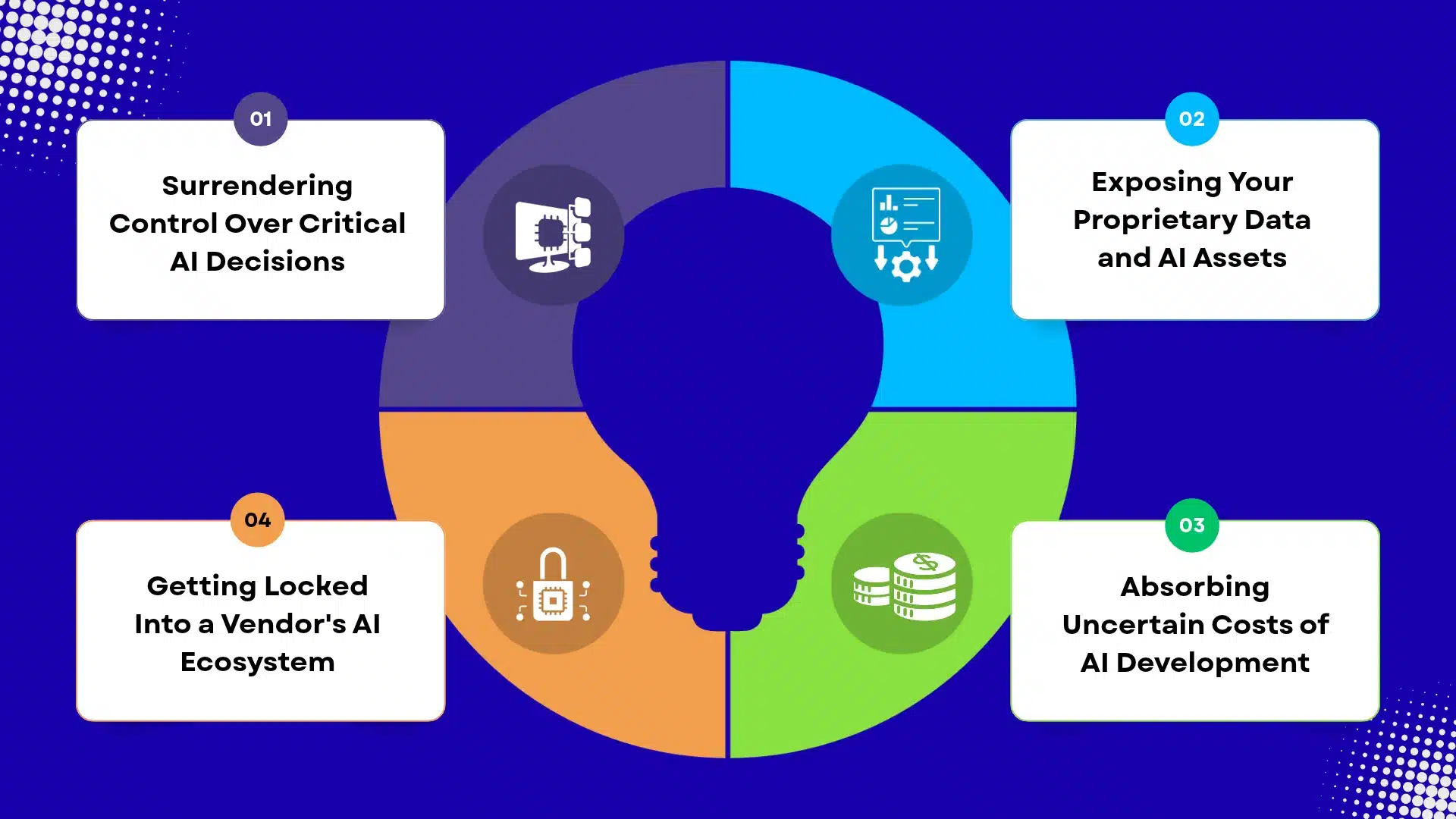
Surrendering Control Over Critical AI Decisions
When an external team controls model selection, RAG architecture, and inference optimization, you risk losing visibility into decisions that determine product performance and operating costs. That’s because a vendor might prioritize implementation speed over long-term scalability. Without internal technical oversight, you will struggle to challenge those choices or assess whether the architecture supports your future product roadmap and commercial requirements.
Exposing Your Proprietary Data and AI Assets
Outsourcing creates additional exposure for your AI app. It usually happens when the developers need to access:
- Customer datasets
- Proprietary workflows
- Evaluation records
- Fine-tuning assets
Now, these resources are usually your strongest competitive advantage. But when it comes to a weak contractual arrangement around data usage, model training, code ownership, and deletion rights, you are bound to become vulnerable. Hence, what you need is explicit ownership and access provisions before sharing commercially sensitive information.
Absorbing Uncertain Costs of AI Development
AI development rarely follows a perfectly predictable scope. Initial testing can reveal poor retrieval quality, inconsistent outputs, or unacceptable inference costs. If that’s the case, you will have to invest in additional experimentation. Now imagine the outsourcing contract not defining how these changes will be priced. In such a scenario, each iteration can increase your budget by ten-fold. A seemingly affordable development engagement will thus become expensive before the product reaches production readiness.
Getting Locked Into a Vendor’s AI Ecosystem
A vendor will build your application around its preferred model APIs, orchestration tools, vector database, or cloud infrastructure. As these choices aren’t rooted in your business’s existing technical infrastructure, they can make future migration difficult. If you plan to switch providers, you may have to:
- Rebuild integrations
- Adapt prompts, reworking them
- Rework evaluation pipelines
- Retest outputs
What’s worse, you may have to bear rising service costs or limited negotiating power because replacing the underlying architecture becomes commercially disruptive.
When is the right time to outsource?
The right time to outsource AI app development is when your product needs specialized engineering capabilities that your current team cannot justify maintaining permanently. Based on this explanation, the scenarios that hold the most relevance include:
- MVP development
- Model experimentation
- Enterprise-grade integration.
It also makes sense when production workloads require expertise in RAG optimization, MLOps, or model evaluation. However, retain internal ownership of your product architecture, proprietary data, AI strategy, and technical roadmap. If you have validated the problem but are still testing model providers, inference costs, and customer willingness to pay, outsourcing will limit your long-term commitment.
How Much Does In-House vs Outsourcing AI App Development Cost?
For a US business, an in-house team that can build and run a production-ready AI app typically costs 300K-500K per year in salaries, benefits, and overhead. Outsourcing the same scope costs roughly 120K–240K in the first year: a 60K–120K fixed-scope MVP plus post-launch engineering and support. The final figure depends on model complexity, integrations, and production requirements. Cloud and model API usage (12K–60K a year) is similar under either model and comes on top.
The economic difference between these two development models becomes more prominent once your AI app starts evolving. With an in-house team, you pay continuously to:
- Improve retrieval accuracy
- Evaluate model versions
- Optimize inference
- Manage production failures
The investment will make sense only when the above-mentioned activities directly influence customer retention, enterprise renewals, or the cost per completed task. Outsourcing, on the other hand, will help you avoid funding this permanent capacity before the demand is proven appropriately. However, repeated vendor engagements for prompt changes, RAG improvements, and model migration can erode your initial savings.
Therefore, your decision needs to reflect where AI engineering creates most value. Outsource when you want to validate demand. Build internally when proprietary model behavior and ongoing optimization are central to your margins and market advantage.
| Cost component | In-house AI app development | Outsourced AI app development |
| Initial MVP development (4–6 months) | $150K–$250K in internal team salaries and setup costs | $60K–$120K in fixed-scope MVP development fees |
| Annual engineering team cost | $300K–$500K in salaries and benefits for AI, backend, and cloud engineers | $120K–$240K in fees for retained external engineering capacity |
| Model experimentation and evaluation | $15K–$35K in model testing and internal engineering time | $8K–$25K in contracted model testing and evaluation |
| RAG pipeline and data integration | $20K–$45K in retrieval development and data connector implementation | $12K–$30K in vendor fees for RAG and data integration |
| Cloud infrastructure and model API usage (annual) | $12K–$60K in hosting, database, and inference charges | $12K–$60K in equivalent usage-based infrastructure and API charges |
| Post-launch maintenance (annual) | $60K–$120K in ongoing engineering salaries and support | $24K–$60K in annual maintenance and support fees |
| Additional feature development (annual) | $40K–$90K in internal development time for new AI capabilities | $25K–$65K in vendor charges for additional features |
| Three-year engineering and maintenance expenditure | $900K–$1,500K in sustained internal engineering and maintenance costs | $360K–$720K in cumulative development and support contract fees |
Ranges assume a US-based team. Model experimentation and RAG costs are included in the MVP figure. Maintenance and feature development are part of the annual team cost, not additional to it. Cloud and API usage is separate and similar for both models. Three-year totals exclude that usage.
Which Is Faster, Higher Quality and More Scalable: In-House or Outsourced?
Development Speed: How Quickly Can You Launch an AI App?
For your AI app, you can determine the development speed based on how quickly you can resolve architectural decisions and move from a pilot model to production release. Outsourcing gives you access to an assembled team with the right skill set needed for your product. This not only reduces recruitment delays but also allows parallel work on model integration, backend services, and deployment. Whether it’s a narrow market-entry window or an MVP to secure initial customers, outsourcing will generate maximum value for your product goals.
In-house development, on the other hand, has a slower setup. However, once established properly, you can easily eliminate vendor approval cycles from your roadmap. By doing so, you get the opportunity to focus on reprioritizing important product features and ground them in customer contracts. What’s more, you don’t have to renegotiate scope for testing competing models and releasing improvements.
AI App Quality: Who Delivers More Accurate and Reliable AI Outputs?
The quality of an AI app is directly reflected in the level of consistency with which it can produce useful outputs across real customer scenarios. These can include:
- Ambiguous inputs
- Incomplete datasets
- Edge-case usage models
Outsourced teams with production-level AI experience will bring established evaluation methods and help you minimize the cost of discovering architectural mistakes. However, a vendor working against predefined acceptance criteria may end up optimizing for delivery only, and not your product’s actual evolving needs.
An in-house team, on the other hand, will help you build evaluation benchmarks around actual customer behavior, monitor failure patterns, and prioritize improvements based on their commercial impact. This will matter the most when output accuracy determines enterprise adoption, renewal rates, or contractual exposure.
Scalability: Which Model Handles Growing Users and AI Workloads Better?
For an AI app, scalability becomes a financial challenge when customer growth increases inference expenditure faster than revenue. A solution that performs well with 500 users can eventually become expensive at 50K. This usually happens when every interaction triggers multiple model calls, retrieval operations, or agent executions. Outsourcing gives you access to specialists for load testing, infrastructure optimization, and deployment changes without maintaining that expertise permanently.
However, repeated optimization engagements can become costly as workloads evolve. An in-house team will offer you continuous control over model routing, caching, inference capacity, and workload allocation. This is particularly important when you offer usage-based pricing or enterprise service commitments. The decision depends on whether scaling is an occasional engineering requirement or a continuous driver of your product’s gross margin.
Do You Need an In-House Team to Build an App With the ChatGPT or Claude API?
No. Using the ChatGPT or Claude API doesn’t, by itself, justify the decision to permanently hire an AI engineering team. Suppose your product relies on foundation model APIs for text generation, summarization, document analysis, or conversational interfaces. In such cases, an experienced outsourced team will help build the necessary integrations, backend architecture, security controls, and deployment infrastructure. If we talk about the economic priority, it’s to validate whether your target customers will pay for the workflow your app delivers. Until and unless demand is proven, carrying the burden of specialist payroll seems irrelevant.
However, this equation completely changes when API becomes central to your product economics. Suppose your AI app needs features like:
- Advanced and sophisticated model routing
- Custom evaluation pipelines
- Domain-specific retrieval pipelines
- Continuous inference cost optimization
In these scenarios, internal technical ownership will become valuable for your business. Here, you won’t need a large team. A capable technical lead or AI engineer can oversee the architecture while external specialists can handle the defined implementation tasks.
What Is the Hybrid Model, and When Does It Make Sense?
A hybrid model is attractive when your AI app needs sustained engineering capacity, but its revenue doesn’t yet justify a full US-based AI department. Here, you won’t have to hire several specialists at annual employment costs. You can retain a technical lead internally and engage a dedicated external team for implementation. This arrangement will cost you around $180K-$300K annually, which is economically sustainable compared to the $300K-$500K budget for in-house. The potential savings of $120K-$200K will give you more capital to invest in customer acquisition, proprietary data, and product validation.
However, the lower payroll commitment comes with a trade-off. Your roadmap will still depend on an external team’s capacity and execution. If technical knowledge remains with the vendor, changing partners or bringing development in-house in the future will be expensive. So, choose this hybrid approach only when you need continuous product development but want to retain internal control over architecture, AI strategy, and commercially sensitive decisions.
| Comparison factor | In-house development | Outsourced development | Hybrid development |
| Initial investment | $150K–$250K for a small AI app team and initial build | $60K–$120K for a defined MVP development engagement | $90K–$160K for initial development with internal technical oversight and external execution |
| Annual engineering cost | $300K–$500K in salaries and employment overheads | $120K–$240K for retained external development capacity | $180K–$300K for a small internal team and dedicated external developers |
| Hiring and recruitment | High recruitment expenditure and time spent securing specialist AI talent | No permanent engineering recruitment; vendor selection and onboarding costs apply | Limited internal recruitment, with specialist capacity supplied externally |
| Development speed | Initial hiring delays, followed by direct control over release priorities | Faster team mobilization, subject to vendor availability and project scope | Internal decisions combined with dedicated external execution capacity |
| AI expertise | Expertise develops internally through sustained product work and production experience. | Access to specialists with experience across different AI implementations | Internal product knowledge combined with external AI engineering expertise |
| AI experimentation costs | Internal engineering time and model-testing expenses remain ongoing payroll and operating costs. | Testing and experimentation are included within the contracted scope or billed separately. | Core evaluation stays internal, while external specialists handle additional experiments and implementation. |
| Product ownership and IP | Direct control over architecture, source code and proprietary AI workflows | Ownership and usage rights depend on contractual provisions | Internal control over architecture and IP, with external access governed by contract |
| Scaling expenditure | Additional demand may require new hires and higher recurring payroll | Engineering expenditure increases through additional project fees or developer hours | External capacity can expand without immediately increasing permanent headcount |
| Post-launch maintenance | $60K–$120K annually in internal engineering costs | $24K–$60K annually under a maintenance agreement | Approximately $40K–$90K annually, depending on internal coverage and external support |
| Best suited for | Established AI businesses where proprietary technology and continuous optimization drive competitive advantage | Startups validating demand or businesses building an AI product without permanent engineering requirements. | Growing AI businesses that need ongoing development and internal technical control without funding a full engineering department |
What Are the Risks of Outsourcing AI Development, and How Do You Reduce Them?
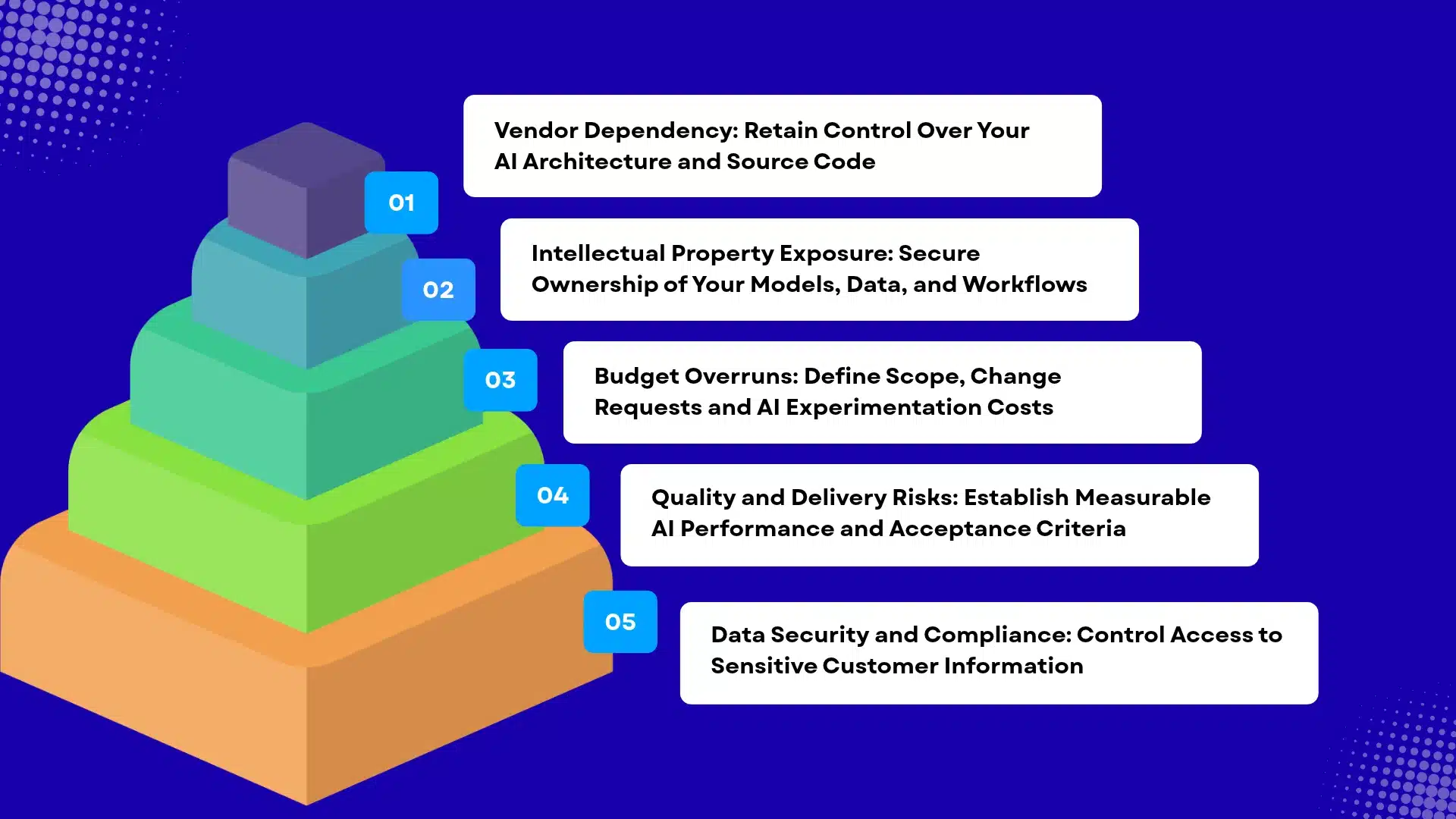
Vendor Dependency: Retain Control Over Your AI Architecture and Source Code
This becomes costly when only your original development team understands the architecture, model configurations, or deployment process. Switching providers will then require rebuilding integrations or interrupting production. This can ultimately weaken your negotiating position and make routine maintenance extremely expensive.
So, keep source-code repositories and cloud accounts under your business’s ownership. Ask for architecture documentation, deployment instructions, and a formal knowledge-transfer process. This way, another engineering team can easily take over without having to rebuild your AI app.
Intellectual Property Exposure: Secure Ownership of Your Models, Data and Workflows
Your competitive advantage will lie in proprietary datasets, custom AI workflows, and domain-specific retrieval. If ownership here remains unclear, your vendor might end up retaining rights to reuse components you funded or restricting your ability to modify them. Confidential customer information can also get exposed during the app development. The key here is to specify ownership of custom deliverables from day one. Also, make sure to distinguish pre-existing vendor technology from newly developed IP. Prohibit any type of unauthorized reuse of proprietary data and workflows.300K–750K
Budget Overruns: Define Scope, Change Requests and AI Experimentation Costs
AI development estimates often increase when initial model testing exposes accuracy problems or architectural limitations. Additional RAG integrations, model changes, and evaluation cycles can then become separately billable work. API consumption and cloud infrastructure can further inflate expenditure.
So, make sure to establish a detailed cost breakdown before development begins. Specify included experimentation rounds and ask for written approval for additional work. Also, keep a contingency budget for technical changes that might emerge during production testing.
Quality and Delivery Risks: Establish Measurable AI Performance and Acceptance Criteria
A completed AI app does not guarantee reliable business performance. Your vendor might demonstrate successful responses using prepared prompts while the application struggles with incomplete customer inputs or complex real-world queries. These failures increase manual intervention and undermine customer confidence. Define measurable acceptance benchmarks using representative datasets. Test retrieval relevance, output accuracy, and response latency under realistic workloads before approving milestones or releasing final payments.
Data Security and Compliance: Control Access to Sensitive Customer Information
External developers introduce additional access points to your customer records and proprietary business data. Information can enter unsecured testing environments or third-party model APIs without appropriate controls. This will then expose your business to breaches and compliance liabilities. Map data flows before development, restrict access through role-based permissions, and use masked datasets for testing. Contractually define processing responsibilities, subprocesser approvals, breach notification timelines, and verifiable data deletion requirements.
How Do You Choose an AI App Development Partner?
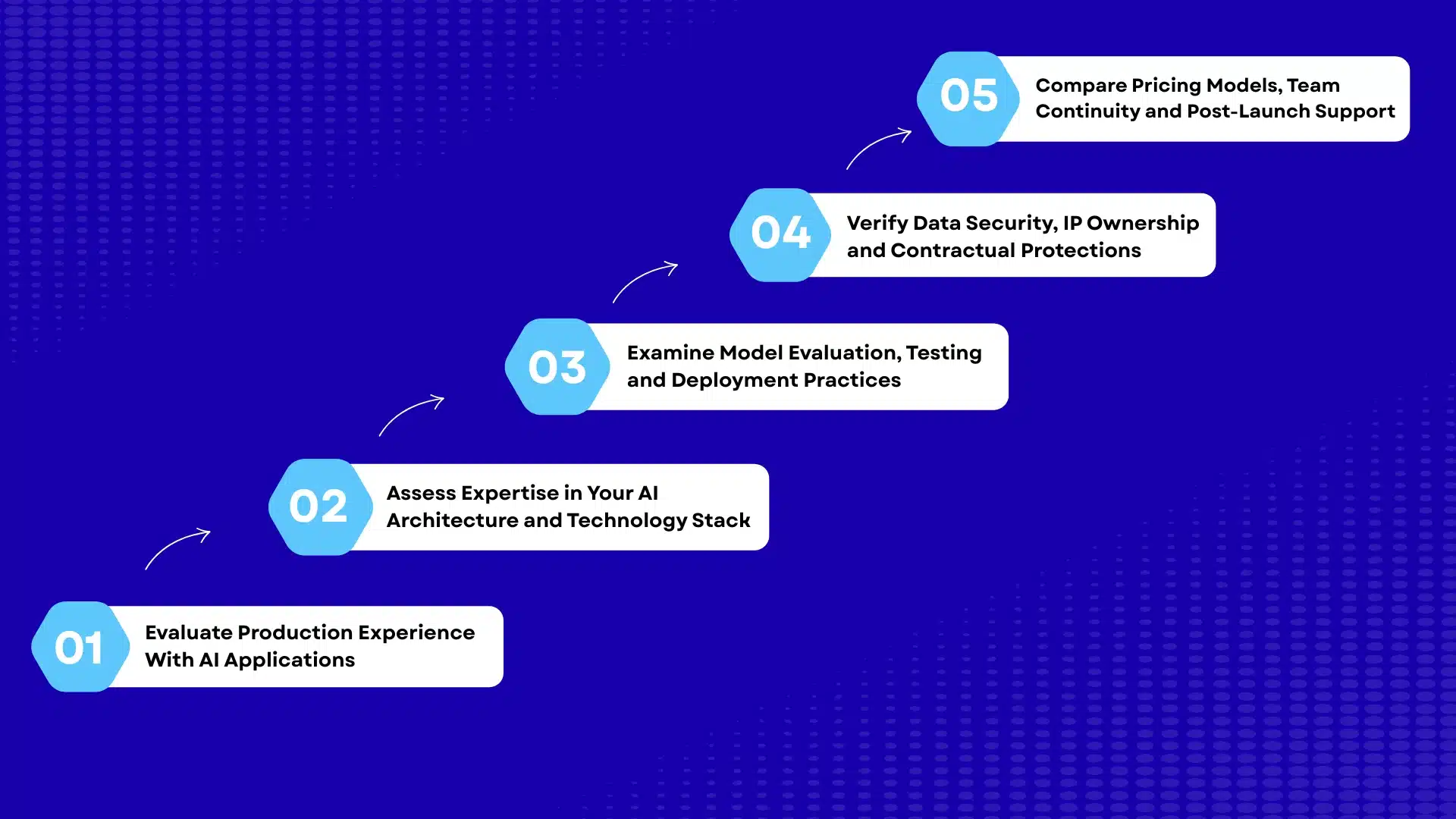
Evaluate Production Experience With AI Applications
A vendor’s portfolio must demonstrate AI apps operating under actual customer workloads, not just polished demos. Examine whether they have handled model failures, inference-cost optimization, and integration challenges after the product launch. Ask for examples involving similar business use cases and understand what the team delivered beyond the initial MVP.
Assess Expertise in Your AI Architecture and Technology Stack
Evaluate whether the team has hands-on experience with your intended architecture, especially when your app requires RAG, agentic workflows, or custom model integrations. A mismatch here can lead to unnecessary infrastructure costs or architectural rework. Ask who will make technical decisions and whether those specialists will remain involved throughout development.
Examine Model Evaluation, Testing and Deployment Practices
Ask how the vendor measures output accuracy and identifies hallucinations before release. Their testing process must include representative datasets, edge cases, and production-like workloads. In addition, examine how they monitor model performance after deployment. Without measurable evaluation methods, you will end up risking paying for an application that works excellently in demonstrations but underperforms in actual use.
Verify Data Security, IP Ownership and Contractual Protections
Review how the vendor handles customer data, third-party model APIs, and development access. Confirm that your company owns custom code and agreed deliverables, with clear provisions for confidential datasets and proprietary workflows. For regulated applications, examine data-processing agreements, subprocessor controls, and relevant security certifications before granting access to sensitive information.
Compare Pricing Models, Team Continuity and Post-Launch Support
Do not compare vendors solely on their initial development quotes. Examine whether pricing includes model experimentation, deployment, maintenance, and subsequent improvements. Confirm which specialists will work on your project and what happens if they leave. A lower MVP quote offers little financial advantage if every post-launch change requires expensive renegotiation.
How GMTA Approaches AI App Development
At GMTA, we approach AI development from the business problem backward, not from the model forward. Before recommending an architecture, we examine where AI will create measurable value in your operations, what decisions it needs to support, and how the application will fit into your existing systems. This helps us avoid building technically impressive features that add little commercial value.
Our development process focuses on selecting the right AI architecture for the intended workload. Whether your application requires RAG, agentic AI, custom model integrations, or conventional machine learning, our experts evaluate the technical requirements against development costs, performance expectations, and future scalability. We also account for data quality and integration dependencies early because these often determine how well an AI application performs in production.
GMTA always places particular emphasis on moving beyond functional prototypes. Our teams build around real-world evaluation requirements, testing model outputs against relevant use cases rather than relying on successful demonstrations. We also consider inference costs and performance as usage grows, so your application does not become unnecessarily expensive to operate.
With experience across 200+ projects and 80+ customers, we bring a delivery-focused approach to AI implementation. Our objective is to build an application that solves a defined business problem and remains commercially viable as your product evolves.
FAQs About In-House vs Outsourcing AI App Development
Is outsourcing AI app development cheaper than hiring an in-house team?
Yes, outsourcing AI app development is comparatively cheaper than building it in-house. That’s because you can then avoid permanent salaries, recruitment expenses, and employee benefits. In the US market, an outsourced MVP costs $60K-$120K for the initial build, compared with $150K-$250K for an equivalent in-house setup. However, repeated vendor engagements, maintenance fees, and change requests can reduce these savings over time.
How long does it take to develop a production-ready AI application?
A production-ready MVP with RAG, model evaluation, and one or two integrations typically takes 4–6 months. A basic API-powered app can launch in 8–12 weeks. Enterprise AI products with multi-agent workflows, several system integrations, and compliance requirements usually take 6–12 months. Security testing, model evaluation, and production validation are included in these ranges.
What types of AI applications are best suited for outsourced development?
AI apps with clearly defined requirements and established implementation patterns are best-suited for outsourcing. These include ChatGPT-powered apps, customer support assistants, document processing tools, recommendation engines, and RAG-based knowledge systems. Outsourcing also becomes sensible for MVP development when you need specialist engineering without permanent hiring.
How do I protect my company’s data when outsourcing AI app development?
You can protect company data by using role-based access controls, encrypted development environments, and masked datasets during testing. Before sharing information, establish a data-processing agreement covering permitted use, retention, deletion, and subprocessors. Also verify whether third-party model APIs retain submitted data or use it for training. Restrict production access and require contractual breach notification obligations from your development partner.
When should a startup switch from outsourced AI development to an in-house team?
A startup should consider building an in-house AI team when continuous model optimization, proprietary AI development, or frequent production changes become core business requirements. If recurring vendor fees approach the cost of permanent engineering salaries, internal hiring deserves consideration. The transition also makes sense when external dependencies delay releases, limit architectural control, or prevent your team from protecting product-specific technical knowledge.

Founder
Anjali Upadhyay is the Founder of GMTA Software Solutions, a mobile and web application development company she built from the ground up in 2019. Under her leadership, GMTA has delivered 200+ production applications across healthcare, fintech, and on-demand services for clients in the US, UK, Singapore, and UAE. She also leads GMTA’s AI practice, which has shipped production AI systems — including HIPAA-compliant healthcare workflows, LLM-integrated logistics platforms, and fintech automation tools — for US-based enterprise clients. Her writing covers AI product strategy, build-vs-buy decisions for AI systems, and the operational realities of moving AI from proof-of-concept to production at scale.