


Key Takeaways
- Your logistics technology budget should account for initial development, legacy-system integration, data migration, employee training, and recurring maintenance rather than just software acquisition
- Start with 2–3 workflows where automation has a direct financial impact, such as freight procurement, warehouse labor allocation, or carrier invoice auditing
- Connecting TMS, WMS, ERP, ELD, and carrier EDI networks requires more planning than purchasing standalone applications. Your integration architecture will influence future development and maintenance costs
- Your platform should accommodate established EDI transaction standards, carrier-specific data formats, and FMCSA-related operational requirements before expanding across a larger carrier network
Being a US-based logistics operator, you know how rising freight costs have left you with little to almost no room to absorb operational inefficiencies. A delayed dispatch by just a couple of minutes disrupts your delivery commitments. Poor inventory visibility makes stock allocation harder to achieve until an order misses its fulfilment window. Add a scenario where your warehouse and transportation teams are forced to work with fragmented systems, and you end up with costlier problems in hand. This is where digital transformation for logistics companies steps into the scene. It addresses all these underlying bottlenecks by connecting operational data and automating decisions that otherwise depend on manual coordination.
Yet, technology investments do not guarantee better operating margins as a right-hand rule. PwC’s 2026 survey covered 767 US operations and supply chain leaders, revealing that 89% of them are yet to fully realize the expected returns from their digital initiatives. In addition, poor data quality with compromised integrity has also affected 87% of respondents. So, implementing a new TMS or WMS will do little to improve execution. Picture the financial risk, and you will find it extending beyond software procurement costs. Integrations automatically increase the initial implementation budget, while employees prefer using spreadsheets.
Having said that, we have prepared a detailed roadmap on digital transformation in transportation and logistics. With this, you can examine the related costs and make accurate ROI considerations before investing. Furthermore, our insights on the practical use cases based on 2026 market dynamics will help you find the best fit for your business. Remember, a successful transformation always starts with identifying where your current processes are losing money.
What does digital transformation in logistics mean?
Supply chain and logistics digital transformation means implementing integrated digital systems to restructure how your business manages day-to-day revenue-generating operations, including:
- Freight movement
- Fleet operations
- Warehouse execution
- Inventory flow
- Order fulfilment
Once you connect TMS with telematics, ELDs, WMS, and ERP, you create pipelines for operational data to move between departments without repeated manual entry. Consider an event of a delayed shipment. The integrated platforms can then automatically update the estimated arrival, flag a missed delivery window, and assist dispatchers in reassessing vehicle assignments. The key takeaway: Your objective here will be to improve execution, minimize OpEx, and make logistics decisions using current operational data.
Why are logistics companies investing in it now?
Investing in logistics and supply chain digital transformation has become a key turning point for most US businesses because rising operating expenses have made process inefficiencies difficult to sustain. Maintaining manual coordination at scale is no longer economically feasible. Consider a fleet operator managing 150 trucks across multiple US states, including Dallas, Seattle, and many more. When dispatchers do not have a complete picture of vehicles’ location and driver hours-of-service data, they risk assigning loads to those who are running a deficit in legal driving hours. The result? Avoidable rescheduling, detention costs, and missed delivery windows.
KPMG’s 2026 Supply Chain Survey backs this example, as it found that 38% of business leaders flagged logistics and transportation costs as their biggest source of value leakage. Another 77%, on the other hand, reported a significant talent deficit in both procurement and supply chain functions. With customers expecting more than basic freight movement, transportation technology investment has accelerated. In Descartes’ 2026 survey, 78% of North American organizations already planned to increase tech-driven initiatives, while 85% identified transportation as a customer-service differentiator. For a 3PL operator, therefore, this translates into practical business requirements, such as:
- Customers demanding shipment-level tracking
- Accurate estimated arrival times
- Advance notifications for deliveries at risk
AI adoption presents another reason to modernize. Descartes found that about 19% of shippers and 15% of logistics service providers have already implemented intelligence in their day-to-day processes at scale. Whether it’s predictive ETA estimation or automated freight document processing, they are now more focused on exploring smarter, AI-driven functions in 2026.
How digitally mature is your logistics operation?
This depends on whether the existing systems your logistics business uses exchange operational data and help employees make decisions without repeatedly reconciling spreadsheets or chasing updates. If your TMS records a dispatched load efficiently but your customer service team has to call drivers just to confirm the delivery status, your operation has a visibility gap. At the same time, a warehouse using a barcode scanner doesn’t have genuine real-time inventory control if it has to update records in batches manually.
So, to assess how digitally mature your logistics and supply chain business is, use a three-level scoring framework. In brief, it looks like:
- At the basic level, inventory updates, dispatch planning, and proof of delivery all depend on fragmented spreadsheets and paper records.
- At the intermediate level, you will have digital TMS, WMS, or fleet management software, but with limited integrations.
- At the advanced level, your systems share data across transportation, warehousing, and order management.
Only by examining where information gets delayed between departments and tracking operational delays can you understand your business’s actual digital maturity.
| Assessment criterion | 1 – Fragmented | 2 – Partially integrated | 3 – Connected |
| Shipment visibility | Dispatchers obtain updates through calls or separate carrier portals | Tracking is digital, but shipment exceptions require manual follow-up | Shipment status and ETA updates flow automatically into operational dashboards |
| Fleet management | Vehicle assignments and utilization are tracked manually | Telematics provides location data, but dispatch decisions remain largely manual | Telematics, ELD data, and dispatch workflows support coordinated fleet planning |
| Warehouse operations | Inventory movements and picking records require manual updates | Barcode scanning updates inventory, but warehouse and order systems operate separately | WMS transactions synchronize with inventory, order, and fulfillment systems |
| System integration | Employees transfer information between disconnected platforms | Selected systems exchange data through scheduled uploads or limited integrations | Core TMS, WMS, ERP, and carrier systems exchange data through established integrations |
| Decision-making | Managers rely on historical reports and individual employee updates | Dashboards provide operational metrics, but exception analysis requires manual investigation | Live operational data and predictive analytics support exception management and planning |
What are the best use cases for logistics digital transformation?
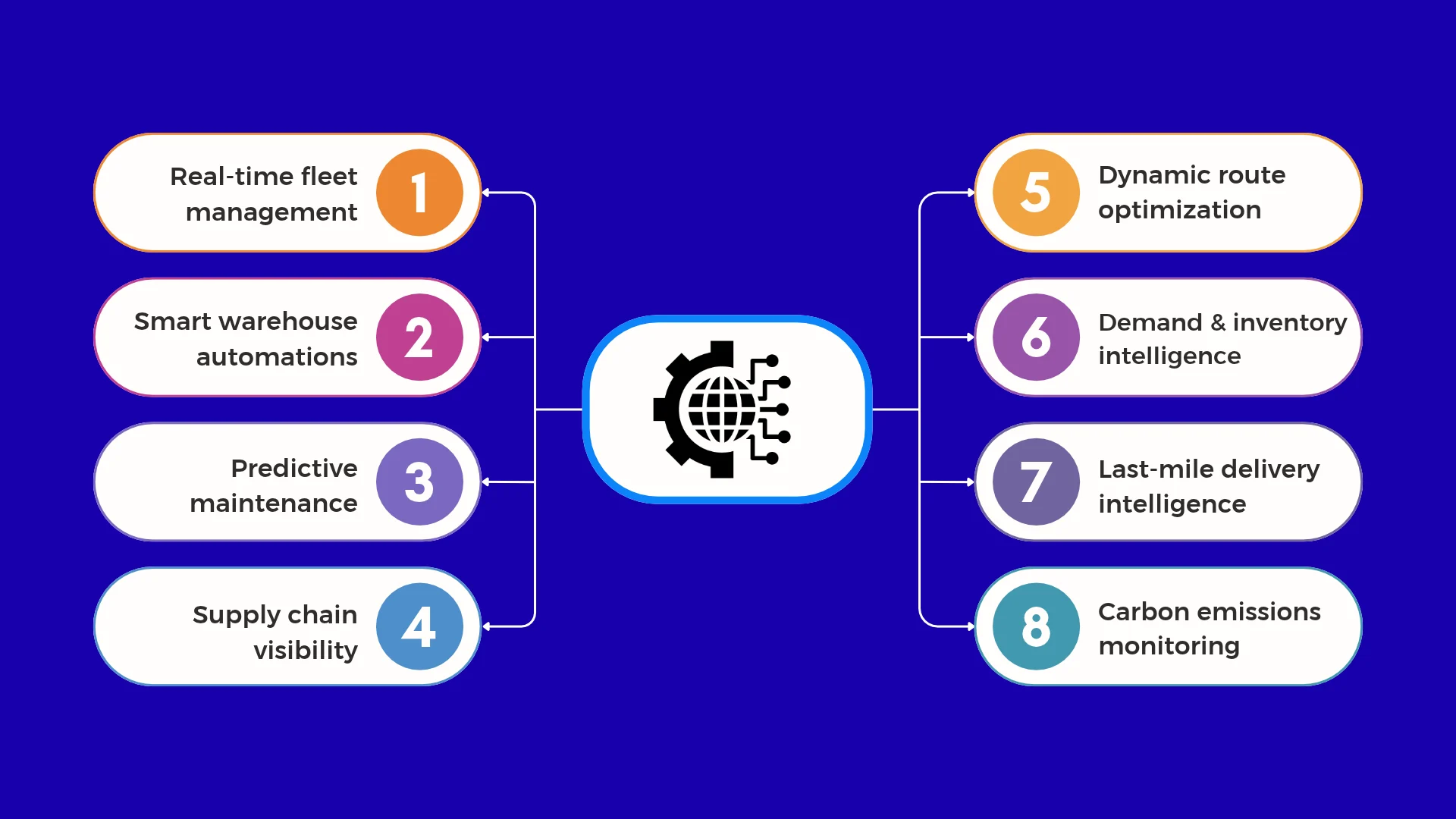
Real-time fleet management
It helps connect vehicle telematics with dispatch systems so that your operations team gains absolute control over fleet activity while vehicles are on the road. This way, you can easily monitor driver HOS alongside truck availability from a unified dashboard, and not switch between fragmented systems. Suppose a driver is approaching the legal hour limit. In such a case, your dispatchers can immediately verify whether the remaining journey will be feasible for the next pickup or not.
With this, you can ensure that no driver is forced to work beyond HOS just because your team didn’t have enough visibility. What’s more, you can use the same metrics to identify trucks spending excessive time at customer facilities. That’s because these places are where detention charges and missed delivery appointments are likely to affect your profit margins.
Take the example of Dohrn Transfer Company. This LTL carrier currently operates across 14 US states. After it deployed Samsara across 500+ vehicles, the teams gained real-time fleet visibility. In addition, they successfully streamlined dispatch operations without having to restructure their operations from scratch. By doing so, the company reported a 50% reduction in vehicle idling and improvements in response times to maintenance issues by 40%.
Another example to consider is XPO, which integrated Samsara telematics with Fleetworthy’s weight station bypass technology. Over just 20 months, it recorded 369K weight station bypasses, returned 30K hours of driving to drivers, and saved 147,821 gallons of fuel.
Smart warehouse automations
Digital transformation will allow you to replace labour-intensive, material-handling operations with robotic systems, which can be easily controlled using warehouse execution software. When events like inbound unloading and pallet movement become a bottleneck during peak demand, smart process automation will help you improve process efficiency in no time.
Take the example of robotic unloading systems. These will allow you to handle floor-loaded cartons and ensure your employees continue to focus on quality checks and exception handling. You can also use automated storage and retrieval systems to make the best use of vertical warehouse space. By doing so, you won’t have to expand your facility’s space just to accommodate additional inventory.
Walmart’s expanded partnership with Symbiotic in October 2026 demonstrates the perfect real-time implementation of smart warehouse automation. It committed about $6 billion to AI-powered automation across 25 regional distribution centers. This initiative helped the retail brand with greater storage capacity and faster inventory replenishment, thereby accelerating eCommerce fulfilment within months.
Gap Inc deployed Boston Dynamics’ Stretch robot to unload shipping containers at its distribution facilities. This initiative helped the company reduce employee count from 12-15 to 1-2 for processing 1K cases per day.
Predictive maintenance
As even the smallest mechanical problem can cause roadside breakdowns and put your delivery commitments at risk, digital transformation will help you identify such issues beforehand. Here, you will be relying on systems that use a combination of vehicle telematics, machine learning algorithms, and engine diagnostics. Unlike fixed maintenance schedules, which service trucks after predetermined mileage or operating hours, predictive models factor in your vehicle’s actual conditions.
An abnormal engine temperature or recurring fault-code patterns usually signal a developing component failure in one of your trucks. The system can then flag the vehicle for further inspection. Maintenance managers can schedule repairs during planned downtime and not remove it from an active delivery route.
A strong, realistic example is Penske Transportation Solutions. It partnered with Hitachi Digital Services to develop an AI-driven diagnostics system for its fleet. By 2025, the company deployed a guided repair solution across more than 117,500 lease trucks. On the other hand, its proactive diagnostic model covered 150K vehicles efficiently. Thanks to this initiative, the company successfully intervened in 90K breakdowns annually.
Another example you can refer to is Interstate Batteries, which used Geotab telematics across its fleet comprising 600+ trucks. After a successful deployment, the company reported about a 10% reduction in maintenance costs, which indeed was a great step towards operational transformation.
Supply chain visibility
This is one of the best digital transformation use cases in the logistics industry, which will help you connect shipment information across carriers, suppliers, warehouses, and distribution centers seamlessly. Your team can then follow an order beyond the point where your own facility does a handover. When implemented correctly, this initiative can generate maximum value in case freight changes carriers or moves between different transportation models.
With no integrated tracking in place, a shipment can appear active in one carrier’s portal while its next movement remains unconfirmed somewhere else. Only by using a visibility platform can you combine all these necessary updates into one shared record. The benefit? Your operations teams can identify missed milestones and intervene immediately before a sudden delay can halt production or put customer delivery at stake.
AFS Logistics, for example, enabled shipment visibility across inbound and outbound movements through project44 integrations. This Shreveport-based 3PL serving 350+ clients ensured every shipment could be tracked properly, even the ones that weren’t booked through its own TMS. It took one step further by enabling automated status notifications and electronic bills of lading to reduce manual communication.
Another noteworthy real-life example would be that of an electromechanical manufacturer working with APL Logistics. Its control tower initiative successfully brought down import-to-assembly delivery time from 72 hours to just 24 hours, alongside saving $100K+ in just 6 months.
Dynamic route optimization
This feature allows logistics operators to recalculate delivery routes using real-time key metrics, like:
- Changing traffic conditions
- Shipment priorities
- Vehicle capacity
- Driver availability
- Customer delivery windows
Unlike static route planning that creates a schedule even before the vehicles depart from their designated depots, dynamic systems can be configured to revise assignments once a delivery gets cancelled or your network suddenly receives an unexpected order. As a US last-mile operator, this will help you address route inefficiency that stems from congestion and geographically dispersed delivery addresses.
UPS demonstrates one of the strongest use cases through its On-Road Integrated Optimization and Navigation system. ORION is capable of evaluating 200K+ route options in under 10 seconds. A report from Drexel University’s case study revealed how UPS has saved $400 million annually, alongside 100 million fewer miles driven.
The United States Postal Service is yet another example we must talk about here. It implemented RouteSmart’s dynamic routing technology for Sunday Amazon deliveries. By doing so, it optimized the routes in a way that proved to be 30% more efficient in the locations examined in the Office of Inspector General audit.
Demand & inventory intelligence
You can use predictive analytics to determine when stocks need replenishment and what’s the best place for positioning across your entire distribution network. This use case becomes more valuable when you operate multiple warehouses in different US states. A product selling quickly in Texas might remain overstocked in a New Jersey facility. If that’s the case, you will end up with a mismatch between available inventory and actual demand.
That’s why using a forecasting system becomes imperative for your logistics business. It will help your operational teams flag regional differences in stocks based on historical sales and replenishment patterns, which otherwise remain buried. What’s more, you can also use the software to recommend stock transfers or revised purchasing quantities before the imbalance leads to excess carrying expenses or lost orders.
An electronic component distributor in the US partnered with Infosys BPM to address forecasting gaps in its day-to-day inventory operations. Its AI/ML-based solution improved the accuracy of demand predictability by 25%. In addition, the software also reduced unnecessary inventory capital lock-in by $3 million.
Another example is a US grocery retailer implementing Blue Yonder’s ERP and merchandizing financial forecasting solutions through UST. The software used two years of historical data to help the retailer improve inventory and financial planning within months.
Last-mile delivery intelligence
Here, you can use a delivery management tool to coordinate the final movement of goods from your distribution facility to the concerned customers. Its importance becomes even clearer when a delivery needs a scheduled unloading appointment or access to a restricted commercial site. Suppose a truck has reached a construction site, but the receiving crew is not yet ready for the next course of action.
In such scenarios, the waiting time can disrupt the driver’s remaining schedule. To address this challenge, you can invest in a delivery intelligence platform. Your operators can then manage these constraints by connecting dispatch plans with customer availability and live delivery progress. The result? You can make the final delivery route more predictable without having to rely on repeated calls between drivers and customers.
US LBM, for example, implemented Descartes’ last-mile delivery technology to connect route planning with customer-facing delivery updates. By doing so, it was able to improve on-time delivery at several locations from 70% to 95%. At the same time, the US building materials distributor successfully reduced transportation costs by 10%.
Another strong use case will be that of Essentia, a US-based luxury mattress brand that partnered with Ryder Last Mile for real-time delivery tracking and proactive customer communication. It achieved 92% on-time delivery and reduced customer complaints by 50%.
Carbon emissions monitoring
This will give your logistics and supply chain business a way to calculate the environmental impact of your transportation activities using actual fuel and vehicle operating data. When enterprise customers request emissions information for freight movements, you can use the data for credible supplier reporting.
Instead of relying on broad estimates, a connected monitoring system will help you calculate vehicle-level fuel consumption and associate it with mileage and operating activity. This creates a more defensible emissions record and helps identify trucks whose fuel consumption is unusually high for their assigned routes or workloads.
ETI, a Pennsylvania-based life sciences logistics carrier, integrated Geotab telematics with GreenIRR’s emissions reporting tool. By doing so, it reduced emissions reporting effort by 99%, lowered Scope 1 emissions by 3.1%, and minimized fuel spending by 2.8%.
Another strong example you can refer to is that of Applus+. The company deployed Geotab telematics across 500 US fleet vehicles. Thanks to this initiative, it reduced the fleet size by more than 20% through improved vehicle utilization.
What technology does a digital logistics operation need?
A digital logistics operation needs more than a TMS or a warehouse automation tool. It requires a connected technology stack that can allow operational data to move between systems and support accurate, fast decision-making across the supply chain. At the technology layer, AI and machine learning help forecast demand and flag operational disruptions before they could affect your planned delivery schedules. IoT and telematics, on the other hand, provide the live vehicle and shipment data needed to act on those predictions.
You have cloud platforms, like Azure or GCP, to make this information accessible across facilities, while robotics improve warehouse execution. Blockchain can support traceability where several parties share shipment records. Next comes the architecture layer, which determines whether these technologies can function as one operating environment. APIs and middleware connect apps, while the data layer consolidates records from ERP, WMS, TMS, and IoT systems. The intelligence layer then processes this information, and dashboards and logistics control towers make the insights usable for decision-making.
| Technology | Primary Function | Logistics Application | Business Benefit |
| AI and Machine Learning | Predicts patterns and supports operational decisions | Demand forecasting, route optimization, predictive maintenance | Better planning and fewer operational disruptions |
| IoT and Telematics | Captures real-time data from vehicles and cargo | GPS tracking, fuel monitoring, temperature and engine alerts | Greater fleet visibility and control |
| Cloud Computing | Hosts applications and centralizes operational data | Cloud-based TMS, WMS, and multi-location logistics platforms | Easier scaling and centralized access |
| Robotics and Automation | Automates physical warehouse tasks | Robotic picking, pallet movement, and automated storage | Higher warehouse throughput and lower manual workload |
| Blockchain | Creates verifiable records of shared transactions | Shipment tracking, custody records, and document verification | Stronger traceability and fewer documentation disputes |
How is AI used in logistics?
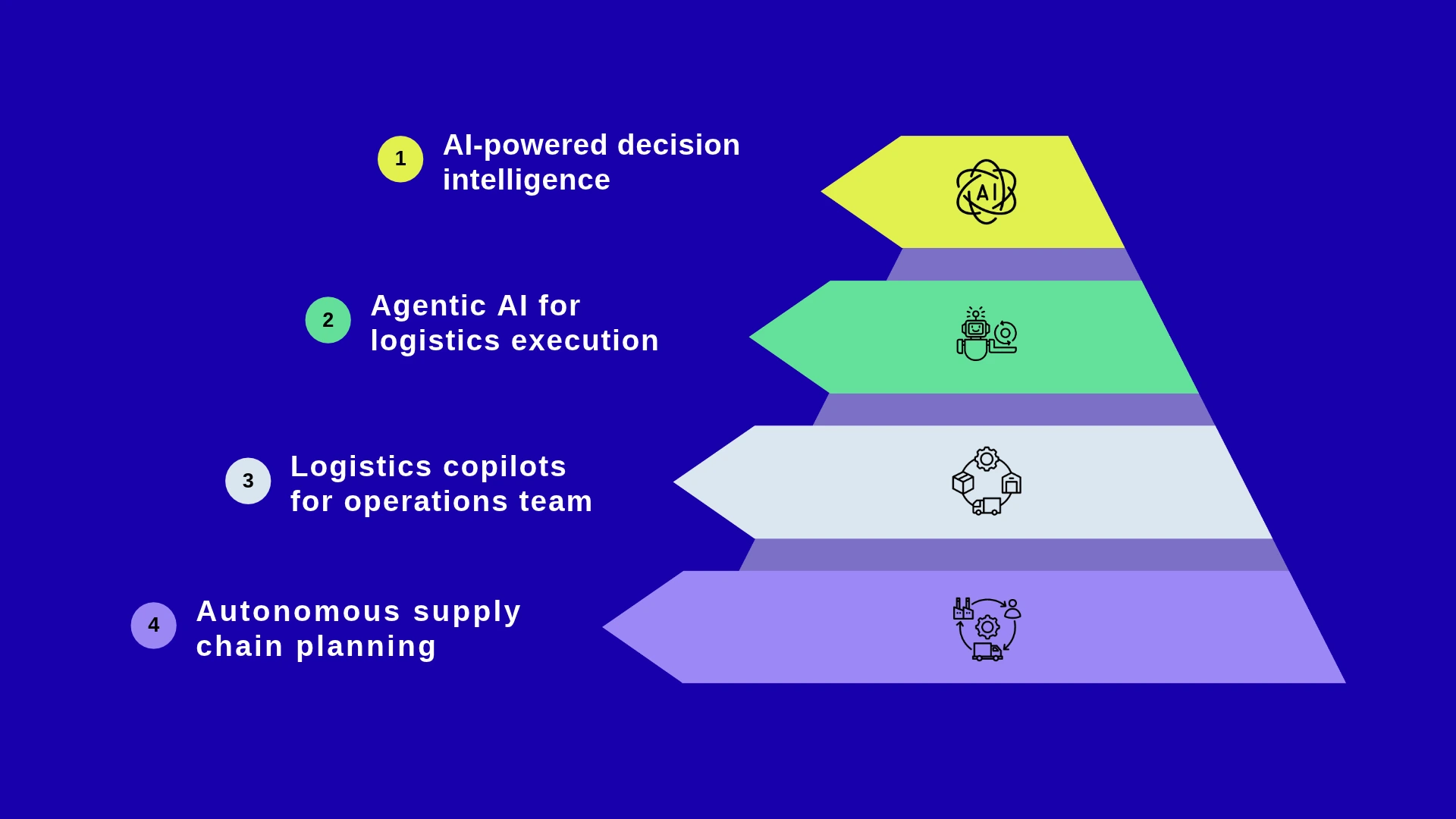
AI-powered decision intelligence
With AI in logistics, you can evaluate competing operational priorities when capacity remains constrained. For example, a carrier handling overlapping delivery commitments can use smart intelligence to assess whether accepting an additional load will create downstream delays, exceed available driver hours, or increase empty miles. The primary value lies in evaluating network-wide consequences before your dispatch team commits capacity, and not just by optimizing individual shipments in isolation.
Agentic AI for logistics execution
Agentic AI becomes relevant for exception-heavy logistics operations where resolving one issue requires actions across multiple connected systems. An agentic bot handling a failed delivery can verify the proof-of-delivery status, inspect the exception code, check customer instructions, and initiate a redelivery workflow automatically. No manual intervention will be needed. The result? Reduced time between identifying an exception and completing the corrective workflow.
Logistics copilots for operations team
When your business operations on information buried in unstructured records, you can deploy a logistics copilot. Dispatchers often need to reconcile carrier emails, delivery notes, detention records, and TMS updates before they can resolve a shipment-related issue. A copilot here can use retrieval-augmented generation technology to fetch relevant records and establish an accurate event timeline. It can also help your team identify conflicting information.
Autonomous supply chain planning
With this, you can address the limitations of static replenishment cycles easily. When demand rises unexpectedly in one region, the AI bot will recalculate inventory requirements against supplier lead times, warehouse capacity, transfer costs, and existing purchase orders. It can then generate a revised replenishment plan and execute changes within approved inventory and spending thresholds. By using an autonomous supply chain planner, you can therefore prevent localized stock corrections from creating shortages at other facilities.
Should you build, buy, or combine logistics software?
You should buy logistics software when your business requirements align with the established workflows, like warehouse operations, standard transportation management, or freight billing. Building custom software, on the other hand, makes sense when packaged platforms cannot support the competitive advantage you need. With this, you can use proprietary dispatch rules, specialized fulfilment processes, and complex business logic to create a differentiator.
A hybrid approach is the best fit when you need proven core systems but also require customization to accommodate existing workflows. For example, you can purchase a TMS while developing custom modules for carrier allocation, customer-specific integrations, and automated freight auditing. So, before you commit, compare licensing and implementation costs against customization, integration, maintenance, and future upgrade expenses, and shortlist a logistics software development partner or compare AI development companies before you commit.
| Decision Factor | Buy Off-the-Shelf Software | Build Custom Logistics Software | Hybrid Approach |
| Best suited for | Standard logistics workflows with limited customization needs | Operations with proprietary processes or specialized requirements | Businesses needing standard functionality alongside differentiated workflows |
| Implementation time | Usually faster with preconfigured modules | Longer due to requirements analysis, development, and testing | Moderate; core platforms are purchased while custom modules are developed |
| Initial investment | Licensing, implementation, and configuration fees | Higher upfront development and infrastructure costs | Combines software licensing with targeted development costs |
| Customization | Limited by vendor capabilities and product roadmap | Full control over workflows, features, and business rules | Customization concentrated on workflows that affect operational performance |
| Integration | Depends on available APIs, EDI support, and vendor connectors | Requires custom integration with existing enterprise systems and partners | Connects commercial platforms with custom-built services through APIs and middleware |
| Scalability | Depends on vendor infrastructure, pricing tiers, and usage limits | Depends on architecture, infrastructure, and engineering capacity | Uses vendor scalability for core functions while custom components scale independently |
| Maintenance | Vendor manages product updates and core platform maintenance | Your team or development partner manages fixes, security, and upgrades | Shared responsibility between software vendors and your development team |
| Long-term cost | Subscription and usage fees may increase as operations expand | Ongoing engineering and infrastructure expenses require budgeting | Balances recurring licensing costs with selective development and maintenance |
| Key limitation | Vendor dependency and restrictions on specialized workflows | Higher delivery risk and long-term technical ownership | Integration complexity and responsibility across multiple providers |
How do you start a logistics digital transformation?
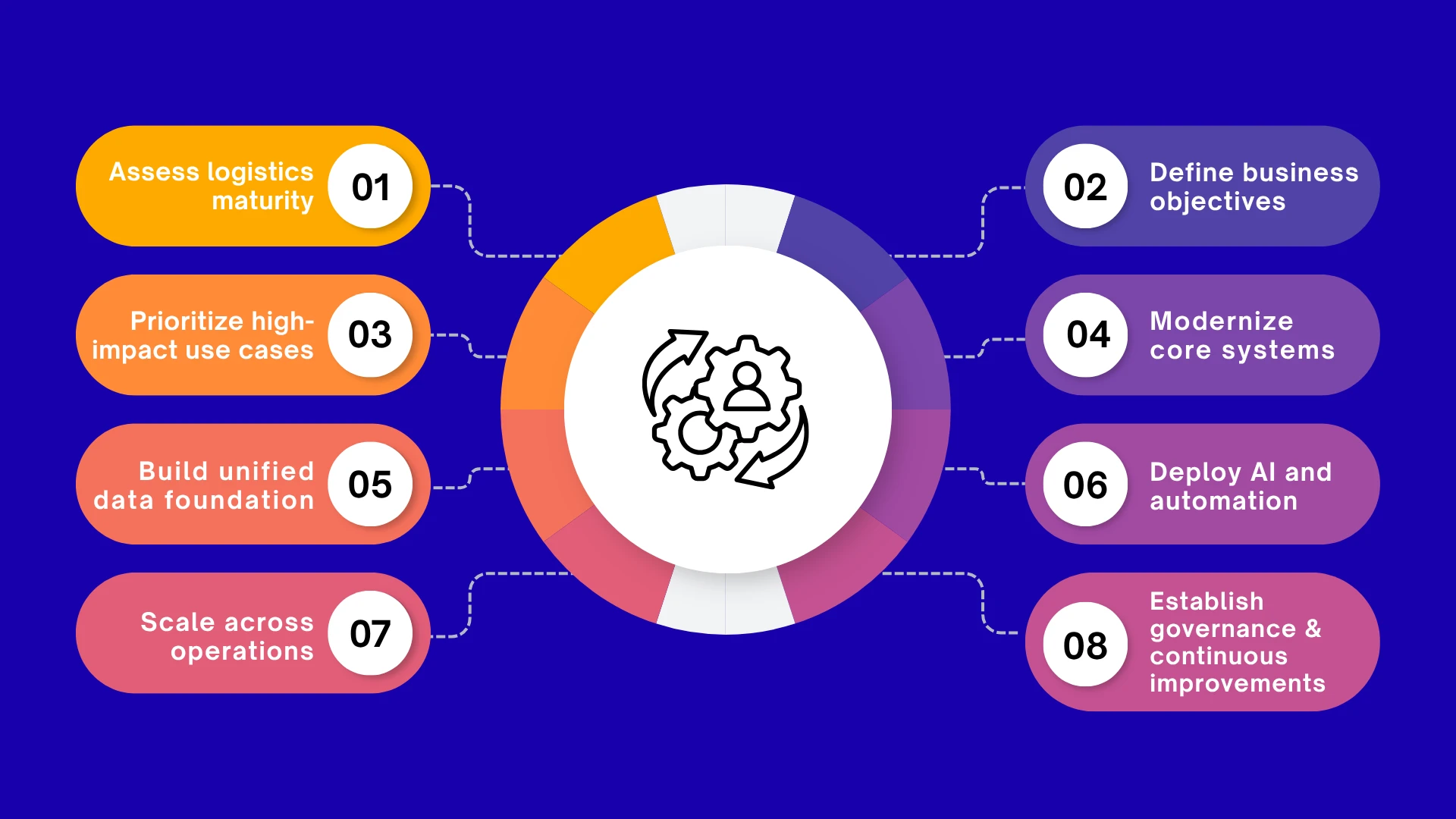
Assess logistics maturity
Begin by auditing how information moves from customer order entry to final proof of delivery. Identify where shipment records have become inconsistent, dispatchers have to override system recommendations, and warehouse transactions have started to fail, these gaps will ultimately uncover your logistics business’s actual technology constraints before procurement can commence.
Define business objectives
Translate operational problems into financial targets before you start selecting the tech stack. For example, calculate how much detention, empty mileage, or failed delivery attempts cost you annually. Use these figures to establish acceptable investment payback periods and prioritize initiatives with measurable margin impact.
Prioritize high-impact use cases
Rank different use cases of digital transformation in the logistics sector by expected savings, implementation effort, and data readiness. Automated freight auditing can deliver value sooner for your business when compared to predictive routing if carrier invoices contain recurring discrepancies. So, prioritize improvements that can release measurable savings without forcing you to replace your existing infrastructure extensively.
Modernize core systems
Determine whether the existing TMS system you use supports multi-carrier tendering, automated freight settlement, and reliable shipment-event updates. If critical workflows still require spreadsheets or manual reconciliation, assess platform replacement. However, preserve systems that are already stable, especially if targeted integrations can help close the functional gaps.
Build unified data foundation
Resolve shipment identity and event-mapping problems before introducing advanced analytics. Your carrier’s PRO number, internal load ID, and customer purchase order must reference the same shipment across all platforms your logistics business currently relies on. Without this reconciliation, duplicate records will undermine visibility and predictive accuracy.
Deploy AI and automation
Start with workflows where historical records can support reliable predictions or automation. Predictive maintenance requires usable engine fault and service-history data. Similarly, automated freight auditing will need contract rates and invoice-level records. So, validate performance against actual costs before you plan autonomous execution.
Scale across operations
Expand only after the pilot performs under peak volumes and real operating exceptions. Test whether the integrations handle carrier-specific data formats and whether response times remain acceptable during dispatch surges. Also, replicate proven configurations rather than rebuilding each facility independently.
Establish governance & continuous improvements
Define who owns data accuracy, integration failures, and automated decision overrides. Set approval thresholds for actions that affect freight expenses or delivery commitment windows. Also, review model drift, API failures, and exception-resolution rates regularly, especially with documented escalation procedures for operational disruptions.
How much does logistics digital transformation cost?
The cost of digital transformation in logistics in the US sits between $50K and $150K for a focused software module, $150K and $500K for a mid-sized platform, and $500K and $2M+ for an enterprise-wide transformation. A basic TMS or WMS implementation will cost much less than replacing multiple legacy systems across different distribution centers.
Your budget also needs to account for:
- Carrier EDI connections
- ERP integration
- Data migration
- Employee training
- Ongoing maintenance
As for AI capabilities and real-time fleet tracking features, you will have to consider additional expenses. So, the biggest budget variable here is integration complexity, not the number of software features.
| Cost Component | Typical US Cost Range | Implementation Time | Major Cost Driver | Annual Recurring Cost |
| TMS implementation | $30K–$150K | 2–6 months | Carrier connections and workflow configuration | $5K–$30K |
| WMS implementation | $40K–$200K | 3–8 months | Warehouse complexity and transaction volume | $8K–$40K |
| Custom logistics software | $50K–$300K+ | 4–12 months | Development scope and functional complexity | $10K–$60K |
| ERP and legacy integration | $20K–$100K | 2–6 months | Legacy architecture and data compatibility | $3K–$15K |
| Telematics and IoT deployment | $15K–$100K | 1–4 months | Fleet size and device requirements | $5K–$25K |
| Data migration and infrastructure | $15K–$80K | 1–4 months | Data volume and migration complexity | $4K–$20K |
| AI and automation | $30K–$200K+ | 3–9 months | Model complexity and data readiness | $10K–$50K |
| Training, security, and change management | $10K–$60K | 1–3 months | Workforce size and security requirements | $2K–$10K |
How do you measure the ROI of logistics technology?
A $200K investment in logistics technology needs to deliver measurable financial returns. If your new TMS reduces freight expenses but adds substantial licensing and integration costs, you will have to factor the latter while determining the ROI of the transformation initiative. The key here is to evaluate each investment against the operating costs as it’s expected to reduce.
To make things easier for you, we have briefly listed the key metrics you must consider for ROI determination of supply chain and logistics digital transformation.
- Transportation cost per mile: Compare vehicle operating expenses against the miles traveled to determine whether route optimization is reducing transportation costs
- Empty-mile percentage: Measure unproductive mileage to see whether better load matching improves vehicle utilization
- Cost per shipment: Track the expense of moving each shipment to identify savings from improved planning and automation
- On-time delivery rate: Monitor delivery performance to understand whether the technology is reducing missed appointments and costly redelivery attempts
- Warehouse labor cost per order: Compare labor expenses against completed orders to measure savings from warehouse automation
- Vehicle downtime: Track hours lost to breakdowns to calculate the operational savings from predictive maintenance
To calculate your initiative’s ROI, use the formula:
ROI (%)=Total Financial Benefits–Total Investment Cost Total Investment Cost×100
For example, suppose you spend $200K on fleet optimization technology. During the first year, it saves $120K in fuel and transportation expenses and another $40K in maintenance costs. Your total savings are $160K. After subtracting the $200K investment, you have a net shortfall of $40K. This means your first-year ROI is -20%. However, if the technology continues generating the same savings, it will recover its initial cost within 15 months.
What are the biggest risks, and how do you reduce them?
Legacy infrastructure dependencies
Your existing TMS can contain years of custom dispatch rules that are poorly documented, and hence understood only by a few employees. In such a case, replacing it completely will risk disrupting active freight operations. So, before migration, reverse-engineer critical workflows and reconcile system outputs against actual transactions. Run the replacement alongside the existing platform until shipment execution and billing records consistently match.
Data silos and integration complexity
The difficult part of logistics integration is not connecting APIs. Rather, it’s maintaining transaction accuracy across all the systems your logistics business uses currently. A carrier might report a shipment as delivered while your TMS shows it’s still in transit. That’s because event code mapping is different. What you need to do here is establish a canonical shipment-event model and test duplicate messages, delayed updates, and out-of-sequence events before enabling automated status changes.
Workforce adoption and training gaps
Automation usually exposes a gap between documented procedures and how dispatchers actually manage exceptions. If experienced employees routinely override load assignments just because the system ignores customer-specific restrictions, adoption will suffer. So, capture these operational rules before deployment and measure override frequency after launch. Repeated overrides usually signal flawed system logic, and not just employee resistance.
Cybersecurity & compliance risks
A compromised carrier integration can expose more than shipment information. It can provide an entry point into connected business systems. So, your security design must prevent external partners from accessing unrelated operational records. For this, you can use separate integration credentials, restrict permissions by function, and validate vendor access continuously. Also, include incident response and breach notification obligations in technology contracts.
What security and compliance issues should you plan for?
Digital transformation exposes your logistics operation to risks that extend beyond conventional IT security. A compromised carrier account can facilitate cargo diversion, while a ransomware attack on your TMS can interrupt dispatch and freight execution. Your security strategy must account for the regulatory obligations and operational dependencies specific to US freight networks.
| Security / Compliance Area | Specific Risk to Logistics Operations | Applicable US Regulation or Standard | Recommended Security Measures |
| Driver and ELD data protection | Unauthorized access or alteration of electronic driver logs can compromise hours-of-service records and create compliance violations. | FMCSA ELD requirements (49 CFR Part 395, Subpart B) | Restrict ELD account permissions, maintain audit trails, and validate records against original device data |
| International cargo security | Weak carrier verification or inadequate cargo controls can compromise shipments entering US ports and create customs delays | CBP Customs Trade Partnership Against Terrorism (CTPAT) | Verify business partners, document cargo security procedures, and control access to shipment and container records |
| Cargo theft and carrier impersonation | Criminals may use stolen carrier credentials to impersonate legitimate trucking companies and redirect high-value freight | FMCSA carrier registration and operating authority requirements | Verify carrier authority through FMCSA records and independently confirm changes to pickup instructions and payment details |
| Ransomware and system disruption | Attacks against TMS or WMS platforms can interrupt dispatch, warehouse execution, and customer deliveries | NIST Cybersecurity Framework 20; applicable contractual security requirements | Maintain isolated backups, enforce multifactor authentication, segment networks, and test disaster recovery procedures |
| Payment and customer data security | Exposed payment card information or customer records can trigger financial losses, contractual penalties, and privacy obligations | PCI DSS; applicable state privacy and data breach notification laws | Encrypt sensitive records, restrict payment data access, and establish retention and breach response procedures |
| Third-party integration security | Compromised EDI connections, telematics providers, or cloud vendors can expose shipment and operational data | NIST Cybersecurity Framework 20; applicable vendor and contractual requirements | Assess vendor security controls, use scoped API credentials, monitor integration activity, and establish incident notification clauses |
What Trend will shape logistics technology next?
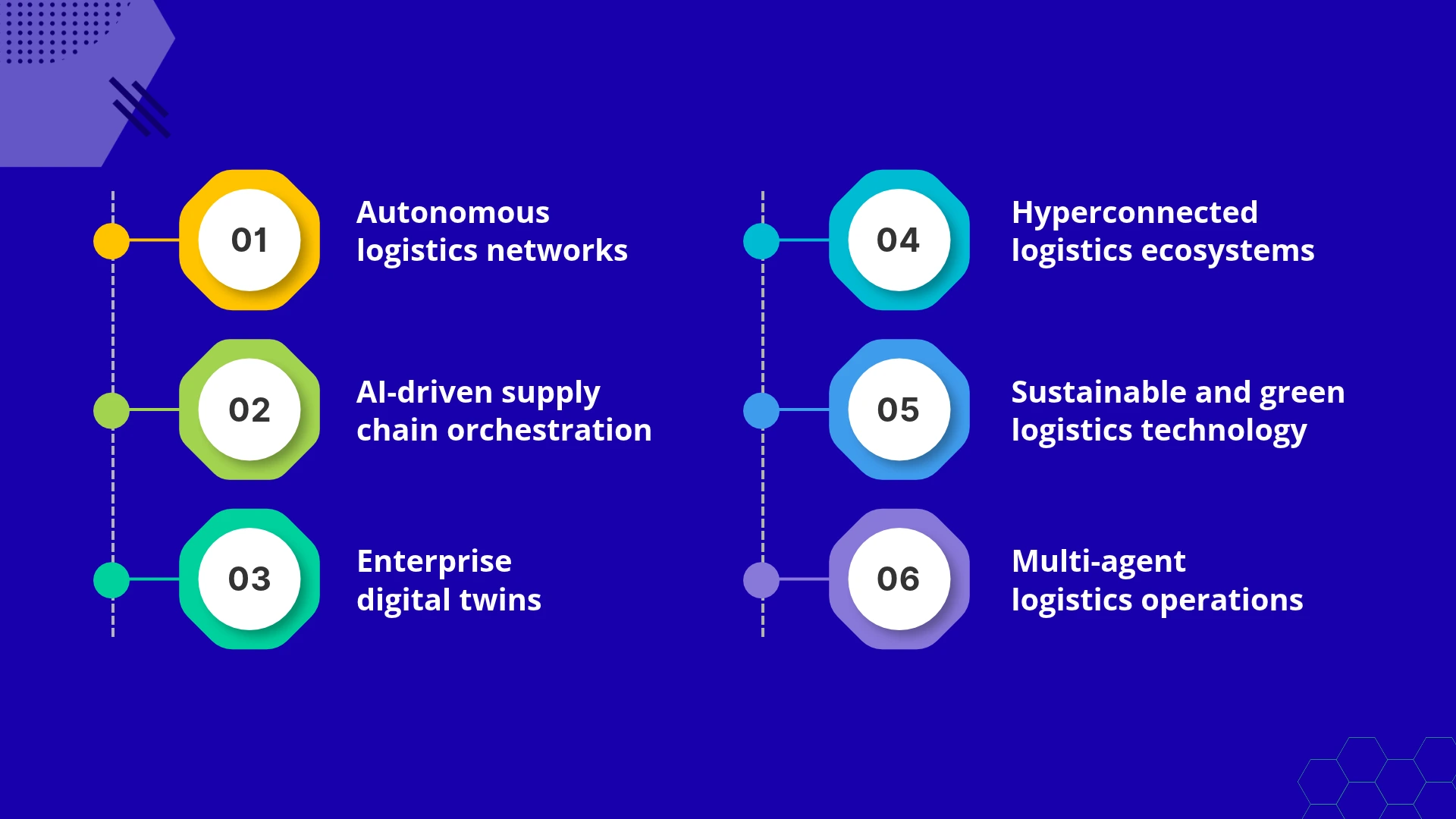
Autonomous logistics networks
Autonomous trucking will change how carriers manage long-haul capacity, especially on repeatable interstate routes. The immediate opportunity, therefore, lies in hub-to-hub operations, where autonomous trucks can cover highway segments while human drivers handle complex urban pickups and delivery conditions. This will completely change the dynamics of driver utilization and terminal planning.
AI-driven supply chain orchestration
The next development in supply chain AI is connected decision-making between procurement and freight execution. If a supplier misses its procurement commitment, orchestration systems will need to recalculate inbound freight schedules and downstream inventory availability before a distribution center faces a stock shortage. This will help connect purchasing decisions directly to transportation capacity.
Enterprise digital twins
Digital twins will become valuable for evaluating network redesigns before companies commit to expensive infrastructure changes. A 3PL considering a new cross-dock facility can simulate inbound arrival variability, dock-door utilization, labor requirements, and outbound departure schedules. By doing so, they can reveal whether the proposed facility can actually improve freight throughput.
Hyperconnected logistics ecosystems
The growing use of interoperable freight data will change how shipment information moves between transportation partners along a supply chain network. Standardized event-sharing through initiatives like the Digital Container Shipping Association’s standards can reduce manual reconciliation between ocean carriers, terminals, and logistics providers.
Sustainable and green logistics technology
Fleet electrification will depend more on route-level economics than broad sustainability targets. Logistics operators will then have to match electric trucks with predictable duty cycles, depot charging capacity, payload requirements, and grid availability. Poor vehicle-to-route matching can increase operating costs even when electricity is cheaper than diesel.
Multi-agent logistics operations
Multi-agent AI will introduce coordination between specialized systems responsible for separate logistics decisions. For example, a freight procurement agent could evaluate carrier bids while a dispatch agent checks equipment availability and a compliance agent validates operating authority. Execution will depend on shared constraints, transaction permissions, and human approval for financially significant decisions.
How can GMTA help with logistics digital transformation?
At GMTA, we approach logistics digital transformation by addressing operational bottlenecks rather than introducing technology for its own sake. We help logistics businesses modernize fragmented systems, improve shipment visibility, and reduce the manual effort involved in coordinating daily operations.
Our strength lies in integrating new capabilities with existing logistics infrastructure. We connect TMS, WMS, ERP, ELD, and telematics platforms through custom APIs and integration layers, allowing dispatchers to work with consistent shipment data without replacing their core systems. This improves load allocation, inventory visibility, and freight reconciliation while reducing delays caused by disconnected workflows.
Our technical experts also bring practical AI capabilities into logistics operations. For instance, we develop predictive models that analyze GPS history, traffic patterns, and delivery schedules to flag shipments at risk of missing delivery windows. Our AI-powered document workflows extract line items from bills of lading and freight invoices, compare charges against TMS records, and flag billing discrepancies. Agentic workflows can also coordinate shipment exception handling by identifying affected orders and preparing customer notifications for approval.
We combine model-agnostic AI development with RAG, workflow automation, and legacy-system integration to address these requirements. If you are considering modernizing your logistics operations, GMTA can help assess your existing technology stack and identify a practical starting point for your digital transformation.
FAQs
How can digital transformation improve last-mile delivery economics?
You can improve last-mile margins by optimizing delivery density rather than focusing only on shorter routes. Your routing engine must consider package dimensions, vehicle capacity, driver shift limits, residential access restrictions, and customer delivery windows at the time of assigning stops. Integrating failed-delivery records will help you prevent repeat attempts at the same addresses. This further improves successful stops per driver-hour and reduces your cost per completed delivery.
How should logistics companies measure the ROI of their digital transformation investments?
You should measure ROI at the workflow level rather than relying on overall revenue growth. For example, if you automate carrier invoice reconciliation, compare the cost of processing each invoice before and after implementation, including exception-handling labor. For a TMS upgrade, track contracted versus spot freight expenditure and carrier tender acceptance. Include integration maintenance and internal training costs to avoid overstating your savings.
What cybersecurity risks emerge when connecting logistics systems and IoT devices?
Your biggest exposure might stem from the connections between systems rather than individual devices. For example, a third-party telematics API with excessive permissions can expose fleet location data or provide an entry point into connected applications. So, before you integrate ELD devices, vehicle gateways, and warehouse sensors, establish separate credentials and restricted API scopes. Also, ask vendors to disclose vulnerability patching timelines and their incident notification procedures.
What is the difference between traditional logistics software and an intelligent logistics platform?
With traditional logistics software, you configure the rules governing load assignment, carrier selection, and dispatch. An intelligent platform can evaluate whether those rules still produce the best operational decision under changing conditions. For example, when a carrier rejects a tender, it can reassess available capacity, contractual rates, delivery commitments, and historical carrier performance before recommending another assignment.
How can small and mid-sized logistics companies adopt digital transformation with limited budgets?
You should prioritize workflows where manual processing creates recurring expenses without requiring a core system replacement. If your team reconciles hundreds of freight invoices against TMS records, start with an integration that can extract invoice line items and flag rate or accessorial discrepancies. Keep the existing TMS as your system of record. By doing so, you can have a measurable automation outcome before having to commit to a larger modernization budget.